Real-Time vs. Historical Hashtag Data
Real-Time vs. Historical Hashtag Data
Real-time and historical hashtag data serve different purposes but are both essential for social media analytics. Real-time data provides instant updates on trends and engagement, helping you act quickly in situations like PR crises or live events. Historical data offers a long-term view, ideal for analyzing patterns, benchmarking, and training AI models.
Key points:
- Real-time data: Captured via streaming APIs (e.g., WebSockets), it’s ultra-fast, with updates in milliseconds. Perfect for live monitoring and immediate responses.
- Historical data: Accessed through REST APIs, it provides archives dating back years. Useful for trend analysis, campaign benchmarking, and research.
Quick tip: Combine both data types for a complete strategy - use historical data to identify patterns and real-time data to track live changes.
Let’s dive deeper into how these data types work, their use cases, and how to access them.
Real-Time Hashtag Data Explained
Features of Real-Time Hashtag Data
Real-time hashtag data captures live activity as it unfolds, providing insights into usage volumes, engagement rates, and sudden spikes. What sets it apart is its incredible speed - data updates with delays measured in milliseconds, not minutes or hours. For example, if #Election2024 sees a 500% surge in activity during a debate, this spike will appear on your dashboard almost instantly, with response times as fast as 500ms.
This immediacy distinguishes real-time data from near-real-time alternatives, which batch updates every few minutes. Real-time streams focus on speed, allowing you to track live conversations as they happen. Imagine monitoring #WorldCupFinal and seeing sentiment shift from 70% positive to 40% negative within seconds. While this kind of data can be unpredictable and noisy, its speed makes it essential for quick decision-making as trends emerge. Let’s explore how this data is gathered so efficiently.
How Real-Time Hashtag Data is Collected
The collection of real-time hashtag data relies on streaming APIs and WebSocket endpoints. Instead of constantly polling for updates, these technologies push new tweets that match your filters as soon as they are posted. WebSockets maintain an open connection for ultra-low latency, while webhooks provide event-driven notifications, eliminating the need for repetitive requests.
Take TwitterAPI.io as an example. Their live data streams handle over 1,000 requests per second and offer pay-as-you-go pricing at $0.15 per 1,000 tweets. If you’re tracking a hashtag like #iPhone16 during a product launch, a streaming API could deliver 10,000 tweets per minute, with updates every 500ms. This allows you to detect anomalies or trends in real time, bypassing the delays typical of polling-based systems. These advanced collection methods are the backbone of real-time analytics, enabling a range of applications.
Common Uses for Real-Time Hashtag Data
One major application of real-time hashtag data is live campaign monitoring. Marketing teams can track hashtags like #AdCampaign during events, adjusting ad spend or messaging on the spot. For instance, if engagement drops during a live broadcast, you can pivot your strategy within minutes instead of waiting for post-event reports. A B2B software company might notice higher engagement among verified accounts using their campaign hashtag, presenting an immediate opportunity to amplify their reach.
Anomaly detection is another critical use. A sudden 300% spike in hashtags like #BrandCrisis might signal a PR issue, triggering automated alerts before it escalates. Similarly, detecting unusual activity - such as artificial trend inflation with hashtags like #CryptoPump - is key to combating manipulative tactics in real time.
Real-time data also powers sentiment analysis. During events like #WorldCupFinal, this allows you to gauge public sentiment instantly and adjust your social media messaging before the conversation shifts. In all these scenarios, even a few minutes of delay can significantly reduce the value of real-time insights.
sbb-itb-9cf686c
Historical Hashtag Data Explained
Features of Historical Hashtag Data
Historical hashtag data provides a comprehensive archive of records dating back to March 2006, offering a complete timeline for analysis. Unlike real-time streams that focus on immediate trends, this dataset allows for a deeper dive into long-term patterns. For instance, you could analyze how a hashtag performed over several years to uncover seasonal trends or track its growth.
The dataset includes detailed metadata, such as engagement metrics (likes, retweets, replies), user information, and Tweet IDs. This metadata enables "re-hydration", which allows researchers to recreate studies even years later. As Twitter Dev explains:
"Full-archive search helps address one of the most common use cases for academic researchers, who might use this for longitudinal studies, or analyzing a past topic or event".
Advanced filtering options, like the since:YYYY-MM-DD and until:YYYY-MM-DD search operators, make it easy to focus on specific timeframes. For example, analyzing the hashtag #ClimateChange during an election cycle lets you pinpoint activity around debates or policy announcements. This level of precision transforms raw data into actionable insights, helping identify patterns and trends.
How Historical Hashtag Data is Retrieved
Accessing historical data relies on REST APIs, specifically the full-archive search endpoints. Instead of maintaining a live connection, you send HTTP requests with parameters like start_time and end_time in RFC3339 format (e.g., 2024-01-01T00:00:00Z). This batch-processing approach is ideal for handling large datasets.
Pagination is used to retrieve the data in manageable chunks, with each request fetching between 800 and 1,200 tweets. Parameters like max_id and cursor help ensure no tweets are missed. For example, analyzing hashtag mentions over several years would require multiple requests to compile the full dataset. The data is typically stored in JSON format, making it easy to process and analyze.
Choosing the right database for storage is essential. MongoDB is a good choice for flexible schemas and varying tweet formats, while PostgreSQL is better suited for complex relational queries and identifying patterns. Services like TwitterAPI.io simplify the retrieval process with pay-as-you-go pricing at $0.15 per 1,000 tweets, making setup quick and efficient.
Common Uses for Historical Hashtag Data
Historical hashtag data is invaluable for understanding trends over time. By mapping changes in hashtag volume, you can track a hashtag's lifecycle - from its initial rise to its peak and eventual decline. This insight helps predict whether emerging hashtags are likely to gain traction or fade away, guiding long-term content strategies.
Another application is campaign performance benchmarking. By comparing data from different campaign periods, businesses can evaluate which strategies drove higher engagement. For example, differences in retweet counts between campaigns might reveal the impact of timing, influencer collaborations, or creative approaches.
This data is also useful for correlating hashtag activity with real-world events. Researchers can overlay tweet volumes with events like Federal Reserve announcements to study how public sentiment shifts in response to policy changes. Unlike real-time data, this longitudinal perspective provides a richer understanding of trends and behaviors.
Real-Time vs. Historical Hashtag Data: Main Differences
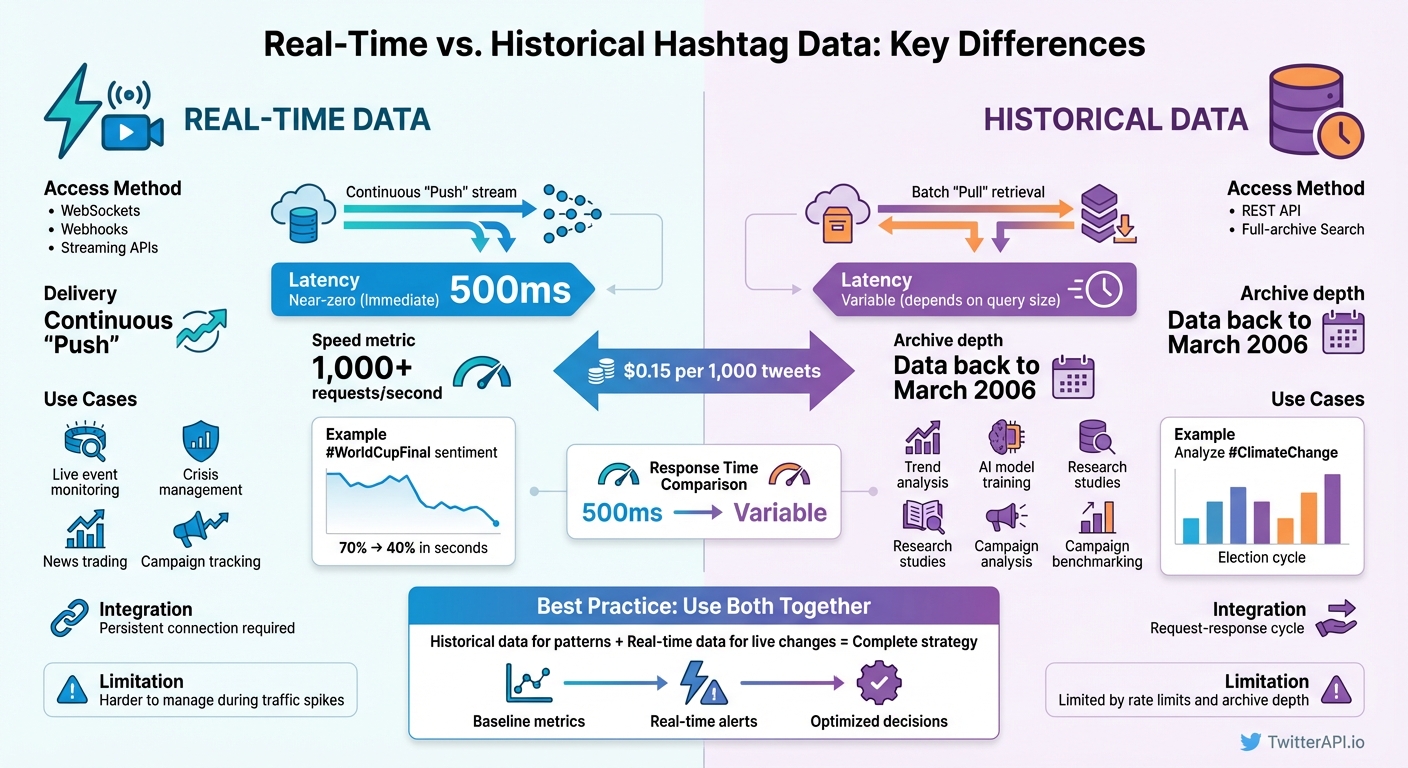
Real-Time vs Historical Hashtag Data: Key Differences and Use Cases
Access Methods and Delivery
When it comes to accessing real-time and historical hashtag data, the methods are quite different. Real-time data relies on streaming protocols like WebSockets or Webhooks. These create a continuous connection, allowing data to flow in real-time without needing repeated requests. Think of it as an open phone line where updates come through instantly.
On the other hand, historical data is accessed via REST APIs, which operate on a request-response model. Here, you specify exactly what you need - such as all tweets with #ClimateChange between January 1, 2024, and March 31, 2024 - and the system retrieves the relevant data in batches. While real-time data is delivered almost instantly with minimal delay, historical data retrieval can take longer, depending on the size and scope of your query.
The table below breaks down these differences further:
Comparison Table: Real-Time vs. Historical Data
| Dimension | Real-Time Hashtag Data | Historical Hashtag Data |
|---|---|---|
| Access Method | WebSockets, Webhooks, Streaming APIs | REST API, Full-archive Search |
| Delivery | Continuous "Push" stream | Batch "Pull" retrieval |
| Latency | Near-zero (Immediate) | Variable (Depends on query size) |
| Typical Use Case | Live event monitoring, News trading | Trend analysis, AI model training |
| Integration | Persistent connection required | Request-response cycle |
| Limitations | Harder to manage during traffic spikes | Limited by rate limits and archive depth |
This table provides a clear overview of which type of data might be the better fit for your needs.
Choosing Between Real-Time and Historical Data
The right choice depends on your goals. Real-time data is ideal when immediate action is critical - whether you're powering live dashboards, running trading algorithms, or managing crisis situations. For example, traders and investors rely on real-time data to make split-second decisions, track market trends, and respond to breaking news.
Historical data, however, is better suited for deeper analysis and long-term projects. Whether you're studying hashtag performance during an election cycle or building a sentiment analysis model, historical archives provide the depth and context you need. This type of data is commonly used for research, backtesting strategies, or training machine learning models.
For the most comprehensive insights, consider combining both types. Use historical data to establish patterns and benchmarks, and then monitor real-time streams to detect significant changes as they unfold. Together, they can give you a complete picture for both immediate decisions and long-term strategies.
Benefits of Using Both Data Types Together
How Real-Time and Historical Data Work Together
When you blend real-time data with historical data, you gain a much sharper analytical perspective. Real-time data gives you a pulse on what’s happening right now - like audience engagement or campaign performance. Historical data, on the other hand, provides the context you need by uncovering patterns and trends over time. Together, they help you make sense of sudden changes. For instance, is a spike in engagement a one-off event, or part of a recurring trend? Historical data helps answer that question.
This combination also powers predictive analytics. Machine learning models can use historical trends to forecast future outcomes, such as which hashtags are likely to trend based on past behaviors. With this foresight, you can better plan and schedule your real-time campaigns, moving from simply reacting to actively anticipating what’s next.
Real-World Applications of Combined Data
The pairing of real-time and historical data transforms how decisions are made, especially in marketing. By using historical insights, teams can pinpoint the best times to launch real-time campaigns, ensuring maximum impact. Real-time alerts, on the other hand, provide immediate updates when performance suddenly spikes or drops, allowing for quick adjustments. As Jens Polomski, Marketing Director at IMAmedia, explained:
"The real-time alerts are a great way to react as soon as something impacts our social campaign performance".
This combination also improves sentiment analysis. Real-time data alerts you to potential crises as they unfold, while historical data helps you track sentiment over longer periods. Together, they enable a more refined and effective approach to managing your brand’s reputation. This is especially crucial when you consider that posts with hashtags on X (Twitter) receive double the engagement compared to those without.
Historical data also serves as a safeguard. It can identify hashtags that have been flagged for spam or policy violations, helping you avoid potential pitfalls before launching real-time campaigns. By integrating both data types, you can craft strategies that balance immediate action with long-term planning, ensuring your campaigns are both timely and sustainable.
Using TwitterAPI.io for Real-Time and Historical Data
TwitterAPI.io makes it simple to access both real-time and historical hashtag data, all through a single, unified platform.
TwitterAPI.io Features
This platform offers REST endpoints for historical data and WebSocket connections for real-time streaming, making it a powerful tool for tracking hashtags. It handles over 1,000 requests per second, delivers response times between 500–800 ms through a global CDN spanning 12+ regions, and promises 99.99% uptime with automatic failover for reliability[2,16].
The pricing is straightforward: $0.15 per 1,000 tweets and $0.18 per 1,000 user profiles. There are no monthly fees or hidden charges - you only pay for what you use. New users can also benefit from free credits ranging from $0.10 to $1.00 upon signup, and students or researchers with a .edu email can access academic discounts. These features make it an attractive option for developers and businesses looking for a seamless solution.
Advantages for Developers and Businesses
TwitterAPI.io is designed with simplicity and efficiency in mind. The setup process takes less than five minutes - no need for the lengthy approval processes required by other platforms. You don’t even need a Twitter developer account or complex OAuth authentication. Just grab an API key, and you’re ready to go. Plus, 24/7 live chat support ensures help is always available if you run into issues[2,16].
Sarah Johnson, CTO of DataInsights, praised the platform, saying:
"Finally, an API that just works. No approval hassles, no rate limit nightmares. Pure gold."
High rate limits allow businesses to track hashtags at the frequency they need. Whether it’s hourly updates during a campaign launch, daily tracking for ongoing campaigns, or weekly analysis for branded hashtags, TwitterAPI.io has you covered. You can even combine historical data to establish baseline metrics and switch to real-time streams to catch sudden spikes - like a 400% increase in volume over 48 hours, signaling potential issues or opportunities.
Indie developer Marcus Liu shared his experience:
"Built my entire startup on TwitterAPI.io. The cost savings are incredible."
Getting Started with TwitterAPI.io
Getting started is easy. Create an account on twitterapi.io and retrieve your API key from the dashboard[2,16]. The platform provides Swagger documentation and a Postman collection to help you integrate quickly. Start by pulling historical data through REST endpoints to establish baseline metrics, such as daily or weekly mention volumes, average engagement rates, and user profile insights. Once you’ve got the groundwork, set up WebSocket streams for real-time monitoring tailored to your specific hashtag tracking needs.
Conclusion
Key Takeaways
When it comes to social analytics, both real-time and historical hashtag data play essential roles. Real-time data offers immediate updates via WebSockets with almost no delay - perfect for crisis monitoring and spotting trends as they happen. On the other hand, historical data, accessed through REST APIs, gives you a deep archive to analyze long-term patterns, conduct market research, and train machine learning models.
The real power lies in combining these two approaches. Historical data helps you set benchmarks, like normal hashtag activity, average engagement rates, or typical sentiment trends. Real-time data then flags any deviations from these norms, such as unexpected spikes in activity or sentiment changes, allowing you to react quickly. Together, they create a system where immediate alerts are backed by meaningful context, helping optimize daily operations and long-term planning.
For developers and businesses, this combination is a game-changer. It enables quick responses during critical situations while also providing a solid foundation for evaluating performance and tracking trends over time.
Next Steps
Ready to get started? Head over to TwitterAPI.io, where you can sign up and grab your API key. Start by pulling historical data to establish your baseline metrics, then activate real-time monitoring to stay on top of live trends. With pricing at just $0.15 per 1,000 tweets and a simple pay-as-you-go model, integrating advanced hashtag analytics has never been easier.
FAQs
How do I choose between real-time and historical hashtag data?
When deciding between real-time and historical hashtag data, it all comes down to what you need from your analytics.
- Real-time data gives you instant insights, making it perfect for tracking live events or spotting trends as they unfold.
- Historical data, on the other hand, is better suited for digging into long-term patterns or conducting in-depth research over time.
For a well-rounded view, you might want to combine the two. Pairing real-time updates with historical datasets can provide a more complete picture of trends and behaviors.
What latency is “real-time” for hashtag streams in practice?
In the context of hashtag streams, "real-time" generally means a latency of just milliseconds to a few seconds. High-performance systems can process and detect trends in less than a second, offering almost immediate insights. This minimal delay allows for quick and actionable analytics, making it easier to track and respond to hashtag performance effectively.
How much historical hashtag data is needed to set a reliable baseline?
When deciding how much historical data to analyze, it largely depends on your objectives and how the hashtag is typically used. Reviewing several months to a year of data is often enough to identify seasonal trends, peak activity periods, and engagement patterns. This approach ensures your analysis is based on consistent, long-term behavior rather than temporary fluctuations. For a more comprehensive perspective, tapping into an extensive historical dataset - like tweets collected over the past 14 years - can offer a solid base for accurate insights.
Tags
Related articles
Ready to get started?
Try TwitterAPI.io for free and access powerful Twitter data APIs.
Get Started Free