How to Search for Deleted Tweets
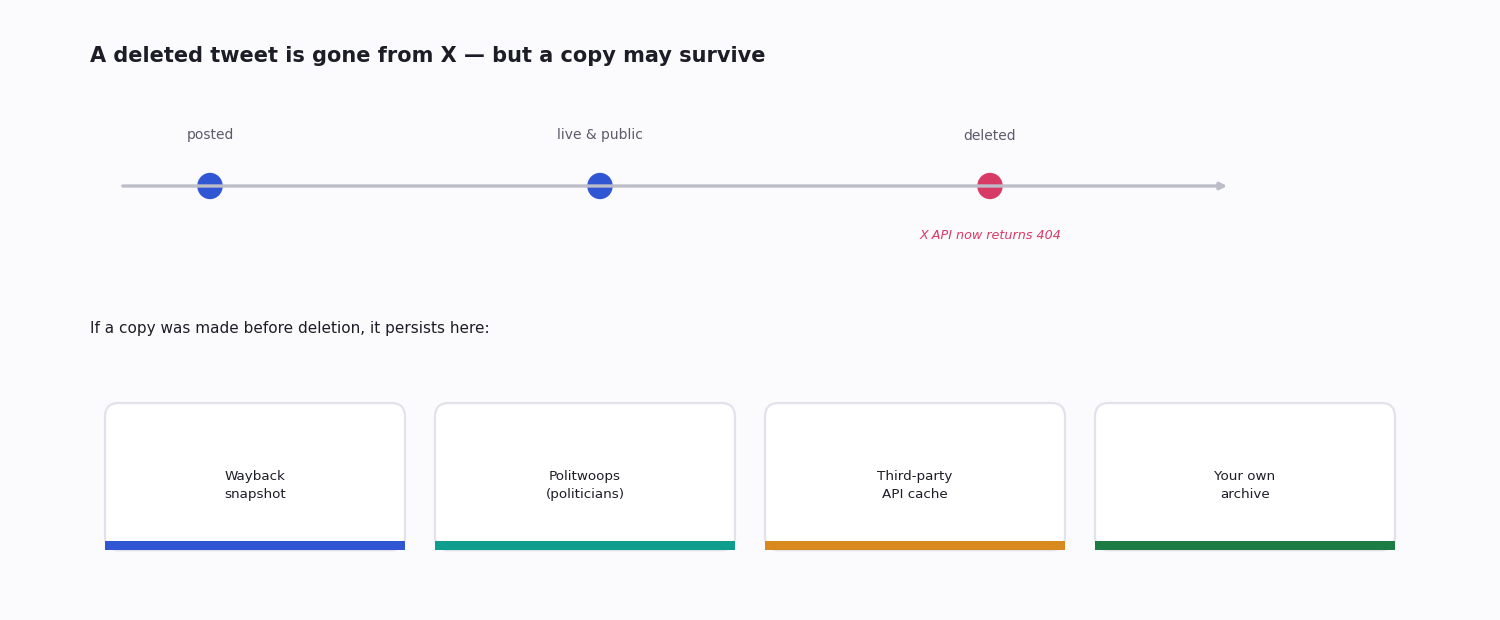
Once a tweet is deleted, it disappears from X (Twitter) within seconds. The X API will not return it — you'll get an empty result or a 404. But "gone from X" doesn't always mean "gone for good." If someone, somewhere, cached the tweet before the delete, it's likely still accessible.
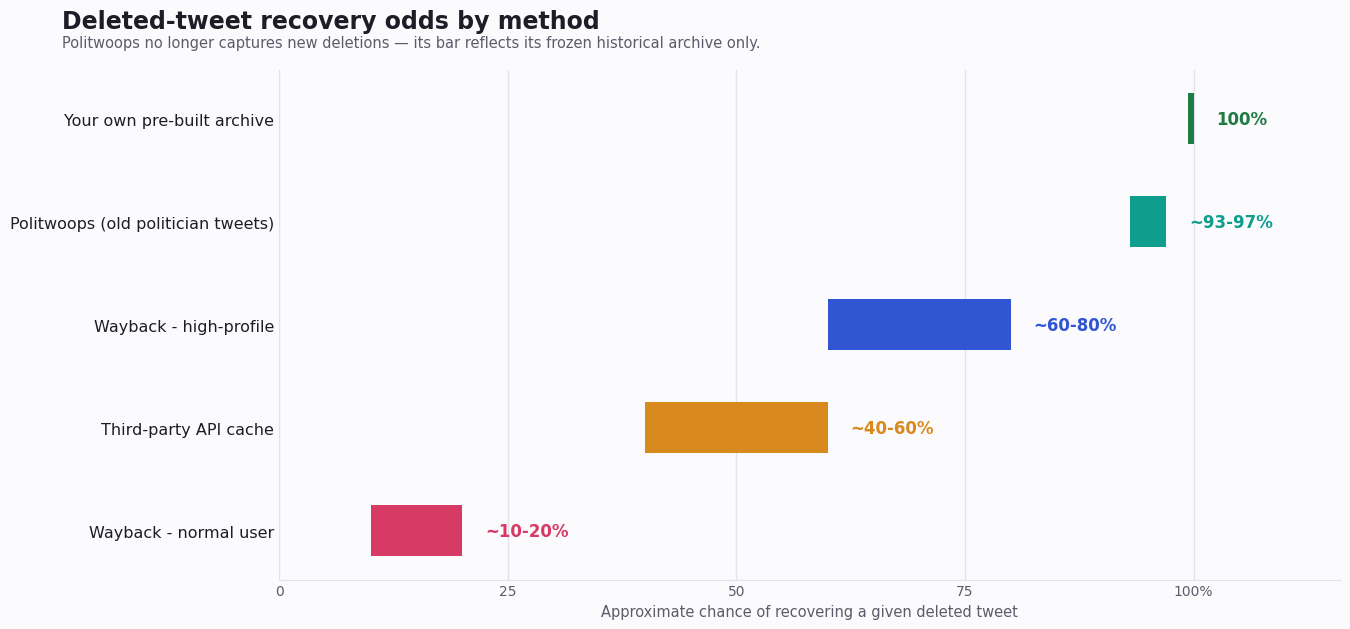
There are three places a deleted tweet can survive: the Internet Archive's Wayback Machine, Politwoops (a now-frozen archive of politicians' deleted tweets), and third-party tweet caches reachable through APIs like TwitterAPI.io. Each catches a different subset of deletions, and none is reliable on its own — the only dependable recovery is an archive you built yourself, before the delete.
Below is each method, how it works, its realistic success rate, and what to do when none of them turns up the tweet you need — plus how to set things up so the next deletion can't erase your copy.
What 'Deleted' Actually Means
Deletion on X is immediate and one-directional. The moment a user — or X itself — removes a tweet, it stops resolving: the public URL returns a 404, the tweet ID returns nothing from the API, and it drops out of search. There is no grace period and no built-in undo.
That is different from a few situations people confuse it with. A suspended account hides every tweet at once, and those can return if the suspension is lifted. A tweet behind the author's protected (private) setting was never public to begin with. A tweet pulled for a policy violation is, for your purposes, deleted. Only genuine deletion is the case this guide addresses — and for that, X keeps nothing accessible to you.
So every recovery method below has the same shape: it works only if a copy was made while the tweet was still live. The real question is never "can I get it back from X" — you can't — but "did anyone capture it first, and can I reach their copy."
Method 1: The Internet Archive Wayback Machine
The Wayback Machine archives publicly accessible web pages, including individual tweet URLs. If anyone snapshotted the tweet — or the user's profile page while it still contained the tweet — before deletion, that snapshot persists.
How to search: paste the tweet URL into https://web.archive.org/web/*/twitter.com/USERNAME/status/TWEET_ID and pick a date before the deletion. Profile-page snapshots also catch many tweets indirectly — try https://web.archive.org/web/*/twitter.com/USERNAME as well.
Success rate: roughly 10-20% for ordinary users, whose content is rarely archived; 60-80% for high-profile accounts — journalists, politicians, celebrities — which get snapshotted often.
Two practical limits keep the odds honest. The Wayback Machine only has what was crawled, and crawls of a single tweet are sparse unless something prompted them — the more shared or controversial a tweet was, the better your chances. And a snapshot is a fixed point in time: if the only capture predates the tweet, or the page rendered as a JavaScript shell, the snapshot exists but the tweet text may not be inside it.
Method 2: Politwoops — A Frozen Historical Archive
Politwoops, a ProPublica project, spent over a decade archiving deleted tweets from elected officials and government accounts — more than half a million of them, spanning the US Congress, governors, and many international leaders.
The caveat that changes everything: Politwoops no longer captures new deletions. It relied on a Twitter API function for detecting deletions; after the ownership change that function was disabled, and the replacement X pointed to did not work for it. ProPublica's database is no longer actively maintained — what remains online is a frozen historical archive, with a partial snapshot of the original data kept for reference.
What it is still good for: if you are after a tweet a politician deleted while Politwoops was running — broadly its first decade of operation — it is the best single source for that narrow case. Browse https://projects.propublica.org/politwoops/ and filter by official; each surviving entry shows the original text, when it was posted, and when it was deleted.
What it cannot do: anything recent. A tweet a politician deleted after Politwoops stopped tracking is not in it and never will be. Treat it as a historical archive, not a live tool — and for current officials you specifically care about, build your own archive, covered further down.
Method 3: Third-Party Tweet Caches (API)
Some third-party APIs (TwitterAPI.io and similar) retain tweet data for a period after first seeing it. If one of your earlier search queries matched the deleted tweet while it was live, the data is in that cache and you can retrieve it.
How it works: query the third-party API's search endpoint with the same query you used originally — or by tweet ID, if you have it. The response includes tweets that were live at the time of indexing but are no longer live now.
Success rate: roughly 40-60% if the tweet matched a query you previously ran and the cache window has not yet expired; close to 0% if you never queried for related content, because the cache populates by query, not from the full firehose. This is exactly why monitoring matters — once a tweet has passed through your audit log, recovering it later costs nothing.
Cost: about $0.15 per 1,000 tweet results through pay-per-call providers, with no subscription minimum — so a recovery search is usually a fraction of a cent.
What Doesn't Work (Save Your Time)
A Google search of the tweet URL. Occasionally works for heavily-shared tweets that were crawled into Google's index — most tweets never are. Try it as a backup: site:twitter.com/USERNAME deleted tweet text. Note that even crawled tweets fall out of Google over the following weeks once the source URL starts returning 404.
Asking the X API directly. The official API does not return deleted content. If you have the tweet ID, you'll get a 404. There is no "deleted tweets" endpoint, on any tier.
Account recovery tools. None of these recover deleted tweets — they recover the account. Different problem entirely.
"Deleted tweet finder" websites. Most sites advertising a deleted-tweet finder either query the Wayback Machine on your behalf — so they surface nothing the Wayback Machine wouldn't — or are simply scams harvesting clicks. None has private access to X's deletion logs; that access does not exist to sell.
Subpoenaing X. Twitter (X) retains deletion logs internally but does not release them to non-government parties, and even US civil discovery typically yields nothing useful at this layer.
Setting Up an Audit Trail Going Forward
If you expect to need a class of tweets recoverable later — say, every post from a specific account, for compliance — the only reliable approach is to actively stream and archive those tweets before they can be deleted.
Setup: create a filter rule for the account list or keyword (value is an advanced-search query). Each match is pushed to your webhook within seconds. Your receiver writes the tweet to your own storage.
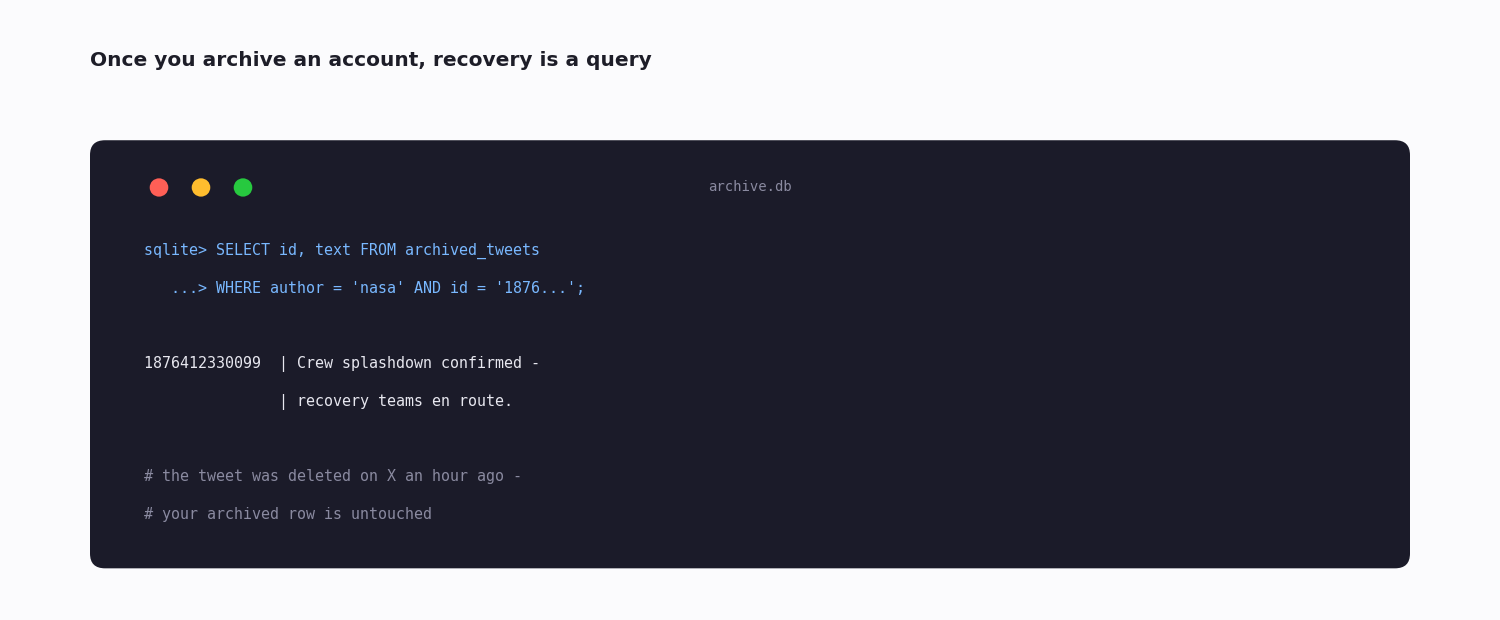
What to store: the whole tweet object, not just the text — id, full text, createdAt, the author block, and any media URLs. Download the media itself if it matters, because media URLs can rot even when the tweet text survives. With the object in your own database, recovery is a SELECT, and it stays a SELECT for as long as you keep the row.
Cost: filter-rule delivery is billed per call at a pay-per-call rate of about $0.15 per 1,000 tweets — for a small account watchlist, a few cents to a couple of dollars a month. Once you have your own archive, deleted-tweet "search" is just a query against your storage: 100% reliable for every account you covered.
Recovering a Specific Tweet: A Decision Path
If you have one specific deleted tweet in mind, work the methods in this order — it ranks them by odds and by how little effort each takes.
Do you have the exact tweet URL or ID? Start with the Wayback Machine — paste the URL into its history view and look for a snapshot dated before the deletion. For a high-profile account this step alone often succeeds.
Is the account a politician or government official, and was the tweet deleted some years ago? Check Politwoops next; its frozen historical archive covers exactly that case and little else.
Did you, or a tool you run, ever query for this content while it was live? A third-party API cache may still hold it — query by tweet ID, or re-run the search that would have matched it at the time.
None of the above? Then there is probably no copy to find, and the realistic answer is that the tweet is gone. The lesson points forward: if this kind of tweet matters to you, start archiving it now — so the next one is a SELECT by tweet ID, not a search across other people's caches.
Code: Archiving an Account Before It Deletes
You cannot retrieve a tweet that was already deleted, so the workable code is preventative: a filter rule that captures an account's tweets as they post, into storage a later deletion can't reach. The snippet below registers that rule — your webhook receiver then writes each pushed tweet to your own database.
import requests

# You cannot retrieve tweets that were ALREADY deleted. The workable
# approach: continuously capture an account's tweets as they post, so a
# later deletion never erases YOUR copy.
API_KEY = "your_api_key"

# Create a filter rule that watches one account. Register your webhook URL
# in the twitterapi.io dashboard (Tweet Filter -> Webhook settings) first;
# matched tweets are pushed there every `interval_seconds`.
resp = requests.post(
    "https://api.twitterapi.io/oapi/tweet_filter/add_rule",
    headers={"X-API-Key": API_KEY},
    json={
        "tag": "archive-nasa",
        "value": "from:nasa",
        "interval_seconds": 5,
    },
    timeout=30,
)
resp.raise_for_status()
print("watching @nasa, rule_id:", resp.json()["rule_id"])

# Your webhook receiver writes each pushed tweet to durable storage.
# When a tweet is later deleted on X, your archived copy is unaffected:
#   SELECT * FROM archived_tweets WHERE author = 'nasa'
Questions readers ask
Can I see deleted tweets from any account?
Only if someone — the Internet Archive, Politwoops for politicians, or a third-party API cache — recorded them before deletion. The X API itself does not return deleted content. For accounts you control or monitor in advance, you can set up your own archive and recover anything they post.
Is searching deleted tweets legal?
Yes for publicly-posted tweets you saw, or could have seen, while they were live. Tweets were public statements, and archiving public content is generally legal. What is not legal is using the archived content for harassment, defamation, or any otherwise-unlawful purpose.
How long do third-party tweet caches keep deleted content?
Most providers retain seen tweets for somewhere between 30 days and 24 months, depending on the plan. After that the data is purged to save storage cost. For a permanent archive, you need your own storage.
Why can't Google find deleted tweets reliably?
Google crawls Twitter selectively — mostly viral or high-authority content. Most ordinary users' tweets are never indexed before deletion. Google also drops a page from its index once the source URL returns 404, so even a crawled tweet disappears from search within weeks of being deleted.
Can I undelete my own tweets?
No — once you delete a tweet, X removes it from its servers. Your options are to paste the text into a new tweet (not the same — a new ID and timestamp), or to recover it from a third-party cache if anyone recorded it. Any recovery is read-only; the tweet does not return to its original URL.
Can I recover my own deleted tweets from the X data archive?
Usually not. The data export X lets you download holds your account's tweets that are live at the time you request it — tweets you already deleted are not in it. A lot of people search for deleted-tweet recovery expecting their archive download to contain them; it does not. To make your own deleted tweets recoverable, you have to archive them yourself, continuously, before they are deleted — the same filter-rule setup described above, pointed at your own handle.
Is Politwoops still tracking deleted tweets?
No. Politwoops stopped capturing new deletions after a Twitter API change removed the function it depended on. ProPublica's database is no longer actively maintained — it survives as a frozen historical archive. It is still useful for politician tweets deleted during its years of operation, but it will not hold anything deleted recently.
Can I recover a deleted tweet if I only have a screenshot?
A screenshot is itself a copy, so you already have the content. What it can't give you is the verifiable original — the live URL, the exact timestamp, the engagement counts. For anything where provenance matters (legal, journalistic, compliance), a screenshot is weak evidence; an archived tweet object, or a Wayback snapshot with its own URL, is far stronger.
How fast do I need to capture a tweet before it's deleted?
There is no safe window — a tweet can be deleted seconds after posting or years later. That is why archiving is set up as a continuous filter rule rather than a scheduled job: a rule with a few-second interval captures an account's tweets almost as they post, well ahead of the vast majority of deletions, which tend to happen later.
Continue
Stop reading. Start building.
Starter credits cover real testing on real data. Google sign-in, no card, no application queue.
Get an API key