Twitter (X) API Cost — A Straight Answer
Twitter (now X) API cost is one of the most confusing developer-pricing questions on the internet — and part of the confusion is that the pricing model itself has changed. The old ladder most articles still describe — a free tier, then Basic, then Pro — is no longer what a new developer signs up for. What you get today is different, and usually more expensive than people expect.
This page lays out the real cost math for the official X API as it stands now: the pay-per-use rates a new account gets by default, the legacy fixed-price tiers that are closed to new signups, and the Enterprise floor. Then it compares all of that against third-party APIs that resell the same public data per call. The short version: for read-heavy work below a few million tweets a month, third-party pricing runs one to two orders of magnitude cheaper.
Quick decision rule: if your project mostly reads public tweets, a third-party pay-per-call API will almost certainly be cheaper and simpler. If you need write access at volume, or metadata only the official API exposes, you are looking at official pricing. The full numbers — and where each path stops making sense — are below.
How X Changed Its API Pricing
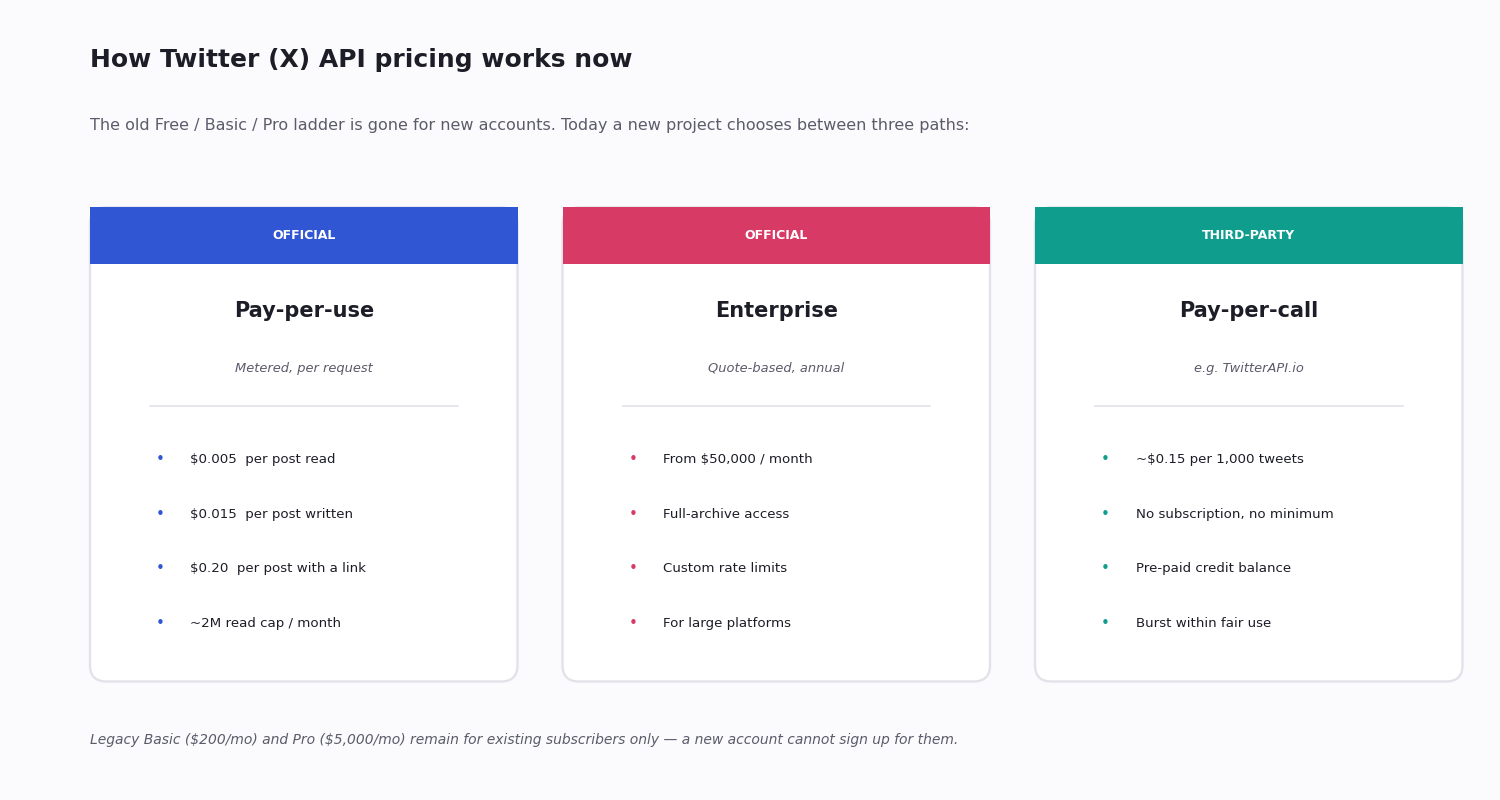
The Twitter API most tutorials describe — a usable free tier, a $200/month Basic tier, a $5,000/month Pro tier — no longer matches what a new developer can actually buy. X restructured access, and the result is three separate things depending on who you are.
New developers land on a pay-per-use model by default: you are billed for each post you read and each post you write, with no flat monthly tier to sit on. There is no free tier in the old sense — the allowance that used to be free is now metered.
Existing subscribers can keep their legacy Basic and Pro plans, the familiar $200 and $5,000 monthly tiers. But those plans are closed — a new account cannot sign up for them. If an article quotes "$200/month for the Twitter API," it is describing a plan most readers can no longer purchase.
Everyone else at scale is pointed at Enterprise, which is quote-based and starts well into five figures a month. So in practice a new project today chooses between metered pay-per-use, an Enterprise contract, or a third-party API — not the old three-rung ladder.
The Official X API: Pay-Per-Use Rates
Pay-per-use is the default for new developer accounts. You are billed per request rather than per month, which sounds flexible but adds up quickly because the per-unit prices are not small.
Reading posts — roughly $0.005 per post retrieved. A timeline pull, a search result, a single looked-up tweet: each post in the response is metered.
Writing posts — roughly $0.015 per standard post (text or media, no link). This rate stepped up from $0.010 — writes got more expensive, not less.
Posts containing a URL — roughly $0.20 per post. A link in the post moves it into a far higher pricing bracket. For anything that publishes links programmatically, this single line item dominates the bill.
Read ceiling — pay-per-use read volume is capped (on the order of 2 million posts a month). It is metered and bounded: past the cap you are pushed toward Enterprise.
What Pay-Per-Use Actually Costs at Volume
Run the read rate of ~$0.005 per post through realistic volumes and the picture is clear:
10,000 posts/month read → about $50/month.
100,000 posts/month read → about $500/month.
1,000,000 posts/month read → about $5,000/month — the same ballpark the old Pro tier cost, except now it scales straight up with usage instead of being a flat fee.
2,000,000 posts/month read → about $10,000/month, at or near the pay-per-use ceiling.
Writes compound the bill independently. 50,000 standard posts a month at ~$0.015 is about $750; if those posts carry links, the same 50,000 at ~$0.20 each is $10,000. For a publishing or automation product, the write side — especially link posts — is often the larger number, and the one teams forget to model.
The Legacy Basic and Pro Tiers
If you (or the account you inherited) subscribed before the restructure, the fixed-price tiers still exist — but they are legacy and closed to new signups.
Basic — $200/month. A modest monthly allowance of reads and posts. It was the entry paid tier; it is the plan most outdated articles still treat as "the" Twitter API price.
Pro — $5,000/month. A much larger monthly allowance, and the tier that bundles the filtered real-time stream and full-archive search. Pro is where serious read volume lived under the old model.
The practical point: do not budget around Basic or Pro unless you already hold that subscription. A new project cannot choose them, so for planning purposes they are reference points, not options.
Enterprise Pricing
Above pay-per-use, the official route is Enterprise — a quote-based, annual, usage-negotiated contract.
Enterprise pricing starts in the tens of thousands of dollars per month (reported entry points begin around $50,000/month) and climbs with volume and data scope. It buys full-archive access, higher and customisable rate limits, and dedicated support.
It is built for large platforms, ad-tech companies, and well-funded research consortia — organisations for whom social data is core infrastructure with a budget line to match. For a startup, an indie developer, a single research project, or a small marketing team, Enterprise is not a realistic line item.
Third-Party Pay-Per-Call APIs
Third-party APIs aggregate the same publicly available Twitter/X data and resell it with per-call billing. They are the reason a small project can still afford Twitter data at all.
Per-tweet rate — on the order of $0.15 per 1,000 tweets retrieved (about $0.00015 a tweet) for search, advanced search, user lookups, replies and retweeters. Follower and following data is typically cheaper still, scaling down toward roughly $0.0045–$0.01 per 1,000 records on higher-volume calls.
No subscription, no monthly minimum. You pre-pay a credit balance and draw it down as you make calls. A month where you pull nothing costs nothing — there is no tier to keep paying for.
No tier ceiling. You burst as much as you need within fair-use rate limits, instead of buying the next plan up to unlock headroom.
The trade-off: third-party APIs serve public data and standard tweet/user objects. If you need to publish at scale, or need official-only signals, the official API still has a role — covered below.
Cost at Common Volumes — Side by Side
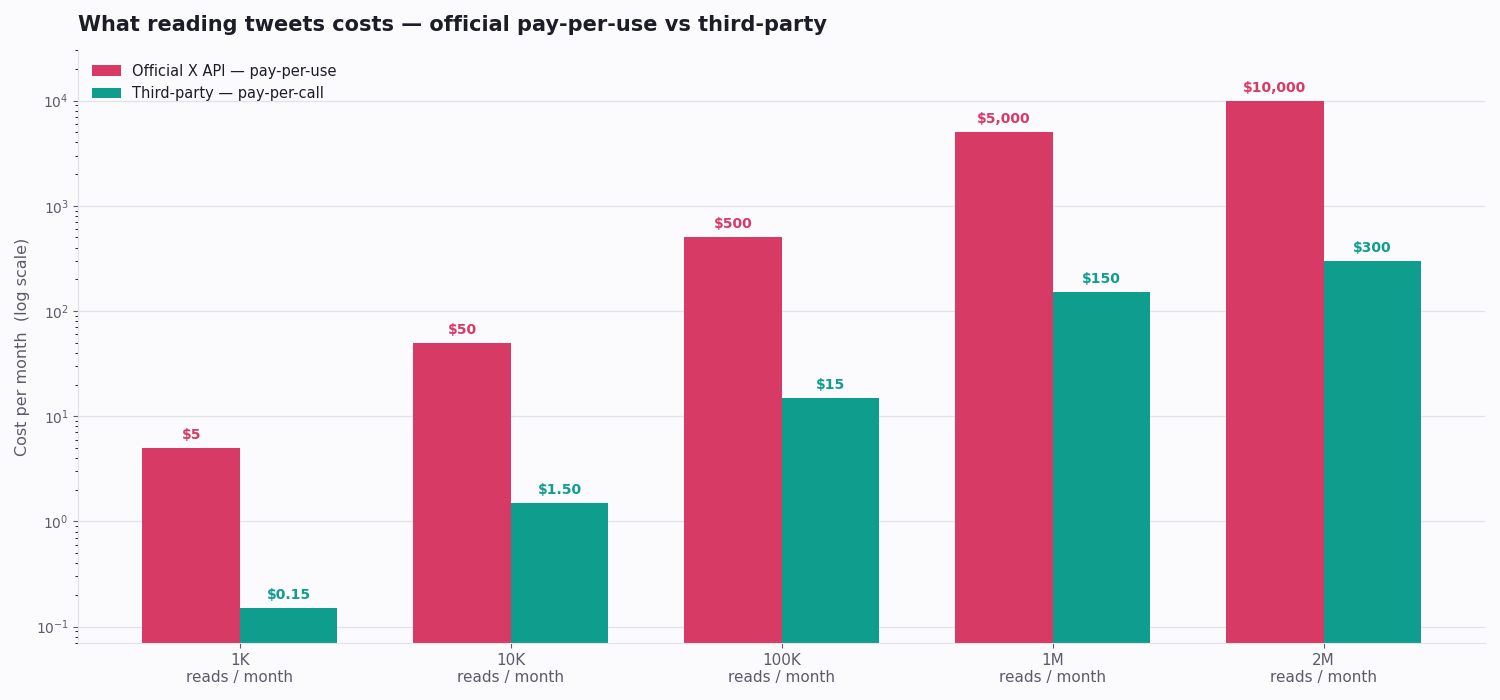
Read-only operations, approximate monthly cost in USD. The official column is pay-per-use (the model a new account actually gets); the third-party column is pay-per-call at ~$0.15 per 1,000 tweets.
1,000 reads — official ≈ $5 · third-party ≈ $0.15.
10,000 reads — official ≈ $50 · third-party ≈ $1.50.
100,000 reads — official ≈ $500 · third-party ≈ $15.
1,000,000 reads — official ≈ $5,000 · third-party ≈ $150.
2,000,000 reads — official ≈ $10,000 (near the cap) · third-party ≈ $300.
The ratio holds remarkably steady — roughly 30× — across the whole range, because both models now scale with usage; the official API simply meters each post far higher. The gap only closes if you genuinely need Enterprise-class scale and the official-only capabilities that come with it.
Hidden Costs You'll Hit With the Official API
The headline rate is not the whole bill. Four things routinely surprise teams:
The URL-post surcharge. A post containing a link is billed at roughly $0.20 versus ~$0.015 for a plain post — more than a 13× jump. Any workflow that auto-posts links needs to model this line on its own; it is frequently the single largest cost.
Retries count. A network blip, your client retries, and both attempts meter. Without idempotency and careful retry logic you pay for failures.
Endpoint gating. Full-archive search, the filtered stream, and some advanced filters are not available on every plan. Paying the pay-per-use rate does not automatically unlock every endpoint — capability and price are separate questions.
Annual commitment on the upper tiers. Legacy Pro and Enterprise are annual — you commit a year of spend before you know your real usage curve. Pay-per-call third-party billing carries none of that lock-in.
When the Official API Is Worth the Cost
Paying X directly still makes sense in specific situations:
Heavy write operations. Posting, replying, liking, following and DMs at volume are first-class on the official API. If publishing is your product, you are on the official write side regardless — just model the URL-post rate carefully.
Official-only metadata. If your product depends on signals the official user and tweet objects expose authoritatively, the official API is the source of record.
Compliance posture. Agencies running paid ads, or partners building official integrations, may need the official API for terms-of-service reasons that simply do not apply to read-only public-data use cases.
For everything else — research datasets, social listening, dashboards, monitoring, analytics — a third-party pay-per-call API delivers the same public data at a fraction of the metered official price.
def estimate_monthly_cost(reads, plain_writes=0, link_writes=0):
    """Rough monthly cost: official X API pay-per-use vs a third-party API."""
    # Official X API pay-per-use (approximate published rates)
    official = reads * 0.005 + plain_writes * 0.015 + link_writes * 0.20

    # Third-party pay-per-call (~$0.15 per 1,000 tweets read)
    third_party = reads * 0.00015

    print(f"{reads:,} reads + {plain_writes:,} posts + {link_writes:,} link-posts / month")
    print(f"  Official X API (pay-per-use): ${official:,.2f}")
    print(f"  Third-party (reads only):     ${third_party:,.2f}")
    if reads:
        print(f"  Read-cost ratio:              {official / max(third_party, 1e-9):,.0f}x")

# Example: a brand-monitoring project — 100k reads, no posting
estimate_monthly_cost(reads=100_000)

# Example: a publishing tool that posts links
estimate_monthly_cost(reads=5_000, plain_writes=0, link_writes=20_000)
Questions readers ask
How much does the Twitter API cost?
For a new developer account the official X API is pay-per-use: roughly $0.005 per post read, $0.015 per standard post written, and about $0.20 per post containing a link, with read volume capped around 2 million a month. The old flat Basic ($200/month) and Pro ($5,000/month) tiers still exist for existing subscribers but are closed to new signups, and Enterprise contracts start in the tens of thousands per month. Third-party APIs resell the same public data at about $0.15 per 1,000 tweets with no monthly minimum.
Is there still a free Twitter API tier?
Not in the old sense. New developer accounts are metered pay-per-use rather than given a free monthly allowance, so reading and writing posts costs money from the first call. Third-party APIs are also paid, but they bill per call with no subscription — you can start with a small pre-paid balance and only spend what you use.
Can I still get the $200/month Basic plan?
Only if you already subscribe to it. The legacy Basic ($200/month) and Pro ($5,000/month) fixed-price tiers remain active for existing subscribers but are closed to new accounts. A new project today chooses between official pay-per-use, an Enterprise contract, or a third-party API — not the old Basic/Pro ladder.
What's the cheapest way to access Twitter data?
For read-heavy work — research, monitoring, analytics, dashboards — third-party pay-per-call APIs are dramatically cheaper than the official metered rates. A 100,000-tweet month costs roughly $15 on a third-party API versus about $500 on the official pay-per-use model, a gap of around 30x that holds across volumes.
Why is the Twitter API so expensive?
The official pricing reflects positioning more than delivery cost. Metered per-post rates and a high Enterprise floor keep casual and small-scale use off the platform and concentrate access among large, well-funded organisations. Third-party APIs exist precisely because that pricing left a gap for everyone who only needs public data.
How much does it cost to post links via the Twitter API?
Posting a tweet that contains a URL is billed at a much higher rate than a plain post — on the order of $0.20 per link post versus about $0.015 for one without a link. Any tool that publishes links programmatically should model this line separately; at volume it is often the single largest cost on the bill.
How much does the official X API Enterprise tier cost?
Enterprise is quote-based, annual, and negotiated on usage and data scope. Reported entry points begin around $50,000 per month and rise from there. It is intended for large platforms, ad-tech firms, and major research programmes — not for startups, indie developers, or single projects.
Do third-party Twitter APIs have monthly fees?
Typically no. A pay-per-call provider like TwitterAPI.io has no subscription and no monthly minimum — you pre-pay a credit balance and draw it down per request. A month with no calls costs nothing, which is the opposite of a fixed-tier plan you pay for whether or not you use it.
What does it cost to pull 1 million tweets a month?
On the official pay-per-use model, 1,000,000 reads at roughly $0.005 each is about $5,000/month. On a third-party pay-per-call API at about $0.15 per 1,000 tweets, the same volume is roughly $150/month. The official route only becomes competitive at genuinely large scale, where you would also need its Enterprise-class capabilities.
Is using a third-party Twitter API allowed?
Third-party APIs serve publicly available Twitter/X data. They are widely used for research, social listening, and analytics. If your use case specifically requires official partner status — for example running paid ads or an official integration — you will need the official API for those compliance reasons; for read-only public-data work, a third-party API is the standard, cost-effective choice.
Continue
- /
- /pricing
- 'Rate Limit Exceeded' on the Twitter (X) API
- /blog/twitter-api-pricing
- /is-twitter-api-free
- /twitter-scraper
- /blog/twitter-api-with-python
Stop reading. Start building.
Starter credits cover real testing on real data. Google sign-in, no card, no application queue.
Get an API key