How Much Does the X (Twitter) API Cost in 2026?
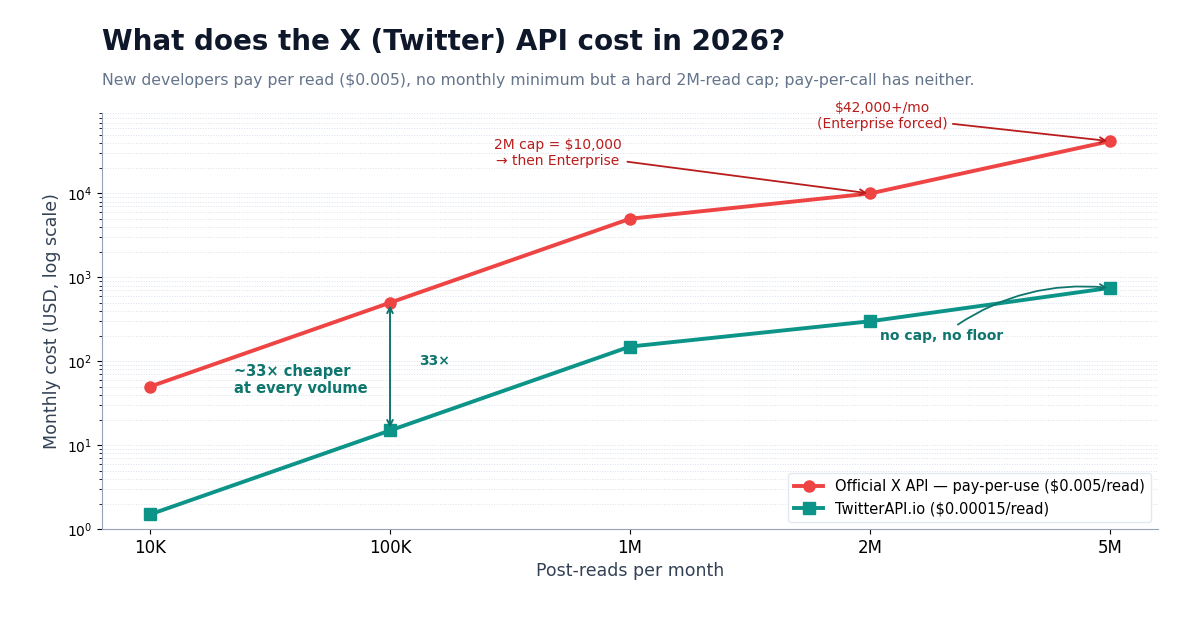
The official X API bills pay-per-usage with no subscriptions — about $0.005 per post read with no monthly minimum, capped at 3,000,000 post reads per monthly billing cycle, so 3M reads cost roughly $15,000/month and anything above needs an Enterprise contract (requested through an interest form, no public price). New developers get $20 in credits when they add a first card, plus a match of up to $50. A third-party API like TwitterAPI.io is ~$0.00015 per read ($0.15 per 1,000 tweets) with no floor and no cap — about 33× cheaper at every volume. That covers what most people searching "how much is an X API access key" need; the rest of this page shows the full math.
There's a common misconception that the X API still starts at a flat monthly subscription. X no longer sells fixed monthly tiers — the API is billed pay-per-usage. So the real entry cost is your read volume × $0.005, which is fine at tiny volume (10K reads = $50) and brutal at scale (3M reads = $15,000, then Enterprise).
Below: the current pay-per-use rates, what changed when X moved to per-resource billing in 2026, a 4-level cost comparison against the pay-per-call alternative, and a runnable estimator. All figures are from the publicly published pricing on docs.x.com and docs.twitterapi.io.
What does an X API access key actually cost in 2026?
There's no one-time "access key" fee. For a new developer, the official X API is billed pay-per-use — you pay per request, with no monthly subscription. The headline rate is $0.005 per post read, with a cap of 3,000,000 post reads per monthly billing cycle. Current published rates:
Important accuracy note: X no longer sells subscriptions or fixed monthly tiers — everything is pay-per-usage. Above the 3M-read cap, the only option is Enterprise, requested through an interest form with no public price. There is no standalone free tier; instead, new developers get $20 in credits when they add a first card, plus a match of up to $50.
For comparison, TwitterAPI.io (the third-party API this site documents) charges $0.00015 per tweet read — about $0.15 per 1,000 tweets — with no monthly minimum and no cap. A new account that passes the automatic bot check gets $1 in free credits (one per person and network), no card required, expiring after 31 days.
What changed when X moved to pay-per-use?
X used to sell fixed monthly tiers: pick a plan, get a fixed monthly allowance, pay the flat fee. Since 2026 the API bills pay-per-usage, with no subscriptions. Instead of a plan, you now pay per resource:
Post read: $0.005 per read (this is the rate that dominates most data projects)
User / DM event / follower read: $0.010 per read
Owned reads (your own account's data): $0.001 per read
Post creation: $0.015 per post; post creation containing a URL: $0.200 per post
Two things matter most. First, there's no monthly minimum — at tiny volume you pay only for what you read (10K reads = $50). Second, pay-per-usage is capped at 3,000,000 post reads per monthly billing cycle: once you hit 3M reads you cannot read more in that cycle except by moving to Enterprise (interest form, no public price). Since post reads are billed at $0.005, hitting that cap means you've already spent about $15,000 that month — and then the wall.
The net effect is a pricing curve that's friendly at the very low end (no floor) but escalates fast: $0.005/read compounds quickly, and the 3M cap turns into a $15,000-then-Enterprise cliff in the mid-to-high volume range where many monitoring, analytics, and AI-data projects live. (This page focuses on reads because that's what data projects spend on; writes are billed separately at the rates above.)
How does the 3,000,000-read/month cap affect real projects?
Under pay-per-use, the 3M cap isn't just a ceiling — it's a $15,000/month ceiling (3M × $0.005), after which you need Enterprise. That lands hard on "mid-sized" data work:
Real-time brand monitoring: 50 keywords × ~1,000 new tweets/day × 30 days ≈ 1.5M reads/month = ~$7,500/month on the official API (half-way to the cap). The same on TwitterAPI.io: ~$225.
KOL / influencer tracking: 500 accounts × ~3 tweets/day × 50 interaction-fetches × 30 days ≈ 2.25M reads/month = ~$11,250/month on the official API, three-quarters of the way to the 3M cap. TwitterAPI.io: ~$338, no ceiling.
AI training-data collection: 100K tweets/day × 30 days = 3M reads/month — exactly the pay-per-usage cap (~$15,000/month), with no headroom; any growth needs Enterprise. TwitterAPI.io: ~$450.
Low-volume zone (well under 3M): individual PoCs and single-brand monitoring (<500K/month) are where pay-per-use's no-minimum helps most — but $0.005/read still adds up (500K reads = $2,500/month vs TwitterAPI.io's $75). The official API's hook (no floor) only wins at genuinely tiny volume, and even there the per-read rate makes it ~33× the third-party cost.
How much do third-party Twitter APIs cost?
Third-party APIs like TwitterAPI.io use a fundamentally simpler model: linear pay-per-call, no subscription, no cap.
$0.00015 per tweet returned (~$0.15 per 1,000 tweets; 15-credit minimum per call) — about 1/33 of the official $0.005/read
No monthly minimum — new accounts that pass the automatic bot check get $1 in free credits (one per person and network, expires after 31 days), no card required
No monthly cap — there's no 3M ceiling and no forced Enterprise jump; you scale smoothly
No tiers — every user gets the same price and the same ~75 endpoints (read + common writes like post/like/retweet/follow; DM-send is intentionally not exposed because API-sent DMs trigger account bans)
The math is monthly cost = monthly reads × $0.00015: 1M reads = $150, 2M = $300, 5M = $750, 10M = $1,500. Because it's the same per-read rate at every volume — and ~33× below the official $0.005 — the cost gap is constant rather than blowing up at a tier boundary.
Which is cheaper for my use case? (cost comparison)
Monthly cost at four common read volumes, using the official pay-per-use rate ($0.005/read) a new developer actually pays vs TwitterAPI.io ($0.00015/read). Figures from publicly published pricing.
The pattern is clean: at every volume up to the cap, the official pay-per-use rate is ~33× the third-party cost. At the 3M cap you've spent ~$15,000 and hit a wall; above it, the official API requires Enterprise (no public price) while TwitterAPI.io just keeps scaling linearly. Most monitoring / analytics / AI projects live in the 100K-10M range — squarely where pay-per-call wins. The official API is only the right call when you specifically need official-only capabilities (Ads API, verified write at scale, partner status).
Is there a free X API tier?
No — there is no standalone free tier. The API is pay-per-usage, with no monthly minimum (so $0 if you make zero calls) but $0.005 per read the moment you actually pull data. The only free allowance is credit: new developers get $20 in credits when they add a first card (about 4,000 post reads at $0.005), plus a match of up to $50.
In practice that means trying the official API requires an X developer account and a saved payment card, and the $20 credit covers only a few thousand post reads. TwitterAPI.io's equivalent is $1 in free credits on signup for new accounts that pass the automatic bot check (one per person and network, no card required, expiring after 31 days), which can run a small proof-of-concept: pull a few thousand tweets, fetch some profiles, test a webhook rule — all before paying anything.
Bottom line on "free": the official free tier is gone; pay-per-use has no floor and a one-time $20 credit, but isn't free for real usage; and a third-party trial credit is the practical way to validate an integration end-to-end at no cost. See the dedicated free-tier comparison linked below.
How to estimate your monthly API cost
Estimating is straightforward. For the official API it's reads × $0.005, until you hit the 3,000,000-read cap per billing cycle, after which you need Enterprise. For TwitterAPI.io it's purely reads × $0.00015.
The estimator below takes your monthly read count and returns both costs side by side, flagging the 3M-cap/Enterprise cliff. For an interactive version with separate sliders per resource type (post reads, user reads, writes), use the rate-limit + cost calculator linked at the bottom.
Rule of thumb for read volume: (keywords × tweets-per-day × 30) + (accounts × polls-per-day × 30) + interaction-fetches. Under ~300K reads/month the official no-minimum is tolerable but still ~33× the third-party cost; anywhere from there to the 3M cap, pay-per-call saves an order of magnitude; above 3M, the official API requires Enterprise and pay-per-call is the only economical path.
# X API monthly cost estimator (2026) — official pay-per-use vs TwitterAPI.io
# The official X API bills pay-per-usage; there are no subscription tiers.

OFFICIAL_READ_RATE = 0.005      # $/post read
OFFICIAL_CAP = 3_000_000        # post reads per monthly billing cycle; above this = Enterprise only
TWITTERAPI_RATE = 0.00015       # $0.15 / 1,000 reads

def estimate(monthly_reads: int):
    """Return (official cost label, TwitterAPI.io cost)."""
    if monthly_reads > OFFICIAL_CAP:
        official = "exceeds 3M cap -> Enterprise (interest form, no public price)"
    else:
        official = f"${monthly_reads * OFFICIAL_READ_RATE:,.2f}"
    twitterapi = monthly_reads * TWITTERAPI_RATE
    return official, twitterapi

for name, reads in [
    ("Individual PoC",       10_000),
    ("Small monitoring",    100_000),
    ("Mid-size SaaS",     1_000_000),
    ("At the 3M cap",     3_000_000),
    ("Large intelligence",5_000_000),
]:
    official, twitterapi = estimate(reads)
    print(f"{name:<20}{reads:>10,} reads  official={official:<40} twitterapi=${twitterapi:,.2f}")

# At 3,000,000 reads:  official=$15,000.00   twitterapi=$450.00   (~33x cheaper)
# Above 3M the official API requires Enterprise; TwitterAPI.io keeps scaling linearly.Questions readers ask
How much does the X API cost in 2026?
The official X API bills pay-per-usage with no subscriptions: about $0.005 per post read with no monthly minimum, capped at 3,000,000 post reads per monthly billing cycle. So 10K reads ≈ $50, 1M reads ≈ $5,000, and 3M reads ≈ $15,000 — after which you need Enterprise (interest form, no public price). TwitterAPI.io is ~$0.00015/read (about 33× cheaper) with no floor or cap.
Can I still buy a fixed monthly X API plan?
No. X no longer sells subscriptions or fixed monthly tiers; the API is pay-per-usage ($0.005/post read, $0.010/user read, no minimum, 3M post-read cap per billing cycle), with Enterprise above the cap. So a flat monthly starter price no longer applies to new projects.
Is the X API free?
No standalone free tier. The API is pay-per-usage, with no monthly minimum (so $0 if you make no calls) but $0.005 per read for actual data. New developers get $20 in credits when they add a first card (about 4,000 post reads), plus a match of up to $50. TwitterAPI.io offers free starter credits ($1 for new accounts that pass the automatic bot check, one per person and network, no card, expires after 31 days) that can run a small proof-of-concept.
What is the 3 million monthly cap on the X API?
Pay-per-usage is capped at 3,000,000 post reads per monthly billing cycle. At $0.005/read that's about $15,000 spent — and once you hit it you cannot read more in that cycle except by moving to Enterprise, which X offers through an interest form with no public price. Third-party APIs like TwitterAPI.io have no such cap, so the same 3M reads cost $450 and you can keep scaling.
Why did the X API get more expensive?
X replaced its fixed monthly tiers with pay-per-usage billing: $0.005 per post read, $0.010 per user read, $0.015 per post created and $0.200 per post containing a URL. Per-read billing plus a 3M-read cap per billing cycle means mid-volume projects pay thousands per month and hit a hard wall — which is why many move to a pay-per-call third-party API.
What's a low-cost way to get Twitter data at scale?
A third-party pay-per-call API. TwitterAPI.io charges $0.00015/read with no floor or cap, so 3M reads = $450 and 5M = $750 — versus the official API's ~$15,000 at the 3M cap and Enterprise (no public price) above it. At every volume the official pay-per-use rate is about 33× the third-party cost, and only the official API requires an Enterprise contract to scale past 3M.
Does the official price include writes, or just reads?
Reads and writes are billed separately. This page focuses on reads ($0.005/post read) because that's what data projects spend on, but the official API also charges for writes: $0.015 per post, $0.200 per post containing a URL, $0.010 per user, DM event or follower read, and $0.001 per owned read. TwitterAPI.io's $0.00015/read covers reads; it offers common writes (post/like/retweet/follow) but not DM-send.
Does TwitterAPI.io have hidden fees?
No — pricing is purely usage-based ($0.00015 per tweet returned, 15-credit minimum per call) against a prepaid balance. No subscription, no minimum spend, no per-seat fees, no monthly cap. You monitor exact spend in the dashboard, and the free starter credits (no card) let you validate cost behavior before committing. For an interactive breakdown, use the rate-limit + cost calculator linked above.
Continue
- X (Twitter) API — official product and access
- X API — official documentation
- X API — official rate limits reference
- Cheapest Twitter API: compare every provider for your workload (calculator)
- TwitterAPI.io pricing →
- X API rate-limit + cost calculator (interactive) →
- 'Rate Limit Exceeded' on the Twitter (X) API
- Twitter API pricing — detailed breakdown →
- The best third-party Twitter API in 2026 →
- 01How Do You Turn On Twitter (X) Dark Mode, and What Are Its Exact Colors?
- 02How Do You Create a Second Twitter (X) Account, and What Does X Allow?
- 03What Was Twitter (X) Circle, and What Can You Use Instead?
- 04What Percentage of Twitter (X) Is Bots? Every Published Estimate and Its Method
- 05Can You Hide Who You Follow on Twitter (X)?
- 06Brand24 vs Mention — the X (Twitter) Data Cost Perspective
- 07Twitter (X) API Cost — A Straight Answer
- 08Twitter (X) API OAuth 2.0 User-Context — Setup + PKCE Guide
Stop reading. Start building.
Starter credits cover real testing on real data. Google sign-in, no card, no application queue.
Get an API key