How do you earn TwitterAPI.io credits by writing about the API?
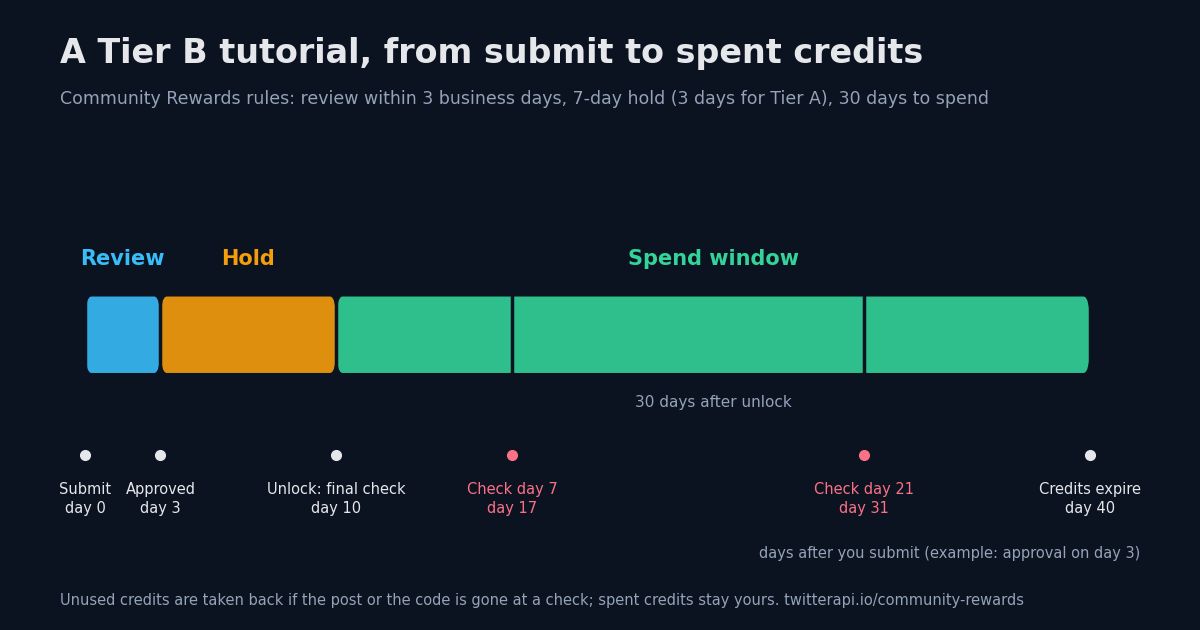
This is a labelled walkthrough, not a creator story. The plan, the share code AB12CD34 and the post URLs below are examples we made up to show the steps. Every rule, amount and time limit comes from the live TwitterAPI.io community rewards page and the submission form in the dashboard.
The program pays credits for honest content about the API: a short post on X, a tutorial on Dev.to or your own blog, a YouTube build, a Show HN thread or an open-source repo that uses us. Critical reviews count too. The bar is whether another developer would learn something, not whether the post praises us.
The walkthrough follows one example from start to finish: a developer who built a small keyword-alert script writes it up once, publishes it on three platforms, posts a short X thread about it, and checks that every post still carries the share code until the credits are spent.
Step 1: Get your share code and referral link
Sign in and open Dashboard → Community Rewards (/dashboard/community-rewards). The section "Your proof-of-authorship credentials" shows two values with copy buttons: your share code (8 characters) and your referral link (twitterapi.io/?ref=<your code>). Either one works. It is the same code as your affiliate link, so you don't need to set anything up separately.
The code is how the review knows the post is yours. The auto-review fetches the public page and looks for the code or the link in the body. The first time a platform account is approved, it is bound to your TwitterAPI.io account; if anyone else later submits a post from that platform account, it goes to a person for review.
Where to put it: in the text of the post itself. A code that only appears in a comment, a reply or a pinned follow-up does not count. On X, put it in the post whose URL you submit.
Step 2: Pick platforms (the tier follows the URL)
You don't choose a tier. The form reads the URL and sets it from the platform. That makes the plan mostly a question of where the post will be useful to readers.
Two limits shape the plan. Each platform pays once per account, ever: a second X post later earns nothing. And one account can receive at most $200 of credits per calendar month across all platforms.
Review sites are out. Trustpilot, G2 and similar sites forbid incentivized reviews, so they are not accepted. Platforms that are not listed can still be submitted; the reviewer will tell you if one doesn't qualify.
Step 3: Write it, then add the disclosure line
Write in your own voice about something you actually built or measured. A post that is mostly links with little text of its own is likely to be held for a person to look at, and a copied post with a swapped share code loses the reward and can end eligibility.
Disclosure is required. The submission form asks you to confirm that the post says you receive credits in return, in whatever form the platform expects (an FTC-style disclosure for US readers, Reddit's self-promotion rules, a platform's own sponsored tag). One plain sentence is enough if readers can't miss it: the FTC's influencer guide warns that a disclosure only at the end of a post, on a profile page or behind a "more" click is likely to be missed, so put it near the top, next to the first mention. For example:
Example disclosure line: "Disclosure: I receive TwitterAPI.io credits for this post through their Community Rewards program. My referral link: twitterapi.io/?ref=AB12CD34"
Links: the program never pays for a dofollow link and never asks for one. Whatever the platform does with links by default (nofollow, UGC, sponsored) is fine.
What to write about is up to you. Topics that tend to help readers are a working script with its output, a cost comparison you measured, a migration from another client, or an honest list of what didn't work. If you need a starting point, the Claude + Twitter API guide and the Twitter API pricing breakdown show the level of detail readers find useful.
Step 4: Submit the URL from the dashboard
In the same dashboard page, paste one public post URL into Post URL, write a short summary (at least 30 characters) under "What's in the post?", tick the disclosure box and press Submit for review. One URL per submission.
Medium and LinkedIn: these pages can't be fetched automatically, so paste the full text of the post into the summary box. The check then runs against that text.
Errors you might see: "platform already used" means you already have a reward on that platform; "duplicate URL" means this URL or a variant of it was already submitted; a non-public URL (an internal address, an IP, a private page) is rejected.
What happens next: the auto-review runs every few hours and checks the body for your code and the tier gates (video length, GitHub stars, Hacker News comments). Personal blogs, Medium, LinkedIn, Hashnode, Qiita, Zenn and Substack go to a short manual review. You get an email when it's decided, within 3 business days.
Step 5: The hold, the unlock and the 30-day window
An approved post doesn't pay immediately. It enters a hold of 3 days for Tier A and 7 days for Tier B and C, while the post is confirmed to still be live. A final automatic check runs at the end of the hold. If the post is still up and still carries your code or link, the credits unlock in your balance.
From the unlock you have 30 days to spend them on any endpoint. During those 30 days the post is checked again on day 7 and day 21. If it has been removed, made private, or the code is gone, the unused part of the reward is taken back; credits you already spent stay yours. If the post disappears during the hold, the reward is cancelled before anything is released.
Reward credits can't be converted to cash. If people sign up through your link and later pay, that is a separate affiliate commission under the affiliate program terms (12-month window, per-payer cap and self-referral rules).
Worked example: one tutorial, four rewards (illustrative)
Our made-up developer wrote one tutorial, "A keyword alert for X in 40 lines of Python", published it on their own blog, cross-posted it to Dev.to and Hashnode, and wrote a three-post X thread that links to it. Each URL is submitted separately.
$65 is under the $200 monthly cap, so all four pay in full. Next month the same four platforms pay nothing more for this account; a YouTube walkthrough of the same build would be new (Tier C, $30), and so would the code as a GitHub repo once it passes 20 stars.
What $65 of credits buys: reads cost $0.15 per 1,000 tweets returned on TwitterAPI.io, so $65 covers about 433,000 tweets. The official X API pay-per-usage rate card (docs.x.com/x-api/getting-started/pricing, as of 2026) lists Posts: Read at $0.005 per resource for reading other accounts' posts, where the same $65 reads 13,000 posts.
If the code goes missing: suppose the Dev.to version is edited on day 10 after unlock and the referral line is cut. The day-21 check finds no code, and whatever is left of that $20 is taken back. That is why the next step exists.
Step 6: Check your own posts before the program does
The script below checks each post you submitted the way the review does: is it still public, and does the body still contain your share code or referral link? X posts are read through GET /twitter/tweets (the text plus the expanded entities.urls, because X shortens links to t.co); other platforms are fetched as plain web pages. Run it before you submit and again around day 7 and day 21 after the unlock.
Cost: each X post checked is one tweet returned, 15 credits ($0.00015). Checking four posts three times costs less than a cent; web pages cost nothing.
"""Self-check for Community Rewards: is each post still public, and does it
still carry my share code or referral link in the body?"""
import re

import requests

API_KEY = "YOUR_API_KEY"       # from twitterapi.io/dashboard
SHARE_CODE = "AB12CD34"        # your 8-character share code (example value)
POSTS = [
    "https://x.com/your_handle/status/1234567890123456789",
    "https://dev.to/your_handle/a-keyword-alert-for-x-in-40-lines-of-python",
    "https://your-blog.example/keyword-alert-for-x",
]


def x_post_body(url):
    tweet_id = re.search(r"/status/(\d+)", url).group(1)
    r = requests.get("https://api.twitterapi.io/twitter/tweets",
                     params={"tweet_ids": tweet_id},
                     headers={"X-API-Key": API_KEY}, timeout=30)
    r.raise_for_status()
    tweets = r.json().get("tweets") or []
    if not tweets:
        return None  # deleted, protected, or no longer visible
    t = tweets[0]
    # X rewrites links to t.co; the real URL is in entities.urls
    links = [u.get("expanded_url", "") for u in (t.get("entities") or {}).get("urls") or []]
    return t.get("text", "") + " " + " ".join(links)


def web_page_body(url):
    r = requests.get(url, timeout=30, headers={"User-Agent": "rewards-self-check/1.0"})
    return r.text if r.ok else None


for url in POSTS:
    body = x_post_body(url) if "/status/" in url else web_page_body(url)
    if body is None:
        print(f"GONE     {url}")
    elif SHARE_CODE in body:
        print(f"OK       {url}")
    else:
        print(f"NO CODE  {url}")
Checklist before you press submit
Public: the post opens in a private browser window without signing in.
Code in the body: your share code or referral link is in the post text, not a comment (the script above prints OK).
Disclosure: one sentence says you receive TwitterAPI.io credits for the post.
Your own words: something you built, measured or ran into, not a rewrite of someone else's post or of our docs.
Tier gate met: 600+ words (1,200+ CJK characters) for Tier B; 3+ minutes of the API actually running for YouTube; 5+ comments for Hacker News; 20+ stars for GitHub.
New platform: you haven't been rewarded on this platform before.
Kept up: you plan to leave the post and the code in place until the credits are spent.
# Read one of your X posts the way the self-check does (15 credits per tweet returned)
curl -s "https://api.twitterapi.io/twitter/tweets?tweet_ids=1234567890123456789" \
-H "X-API-Key: $TWITTERAPI_IO_API_KEY"Questions readers ask
Do I have to be a paying customer to take part?
You need a TwitterAPI.io account to get a share code and to submit, because rewards are paid as credits into that account. Creating the account is free.
Can I write a critical or negative review?
Yes. The program asks for honest content, and a post that lists what didn't work is welcome. The test is whether another developer learns something from it.
Can I submit a post I wrote before the program started?
Yes, if it is still live, carries your share code or referral link in the body, and shows a disclosure (you can add both now).
Why was my X post not counted when the code was in a reply?
The code has to be in the body of the post whose URL you submit. Replies, comments and follow-up posts are not checked.
Are Community Rewards credits the same as affiliate commission?
No. The reward is credits for the post, capped at $200 a month and spendable for 30 days. Affiliate commission is earned on payments by people who sign up through your link, under the affiliate program terms. The same share code serves both.
Continue
- FTC: Disclosures 101 for social media influencers
- TwitterAPI.io docs: get tweets by IDs
- X API pricing (official rate card)
- TwitterAPI.io community rewards: tiers, platforms and fair-play rules
- Affiliate program: commission on payments by people you refer
- How to use Claude with the Twitter API
- Twitter API pricing explained
- TwitterAPI.io pay-per-call pricing
- 01Twitter (X) Lists: What They Are, How to Make One, and How to Use Them
- 02Tweepcred: How Twitter (X) Scores Account Reputation, Read From the Code
- 03Tweet Failed to Send on Twitter (X)? What Each Error Means and How to Fix It
- 04How to Embed a Video on Twitter (X): In a Post or on Your Website
- 05Twitter (X) Direct Message Limit: the Daily DM Cap, Who Can Message You, and Why DMs Fail to Send
- 06Get Twitter (X) Data in Python (2026 Tutorial)
- 07X API 403 Forbidden: Every Cause on the Twitter (X) API and How to Fix Each One
- 08Michael Saylor on Twitter — A Tracking Guide for Crypto Traders
Stop reading. Start building.
Starter credits cover real testing on real data. Google sign-in, no card, no application queue.
Get an API keyAlready building with TwitterAPI.io? Publish an honest tutorial or build log about it and earn up to $200 a month in API credits.