Qwen API Pricing in 2026: Every Tier, Kimi, GLM and MiniMax Compared
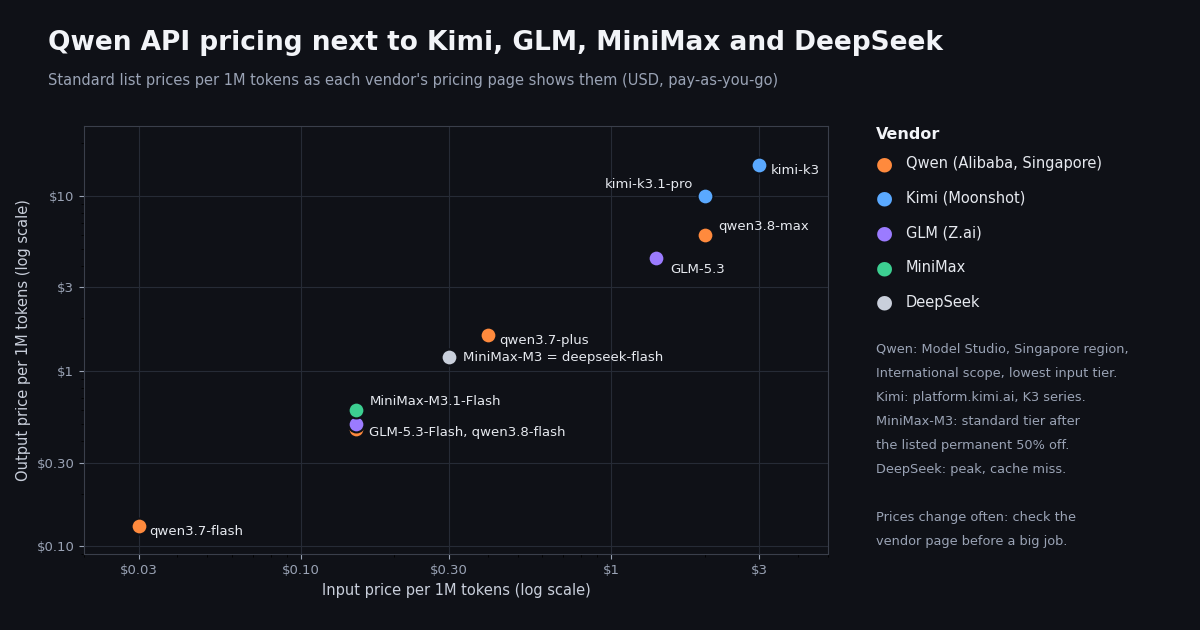
- Qwen is billed per token, per model, per region. Singapore list prices:
qwen3.8-max$2 / $6,qwen3.7-plus$0.4 / $1.6 (up to 256K input),qwen3.8-flash$0.15 / $0.47,qwen3.7-flash$0.03 / $0.13 (up to 32K input), per 1M input / output tokens. - Region changes the bill. China (Beijing) and Global-scope tables list
qwen3.8-maxat $1.65 / $4.951 andqwen3.7-plusat $0.276 / $1.101; API keys, endpoints and model lists do not cross regions. - Discounts stack only one at a time. Batch calls are 50% of real-time price; context-cache hits are 10% of input; the two do not combine. Free quota (about 1M tokens per model, 90 days) exists only in Singapore.
- Rivals at list price:
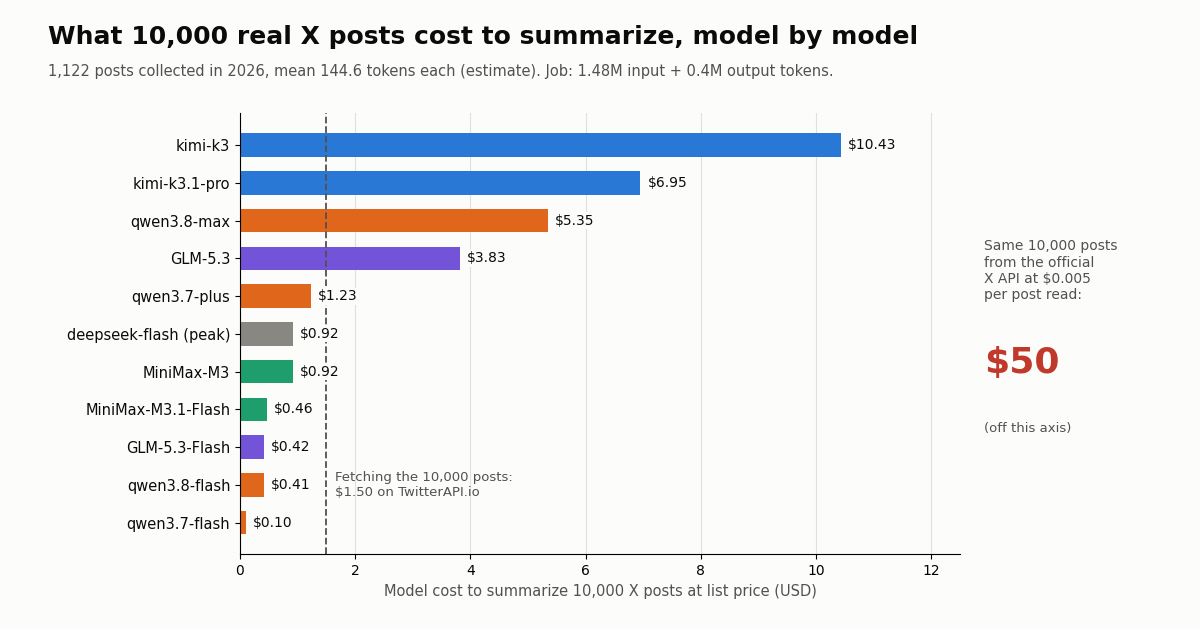
kimi-k3.1-pro$2 / $10,GLM-5.3$1.4 / $4.4,MiniMax-M3$0.30 / $1.20 (after a listed permanent 50% off),GLM-5.3-Flash$0.15 / $0.50. - Real-data cost test: 1,122 X posts collected in 2026 averaged 144.6 tokens (estimate); summarizing 10,000 of them runs from $0.10 (
qwen3.7-flash) to $10.43 (kimi-k3). - The data side: fetching those 10,000 posts costs $1.50 on TwitterAPI.io ($0.15 per 1,000 tweets returned) versus $50 on the official X API at $0.005 per post read, about 33x apart.
Searches for qwen api pricing keep climbing because Qwen models now sit in many agent stacks as the low-cost workhorse next to a frontier model. The trouble is that Alibaba Cloud's price table is long: it splits every model by region (Singapore, US Virginia, Germany Frankfurt, Japan Tokyo, Hong Kong, China Beijing), by deployment scope (International, Global, US, Chinese mainland), by thinking versus non-thinking output, and by input-length tier. This page reads that table for you, model by model, and adds the three open-weight rivals people price it against: Kimi from Moonshot, GLM from Z.ai and MiniMax.
The angle here is the per-token price of Qwen and its peers, plus one measured job. DeepSeek's own pricing lives on our DeepSeek V4 Flash page, routing many models through one key is covered on our OpenRouter API page, and wiring Kimi Code to X data is on our Kimi Code page; this page links to them rather than repeating them. Every price below was read from the vendor's own pricing page this session, and every study number comes from real X posts we collected in 2026.
$0.10 on qwen3.7-flash, $1.23 on qwen3.7-plus, $5.35 on qwen3.8-max and $10.43 on kimi-k3 at list price (1,122 posts collected in 2026, mean 144.6 tokens each, estimated); fetching the posts costs $1.50 on TwitterAPI.io versus $50 on the official X API.
Qwen API pricing by model (Singapore, International scope)
Alibaba Cloud Model Studio bills Qwen API calls pay-as-you-go by default: you pay for input tokens and output tokens separately, at a unit price set per model. Most English-language buyers start in the Singapore region, because that is the only region where new accounts get a free quota. The table below copies the standard prices from Alibaba's alibabacloud.com/help/en/model-studio/model-pricing page for the current text models.
Thinking mode. For qwen3.8-max and qwen3.7-max one price covers both thinking and non-thinking output. For qwen3.7-plus the non-thinking and thinking output prices are the same ($1.6 in the lowest tier). The older qwen-plus alias is the exception: $1.2 output without thinking but $4 with thinking, so check which mode your client enables.
Promotions. Alibaba marks qwen3.7-plus as a limited-time 20% off list price in Singapore and US scope, and some Global-scope models carry night-time discounts (22:00 to 08:00 UTC+8). The page states it lists standard prices and points to the Model Studio console for current promotions, so treat any discount as temporary.
Older aliases still bill. qwen-max (International) is $1.6 / $6.4, qwen-plus is $0.4 / $1.2 non-thinking, and qwen-flash is $0.05 / $0.4 up to 256K. If your code still calls an alias, the alias price applies, not the newest model's.
How tiered pricing, regions and discounts change the bill
Tiers are decided per request, not per month. Alibaba's rule is that the total input tokens in a single request pick the tier, and every token in that request is billed at that tier's price. A 300K-token request to qwen3.7-plus is billed entirely at $1.2 / $4.8, not partly at $0.4. For a pipeline that classifies short posts, keeping each request small keeps you in the lowest tier.
Region and scope. Each region has its own endpoint, its own API keys and its own model list, and keys cannot be used across regions. The same model ID carries different prices by scope:
Prices are input / output per 1M tokens, as Alibaba prints them in USD. The Global scope is selectable from US (Virginia), Hong Kong and Germany; data residency and latency differ, so pick the scope your compliance team accepts before you pick the price.
Batch and cache. Where a model supports batch calls, both input and output are billed at 50% of the real-time price. Where it supports context caching, cache hits are billed at 10% of the input price and explicit cache creation at 125%. Alibaba states the two discounts cannot apply to the same call. A nightly job that re-reads the same long system prompt benefits from caching; an overnight bulk classification benefits from batch.
How to get a Qwen API key (and claim the free quota)
The steps below follow Alibaba's "Obtain an API key" and "Free quota for new users" pages for Model Studio.
Step 1: Create and complete the Alibaba Cloud account. Alibaba now requires completed account information before Model Studio can be activated. Then open Model Studio in the Singapore region and accept the service agreement; that activation grants the free quota automatically (it can take up to two hours to show).
Step 2: Create the key. On the Model Studio API Key page, select the region in the upper-right corner and click Create API Key. Choose the default workspace, optionally add a description, and pick All permissions or Custom (IP allowlist and model list). Copy the key immediately; the full value is shown only once.
Step 3: Store it as an environment variable. Alibaba's docs use DASHSCOPE_API_KEY, for example export DASHSCOPE_API_KEY="sk-..." in ~/.zshrc. Token Plan and Coding Plan subscriptions use a separate dedicated key that starts with sk-sp-; it is not interchangeable with the pay-as-you-go key.
Step 4: Point an OpenAI-compatible client at your region. The Singapore base URL is https://{WorkspaceId}.ap-southeast-1.maas.aliyuncs.com/compatible-mode/v1, and US (Virginia) uses us-east-1 in the same pattern. Alibaba asks Beijing, Singapore and Hong Kong users to migrate from the older shared domains to these workspace-specific ones.
Step 5: Protect the free quota. The quota is per model (typically 1,000,000 tokens each, input and output combined), shared by the account and its RAM users, valid 90 days and not renewed. Turn on "Free Quota Only" per model if you want calls to fail with AllocationQuota.FreeTierOnly instead of starting to bill once the quota is used.
Qwen vs Kimi vs GLM vs MiniMax API pricing
The three open-weight rivals most often priced against Qwen each publish a USD price table. All figures are standard pay-as-you-go list prices per 1M tokens, read from each vendor's pricing page this session.
Kimi API pricing. Moonshot's platform (platform.kimi.ai/docs/pricing/chat) bills pay-as-you-go with no subscription for the API, separate from Kimi membership and Kimi Code. K3-series models have a 1,048,576-token context, cache writes priced by TTL (5 minutes or 1 hour), and batch at 60% of standard price. Moonshot states that from October 31, 2026 K2-series models are closed to newly registered users and that it plans to retire them by the end of December 2026, so new projects should price K3.
GLM API pricing. Z.ai's developer docs (docs.z.ai/guides/overview/pricing) list GLM-5.3 and GLM-5.2 at the same $1.4 / $4.4, with cached-input storage marked limited-time free. GLM-4.7-Flash and GLM-4.5-Flash are listed as free. Z.ai also sells a separate Coding Plan subscription; this page covers the per-token API only.
MiniMax API pricing. MiniMax's pricing overview (platform.minimax.io/docs/guides/pricing) shows MiniMax-M3 at a list price of $0.60 / $2.40 with a "permanent 50% off" to $0.30 / $1.20 for inputs up to 512K tokens, doubling above 512K. A Priority service tier costs 1.5x standard.
DeepSeek for reference. DeepSeek's own page lists deepseek-flash at $0.30 / $1.20 at peak on a cache miss and half that off-peak; our DeepSeek V4 Flash page covers it in depth.
Measured: what 10,000 real X posts cost to summarize on each model
Per-token prices are hard to compare until you run a real job through them. We collected 1,122 recent English X posts about these four model families in 2026 (search queries for Qwen, Kimi, GLM / Z.ai and MiniMax) and counted their tokens. The median post was 261 characters and 74 tokens; the mean was 144.6 tokens, pulled up by long posts (the 90th percentile was 300 tokens). Billing follows the mean, so we used it.
The job: summarize 10,000 posts in batches of 20, with a 60-token instruction per batch and 40 output tokens per post. That is 1.48M input tokens and 0.4M output tokens. At each vendor's list price:
What the numbers say. The spread is about 100x: $0.10 on qwen3.7-flash against $10.43 on kimi-k3. Inside Qwen alone, moving from Max to Plus cuts the job from $5.35 to $1.23. Output tokens dominate the premium models: on kimi-k3.1-pro the 0.4M output tokens cost $4.00 of the $6.95.
What it cannot show. Token counts use the cl100k_base tokenizer as a stand-in; each vendor's tokenizer splits text differently, so treat costs as estimates within a few tens of percent. Quality is not measured here, only cost.
What developers on X say about these APIs
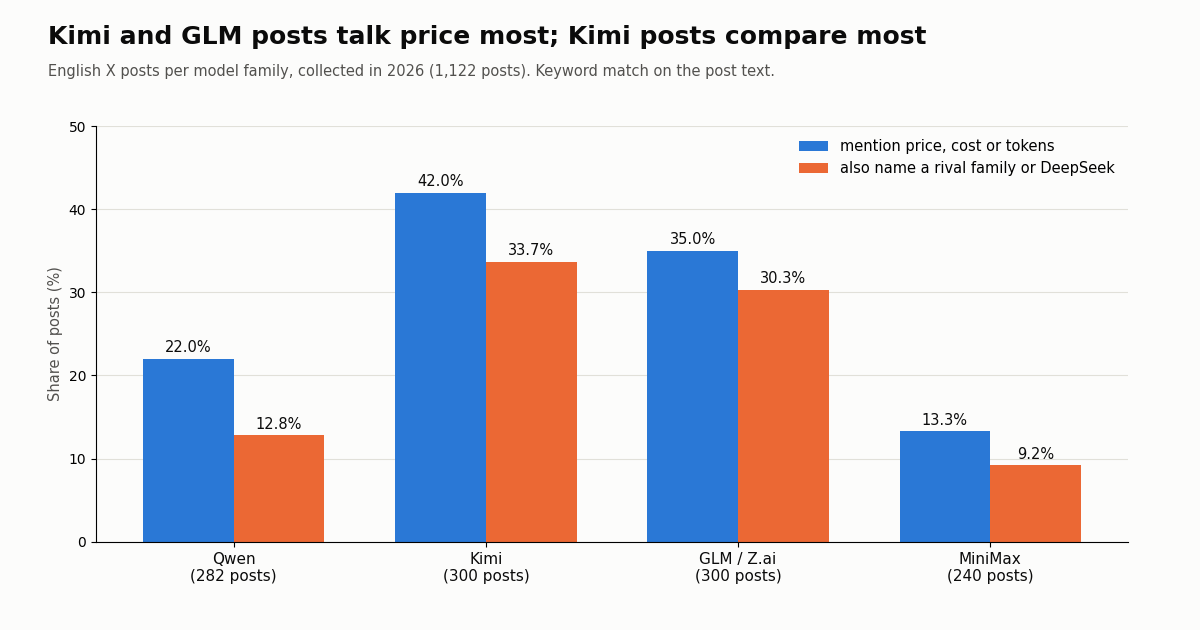
The same sample shows how each family is discussed. Kimi posts were the most price-focused: 42.0% mentioned price, cost or tokens, and 33.7% also named a rival family or DeepSeek. GLM / Z.ai posts followed at 35.0% and 30.3%. Qwen (22.0%) and MiniMax (13.3%) posts were mostly about launches, benchmarks and usage rather than price.
Volume is uneven. The Qwen search filled 282 posts in 6.6 hours and MiniMax 240 in 8.4 hours, while the narrower GLM query needed 297.5 hours for 300 posts. Kimi's query sat between at 58.2 hours.
Official accounts. On their own timelines, @Alibaba_Qwen posted about 0.68 times a day with median 82,630 views per post, @Kimi_Moonshot 0.3 a day with median 191,584 views, @Zai_org 0.47 a day with median 151,622 views, and @MiniMax_AI 1.82 a day with median 23,870 views (last 40 to 60 posts each).
Feeding X data into a Qwen pipeline: the other half of the bill
A Qwen model does not read X on its own. To summarize, classify or monitor posts you fetch them first, and in this job the data side is not small next to the model side.
With qwen3.7-flash the full job is about $1.60 on TwitterAPI.io data versus $50.10 on the official X API, so for cheap models the data source decides most of the bill. The official rate card works out to $5 per 1,000 posts against $0.15, about 33x. X's pay-per-usage tier is capped at 3M post reads a month, with Enterprise above that.
REST path. /twitter/tweet/advanced_search takes X search syntax (from:, lang:, -is:retweet, since_time:) and returns 20 posts per page with has_next_page and next_cursor. /twitter/user/last_tweets returns an account's timeline. Reads need only an API key; no X account needed. An empty search still costs the 15-credit minimum ($0.00015), so a monitor that polls every 60 seconds for a month spends $6.48 on empty checks.
MCP path. For an agent client, our hosted MCP server at https://mcp.twitterapi.io/mcp takes an Authorization: Bearer <your key> header and exposes X search and lookup as tools, so a Qwen-backed agent in an MCP-capable client can call them directly. Setup per client is on our MCP server page.
New accounts that pass the automatic bot check get up to $1 of free credits (at most 100,000 credits, no card, one per person or network, expiring after 31 days), enough for about 6,600 tweets on the search endpoint.
# 20 recent posts about the Qwen API (billed per tweet returned)
curl -s "https://api.twitterapi.io/twitter/tweet/advanced_search?queryType=Latest&query=%22qwen%20api%22%20lang%3Aen%20-is%3Aretweet" \
-H "X-API-Key: $TWITTERAPI_IO_KEY" | jq '.tweets[] | {createdAt, likeCount, text}'Which Qwen tier to pick for a given job
High-volume classification or tagging. qwen3.7-flash in the lowest tier ($0.03 / $0.13) is the lowest list price in our comparison table; at $0.10 per 10,000 posts the model cost is a rounding error next to data. Keep requests under 32K input tokens to stay in that tier.
Summaries a person will read. qwen3.7-plus ($1.23 per 10,000 posts) or qwen3.8-flash ($0.41) are the middle ground. GLM-5.3-Flash and MiniMax-M3.1-Flash land within a few cents of qwen3.8-flash.
Hard reasoning over long context. qwen3.8-max ($5.35) keeps one price up to 1M input tokens, which is simpler to budget than the tiered Plus models once prompts get long. kimi-k3.1-pro costs more per job here ($6.95) because of its $10 output price.
Many models behind one key. If you want to switch between Qwen, Kimi, GLM and DeepSeek without four accounts, a router like OpenRouter adds that convenience; compare its per-model price with the vendor's own before you commit.
Run the numbers on your own data. Our measured averages (about 145 tokens per post) apply to X posts; long-form documents and code have very different token counts. The code below logs real usage tokens per batch so you can replace our estimate with your own.
How we collected this
Question. What does it cost to run Qwen, Kimi, GLM and MiniMax models over real X posts, and how do developers talk about these APIs?
Accounts and queries. Four /twitter/tweet/advanced_search queries (Latest, English, no reposts) for Qwen, Kimi, GLM / Z.ai and MiniMax, up to 15 pages each; plus the timelines of the official organization accounts @Alibaba_Qwen, @Kimi_Moonshot, @Zai_org and @MiniMax_AI via /twitter/user/last_tweets, 3 pages each.
Window and sample. The most recent matching posts at collection time, collected in 2026: 1,122 search posts from 916 author slots and 220 official-account posts. 75 API requests in total.
Method. Tokens counted with the cl100k_base tokenizer as a stand-in for each vendor's own. Price and rival mentions are keyword matches on the post text. Costs use each vendor's standard list price read the same day; promotions are excluded.
What the sample cannot show. Model quality, latency or rate limits; non-English posts; tokenizer differences between vendors; and anything beyond a short collection window (the GLM query spans more days than the others).
Privacy. Aggregates only. Search authors are private individuals and are never named; only the four official organization accounts are named. Raw search pages were not stored in the repository.
"""qwen_x_digest.py - pull recent X (Twitter) posts with TwitterAPI.io, then summarize them
with a Qwen model on Alibaba Cloud Model Studio (OpenAI-compatible endpoint).
pip install requests ; export TWITTERAPI_IO_KEY=... DASHSCOPE_API_KEY=... QWEN_WORKSPACE_ID=..."""
import json
import os

import requests

TW_BASE = "https://api.twitterapi.io"
TW_HEADERS = {"X-API-Key": os.environ["TWITTERAPI_IO_KEY"]}
# Singapore region, workspace-specific domain (copy the workspace ID from the Model Studio console).
QWEN_URL = "https://your-workspace-id.ap-southeast-1.maas.aliyuncs.com/compatible-mode/v1/chat/completions".replace(
    "your-workspace-id", os.environ["QWEN_WORKSPACE_ID"])
QWEN_HEADERS = {"Authorization": f"Bearer {os.environ['DASHSCOPE_API_KEY']}"}
MODEL = "qwen3.7-flash"  # swap for qwen3.8-flash, qwen3.7-plus or qwen3.8-max
BATCH = 20


def fetch_posts(query, max_pages=5):
    """Latest posts for an X search; 20 per page, billed per tweet returned."""
    posts, cursor = [], ""
    for _ in range(max_pages):
        r = requests.get(f"{TW_BASE}/twitter/tweet/advanced_search", headers=TW_HEADERS,
                         params={"query": query, "queryType": "Latest", "cursor": cursor}, timeout=30)
        r.raise_for_status()
        body = r.json()
        for t in body.get("tweets", []):
            posts.append({"text": t["text"], "likes": t.get("likeCount", 0),
                          "views": t.get("viewCount", 0), "createdAt": t["createdAt"]})
        if not body.get("has_next_page"):
            break
        cursor = body.get("next_cursor", "")
    return posts


def summarize(batch):
    lines = "\n".join(f"{i + 1}. {p['text'][:1200]}" for i, p in enumerate(batch))
    payload = {
        "model": MODEL,
        "messages": [
            {"role": "system", "content": "You summarize X posts for a developer. One line per post: topic, sentiment, any price mentioned."},
            {"role": "user", "content": lines},
        ],
    }
    r = requests.post(QWEN_URL, headers=QWEN_HEADERS, json=payload, timeout=120)
    r.raise_for_status()
    reply = json.loads(r.text)  # OpenAI-compatible chat completion
    usage = reply.get("usage", {})
    return reply["choices"][0]["message"]["content"], usage.get("prompt_tokens", 0), usage.get("completion_tokens", 0)


if __name__ == "__main__":
    posts = fetch_posts('("qwen api" OR qwen3) lang:en -is:retweet', max_pages=5)
    print(f"fetched {len(posts)} posts")
    tok_in = tok_out = 0
    for i in range(0, len(posts), BATCH):
        text, pin, pout = summarize(posts[i:i + BATCH])
        tok_in += pin
        tok_out += pout
        print(text, "\n---")
    # qwen3.7-flash list price, Singapore, 0-32K input tier: $0.03 in / $0.13 out per 1M tokens.
    model_cost = tok_in / 1e6 * 0.03 + tok_out / 1e6 * 0.13
    x_cost = len(posts) * 0.15 / 1000  # $0.15 per 1,000 tweets returned
    print(f"tokens in {tok_in}, out {tok_out}; model ~${model_cost:.5f}; X data ~${x_cost:.4f}")
Researching this?Free starter credits cover end-to-end testing — Google sign-in, no card. Get a key.
Questions readers ask
How much does the Qwen API cost?
It depends on model and region. In Singapore (International scope), Alibaba lists qwen3.8-max at $2 input and $6 output per 1M tokens, qwen3.7-plus at $0.4 and $1.6 up to 256K input, qwen3.8-flash at $0.15 and $0.47, and qwen3.7-flash at $0.03 and $0.13 up to 32K input. China (Beijing) and Global-scope prices are lower, for example $1.65 and $4.951 for qwen3.8-max.
Is the Qwen API free?
There is a free quota, not a free tier. When you first activate Model Studio in the Singapore region you get a per-model quota, typically 1,000,000 tokens (input and output combined), valid for 90 days. Other regions get no free quota. After it runs out you are billed pay-as-you-go unless you enable Free Quota Only.
How do I get a Qwen API key?
Complete your Alibaba Cloud account information, activate Model Studio (Singapore for the free quota), open the API Key page, select the region, and click Create API Key. Copy the key right away, since it is shown in full only once, and store it as DASHSCOPE_API_KEY. Keys are tied to one region.
What is the difference between Qwen Max, Plus and Flash pricing?
Max is the most capable and costs $2 / $6 per 1M tokens (qwen3.8-max, Singapore). Plus balances cost and quality at $0.4 / $1.6 in its lowest tier. Flash is built for speed and volume: qwen3.8-flash is $0.15 / $0.47 and qwen3.7-flash $0.03 / $0.13 in its lowest tier. In our 10,000-post test that meant $5.35, $1.23, $0.41 and $0.10.
Does Qwen charge more for long prompts?
Some models do. Tiered models price the whole request by its total input tokens, so a qwen3.7-plus request above 256K tokens is billed entirely at $1.2 / $4.8 instead of $0.4 / $1.6. qwen3.8-max and qwen3.8-flash keep one price up to 1M input tokens.
How does Qwen API pricing compare with Kimi and GLM?
At list price, kimi-k3.1-pro is $2 / $10 and kimi-k3 $3 / $15 per 1M tokens on Moonshot's platform; GLM-5.3 is $1.4 / $4.4 and GLM-5.3-Flash $0.15 / $0.50 on Z.ai. On our 10,000-post job that came to $6.95 and $10.43 for Kimi, $3.83 and $0.42 for GLM, against $5.35 for qwen3.8-max and $0.41 for qwen3.8-flash.
Are there discounts for batch jobs?
Yes. Model Studio bills batch calls at 50% of the real-time price for models that support batch, and cache hits at 10% of input; the two do not combine on one call. Moonshot bills Kimi K3 batch at 60% of standard price.
How do I get X (Twitter) posts into a Qwen model?
Fetch them with an X data API, then pass the text to Qwen's OpenAI-compatible endpoint. TwitterAPI.io's /twitter/tweet/advanced_search returns 20 posts per page at $0.15 per 1,000 tweets returned, so 10,000 posts cost $1.50 against $50 at the official X API's $0.005 per post read. An agent can also use our hosted MCP server at mcp.twitterapi.io.
Continue
- Alibaba Cloud Model Studio: model inference pricing (all Qwen models, regions, tiers)
- Alibaba Cloud Model Studio: obtain an API key
- Alibaba Cloud Model Studio: free quota for new users
- Kimi API Platform: model inference pricing
- Z.ai developer docs: pricing
- MiniMax API docs: pricing overview
- X API hub: endpoints, pricing and guides
- DeepSeek V4 Flash API pricing and model notes
- OpenRouter API: one key for many models, fees explained
- Kimi Code with Twitter (X) data over MCP
- Claude API pricing for comparison
- How the TwitterAPI.io MCP server works
- TwitterAPI.io pricing: $0.15 per 1,000 tweets
- 01Pipedream Pricing in 2026: Connect Plans, Credits and the Workflows Shutdown
- 02Cloudflare Pay per Crawl: How the HTTP 402 Handshake Works, and What It Means for Twitter (X) Data
- 03ScrapingBee Pricing in 2026: Plans, Credit Costs and Alternatives
- 04Firecrawl Pricing: Plans, Credit Costs and What an X (Twitter) URL Costs
- 05LunarCrush API: What It Returns, What It Costs, and When Raw Twitter (X) Data Is the Better Input
- 06Exa Pricing: What Exa's Search API Costs per Endpoint, With Worked Examples
- 07Composio Pricing in 2026: Plans, Tool Calls and the Twitter (X) Data Bill
- 08Claude API Pricing in 2026: Per-Token Rates and What 1,000 Tweets Really Cost
Writing about something you built with TwitterAPI.io? Our community rewards program pays API credits for honest tutorials, build logs and videos.
Stop reading. Start building.
Starter credits cover real testing on real data. Google sign-in, no card, no application queue.
Get an API keyAlready building with TwitterAPI.io? Publish an honest tutorial or build log about it and earn up to $200 a month in API credits.