Exa Pricing: What Exa's Search API Costs per Endpoint, With Worked Examples
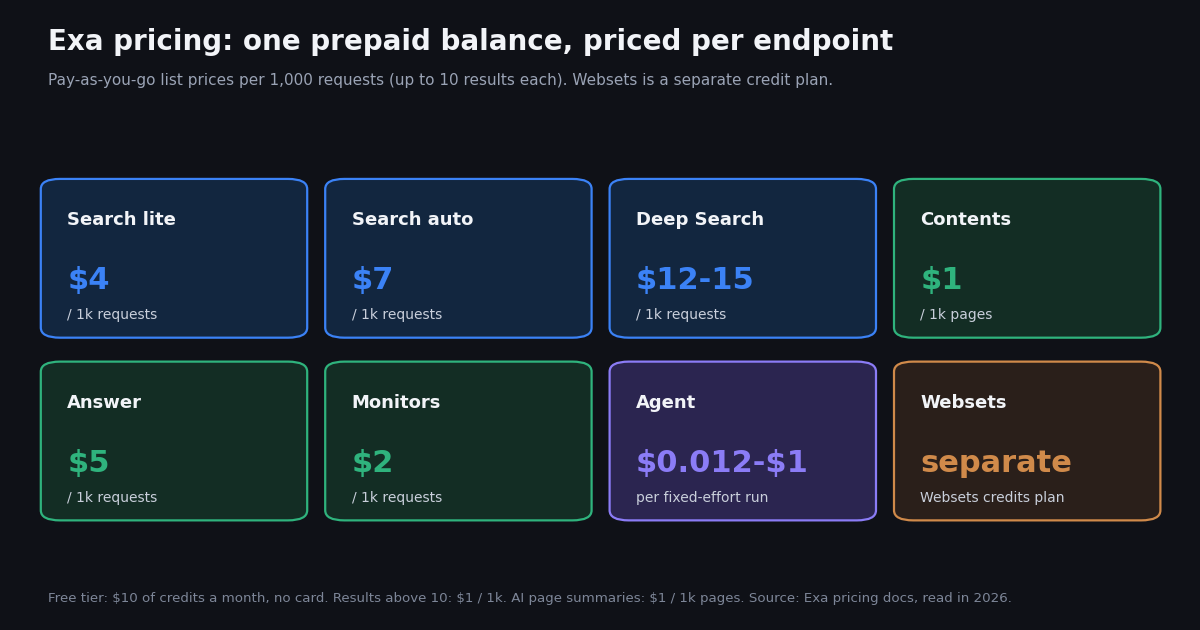
- No plans, only prepaid credits. Exa is pay-as-you-go with no subscription or minimum; requests draw down a dollar balance.
- Search:
lite$4 andauto$7 per 1,000 requests, up to 10 results included, then $1 per 1,000 extra results. Deep Search: $12 to $15 per 1,000. - Contents $1 per 1,000 pages per content type, Answer $5 per 1,000, Monitors $2 per 1,000, Agent $0.012 to $1.00 per fixed-effort run.
- Free tier: $10 of credits every month, reset on the first, no card; plus a one-time $10 bonus for completing onboarding. Rate limit 10 QPS.
- Websets is a separate credit plan; its per-credit rates are shown only on the Websets billing page, and the Free plan caps a webset at 25 verified results.
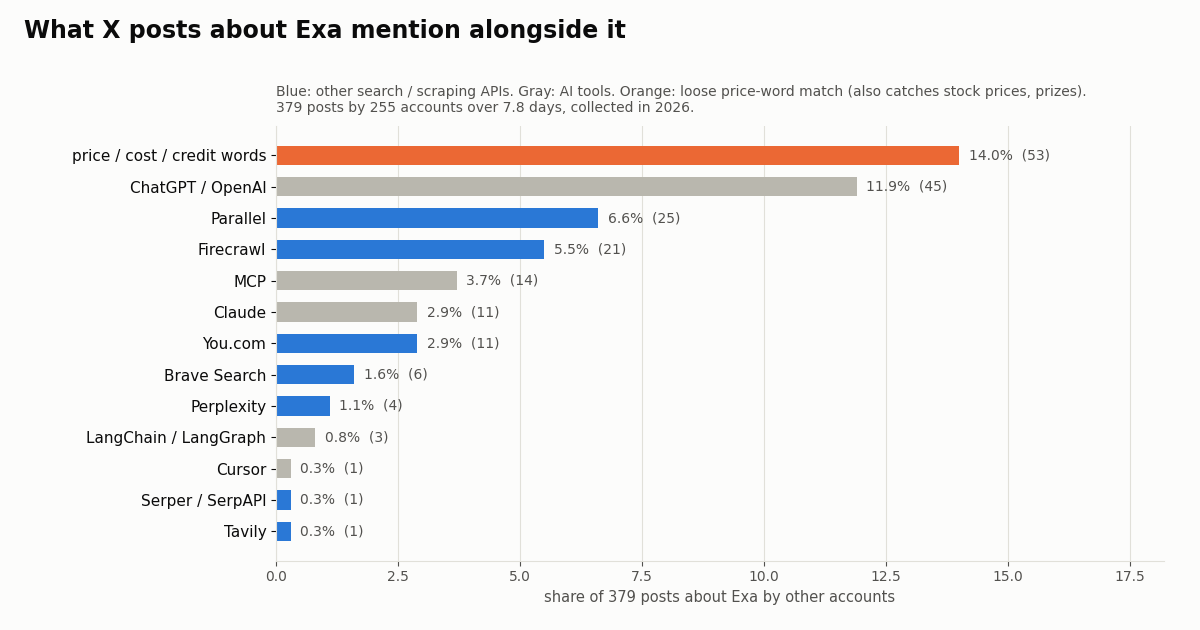
- X data is not in Exa's index categories any more. In our study of 379 X posts about Exa, 6.6% named Parallel and 5.5% Firecrawl; pulling the study's 600 posts (search plus Exa's timeline) cost $0.0902 on TwitterAPI.io versus $3.01 at X's own rate card.
Exa is a web search API built for AI agents and LLM applications: you send a query, it returns ranked pages with clean text or highlights that a model can read. Because almost every agent framework now ships an Exa tool or MCP connection, the practical question is what a given workload will cost, and Exa's billing has changed several times in recent releases (a simplified rate card on March 3, 2026, a new lite search type on October 19, 2026, metered Agent runs in between).
This page is the price reference: every Exa endpoint, the units each one bills (requests, results, pages, content types, compute units), the free tier, rate limits, Enterprise, Websets, and worked monthly examples, all read from Exa's own pricing and billing documentation this year. It does not try to pick between search APIs; a short list-price table puts Exa next to Tavily, Brave and Serper, and the rest stays on Exa. Because Exa's index no longer has a tweet category, the last sections measure how people discuss Exa on X and what live X data costs when your agent needs it.
$0.0902 vs $3.01
Exa's full rate card, endpoint by endpoint
Exa's pricing documentation (exa.ai/docs/reference/pricing) states the model in one line: pay-as-you-go, no subscription, no minimum spend, credits loaded in advance and charged per request. Each search-style endpoint has a base price per request that already covers up to 10 results; extra results and Exa-written page summaries are billed on top.
Per request, not per result. A $7 per 1,000 rate is $0.007 for one auto search, whether it returns 1 result or 10. The glossary in Exa's docs spells out the edge case: numResults: 20 costs the base price plus 10 additional results, so one such auto call is $0.007 + $0.010 = $0.017.
Legacy types keep their prices. instant, fast and deep-reasoning still work at the rates above, but Exa now recommends lite, auto and deep for new code. The October 19, 2026 changelog entry says lite runs the same search as fast at $4 instead of $7, serves page content only from Exa's cache (it never fetches a page live) and rejects unsupported parameters with a 400 that names them.
Every response carries a cost estimate. Search responses include a costDollars.total field. Exa's OpenAPI spec describes it as an estimated cost for the completed request, not an invoice record, which makes it a convenient budget meter inside an agent loop.
How Exa counts requests, results, pages and content types
Most Exa bills that surprise people come from the unit, not the rate. Exa's glossary defines five units, and each endpoint uses a different mix of them.
Request. One API call. Search, Answer, Monitors and Deep Search are priced per 1,000 requests.
Result. One search result in a response. The first 10 are included in the request price; results 11 and up cost $1 per 1,000. Asking for 100 results (the public maximum on numResults) adds 90 extra results to that one request, $0.09 on top of the base price.
Page and content type. /contents bills each URL once per view you ask for: text, highlights and summary are separate content types. One page fetched with text and highlights counts as two, so 1,000 URLs with both views cost $2, not $1.
AI page summary. A summary that Exa writes with an extra model call on its side, $1 per 1,000 pages on any endpoint that returns one. lite does not offer summaries.
Agent Compute Unit (ACU). The unit of model computation an Agent run uses, reported as usage.agentComputeUnits. Longer runs, larger input.data and more reasoning steps consume more ACUs, at $0.10 each.
The March 3, 2026 pricing update is why search looks simple today: Exa folded text and highlights for the first 10 results into the $7 auto price, so a typical RAG call that used to be a search plus a contents fetch is now a single request.
Free tier, rate limits and the Enterprise plan
Exa's billing documentation (exa.ai/docs/admin/billing) lists three ways to pay. The free grant is a monthly reset rather than a one-off trial, and it does not accumulate: unused free credits do not carry into the next month.
What $10 buys. Exa's own example is up to 2,500 lite searches. The same $10 covers about 1,428 auto searches, 2,000 Answer calls or 10,000 Contents pages in a single content type. The Free tier does not include Exa Snapshot.
Per-endpoint limits. /search, /answer and /chat/completions default to 10 QPS; Deep Search types to 5 QPS; /contents to 100 QPS; /agent/runs to 5 QPS with 50 active runs; /websets/* to 20 QPS. Over the limit returns 429 Too Many Requests; an empty balance or a key that hit its own budget returns 402 Payment Required.
25 QPS without a contract. Buying $1,000 of credits within any 30-day window lifts a pay-as-you-go team to 25 QPS for 90 days, automatically. The threshold counts credits purchased, not spent.
Enterprise. Team owners can buy the annual Enterprise plan from the dashboard: $12,000 paid upfront, which includes $12,000 of API credits, Zero Data Retention and 25 QPS for a 12-month term. Custom quotes add up to 1,000 results per search, custom indexes, SLAs, volume discounts and postpaid invoices.
Auto recharge. Recharge amounts run from $5 to $10,000 with an optional monthly maximum, so an unattended agent cannot drain an unlimited card.
Exa Agent and Deep Search: the two pricing modes
Deep Search is a type on the normal /search endpoint, billed per request like any search: deep-lite is $12 per 1,000 at about 4 seconds, deep is $12 per 1,000 at 4 to 15 seconds, and deep-reasoning is $15 per 1,000 at 12 to 40 seconds. Extra results and summaries cost the same as standard search.
Exa Agent (launched June 16, 2026) is an asynchronous research API for list building and enrichment, and it has two billing modes. A fixed effort gives a flat price per run:
Metered modes. auto (the default) and ultra bill actual usage: $0.10 per Agent Compute Unit, $0.005 per search tool call, $0.02 per email found and $0.07 per phone number found. auto stops at a default $5 per run and ultra (added September 24, 2026) at $20; budget.maxCostDollars changes the cap.
Exa Connect providers bill on top. Runs that pull partner data sources add each provider's charge, for example Fiber.ai at $0.02 per credit and Baselayer at $0.10 to $4.00 per order, per Exa's Connect pricing page.
Which to pick. If a task is one well-defined lookup, a fixed low or medium effort makes the bill predictable. Metered auto is the risky one for budgets because the cap, not the typical run, sets your worst case: 1,000 runs that each hit the $5 default cap is $5,000.
Exa Websets pricing: a separate credit plan
Websets builds verified, enriched lists of companies, people or pages from the web, and it does not draw on the API balance described above. Exa's Websets guide (exa.ai/docs/websets/quickstart) says Websets is billed in Websets credits, which are separate from Search API credits, and that verified results, enrichments, contact data, imports and API previews each consume them.
Rates are not on the public price list. The same guide points to the Websets billing page inside the Websets app for current rates, plan comparison and top-ups. When we loaded the public Websets pages this year, no plan prices rendered without signing in, so this page does not quote a Websets price rather than repeat an old one.
What is documented. The Websets API requires a paid Websets plan, the Free plan caps a single webset at 25 verified results, and count is a target rather than a guarantee: a webset stops when it finds that many items that pass every criterion or runs out of candidates. Requests for 1,000+ items scan a much larger candidate pool and take significantly longer.
Agent as the metered alternative. For list building through the API, Exa's docs point at Exa Agent, which is billed pay-as-you-go from the normal API account at the rates in the previous section.
Worked examples: what common Exa workloads cost each month
These examples apply Exa's list prices directly, before the $10 monthly free credit and before any Enterprise discount. They assume one content type unless stated.
Where Exa bills climb. Three settings move the total more than the base rate: raising numResults above 10, requesting several content types per page, and leaving Agent on metered auto. A team that keeps lite at 10 results and one content type pays close to the headline $4 per 1,000.
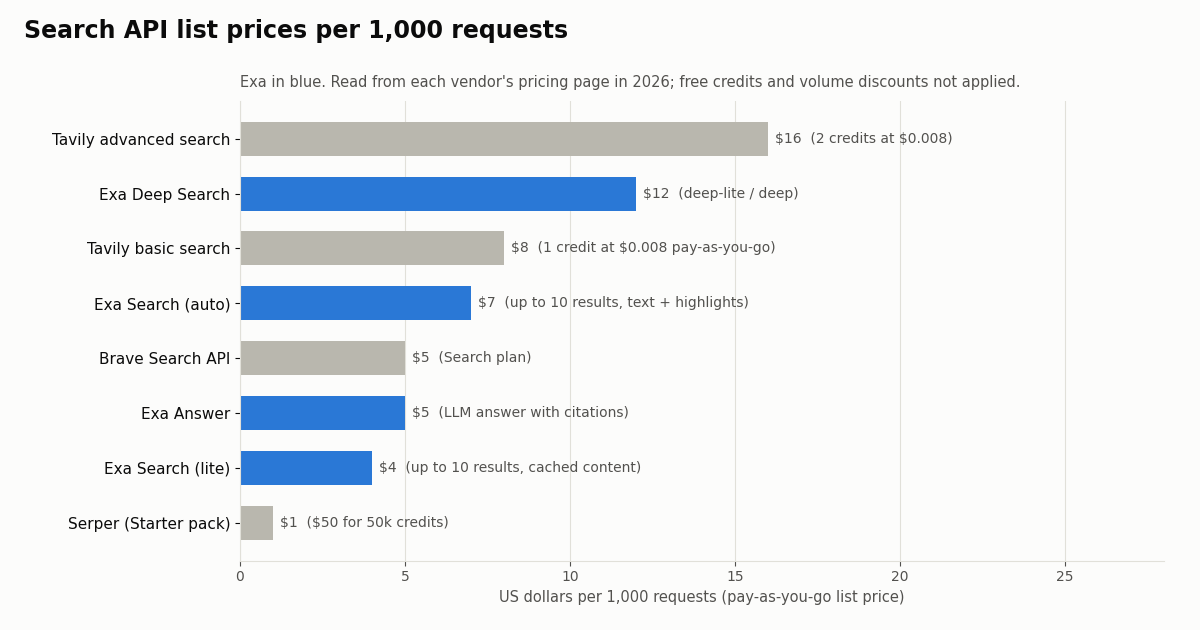
For a sense of scale against other search APIs that agents call, the chart below puts Exa's entry rates next to the pay-as-you-go list prices that Tavily, Brave and Serper show on their own pricing pages. The units differ: Exa and Brave bill per request, Tavily bills credits (1 per basic search, 2 per advanced), and Serper sells credit packs that are valid for 6 months.
Serper and Brave return a search engine results page; Exa and Tavily return page content an LLM can read directly, so the lowest bar on a chart is not always the lowest total once a pipeline adds a separate fetch step. Tavily's subscription tiers and features are covered in our Tavily API guide linked below.
Can Exa search X (Twitter) posts? What live X data costs instead
Not as a first-class category any more. Exa's July 23, 2026 changelog lists the pdf, github and tweet search categories as being deprecated, and the category enum in Exa's current OpenAPI spec contains only company, publication, news, personal site, financial report and people. Other strings are accepted only as hints. Exa's lite type also serves content from its cache and never fetches live, which is the opposite of what a feed of new posts needs.
So an agent that must answer "what are people saying on X about this launch right now" needs an X data source next to its web search tool. That is a different bill with a different unit: you pay per post returned, not per search.
At list prices that is about 33x per 1,000 tweets ($5 versus $0.15). The study below pulled 600 posts and one profile in 32 requests; at TwitterAPI.io's $0.15 per 1,000 tweets plus $0.18 per 1,000 profiles it cost $0.0902, and the same reads at X's $0.005 per post and $0.010 per user would be $3.01. On TwitterAPI.io a request that finds nothing is billed the 15-credit minimum ($0.00015), and a full 20-tweet page is $0.003.
A daily brand watch, priced. Posts mentioning Exa arrived at about 48.6 a day in our sample. Reading a month of them once a day is about 1,458 posts: $0.22 on TwitterAPI.io, $7.29 at X's post-read rate. Polling every 60 seconds instead costs at least $6.48 a month on TwitterAPI.io from empty checks alone (43,200 checks at $0.00015), so for a slow topic a daily or hourly sweep is the economical choice.
Wiring it into an agent. The hosted MCP server at https://mcp.twitterapi.io/mcp takes an Authorization: Bearer <your key> header and exposes X search, timelines and profiles as tools next to Exa's own MCP server (https://mcp.exa.ai/mcp), so Claude, Cursor or any MCP client can call both. Reads need no X account. Without MCP, the two REST calls in the example below do the same job. New TwitterAPI.io accounts that pass the automatic bot check get up to $1 of free credits (at most 100,000 credits, no card, one per person or network, expiring after 31 days); purchased credits never expire. The rate limit is 0.2 requests per second before the first payment and 20 once paid.
import os
import requests

EXA_KEY = os.environ["EXA_API_KEY"]
TW_KEY = os.environ["TWITTERAPI_IO_KEY"]
BASE = "https://api.twitterapi.io"

# 1) Web context from Exa: one lite search, up to 10 results, highlights only ($4 per 1,000 requests)
exa = requests.post(
    "https://api.exa.ai/search",
    headers={"x-api-key": EXA_KEY},
    json={"query": "Exa Agent pricing changes", "type": "lite", "numResults": 10,
          "contents": {"highlights": True}},
    timeout=30,
).json()
print("Exa estimated cost:", exa.get("costDollars", {}).get("total"))
for r in exa.get("results", []):
    print("WEB", r.get("title"), r.get("url"))

# 2) Live X posts from TwitterAPI.io: $0.15 per 1,000 tweets returned
r = requests.get(
    f"{BASE}/twitter/tweet/advanced_search",
    headers={"X-API-Key": TW_KEY},
    params={"query": "(exa.ai OR @ExaAILabs) -filter:retweets", "queryType": "Latest"},
    timeout=30,
).json()
for t in r.get("tweets", [])[:10]:
    print("X", t["createdAt"], t["likeCount"], t["text"][:100])
What X posts about Exa talk about: a measured sample
To see how builders actually discuss Exa, we read the most recent X posts that mention exa.ai, @ExaAILabs, "exa search", "exa api" or "exa mcp" (reposts excluded), plus the last 200 posts on Exa's own account. The search returned 379 posts from 255 other accounts over 7.8 days, about 48.6 a day.
Mostly conversation, little reach. 80.2% of the posts were replies, the median post had 1 like and 30 views, and 49.9% had no likes at all. Of the 255 accounts, 128 had fewer than 1,000 followers and 4 had more than 100,000.
Price comes up, but loosely. 14.0% of posts used a price, cost or credit word. That keyword match is generous (it also catches stock prices in finance demos and hackathon prizes), so read it as an upper bound on how often Exa's cost is the topic.
The comparison set is not Tavily. Exa was named next to Parallel in 6.6% of posts, Firecrawl in 5.5% and You.com in 2.9%, mostly in shared benchmark threads. Tavily appeared in 0.3% and Serper or SerpAPI in 0.3%. Altogether 11.1% of posts named another search or scraping API.
Exa's own account. @ExaAILabs had 66,567 followers when we collected. Its last 200 posts span 707 days, about 1.98 a week with a median gap of 2.04 days; 19.5% were reposts. Of 161 original posts, 29.2% used launch words (introducing, launch, new, now available) but only 17 (10.6%) used a price or cost word. Pricing changes land in the docs changelog, not on X, which is why this page reads the docs.
Reach of the official posts. Original posts had a median of 130 likes and 24,274 views; the top tenth passed 388,068 views.
How we collected this
Question. How do builders discuss Exa on X, how often does price come up, which other search APIs and AI tools are named alongside it, and how often does Exa's own account post about pricing.
Accounts and query. Exa's organization account @ExaAILabs (its last 200 posts via /twitter/user/last_tweets, replies excluded) and an /twitter/tweet/advanced_search query, (exa.ai OR @ExaAILabs OR "exa search" OR "exa api" OR "exa mcp") -filter:retweets, sorted Latest, read until the search had no more pages.
Window and sample. The most recent posts at collection time, collected in 2026: 200 official posts covering 707 days and 380 search results covering 7.8 days (1 from Exa itself, excluded from the shares). 32 requests, 600 posts billed (a few search posts repeated across pages and were counted once in the shares) and one profile in total, $0.0902 at TwitterAPI.io list prices.
What the sample cannot show. A week of Latest search is a snapshot, not a trend; keyword matching on post text misses images and links and over-counts loose words such as "price"; Latest search returns what X serves for that query, not every post ever written about Exa. The vendor prices on this page come from vendor documentation, not from the X sample.
Privacy. Aggregates only. The only account named is Exa's organization account; authors in the search sample are private individuals and are never named, quoted or profiled, and their raw pages were not kept in the repository.
import os
import time
import requests

# Daily X sweep for an agent tool: read every new post about a product since the last run.
# Billed $0.15 per 1,000 tweets returned on TwitterAPI.io; an empty page costs the 15-credit minimum.
BASE = "https://api.twitterapi.io"
HEADERS = {"X-API-Key": os.environ["TWITTERAPI_IO_KEY"]}


def sweep(query, since_unix, max_pages=20):
    q = f"{query} -filter:retweets since_time:{since_unix}"
    cursor, posts = "", []
    for _ in range(max_pages):
        params = {"query": q, "queryType": "Latest"}
        if cursor:
            params["cursor"] = cursor
        r = requests.get(f"{BASE}/twitter/tweet/advanced_search", headers=HEADERS, params=params, timeout=30)
        r.raise_for_status()
        body = r.json()
        posts.extend(body.get("tweets", []))
        if not body.get("has_next_page"):
            break
        cursor = body.get("next_cursor", "")
    return posts


if __name__ == "__main__":
    day_ago = int(time.time()) - 86400
    posts = sweep("(exa.ai OR @ExaAILabs OR \"exa api\")", day_ago)
    print(len(posts), "posts, about $%.4f" % (max(len(posts), 1) * 0.00015))
    for t in posts[:20]:
        a = t["author"]
        print(t["createdAt"], a["followers"], t["likeCount"], t["viewCount"], t["text"][:120].replace("\n", " "))
Researching this?Free starter credits cover end-to-end testing — Google sign-in, no card. Get a key.
Questions readers ask
Is Exa free?
Partly. Every Exa team gets $10 of free credits each month, reset on the first day of the month, with no payment method required, plus a one-time $10 bonus for completing dashboard onboarding. Exa says $10 covers up to 2,500 lite searches. Unused free credits do not roll over, and the Free tier does not include Exa Snapshot.
How much does one Exa search cost?
$0.004 on the lite type and $0.007 on auto (Exa's $4 and $7 per 1,000 requests), for up to 10 results. Each result above 10 adds $0.001, and an Exa-written page summary adds $0.001 per page. Deep Search costs $0.012 to $0.015 per request.
Does Exa have monthly plans?
No subscription tiers for the API: it is pay-as-you-go from prepaid credits with no minimum spend. The only fixed-price option is the annual Enterprise plan at $12,000 paid upfront, which includes $12,000 of API credits, Zero Data Retention and 25 QPS. Websets is a separate credit plan.
How is Exa Websets priced?
In Websets credits, which are separate from API credits. Verified results, enrichments, contact data, imports and API previews consume them. Exa shows current rates and plans only on the Websets billing page; the public pages we loaded did not render prices, so we do not quote one. The Free plan caps a webset at 25 verified results and the Websets API needs a paid Websets plan.
What happened to Exa's /research endpoint?
Exa retired it in its April 1, 2026 deprecation notice and replaced it with /search using type: "deep-reasoning" ($15 per 1,000 requests). For long research and list building, Exa now points to Exa Agent, priced from $0.012 per fixed-effort run.
What are Exa's rate limits?
10 queries per second by default for /search and /answer, 5 QPS for Deep Search, 100 QPS for /contents, 5 QPS and 50 active runs for Agent, and 20 QPS for Websets. Buying $1,000 of credits within 30 days raises a pay-as-you-go team to 25 QPS for 90 days.
Can I use Exa to get tweets?
Not reliably. Exa's July 23, 2026 changelog lists the tweet category as deprecated, and its current spec no longer offers it. For live X posts, an X data API is the direct route: TwitterAPI.io charges $0.15 per 1,000 tweets returned, while the official X API pay-per-usage rate card charges $0.005 per post read ($5 per 1,000).
Is Exa cheaper than Tavily?
At list prices per basic search, yes: Exa lite is $4 per 1,000 requests and auto $7, while Tavily's pay-as-you-go rate is $0.008 per credit, so a basic search (1 credit) is $8 per 1,000 and an advanced search (2 credits) $16. Tavily's monthly plans lower the per-credit price, so compare at your own volume.
Continue
- Exa docs: Pricing (rate card, Agent, Deep Search, Enterprise)
- Exa docs: Billing and rate limits
- Exa docs: Changelog (pricing update, lite, deprecated categories)
- Exa docs: Websets plans and credits
- X developer docs: X API pay-per-usage pricing
- TwitterAPI.io documentation: endpoints and MCP server
- X (Twitter) API hub: endpoints, pricing and guides
- Tavily API guide: plans, credits and search depth
- Perplexity API pricing and models for builders
- Firecrawl alternatives for agent web scraping
- What an MCP server is, with a hosted X example
- How to build an AI agent with web and X data tools
- TwitterAPI.io pricing: $0.15 per 1,000 tweets returned
- 01Pipedream Pricing in 2026: Connect Plans, Credits and the Workflows Shutdown
- 02Cloudflare Pay per Crawl: How the HTTP 402 Handshake Works, and What It Means for Twitter (X) Data
- 03ScrapingBee Pricing in 2026: Plans, Credit Costs and Alternatives
- 04Firecrawl Pricing: Plans, Credit Costs and What an X (Twitter) URL Costs
- 05LunarCrush API: What It Returns, What It Costs, and When Raw Twitter (X) Data Is the Better Input
- 06Composio Pricing in 2026: Plans, Tool Calls and the Twitter (X) Data Bill
- 07Qwen API Pricing in 2026: Every Tier, Kimi, GLM and MiniMax Compared
- 08Claude API Pricing in 2026: Per-Token Rates and What 1,000 Tweets Really Cost
Writing about something you built with TwitterAPI.io? Our community rewards program pays API credits for honest tutorials, build logs and videos.
Stop reading. Start building.
Starter credits cover real testing on real data. Google sign-in, no card, no application queue.
Get an API keyAlready building with TwitterAPI.io? Publish an honest tutorial or build log about it and earn up to $200 a month in API credits.