Pipedream Pricing in 2026: Connect Plans, Credits and the Workflows Shutdown
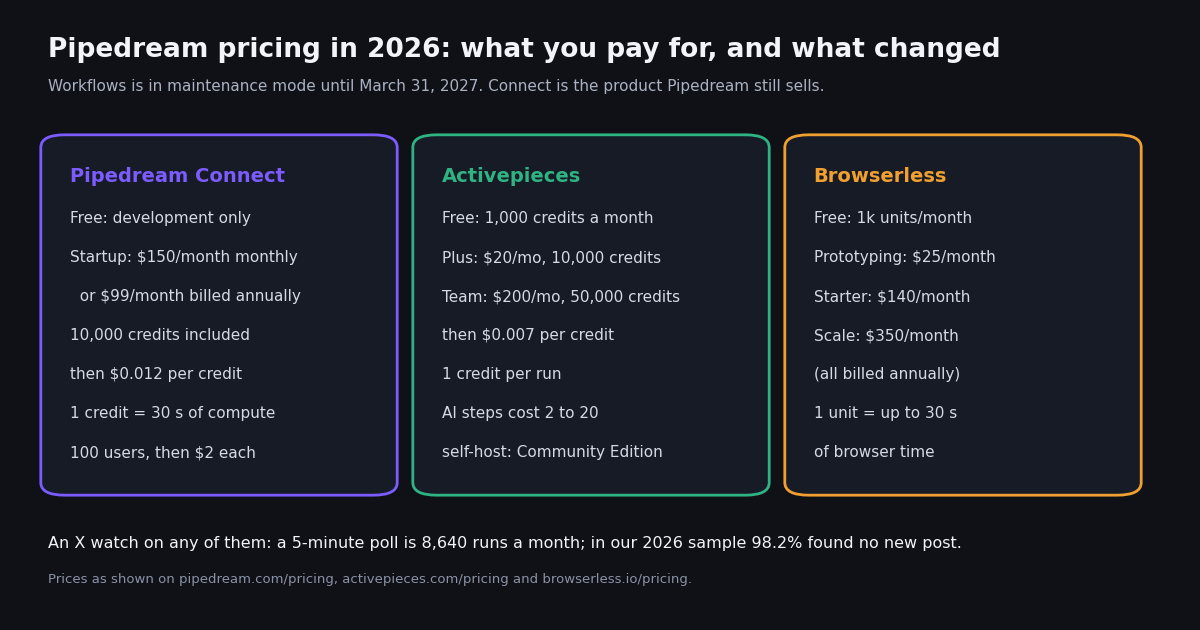
- Startup costs $150/month billed monthly or $99/month billed annually and includes 10,000 usage credits and 100 external users; extra credits are $0.012 each and extra users $2 per month (pipedream.com/pricing).
- A credit is 30 seconds of compute per action run, MCP tool call, Connect proxy request or trigger emit. Management calls (listing apps, accounts, configuring components) use no credits.
- Workflows is closing: Pipedream Workflows and String shut down on March 31, 2027; no new signups or subscriptions, data deleted by April 30, 2027. Connect is not affected.
- Our X study: for five automation-vendor accounts posting 5.5 times a day combined, 98.2% of 5-minute polls found nothing, yet a 5-minute poll is 8,640 runs a month on any per-run plan.
- Trigger design beats plan choice: the same watch is 43,200 runs as five separate 5-minute polls, 8,640 as one combined search, and about 165 runs if the platform only runs when a post arrives.
- The X data itself is the small line: 165 posts a month cost $0.025 at $0.15 per 1,000 tweets on TwitterAPI.io, versus $0.83 at the official X API's $0.005 per post read (about 33x).
Several third-party pages that rank for "pipedream pricing" still list the old Workflows tiers. Pipedream's own pricing page no longer does: it now prices Pipedream Connect, the API and SDK that lets your app or AI agent act in 3,000+ third-party apps, and its docs announce that Workflows shuts down on March 31, 2027. This page gives the current plans exactly as Pipedream shows them, explains what a credit buys, and then does the arithmetic for one concrete job: a workflow that watches X (Twitter) accounts and reacts to new posts.
It is a pricing page, not a platform comparison. For the per-tool detail on the platforms Workflows users are moving to, see our pages on Zapier, n8n and Make pricing and the n8n vs Zapier comparison (linked below); here Activepieces and Browserless get one compact section each because they are the two names searched alongside Pipedream, and every X number comes from a small study we ran on public timelines collected in 2026.
98.2% for five automation-vendor accounts posting 5.5 times a day combined (collected in 2026). On a per-run plan that is 8,640 runs a month to catch about 165 posts.
Pipedream pricing at a glance: Free, Startup and Business
Pipedream's pricing page (pipedream.com/pricing) lists three plans. The headline is "Free to build. Pay when your integrations go to production." Everything below is copied from that page; billing periods are written the way Pipedream writes them.
What every plan includes. Managed auth for 3,000+ APIs, 10,000+ prebuilt tools and triggers, MCP servers, the Connect proxy, custom OAuth clients and unlimited team members. You do not pay per seat on Pipedream; you pay per external user (an end user of your app who connects at least one account) and per credit.
The annual discount. $99 against $150 is a 34% saving for committing to a year. Pipedream's FAQ says cancelling or downgrading is self-serve from the workspace billing settings, and the screen shows whether the change applies now or at the end of the billing period.
What is not on the page. There is no public price for the Business plan and no published volume curve beyond "the rate drops at higher volume". There are also no Workflows plans any more; the section on the shutdown below explains why.
What a Pipedream credit is, and what uses one
Pipedream bills usage in credits. For Connect, the docs (pipedream.com/docs/pricing) and the pricing FAQ give the same rule: running an action, calling a tool through MCP, sending a request through the Connect proxy, and emitting an event from a deployed trigger each use 1 credit per 30 seconds of compute. Listing apps, actions, triggers and accounts, configuring components and other management calls use no credits.
The 30-second block matters more than the step count. A call that finishes in 2 seconds still uses one credit; a call that runs 35 seconds uses two. Short, frequent calls are therefore the expensive pattern per unit of work, which is exactly what a scheduled poll is.
Workflows used the same unit with memory on top. For the legacy Workflows product the docs say one credit is 30 seconds of compute at 256 MB per workflow segment, that memory scales the cost in 256 MB steps (512 MB doubles it, 1 GB quadruples it), that test runs in the builder are free, and that sources from the public registry run free when they trigger a workflow. A linear workflow that runs 15 seconds is 1 credit at 256 MB and 4 credits at 1 GB.
How overage is billed. The platform fee is charged at the start of each billing period and grants the included credits. Credits beyond that are "additional credits" and are added to the next invoice. On Startup that is $0.012 each, so 10,000 extra credits add $120.
The Workflows shutdown: what it means for pricing
Pipedream's docs carry a notice titled "Workflows and String Are Shutting Down on March 31, 2027" (pipedream.com/docs/workflows). The key lines, paraphrased closely: Workflows is in maintenance mode; existing workflows keep running through March 31, 2027; Pipedream is no longer accepting signups or subscriptions for Workflows and will not ship new Workflows features; all Workflows data, including credentials and OAuth tokens of connected accounts, is permanently deleted by April 30, 2027.
Billing. Subscriptions stay active until March 31, 2027, when Pipedream cancels them automatically and issues a prorated refund. Monthly subscribers can cancel earlier in their account settings; annual subscribers can ask support for an early cancellation with a prorated refund.
Export. Pipedream built an export tool that downloads the structure of your workflows as JSON, one project at a time. It exports structure, not the hosted runtime, so plan to rebuild triggers, schedules and credentials on the new platform.
Why this happened. The notice says the company is focusing on being "the integration layer companies rely on to connect AI to the outside world" and that Workflows falls outside that focus. The change follows Workday's announcement on November 19, 2025 that it had signed a definitive agreement to acquire Pipedream (Workday newsroom).
What to do if you are pricing Pipedream today. If you need an embeddable integration layer for your own product or agent, Connect is the product and the table above is its price. If you need a place to run scheduled or event-driven automations, Pipedream is not an option for new work: price Activepieces (below), n8n, Zapier or Make instead, and plan the migration before the March 31, 2027 cut-off.
Activepieces pricing: the open-source route
Activepieces is an open-source automation platform (an open-source Community Edition you can self-host) with a hosted cloud. Its pricing page (activepieces.com/pricing) lists four self-serve or sales-led plans; annual billing is offered with "Save 2 months".
The unit. Per the Activepieces FAQ, a run is one credit however many steps it has. AI steps cost more because Activepieces pays the model provider: 2 credits on a fast model, 10 on a smart model, 20 on a frontier model, 1 per agentic action. On Plus and up you can bring your own AI keys, which drops every AI step to 1 credit.
Limits. Free and Plus allow up to 5 users; Team includes 25 users, unlimited projects, SSO and email support; Ultimate adds dedicated workers, execution priority, SCIM, Git sync and audit logs. Embedding the builder in your own product starts at $36k a year. One inconsistency worth noting: the comparison table lists the Free plan's credit reset as daily while the FAQ describes a fresh 1,000 credits every month, so check your workspace's usage screen.
Pipedream vs Activepieces in one line. Pipedream bills compute time (30-second blocks) and sells production Connect from $99/month billed annually; Activepieces bills runs (any number of steps) from $20/month with a cheaper overage ($0.007 vs $0.012 per credit) and a self-host option.
Browserless pricing: when the job needs a real browser
Browserless (browserless.io) sells hosted headless Chrome, Firefox and WebKit for Puppeteer and Playwright scripts, so it is searched together with Pipedream by people whose workflow needs to load a web page rather than call an API. Its pricing page (browserless.io/pricing) bills in units: one unit is a block of up to 30 seconds of browser time per browser connection, and every reconnect starts a new unit.
Extras that add units. Residential proxy traffic costs 6 units per MB, datacenter proxy traffic 2 units per MB, and each successful captcha solve 10 units. Concurrency runs from 2 browsers on Free to 100 on Scale; Enterprise is custom and includes self-hosting licenses. The static page we fetched shows the annual prices only.
For X data specifically, an API is the simpler unit. If every X profile page is its own browser connection, 1,000 profiles is at least 1,000 units: $2.00 at the Prototyping overage rate before any proxy bandwidth, plus the page parser you maintain when the markup changes. The same 1,000 profiles from /twitter/user/info on TwitterAPI.io cost $0.18 (18 credits per user), returned as JSON fields such as followers, statusesCount and createdAt, with no X account needed. Our comparison of web scraping and APIs covers the trade-off in general.
Pricing an X (Twitter) workflow: runs, credits, the data bill, and the fix
A common reason to price an automation platform is a social workflow: watch some X accounts or keywords, then post to Slack, write to a sheet, or hand the post to an AI step. Two bills apply. The platform bill counts runs (Activepieces credits, Pipedream credits, n8n executions, Zapier tasks). The X data bill counts posts returned. The study below measured how often such a watch actually finds something.
We followed five active automation and browser-infrastructure vendor accounts (@zapier, @n8n_io, @make_hq, @triggerdotdev, @browserless) and replayed their real posting times. Together they posted 154 times in 28 days, 5.5 a day. Watched with one combined search, 98.2% of 5-minute checks and 99.6% of 60-second checks would have found no new post.
The run counts assume one credit per run, the default on both platforms for a short run (Pipedream bills 30-second blocks; Activepieces bills a run as one credit without AI steps).
The X data bill is the small line. 165 posts a month from these five accounts cost $0.025 at TwitterAPI.io's $0.15 per 1,000 tweets returned, and $0.83 at the official X API pay-per-use rate card's $0.005 per post read (docs.x.com/x-api/getting-started/pricing), about 33x more per 1,000 posts. On TwitterAPI.io an empty check is billed the 15-credit minimum ($0.00015), so the polling floor is $1.30 a month at 5 minutes and $6.48 at 60 seconds; you pay only for the data returned above that floor.
The design choice is worth more than the plan choice. Moving from five per-account polls to one combined from:a OR from:b search cuts the runs five-fold. Moving the polling out of the platform, so the platform runs only when a post exists, cuts them by another factor of about fifty. The code below does exactly that.
The pattern: a small script (cron, a tiny VM, a serverless function on a schedule) runs one combined /twitter/tweet/advanced_search query with a since_time: cursor, keeps a list of post IDs it has already forwarded, and POSTs each new post to your platform's webhook trigger. The platform's run count then equals the number of new posts, not the number of checks. It works the same with any platform that starts a run from an incoming webhook, such as Activepieces, n8n, Zapier or Make.
What it costs on the X side. Each pass is one search call. An empty pass costs the 15-credit minimum ($0.00015); each post returned costs $0.00015. That is the $1.30 monthly floor at a 5-minute interval, plus $0.15 per 1,000 posts.
When you would rather not run a scheduler. TwitterAPI.io can also push: register a filter rule with /oapi/tweet_filter/add_rule using the same from: syntax, activate it with /oapi/tweet_filter/update_rule, and point your account's webhook URL straight at the platform's webhook trigger. Filter-rule billing is listed on the pricing page linked below.
If the workflow writes back to X. Write actions (post, reply, like, follow) run through an authenticated session: one /twitter/user_login_v2 login ($0.10, with a proxy you supply) returns login_cookies, then each action such as /twitter/create_tweet_v2 is 60 credits ($0.0006), billed per HTTP 200 call. The call acts as that account, so X can rate-limit, lock or suspend it: keep to your own account and a normal human pace, expect the session to need a fresh login now and then, and treat X's automation rules as the limit, not something to work around.
# Combined query sent each pass (five accounts, posts newer than the last pass):
# (from:zapier OR from:n8n_io OR from:make_hq OR from:triggerdotdev OR from:browserless) since_time:1767225600
# GET https://api.twitterapi.io/twitter/tweet/advanced_search?query=...&queryType=Latest
# Header: X-API-Key: <your key>
# Response: {"tweets": [...], "has_next_page": false, "next_cursor": ""}
# An empty list costs the $0.00015 minimum; each returned post costs $0.00015.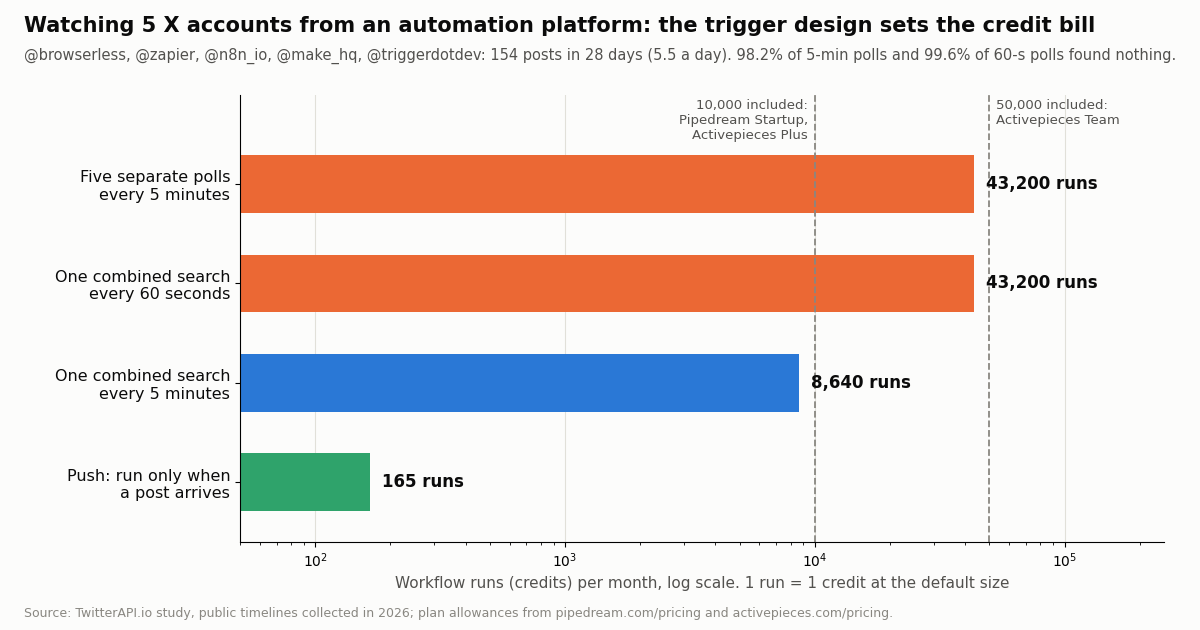
A keyword watch for "pipedream" on X is mostly noise
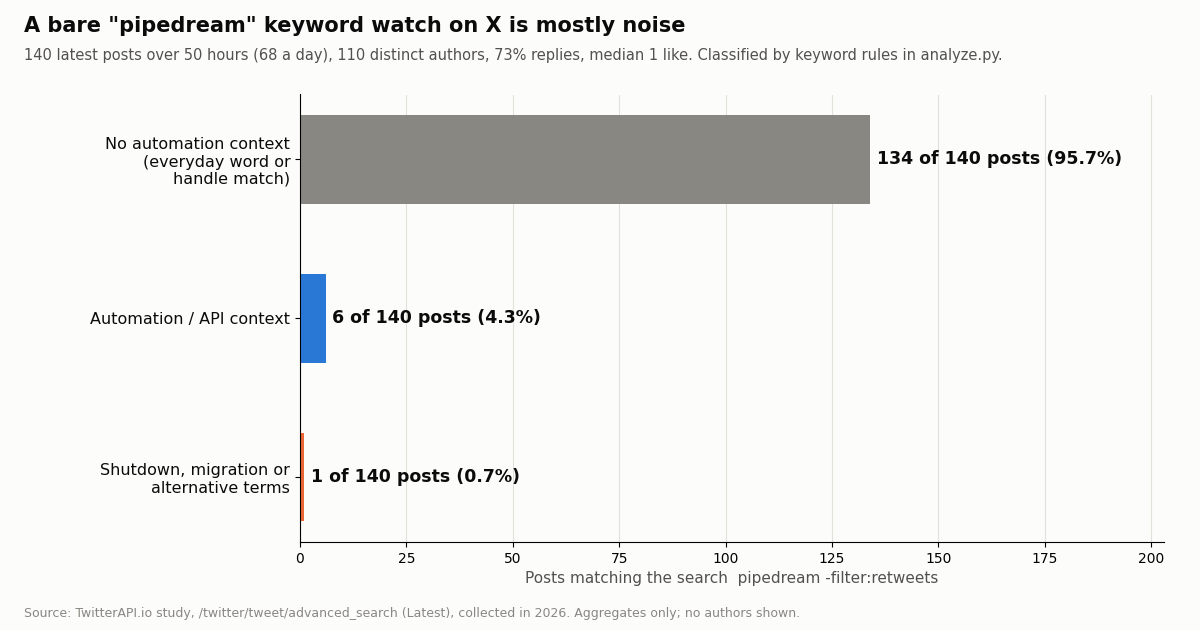
Many buyers want to follow what developers say about a tool, for example the reaction to the Workflows shutdown. We pulled the latest 140 posts matching pipedream -filter:retweets (50 hours, about 68 posts a day, 110 distinct authors, 73% of them replies, median 1 like). Only 6 of 140 (4.3%) had any automation or API context, and 1 (0.7%) mentioned a shutdown, migration or alternative. The rest used "pipedream" as an everyday word or matched a handle.
What this means for a monitoring workflow. A bare product name is a poor filter when the name is also a common word. Every irrelevant post is a run on a per-run platform and a returned post on the data bill. Narrow the query before it reaches the platform: pipedream (workflow OR workflows OR connect OR api OR mcp) lang:en -filter:replies, or watch the vendor's handle with to: and from: operators.
A footnote on Pipedream's own X account. In the timeline we pulled, @pipedream's latest post was 343 days old at collection time (its last post dates from 2025), so following the official account is not how you will hear about pricing or shutdown changes; the docs and the billing email are.
How we collected this
Question. How often would an X watch built on an automation platform find a new post, how many platform runs would it use under different trigger designs, and what does a keyword search for the vendor's name actually return?
Accounts and query. Timelines of eight organization accounts: @pipedream, @activepieces, @browserless, @zapier, @n8n_io, @make_hq, @triggerdotdev and @windmill_dev, up to 100 recent posts each via /twitter/user/last_tweets. Five posted in the 180 days before collection and form the combined feed; @pipedream and @activepieces had not posted in that window, and @windmill_dev returned no posts. Search: pipedream -filter:retweets, queryType=Latest, via /twitter/tweet/advanced_search.
Window and size. Collected in 2026. 726 posts in 42 requests; the X data for the whole study cost about $0.11. The combined-feed metrics use the last 28 days before collection, about the span covered by @zapier's 85 most recent posts.
Method. Polling windows were replayed on the real post timestamps: a window is empty when no watched account posted inside it. Run counts assume one platform credit per run; prices are the ones shown on each vendor's pricing page when we fetched it. Search posts were labeled with simple keyword rules (published in the study's analyze.py), not by hand.
What the sample cannot show. Five vendor accounts are low-volume posters; a watch on news or high-volume accounts finds new posts far more often and the run gap narrows. Two days of search results are a snapshot, not a trend. Runs that take longer than 30 seconds, use more memory, or call AI models cost more credits than assumed here.
Privacy. Aggregates only. Timelines are from organization accounts; search results, mostly from private individuals, were never stored with IDs, URLs, text or handles.
Which option to pick
You are adding integrations to your own app or AI agent. Pipedream Connect is what Pipedream sells. Build free in development; production starts at $99/month billed annually ($150/month billed monthly) with 10,000 credits and 100 external users.
You run automations on Pipedream Workflows today. Export your workflows, pick a destination, and move before March 31, 2027. Price by run count, not by plan headline: Activepieces bills a run as one credit, n8n bills executions, Zapier bills tasks, Make bills operations.
You need X (Twitter) data inside any of these. Keep the polling outside the platform or use a push rule, send only new posts, and filter noisy keywords before they cost a run. The X data at $0.15 per 1,000 tweets is usually the smallest line on the bill; new accounts get up to $1 of free credits (at most 100,000 credits, no card, one per person or network, expiring after 31 days) after the automatic bot check, enough to run this study several times over.
You need to load web pages, not call APIs. Browserless prices browser time in 30-second units from $25/month billed annually; for X profiles and posts, the JSON API is the smaller unit.
"""x_watch_to_workflow.py - watch X (Twitter) accounts and call an automation-platform
webhook (Pipedream Connect, Activepieces, n8n, Zapier, Make...) ONLY when a new post exists.

The polling runs here, outside the platform, so the platform runs (and spends credits)
once per new post instead of once per check.

    pip install requests
    export TWITTERAPI_IO_API_KEY=...          # from the twitterapi.io dashboard
    export WORKFLOW_WEBHOOK_URL=https://...   # your platform's webhook / HTTP trigger URL
    python x_watch_to_workflow.py             # one pass: run from cron every 5 minutes
    python x_watch_to_workflow.py --loop 300  # or keep it running

X data cost: one advanced_search call per pass. A pass that finds nothing costs the
$0.00015 minimum (15 credits); every post returned costs $0.00015 ($0.15 per 1,000 tweets).
Every 5 minutes for a month is 8,640 passes, a $1.30 floor before the posts themselves.
"""
import argparse
import json
import os
import time

import requests

API = "https://api.twitterapi.io"
X_KEY = os.environ["TWITTERAPI_IO_API_KEY"]
HOOK = os.environ["WORKFLOW_WEBHOOK_URL"]
WATCH = ["zapier", "n8n_io", "make_hq", "triggerdotdev", "browserless"]
STATE_FILE = "x-watch-state.json"
OVERLAP = 120      # seconds re-read each pass; the seen-ids list removes duplicates
MAX_PAGES = 5      # safety cap per pass (a full page is up to 20 posts = $0.003)


def load_state():
    if os.path.exists(STATE_FILE):
        with open(STATE_FILE) as f:
            return json.load(f)
    return {"since_time": int(time.time()) - 3600, "seen": []}


def save_state(state):
    state["seen"] = state["seen"][-2000:]
    with open(STATE_FILE, "w") as f:
        json.dump(state, f)


def fetch_new(since_time):
    """One combined query for all accounts; an idle pass returns an empty list."""
    query = "(" + " OR ".join(f"from:{h}" for h in WATCH) + f") since_time:{since_time}"
    tweets, cursor = [], None
    for _ in range(MAX_PAGES):
        params = {"query": query, "queryType": "Latest"}
        if cursor:
            params["cursor"] = cursor
        r = requests.get(f"{API}/twitter/tweet/advanced_search",
                         headers={"X-API-Key": X_KEY}, params=params, timeout=30)
        r.raise_for_status()
        body = r.json()
        tweets.extend(body.get("tweets", []))
        if not body.get("has_next_page") or not body.get("next_cursor"):
            break
        cursor = body["next_cursor"]
    return tweets


def to_payload(t):
    a = t.get("author") or {}
    return {
        "id": t["id"],
        "url": t.get("url"),
        "text": t.get("text", ""),
        "created_at": t.get("createdAt"),
        "author": a.get("userName"),
        "author_followers": a.get("followers"),
        "likes": t.get("likeCount", 0),
        "reposts": t.get("retweetCount", 0),
        "views": t.get("viewCount"),
        "is_reply": t.get("isReply", False),
    }


def one_pass():
    state = load_state()
    started = int(time.time())
    new = [t for t in fetch_new(state["since_time"] - OVERLAP) if t["id"] not in state["seen"]]
    new.sort(key=lambda t: t["id"])
    for t in new:
        # One platform run per new post. Batch them into one POST if your plan bills per run.
        requests.post(HOOK, json=to_payload(t), timeout=30).raise_for_status()
        state["seen"].append(t["id"])
    state["since_time"] = started
    save_state(state)
    print(f"{len(new)} new post(s) forwarded")


if __name__ == "__main__":
    ap = argparse.ArgumentParser()
    ap.add_argument("--loop", type=int, default=0, help="seconds between passes (0 = run once)")
    args = ap.parse_args()
    while True:
        one_pass()
        if not args.loop:
            break
        time.sleep(args.loop)
Researching this?Free starter credits cover end-to-end testing — Google sign-in, no card. Get a key.
Questions readers ask
How much does Pipedream cost?
Free is $0 for development. Startup is $150/month billed monthly or $99/month billed annually, with 10,000 usage credits and 100 external users included; extra credits are $0.012 each and extra users $2 per month. Business is custom and billed annually.
What is a Pipedream credit?
One credit covers up to 30 seconds of compute for an action run, an MCP tool call, a Connect proxy request or an event emitted by a deployed trigger. A 35-second run uses two credits. Listing apps and accounts and configuring components use none.
Is Pipedream shutting down?
Pipedream Workflows and String shut down on March 31, 2027, and Workflows data is deleted by April 30, 2027. Pipedream Connect, the MCP servers and the API proxy are not affected and remain supported.
Can I still sign up for a Pipedream Workflows plan?
No. Pipedream's notice says Workflows is in maintenance mode and no longer accepts signups or subscriptions. Existing subscriptions run until March 31, 2027 and are then cancelled with a prorated refund.
Does Pipedream have a free plan?
Yes. The Free plan costs $0 with no credit card and includes every feature in development, 3,000+ connectors and unlimited team members. Production use and real external users need Startup or Business.
How does Activepieces pricing compare with Pipedream?
Activepieces has Free (1,000 credits), Plus at $20/month (10,000 credits), Team at $200 monthly (50,000 credits) and custom Ultimate, with $0.007 per extra credit. A run is one credit regardless of step count. Pipedream bills 30-second compute blocks at $0.012 per extra credit.
How much does Browserless cost?
Browserless lists Free (1,000 units a month), Prototyping $25/month, Starter $140/month and Scale $350/month, all billed annually, with overage from $0.0020 to $0.0015 per unit. A unit is up to 30 seconds of browser time per connection.
How do I keep an X monitoring workflow from using up my credits?
Combine accounts into one search with from: operators, poll outside the platform and call its webhook only when a new post exists, or use a push rule. In our study that cut a five-account watch from 43,200 runs a month to about 165.
Continue
- Pipedream pricing page: Free, Startup and Business plans, usage credits, external users
- Pipedream docs: Plans and Pricing (credit rules for Connect and Workflows, memory scaling, billing periods)
- Pipedream docs: Workflows and String are shutting down on March 31, 2027
- Activepieces pricing: Free, Plus, Team, Ultimate, credit rules and overage
- X API pricing (official pay-per-usage rate card): $0.005 per post read
- TwitterAPI.io docs: advanced search endpoint used in the study and the code
- X (Twitter) API overview and endpoints
- Zapier pricing: plans and task costs
- n8n pricing: cloud vs self-hosted costs
- Make.com pricing and operations
- n8n vs Zapier compared
- n8n workflow for X (Twitter) data
- Web scraping vs an API for X data
- TwitterAPI.io pricing per 1,000 tweets
- 01Cloudflare Pay per Crawl: How the HTTP 402 Handshake Works, and What It Means for Twitter (X) Data
- 02ScrapingBee Pricing in 2026: Plans, Credit Costs and Alternatives
- 03Firecrawl Pricing: Plans, Credit Costs and What an X (Twitter) URL Costs
- 04LunarCrush API: What It Returns, What It Costs, and When Raw Twitter (X) Data Is the Better Input
- 05SerpApi Pricing: Every Plan, the Real Cost per Search, and the Alternatives
- 06Apify Pricing in 2026: Plans, Compute Units and What Twitter (X) Data Really Costs
- 07RapidAPI Pricing in 2026: How Plans, Overages and the 25% Fee Work, and What Twitter (X) APIs Cost There
- 08Lovable pricing in 2026: plans, credits, and what an app that pulls Twitter (X) data really costs
Writing about something you built with TwitterAPI.io? Our community rewards program pays API credits for honest tutorials, build logs and videos.
Stop reading. Start building.
Starter credits cover real testing on real data. Google sign-in, no card, no application queue.
Get an API keyAlready building with TwitterAPI.io? Publish an honest tutorial or build log about it and earn up to $200 a month in API credits.