NoSQL vs SQL: Performance with Twitter Data
NoSQL vs SQL: Performance with Twitter Data
Which database is better for Twitter data? It depends on your use case. NoSQL databases like MongoDB and Cassandra excel at handling large-scale, semi-structured, and real-time tweet data thanks to their horizontal scaling and schema flexibility. SQL databases like PostgreSQL perform better for tasks requiring structured data, complex relationships, and ACID compliance, such as user management or analytics.
Key Takeaways:
- NoSQL Advantages: Faster at ingesting tweets, better for real-time operations, handles semi-structured JSON data without schema changes.
- SQL Advantages: Strong at relational tasks like joins, consistent data integrity, and predefined schemas for structured data.
- Performance Benchmarks: NoSQL databases (e.g., Cassandra) can handle up to 106,000 operations per second, while SQL databases (e.g., PostgreSQL) max out at around 32,000.
Quick Comparison:
| Use Case | Best Database Type | Why? |
|---|---|---|
| High-speed tweet ingestion | NoSQL (Cassandra) | Handles large-scale, write-heavy data |
| User account management | SQL (PostgreSQL) | Ensures data consistency (ACID) |
| Real-time caching | NoSQL (Redis) | Processes 100,000+ ops/sec in memory |
| Complex joins/relationships | SQL (PostgreSQL) | Optimized for relational queries |
| Unstructured tweet storage | NoSQL (MongoDB) | Handles JSON-like documents easily |
For large-scale Twitter data, consider a hybrid approach. For example, use PostgreSQL for structured user data and Cassandra for tweet ingestion. Tools like TwitterAPI.io integrate seamlessly with both database types, delivering high-speed JSON data for $0.15 per 1,000 tweets.
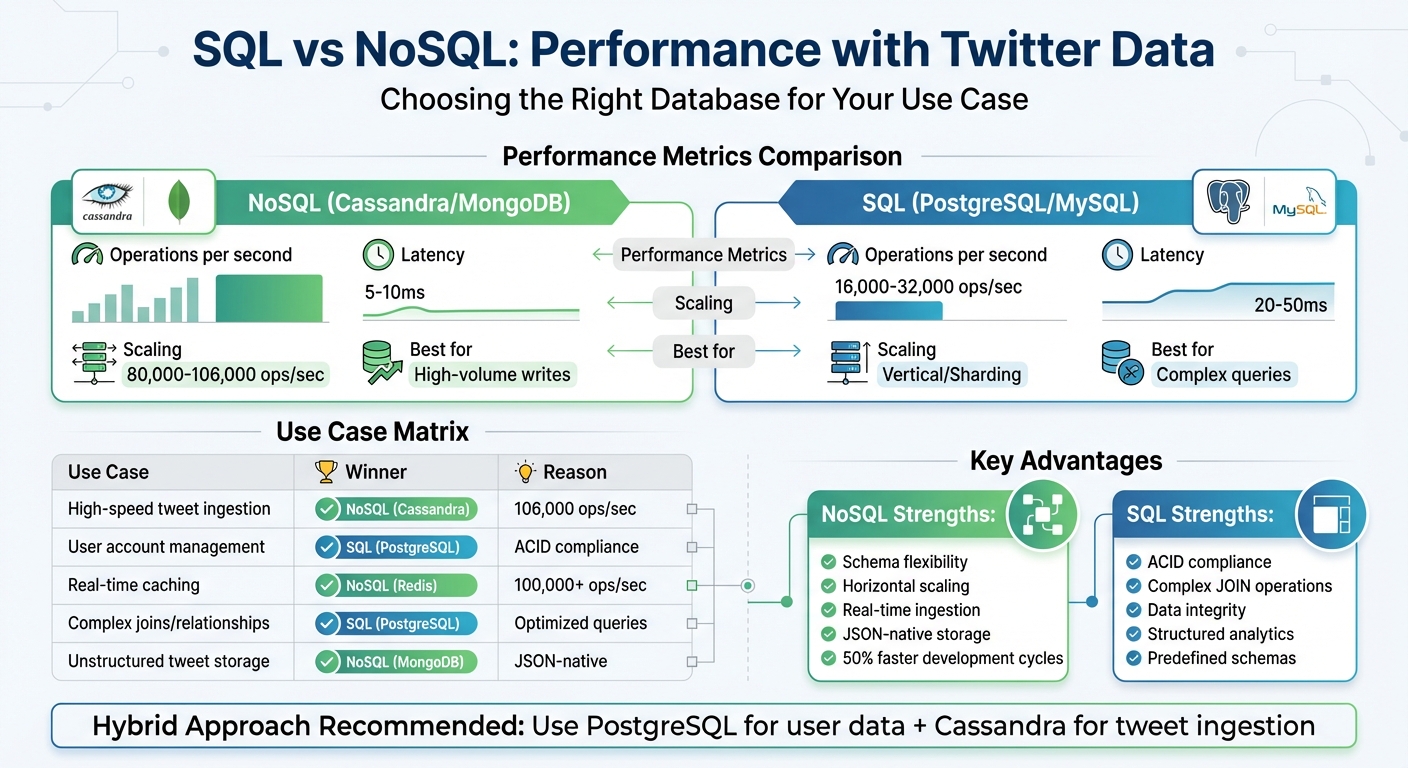
SQL vs NoSQL Database Performance Comparison for Twitter Data
SQL Databases: Strengths for Structured Twitter Data
Core Features of SQL Databases
SQL databases organize data into structured tables with rows and columns, using primary and foreign keys to link entities such as users, tweets, and engagement metrics. This relational setup makes it easier to track how users interact with content on the platform.
One of SQL's standout features is its ACID compliance (Atomicity, Consistency, Isolation, Durability), which ensures transactions like updating follower counts or processing likes are executed reliably and without errors. Additionally, predefined schemas act as a gatekeeper for data quality, blocking malformed data from entering the system. This is especially crucial for maintaining the accuracy of structured metadata, such as user profiles or billing details.
Modern SQL databases, like PostgreSQL, even support JSONB columns, which allow semi-structured data - like tweet payloads - to be stored (often retrieved via X API alternatives) while still benefiting from relational database features. On typical hardware, SQL databases manage 18,000 to 32,000 operations per second for read-heavy tasks. These capabilities set the stage for scenarios where SQL databases outperform NoSQL for Twitter data.
When SQL Performs Better Than NoSQL for Twitter Data
SQL databases shine when working with interconnected relationships in Twitter data. For example, complex JOIN operations run at 1,850–2,000 operations per second, far outpacing the performance of manually combining data at the application level. This efficiency is a cornerstone of SQL's strong performance in real-world Twitter data applications.
"SQL databases offer powerful querying capabilities, enabling data retrieval and manipulation... With filtering, aggregation functions, and join operations, SQL empowers users to obtain meaningful insights." - Matea Pesic, Memgraph
For tasks like user segmentation and metadata analysis, SQL is particularly effective. It can analyze interconnected data to identify users by topics, locations, or engagement levels. Major companies leverage this strength: Facebook relies on MySQL for its social graph and user data, while Uber uses PostgreSQL for geospatial analytics. These use cases align with Twitter's needs, such as tracking hashtag trends or segmenting users based on their engagement patterns.
sbb-itb-9cf686c
SQL vs NoSQL: When to Use Each? Real-World Architecture Guide with Amazon Case Study
NoSQL Databases: Speed and Flexibility for High-Volume Tweet Data
Handling Twitter's massive and ever-growing tweet data requires a database solution that's both fast and adaptable. NoSQL databases step up to this challenge with their ability to manage high volumes of data efficiently, offering a level of flexibility that traditional SQL databases struggle to match.
Core Features of NoSQL Databases
NoSQL databases take a different approach from SQL by using a schema-less design. This means they can handle various data formats without needing a rigid structure, making it easy to incorporate new metadata without disrupting operations. This adaptability is key for platforms like Twitter, where data formats evolve frequently.
Another standout feature is horizontal scalability, which allows NoSQL systems to expand seamlessly as data volumes grow. Twitter's Ryan King summed up the importance of this approach: "We have a lot of data, the growth factor in that data is huge and the rate of growth is accelerating... We need a system that can grow in a more automated fashion and be highly available". This scalability ensures the platform can handle rapid data increases without performance bottlenecks.
NoSQL databases also operate under the BASE model (Basically Available, Soft state, Eventual consistency), prioritizing speed and availability over strict consistency. For example, a tweet might appear to users almost instantly, even if all servers haven't updated simultaneously. This trade-off is ideal for real-time platforms like Twitter. Document-oriented NoSQL databases, such as MongoDB, store data in JSON-like structures, perfectly aligning with the JSON format used by TwitterAPI.io. With average transaction latencies of 5–10 ms - compared to the 20–50 ms typical of relational databases - NoSQL delivers the speed needed for lightning-fast interactions.
When NoSQL Outshines SQL for Twitter Data
NoSQL's strengths shine in scenarios requiring real-time tweet ingestion. In tests involving 1 million Twitter records, MongoDB consistently outperformed MySQL in key operations like insert, select, update, and delete. For large-scale storage, Cassandra also proves faster than relational databases, though it may underperform with smaller datasets.
The schema-less design of NoSQL is particularly useful for processing unstructured data like tweets. Tweets often include diverse metadata - some have location tags, others include media, and new features are introduced regularly. NoSQL handles this variability effortlessly, unlike SQL, which forces data into predefined columns. Studies show MongoDB and Couchbase excel at storing, preprocessing, and analyzing tweets, thanks to their robust tool support and performance capabilities.
"NoSQL databases allow developers to deal with changing schemas while managing unstructured or semi-structured data." - Sagar Malik, Research Associate, CloudThat
For large-scale data processing, NoSQL databases like Cassandra truly shine. While it may not be the fastest for small queries, its performance with massive datasets is unmatched. It's no surprise that over 70% of developers now integrate NoSQL technologies into their projects. Companies leveraging modern NoSQL solutions also report development cycles up to 50% faster, thanks to the flexibility of schema-less systems.
Performance Benchmarks: SQL vs NoSQL with Twitter Data
Benchmark Results Overview
When it comes to handling Twitter data, real-world benchmarks highlight clear performance differences between SQL and NoSQL databases. A study conducted in December 2018 by Ming‑Li Emily Chang and Hui Na Chua from Sunway University tested MongoDB and MySQL using 1 million Twitter data records. This type of benchmarking is essential when collecting Twitter data for academic research to ensure infrastructure can handle the study's scope. They evaluated four operations - insert, select, update, and delete - and found that MongoDB outperformed MySQL across all operations when processing semi-structured social media data. However, MySQL offered more options for fine-tuning performance optimizations.
Specialized NoSQL databases take this performance gap even further. For instance, Cassandra achieves around 97,500 operations per second on an 8-core setup, compared to PostgreSQL’s 32,000 operations per second on the same hardware. Redis, an in-memory database, excels in real-time scenarios, handling over 100,000 read operations per second, making it a top choice for Twitter session caching.
Latency comparisons also favor NoSQL. Document-based NoSQL databases process transactions in just 5–10 milliseconds, while relational databases typically range between 20–50 milliseconds. This speed advantage makes NoSQL databases particularly suited for high-frequency Twitter data streams, where even minor delays can have significant impacts.
Performance Metrics Comparison Table
| Database Type | Database | Read/Write Profile | Throughput (Ops/Sec) | Latency (p95) | Scaling Method |
|---|---|---|---|---|---|
| In‑Memory | Redis | 100% Read | 100,000+ | <1ms | Horizontal |
| NoSQL | Cassandra | 50/50 Mixed | 80,000–106,000 | ~10ms | Linear Horizontal |
| NoSQL | MongoDB | 50/50 Mixed | 18,000–26,000 | 15–20ms | Horizontal |
| SQL | PostgreSQL | 75/25 Read‑Heavy | 18,000–32,000 | 2.5ms | Vertical/Sharding |
| SQL | MySQL | 75/25 Read‑Heavy | 10,000–15,000 | 5–10ms | Vertical/Sharding |
Benchmarks based on 8 vCPU / 32 GB RAM baseline
Scalability and Data Volume Handling
Scalability is another area where SQL and NoSQL diverge significantly. Tests show that Cassandra’s linear scalability results in throughput gains of 1.7–1.8x with each doubling of resources. This means adding more servers directly improves performance, a critical feature for managing unpredictable spikes in Twitter data volumes.
SQL databases, on the other hand, rely heavily on vertical scaling - upgrading existing hardware - which eventually hits a limit. For example, PostgreSQL handles write-heavy workloads 1.8x faster than MySQL, achieving 16,000 operations per second compared to MySQL’s 10,000. However, both PostgreSQL and MySQL encounter scalability constraints tied to their reliance on single-node architectures.
Even NoSQL solutions have their limits. MongoDB, for instance, starts to plateau at around 500–700 concurrent threads due to architectural bottlenecks like balancer and single-shard limitations.
"NoSQL distributed systems (Cassandra, Couchbase) achieve 3–6x higher mixed‑workload throughput than relational databases, scaling linearly to 100k+ ops/sec." - Vicky, Technical Researcher
For organizations managing Twitter’s immense "firehose" data streams, these scalability differences directly influence infrastructure costs and system reliability. Choosing the right database type can have a big impact on both performance and cost-efficiency in high-volume environments.
Developer Considerations: Schema Flexibility and Development Speed
Development Speed and Schema Design
SQL databases come with strict schema rules, where every row in a table must follow the same structure. On the other hand, NoSQL databases offer a more adaptable setup. Each document can have its own structure, including nested arrays and sub-objects, without requiring prior planning. This difference plays a huge role in how quickly developers can build and refine applications that handle Twitter data.
"When you decide you want to store a new field in a NoSQL database like MongoDB, the change is entirely in your application layer and the database does largely as it is told. No migrations, no generated DDL, no schema / database 'sync'." - James Mikrut, Author, Payload CMS
Making changes to a SQL schema can be a major hurdle, especially in production. For example, adding a column to a table with 50 million rows might take 45 minutes, locking the database during that time. In contrast, performing the same operation in a staging environment might take just 2 seconds. The stakes are high - over 90% of midsize and large companies report that an hour of database downtime can cost more than $300,000. For Twitter data applications that need to stay online 24/7, these risks can be a serious challenge.
NoSQL databases can speed up development cycles by as much as 50%. Without the need for extensive coordination with database administrators, developers can quickly iterate and adapt. This agility is a game-changer when working with constantly evolving real-time Twitter data.
Adapting to Changing Social Media Data
The need for rapid development ties directly to the challenge of handling Twitter's ever-changing data structure. Twitter data is delivered in JSON format via a Twitter data API, which naturally aligns with NoSQL databases like MongoDB. Since MongoDB stores data in BSON (binary JSON), developers can save tweet objects directly, avoiding the need to flatten them into rigid table columns. When Twitter introduces new metadata fields, NoSQL databases can handle the changes immediately. In contrast, SQL databases require ALTER TABLE commands, which can lock production databases when dealing with large datasets.
To avoid downtime during SQL schema changes, developers often rely on the "Expand and Contract" approach. This involves adding new columns, using triggers to sync data, migrating existing records, updating application code, and eventually removing old columns. The entire process can take weeks.
However, this flexibility comes with a tradeoff. SQL’s strict schema ensures data integrity by catching errors at the time of writing, which prevents invalid data from entering the system. In schema-less NoSQL databases, validation happens at the application level, making it harder to manage "bad data". Additionally, SQL schema changes, being stateful operations, carry the risk of data loss. For Twitter analytics that rely on strict consistency and complex joins across normalized tables, SQL’s built-in validation is a significant advantage. But in the fast-paced world of social media feeds, where data structures are constantly evolving, NoSQL's adaptability often takes precedence over rigid constraints.
These differences in development speed and schema flexibility directly impact the performance, scalability, and overall cost of managing Twitter data.
Choosing the Right Database for Your Twitter Data Needs
Use Case Scenarios: SQL vs NoSQL
Picking between SQL and NoSQL depends entirely on how you plan to use your Twitter data. For tasks like user account management, SQL databases such as PostgreSQL or MySQL are ideal because they ensure transactional integrity through ACID compliance, which is critical for authentication and billing processes. On the other hand, if you're dealing with millions of tweets pouring in every hour, a NoSQL option like Cassandra is better suited. It offers horizontal scalability and handles high write throughput efficiently.
| Use Case Scenario | Recommended Database Type | Key Reason |
|---|---|---|
| User Account Management | SQL (PostgreSQL, MySQL) | Ensures ACID compliance and relational integrity |
| High-Speed Tweet Ingestion | NoSQL (Cassandra, ScyllaDB) | Handles high write throughput and scales horizontally |
| Follower/Following Graphs | SQL or Graph NoSQL (Neo4j) | Optimized for relationship traversal and complex joins |
| Trending Topics & Caching | NoSQL (Redis) | Provides in-memory speed for real-time updates in milliseconds |
| Full-Text Search/Analytics | NoSQL (Elasticsearch) | Supports faceted search and fast queries on large datasets |
SQL is particularly strong when it comes to analytical reporting, such as conducting multi-table joins to gain insights into localized user behavior. A study presented by Muh. Rafif Murazza and Arif Nurwidyantoro at the ISITIA conference in 2016 compared Cassandra with SQL for managing near real-time Twitter data. Their findings showed that Cassandra outperformed SQL in handling real-time streams and querying large datasets efficiently. As the data volume increased, relational databases struggled to keep up, while Cassandra maintained its performance. This highlights the potential of hybrid systems that blend the strengths of both database types.
Hybrid Approaches: Combining SQL and NoSQL
To address the diverse needs of Twitter data, many production systems now use a mix of SQL and NoSQL databases. This hybrid approach takes advantage of SQL's structured data integrity and NoSQL's speed and scalability. For example, you might use SQL to manage structured data like user profiles and billing, while NoSQL handles the rapid ingestion and storage of high-frequency tweet data.
"Ultimately, it's not SQL vs NoSQL - it's SQL and NoSQL can complement each other for optimal data architecture." - Khaled Abbas, CTO
A practical hybrid setup could involve PostgreSQL for managing user accounts and follower relationships, Cassandra for processing the massive volume of tweets, and Redis as a caching layer to handle trending topics and session data with lightning-fast response times. Additionally, PostgreSQL's JSONB support allows developers to store document-like tweet metadata without losing the advantages of a relational database.
Using TwitterAPI.io for Scalable Data Access
Whether you're using SQL, NoSQL, or a combination of both, your database must integrate seamlessly with your data source. TwitterAPI.io offers a robust solution, delivering over 1,000 requests per second with sub-second latency across 12+ global regions. This makes it compatible with both SQL and NoSQL setups for real-time and historical data retrieval. Its JSON format works naturally with NoSQL document databases, while PostgreSQL users can leverage JSONB columns for added flexibility.
With a pay-as-you-go pricing model at $0.15 per 1,000 tweets, you can scale your data access without any upfront investment. Plus, its auto-scaling capabilities and 24/7 support ensure a reliable data pipeline, whether you're using Cassandra to handle 100,000 operations per second or running complex analytics in PostgreSQL.
Conclusion: Key Takeaways on SQL vs NoSQL for Twitter Data
Performance Summary
Performance benchmarks highlight the distinct behaviors of SQL and NoSQL when working with Twitter data. NoSQL systems handle 80,000–106,000 operations per second on mixed workloads, far outpacing SQL databases, which manage 16,000–32,000 ops/sec on comparable hardware. Latency is another key difference: NoSQL averages 5–10 ms, while SQL systems lag behind at 20–50 ms. On write-heavy tasks, PostgreSQL shows 1.8x better throughput than MySQL, achieving 16,000 ops/sec compared to MySQL's 10,000 ops/sec.
"Cassandra performs significantly better in storing data than the relational databases. Meanwhile, in its querying performance, Cassandra is slower while using small data but way faster on vast data." - IEEE Conference Publication
SQL databases excel in handling complex joins and structured datasets, while NoSQL thrives in high-volume tweet ingestion and horizontal scaling scenarios. For example, Redis processes over 100,000 read operations per second, making it ideal for real-time caching.
Choosing Based on Use Case
The choice between SQL and NoSQL depends on your specific needs for Twitter data. SQL databases like PostgreSQL or MySQL are ideal for scenarios requiring ACID compliance, such as managing user accounts, billing systems, or follower relationships where data consistency is critical. On the other hand, NoSQL options like Cassandra are better suited for handling millions of tweets per hour, especially when horizontal scaling across multiple data centers is necessary.
"The choice between them is not about which is 'better.' It is about which fits your data model, query patterns, scaling requirements, and team expertise." - AI2SQL
For many projects, PostgreSQL offers a reliable middle ground. Its JSONB support combines the flexibility of document storage with the power of relational databases, making it a solid option when you need both structured queries and adaptability. However, if you're building a near real-time data warehouse for massive Twitter streams, Cassandra stands out for its superior storage capabilities. Keep in mind that 85% of companies encounter challenges when switching data methodologies, so selecting the right database from the start can save both time and resources.
Integrating TwitterAPI.io for Consistent Data Access
No matter your database choice - SQL, NoSQL, or a combination - you need a dependable data source. TwitterAPI.io provides over 1,000 requests per second with sub-second latency across 12+ global regions, ensuring compatibility with both database types. Its native JSON format works seamlessly with NoSQL document stores, while PostgreSQL users can take advantage of JSONB columns for added flexibility. At $0.15 per 1,000 tweets with pay-as-you-go pricing, TwitterAPI.io offers a scalable, cost-effective solution to feed your database with high-quality Twitter data. Whether you're managing 100,000 operations per second in Cassandra or running in-depth analytics in PostgreSQL, this API ensures consistent and reliable data access.
FAQs
How do I choose between SQL and NoSQL for my Twitter workload?
Choosing between SQL and NoSQL comes down to your specific needs regarding data structure, scalability, and performance.
- SQL works best when dealing with structured data, complex queries, and maintaining data integrity. It’s the go-to choice for scenarios where relationships between data points and strict consistency are crucial.
- On the other hand, NoSQL shines when handling large amounts of unstructured or semi-structured data, like Twitter data. It’s particularly strong in horizontal scaling and managing real-time processing demands.
Deciding between the two depends on your priorities: do you need structured, transactional data management, or are you looking for flexible, high-throughput scalability?
What tweet queries will be slow or hard in NoSQL?
NoSQL databases, particularly key-value stores, face challenges when it comes to handling queries based on tweet content. For example, tasks like identifying tweets from specific users, containing certain keywords, or originating from a particular location often demand scanning through all records. This is because NoSQL databases typically lack built-in indexing for such detailed searches. In contrast, relational databases or systems equipped with advanced indexing capabilities can manage these types of queries much more efficiently, making NoSQL databases less suitable for complex, content-driven searches.
When does a hybrid SQL + NoSQL setup make sense?
A hybrid SQL + NoSQL setup works well when you need the benefits of both systems: SQL for managing structured, transactional data and NoSQL for handling unstructured or semi-structured data with scalability and flexibility. A great example is Twitter, which uses a hybrid-cloud SQL federation system to process massive amounts of real-time data. This approach supports the platform's need for scalability and availability while managing diverse, high-throughput data efficiently.
Tags
Related articles
Ready to get started?
Try TwitterAPI.io for free and access powerful Twitter data APIs.
Get Started Free