Codex vs Claude Code: Setup, MCP, Headless Runs and Pricing Compared for Twitter (X) Data Agents
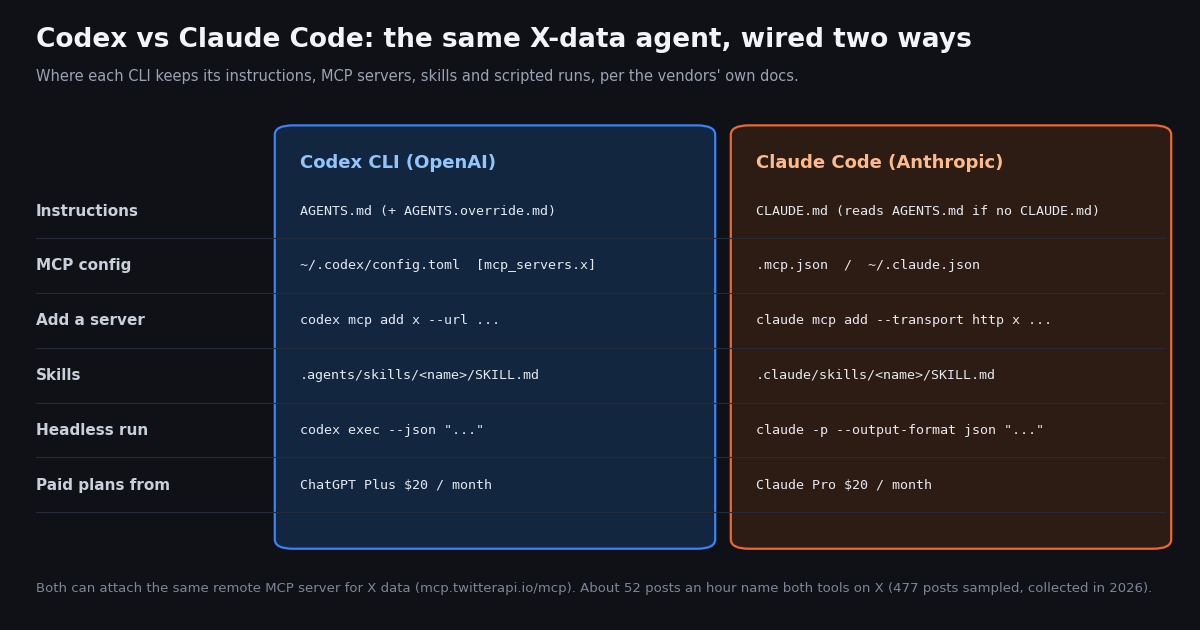
This page compares OpenAI's Codex and Anthropic's Claude Code head to head on the parts that decide day-to-day work: instruction files, MCP configuration, skills, headless and scheduled runs, and plan pricing. It is different from our OpenClaw vs Claude Code page, which compares Claude Code with a self-hosted personal agent, and from the Codex Twitter and Codex MCP guides, which cover one tool only. Every configuration key, command and price below comes from the vendors' own documentation and pricing pages read for this page; we did not run either agent for this comparison, so there are no benchmark claims here.
To keep it concrete, we give both agents the same job: an X (Twitter) data agent that watches a keyword and reports what changed. You will see the same MCP server and the same instructions wired into each tool, the headless command for each, and what the data costs. Alongside that, we measured how the two products are discussed on X: the vendors' own accounts and a de-identified sample of posts that mention both tools.
Codex vs Claude Code at a glance
Both products are agentic coding tools that work in your repository from a terminal (and from IDE extensions and desktop apps). The useful differences are in where configuration lives, how each one runs unattended, and what the plans include. This matrix is built only from the vendors' docs read for this page.
Install. Codex installs with npm install -g @openai/codex, brew install --cask codex or the standalone script at chatgpt.com/codex/install.sh; you sign in with ChatGPT or an API key. Claude Code installs with the native script at claude.ai/install.sh or brew install --cask claude-code, and signs in with a Claude subscription or a Console API key.
Docs host. OpenAI's Codex documentation now redirects from developers.openai.com/codex to learn.chatgpt.com/docs, and Claude Code's lives at code.claude.com/docs. Both publish markdown versions of every page (append .md), which is handy if you want an agent to read the docs itself.
Instruction files: AGENTS.md vs CLAUDE.md
This is the difference most people hit first, and it is smaller than it used to be. Codex builds an instruction chain once per run: a global file in ~/.codex (AGENTS.override.md if present, otherwise AGENTS.md), then one file per directory from the Git root down to your working directory, checking AGENTS.override.md, then AGENTS.md, then any names you list in project_doc_fallback_filenames. Files are concatenated root first, so the closest file wins, and Codex stops adding text once the combined size reaches project_doc_max_bytes, 32 KiB by default.
Claude Code loads ~/.claude/CLAUDE.md (personal, all projects), ./CLAUDE.md or ./.claude/CLAUDE.md (team, committed) and ./CLAUDE.local.md (personal, gitignored) from your working directory and every directory above it; files in subdirectories load on demand. It supports @path imports up to four hops deep and path-scoped rules in .claude/rules/. Anthropic's guidance is to keep each CLAUDE.md under 200 lines, because longer files cost context and reduce adherence.
Sharing one file. Claude Code reads AGENTS.md directly when the repository has no CLAUDE.md or CLAUDE.local.md (Claude Code v2.1.277 or later). If both exist, it reads only the CLAUDE.md files unless you change the Project instructions setting or import AGENTS.md from CLAUDE.md. The practical pattern for a team that uses both agents is to keep the shared rules in AGENTS.md and make CLAUDE.md a one-line @AGENTS.md import plus anything Claude-specific.
Here is that layout for the X data agent. The rules tell either agent how to reach X data, what fields exist, and how much it may spend.
# AGENTS.md  (Codex reads it; Claude Code reads it too when the repo has no CLAUDE.md)

## X data
- Use the twitterapi MCP server for X (Twitter) reads, or scripts in tools/ that call
  https://api.twitterapi.io with the X-API-Key header from TWITTERAPI_IO_API_KEY.
- Never print or commit the key. Paginate with has_next_page / next_cursor.
- Tweet fields: id, url, text, createdAt, lang, likeCount, retweetCount, viewCount, author.userName.
- Budget: 15 credits per post returned; stop after 5 pages unless asked.

# CLAUDE.md  (only needed if you want Claude-specific rules on top)
@AGENTS.md
- Prefer the MCP tool over writing new HTTP code for one-off lookups.MCP: connecting the same X data server to both agents
Both agents speak the Model Context Protocol, so one remote MCP server serves both. We used the TwitterAPI.io server at mcp.twitterapi.io/mcp: we sent it an MCP initialize request while writing this page and it answered as twitterapi-mcp 0.1.0, describing 12 tools (search posts, user lookup, followers, replies, trends and more) with the API key sent as a bearer token. A stdio version is published on npm as @twitterapi_io/mcp-server.
Codex. Codex stores MCP servers in config.toml, globally in ~/.codex/config.toml or per project in .codex/config.toml (trusted projects only). Each server is a [mcp_servers.<name>] table. Remote Streamable HTTP servers take url plus bearer_token_env_var, http_headers or env_http_headers; stdio servers take command, args and env. Useful extras from the reference: startup_timeout_sec (default 10), tool_timeout_sec (default 60), enabled_tools / disabled_tools, required = true (so codex exec fails instead of running without the server), and default_tools_approval_mode with the values auto, prompt, writes and approve. The CLI shortcut is codex mcp add <name> -- <command> for stdio servers, codex mcp list and codex mcp login for OAuth servers.
Claude Code. claude mcp add --transport http <name> <url> adds a remote server, --header attaches an auth header, and stdio servers go after a -- separator. By default a server lands in local scope (your user, this project, stored in ~/.claude.json); --scope project writes it to .mcp.json at the repo root for the team, and --scope user makes it available in every project. Claude Code also tries HTTP first and falls back to SSE for older servers.
Approval is the gotcha. A project-scoped server from .mcp.json shows Pending approval until someone runs claude interactively in that folder and approves it; a cloned repository cannot approve its own servers. Codex has a related rule from the other side: project .codex/config.toml files only load in trusted projects.
Secrets. Claude Code expands ${VAR} and ${VAR:-default} in a server's command, args, env, url and headers, so the committed .mcp.json below carries no key. Codex does the same job with bearer_token_env_var and env_http_headers, which name the environment variable instead of the value. Either way the key stays in your shell or CI secret store, not the repository.
Once connected, MCP tools in Claude Code are named mcp__<server>__<tool>, which is what you use in permission rules: mcp__twitterapi__* allows every tool from this server. Codex filters with enabled_tools and disabled_tools on the server table.
# ---------- Codex ----------
# ~/.codex/config.toml  (or .codex/config.toml in a trusted project)
[mcp_servers.twitterapi]
url = "https://mcp.twitterapi.io/mcp"
bearer_token_env_var = "TWITTERAPI_IO_API_KEY"   # sent as Authorization: Bearer <key>
tool_timeout_sec = 60                            # documented default
default_tools_approval_mode = "writes"           # prompt only for tools not marked read-only

# then, from the shell
#   export TWITTERAPI_IO_API_KEY=...
#   codex mcp list            # the server shows up with its auth status
#   codex                     # type /mcp to see the 12 X tools

# ---------- Claude Code ----------
# One command (writes to local scope; add --scope project to share it via .mcp.json)
claude mcp add --transport http twitterapi https://mcp.twitterapi.io/mcp \
  --header "Authorization: Bearer $TWITTERAPI_IO_API_KEY"

# Or commit this .mcp.json at the repo root; ${VAR} is expanded from the environment
{
  "mcpServers": {
    "twitterapi": {
      "type": "http",
      "url": "https://mcp.twitterapi.io/mcp",
      "headers": { "Authorization": "Bearer ${TWITTERAPI_IO_API_KEY}" }
    }
  }
}

# Check it: claude mcp get twitterapi (project servers wait for approval in an interactive session)Headless and scheduled runs: codex exec vs claude -p
An X monitoring agent is only useful if it runs without you. Both tools have a first-class non-interactive mode, and both document JSON output for scripts.
Codex details. codex exec streams progress to stderr and prints only the final agent message to stdout, so it pipes cleanly. OpenAI notes that --full-auto is no longer supported (use --sandbox workspace-write), recommends its GitHub Action for CI rather than exposing an API key to repository code, and warns against setting OPENAI_API_KEY or CODEX_API_KEY as a job-level variable where untrusted code runs.
Network for scripts in Codex. OpenAI's security docs say the CLI's sandbox keeps network access off by default, including in workspace-write mode, until you set network_access = true under [sandbox_workspace_write] in config.toml. So if your agent runs a Python script that calls api.twitterapi.io, enable that (and --sandbox workspace-write so the script can save its state file), or let the agent use the MCP server instead. In Claude Code the equivalent gate is the permission rule: pre-approve the exact command, for example Bash(python x_keyword_report.py).
Claude Code details. With --output-format json the result includes total_cost_usd and a per-model cost breakdown (a client-side estimate), which makes per-run budgeting easy. Without --bare, a -p run loads hooks and .mcp.json servers from the folder without a trust dialog, so Anthropic recommends --bare for scripted calls and says it will become the default for -p.
Scheduling. Claude Code documents three options: cloud routines (Anthropic-managed, run with your machine off, minimum interval 1 hour, MCP via connectors per task), Desktop scheduled tasks (your machine, local files, 1 minute minimum when Claude sets it, 1 hour in the forms) and /loop inside a session. Codex scheduled tasks run from the ChatGPT desktop app, where they can use a local project or isolated worktree as long as the computer stays on and the app is running, or from the web with connected tools but no local folder. Both also run fine from plain cron calling the headless command.
# Codex: read-only sandbox by default; final message to stdout, progress to stderr
CODEX_API_KEY="$OPENAI_KEY_FOR_CI" codex exec --json \
  "Use the twitterapi MCP server to find posts about 'claude code' from the last hour and list the 5 most-liked" \
  > codex-run.jsonl

# Claude Code: -p is the non-interactive mode; --allowedTools pre-approves the server's tools.
# For CI, add --bare (needs ANTHROPIC_API_KEY): it skips hooks, plugins, memory and CLAUDE.md,
# and only MCP servers passed with --mcp-config connect.
claude -p "Use the twitterapi MCP server to find posts about 'codex' from the last hour and list the 5 most-liked" \
  --allowedTools "mcp__twitterapi__*" \
--output-format json > claude-run.jsonPlans and pricing, plus the X data bill
Both vendors bundle the agent into a chat subscription and also let you pay per token with an API key. These figures are copied from learn.chatgpt.com/docs/pricing (Codex) and claude.com/pricing (Claude) as read for this page; check them before you buy, since both pages say plans change.
Models. The Codex pricing page lists GPT-6.1 Sol and GPT-6 Luna on Plus, and notes that GPT-5.5 retired from Codex with ChatGPT sign-in on October 14, 2026 (API-key sessions unaffected). Claude Code exposes aliases rather than fixed IDs: sonnet, opus, haiku, fable and best, with Fable available on Max (up to half the weekly limit) and on Pro paid with usage credits, per the pricing page.
Usage limits, not prices, are what people argue about. Claude's plans meter usage every 5 hours and every week (Ultra drops the 5-hour limit for verified accounts), and Anthropic's cost page puts enterprise Claude Code spend at around $13 per developer per active day and $150 to $250 per developer per month on API billing. OpenAI's page notes that ChatGPT Work and Codex share the same usage and credits, and that API token prices should not be used to estimate included tasks. That matches what we saw on X: pricing and limits lead every other topic in posts comparing the two.
The agent's subscription pays for the model. The X data is a separate bill, and it is identical in Codex and Claude Code because both call the same MCP server or the same REST endpoint. TwitterAPI.io bills tweet endpoints such as /twitter/tweet/advanced_search and /twitter/user/last_tweets at 15 credits per post returned, which is $0.15 per 1,000 posts, with a 15-credit minimum per request: a check that finds nothing costs $0.00015, and a full 20-post page costs $0.003. Profiles from /twitter/user/info are $0.18 per 1,000. You pay only for the data returned.
On the official X API rate card at docs.x.com/x-api/getting-started/pricing, pay-per-usage reads cost $0.005 per post and $0.010 per user, are capped at 3 million post reads per monthly billing cycle (Enterprise above that), and new payers get $20 of credits on a first eligible card plus a match of the first auto-recharge up to $50. Per 1,000 posts that is $5 against $0.15, roughly 33x.
For scale, this page's whole study (1,134 posts across 58 requests) cost about $0.17 in data. New TwitterAPI.io accounts that pass the automatic bot check get up to $1 of free credits (at most 100,000 credits, no card, one per person or network, expiring after 31 days); purchased credits never expire. Rate limits are 0.2 requests per second before the first payment and 20 once paid. Reads need no X account.
If your agent should also post, TwitterAPI.io's write endpoints such as /twitter/create_tweet_v2 run through an authenticated session: one /twitter/user_login_v2 login ($0.10, with a proxy you supply) returns login_cookies, and each post, like, follow or other action is 60 credits ($0.0006), billed per HTTP 200 call. The call acts as that account, so X can rate-limit, lock or suspend it; keep a human pace, and expect the session to need a re-login now and then.
What X posts comparing Codex and Claude Code actually talk about
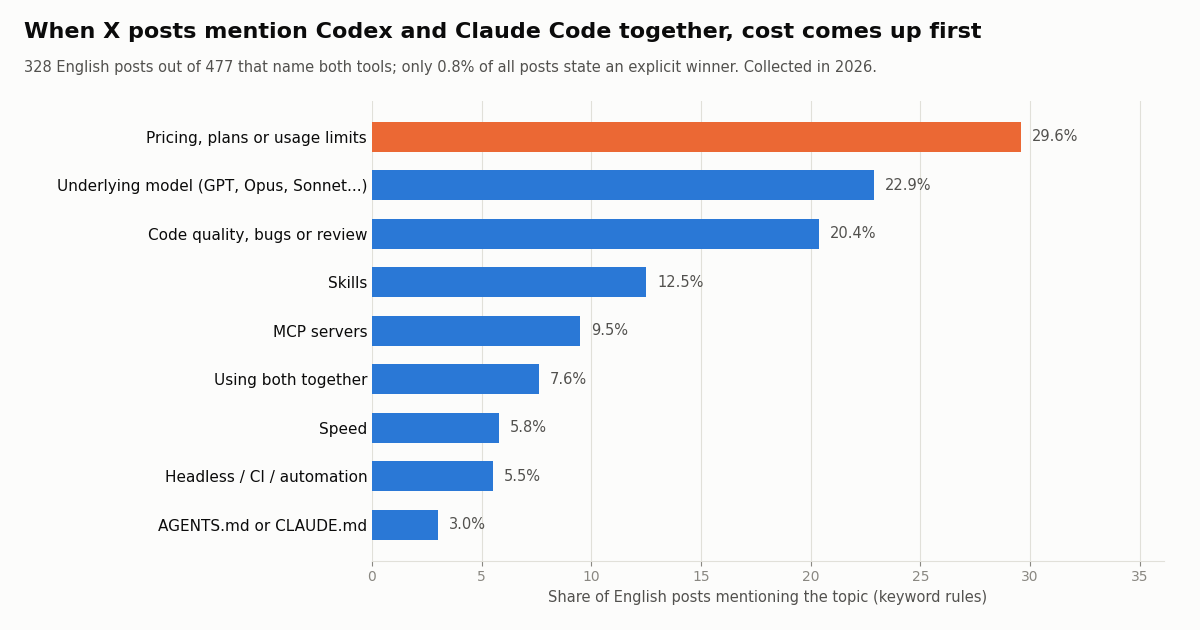
We pulled 477 recent posts that name both tools (search codex "claude code", reposts excluded, Latest plus Top, deduplicated) and tagged each with simple keyword rules. The volume alone says something: the 400 most recent matches spanned just 7.7 hours, about 52 posts an hour. English made up 68.8% of the sample, Chinese 11.1% and Japanese 7.5%; 30.6% were replies inside threads.
Among the 328 English posts, the most frequent topic is pricing, plans or usage limits (29.6%), ahead of the underlying model (22.9%) and code quality, bugs or review (20.4%). Skills (12.5%) and MCP (9.5%) come next; headless or CI runs (5.5%) and the instruction files themselves (3.0%) are rarely the subject. 7.6% talk about using both together.
The most striking number is how rarely anyone picks a side in plain words. Only 0.8% of all 477 posts matched our explicit-preference rules (phrases such as "switched to Codex" or "Claude Code is better"): 3 leaned Claude Code and 1 leaned Codex. Most posts describe a workflow, a limit or a price rather than a verdict, which fits the common advice to route tasks between the two.
Engagement is extremely skewed: the median post in the sample has 1 like, the 90th percentile 350, and the posts X ranks as Top have a median of 722 likes. A few large accounts shape the comparison that most people see.
How OpenAI and Anthropic promote their agents on X
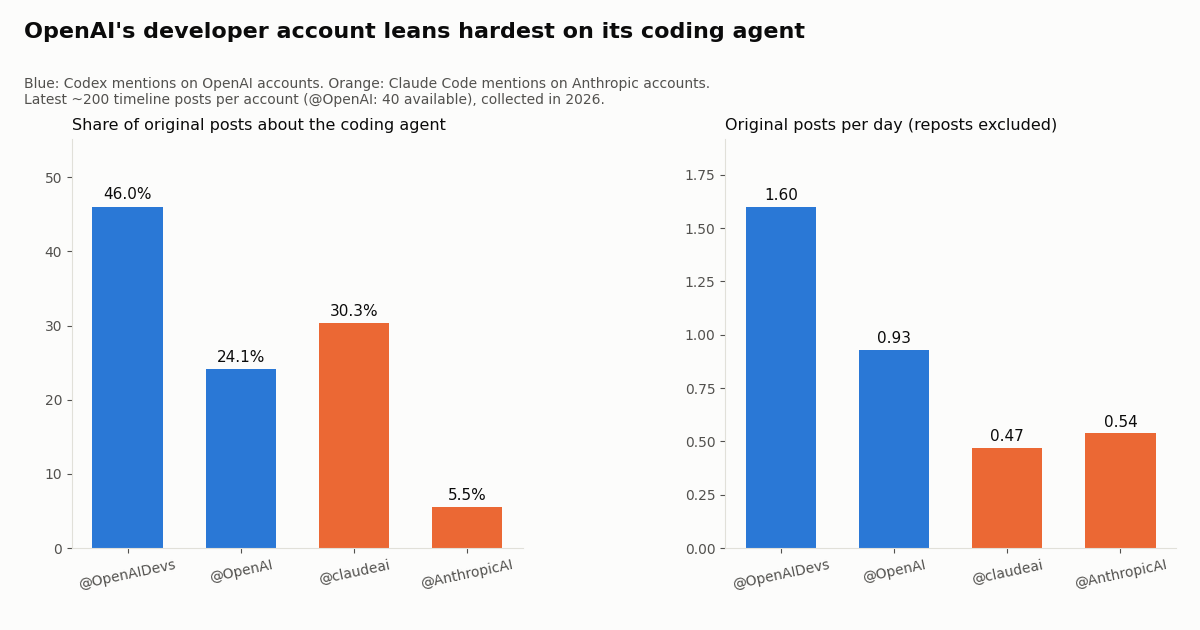
We also read the recent timelines of the four official accounts that announce these products and counted original posts (reposts excluded) that mention the vendor's own agent: Codex for @OpenAIDevs and @OpenAI, Claude Code for @claudeai and @AnthropicAI.
OpenAI's developer account is mostly a Codex channel. 46.0% of @OpenAIDevs' own posts mention Codex, and 150 of its 200 latest timeline items are reposts, 47 of them about Codex. Its Codex posts drew a median of 176,784 views against 141,547 for its other posts.
Anthropic posts less often and keeps Claude Code on the product account. @claudeai averages 0.47 original posts a day, and 30.3% of them mention Claude Code; the company account @AnthropicAI mentions it in only 5.5%. Claude Code posts on @claudeai drew a median of 9,650 likes, a little below the 11,536 for its other posts, so the agent is not the account's only draw.
If you follow these tools for release notes, that is the practical takeaway: @OpenAIDevs is where Codex changes land, and @claudeai is the Anthropic account to watch for Claude Code.
Which one should you use for an X data agent?
Pick Codex if you already pay for ChatGPT, want the CLI source under Apache-2.0, like keeping every setting in one TOML file, or want a read-only sandbox as the default for unattended runs. codex exec --output-schema is a clean way to turn an X report into fixed JSON for a downstream job.
Pick Claude Code if you want cloud routines that run with your laptop closed, per-run cost in the JSON output, a committed .mcp.json the whole team shares, or the layered CLAUDE.md plus .claude/rules/ setup. Claude Code is not on Claude's Free plan, so budget at least Pro.
Or use both. Put the shared rules in AGENTS.md, make CLAUDE.md import it, and point both at the same MCP server. The X data layer does not care which agent calls it, and that is what the X conversation suggests most people do: few posts declare a winner, and the debate is mostly about limits and price.
For the X side specifically, the worked example in this guide is small on purpose: a keyword search, a state file and a markdown report. Give that script to either agent, ask it to run on a schedule, and the agent's job reduces to reading the report and deciding what is worth telling you.
How we collected this
Question. How do OpenAI and Anthropic present their coding agents on X, and what do people who mention both Codex and Claude Code in one post compare them on?
Accounts and query. Part A: the latest timeline posts (replies excluded) of @OpenAIDevs, @OpenAI, @claudeai and @AnthropicAI via /twitter/user/last_tweets, up to 200 per account (@OpenAI returned 40). Part B: /twitter/tweet/advanced_search with codex "claude code" -filter:retweets, 400 Latest and 77 additional Top results after deduplication.
Window and size. The most recent posts at collection time, collected in 2026: 640 timeline posts and 477 search posts, 58 requests in total. Per-account windows differ because the accounts post at different rates (about a month for the OpenAI accounts, about a year for the Anthropic ones).
What it cannot show. Topic and preference tags come from English keyword rules, so they miss sarcasm, paraphrase and most non-English posts (which is why topic shares are reported for English posts only). The search sample is the most recent matching posts, not a random sample of all opinion, and a post that names a dimension is not necessarily critical of it. Nothing here measures which agent writes better code; we did not run either agent for this page.
Privacy. Aggregates only. Vendor accounts are organizations and are named; posts in the search sample are by individuals, so raw pages were kept out of the repository and the published sample keeps only de-identified fields (no IDs, URLs, text or handles).
"""x_keyword_report.py - the X-data task we give both agents in this comparison.

Pull new posts for a keyword from TwitterAPI.io, keep state between runs, and print a short
markdown report. Run it directly, or have Codex / Claude Code run it in a headless job:

    pip install requests
    export TWITTERAPI_IO_API_KEY=...          # twitterapi.io dashboard
    python x_keyword_report.py '"claude code" codex -filter:retweets lang:en'

    # Codex runs shell commands with network off by default: use --sandbox workspace-write
    # plus [sandbox_workspace_write] network_access = true in ~/.codex/config.toml
    codex exec --sandbox workspace-write "Run python x_keyword_report.py and summarize what changed"
    claude -p "Run python x_keyword_report.py and summarize what changed" --allowedTools "Bash(python x_keyword_report.py)"

Cost: advanced_search bills 15 credits per post returned ($0.15 per 1,000 posts) with a
15-credit minimum per request, so a run that finds nothing costs $0.00015.
"""
import json
import os
import sys
from datetime import datetime

import requests

BASE = "https://api.twitterapi.io"
HEADERS = {"X-API-Key": os.environ["TWITTERAPI_IO_API_KEY"]}
STATE = "x-keyword-state.json"
MAX_PAGES = 5                      # 20 posts per page, newest first


def load_state():
    if os.path.exists(STATE):
        with open(STATE) as f:
            return json.load(f)
    return {"seen": []}


def fetch_new(query, seen):
    """Page through Latest results until we hit a post we already reported."""
    new, cursor = [], ""
    for _ in range(MAX_PAGES):
        r = requests.get(
            f"{BASE}/twitter/tweet/advanced_search",
            headers=HEADERS,
            params={"query": query, "queryType": "Latest", "cursor": cursor},
            timeout=30,
        )
        r.raise_for_status()
        body = r.json()
        stop = False
        for t in body.get("tweets", []):
            if t["id"] in seen:
                stop = True
                break
            new.append(t)
        if stop or not body.get("has_next_page"):
            break
        cursor = body.get("next_cursor", "")
    return new


def report(query, posts):
    print(f"## X report for `{query}`: {len(posts)} new posts\n")
    langs = {}
    for t in posts:
        langs[t.get("lang") or "und"] = langs.get(t.get("lang") or "und", 0) + 1
    if langs:
        print("Languages: " + ", ".join(f"{k} {v}" for k, v in sorted(langs.items(), key=lambda kv: -kv[1])))
    top = sorted(posts, key=lambda t: t.get("likeCount", 0), reverse=True)[:5]
    for t in top:
        when = datetime.strptime(t["createdAt"], "%a %b %d %H:%M:%S %z %Y")
        text = " ".join(t.get("text", "").split())[:140]
        print(f"- {when:%H:%M} UTC | {t.get('likeCount', 0)} likes | {t.get('viewCount', 0)} views | {text}")
        print(f"  {t['url']}")


def main():
    query = sys.argv[1] if len(sys.argv) > 1 else '"claude code" codex -filter:retweets lang:en'
    state = load_state()
    posts = fetch_new(query, set(state["seen"]))
    report(query, posts)
    state["seen"] = ([t["id"] for t in posts] + state["seen"])[:2000]
    with open(STATE, "w") as f:
        json.dump(state, f)


if __name__ == "__main__":
    main()
Questions readers ask
Is Codex better than Claude Code?
Neither vendor publishes a like-for-like benchmark of the two agents, and we did not run one, so this page compares documented features instead. They overlap heavily: both read an instructions file, connect to MCP servers, run headless and start at $20 a month. On X, only 0.8% of 477 posts naming both declared an explicit winner; most compare limits, price and model rather than crowning one.
Can Claude Code read AGENTS.md?
Yes. Since Claude Code v2.1.277, it reads AGENTS.md as the project instructions when the repository has no CLAUDE.md or CLAUDE.local.md. If both exist it reads only CLAUDE.md unless you change the Project instructions setting or add an @AGENTS.md import to CLAUDE.md.
Does Codex read CLAUDE.md?
Not by default. Codex checks AGENTS.override.md and AGENTS.md in each directory, plus any filenames you list in project_doc_fallback_filenames in ~/.codex/config.toml. Add CLAUDE.md to that list if you want Codex to treat it as an instructions file.
Is Claude Code free? Is Codex free?
Claude Code is not included on Claude's Free plan; it starts with Pro at $20 monthly ($17 a month billed annually). OpenAI's Codex pricing page lists a Free plan with GPT-6 Luna in the desktop app, subject to rollout, while the CLI, IDE extension and web access are listed from Plus at $20. Both can also be used with a pay-per-token API key.
What is the Codex equivalent of claude -p?
codex exec. It runs a task without the interactive interface, prints only the final message to stdout, supports --json event streams and --output-schema for structured results, and runs in a read-only sandbox unless you pass --sandbox workspace-write. Claude Code's claude -p offers --output-format json, --json-schema and --bare for clean scripted runs.
Can Codex and Claude Code share the same MCP server?
Yes. Configure the server once per tool: a [mcp_servers.<name>] table in ~/.codex/config.toml for Codex, and claude mcp add or an .mcp.json entry for Claude Code. The TwitterAPI.io remote server at mcp.twitterapi.io/mcp works in both with the API key as a bearer token.
Which is better for building a Twitter (X) data agent?
Either works, because the data layer is the same: both call the same MCP server or REST endpoints, at $0.15 per 1,000 posts returned. Choose Claude Code if you want cloud routines that run with your machine off and per-run cost in the JSON output; choose Codex if you want a read-only sandbox by default, an Apache-2.0 CLI and one TOML config file.
How much does the X data cost compared with the official X API?
TwitterAPI.io charges $0.15 per 1,000 posts returned and $0.18 per 1,000 profiles. The official X API pay-per-usage rate card lists $0.005 per post read ($5 per 1,000) and $0.010 per user read, capped at 3 million post reads a month. That is about 33x more per 1,000 posts on the official API.
Continue
- OpenAI Codex docs: Custom instructions with AGENTS.md (discovery order, 32 KiB default limit)
- OpenAI Codex docs: Model Context Protocol (config.toml keys, codex mcp commands)
- OpenAI Codex docs: Non-interactive mode (codex exec, --json, --output-schema, CODEX_API_KEY)
- OpenAI Codex docs: Pricing (Free, Go, Plus, Pro, Business, API key)
- Claude Code docs: Connect Claude Code to tools via MCP (scopes, .mcp.json, env expansion)
- Claude Code docs: CLAUDE.md, AGENTS.md and memory
- Claude Code docs: Run Claude Code programmatically (claude -p, --bare, --output-format)
- Claude plans and pricing (Free, Pro, Max, Ultra, Team, Enterprise)
- X (Twitter) API guide: endpoints, pricing and access options
- OpenClaw vs Claude Code: personal agent vs coding agent
- Codex MCP setup: every config.toml key explained
- Using OpenAI Codex with the Twitter (X) API
- How to use Claude with the Twitter (X) API
- MCP vs CLI tools for AI agents
- Claude Code pricing and usage limits explained
- TwitterAPI.io pricing: pay per post returned
- 01Twitter (X) API License: The Developer Agreement in Plain English
- 02Claude Agent SDK: Build a Twitter (X) Research Agent in Python
- 03OpenRouter API: Base URL, API Key, Free Models and Pricing, Plus a Twitter (X) Agent That Swaps Models
- 04Open AI API Key: How to Get One, Pay for It, Keep It Safe and Feed It Live Twitter (X) Data
- 05How to Get a Claude API Key: Console Steps, Billing, First Call and Live X (Twitter) Data
- 06OpenClaw vs Claude Code: which agent should run your Twitter (X) jobs?
- 07Claude Code Channels: Telegram, Discord and Twitter (X) Alerts in Your Session
- 08Claude Code Pricing in 2026: Plans, Usage Limits and the Real Cost of an Always-On Agent
Stop reading. Start building.
Starter credits cover real testing on real data. Google sign-in, no card, no application queue.
Get an API keyAlready building with TwitterAPI.io? Publish an honest tutorial or build log about it and earn up to $200 a month in API credits.