OpenClaw vs Claude Code: which agent should run your Twitter (X) jobs?
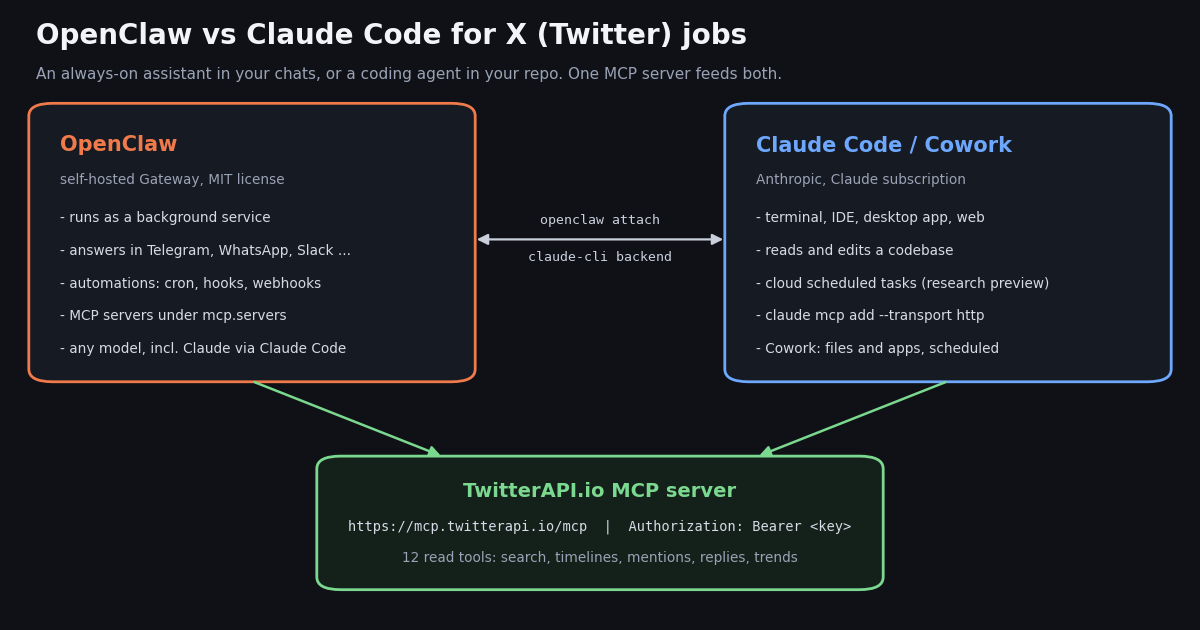
This page compares two agents for X (Twitter) work: OpenClaw, the open-source assistant that runs on your own hardware, and Claude Code (with its sibling Claude Cowork) from Anthropic. It is not our Grok Bot vs Claude comparison, which pits xAI's built-in X search against Claude connectors; and it is not the OpenClaw setup guide, which walks through wiring X data into OpenClaw step by step. Here the question is which agent should own which X job, and how to give both the same data.
Every product fact below comes from the projects' own documentation, read for this page: docs.openclaw.ai, the openclaw/openclaw README on GitHub, code.claude.com/docs, claude.com/product/cowork and Anthropic's support article on custom connectors. The X pricing comes from docs.x.com/x-api/getting-started/pricing. The study numbers come from public X posts we collected through our own API in 2026; the method is at the end.
Short version: if the job should run whether or not you are at a computer and report into a chat, OpenClaw is built for it. If the job is to write, test and ship code that touches X data, Claude Code is built for that. Many builders run both, and the two projects document a bridge between them.
OpenClaw vs Claude Code at a glance
The two products answer different questions. OpenClaw's docs describe it as "an open-source AI assistant that runs on your own hardware and meets you in every chat app you already use". Claude Code's docs call it "an agentic coding tool that reads your codebase, edits files, runs commands, and integrates with your development tools". The table puts the facts that matter for X jobs side by side.
Reading the table. OpenClaw is the only one of the three that is designed to stay up as a service and talk to you through a messaging app; Claude Code is the only one designed to own a codebase; Cowork is the no-terminal option. None of them reads X by itself for free: OpenClaw's X channel uses your own X developer app and its billing, and the Claude products have no X source of their own, so all three need a data source such as an MCP server.
One caution on comparisons you will find elsewhere. Many comparison posts treat OpenClaw and Claude Code as rival coding agents. The OpenClaw docs describe the opposite relationship: Claude Code can be an OpenClaw runtime. That changes the decision from either-or to which layer does what.
How each one runs an always-on X job
Most X work is recurring: check a keyword every few minutes, summarize mentions every morning, watch competitors' accounts, alert on a spike. The question is what wakes the agent up and where the result lands.
OpenClaw. Automations are "OpenClaw's built-in scheduler": the Gateway persists jobs, wakes the agent at the right time and delivers the output "to a chat channel, a webhook, or nowhere". A schedule can be a one-shot at, a fixed every interval such as 10m or 1h, a 5- or 6-field cron expression with an optional timezone, an on-exit trigger or a stream source. Jobs default to announcing their result in a chat, and --command jobs run a script without starting a model turn, which is useful when a plain HTTP call can decide whether anything happened.
Claude Code. Anthropic documents three ways to schedule. Cloud scheduled tasks (formerly routines) run on Anthropic-managed infrastructure, keep running with your laptop closed and are available on Pro, Max, Team and Enterprise plans, with a minimum interval of one hour; they are in research preview. Desktop scheduled tasks run on your machine with your local files, but "only fire while the app is open and your computer is awake". /loop repeats a prompt inside an open CLI session, down to one minute. Cloud tasks also carry an account limit of 100 scheduled runs per hour, and runs draw down subscription usage like interactive sessions.
Claude Cowork. The product page says you can "schedule a task for any cadence, and it runs unattended" and "get it daily, weekly, or monthly". It also says Cowork "consumes limits faster than Chat", which matters for a job that fires many times a day.
The rule of thumb. If the interval is shorter than an hour and nobody will be at a laptop, OpenClaw (or a Desktop task on a machine that never sleeps) is the natural home. If the deliverable is code or a document, Claude Code or Cowork is.
One MCP server in both, and the bridges between them
The X data layer does not have to differ. TwitterAPI.io runs a hosted Model Context Protocol server at https://mcp.twitterapi.io/mcp. We sent it an initialize request for this page; its reply names the server twitterapi-mcp and says: "Read-only access to Twitter/X data via 12 tools (search tweets, user lookup, followers, replies, trends, etc.). Auth: paste your twitterapi.io API key as the Bearer token." The 12 tools include search_tweets, get_user_last_tweets, get_user_mentions, get_tweet_replies, get_tweet_quotes and get_trends.
OpenClaw. MCP servers live under mcp.servers in ~/.openclaw/openclaw.json, a JSON5 file the Gateway watches and hot-reloads. Remote entries take a url, transport: "streamable-http" and headers; the docs' own example uses Authorization: "Bearer ${MCP_REMOTE_TOKEN}", so the key can come from the Gateway's environment instead of the file. openclaw mcp set writes the same block from the command line.
Claude Code. The MCP docs give the exact form: claude mcp add --transport http <name> <url> with --header "Authorization: Bearer your-token". The same server then works on every Claude Code surface, because "your repo's CLAUDE.md files, settings, and MCP servers work across all of them". For cloud scheduled tasks, connectors are chosen per task.
Claude Cowork and the Claude apps. Anthropic's support article says custom connectors using remote MCP "are available on Claude, Cowork, and Claude Desktop", on Free, Pro, Max, Team and Enterprise plans (Free is limited to one custom connector). You add the URL under Customize, Connectors, Add custom connector, and put the key under Request headers. The connection "originates from Anthropic's servers", so it works with your laptop closed.
No X developer account is needed for any of these reads. New TwitterAPI.io accounts that pass the automatic bot check get up to $1 of free credits (at most 100,000 credits, no card, one per person or network, expiring after 31 days); purchased credits never expire.
Two documented bridges. Beyond sharing a data source, the two projects can call each other, which changes the comparison from either-or to which layer does what.
Claude Code as OpenClaw's brain. OpenClaw's CLI backends page says it "can run agent turns through a local AI CLI, such as Claude Code or Gemini CLI, instead of calling the provider API itself". The bundled Anthropic plugin registers a claude-cli backend; with Claude Code installed and logged in on the Gateway host, openclaw models auth login --provider anthropic --method cli --set-default routes Claude models through it. A backend with bundleMcp: true receives Gateway tools through a loopback MCP bridge. In practice: OpenClaw keeps the schedule and the chat, Claude Code does the thinking.
OpenClaw tools inside Claude Code. openclaw attach "launches Claude Code with a strict temporary MCP config bound to one Gateway session". It passes --strict-mcp-config --mcp-config <path> so your other Claude MCP servers do not join, keeps the bearer token out of argv, and revokes the grant when Claude Code exits. That lets a coding session read or answer an OpenClaw conversation, for example the Telegram thread where your X alerts land.
A split that works for X jobs. Let OpenClaw own the always-on part (a */15 * * * * automation that searches for a keyword through the MCP server and posts the matches to Telegram), and open Claude Code when the job turns into software (a scorer for which posts deserve an alert, a database of hits, a dashboard). Both read the same data with the same key, so numbers agree.
Account terms are yours to check. Running Claude through Claude Code inside another tool uses your Claude account; read Anthropic's terms for your plan before you automate it at volume.
# Your key from https://twitterapi.io/dashboard
export TWITTERAPI_IO_API_KEY=your_key

# --- Claude Code: add the hosted server over HTTP, then check it
claude mcp add --transport http twitterapi-io https://mcp.twitterapi.io/mcp \
  --header "Authorization: Bearer $TWITTERAPI_IO_API_KEY"
claude mcp list

# --- OpenClaw: same server under mcp.servers in ~/.openclaw/openclaw.json (JSON5)
# {
#   mcp: {
#     servers: {
#       twitterapi: {
#         url: "https://mcp.twitterapi.io/mcp",
#         transport: "streamable-http",
#         headers: { Authorization: "Bearer ${TWITTERAPI_IO_API_KEY}" },
#       },
#     },
#   },
# }
# The key must be in the Gateway's environment for ${...} to resolve.

# --- Cowork / Claude apps: Customize > Connectors > Add custom connector
#     URL: https://mcp.twitterapi.io/mcp
# Request header: Authorization = Bearer <your key>Posting to X: what each agent can actually do
Reading is the easy half. Posting is where the two differ most, and where you should keep a human in the loop.
OpenClaw's X channel. The X plugin "turns mentions of your bot account into agent conversations and posts the agent's answer as a public reply". Only allowlisted authors can trigger a reply by default, and the docs are explicit that "DMs, original posts, likes, and follows are not supported". It needs an X confidential OAuth2 app authorized with tweet.read tweet.write users.read offline.access media.write, polls mentions every pollSeconds (60 in the docs' example) or streams them, and has costLimits with daily and monthly dollar caps because it bills against your X API credits. On X's pay-per-use rate card a post costs $0.015 to create ($0.20 with a URL) and every post read costs $0.005.
Claude Code and Cowork. Neither has an X posting feature. Claude Code can write and run a script that posts, and Cowork can act in apps you connect, but the X part is whatever API you give them.
The TwitterAPI.io MCP server reads; the REST API also writes. The hosted server's 12 tools are reads. Posting from an agent goes through the write endpoints in a script or skill: one /twitter/user_login_v2 login ($0.10, with a proxy you supply) returns login_cookies, then each /twitter/create_tweet_v2, like, retweet or follow call costs 60 credits ($0.0006). Each call acts as that account, so X can rate-limit, lock or suspend it; keep a human pace, expect to log in again when a session expires, and note that billing is per HTTP 200 call.
Our advice for either agent. Let the agent draft and queue posts, and approve them yourself in the chat (OpenClaw) or the terminal (Claude Code). The OpenClaw setup guide on this site has a worked approval flow.
What people on X say when they compare them
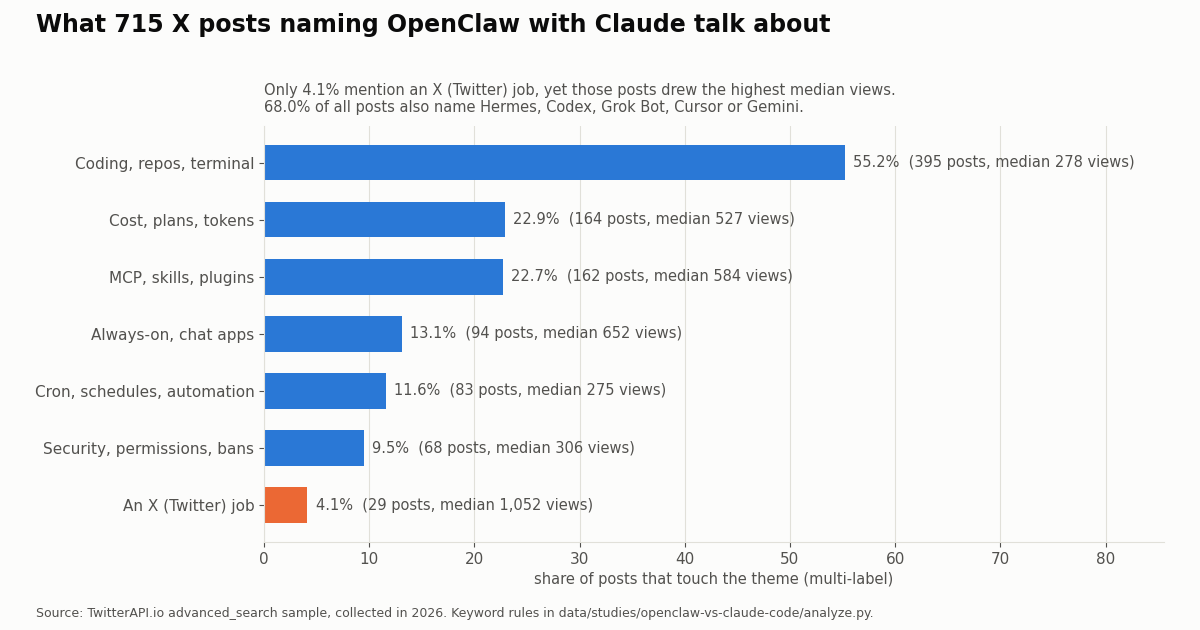
We searched public X posts that name OpenClaw together with Claude Code, Cowork or Claude, and classified each post with simple keyword rules (715 posts after de-duplication; the main query alone returned 400 posts in 9.1 days, so the pairing comes up about 44 times a day). A post can match several themes.
Coding dominates the conversation. 55.2% of posts touch code, repos or the terminal, which is why so many comparisons frame OpenClaw as a coding agent. Cost and plans (22.9%) and MCP, skills and plugins (22.7%) come next.
X jobs are rare but draw attention. Only 29 posts (4.1%) mention a Twitter or X job such as monitoring, posting or reading timelines, but their median of 1,052 views is the highest of any theme, against 328 for the whole sample. With 29 posts the gap is directional, not a measured effect.
People run a stack, not one agent. 68.0% of posts also name another agent: Codex in 38.5%, Hermes in 33.8%, Grok Bot in 24.5%, Cursor in 18.3% and Gemini in 8.4%. Only 13.1% use comparison language such as vs, instead of or switched. Claude Code is named in 49.0% and Cowork in 23.4%.
It is a global conversation. 62.2% of posts are in English, 14.4% in Chinese and 6.3% in Japanese; 9.8% are link-only posts with no detectable language.
What the official accounts ship
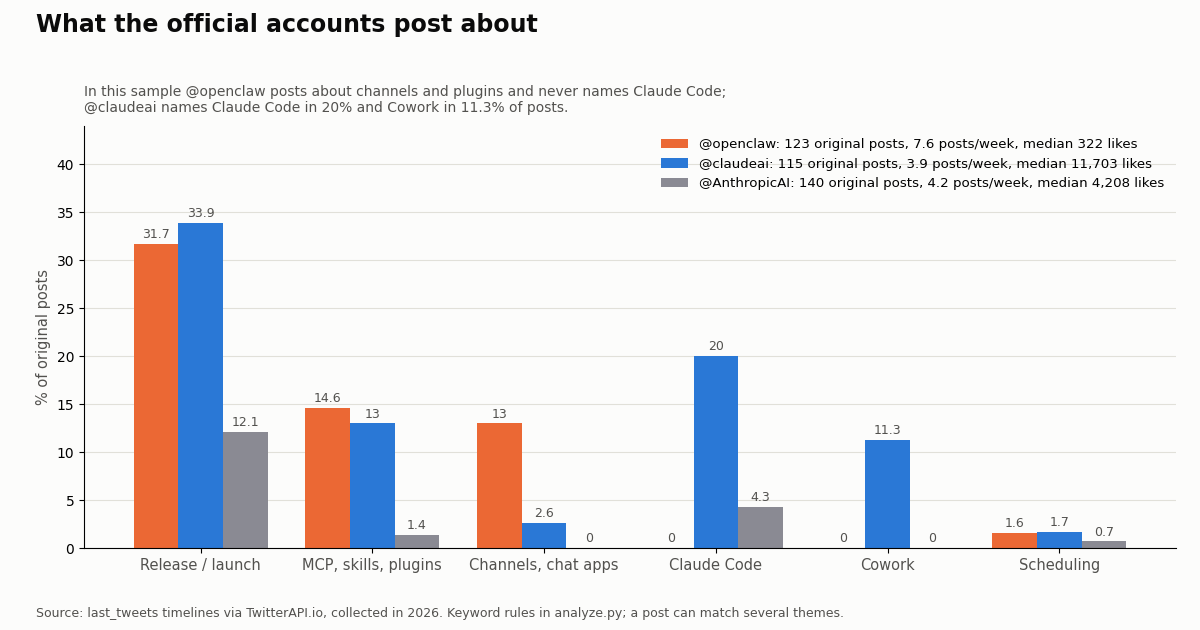
The second half of the study reads the official timelines of @openclaw, @claudeai and @AnthropicAI, which shows where each project is putting its attention.
OpenClaw ships often and talks about reach. @openclaw posted 7.6 times a week in the sample, 31.7% of its original posts are releases or launches, 14.6% are about MCP, skills or plugins and 13.0% about channels and chat apps. None of its original posts in the sample names Claude Code.
@claudeai is where Claude Code and Cowork news lands. 20.0% of its original posts name Claude Code and 11.3% name Cowork, against 4.3% and 0.0% on @AnthropicAI. If you want to track Claude Code changes from X, follow @claudeai; for OpenClaw, @openclaw announces its releases.
Scheduling is barely marketed by either. Under 2% of original posts on each account mention scheduling or automations, even though both products now document it in depth. Check the docs, not the timeline, before you decide on cadence.
This is also a ready-made X job. Watching three official accounts for release posts is exactly the kind of task this page is about: get_user_last_tweets through the MCP server, on a daily schedule, in whichever agent you prefer.
What the X data costs in either agent
The agent's own price and the X data price are separate bills. OpenClaw has "no paid tier, hosted service, or token", but you pay your model provider; Claude Code and Cowork run on a Claude plan's usage. The X data is the same in both when it comes from the same MCP server.
For a sense of scale. This page's study returned 1,155 posts and 3 profiles in 54 requests and cost $0.17 on TwitterAPI.io. The same 1,155 post reads at $0.005 each on the official X API rate card would be $5.78, about 33x more per 1,000 posts.
Polling floors are small. An agent that checks a keyword every 5 minutes for a month spends about $1.30 on empty checks; every 60 seconds, $6.48. Posts that come back cost $0.15 per 1,000 on top. The model cost of reading them (OpenClaw's provider or your Claude plan) is usually the bigger number, which is one more reason to trim posts before the model reads them.
Paid plans and rate limits. Pay as you go needs no subscription; monthly plans start at Starter for $29. Before the first payment the API allows 0.2 requests per second, 20 after it. See the pricing page for the plan list.
Which one should you pick?
Pick OpenClaw if you want an assistant that is always on, lives in Telegram, WhatsApp, Slack or Discord, runs X checks every few minutes on hardware you control, and can use any model. Expect more setup: you run the Gateway, manage keys in its environment and own its security. Its X channel is the only built-in way, of the three, to answer people who mention a bot account.
Pick Claude Code if the X job is a piece of software: a monitor you will deploy, a scraper for research, a dataset, an integration in an existing codebase. It runs where developers already work, uses the same MCP server across terminal, IDE, desktop and web, and its cloud scheduled tasks cover hourly or daily jobs without your machine.
Pick Claude Cowork if you do not want a terminal at all and the job is a recurring report or document built from X data. Add the MCP server as a custom connector and schedule it.
Pick both if you want minute-level alerts in a chat and serious engineering on the same data. Run OpenClaw as the always-on layer, give it Claude through the claude-cli backend if Claude is your model, and use openclaw attach or a plain Claude Code session for the code.
How we collected this
Question. When people on X compare OpenClaw with Claude Code or Cowork, what do they talk about, and what do the two projects' official accounts post about?
Posts searched. Three /twitter/tweet/advanced_search queries with queryType=Latest: openclaw "claude code" (20 pages), openclaw cowork (8 pages) and openclaw claude -"claude code" (8 pages), de-duplicated to 715 posts. The window is the most recent matching posts at collection time (collected in 2026); the second query reached further back than the others because the pairing is rarer.
Official timelines. /twitter/user/last_tweets for @openclaw, @claudeai and @AnthropicAI, up to 8 pages each (440 posts), plus one /twitter/user/info call per account to confirm the handles.
Method. Case-insensitive keyword rules over the post text, listed in data/studies/openclaw-vs-claude-code/analyze.py; a post can match several themes. 54 requests, 1,155 posts and 3 profiles returned, $0.17 in credits.
What the sample cannot show. Keyword rules miss sarcasm and context, and a recent window over-weights whatever shipped that week. Views and likes are what X reported at collection time. The study says nothing about which agent performs better at an X job; it shows what people discuss.
Privacy. The searched posts are by private individuals, so only aggregates and de-identified rows (theme flags, language, engagement counts, week) are kept; no ids, URLs, text or handles. Official organization accounts are named.
"""x_digest.py - one X job that either agent can run on a schedule.

OpenClaw:     openclaw automations create "*/15 * * * *" --name "X digest" \
                --command "python3 x_digest.py" --announce --channel telegram --to "<chat id>"
Claude Code:  ask it to run this script from a scheduled task, or call the MCP
              tool search_tweets instead of this file.
Prints NO_REPLY when nothing new arrived, which OpenClaw command jobs suppress.
"""
import json
import os
import time
from pathlib import Path

import requests

BASE = "https://api.twitterapi.io"
HEADERS = {"X-API-Key": os.environ["TWITTERAPI_IO_API_KEY"]}
QUERY = '(openclaw OR "claude code") lang:en -filter:retweets'
STATE = Path.home() / ".x_digest_seen.json"


def search(query, max_pages=3):
    """Latest posts for a query; 15 credits per post returned, 15 minimum per request."""
    posts, cursor = [], ""
    for _ in range(max_pages):
        r = requests.get(
            f"{BASE}/twitter/tweet/advanced_search",
            headers=HEADERS,
            params={"query": query, "queryType": "Latest", "cursor": cursor},
            timeout=30,
        )
        r.raise_for_status()
        body = r.json()
        posts += body.get("tweets", [])
        if not body.get("has_next_page"):
            break
        cursor = body.get("next_cursor", "")
        time.sleep(0.5)
    return posts


def main():
    seen = set(json.loads(STATE.read_text())) if STATE.exists() else set()
    fresh = [t for t in search(QUERY) if t["id"] not in seen]
    if not fresh:
        print("NO_REPLY")
        return
    fresh.sort(key=lambda t: (t.get("likeCount") or 0) + 2 * (t.get("retweetCount") or 0), reverse=True)
    lines = [f"{len(fresh)} new posts for {QUERY}"]
    for t in fresh[:10]:
        a = t["author"]
        text = " ".join(t["text"].split())[:200]
        lines.append(f"- @{a['userName']} ({a.get('followers', 0):,} followers), "
                     f"{t.get('likeCount', 0)} likes: {text}\n  {t['url']}")
    print("\n".join(lines))
    STATE.write_text(json.dumps(sorted(seen | {t["id"] for t in fresh})[-5000:]))


if __name__ == "__main__":
    main()
Questions readers ask
Is OpenClaw better than Claude Code?
They do different jobs. OpenClaw is a self-hosted assistant that runs as a service and talks to you through chat apps; Claude Code is a coding agent for your terminal, IDE, desktop app and browser. For always-on monitoring that reports into Telegram or Slack, OpenClaw fits better. For writing and shipping code, Claude Code does. OpenClaw can also run its Claude turns through Claude Code via its claude-cli backend.
Can OpenClaw use Claude Code?
Yes. OpenClaw's docs describe CLI backends that run agent turns through a local AI CLI such as Claude Code. With Claude Code installed and logged in on the Gateway host, openclaw models auth login --provider anthropic --method cli --set-default sends Claude models through it. In the other direction, openclaw attach launches Claude Code with a temporary MCP grant bound to one OpenClaw session.
What is the difference between Claude Cowork and OpenClaw?
Cowork is Anthropic's agent for files, apps and recurring reports, included from the Pro plan and run from the Claude desktop app, web and mobile. OpenClaw is free, open source and self-hosted, answers in many chat apps and works with any model. Cowork needs no server; OpenClaw gives you control over hardware, models and schedules down to minutes.
Can Claude Code run on a schedule like OpenClaw?
Yes, in three ways. Cloud scheduled tasks run on Anthropic infrastructure on Pro, Max, Team and Enterprise plans, with a one-hour minimum interval (research preview). Desktop scheduled tasks run on your machine while the app is open and the computer is awake. /loop repeats a prompt inside an open session, down to one minute. OpenClaw's automations accept intervals such as 10m or any cron expression.
How do I connect OpenClaw and Claude Code to Twitter (X) data?
Add TwitterAPI.io's hosted MCP server, https://mcp.twitterapi.io/mcp, with the header Authorization: Bearer <your API key>. In OpenClaw it goes under mcp.servers in ~/.openclaw/openclaw.json; in Claude Code use claude mcp add --transport http; in Cowork add it as a custom connector. No X developer account is needed, and posts cost $0.15 per 1,000 returned.
Can OpenClaw post to X by itself?
Its X channel plugin replies publicly to mentions of a bot account from allowlisted authors, using your own X OAuth2 app and the official X API, which bills $0.015 per post created. The docs say DMs, original posts, likes and follows are not supported by the channel. For other actions, a script or skill can call a write API, ideally with your approval before each post.
Is OpenClaw free?
The software is free and MIT-licensed, and the README says the project has no paid tier, hosted service or token. You still pay for the model provider you configure (or use a Claude subscription through Claude Code), for the machine it runs on, and for any API data it reads.
Continue
- OpenClaw docs: CLI backends (Claude Code as a runtime)
- OpenClaw docs: Automations (scheduled jobs)
- openclaw/openclaw on GitHub (README, MIT license)
- Claude Code docs: overview
- Claude Code docs: cloud scheduled tasks
- X API pricing (pay-per-use rate card)
- Twitter (X) API hub: endpoints, pricing and guides
- OpenClaw Twitter (X) skill and MCP setup, step by step
- Grok Bot vs Claude for X data and cost
- Connect Claude to the Twitter (X) API with MCP
- Hermes vs OpenClaw for X (Twitter) jobs
- Claude Code channels for real-time X alerts
- TwitterAPI.io MCP server: 12 X tools for AI agents
- TwitterAPI.io pricing: pay per post returned
- 01How to Build an MCP Server in Python for Twitter (X) Data
- 02Hermes Agent vs OpenClaw: Which Agent Fits Twitter (X) Work?
- 03Claude Code Channels: Telegram, Discord and Twitter (X) Alerts in Your Session
- 04Codex MCP: How to Add Any MCP Server to OpenAI Codex (CLI, IDE and App)
- 05MCP Server Workflow Automation: the 14 Best MCP Servers for Claude Code, Codex and Cursor, Twitter (X) Data Included
- 06How to Use Claude with the Twitter (X) API
- 07Grok Bot vs Claude: which agent can read and act on Twitter (X) data, and what it costs
- 08OpenClaw Twitter (X) Skill: Connect Your Agent to X Data
Stop reading. Start building.
Starter credits cover real testing on real data. Google sign-in, no card, no application queue.
Get an API keyAlready building with TwitterAPI.io? Publish an honest tutorial or build log about it and earn up to $200 a month in API credits.