How Many Twitter (X) Users Are There in 2026?
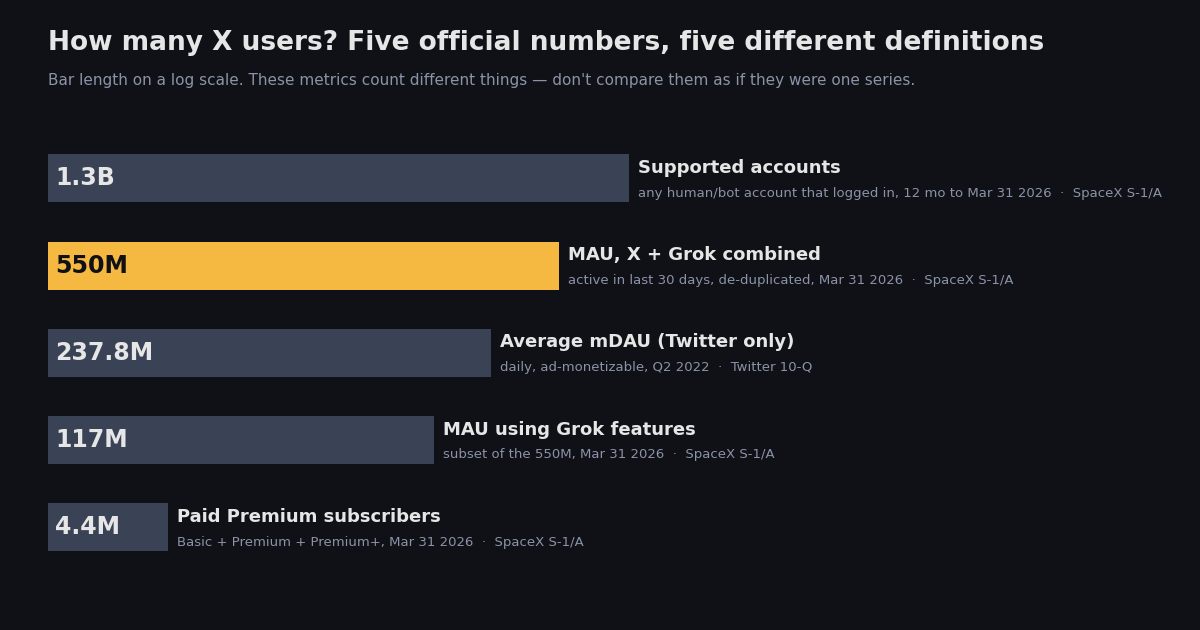
"How many people use Twitter?" sounds like it should have a single answer. In practice there are at least five different numbers in circulation, and they measure different things: monthly users, daily users, yearly logged-in accounts, survey-based adoption, and paying subscribers. Quoting the wrong one in a pitch deck, research paper or market-sizing model can be off by a factor of two or more.
This page collects only figures we could trace to a primary document: SEC filings (the 2026 SpaceX S-1/A and Twitter's 2022 10-Q) and Pew Research Center's survey data. Every number below names its source and measurement date. Where we do arithmetic on those numbers, we show the inputs. At the end, there is a short Python script for the question most developers and analysts actually need answered: not how many users X has in total, but how many of them are in the audience you care about.
Every official X user number, side by side
The table below lists each user metric with its exact definition. The "Counts" column is the part most statistics roundups leave out, and it explains why the numbers disagree.
If you need one number for a sentence, the defensible phrasing is: "X and Grok had about 550 million combined monthly active users as of March 31, 2026, according to SpaceX's S-1 filing." Writing "X has 550 million users" drops the Grok qualifier that the filing itself includes.
Why the 550 million figure is not "X users" alone
X Holdings and xAI merged, and the combined company became part of SpaceX, which filed to go public in 2026. Its S-1/A reports user metrics for its "AI segment" as one platform. In the definitions section, MAU counts "the total number of users who have interacted with Grok or X through web browsers or mobile applications at least once during the 30-day period ending on the date of measurement." The filing adds three qualifiers worth knowing.
De-duplication is approximate. Users of both apps are matched "based on sign-in traffic" so they are not counted twice, but the filing says the method "may not fully capture all instances of duplication" and that the MAU should be viewed as an estimate.
Only registered users count. Logged-out readers, including people who open a tweet link without an account, are excluded from the MAU.
The 1.3 billion number is much looser. "Supported accounts" means any "human, bot or similar account" that logged in during the trailing twelve months, and the filing states that this total "may include fake, spam or bot accounts if they are active." It measures reach over a year, not monthly usage.
Some quick arithmetic on the filing's own numbers: 117M of 550M MAUs, about 21%, used Grok's AI features in March 2026, up from 89M of 520M (about 17%) in December 2025. Combined MAU grew by about 30 million, roughly 5.8%, in that quarter. The filing does not split the remaining MAUs by app, so an exact X-only figure cannot be derived from it.
From mDAU to MAU: why 2022 and 2026 numbers don't compare
Until its acquisition in October 2022, Twitter reported monetizable daily active usage (mDAU): accounts that logged in on a given day and could be shown ads. Its last 10-Q, covering the three months to June 30, 2022, reported 237.8 million average mDAU, up 16.6% year over year. That split into 41.5 million in the United States and 196.3 million in the rest of the world, so about 17.5% of mDAU were US-based (41.5 ÷ 237.8).
Comparing 237.8M (2022) with 550M (2026) and calling it growth would be a mistake, for three reasons.
A monthly metric is always larger than a daily one for the same product, because occasional users count once a month but only on the days they show up. Adding Grok widens it further. The two numbers describe different things, and no public filing bridges them.
Twitter (X) demographics: US adoption by age and gender
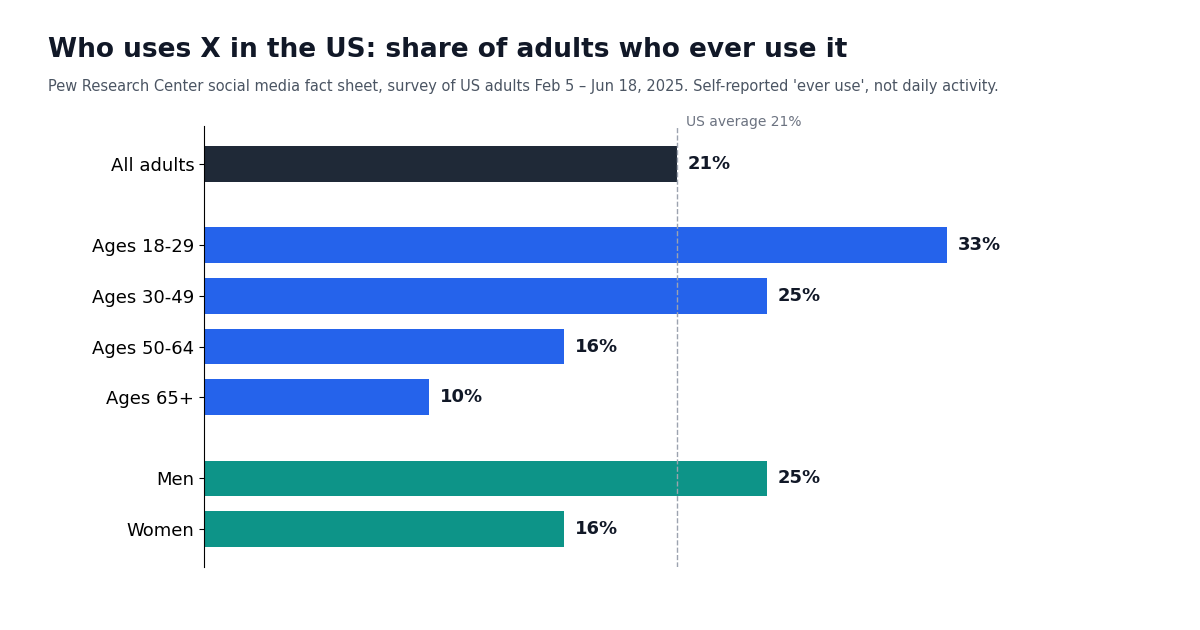
Company filings tell you how many accounts are active. Surveys tell you who the people are. Pew Research Center's social media fact sheet, based on a survey of US adults conducted February 5 to June 18, 2025, puts X use at 21% of US adults. That is about where it has been for years: Pew's own trend line shows 24% in January 2018, 22% in 2019, 23% in 2021, 22% in 2023 and 21% in 2024.
Two practical takeaways. X skews younger and male in the US, so a platform-wide user count overstates reach for older or female-skewed audiences. And survey adoption ("ever use") is a lower bar than daily activity, which is why Pew's share should not be multiplied out into a precise user count without stating that assumption.
How many X users pay? Premium subscriber counts
The S-1/A also discloses paid subscribers. As of December 31, 2025 there were about 4.1 million paid X Premium subscribers (Basic, Premium and Premium+ combined), rising to about 4.4 million by March 31, 2026. Across X and Grok together, paid subscribers went from about 4.9 million to about 6.3 million over the same quarter, with most of that growth coming from Grok's SuperGrok tiers.
Measured against the 550M combined MAU, X Premium subscribers equal roughly 0.8% (4.4 ÷ 550). Because the denominator includes Grok-only users, the real conversion rate among X users alone is somewhat higher, but the filing doesn't give the inputs to compute it. For anyone using paid status as a filter in research data, this is the useful number: paying accounts are a small minority of the active base.
Platform totals vs your audience: measure the users who matter
For product, research and marketing work, "how many X users are there" usually stands in for a narrower question: how many people on X are in my niche, and how reachable are they? Platform MAU can't answer that. Account-level data can.
A practical approach is to start from a seed list of accounts that define the niche, such as conference speakers, top projects in a category, or accounts surfaced by a keyword user search, and pull their public profile data: follower counts, account creation dates and self-reported locations. The snippet below uses TwitterAPI.io's user search endpoint to collect candidate accounts for a keyword. The full end-to-end script at the bottom of the page then sizes a handle list.
Two caveats keep the output honest. Follower counts overlap heavily inside a niche, so the sum of followers is an upper bound on reach, not a count of unique people. And profile location is free text typed by the user. Treat it as a rough signal, not geodata.
# Collect candidate accounts for a niche via keyword user search.
import os, requests

HEADERS = {"X-API-Key": os.environ["TWITTERAPI_IO_KEY"]}

def search_users(query: str, max_pages: int = 3) -> list[dict]:
    users, cursor = [], ""
    for _ in range(max_pages):
        r = requests.get(
            "https://api.twitterapi.io/twitter/user/search",
            headers=HEADERS,
            params={"query": query, "cursor": cursor},
            timeout=15,
        )
        r.raise_for_status()
        body = r.json()
        users.extend(body.get("users", []))
        if not body.get("has_next_page"):
            break
        cursor = body.get("next_cursor", "")
    return users

for u in search_users("vector database")[:20]:
print(f"@{u['userName']:<20} followers={u.get('followers', 0):>9,} {u.get('location', '')}")What it costs to size an audience via API
Profile lookups are the main cost when sizing an audience this way. TwitterAPI.io charges $0.18 per 1,000 user profiles returned (twitterapi.io/pricing). The official X API's pay-per-use plan charges $0.010 per User read resource (docs.x.com pricing). That is about 55× more per profile ($0.010 ÷ $0.00018 ≈ 55.6).
The official API remains the right choice if you need X's first-party guarantees or write access under its developer agreement. For read-only audience research at volume, the per-profile price difference dominates the budget.
# Size a niche audience on X from a list of handles.
# Outputs follower reach (upper bound), account age buckets and top self-reported locations.
import os, requests
from collections import Counter
from datetime import datetime, timezone

HEADERS = {"X-API-Key": os.environ["TWITTERAPI_IO_KEY"]}
HANDLES = ["vercel", "supabase", "github", "cloudflare", "neondatabase"]

def get_profile(handle: str) -> dict | None:
    r = requests.get(
        "https://api.twitterapi.io/twitter/user/info",
        headers=HEADERS,
        params={"userName": handle},
        timeout=15,
    )
    if r.status_code != 200:
        return None
    return r.json().get("data")

def account_age_years(created_at: str) -> float | None:
    # createdAt looks like "Tue Mar 21 20:50:14 +0000 2006"
    try:
        dt = datetime.strptime(created_at, "%a %b %d %H:%M:%S %z %Y")
    except (TypeError, ValueError):
        return None
    return (datetime.now(timezone.utc) - dt).days / 365.25

profiles = [p for p in (get_profile(h) for h in HANDLES) if p]

reach = sum(p.get("followers", 0) for p in profiles)
ages = Counter()
for p in profiles:
    age = account_age_years(p.get("createdAt", ""))
    if age is not None:
        ages["<3y" if age < 3 else "3-10y" if age < 10 else "10y+"] += 1
locations = Counter(p.get("location") or "(blank)" for p in profiles)

print(f"profiles fetched: {len(profiles)}/{len(HANDLES)}")
print(f"summed followers (upper bound, overlaps not removed): {reach:,}")
print(f"account age: {dict(ages)}")
print(f"top locations: {locations.most_common(5)}")
print(f"cost: {len(profiles)} profiles x $0.00018 = ${len(profiles) * 0.00018:.5f}")Questions readers ask
How many people use Twitter (X) in 2026?
About 550 million monthly active users across X and Grok combined as of March 31, 2026, according to SpaceX's S-1/A filed with the SEC. X does not publish a separate X-only monthly figure.
How many daily active users does X have?
There is no current official daily figure. The last one was 237.8 million average monetizable daily active users (mDAU) in Q2 2022, from Twitter's final 10-Q before it went private. Daily numbers quoted for later years come from estimates or executive statements, not SEC filings.
What is the difference between MAU and supported accounts?
MAU (~550M) counts registered X or Grok users active at least once in a 30-day window, de-duplicated across the two apps. Supported accounts (~1.3B) count any human, bot or similar account that logged in during the trailing 12 months, and the filing notes it may include spam and bot accounts.
How many Twitter users are in the United States?
The last company figure is 41.5 million US mDAU in Q2 2022, about 17.5% of the 237.8M total. The 2026 filing does not break MAU out by country. For a current US view, Pew Research Center's 2025 survey found 21% of US adults say they ever use X.
How many X Premium subscribers are there?
About 4.4 million paid X Premium subscribers (Basic, Premium and Premium+ combined) as of March 31, 2026, up from about 4.1 million at the end of 2025, per the SpaceX S-1/A.
Is the number of Twitter users growing or shrinking?
On the filing's own metric, combined X and Grok MAU rose from about 520M to about 550M between December 31, 2025 and March 31, 2026. Because Grok is included, that change cannot be attributed to X alone. US adoption in Pew's survey has stayed between 21% and 24% since 2018.
Can I count users in a specific niche with an API?
Yes, approximately. Build a seed list of accounts through keyword user search or a known handle list, then pull profile data (follower counts, creation dates, locations) per account. Summed follower counts overlap, so treat them as an upper bound on reach. On TwitterAPI.io, profile lookups cost $0.18 per 1,000.
Continue
- SpaceX Form S-1/A (SEC EDGAR) — MAU, supported accounts and subscriber definitions for X and Grok
- Twitter, Inc. Form 10-Q for Q2 2022 (SEC EDGAR) — last reported mDAU, US vs international
- Pew Research Center — Social media fact sheet (X use by age, gender, trend since 2012)
- X Developer Platform — pay-per-use pricing (User: Read per resource)
- TwitterAPI.io docs — user info endpoint and response fields
- TwitterAPI.io pricing — $0.18 per 1,000 profiles
- Twitter (X) API — endpoint hub
- Get any account's follower count via API
- Who has the most Twitter followers — live leaderboard
- Twitter (X) data for academic research
- Export a Twitter dataset for research
- Twitter profile analytics via API
- TwitterAPI.io vs the official X API
- TwitterAPI.io pay-per-call pricing
Stop reading. Start building.
Starter credits cover real testing on real data. Google sign-in, no card, no application queue.
Get an API key