n8n Pricing in 2026: Plans, Executions and the Twitter (X) Data Cost
This page is about what n8n costs, plan by plan, and what an X (Twitter) workflow inside n8n costs once it runs every few minutes. If you want the step-by-step build (credentials, nodes, the HTTP Request setup), read our n8n Twitter API workflow guide instead; here we price it.
Every n8n price below comes from n8n.io/pricing, read for this page, including the numbers behind its Monthly / Annually toggle and its plan tooltips. n8n shows the prices in euros, so we quote them in euros. The X side uses the official X API pay-per-usage rate card on docs.x.com and TwitterAPI.io's own price list, both in US dollars.
The part most n8n pricing guides skip is the interaction between the two meters. A polling workflow burns one n8n execution per run whether it finds a tweet or not, and the data source bills per tweet returned. We measured how often real keyword polls actually find something, then turned those hit rates into a calculator table you can read off directly.
n8n pricing at a glance: every plan, side by side
n8n has four commercial plans plus a free self-hosted edition. The pricing page says all plans "include unlimited users & workflows and every integration" and that pricing "is based on monthly workflow executions, regardless of complexity". Annual billing is labeled "Save 17%".
Starter is pitched as "Build and run your first workflows and agents": 1 shared project, 5 concurrent executions, a 5-minute maximum execution duration, 1,600 Assistant credits a month and forum support. Pro adds 3 shared projects, admin roles, workflow history, 7 days of insights and up to 50 concurrent executions (the tooltip says 20 on the 10k size and 50 on the 50k size), with a 40-minute maximum execution duration.
Overages. The pricing tooltip states that Starter and Pro "are capped and have no overages": hit the limit and you upgrade rather than receive a surprise invoice. Business overage is listed at EUR 4,000 / $4,800 per extra 300,000 executions, and Enterprise overage terms are set in the order form.
Free trial. The n8n Cloud trial needs no credit card and comes with Pro-level features but trial limits of 1,000 executions, 5 concurrent executions, a 180-second execution timeout and 1 team project. A card is required only for the Business trial, which runs 14 days.
Currency. We read the page with euro prices. n8n also takes dollar payment for the annual Business plan (it offers separate euro and dollar contract forms), and the overage tooltip quotes both currencies. Check the page in your own region before you budget.
What counts as an n8n execution (the unit you are billed on)
n8n's own definition: "An execution is a single run of your entire workflow. It doesn't matter how many steps are in the workflow or how much data it processes. It's still a single execution." A workflow with a trigger, an HTTP Request, an IF, a Code node and a Slack node is one execution per run, not five.
Scheduled workflows count every time the schedule fires. n8n's pricing FAQ gives the reference point itself: a daily schedule is 30 or 31 executions a month, while one that runs every 5 minutes "would result in about 8,600-8,900 executions monthly". Our calculator uses a 30-day month, so 5 minutes is 8,640.
Webhook workflows count once per incoming event. If the event happens 50 times a day, that is 50 executions a day, which is why push delivery is usually cheaper on the n8n side than polling (more on that below).
Concurrency is a separate limit. The n8n docs on concurrency say limits apply to production executions (those started from a webhook or trigger node), not to manual, sub-workflow or error executions; anything over the limit waits in a first-in, first-out queue. A single X polling workflow never comes near Starter's 5 concurrent executions, so for this use case the execution count is the constraint that decides your plan.
Saved executions are not billed executions. Each plan keeps a limited history for debugging (2.5k saved executions on Starter, 25k on Pro, 50k on Enterprise, with 7 days, 30 days and unlimited log retention). The page is explicit that reaching a history limit "does not stop your workflows from running"; it only trims the oldest records.
n8n self-hosted pricing: Community edition, Business license and the license terms
Community edition: free. The n8n docs describe it as "the free edition. This is what n8n runs without a license key", with "almost the complete feature set". The main thing it lacks is sharing: only the instance owner and the creator can access workflows and credentials. Registering the instance with an email unlocks a few extras (folders among them) and stays free. The pricing page notes the GitHub repository and its star count rather than any price.
There is no execution meter on the Community edition. Your cost is the server, its uptime and your time maintaining it. For a polling workflow that means 43,200 runs a month cost the same in n8n fees as 720 runs: zero. The data source still bills, so the X data rows of the calculator below apply unchanged.
The license matters for some builders. n8n is not under an OSI open-source license. Its LICENSE.md on GitHub applies the Sustainable Use License, which says: "You may use or modify the software only for your own internal business purposes or for non-commercial or personal use." Files with .ee. in the name need an Enterprise license. If you plan to resell hosted n8n to clients, read the license before you build the business case on the free edition.
Business (self-hosted license). When you need SSO and LDAP, multiple environments, Git version control, queue mode for scaling or 30 days of insights, the self-hosted path is the Business plan. You receive a license key that "must ping our license server daily to stay active", and that ping reports production executions, so the 40,000-execution quota applies to self-hosted runs too. The same key can go on unlimited instances; usage is pooled.
Startup discount. The pricing page offers a Startup plan at 50% off Business for companies under 20 employees, subject to qualification. Business is self-serve: dedicated support is only part of Enterprise.
Is Business available on n8n Cloud? Not yet, according to the FAQ on the pricing page; there is a waitlist for a hosted Business plan.
n8n enterprise pricing: what you get when the price says Contact Sales
Enterprise has no public price. The plan card lists "Custom workflow executions" and says it can be hosted by n8n or self-hosted. On top of Business it adds unlimited shared projects, 200+ concurrent executions, 365 days of insights, external secret store integration, end-user credentials (preview), log streaming, extended data retention and dedicated support with an SLA.
The comparison table adds audit logging, custom roles, execution data redaction, enforcing 2FA across the instance, a worker view for queue mode, two included instances (dev and prod) and pay-by-invoice procurement. Queue mode on n8n Cloud is an Enterprise feature that you enable by contacting n8n.
For an X monitoring workload, Enterprise is rarely about executions. Teams move to it for governance: SSO, audit logs, secrets in an external vault and a support SLA for business-critical alerting. If your only problem is volume, the self-hosted Community edition or a larger Pro or Business tier is the cheaper answer.
Calculator: polling X every N minutes, monthly n8n executions, plan and data cost
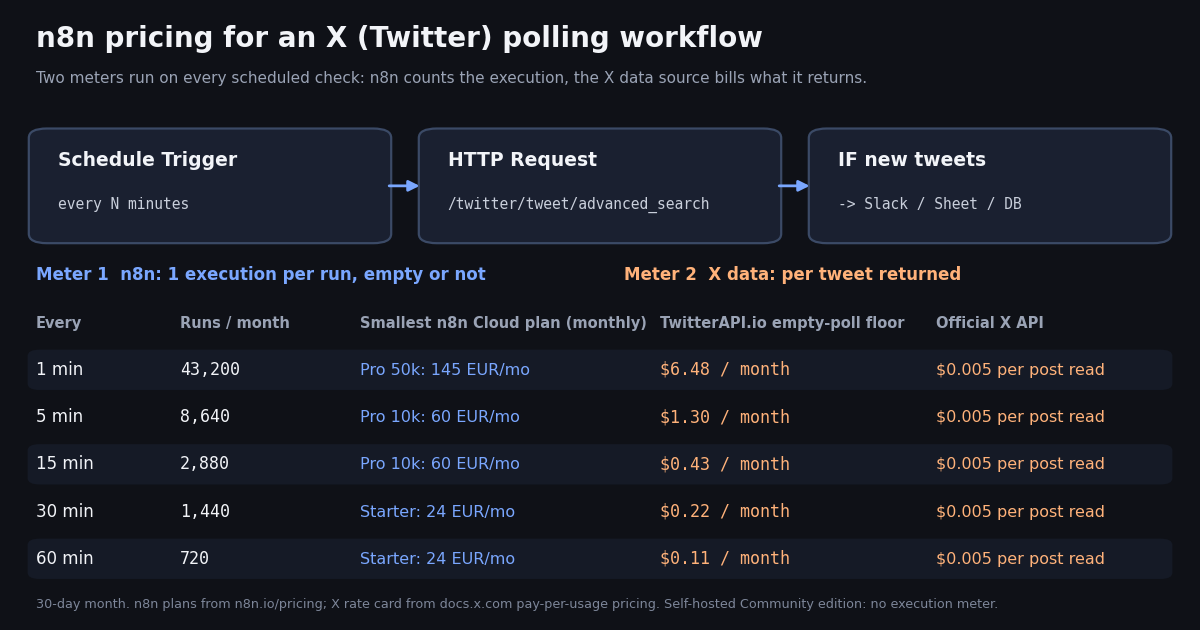
Take one workflow: Schedule Trigger, then an HTTP Request node that calls /twitter/tweet/advanced_search with a since_time: filter, then an IF node that forwards new tweets. Each run is one n8n execution. Each run is also one data request, billed at TwitterAPI.io's 15 credits per tweet returned with a 15-credit minimum ($0.00015) when nothing new comes back.
Two thresholds stand out. A 15-minute schedule is 2,880 runs, which is just over Starter's 2,500, so it needs Pro; 20 minutes (2,160 runs) or slower fits Starter. A 1-minute schedule is 43,200 runs, beyond the 10k Pro size, so it needs the 50k Pro size. Plan prices shown are the monthly-billing figures; annual billing is cheaper (Starter EUR 20, Pro 10k EUR 50 a month).
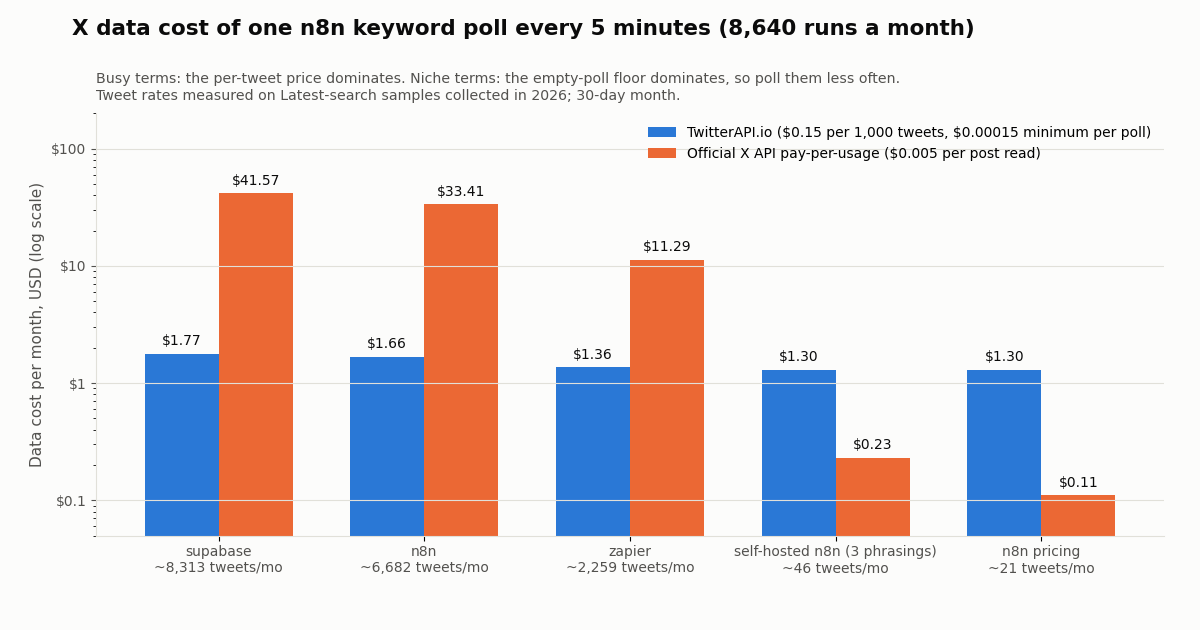
The floor is only what empty polls cost. Real keywords return tweets, so the data line depends on how busy the keyword is. Using the tweet rates we measured (next section), here is the full monthly data cost of one keyword polled every 5 minutes, on both rate cards.
How the two rate cards differ. TwitterAPI.io charges $0.15 per 1,000 tweets returned; the official X API pay-per-usage card on docs.x.com/x-api/getting-started/pricing lists Posts: Read at $0.005 per resource, which is $5 per 1,000 posts, about 33 times more per tweet. X bills per resource fetched and deduplicates the same post within a 24-hour UTC window, so in our model an empty X poll costs nothing. That is why the official API comes out lower for very quiet keywords polled often: the $0.00015 floor on 8,640 empty polls outweighs a handful of $0.005 posts. Poll quiet terms every 30 to 60 minutes and the two lines meet ("n8n pricing" at 60 minutes: $0.11 on both).
What the official X API also requires. Pay-per-usage needs a developer account with prepaid credits; the docs mention $20 of credits when you save a first card and buy credits, plus a match of your first auto-recharge up to $50, and a cap of 3 million post reads per monthly billing cycle before Enterprise. TwitterAPI.io reads need no X account; new accounts that pass the automatic bot check get up to $1 of free credits (at most 100,000 credits, no card, one per person or network, expiring after 31 days), and purchased credits never expire.
How often does a scheduled X poll actually find a new tweet?
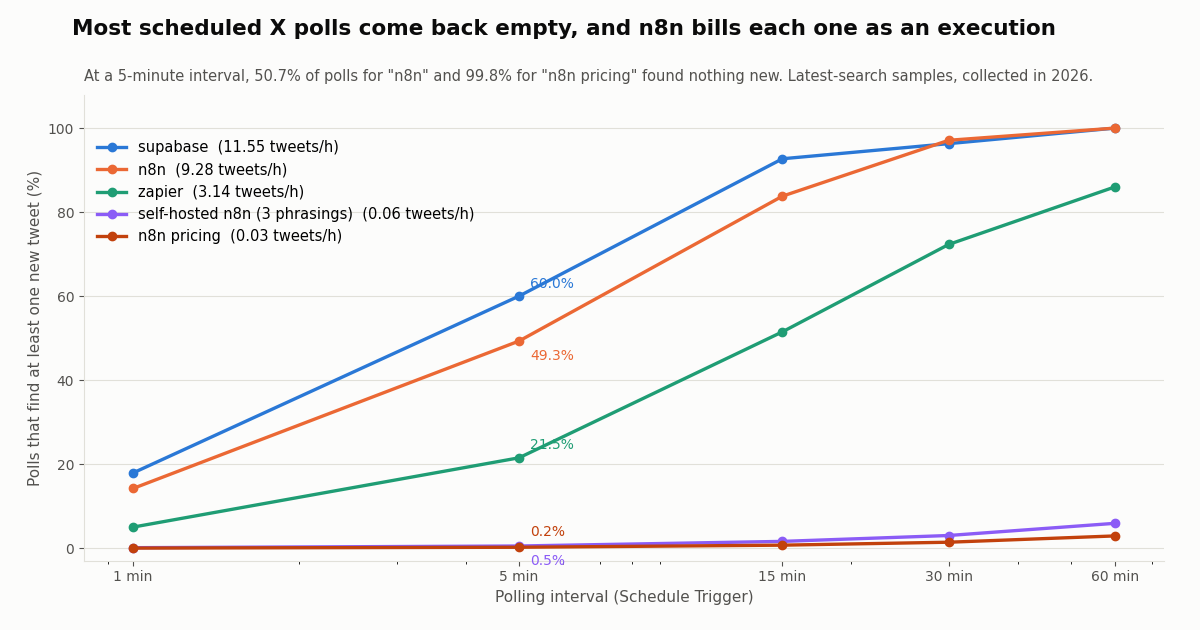
We pulled the most recent tweets for five keywords with /twitter/tweet/advanced_search (Latest), then replayed a Schedule Trigger over the sampled period: cut the time span into back-to-back 1, 5, 15, 30 and 60 minute windows and counted the windows that contained at least one tweet. A window with zero tweets is a run that would cost an n8n execution and return nothing.
Reading the table. Even "n8n", a brand term at 9.28 tweets an hour in our sample, leaves 85.8% of 1-minute polls empty. A niche phrase like "n8n pricing" (about 21 matching tweets a month at the measured rate) finds something in fewer than 3 of every 100 hourly polls. Every one of those empty runs is still an n8n execution.
What this means for your plan choice. Polling faster than the keyword moves buys almost nothing. For "n8n", going from 15 minutes to 5 minutes triples executions (2,880 to 8,640) to catch tweets an average of a few minutes sooner. For "n8n pricing", hourly polling (720 runs, Starter) misses nothing that a 5-minute poll catches, because the query returns everything since the last since_time: either way.
The @n8n_io account itself. As a side check we read 120 recent posts from the official @n8n_io account (84,848 followers at collection). It posted about 7.8 times a week, almost all original posts (3.3% reposts, 4.2% quotes), and 10 of its 116 original posts (8.6%) mentioned pricing, plans, executions or self-hosting. Median original post: 26 likes and about 3,804 views. If you only follow the vendor account for pricing news, an hourly poll of from:n8n_io is more than enough.
Five ways to cut both bills on an n8n X workflow
1. Match the interval to the keyword. Use the hit-rate table: busy brand terms justify 5 to 15 minutes, niche phrases are fine at 30 to 60 minutes. Moving a niche term from 5 to 60 minutes drops 7,920 executions a month and cuts its empty-poll floor from $1.30 to $0.11.
2. Put many keywords in one query, not many workflows. An execution is one run "regardless of complexity", so one workflow that searches ("n8n pricing" OR "n8n cloud" OR "self-hosted n8n") costs one execution per run instead of three. On the data side it is one request too, so you pay the 15-credit minimum once per run instead of three times.
3. Always filter by time. Add since_time:<unix seconds> from the previous run to the query (the TwitterAPI.io docs list since_time and until_time as the supported operators). The node then only receives new tweets, and you pay only for those. Without it you re-download, and re-pay for, the same 20 tweets on every run.
4. Switch to push when the keyword is quiet. Instead of polling, a TwitterAPI.io filter rule (/oapi/tweet_filter/add_rule, activated with /oapi/tweet_filter/update_rule) can POST matching tweets to an n8n Webhook trigger. n8n then counts an execution only when a match arrives: for "n8n pricing" that is a few dozen runs a month instead of 8,640. See the pricing page for how rules are billed.
5. Self-host when executions, not features, are the problem. A 1-minute poll on several keywords is cheap in data but needs the 50k Pro size on n8n Cloud. On a self-hosted Community edition instance the same workflow has no execution fee at all; you trade the subscription for running the server yourself.
The HTTP Request node settings for the poll look like this (the same call as curl, so you can test it before you build the node):
# n8n HTTP Request node: Method GET, URL below, header X-API-Key, query params query + queryType + cursor
# Replace 1767225600 with the unix time of the previous run (an n8n expression in the node).
curl -sS -G "https://api.twitterapi.io/twitter/tweet/advanced_search" \
  -H "X-API-Key: $TWITTERAPI_IO_KEY" \
  --data-urlencode 'query=("n8n pricing" OR "n8n cloud" OR "self-hosted n8n") since_time:1767225600' \
  --data-urlencode 'queryType=Latest' \
  --data-urlencode 'cursor='
# Response: {"tweets": [...], "has_next_page": true|false, "next_cursor": "..."}
# Empty result = 15 credits ($0.00015); otherwise 15 credits per tweet returned.How we collected this
Question. If an n8n workflow polls X for a keyword on a schedule, how many runs find a new tweet, and what does that imply for n8n executions and the X data bill on two rate cards?
Queries and account. Five Latest searches on /twitter/tweet/advanced_search: n8n, n8n pricing, zapier, supabase, and "self-hosted n8n" OR "self-host n8n" OR "n8n self-hosted", up to 8 pages (about 160 tweets) each. Plus 6 timeline pages from the organization account @n8n_io via /twitter/user/last_tweets and one /twitter/user/info call.
Window and sample. The most recent matching tweets at collection time, collected in 2026: 789 search tweets and 120 @n8n_io posts. Spans ranged from 13.8 hours (supabase) to about 209 days (n8n pricing), because quiet terms reach further back in 160 tweets. 47 requests in total, about $0.14 of credits.
Method. Each query's span was cut into back-to-back windows of 1, 5, 15, 30 and 60 minutes; a window counts as a hit when it holds at least one sampled tweet. Monthly figures extrapolate the measured tweet rate to a 30-day month. TwitterAPI.io cost per run is 15 credits times the tweets returned, minimum 15; the official X API cost is $0.005 per post, each post read once.
What the sample cannot show. Tweet rates swing with news, launches and outages; a single span of hours for busy terms can be higher or lower than that term's monthly average. Search results reflect what the search index returns for the query, not every post on X. The calculator ignores multi-page runs (a burst of more than 20 new tweets needs a second request) and taxes or currency conversion on n8n's euro prices.
Privacy. Aggregates only. Search results come mostly from private individuals, so those raw pages were not kept in the repository and no author is named or profiled; the published sample holds de-identified rows (minutes since the newest tweet, engagement counts, language, reply flag). @n8n_io is an organization account.
Price your own n8n X workflow before you pick a plan
The order that saves money: measure the keyword first, pick the interval from its hit rate, then pick the n8n plan from the resulting run count, and only then compare data rate cards. The Python script below does exactly that for any query: it pulls the last 24 hours of matching tweets, replays 1 to 60 minute schedules over them, and prints executions, the smallest n8n Cloud plan and the monthly data cost on both rate cards.
Getting a key. Create an account in the dashboard to get an API key; requests run at 0.2 per second before the first payment and 20 per second once paid, which is far above what a schedule needs (one request a minute is 0.017 per second). The full endpoint reference lives at docs.twitterapi.io, and the end-to-end node setup is in the n8n Twitter API workflow guide linked below.
Rule of thumb from our data. Busy keyword, under 15 minutes: Pro on n8n Cloud, and the per-tweet data price decides the rest. Quiet keyword: poll every 30 to 60 minutes on Starter, or push through a filter rule into a Webhook trigger, and the data line stays near the floor. Many keywords or 1-minute freshness: self-host the Community edition and keep the data line as the only meter.
"""n8n_x_cost.py - price an n8n Schedule Trigger + X keyword poll before you build it.

Pulls the last 24 hours of tweets for a query from TwitterAPI.io, replays 1-60 minute
schedules over them, and prints n8n executions, the smallest n8n Cloud plan and the
monthly X data cost on TwitterAPI.io vs the official X API rate card.

pip install requests ; export TWITTERAPI_IO_KEY=...
python n8n_x_cost.py '"n8n pricing" OR "self-hosted n8n"'
"""
import os
import sys
import time
from datetime import datetime

import requests

BASE = "https://api.twitterapi.io"
KEY = os.environ["TWITTERAPI_IO_KEY"]
MONTH_MIN = 30 * 24 * 60          # 43,200 minutes in a 30-day month
TWAPI_PER_TWEET = 0.00015         # 15 credits per tweet returned ($1 = 100,000 credits)
X_PER_POST = 0.005                # official X API pay-per-usage, Posts: Read
# n8n Cloud plans, billed monthly, from n8n.io/pricing (EUR)
PLANS = [("Starter", 2_500, 24), ("Pro 10k", 10_000, 60), ("Pro 50k", 50_000, 145)]


def fetch_since(query, since_unix, max_pages=10):
    """All tweets matching query since since_unix, following next_cursor."""
    tweets, cursor = [], ""
    for _ in range(max_pages):
        r = requests.get(
            f"{BASE}/twitter/tweet/advanced_search",
            headers={"X-API-Key": KEY},
            params={"query": f"{query} since_time:{since_unix}", "queryType": "Latest", "cursor": cursor},
            timeout=30,
        )
        r.raise_for_status()
        body = r.json()
        tweets.extend(body.get("tweets", []))
        if not body.get("has_next_page"):
            break
        cursor = body.get("next_cursor", "")
        time.sleep(5)  # stay under 0.2 requests/s on a free account
    return tweets


def plan_for(runs):
    for name, cap, eur in PLANS:
        if runs <= cap:
            return f"{name} (EUR {eur}/mo)"
    return "over 50k: Business self-hosted, Enterprise, or Community edition"


def main(query):
    now = int(time.time())
    tweets = fetch_since(query, now - 24 * 3600)
    stamps = [datetime.strptime(t["createdAt"], "%a %b %d %H:%M:%S %z %Y").timestamp() for t in tweets]
    ages_min = [(now - s) / 60 for s in stamps]
    per_month = len(tweets) * 30  # tweets in 24 h x 30 days
    print(f"{len(tweets)} tweets in the last 24 h -> about {per_month:,} a month")
    if len(tweets) >= 200:
        print("(hit max_pages: busy query, the rate is a lower bound)")
    print(f"{'every':>6} {'runs/mo':>8} {'hit%':>6} {'TwitterAPI.io':>14} {'official X':>11}  n8n plan")
    for every in (1, 5, 15, 30, 60):
        windows = (24 * 60) // every
        counts = [0] * windows
        for a in ages_min:
            i = int(a // every)
            if i < windows:
                counts[i] += 1
        hit = sum(1 for c in counts if c) / windows
        runs = MONTH_MIN // every
        billed_units = sum(max(1, c) for c in counts) / windows  # empty run still bills the 15-credit minimum
        twapi = runs * billed_units * TWAPI_PER_TWEET
        xapi = per_month * X_PER_POST
        print(f"{every:>4} m {runs:>8,} {hit:>6.1%} {twapi:>13.2f}$ {xapi:>10.2f}$  {plan_for(runs)}")
    print("Self-hosted Community edition: no n8n execution fee; the data columns still apply.")


if __name__ == "__main__":
    main(sys.argv[1] if len(sys.argv) > 1 else "n8n")
Questions readers ask
How much does n8n cost per month?
On n8n.io/pricing, n8n Cloud Starter is EUR 24 a month billed monthly or EUR 20 a month billed annually for 2,500 executions; Pro is EUR 60 monthly or EUR 50 a month annually for 10,000 executions, with a 50,000-execution size at EUR 145 monthly. Business is EUR 800 monthly or EUR 667 a month annually for 40,000 executions, self-hosted only. Enterprise is quoted by sales, and the self-hosted Community edition is free.
Is n8n free to self-host?
Yes. The Community edition is what n8n runs without a license key and the n8n docs call it free, with almost the complete feature set except workflow and credential sharing. It is under the Sustainable Use License, which allows use for your own internal business purposes or non-commercial and personal use. You pay for the server you run it on.
Does n8n charge per step or per node?
No. n8n bills per execution, and an execution is one run of the entire workflow regardless of how many steps it has or how much data it processes. A trigger plus ten nodes is still one execution per run.
How many executions does a workflow that runs every 5 minutes use?
About 8,640 in a 30-day month; n8n's own FAQ says about 8,600 to 8,900. That is over Starter's 2,500, so it needs Pro (10,000). Every 15 minutes is 2,880 runs, also over Starter; every 30 minutes is 1,440 and fits Starter; every minute is 43,200 and needs the 50,000-execution Pro size.
What happens if I go over my n8n execution limit?
The pricing page says Starter and Pro are capped and have no overages, so you upgrade to a bigger plan. On Business your workflows keep running and overage is listed at EUR 4,000 / $4,800 per extra 300,000 executions unless you move to the next tier. Enterprise overage is set in the order form.
Is the n8n Business plan available on n8n Cloud?
Not yet. The pricing page FAQ says Business is currently only available for self-hosted n8n and offers a waitlist for a hosted version. Hosted plans are Starter, Pro and Enterprise.
Do empty polls count as n8n executions?
Yes. A Schedule Trigger run is an execution whether or not the HTTP Request finds new data. In our 2026 sample half of 5-minute polls for "n8n" and 99.8% for "n8n pricing" found nothing new, so match the interval to how busy the keyword is, or use a webhook so runs happen only when a match arrives.
What does the X (Twitter) data cost inside an n8n workflow?
It depends on the source. The official X API pay-per-usage rate card lists $0.005 per post read ($5 per 1,000). TwitterAPI.io bills $0.15 per 1,000 tweets returned with a $0.00015 minimum per request, so an every-minute poll that never finds anything costs $6.48 a month. For a busy keyword polled every 5 minutes we measured about $1.66 a month on TwitterAPI.io vs $33.41 on the official card.
Continue
- n8n Plans and Pricing: Starter, Pro, Business, Enterprise, executions, trial and FAQ
- n8n docs: Compare editions (Community, Registered Community, Business, Enterprise)
- n8n LICENSE.md on GitHub: Sustainable Use License
- n8n docs: Understand concurrency (production executions, queueing)
- X API pay-per-usage pricing and credits (Posts: Read $0.005 per resource)
- TwitterAPI.io docs: advanced_search (query, queryType, cursor, since_time)
- X (Twitter) API hub: endpoints, auth and pricing
- n8n Twitter API workflow: build the polling nodes step by step
- Make.com Twitter integration and its operations-based cost
- Developer guide to keyword alerts on X
- Twitter API pricing compared across rate cards
- Twitter rate limit calculator for polling schedules
- TwitterAPI.io pricing: credits per tweet and per profile
- Get a TwitterAPI.io API key in the dashboard
- 01Twitter (X) API License: The Developer Agreement in Plain English
- 02Claude Managed Agents: What It Is, What It Costs, and a Twitter (X) Monitoring Agent Built on It
- 03Cursor vs Claude Code: Plans, MCP Setup and Headless Runs Compared for Twitter (X) Data Work
- 04Codex Pricing in 2026: ChatGPT Plans, Usage Limits, Credits and API-Key Costs
- 05Claude Code --dangerously-skip-permissions: what it skips, what it still blocks, and a safer unattended setup
- 06n8n Twitter (X) API Workflow: Post New Tweets to Slack in 2026
- 07Claude Code Pricing in 2026: Plans, Usage Limits and the Real Cost of an Always-On Agent
- 08Claude API Pricing in 2026: Per-Token Rates and What 1,000 Tweets Really Cost
Stop reading. Start building.
Starter credits cover real testing on real data. Google sign-in, no card, no application queue.
Get an API keyAlready building with TwitterAPI.io? Publish an honest tutorial or build log about it and earn up to $200 a month in API credits.