Twitter (X) Ads Library: What the X Ads Repository Shows, and What It Misses
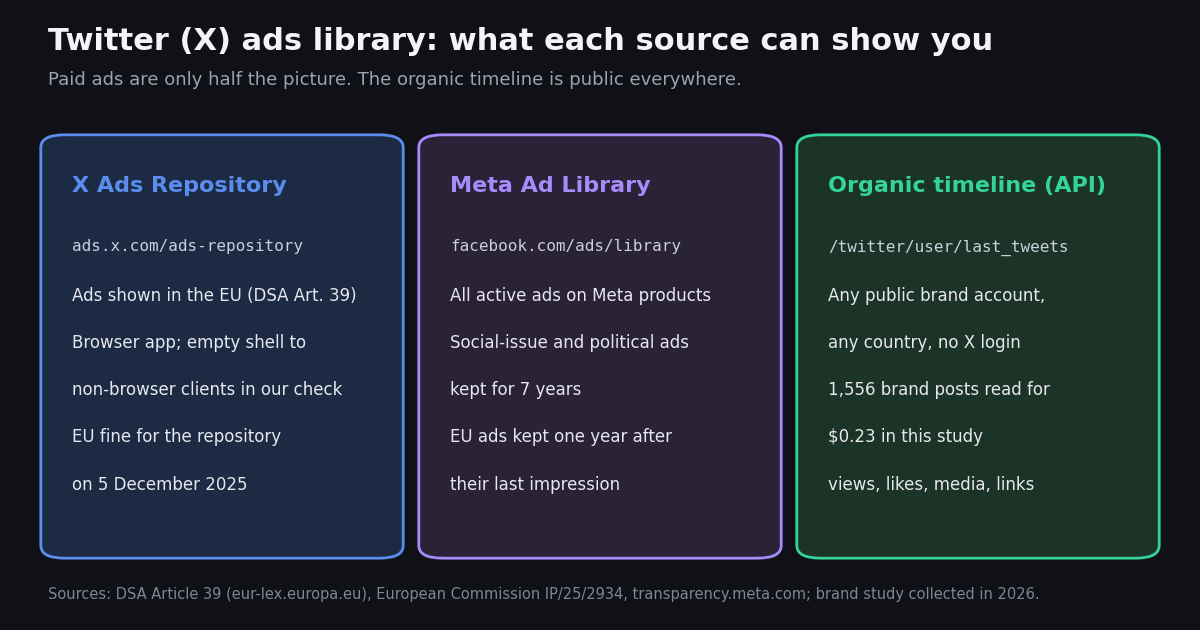
- The X Ads Repository is the Twitter ads library:
ads.x.com/ads-repository, built for Article 39 of the EU Digital Services Act. The legal duty is EU-only. - What the law requires it to show: ad content, advertiser, payer, display period, targeting parameters, recipients reached (with EU country breakdowns), kept until one year after the last impression.
- What the EU says it lacks: the 5 December 2025 decision (€120 million fine) found no ad content, topic or paying entity, plus access barriers such as excessive processing delays.
- Meta's Ad Library is broader: all active ads on Meta products, social-issue and political ads kept 7 years, plus an Ad Library API for authorized users.
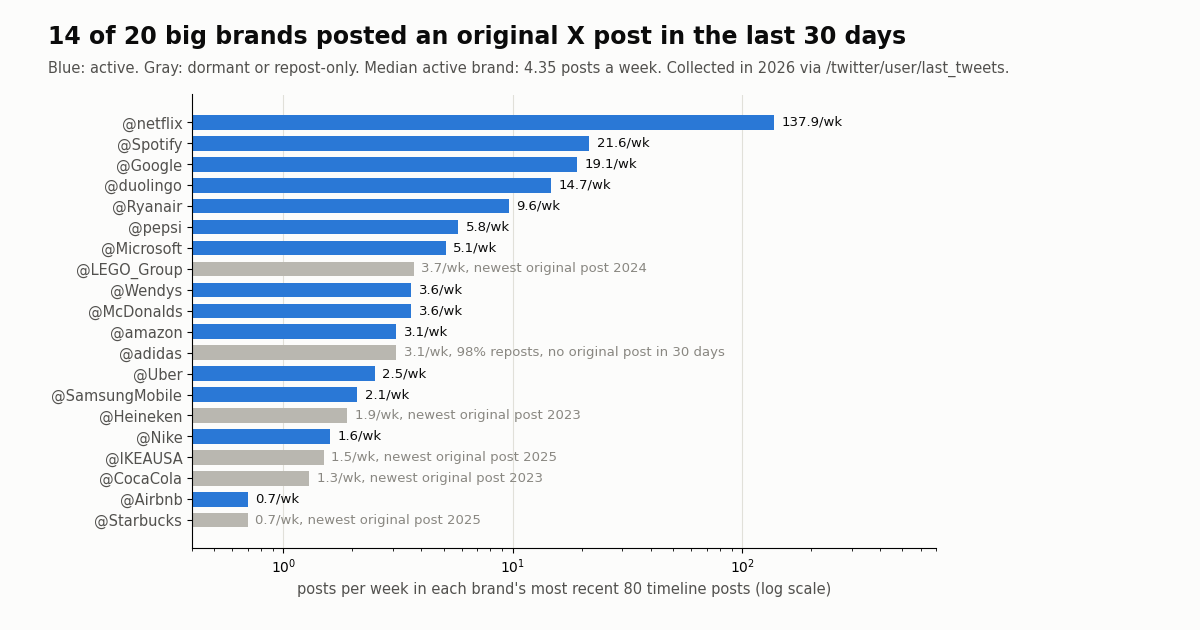
- The organic side is public everywhere: 14 of 20 big brands posted originally on X in the last 30 days; the median active brand posted 4.35 times a week, and only 2.8% of their original posts carried an external link.
- Track brands for cents: 1,556 brand posts cost $0.23 with
/twitter/user/last_tweets($0.15 per 1,000 tweets) versus $7.78 at X's $0.005 per post read.
People who search for a Twitter ads library usually want one thing: to see what a competitor is running on X. X does have a public ad archive, the X Ads Repository, but it exists to satisfy an EU law, it covers the ads that law covers, and the European Commission has formally found it short of that law. This page lays out what the repository is required to contain, what we could and could not see in it, how it compares with the Meta Ad Library, and where the gap leaves you.
The angle here is competitor research, not running your own campaigns. If you want programmatic access to your own ad accounts (campaigns, audiences, analytics), that is the X Ads API, covered in our guide to X Ads API access. If you want to measure your own account's performance, start with the Twitter analytics guide. This page covers the public transparency library and the organic data you can pair with it.
Because the repository is EU-only and thin, we also ran a real-data study: the latest timelines of 20 large consumer brands, 1,556 posts read through the API and collected in 2026, to show what a brand's public X activity actually looks like and what it costs to watch it.
14 of 20. Six household names (Coca-Cola and Heineken since 2023, LEGO Group since 2024, Starbucks and IKEA USA since 2025, adidas reposts only) had gone quiet; 1,556 posts read for $0.23, collected in 2026.
What the Twitter (X) ads library is: the X Ads Repository
X's ad archive lives at ads.x.com/ads-repository (the old ads.twitter.com/ads-repository address serves the same page). X describes it on its ads transparency help pages, business.x.com/en/help/ads-policies/product-policies/ads-transparency and help.x.com/en/business-and-advertising/ads-transparency; both returned a 403 challenge to our fetch, so we cite them as pointers and take the requirements from the law itself.
The legal basis is DSA Article 39. Regulation (EU) 2022/2065, the Digital Services Act, says that providers of very large online platforms that present advertisements "shall compile and make publicly available" a repository "through a searchable and reliable tool that allows multicriteria queries and through application programming interfaces", for the whole period an ad runs "and until one year after the advertisement was presented for the last time". The repository must not contain personal data of the people who saw the ad.
The seven required items. Article 39(2) lists the minimum content of each entry:
Removed ads are handled differently. Under Article 39(3), if the platform removed an ad for alleged illegality or a terms violation, the entry drops points (a) to (c) and instead carries the statement of reasons required elsewhere in the DSA. So a pulled ad can still appear, without its creative or advertiser.
What we could see, and what the European Commission found
Our reachability check. We requested ads.x.com/ads-repository without logging in. It answered HTTP 200 with a 2,368-byte HTML page titled "Ads repository" whose body is an empty application root plus two JavaScript bundles. A non-browser client sees no ads, no search form and no download links; everything is rendered client-side. We did not log in or drive a browser session, so this page reports no repository entries, fields or advertisers that we did not see ourselves.
The Commission's findings. On 5 December 2025 the European Commission issued its first DSA non-compliance decision and fined X €120 million (press release IP/25/2934). On the repository it found that X's advertisement repository "fails to meet the transparency and accessibility requirements of the DSA", that X "incorporates design features and access barriers, such as excessive delays in processing", and that the repository "lacks critical information, such as the content and topic of the advertisement, as well as the legal entity paying for it."
What happens next. The same decision gave X 90 working days to submit an action plan for the Article 39 (ads repository) and Article 40(12) (researcher data access) breaches; the Board of Digital Services then has one month to give its opinion and the Commission another month to decide and set an implementation period. Non-compliance can lead to periodic penalty payments. In practice, treat the repository as a moving target and check it in a browser before relying on any field.
What this means for competitor research. Points (a) and (c) of Article 39(2), the creative and the payer, are exactly what a marketer wants, and they are the items the Commission says are missing. Even when the repository works as the law intends, it only has to cover ads presented in the EU.
X Ads Repository vs Meta Ad Library
Meta's Ad Library is the reference point most marketers have in mind. Meta's own description (transparency.meta.com/researchtools/ad-library-tools) says people "can search for all active ads running across products from Meta", that ads about social issues, elections or politics are "stored in the Ad Library for 7 years", and that EU ads get extra detail and are "archived for one year upon the delivery of their last impression." The two libraries line up like this:
The practical gap. If your competitor sells in the US, Canada, Japan, Brazil or Australia and never targets EU users, no law requires X to publish their promoted posts, and nothing in the repository's legal basis covers them. Meta's library would show the same brand's active Facebook and Instagram ads in any country. On X, the dependable public record outside the EU is the brand's organic timeline.
The other half: what brands post organically on X
Promoted posts on X are usually built from, or alongside, a brand's own posts, so watching the organic timeline tells you what a brand is pushing, how often, and in what format. We read the latest timeline (about 80 posts) of 20 large consumer brands with /twitter/user/last_tweets: 1,556 posts in total, 1,208 of them original (not reposts), collected in 2026.
Finding 1: a big brand being on X does not mean it is active on X. Only 14 of 20 brands had an original post in the last 30 days. Coca-Cola's and Heineken's newest original posts date from 2023, LEGO Group's from 2024, Starbucks' and IKEA USA's from 2025, and adidas' recent timeline was 98% reposts. Before you spend time looking for a brand's X ads, check whether it still uses the account at all.
Finding 2: cadence varies by two orders of magnitude. Among active brands the median was 4.35 posts a week, but Netflix posted 137.9 times a week in its window while Airbnb posted 0.7. The median active brand's timeline was 25.6% reposts, so a lot of what appears on a brand's profile is amplification of other accounts (sub-brands, executives, partners).
Finding 3: weekends are quiet. Only 12.0% of the active brands' posts went out on a Saturday or Sunday (UTC). Wednesday (244 posts) and Thursday (232) were the busiest days.
Formats and reach: what the organic data says about creative choices
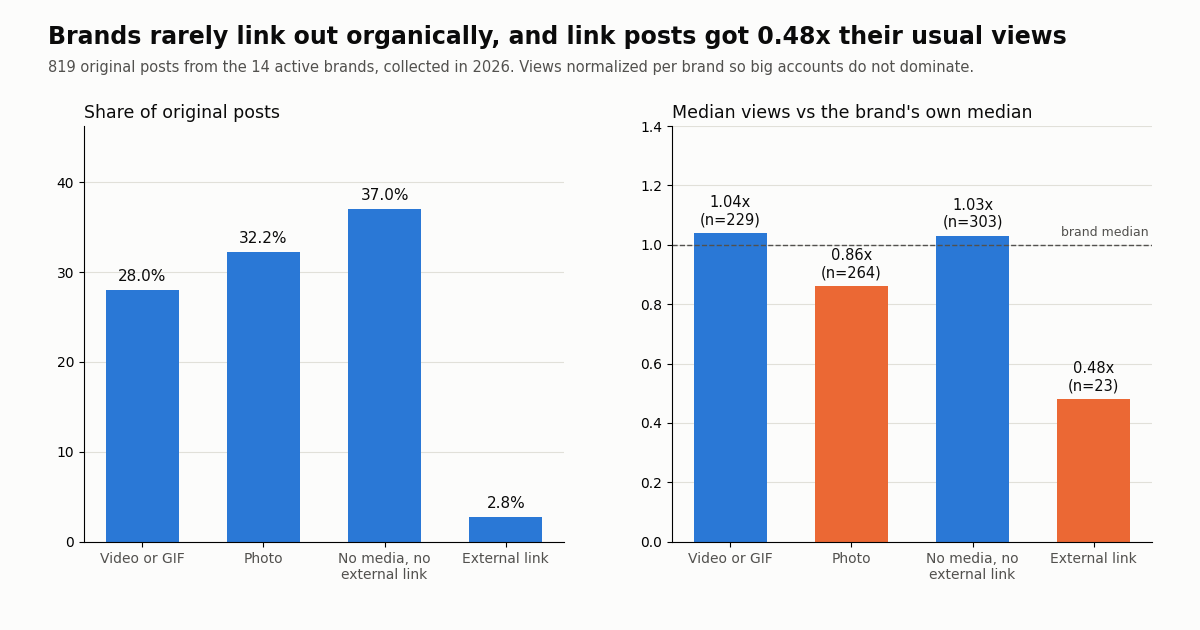
For the 14 active brands we classified each original post by its richest element (video or GIF, then photo, then an external link, otherwise none) and compared its views with that brand's own median, so one viral account does not swamp the rest.
Links are rare and under-viewed. Only 2.8% of original posts carried an external link, and those 23 posts reached a median of 0.48x the brand's usual views. Video and plain posts sat at about the brand median (1.04x and 1.03x), photos slightly below (0.86x). The link sample is small (n=23), so read it as a direction, not a rule; X does not say how it ranks posts with links.
Engagement per view is low and similar across brands. The median active brand earned 0.62% engagements (likes, reposts, replies, quotes) per view. Duolingo (2.10%) and Pepsi (1.21%) were well above that, Uber (0.23%) well below. If you want to compute the same ratio for one account, the engagement rate calculator does it in the browser.
What the public data cannot tell you. viewCount is a single number. Nothing in the post object marks whether some of those views came from paid promotion, so a post far above a brand's usual reach is a candidate for a promoted post, not proof of one. That is where the repository (for EU campaigns) or the brand's own disclosures come in.
Build a competitor post tracker with the API
The study above is a few dozen lines of Python. The script below reads the latest posts of a list of brand accounts, classifies each original post's format, scores its views against the brand's own median, writes a CSV and prints the posts with unusual reach. No X account is needed for reads: you authenticate with the X-API-Key header.
Fields used, exactly as the API returns them. /twitter/user/last_tweets returns data.tweets[] (20 per page, newest first) with has_next_page and next_cursor at the top level. Each tweet carries createdAt, viewCount, likeCount, retweetCount, replyCount, quoteCount, entities.urls[], extendedEntities.media[] (with type photo, video or animated_gif) and retweeted_tweet when the post is a repost. An unknown account comes back as HTTP 200 with status set to error and the reason in msg.
Run it on a schedule. Run it once a day per brand list and you have a running record of what each competitor posted, in what format and with what reach, which is the data the X Ads Repository does not give you outside the EU.
import csv
import os
import statistics
from datetime import datetime

import requests

BASE = "https://api.twitterapi.io"
HEADERS = {"X-API-Key": os.environ["TWITTERAPI_IO_KEY"]}
BRANDS = ["McDonalds", "Wendys", "pepsi", "SamsungMobile"]  # public brand accounts you want to watch
PAGES_PER_BRAND = 2  # 20 posts per page, newest first


def classify(tweet):
    media = (tweet.get("extendedEntities") or {}).get("media") or []
    types = {m.get("type") for m in media}
    if types & {"video", "animated_gif"}:
        return "video"
    if "photo" in types:
        return "photo"
    for u in (tweet.get("entities") or {}).get("urls") or []:
        host = (u.get("expanded_url") or "").split("//")[-1].split("/")[0].replace("www.", "")
        if host and host not in ("x.com", "twitter.com", "t.co"):
            return "link"
    return "text"


def brand_posts(user_name):
    posts, cursor = [], ""
    for _ in range(PAGES_PER_BRAND):
        params = {"userName": user_name}
        if cursor:
            params["cursor"] = cursor
        r = requests.get(f"{BASE}/twitter/user/last_tweets", headers=HEADERS, params=params, timeout=30)
        r.raise_for_status()
        body = r.json()
        if body.get("status") == "error":
            raise RuntimeError(body.get("msg"))
        data = body.get("data") or {}
        posts.extend(data.get("tweets", []))
        if not body.get("has_next_page") or not body.get("next_cursor"):
            break
        cursor = body["next_cursor"]
    return posts


rows = []
for brand in BRANDS:
    posts = brand_posts(brand)
    original = [t for t in posts if not t.get("retweeted_tweet")]
    views = [t.get("viewCount") or 0 for t in original if t.get("viewCount")]
    median_views = statistics.median(views) if views else 0
    for t in original:
        v = t.get("viewCount") or 0
        engagement = (t.get("likeCount") or 0) + (t.get("retweetCount") or 0) + (t.get("replyCount") or 0) + (t.get("quoteCount") or 0)
        rows.append({
            "brand": brand,
            "created_at": datetime.strptime(t["createdAt"], "%a %b %d %H:%M:%S %z %Y").isoformat(),
            "format": classify(t),
            "views": v,
            "views_vs_brand_median": round(v / median_views, 2) if median_views else None,
            "engagement_per_view": round(engagement / v, 5) if v else None,
            "url": t.get("url"),
        })

with open("brand_posts.csv", "w", newline="") as f:
    writer = csv.DictWriter(f, fieldnames=list(rows[0].keys()))
    writer.writeheader()
    writer.writerows(rows)

# Posts far above the brand's usual reach are the ones worth checking in an ads library by hand.
for row in sorted(rows, key=lambda r: -(r["views_vs_brand_median"] or 0))[:10]:
    print(row["brand"], row["format"], row["views"], row["views_vs_brand_median"], row["url"])
What tracking brands on X costs
This study. The 1,556 posts cost $0.23 on TwitterAPI.io, which bills timeline reads at 15 credits per tweet returned, $0.15 per 1,000 tweets. The same 1,556 post reads at the official X API pay-per-usage rate card of $0.005 per post read would be $7.78. Per 1,000 tweets that is $0.15 versus $5.00, about 33x (rate card: docs.x.com/x-api/getting-started/pricing, which also caps pay-per-usage at 3 million post reads a month).
Polling for new posts. A check that finds nothing still costs the 15-credit minimum, $0.00015. Checking one brand every 5 minutes for a month is 8,640 checks, a $1.30 floor before any tweets are returned; every 60 seconds it is 43,200 checks, $6.48. For a daily competitor report, one or two pages per brand per day is enough: a brand that posts 4 or 5 times a week rarely fills a 20-post page in a day.
Getting started. New accounts that pass the automatic bot check get up to $1 of free credits (at most 100,000 credits, no card, one per person or network, expiring after 31 days). Purchased credits never expire. Before the first payment the rate limit is 0.2 requests per second; it rises to 20 once you have paid. Plans and credit packs are on the pricing page.
A workflow that combines the repository and organic data
Step 1: confirm the brand is active. Pull the last 20 to 40 posts. If the newest original post is months old, as it was for 6 of the 20 brands we checked, there is little to track organically and any X advertising is likely run from a different handle or not at all.
Step 2: build the organic baseline. Record posting cadence, the format mix and median views for each brand. Our numbers above are a reasonable starting reference for large consumer brands: about 4 posts a week, roughly a third video, a third photo and a third plain posts, almost no external links.
Step 3: flag outliers. Posts with several times the brand's median views are the ones worth looking up. They may be organic hits, or they may have been promoted.
Step 4: check the EU repository by hand. For brands that advertise in the EU, open ads.x.com/ads-repository in a logged-in browser and search the advertiser. Expect gaps: by the Commission's account the entries may lack the creative, the topic and the payer.
Step 5: widen beyond the brand's own account. Campaign hashtags, product names and replies to the brand are searchable with advanced search operators (for example from:, to: and filter:links), which shows how a campaign travels beyond the brand's own posts.
How we collected this
Question. The X Ads Repository only has to cover EU ads, and it showed no content to a non-browser client in our check, so what can a marketer learn about a big brand's X activity from public organic posts alone?
Accounts. 20 brand accounts chosen as large, well-known consumer advertisers before collection: @Nike, @adidas, @McDonalds, @Wendys, @Starbucks, @CocaCola, @pepsi, @SamsungMobile, @netflix, @Spotify, @amazon, @Google, @Microsoft, @Uber, @Airbnb, @duolingo, @Ryanair, @Heineken, @IKEAUSA, @LEGO_Group. Organization accounts only.
Method and window. /twitter/user/last_tweets with default settings (replies excluded), newest first, up to 4 pages (about 80 posts) per brand: 79 requests, 1,556 posts, 1,208 original, collected in 2026. The window per brand runs from its oldest to newest post in the sample, so it ranges from a few days (Netflix) to several years (dormant accounts). "Active" means an original post within 30 days of the newest post in the whole sample.
What the sample cannot show. It cannot tell which posts were promoted or how many views were paid. Twenty brands are not a market average. A pinned post, if returned, can stretch a brand's window. Format classes are by the richest element in the post. Repository content was not collected: we saw only the page shell.
Privacy. Aggregates only, brand accounts only; we did not analyze the authors of reposted or quoted posts. Analysis and chart scripts sit in the repository next to the results file.
import csv
import os
import statistics
from datetime import datetime

import requests

BASE = "https://api.twitterapi.io"
HEADERS = {"X-API-Key": os.environ["TWITTERAPI_IO_KEY"]}
BRANDS = ["McDonalds", "Wendys", "pepsi", "SamsungMobile"]  # public brand accounts you want to watch
PAGES_PER_BRAND = 2  # 20 posts per page, newest first


def classify(tweet):
    media = (tweet.get("extendedEntities") or {}).get("media") or []
    types = {m.get("type") for m in media}
    if types & {"video", "animated_gif"}:
        return "video"
    if "photo" in types:
        return "photo"
    for u in (tweet.get("entities") or {}).get("urls") or []:
        host = (u.get("expanded_url") or "").split("//")[-1].split("/")[0].replace("www.", "")
        if host and host not in ("x.com", "twitter.com", "t.co"):
            return "link"
    return "text"


def brand_posts(user_name):
    posts, cursor = [], ""
    for _ in range(PAGES_PER_BRAND):
        params = {"userName": user_name}
        if cursor:
            params["cursor"] = cursor
        r = requests.get(f"{BASE}/twitter/user/last_tweets", headers=HEADERS, params=params, timeout=30)
        r.raise_for_status()
        body = r.json()
        if body.get("status") == "error":
            raise RuntimeError(body.get("msg"))
        data = body.get("data") or {}
        posts.extend(data.get("tweets", []))
        if not body.get("has_next_page") or not body.get("next_cursor"):
            break
        cursor = body["next_cursor"]
    return posts


rows = []
for brand in BRANDS:
    posts = brand_posts(brand)
    original = [t for t in posts if not t.get("retweeted_tweet")]
    views = [t.get("viewCount") or 0 for t in original if t.get("viewCount")]
    median_views = statistics.median(views) if views else 0
    for t in original:
        v = t.get("viewCount") or 0
        engagement = (t.get("likeCount") or 0) + (t.get("retweetCount") or 0) + (t.get("replyCount") or 0) + (t.get("quoteCount") or 0)
        rows.append({
            "brand": brand,
            "created_at": datetime.strptime(t["createdAt"], "%a %b %d %H:%M:%S %z %Y").isoformat(),
            "format": classify(t),
            "views": v,
            "views_vs_brand_median": round(v / median_views, 2) if median_views else None,
            "engagement_per_view": round(engagement / v, 5) if v else None,
            "url": t.get("url"),
        })

with open("brand_posts.csv", "w", newline="") as f:
    writer = csv.DictWriter(f, fieldnames=list(rows[0].keys()))
    writer.writeheader()
    writer.writerows(rows)

# Posts far above the brand's usual reach are the ones worth checking in an ads library by hand.
for row in sorted(rows, key=lambda r: -(r["views_vs_brand_median"] or 0))[:10]:
    print(row["brand"], row["format"], row["views"], row["views_vs_brand_median"], row["url"])
Researching this?Free starter credits cover end-to-end testing — Google sign-in, no card. Get a key.
Questions readers ask
Does Twitter (X) have an ads library?
Yes. X runs the X Ads Repository at ads.x.com/ads-repository. It exists because Article 39 of the EU Digital Services Act requires very large online platforms to publish a searchable repository of the ads they present, so its legal scope is ads shown in the EU.
Can I see a competitor's X ads in the US?
Not through a legal requirement: the DSA duty behind the repository covers ads presented in the EU, and we found no first-hand statement from X that the repository covers ads shown only elsewhere. Outside the EU, the dependable public record is the brand's organic timeline and posts that mention it.
What information does the X Ads Repository have to include?
Under DSA Article 39(2): the ad content, the advertiser, the payer if different, the period shown, whether it was targeted and the main targeting parameters, commercial communications flagged under Article 26(2), and the number of people reached with per-country counts where applicable, kept until one year after the ad last ran.
Why was X fined over its ads repository?
On 5 December 2025 the European Commission fined X €120 million under the DSA. For the repository it found missing information (the content and topic of ads and the legal entity paying) and access barriers such as excessive processing delays. X was given 90 working days to submit an action plan.
How is the X Ads Repository different from the Meta Ad Library?
Meta says its library lets anyone search all active ads across Meta products, keeps social-issue and political ads for 7 years and offers an Ad Library API to authorized users. X's repository is tied to the EU DSA duty, and the European Commission found it lacks the ad content and payer.
Is the X Ads API the same as the ads library?
No. The X Ads API (docs.x.com/x-ads-api/introduction) is for managing campaigns, audiences, creatives and analytics on ad accounts you work with. It is not a public library of other advertisers' ads.
How much does it cost to track a brand's X posts?
Timeline reads on TwitterAPI.io are $0.15 per 1,000 tweets returned. Our 1,556-post study of 20 brands cost $0.23; the same reads at X's $0.005 per post read would be $7.78. A check that finds no new posts costs the $0.00015 minimum.
Can I tell from the API whether a post was promoted?
No. Public post objects carry viewCount, likes, reposts, replies and quotes, but no flag for paid distribution. A post far above a brand's usual views is a candidate worth checking, not proof that it was promoted.
Continue
- Digital Services Act, Regulation (EU) 2022/2065, Article 39 (EUR-Lex)
- European Commission: Commission fines X €120 million under the Digital Services Act (IP/25/2934)
- Meta Transparency Center: Ad Library tools
- X Developer Platform: X Ads API introduction
- X Developer Platform: X API pricing
- TwitterAPI.io documentation
- Twitter (X) API hub: endpoints, pricing and guides
- X Ads API access: managing your own campaigns programmatically
- Twitter (X) analytics: measuring your own account
- Advanced search operators for tracking campaigns and hashtags
- Brand monitoring tools compared on X data cost
- Twitter competitor analysis with an API
- Twitter engagement rate calculator
- TwitterAPI.io pricing: pay per tweet returned
- 01Most Mentioned Stocks and Crypto on Twitter (X): 81.3 Million Cashtag Mentions, 2024-2026
- 02Twitter (X) Images Not Loading: A Five-Hop Fix Checklist
- 03X Premium in 2026: The X Subscription Tiers, What They Unlock, and How to Cancel
- 04TweetScout explained: the crypto Twitter (X) score, its API, and a smart-follower score you can build yourself
- 05Twitter (X) Spaces API: Official Endpoints, Space Details and Real Listener Data
- 06Twitter (X) Ads API: what it does, how to get access, and what it cannot read
- 07Twitter "This Request Looks Like It Might Be Automated" — Error 226, and How to Fix It
- 08Twitter (X) Templates — Bulk Post via API
Writing about something you built with TwitterAPI.io? Our community rewards program pays API credits for honest tutorials, build logs and videos.
Stop reading. Start building.
Starter credits cover real testing on real data. Google sign-in, no card, no application queue.
Get an API keyAlready building with TwitterAPI.io? Publish an honest tutorial or build log about it and earn up to $200 a month in API credits.