API Monetization: Models, Metering and Billing for 2026
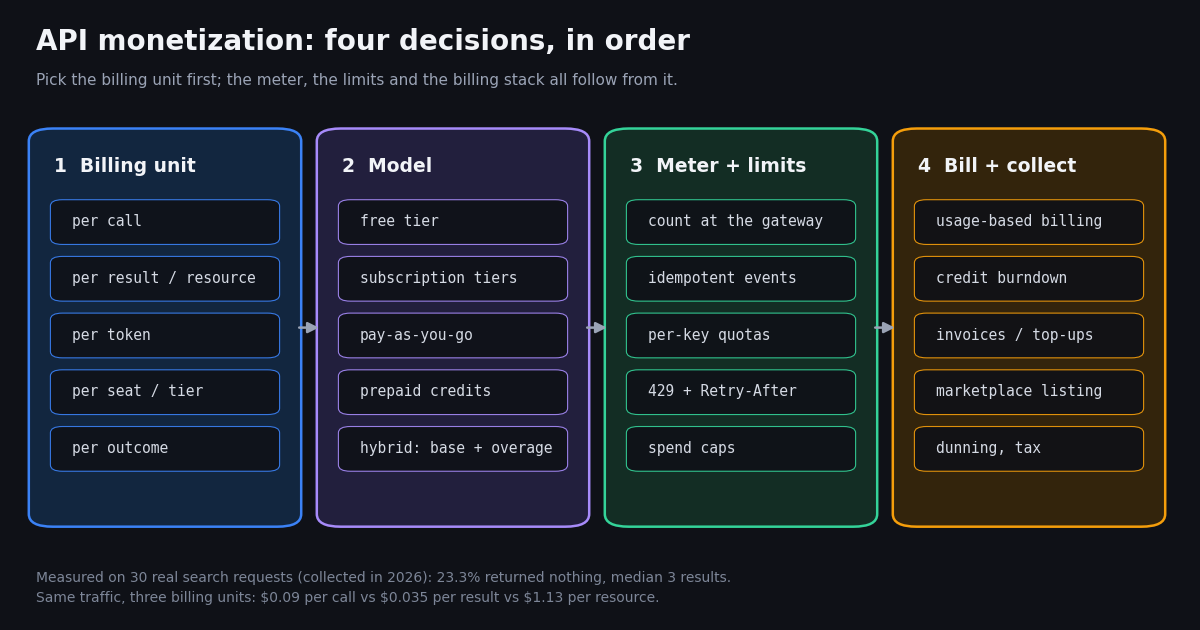
- Four decisions, in order: billing unit (call, result, token, seat, outcome), model (free tier, tiers, pay-as-you-go, credits, hybrid), metering and limits, then the billing and collection stack.
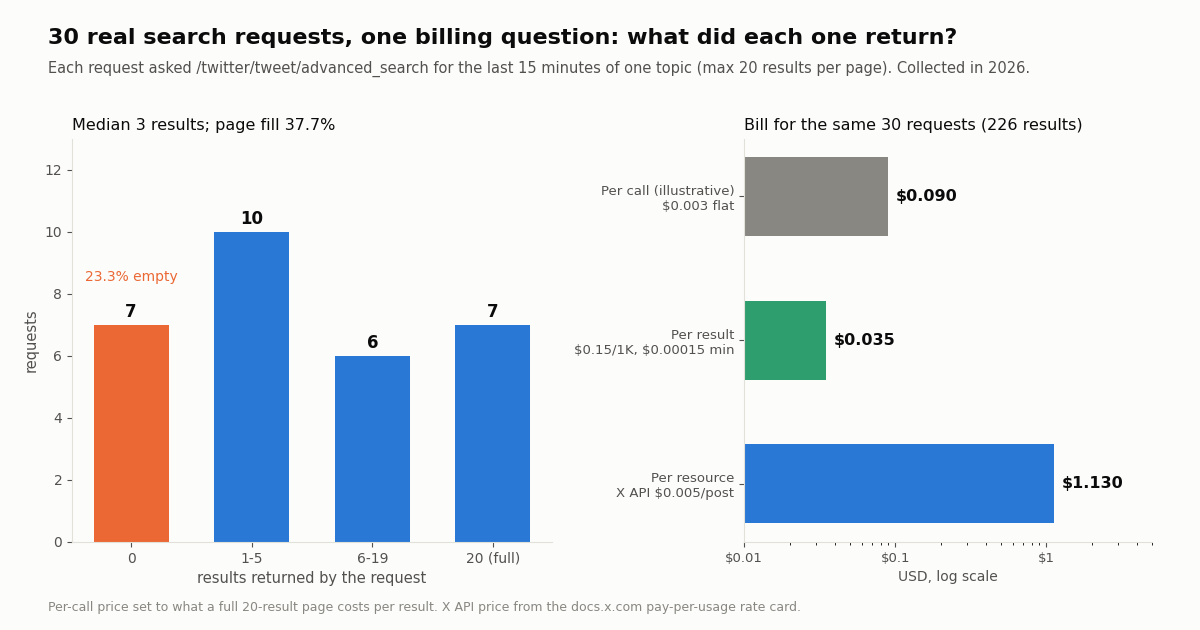
- Measured: 30 real search requests for the last 15 minutes of a topic returned 226 results; 23.3% returned zero, 53.3% a partial page, 23.3% a full page of 20. Median 3.
- The unit changes the bill: the same 30 requests cost $0.09 at a flat $0.003 per call, $0.035 at $0.15 per 1,000 results with a $0.00015 minimum, and $1.13 at X's $0.005 per post read. Per call charges low-yield traffic 2.6x more.
- Meter at the edge, bill asynchronously: Stripe's
POST https://api.stripe.com/v1/billing/meter_eventstakes anidentifierit de-duplicates for at least 24 hours and timestamps up to 35 days old, so retries do not double-bill. - Limits are part of the product: answer overload with
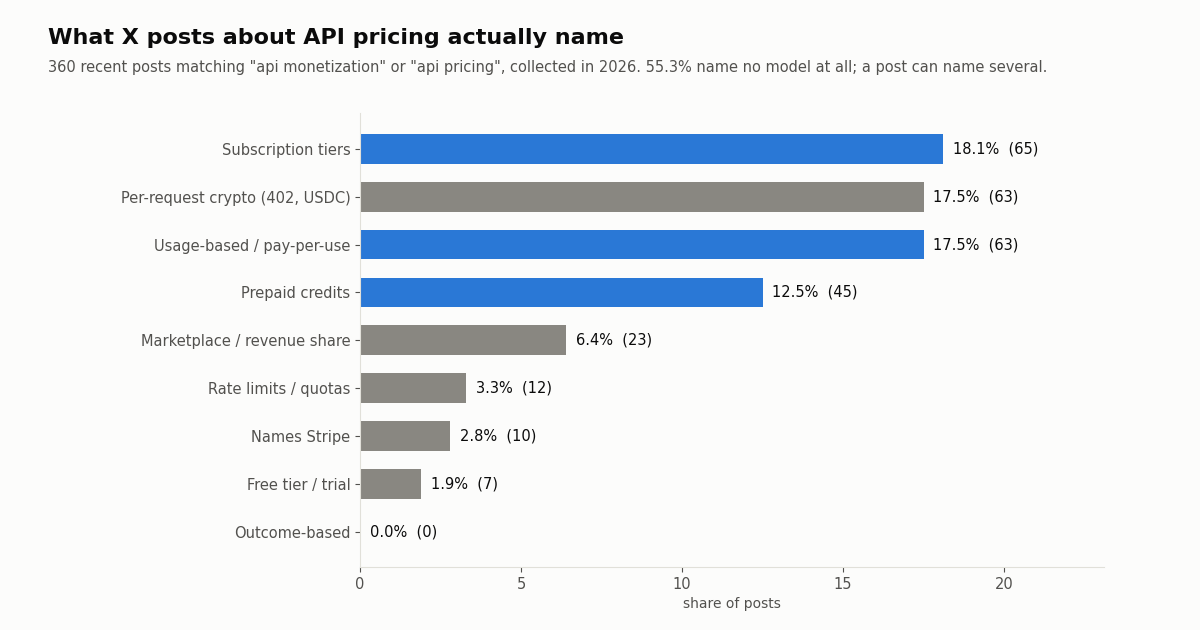
429 Too Many RequestsplusRetry-After(RFC 6585), and tie higher rate limits to payment. AWS documents its own usage-plan quotas as best-effort, so do not rely on them for spend control. - What builders on X name: in 360 recent posts about API pricing or monetization, subscription tiers (18.1%), usage-based (17.5%) and per-request crypto payments (17.5%) led; 55.3% named no model at all.
Most API monetization guides list the same six to eight pricing models with illustrative numbers (a hypothetical $0.01 per call, an imagined 50,000-credit plan) and stop there. That is useful vocabulary, but it skips the question that actually decides your revenue and your customers' bills: what unit are you counting, and how much real traffic produces zero, some, or a full page of value? This page answers that with measurements, then walks through models, metering, rate limits, the billing stack and the pricing page, in the order you would build them.
We sell a pay-per-use data API (X data, priced per result returned), so we use our own public rate card as one worked example, alongside X's own pay-per-usage pricing as a second one. Nothing here relies on internal figures: no revenue, no customer counts. The angle is deliberately narrow: how to monetize an API you run. If you are building an agent that needs to pay for APIs rather than charge for one, our guide to agentic payment protocols covers that side; if you are comparing what X data costs, the X API cost breakdown does.
Every number in the study sections was collected in 2026 with a rate-limited, read-only client; the method, the query list and the limits of the sample are at the end.
23.3% of 30 search requests (collected in 2026) returned zero results and the median returned 3 of 20, so the same traffic costs $0.09 billed per call but $0.035 billed per result.
What API monetization means (direct vs indirect)
Direct monetization means the API itself is the product and customers pay for using it: a weather API billed per call, an LLM API billed per token, a data API billed per record returned, a payments API billed per transaction. This page is about direct monetization.
Indirect monetization means the API is free or bundled but drives revenue elsewhere: a shipping company's tracking API reduces support calls, an e-commerce platform's partner API sells more subscriptions, a social network's API keeps developers building on its platform. The economics are measured in retention and conversion, not invoices.
Hybrids are the norm. Most paid APIs combine a free allowance to get developers started, a usage-based core that scales with value, and a contract or subscription layer for buyers who want predictable bills. Stripe's own pricing-model documentation reflects that split: it lists flat rate, per-seat, tiered (volume-based or graduated) and usage-based pricing, and under usage-based it names three patterns, fixed fee and overage, pay as you go, and credit burndown.
The rest of this page treats monetization as four decisions made in order: the billing unit, the model, metering and limits, and billing and collection. Get the first one wrong and no billing system will fix it.
API monetization models compared
These are the models you will combine. The right column is the question to ask before picking each one.
Pay-per-call is a billing unit, not a model. A pay-per-call API can be sold as pay-as-you-go, as prepaid credits, or as a tier with a monthly call quota. The searches for "pay per call api" mostly want the unit, which is why the next section is about units.
Credits are a translation layer. When different operations cost different amounts (a search, a profile lookup, a write), credits let you show one balance and one price per credit while each operation burns a different number of them. X's own API now works this way for developers: per its pricing page, credits are purchased upfront in the Developer Console and deducted as requests are made, with reads charged per resource returned and writes per request.
Choosing the billing unit: per call, per result, per token, per seat
The billing unit is what your meter counts. It should track what the customer values and roughly what each unit costs you to serve, because a unit that drifts from both produces bills that feel arbitrary.
Per call (per request). Simple to meter (one event per request) and simple to explain. It works when every call delivers roughly the same value: a geocode, an SMS sent, an image resized. It works badly when calls vary widely in what they return, because a call that returns nothing costs the same as one that returns a full page.
Per result or per resource returned. The meter counts items in the response: records, tweets, rows, documents. It tracks value closely for search and data APIs and lets customers poll without paying full price for empty checks. It needs a small minimum per request so an empty call still covers the cost of serving it. X's official API bills reads this way ($0.005 per post read, $0.010 per user read) and de-duplicates resources within a 24-hour UTC day, per its pricing page.
Per token or per unit of compute. Standard for LLM APIs, because cost to serve scales with input and output length. Customers find it hard to predict, so pair it with a calculator and spend caps.
Per seat or per tier. Charges per user or per plan regardless of calls. It fits dashboards and internal tools more than machine-to-machine APIs, where a single seat can generate unlimited traffic.
Per outcome. Charges only when a defined result happens. Attractive to buyers, risky for sellers, and only workable when success is unambiguous. In our sample of X posts about API pricing it barely registered (next sections).
The study below puts real numbers on the per-call versus per-result choice, because that is the one most data and search APIs get wrong.
Study: the same traffic billed three ways
We sent 30 real requests to a search endpoint (/twitter/tweet/advanced_search), each asking for posts on one topic from the last 15 minutes: the shape of a typical polling integration that checks a list of brands and keywords on a schedule. Topics ranged from very active (large AI and developer brands) to quiet (niche phrases). Each request could return at most 20 results.
Only 37.7% of the possible result slots were filled. Now bill that identical traffic three ways. The per-call price is illustrative: $0.003, what a full 20-result page costs at $0.15 per 1,000 results, i.e. the per-call price a seller would set if they priced every call as if it were full.
Reading the table. Per call charges this traffic 2.6x what per result does, and nearly all of the gap comes from the 23.3% of requests that returned nothing plus the half that returned a few items. The X API column shows a different point: the unit is the same as per result, but the rate is higher, so the bill is about 32x the per-result line. The month column multiplies each bill by 2,880 runs (every 15 minutes for 30 days); at 650,880 posts a month that workload stays under X's pay-per-usage cap of 3 million post reads per monthly billing cycle.
A second lesson for sellers: 76.7% of the requests reported has_next_page: true, including many partial pages. A short page does not mean the result set is exhausted, so a per-call price also charges customers again for the follow-up page. If you price per call, document how pagination behaves; if you price per result, it matters much less.
Metering and rate limits: count at the edge, bill later
Metering is the plumbing that turns requests into billable quantities. Three rules keep it honest.
Count at the edge, from the response. Meter in the gateway or the middleware that sits in front of your handlers, after the response is built, so you can count what was actually returned (results, tokens, bytes) rather than what was asked for. Attach the API key's customer id to every event.
Make every event idempotent. Networks retry. Give each usage event a unique id derived from the request id, so a retried report does not bill twice. Stripe's meter-event API is built around this: POST https://api.stripe.com/v1/billing/meter_events takes an event_name, a payload with the customer id and value, and an optional identifier; per Stripe's API reference, it enforces uniqueness of that identifier "within a rolling period of at least 24 hours", and an event's timestamp must be within the past 35 calendar days or up to 5 minutes in the future.
Aggregate asynchronously, show usage in near real time. Stripe notes that meter events are processed asynchronously, so invoice previews can lag. Customers still want to see their balance now; keep your own running counter per key for the dashboard and the spend cap, and treat the billing system as the system of record at invoice time.
Bill on what you can defend. Decide and document edge cases before launch: is an error billed, is a timeout billed, is an empty result billed (and at what minimum), is a duplicate within a day billed? X's pricing page answers the last one explicitly (resources are de-duplicated within a 24-hour UTC day window, as a soft guarantee). Writing these rules on the pricing page prevents most billing disputes.
Rate limits are part of the price. A rate limit protects your infrastructure; a quota caps what a plan includes. Both are also pricing levers: higher limits are a reason to pay, and a published limit tells a buyer whether your API can carry their workload at all.
Use the standard signal. RFC 6585 defines 429 Too Many Requests for a client that "has sent too many requests in a given amount of time" and says the response MAY include a Retry-After header. Send it, with a body that names the limit and the window, and document the backoff you expect.
Do not treat gateway quotas as spend control. AWS API Gateway usage plans pair API keys with throttling and quota limits, but its documentation states that usage plan throttling and quotas "are not hard limits, and are applied on a best-effort basis" and that clients can exceed them; it recommends AWS Budgets for cost monitoring. The same page warns not to use API keys alone for authentication or authorization. If a customer's spend cap matters, enforce it in your own metering path against the running counter.
Tie limits to trust and payment. A free or unverified key gets a low limit; a paying key gets more; a contract gets more again. Our own rate card works this way: 0.2 requests per second before the first payment, 20 once paid, 50 on the Scale plan, 500 on Business, and up to 1,000 on request. Publishing the ladder lets buyers self-select.
Make the limit visible before the 429. Return remaining-quota headers on every response and show usage against limits in the dashboard. Customers who can see the wall coming rarely file tickets about hitting it.
import os, uuid, requests

STRIPE = "https://api.stripe.com/v1/billing/meter_events"


def report_usage(customer_id: str, request_id: str, units: int) -> None:
    """Record billable units for one API request. Safe to retry: same request_id, same identifier."""
    if units <= 0:
        units = 1  # bill the per-request minimum as one unit; document this rule
    r = requests.post(
        STRIPE,
        auth=(os.environ["STRIPE_SECRET_KEY"], ""),
        data={
            "event_name": "results_returned",
            "payload[stripe_customer_id]": customer_id,
            "payload[value]": str(units),
            "identifier": f"req_{request_id}",
        },
        timeout=10,
    )
    r.raise_for_status()


# in your API middleware, after the response body is built:
# report_usage(key.customer_id, request.id, len(body["results"]))
The billing stack: build, buy, or list on a marketplace
Three ways to collect the money, with real trade-offs.
Stripe Billing. Stripe's billing pricing page lists a pay-as-you-go fee of 0.7% of billing volume (transactions processed on and off Stripe, excluding one-off invoices), with annual subscription tiers for higher volume. The building blocks are products, prices and meters; usage arrives as meter events.
Metronome. Stripe's usage-based billing documentation now says Metronome is part of Stripe and is its recommended starting point for new usage-based integrations, particularly for prepaid credits and credit burndown, enterprise commits and ramp schedules, real-time usage visibility and high-volume event ingestion. Existing integrations on the Meters API remain supported.
Gateways. Managed gateways (AWS API Gateway, Kong, Apigee, Zuplo and others) issue keys and enforce throttling and quotas at the edge (AWS calls the bundle a usage plan). They save building the edge; they do not decide your pricing, and you still need a billing system behind them.
Marketplaces. An API marketplace such as RapidAPI (rapidapi.com) handles discovery, keys and payment for a fee per sale, at the cost of owning the customer relationship. In our sample, marketplace or revenue-share terms came up in about one post in sixteen about API pricing. If you leave a marketplace later, your users have to move keys and endpoints; plan the exit before you list.
Worked example: a pay-per-result data API
Here is how one real API puts the pieces together, using only its public rate card (our own; numbers from twitterapi.io/pricing and our docs).
Unit: per result returned. Tweet endpoints cost 15 credits per tweet returned, which is $0.15 per 1,000 tweets. A request that returns nothing still costs the 15-credit minimum ($0.00015), so polling a quiet query on a schedule costs little: a check every 60 seconds for a month is 43,200 checks, which is $6.48 at the floor, or $1.30 at every 5 minutes. There is no per-request cap, so a full 20-tweet page costs $0.003. Profiles are 18 credits per user ($0.18 per 1,000), and follower or following lists cost 1 to 3 credits per user returned.
Model: prepaid credits plus optional subscriptions. $1 buys 100,000 credits, and purchased credits never expire. New accounts that pass the automatic bot check get up to $1 of free credits (at most 100,000 credits, no card, one per person or network, expiring after 31 days). For predictable spend there are monthly plans (Starter $29, Builder $99, Pro $199, Scale $499, Business $1,499 a month); see the pricing page for what each includes rather than an effective per-unit price.
Limits: tied to payment. 0.2 requests per second before the first payment, 20 once paid, 50 on Scale, 500 on Business, up to 1,000 on request. The free allowance is real but slow, which keeps abuse expensive and lets legitimate users upgrade by paying once.
Comparison on the page. The official X API's pay-per-usage rate card charges $0.005 per post read, which is $5 per 1,000 posts against $0.15 per 1,000 tweets here, about 33x per 1,000 tweets. Putting the competitor's rate card on your own pricing page, with both prices and the source named, answers the first question every buyer of a data API asks.
Writes are priced separately. Reads need no X account. Write actions (post, like, follow, DM and so on) run through an authenticated session created once with /twitter/user_login_v2 ($0.10, with a proxy the customer supplies); each write after that is 60 credits ($0.0006), billed per HTTP 200 call. Those calls act as that account, so X can rate-limit, lock or suspend it; keep a human pace, and expect the session to need re-login at times. Pricing writes as a different unit from reads is the same principle as the rest of this page: charge for the thing the customer actually gets.
What builders on X say about API pricing (study)
To see which models people actually discuss, we pulled recent posts for five pricing searches, 890 distinct posts in all, and classified each by the models and tools it names. The two neutral searches ("api monetization" and "api pricing") are the fairest read, because the other three searches already contain a model's name.
Three readings. First, 55.3% of posts named no model at all: most API pricing talk is complaints about a specific price or announcements, not strategy. Second, per-request crypto payments, where an agent pays for a single call over HTTP (status 402, which RFC 9110 still lists as reserved for future use), were named as often as usage-based pricing; our agentic payments guide covers those protocols. Third, outcome-based pricing, prominent in vendor blogs, appeared in none of the 360 posts.
Volume tells a story too. The phrase "api pricing" produced about 150 matching posts a day and the "pay per call" family about 106, while "api monetization" itself produced about 0.6 a day: the people who will pay you talk about prices and units, rarely about monetization as a strategy.
Pricing-page patterns, and how we collected this
Pricing page checklist. Show the unit and the price per 1,000 units in one line. State the minimum per request and what an empty or failed request costs. List rate limits per plan. Say whether credits expire. Give one worked example (a realistic month for a realistic workload). If a well-known alternative exists, show its rate card next to yours with the source named. Link a calculator instead of computing effective prices for every plan.
How we collected this. Question: what does a realistic polling workload return per request, how far apart are the bills under three billing units, and which pricing models do builders name on X? Method: a rate-limited, read-only client against /twitter/tweet/advanced_search (queryType Latest). Part A: 30 topic queries, each limited to the last 15 minutes, one page each. Part B: five searches ("api monetization", "api pricing", "usage-based pricing", "pay per call" and "metered billing" families, English, no reposts), nine pages each, 890 distinct posts after de-duplication, classified by fixed keyword patterns. Window: the most recent matching posts at collection time; collected in 2026. Requests: 75.
What the sample cannot show. Thirty requests is one snapshot of one workload; a different topic list or time of day changes the fill rate. The per-call price is illustrative, not any vendor's. Keyword classification misses posts that describe a model without naming it, and a post can match several categories. The X-post sample covers recent posts only, so a single viral thread can move a share.
Privacy. Aggregates only. Search results come from private individuals, so raw pages were not kept in our repository; the study folder holds de-identified rows (category flags, engagement counts, text length) with no ids, links, text or handles. No TwitterAPI.io customer data was used.
"""Resell-style metering demo: fetch X data per customer request, bill per result returned.

Reads tweets from twitterapi.io (pay only for the data returned), then records
the billable quantity in Stripe as an idempotent meter event.
"""
import os
import uuid

import requests

BASE = "https://api.twitterapi.io"
HEADERS = {"X-API-Key": os.environ["TWITTERAPI_IO_KEY"]}
STRIPE_KEY = os.environ["STRIPE_SECRET_KEY"]


def search(query: str, max_pages: int = 3) -> list[dict]:
    tweets, cursor = [], ""
    for _ in range(max_pages):
        r = requests.get(
            f"{BASE}/twitter/tweet/advanced_search",
            headers=HEADERS,
            params={"query": query, "queryType": "Latest", "cursor": cursor},
            timeout=30,
        )
        r.raise_for_status()
        body = r.json()
        tweets.extend(body.get("tweets", []))
        if not body.get("has_next_page"):
            break
        cursor = body.get("next_cursor", "")
    return tweets


def bill(customer_id: str, request_id: str, units: int) -> None:
    r = requests.post(
        "https://api.stripe.com/v1/billing/meter_events",
        auth=(STRIPE_KEY, ""),
        data={
            "event_name": "results_returned",
            "payload[stripe_customer_id]": customer_id,
            "payload[value]": str(max(units, 1)),  # documented minimum: 1 unit per request
            "identifier": request_id,  # Stripe de-duplicates this for at least 24 hours
        },
        timeout=10,
    )
    r.raise_for_status()


def handle_customer_request(customer_id: str, query: str) -> list[dict]:
    request_id = f"req_{uuid.uuid4().hex}"
    tweets = search(query)
    rows = [
        {
            "id": t["id"],
            "created_at": t["createdAt"],
            "text": t["text"],
            "likes": t.get("likeCount", 0),
            "author": (t.get("author") or {}).get("userName"),
        }
        for t in tweets
    ]
    bill(customer_id, request_id, len(rows))
    return rows


if __name__ == "__main__":
    out = handle_customer_request(os.environ["STRIPE_TEST_CUSTOMER"], '"api pricing" -is:retweet lang:en')
    print(f"returned {len(out)} results, billed {max(len(out), 1)} units")
Researching this?Free starter credits cover end-to-end testing — Google sign-in, no card. Get a key.
Questions readers ask
What is API monetization?
API monetization is earning revenue from an API, either directly by charging for usage (per call, per result, per token, per seat or per outcome, sold as a free tier, subscriptions, pay-as-you-go, prepaid credits or a hybrid) or indirectly when the API drives sales of another product. Direct monetization needs four things: a billing unit, a model, metering with rate limits, and a billing and collection system.
What are the main API monetization models?
Free tier or freemium, subscription tiers, pay-as-you-go, prepaid credits, hybrid base fee plus overage, revenue share or marketplace listing, and outcome-based pricing. Stripe's documentation groups usage-based pricing into fixed fee and overage, pay as you go, and credit burndown. Most paid APIs combine a free allowance, a usage-based core and a subscription or contract layer.
Is pay-per-call pricing a good idea?
It is simple and fits APIs where every call delivers similar value, such as sending an SMS or geocoding an address. It fits search and data APIs badly: in our test of 30 real search requests, 23.3% returned nothing and the median returned 3 of 20 results, so a per-call price set at full-page value charged that traffic 2.6x what per-result pricing with a small minimum did.
How do you meter API usage for billing?
Count usage at the edge (gateway or middleware) after the response is built, attach the customer id from the API key, send each count as an event with a unique identifier so retries are not billed twice, and aggregate asynchronously. Stripe's POST https://api.stripe.com/v1/billing/meter_events de-duplicates the identifier for at least 24 hours and accepts timestamps up to 35 days old. Keep your own running counter for dashboards and spend caps.
What is the best platform for API monetization?
It depends on what you already run. Stripe Billing meters charge 0.7% of billing volume pay as you go, and Stripe now recommends Metronome (part of Stripe) for new usage-based integrations that need prepaid credits, commits or high event volume. Managed API gateways handle keys and limits; API marketplaces handle discovery and payment for a fee per sale but own the customer relationship.
Should rate limits differ by plan?
Yes. Rate limits are a pricing lever as well as protection. Return 429 Too Many Requests with a Retry-After header (RFC 6585), publish limits per plan, and raise them with payment. Do not rely on gateway quotas for spend control: AWS documents its usage-plan throttling and quotas as best-effort, not hard limits.
How do X (Twitter) data APIs charge?
The official X API's pay-per-usage plan sells prepaid credits and charges $0.005 per post read and $0.010 per user read, capped at 3 million post reads per monthly billing cycle, with resources de-duplicated within a 24-hour UTC day. TwitterAPI.io charges $0.15 per 1,000 tweets returned with a 15-credit ($0.00015) minimum on a request that returns nothing, about 33x less per 1,000 tweets than X's rate card.
Continue
- Stripe docs: usage-based billing (Meters API and Metronome)
- Stripe API reference: create a billing meter event
- Stripe Billing pricing (0.7% of billing volume pay as you go)
- X API pricing: pay-per-usage rate card, credits and de-duplication
- AWS API Gateway: usage plans, API keys, throttling and quotas
- RFC 6585: 429 Too Many Requests and Retry-After
- X API hub: endpoints, pricing and guides
- Agentic payment protocols compared (paying for APIs per request)
- X API cost breakdown: what X data really costs
- TwitterAPI.io vs the official X API, side by side
- How 429 rate-limit errors work on the X API
- Rate limit calculator for polling workloads
- Moving an X data integration off an API marketplace
- TwitterAPI.io pricing: per-result rates and plans
- 01Pipedream Pricing in 2026: Connect Plans, Credits and the Workflows Shutdown
- 02Cloudflare Pay per Crawl: How the HTTP 402 Handshake Works, and What It Means for Twitter (X) Data
- 03ScrapingBee Pricing in 2026: Plans, Credit Costs and Alternatives
- 04Firecrawl Pricing: Plans, Credit Costs and What an X (Twitter) URL Costs
- 05LunarCrush API: What It Returns, What It Costs, and When Raw Twitter (X) Data Is the Better Input
- 06claude-mem: the persistent memory plugin for Claude Code, explained and measured on Twitter (X)
- 07Birdclaw (X/Twitter archive tool): what it stores and how to feed it any account
- 08Twitter Streaming API
Writing about something you built with TwitterAPI.io? Our community rewards program pays API credits for honest tutorials, build logs and videos.
Stop reading. Start building.
Starter credits cover real testing on real data. Google sign-in, no card, no application queue.
Get an API keyAlready building with TwitterAPI.io? Publish an honest tutorial or build log about it and earn up to $200 a month in API credits.