Dify vs n8n: Which One to Build On, What Each Costs, and How Each Handles Twitter (X) Data
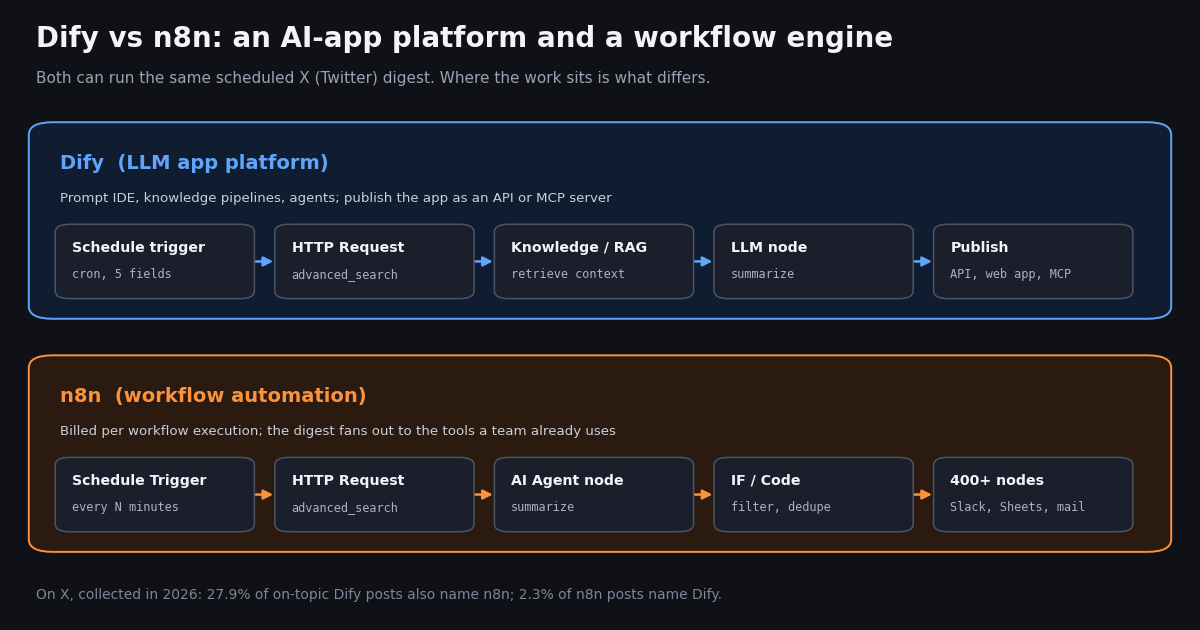
- Different centers of gravity. Dify builds AI apps (RAG, agents, prompt IDE, publish as API or MCP server); n8n automates processes across 400+ integrations with AI as one node.
- Cloud prices as listed: Dify Professional $59 per workspace a month or $590 a year, Team $159 or $1,590; n8n Starter 20 euros, Pro 50 euros a month billed annually, Business 667 euros (self-hosted only).
- Licenses differ: Dify is modified Apache 2.0 (no multi-tenant SaaS, keep the console logo); n8n's Sustainable Use License allows internal business, non-commercial or personal use.
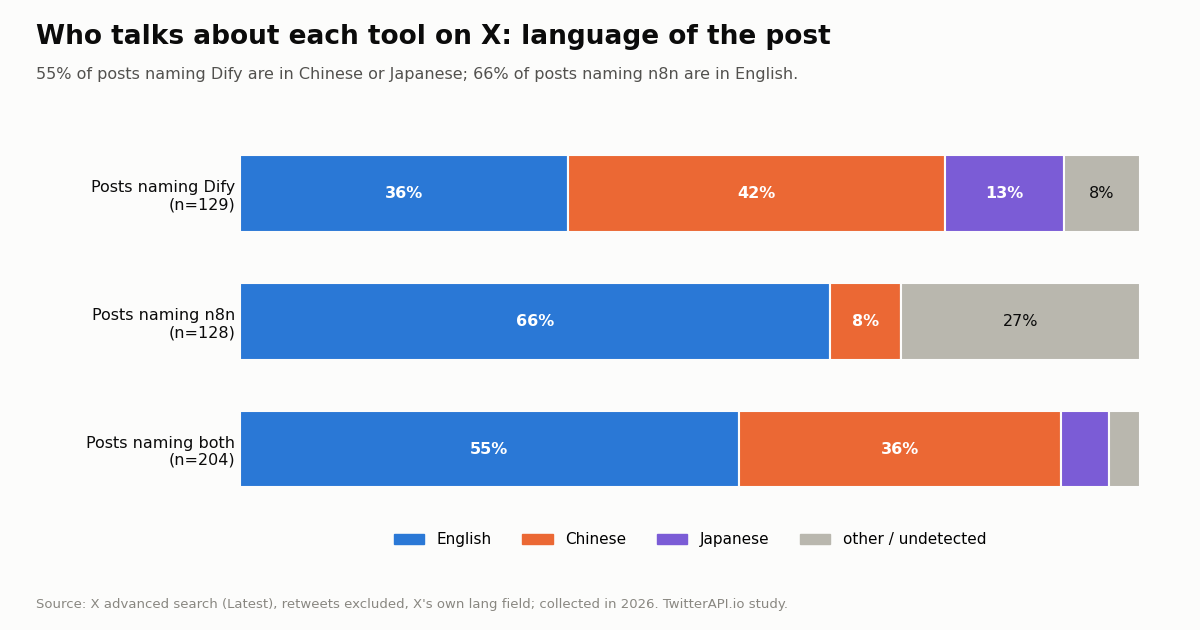
- X study, collected in 2026: on a typical day, posts naming n8n appeared about 12.7x as often as on-topic posts naming Dify; 55% of Dify posts were in Chinese or Japanese, 66% of n8n posts in English.
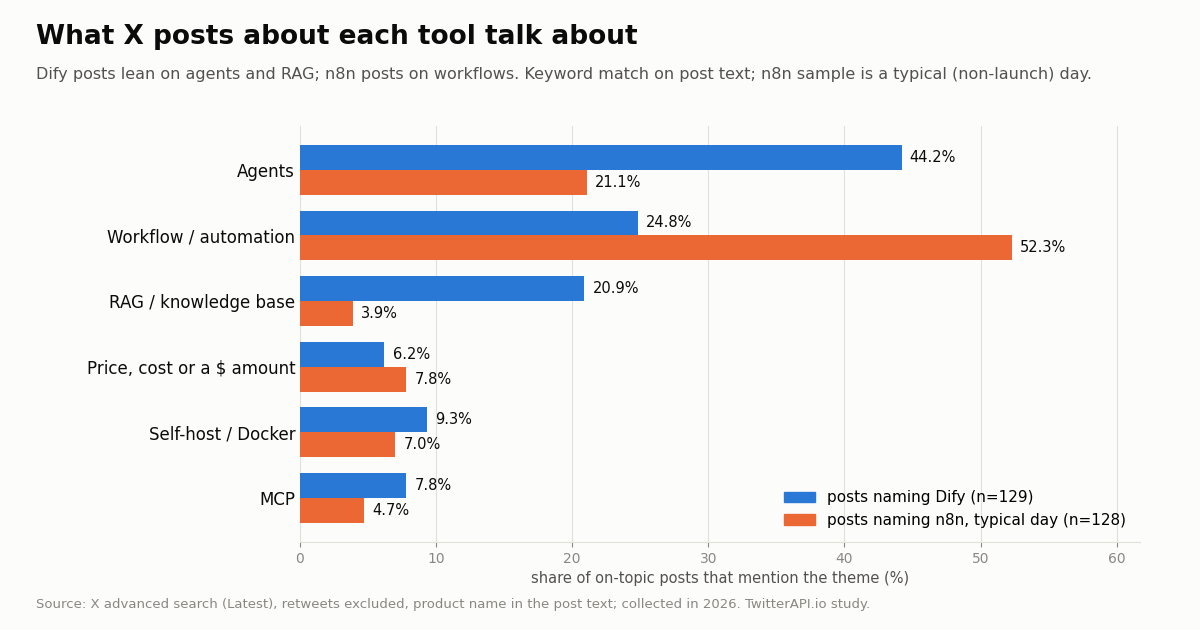
- Themes differ: RAG or knowledge bases came up in 20.9% of Dify posts vs 3.9% of n8n posts; workflows or automation in 52.3% of n8n posts vs 24.8% of Dify posts.
- X data in either tool: an HTTP Request node calling
/twitter/tweet/advanced_search($0.15 per 1,000 tweets returned) or the hosted MCP server athttps://mcp.twitterapi.io/mcp; the official X API lists $0.005 per post read.
Dify and n8n both show a canvas of connected nodes, both run AI agents, both can be self-hosted with Docker, and both have six-figure GitHub star counts (about 161,000 for langgenius/dify and 210,000 for n8n-io/n8n on the repository pages this session). That surface similarity is why the comparison gets searched. Underneath, they are built for different deliverables, and they bill for different things: Dify Cloud by workspace with message credits and trigger events, n8n by workflow executions.
This page is the platform choice. For n8n alone, n8n pricing covers its execution math in detail, n8n alternatives covers replacements by reason for leaving, and the n8n Twitter API workflow guide is the step-by-step import; links are at the end. Here you get the side-by-side: verified prices and licenses, a measured look at who discusses each tool on X, and the same X (Twitter) digest wired into both, with the X data bill next to the official X API's rate card.
27.9% vs 2.3%
Dify vs n8n at a glance
The table compresses what each project's own pricing page, README and license file say. Every row is checked against those primary sources this session; the sections below give the detail.
The one-line rule. If you would describe the project as "a chatbot / assistant / agent that knows our documents", start in Dify. If you would describe it as "when X happens, do Y in these five tools", start in n8n. You can also run both: n8n moves the data and calls a Dify app through its API for the AI step.
What Dify is, and what it is not
Dify's GitHub description reads: "Build Agentic workflows, RAG pipelines, with rich AI model and tool support on one collaborative workspace. Deploy on cloud, VPC, or self-hosted." The repository is maintained by LangGenius, Inc.; version 1.19.0 was published on November 4, 2026, twelve days after 1.18.0.
App types. Dify builds Workflow apps (one input, one run, structured output), Chatflow apps (multi-turn chat with memory) and Agent apps. Workflows contain nodes such as LLM, Knowledge Retrieval, HTTP Request, Code, If/Else and Agent. Triggers (schedule, webhook or plugin events) are available for Workflow apps only, and Dify's docs allow at most one schedule trigger per workflow, set with a visual picker or a five-field cron expression.
Knowledge and RAG. This is where Dify is strongest relative to n8n. Knowledge bases with document processing, indexing modes and retrieval settings are first-class objects with their own quotas on the pricing page (documents, storage and a knowledge request rate limit per minute).
Publishing. A finished app can be called through Dify's Service API (POST https://api.dify.ai/v1/workflows/run for a workflow app, with Authorization: Bearer <app key> and a blocking or streaming response mode), embedded as a web app, or published as an MCP server. Dify can also consume MCP servers: per its docs you add a server by URL, name and identifier, only HTTP transport is supported, and you can send custom headers with every request.
What it is not. Dify is not built around an integration catalog. It reaches outside services through marketplace plugins, the HTTP Request node and MCP tools, while n8n's 400+ integrations are the core of that product. If the job is mostly moving rows between a CRM, a spreadsheet and a mailbox, Dify is the wrong center.
What n8n is, and where its AI fits
n8n's repository describes itself as a "Fair-code workflow automation platform with native AI capabilities. Combine visual building with custom code, self-host or cloud, 400+ integrations." Releases are frequent: n8n@2.47.4 was tagged on November 11, 2026, with a maintenance line (n8n@1.123.94) published the same day.
Execution model. n8n's pricing page states that plans are "based on monthly workflow executions, regardless of complexity", and that all plans include unlimited users and workflows and every integration. One execution is one run of a whole workflow, whatever the number of nodes. Every plan lists Agents, MCP and AI nodes; the comparison table shows the AI Agent node, an MCP Server Trigger, an MCP Client, human approval for tool calls, and code steps in JavaScript or Python on all cloud tiers.
AI inside a process. n8n's AI Agent node takes a chat model, memory and tools. Its MCP Client Tool node lets that agent call tools on an external MCP server, with Bearer, generic header, multiple headers or OAuth2 authentication per n8n's docs. The design point is that the agent is a step inside a larger workflow that also writes to Slack, Sheets, a database or email.
What it is not. n8n has no knowledge-base product of its own with document quotas and an indexing UI; RAG in n8n means wiring a vector store node, an embeddings node and a retriever yourself. That is flexible, but it is assembly work Dify does for you.
Pricing, self-hosting and licenses compared
Prices below are copied from each vendor's pricing page as shown to us this session, in the currency and billing period displayed. Dify shows US dollars with a monthly or annual toggle (annual "Save 17%"). n8n showed euros to our session and the per-month figure "billed annually" (also "Save 17%"); your region may see another currency. Taxes are extra on both.
What the units mean. Dify's message credits pay for model calls on Dify-provided keys (OpenAI, Anthropic, Gemini, xAI, Tongyi per the page); once they run out you can plug in your own provider key and pay the provider directly. Its trigger events count each automatic start through a plugin, schedule or webhook trigger. n8n bills a run of the whole workflow, even a scheduled run that finds nothing; model usage is your own provider bill unless you use the Gateway credits n8n Cloud includes on Starter and Pro.
A concrete schedule. An hourly job is 720 runs in a 30-day month. That fits n8n Starter's 2,500 executions and Dify Professional's 20,000 trigger events; Dify Sandbox lists 3,000 trigger events without a period, so treat it as a trial allowance. Every 5 minutes is 8,640 runs: Dify Professional (20,000 trigger events a month) or n8n Pro (10,000 executions). Every minute is 43,200 runs: Dify Team (unlimited trigger events), while on n8n it exceeds both the Pro and Business execution counts listed, so check the larger sizes on n8n's pricing page.
Self-hosting. Both Community editions are free to download. Dify's self-host guide asks for at least 2 CPU cores and 4 GiB of RAM, Docker Compose 2.35.0 or later, then git clone --branch <version> --depth 1 https://github.com/langgenius/dify.git, cd dify/docker and docker compose up -d; its compose file defines API, worker, web, database, Redis, sandbox, plugin daemon, Nginx and vector-store services. n8n's Docker guide starts it as a single n8nio/n8n container on port 5678 with SQLite as the default database (PostgreSQL is an option). Neither license is a standard OSI license, which matters more than the server bill; see the next section. For n8n's full tier ladder, overage rules and self-host math, read the n8n pricing page linked below.
Dify. The LICENSE file in langgenius/dify says Dify is "licensed under a modified version of the Apache License 2.0" with added conditions. Commercial use is allowed, "including as a backend service for other applications or as an application development platform for enterprises". Two things require a commercial license: operating a multi-tenant environment (one tenant equals one workspace), and removing or modifying the logo or copyright information in the Dify console or apps when you use its frontend. Contributors also agree the producer can change the license terms.
n8n. LICENSE.md in n8n-io/n8n puts most of the code under the Sustainable Use License 1.0: "You may use or modify the software only for your own internal business purposes or for non-commercial or personal use." Files with .ee. in their name need an n8n Enterprise license. Running n8n for your own company is allowed; reselling hosted n8n or embedding it in a product you charge for is what the license restricts.
What this means in practice. An agency that wants one self-hosted install serving many paying clients hits a wall in both: Dify's multi-tenant clause and n8n's internal-use clause. A company running either for its own staff is fine with both. If you need an OSI open-source license, neither qualifies; n8n alternatives lists options by license.
What X (Twitter) says about Dify and n8n
To see who actually uses each tool, we pulled recent X posts that name Dify, posts that name n8n, posts that name both, and the timelines of the two official accounts, then measured language, themes and engagement. The full method is in the last section. All figures are from that sample, collected in 2026.
Volume. On a typical day, posts naming n8n arrived at about 16.5 an hour (107 distinct authors in 7.8 hours); on-topic posts naming Dify at about 1.3 an hour (96 authors in 98.8 hours). That is roughly 12.7x. Our first n8n sample happened to land on the day n8n Labs launched Nod, an open-source personal agent: that window ran at 25.2 posts an hour and 33.2% of posts mentioned Nod, so we added a second n8n window a week earlier and use it as the typical day below. A raw X search for "dify" is noisy: 65.5% of what it returned did not have the word in the post text itself (X search also matches handles and display names), so we kept the 129 posts with "dify" in the text itself.
One-way comparison. 27.9% of on-topic Dify posts also name n8n; 2.3% of n8n posts name Dify. People discussing Dify often measure it against n8n; people discussing n8n rarely bring Dify up. Posts naming n8n mention Zapier (6.2%) more often than Dify.
Themes. RAG and knowledge bases are a Dify topic (20.9% vs 3.9%) and agents come up twice as often around Dify (44.2% vs 21.1%), while workflows and automation dominate n8n posts (52.3% vs 24.8%). That matches where each product puts its effort. Price talk is low for both (6.2% and 7.8%). Self-hosting is the theme that rises most when people compare the two: 25.0% of posts naming both, against 9.3% and 7.0% for single-tool posts.
Comparison posts are list posts. 39.2% of posts naming both tools also name three or more of the other tools we tracked. LangChain or LangGraph appear in 42.6% of them, Claude in 41.7%, CrewAI in 34.3%, Ollama in 27.0% and Zapier in 21.6%. Posts naming both drew a median of 628 views against 56 and 28 for single-tool posts: comparison content travels further than single-tool chatter.
Two different audiences: language and the official accounts
Language. 41.9% of on-topic posts naming Dify were in Chinese, 13.2% in Japanese and 36.4% in English (X's own language field). For n8n on a typical day, 65.6% were in English and 7.8% in Chinese; on the Nod launch day English rose to 83.9%. Posts naming both split 55.4% English and 35.8% Chinese. Dify's Japanese presence is visible in its own timeline too: its newest post in the sample announced the head of its Japanese subsidiary, LangGenius K.K.
Official accounts. The two company accounts post at different rhythms and in different formats. Replies are excluded from both timelines (default timeline settings).
n8n leans on video (29.4% of its posts carry video vs 5.0% for Dify) and gets a median of 26 likes per post against 8 for Dify. Dify quotes and reposts partners more often (13.8% quotes, 10.0% reposts vs 3.1% and 4.4%), much of it integration and template announcements. For a buyer the takeaway is practical: English tutorials, templates and freelancers are easier to find for n8n, while Dify's community content is strongest in Chinese and Japanese.
Building the same X (Twitter) digest in Dify and in n8n
The test job: every hour, pull recent posts that match a search, summarize them with an LLM, and deliver the digest. Both platforms can do it with an HTTP Request node that calls GET https://api.twitterapi.io/twitter/tweet/advanced_search with an X-API-Key header. The response carries a top-level tweets list plus has_next_page and next_cursor; each tweet has text, url, createdAt, likeCount, viewCount and an author object with userName. Reads need no X account.
In Dify. Create a Workflow app. Add a Schedule trigger (cron 0 * * * *). Add an HTTP Request node: method GET, the URL above, auth type API Key with the Custom subtype and header name X-API-Key, query params query and queryType=Latest. Dify's HTTP node retries failed requests up to 10 times and exposes body, status_code and headers to later nodes. Add a Code node that parses body and keeps text, author and counts; then an LLM node with your summary prompt; then deliver through another HTTP Request (a Slack or Discord webhook) or publish the workflow and call it through the Service API. A Knowledge Retrieval node between the Code and LLM nodes lets the summary use your own docs as context, which is the step n8n has no built-in equivalent for.
In n8n. Schedule Trigger (every hour), HTTP Request node with Header Auth credentials (X-API-Key), an optional Code node to keep only new posts (store the last run time and add since_time:<unix seconds> to the query), the AI Agent or a Basic LLM Chain node for the summary, then any of the delivery nodes. The n8n Twitter API workflow guide walks through an importable version of this pattern.
Through MCP instead of HTTP. Both tools can call our hosted MCP server at https://mcp.twitterapi.io/mcp with the header Authorization: Bearer <your key>; it exposes 12 read tools (search, profiles, timelines, replies, followers, trends). In Dify, add it under Tools, MCP with a name and server identifier and put the header in the custom headers; its tools then appear as Tool nodes and inside Agent nodes. In n8n, attach an MCP Client Tool node to the AI Agent with Bearer auth. MCP suits an agent that decides what to look up; the HTTP node suits a fixed schedule where you want a predictable bill.
Posting the digest back to X. If the digest should go out as a post, that is a write action through an authenticated session: one /twitter/user_login_v2 login ($0.10, with a proxy you supply) returns login_cookies, then each /twitter/create_tweet_v2 call is 60 credits ($0.0006), billed per HTTP 200 call. The call acts as that account, so X can rate-limit, lock or suspend it; keep a human pace (an hourly or daily digest, not a burst), and expect the session to need a re-login from time to time.
The function below is the fetch step both platforms are doing; the full script that hands the result to a Dify workflow or an n8n webhook is at the end of the page.
import os, time, requests

API = "https://api.twitterapi.io"
HEADERS = {"X-API-Key": os.environ["TWITTERAPI_IO_KEY"]}


def fetch_posts(query, since_unix, max_pages=5):
    """Posts matching `query` newer than since_unix, newest first."""
    posts, cursor = [], ""
    for _ in range(max_pages):
        r = requests.get(
            f"{API}/twitter/tweet/advanced_search",
            headers=HEADERS,
            params={"query": f"{query} since_time:{since_unix}", "queryType": "Latest", "cursor": cursor},
            timeout=30,
        )
        r.raise_for_status()
        data = r.json()
        posts.extend(data.get("tweets", []))
        if not data.get("has_next_page"):
            break
        cursor = data.get("next_cursor", "")
return postsThe X data bill: TwitterAPI.io vs the official X API
Whichever platform you choose, the X data is a separate bill. TwitterAPI.io charges per result: 15 credits per tweet returned, which is $0.15 per 1,000 tweets, with a minimum of 15 credits ($0.00015) for a request that returns nothing. X's own pay-per-usage rate card on docs.x.com lists $0.005 per post read and $0.010 per user read, capped at 3 million post reads a month before Enterprise. Per 1,000 tweets that is $0.15 vs $5, about 33x.
Our own study as the example. This page's study returned 1,334 tweets and 2 profiles in 71 requests for about $0.20; at the official rate card's $0.005 per post read and $0.010 per user read, the same reads would be about $6.69.
Other costs to add. Dify's LLM node consumes message credits or your provider key; n8n counts each run as an execution. Rate limits on our side are 0.2 requests per second before the first payment and 20 once paid, which an hourly digest never approaches. New accounts that pass the automatic bot check get up to $1 of free credits (at most 100,000 credits, no card, one per person or network, expiring after 31 days); purchased credits never expire. Plans and the full price list are on the pricing page.
How we collected this
Question. How does the X conversation about Dify differ from the one about n8n (volume, language, themes, engagement), and how do the two official accounts post?
Data. Four X searches through TwitterAPI.io's advanced_search (Latest order, retweets excluded): "dify", "n8n" (twice: the most recent posts, and a window ending a week earlier via until_time), and posts containing both. Plus the profile and recent timeline (about 160 posts each, replies excluded) of the official organization accounts @dify_ai and @n8n_io. 71 requests, 1,334 tweets and 2 profiles returned, collected in 2026.
On-topic rule. X search also matches handles and display names, so a search post counts only if the product name appears in its text outside @handles. That kept 129 of 374 Dify results, 128 of 160 (typical day) and 205 of 240 (launch day) n8n results, and 204 of 240 posts naming both.
Windows. The samples are the most recent posts at collection time, so they cover different spans: 98.8 hours for Dify, 7.8 hours for the typical n8n day and 8.1 hours for the launch day (n8n is much busier, so the same page budget covers less time), about 43 days for posts naming both, about 346 days of @dify_ai posts and 159 days of @n8n_io posts. Rates per hour are comparable; raw counts are not.
Themes are case-insensitive keyword matches on the post text (for example agent, rag, knowledge base, docker, self-host, pricing, a dollar amount). They are a lexical proxy, not a judgment of sentiment or quality.
What it cannot show. A few days of public posts is a snapshot, not market share, revenue or user counts; X's audience skews toward some regions and languages; private communities (Discord, forums, WeChat groups) are not in it; a launch week can move any number.
Privacy. Aggregates only. The two official organization accounts are named; individual posters are not profiled. Search pages from private individuals stay outside the repository, and the published sample keeps only de-identified rows (language, counts, theme flags).
"""Hourly X (Twitter) digest: fetch posts, then hand them to a Dify workflow or an n8n webhook.

pip install requests
env: TWITTERAPI_IO_KEY, and DIFY_APP_KEY (Dify workflow app key) and/or N8N_WEBHOOK_URL
"""
import os
import time

import requests

API = "https://api.twitterapi.io"
HEADERS = {"X-API-Key": os.environ["TWITTERAPI_IO_KEY"]}
QUERY = '("dify" OR "n8n") -filter:retweets lang:en'


def fetch_posts(query, since_unix, max_pages=5):
    posts, cursor = [], ""
    for _ in range(max_pages):
        r = requests.get(
            f"{API}/twitter/tweet/advanced_search",
            headers=HEADERS,
            params={"query": f"{query} since_time:{since_unix}", "queryType": "Latest", "cursor": cursor},
            timeout=30,
        )
        r.raise_for_status()
        data = r.json()
        posts.extend(data.get("tweets", []))
        if not data.get("has_next_page"):
            break
        cursor = data.get("next_cursor", "")
    return posts


def to_lines(posts):
    lines = []
    for t in posts:
        author = (t.get("author") or {}).get("userName", "")
        text = " ".join((t.get("text") or "").split())[:280]
        lines.append(f"- @{author} ({t.get('likeCount', 0)} likes, {t.get('viewCount', 0)} views): {text} {t.get('url', '')}")
    return "\n".join(lines)


def run_dify(digest_text):
    """Dify Service API: run a published Workflow app whose Start node has a `posts` text input."""
    r = requests.post(
        "https://api.dify.ai/v1/workflows/run",  # self-hosted: your own host + /v1
        headers={"Authorization": f"Bearer {os.environ['DIFY_APP_KEY']}"},
        json={"inputs": {"posts": digest_text}, "response_mode": "blocking", "user": "x-digest-cron"},
        timeout=120,
    )
    r.raise_for_status()
    return r.json()  # blocking mode: workflow_run_id, task_id, data (status, outputs)


def send_n8n(posts):
    """n8n: a Webhook node (production URL) receives the raw posts; the workflow does the rest."""
    r = requests.post(os.environ["N8N_WEBHOOK_URL"], json={"posts": posts}, timeout=30)
    r.raise_for_status()
    return r.status_code


if __name__ == "__main__":
    since = int(time.time()) - 3600
    posts = fetch_posts(QUERY, since)
    print(f"{len(posts)} posts in the last hour")
    if not posts:
        raise SystemExit(0)
    if os.environ.get("DIFY_APP_KEY"):
        result = run_dify(to_lines(posts))
        print("Dify outputs:", result["data"]["outputs"])
    if os.environ.get("N8N_WEBHOOK_URL"):
        print("n8n webhook status:", send_n8n(posts))
Researching this?Free starter credits cover end-to-end testing — Google sign-in, no card. Get a key.
Questions readers ask
Is Dify better than n8n?
Neither is better in general; they solve different problems. Dify is built around AI apps: knowledge bases, RAG, a prompt IDE, agents, and publishing the result as an API, web app or MCP server. n8n is built around processes that move data between tools, with 400+ integrations and an AI Agent node as one step. Choose by the deliverable: an AI app points to Dify, an automated process points to n8n.
Is Dify free? Is n8n free?
Both have a free self-hosted Community edition. Dify Cloud also has a free Sandbox plan (200 message credits, 5 apps, 3,000 trigger events, 30-day logs). n8n Cloud has a free trial but no free plan; Starter is listed at 20 euros a month billed annually. Self-hosting costs your server and your time, and each edition's license sets what you may do with it.
How much does Dify cost compared with n8n?
Dify Cloud Professional is listed at $59 per workspace a month or $590 a year, Team at $159 or $1,590. n8n Cloud lists Starter at 20 euros and Pro at 50 euros a month billed annually, with Business at 667 euros a month billed annually for self-hosted instances. Dify bills by workspace with message credits and trigger events; n8n bills by workflow executions.
Can I use Dify and n8n together?
Yes. One workable split is n8n for triggers, integrations and delivery, calling a published Dify workflow through Dify's Service API (a POST to https://api.dify.ai/v1/workflows/run, or the same path on your own host, with a Bearer app key) for the AI step that needs a knowledge base. n8n can also call Dify through MCP if you publish the Dify app as an MCP server.
Can I sell a product built on self-hosted Dify or n8n?
Read the licenses first. Dify's modified Apache 2.0 allows commercial use, including as a backend for other applications, but running a multi-tenant service or removing the console logo needs a commercial license. n8n's Sustainable Use License allows use only for your own internal business, non-commercial or personal purposes, so reselling hosted n8n or embedding it in a paid product needs an agreement with n8n.
Which one is easier to self-host?
n8n's Docker guide starts it as one container with SQLite by default. Dify's Docker Compose setup starts several services (API, worker, web, database, Redis, sandbox, plugin daemon, Nginx and a vector store) and its docs ask for at least 2 CPU cores and 4 GiB of RAM. Both are routine for anyone comfortable with Docker, but Dify has more moving parts to upgrade and back up.
How do I get Twitter (X) data into Dify or n8n?
Use an HTTP Request node that calls TwitterAPI.io's /twitter/tweet/advanced_search (or a timeline endpoint) with an X-API-Key header, or connect the hosted MCP server at https://mcp.twitterapi.io/mcp with a Bearer header. Reads cost $0.15 per 1,000 tweets returned and need no X account; the official X API lists $0.005 per post read.
Does Dify or n8n support MCP?
Both. Dify can add external MCP servers over HTTP transport (with custom headers) and use their tools in workflows and agents, and it can publish its own apps as MCP servers. n8n has an MCP Client Tool node for its AI Agent (Bearer, header or OAuth2 auth) and an MCP Server Trigger to expose n8n workflows as MCP tools.
Continue
- Dify pricing page: Sandbox, Professional, Team, Enterprise and Community plans
- n8n pricing page: Starter, Pro, Business, Enterprise and the plan comparison table
- Dify LICENSE on GitHub (modified Apache License 2.0)
- n8n LICENSE.md on GitHub (Sustainable Use License 1.0)
- X API pricing: pay-per-usage rate card
- TwitterAPI.io documentation: advanced_search and the hosted MCP server
- X (Twitter) API hub: endpoints, pricing and guides
- n8n pricing: cloud tiers, executions and self-hosted costs
- n8n alternatives by license, self-hosting and price
- n8n Twitter API workflow you can import
- n8n vs Zapier for X (Twitter) automations
- Twitter (X) MCP server setup for AI agents
- How to build an AI agent that reads X data
- TwitterAPI.io pay-per-use pricing
- 01Pipedream Pricing in 2026: Connect Plans, Credits and the Workflows Shutdown
- 02Cloudflare Pay per Crawl: How the HTTP 402 Handshake Works, and What It Means for Twitter (X) Data
- 03ScrapingBee Pricing in 2026: Plans, Credit Costs and Alternatives
- 04Firecrawl Pricing: Plans, Credit Costs and What an X (Twitter) URL Costs
- 05LunarCrush API: What It Returns, What It Costs, and When Raw Twitter (X) Data Is the Better Input
- 06n8n Twitter (X) API Workflow: Post New Tweets to Slack in 2026
- 07n8n Alternatives in 2026: Pick by Why You Are Leaving, and Keep Your Twitter (X) Workflows
- 08n8n vs Zapier vs Make in 2026: Pricing, Self-Hosting, AI Agents and the Same Twitter (X) Flow Built in All Three
Writing about something you built with TwitterAPI.io? Our community rewards program pays API credits for honest tutorials, build logs and videos.
Stop reading. Start building.
Starter credits cover real testing on real data. Google sign-in, no card, no application queue.
Get an API keyAlready building with TwitterAPI.io? Publish an honest tutorial or build log about it and earn up to $200 a month in API credits.