n8n vs Zapier vs Make in 2026: Pricing, Self-Hosting, AI Agents and the Same Twitter (X) Flow Built in All Three
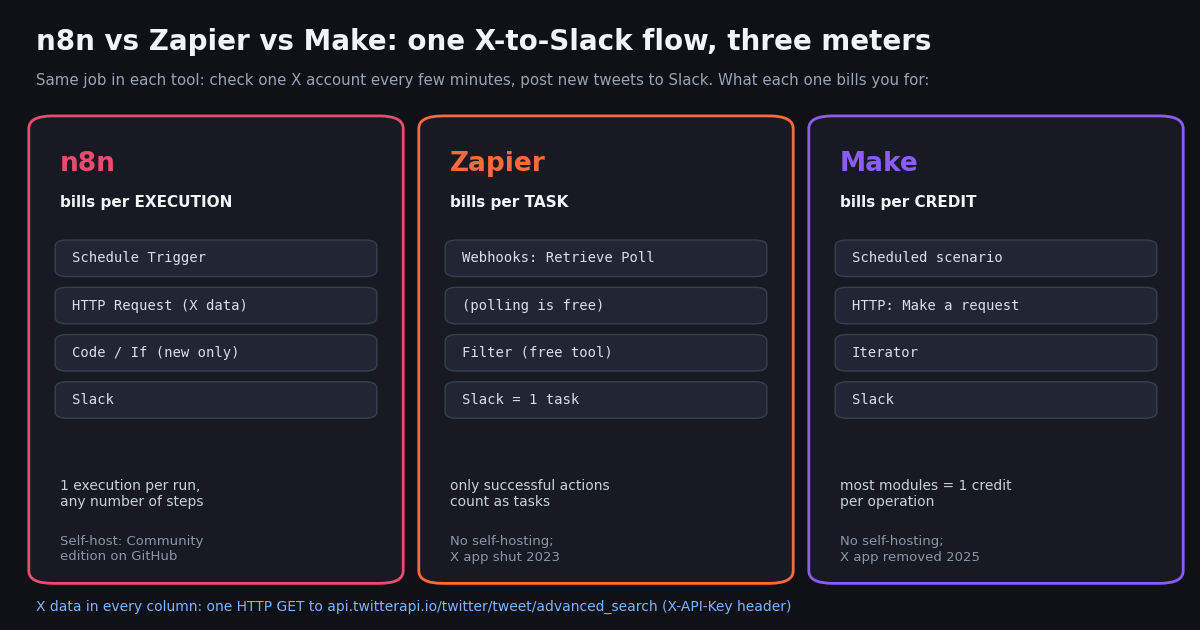
- Billing unit decides the bill: n8n counts one execution per workflow run; Zapier counts one task per successful action (triggers and polling are free); Make counts credits, usually 1 per module operation.
- Entry prices (vendor pages, this session): n8n Starter EUR 24/month monthly or EUR 20 annually for 2,500 executions; Zapier Pro $29.99 monthly or $19.99 annually for 750 tasks; Make Free 1,000 credits a month, paid prices not rendered on its page.
- Self-hosting: only n8n has a self-hosted edition (Community edition on GitHub; Business EUR 800 a month monthly is self-hosted only). Zapier and Make are cloud services.
- AI agents and MCP: all three now ship both. n8n lists the AI Agent node, MCP Server Trigger and MCP Client on Starter and Pro; Zapier MCP is on every plan (one MCP tool call = 2 tasks in its example); Make MCP server lets clients run on-demand scenarios.
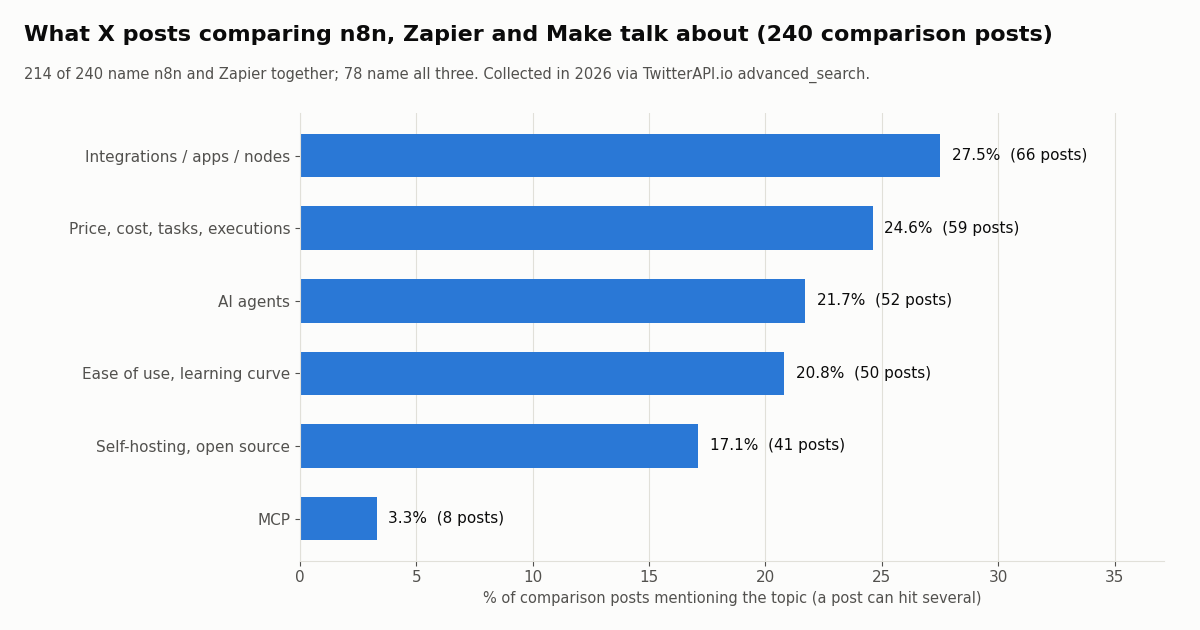
- What X users argue about: in 240 posts comparing the tools, collected in 2026, 27.5% mention integrations, 24.6% price, 21.7% AI agents, and only 3.3% MCP.
- X (Twitter) data: no first-party X trigger works in any of the three; one HTTP GET to
/twitter/tweet/advanced_searchdoes, at $0.15 per 1,000 tweets vs $5.00 per 1,000 post reads on the official X API rate card.
Searches for n8n vs Zapier almost always end up as a three-way question, because Make sits between them on price and complexity. The useful comparison is not a feature checklist (all three connect thousands of apps and all three now have AI agents) but the meter: what each tool counts, how fast that count grows for a polling workflow, and whether you can take the whole thing onto your own server.
This page answers that with the vendors' own pricing pages read this session, one concrete workflow (watch an X account, post new tweets to Slack) built in each tool with step counts and a monthly bill, and a real-data study of how people on X compare the three, plus what the three vendors themselves post. For deeper single-tool guides, see our pages on n8n pricing, Zapier alternatives and the Make X integration linked below; this page does not repeat them.
89.2%
n8n vs Zapier vs Make at a glance: the comparison table
Every price below was read on the vendor's own pricing page this session (n8n.io/pricing, zapier.com/pricing, make.com/en/pricing). Currency and billing period are written as each vendor shows them.
How to read it. Zapier has the highest entry price per unit ($29.99 for 750 tasks vs EUR 24 for 2,500 n8n executions) but charges nothing for checking, filtering or formatting, so a sparse workflow (rare events, one action each) can sit inside a small plan. n8n is the most generous for long workflows, because a 20-step run still counts as one execution. Make is the most granular: each module touched in a run spends a credit, so you design scenarios to touch as few modules as possible.
Pricing units and free tiers: execution vs task vs credit
n8n: execution. The pricing page states it directly: "An execution is a single run of your entire workflow", and pricing is "based on monthly workflow executions, regardless of complexity." A schedule that fires every 5 minutes is, in n8n's own FAQ, about 8,600 to 8,900 executions a month, whether or not anything new was found. Starter and Pro are labeled "Capped" for overages, so a busy month stops rather than surprising you with a bill. The detail on every n8n tier, including Business tiers and the license terms, lives on our n8n pricing page.
Zapier: task. "A task is counted whenever Zapier successfully completes a unit of work for you." Failed actions are not counted, and neither are triggers, polling, or built-in tools such as Formatter, Paths, Filter, Delay, Looping, Digest, Storage and Tables. That makes Zapier's meter event-driven: a Zap that checks a feed every 2 minutes but finds something twice a day spends two tasks a day per action step. When you exceed the plan, Zapier switches to pay-per-task at an overage rate (about 1.25x the base task rate on annual plans and 2.5x on monthly) and pauses at 3x your task subscription.
Make: credit. "Credits are the billing unit in Make"; most actions consume 1 credit, while some features using Make's AI provider use more. Reading, searching, creating, updating, transforming, aggregating and iterating all count; error handlers and the Router do not. A scheduled scenario spends credits on every run for every module that executes, even when the first module returns nothing new.
The practical rule. Many steps per run and a high run count favors n8n. Few actions per event and a long polling cadence favors Zapier. Mid-sized visual scenarios with branching, run on a modest schedule, are where Make's credit math usually lands between the two.
Zapier Free gives 100 tasks a month, unlimited Zaps within that limit, two-step Zaps only, and 15-minute polling. Premium apps (including Webhooks by Zapier, which the X flow below needs) are not on Free.
Make Free gives 1,000 credits a month, 1 MB of data storage and one data store. That is enough to learn the canvas and run a light scenario a few times a day.
n8n has no permanent free cloud plan; the Cloud trial includes 1,000 executions, 5 concurrent executions and a 180-second timeout with no card. What n8n has instead is the self-hosted Community edition, which the pricing page points to on GitHub. Running it means paying for a server and doing the upgrades yourself, but there is no execution meter. Its license is the Sustainable Use License rather than an OSI license; what that allows is covered on our n8n alternatives page.
Business self-hosting is n8n-only too: the Business plan (EUR 800 a month billed monthly, EUR 667 billed annually, 40,000 executions) is listed as self-hosted only, with a cloud version on a waitlist. Zapier and Make do not list a self-hosted edition on their pricing pages.
AI agents and MCP: zapier vs n8n for AI agents
n8n lists "Agents, MCP and AI nodes" on every cloud plan: the AI Agent node and AI steps, an MCP Server Trigger (expose a workflow as an MCP tool), an MCP Client (let an agent call any MCP server) and instance-level MCP. The in-editor Assistant comes with 1,600 credits a month on Starter and up to 9,600 on Pro; self-hosted users bring their own model key.
Zapier prices Agents separately from tasks, in activities: 400 a month on Free and 1,500 on Pro. Zapier MCP is available on all plans, and the rate card's own example is "one MCP tool call = 2 tasks". Copilot in the editor has a daily message limit on Free and is unlimited on paid plans.
Make lists AI agents, the Maia assistant and an MCP server. Make's help center says scenario-run scopes for the MCP server are available on all plans (management scopes need a paid plan), and a scenario becomes an MCP tool when it is active with on-demand scheduling and defined inputs and outputs.
Which is better for agents? If the agent itself should live in the workflow (an LLM node that plans, calls tools and loops), n8n's node model is the most flexible and the execution meter does not grow with tool calls. If you want to give an outside assistant (Claude, ChatGPT, Cursor) access to thousands of SaaS actions with no hosting, Zapier MCP is the shortest path, priced in tasks per tool call. Make sits in between: its MCP server turns your existing scenarios into tools.
The same flow in all three: new tweet from an account to Slack
To make the comparison concrete we priced one workflow in each tool: check one X account every few minutes and post each new tweet to a Slack channel. Volume used for the math: a check every 5 minutes is 8,640 checks in a 30-day month, and the account posts about 37 times a month (the pace of @n8n_io in our sample, 1.23 posts a day). None of the three has a working first-party X trigger, so in every tool the X data comes from one HTTP call to TwitterAPI.io's /twitter/tweet/advanced_search with the query from:<account> since_time:<unix seconds> and an X-API-Key header. No X account or X developer app is needed for reads.
n8n (4 nodes). Schedule Trigger (every 5 min) > HTTP Request (advanced_search) > Code or If (keep only new tweet IDs) > Slack. Each run is one execution whatever it finds, so 8,640 executions a month: above Starter's 2,500, inside Pro's 10,000 (EUR 60 monthly, EUR 50 annually). Stretch the schedule to every 20 minutes (2,160 runs) and Starter fits. Self-hosted, there is no meter. The importable workflow JSON is on our n8n Twitter workflow page.
Zapier (2 steps plus a free filter). Webhooks by Zapier Retrieve Poll trigger ("Triggers when a request to a URL returns new entries") on the advanced_search URL with the key in a request header > Slack action. Polling and deduplication are free; only the Slack post is a task, so about 37 tasks a month. That fits the Pro 750-task tier ($29.99 monthly, $19.99 annually). It does not fit Free, because Webhooks by Zapier is a Premium app. Zapier sets the polling cadence itself: 2 minutes on Pro, 1 minute on Team.
Make (4 modules). Scheduled scenario (every 5 min) > HTTP Make a request > Iterator > Slack Create a Message. The HTTP module runs on every schedule tick (8,640 credits) and the Iterator and Slack modules run only when tweets arrive (about 74 credits), so roughly 8,700 credits a month. That is above Free's 1,000 and inside a 10,000-credit paid tier, whose price did not render on Make's page. The importable blueprint is on our Make.com Twitter integration page.
The surprise. For this sparse, event-driven flow, Zapier's task meter is the most forgiving because its polling is free, while n8n and Make bill every check. Flip the shape (a 10-step flow that runs on every check and acts on most of them) and the order reverses.
The X data bill: TwitterAPI.io vs the official X API
The platform bill is only half of a Twitter workflow. The other half is the X data each check pulls. TwitterAPI.io bills 15 credits per tweet returned ($0.15 per 1,000 tweets) with a 15-credit minimum per request, so a check that finds nothing costs $0.00015. The official X API pay-per-usage rate card (docs.x.com/x-api/getting-started/pricing) bills $0.005 per post read and $0.010 per user read, capped at 3 million post reads a month.
Read this honestly. For one quiet account, the official X API's per-post charge is lower than our polling floor, because X does not bill empty reads; what it does require is an X developer account and app. Once the workflow reads volume (keyword searches, mentions, many accounts), the per-post rates decide it: $0.15 vs $5.00 per 1,000, about 33x on the official rate card. To trim the floor in any of the three tools, poll less often: every 15 minutes is 2,880 checks, about $0.43 a month.
New accounts that pass the automatic bot check get up to $1 of free credits (at most 100,000 credits, no card, one per person or network, expiring after 31 days), enough for the 5-minute flow above for most of a month. Purchased credits never expire.
What X users say when they compare n8n, Zapier and Make
We pulled recent English posts that name the tools together and posts with switch phrases (switched, moved, migrated or left), 628 distinct posts from 377 accounts, collected in 2026. 240 of them name at least two of the three tools; those are the comparison posts below.
n8n vs Zapier is the main event. 214 of the 240 comparison posts (89.2%) name n8n and Zapier together, 97 (40.4%) name Zapier and Make, 85 (35.4%) name n8n and Make, and 78 (32.5%) name all three. That matches the search data: the n8n-Zapier pair is the biggest of the comparison queries.
Self-hosting is an n8n conversation. Among the 221 comparison posts that name n8n, 18.6% mention self-hosting or open source; among the 19 that compare only Zapier and Make, 0.0% do. Those Zapier-vs-Make posts lean instead on ease of use (31.6%).
Which way do people move? Only 13 posts state a clear from-to switch, so treat this as anecdote, not a market share: Zapier to Make 7, Make to n8n 5, Zapier to n8n 1, and none in the other direction. The pattern is a ladder: people leave Zapier when task counts grow, and some later leave Make for n8n when they want code, self-hosting or a flat execution price. The longer version of this story, by reason for leaving, is on our Zapier alternatives page.
How the three vendors use X: @n8n_io, @zapier and @make_hq
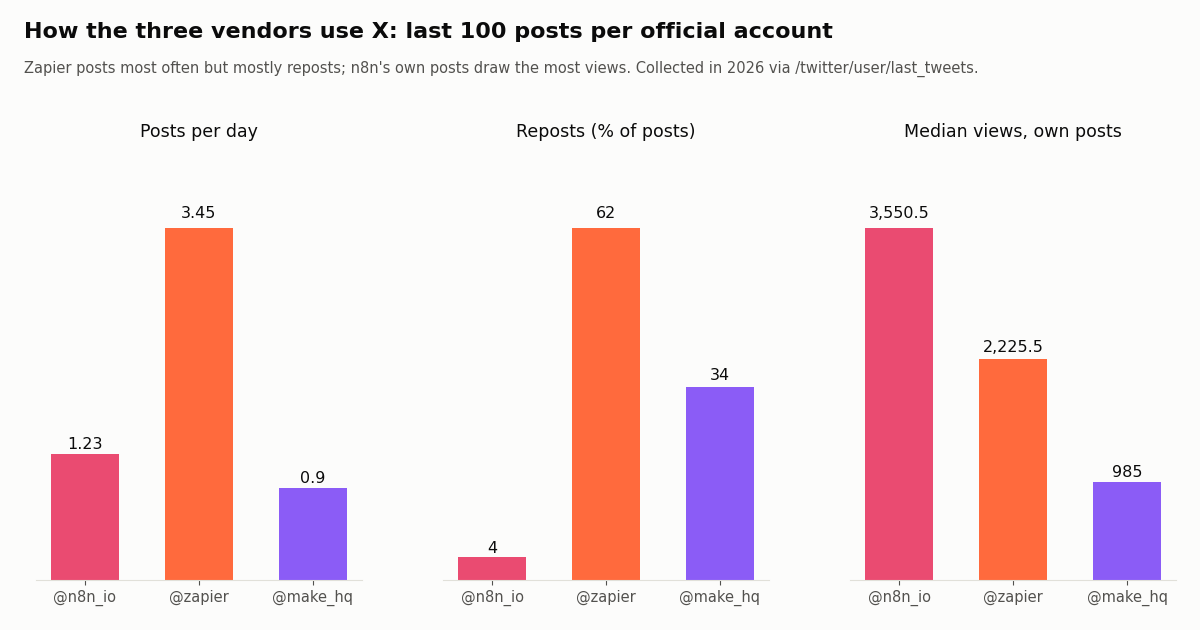
We also read the last 100 posts of each vendor's official account. The three run very different X strategies.
@zapier is the busiest (3.45 posts a day) but 62.0% of its feed is reposts; it also talks about MCP most, in 15.8% of its own posts. @n8n_io posts 1.23 times a day, almost all original, and its own posts draw the highest median views (3,550). @make_hq posts least often (0.9 a day) with a median of 985 views on its own posts, and mentions AI in 45.5% of them. AI agents appear in 25.0% of n8n's own posts and 26.3% of Zapier's: all three vendors are selling the agent story now.
Which should you choose? n8n vs Zapier vs Make by situation
Choose Zapier when non-developers own the automations, the app you need is only in Zapier's catalog, or the workflow is sparse (few events, one or two actions each), because free polling keeps the task count low. Budget for Premium apps (Webhooks) on Pro, and for MCP tool calls at 2 tasks each in Zapier's example.
Choose Make when you want a visual canvas with routers, iterators and error handlers, and runs are moderate. Keep scenarios lean: every module that runs spends a credit. Check the current Core and Pro prices on Make's own page; they did not render in our fetch.
Choose n8n when you want to self-host, keep data on your own infrastructure, write JavaScript or Python in Code nodes, or build AI agents with many tool calls per run. On n8n Cloud, size the plan by schedule frequency, not by step count.
For Twitter (X) workflows in any of them, skip the native X apps (gone or action-only) and add one HTTP step to TwitterAPI.io, or point the tool's MCP client at our hosted MCP server, https://mcp.twitterapi.io/mcp with the header Authorization: Bearer your_key_here. The code below is the same 5-minute X-to-Slack job as plain Python, useful as a reference for what each visual flow does.
HTTP step (n8n HTTP Request / Zapier Retrieve Poll / Make HTTP Make a request)

Method: GET
URL:    https://api.twitterapi.io/twitter/tweet/advanced_search
Query:  query = from:n8n_io since_time:<unix seconds of last check>
        queryType = Latest
Header: X-API-Key: <your key>

Response: tweets[] (id, url, text, createdAt, author.userName ...),
has_next_page, next_cursorHow we collected this
Question. When people on X compare n8n, Zapier and Make, which tools do they pair, what do they argue about, and which way do stated switches go? And how active is each vendor's own account?
Queries and accounts. Four advanced_search queries (Latest, English, no reposts): n8n with Zapier; n8n with Make (make.com, "make com" or Integromat); Zapier with Make excluding n8n; and switch phrases (switched, moved, migrated from, or left Zapier, n8n or Make). Plus /twitter/user/last_tweets for @n8n_io, @zapier and @make_hq, 100 posts each.
Window and size. The most recent matching posts at collection time, collected in 2026: 628 distinct search posts (377 accounts) and 300 vendor posts, 934 tweets returned in 53 requests, about $0.14 of API credit. The n8n-Zapier query covered about 5 days; the rarer queries reached back further, and the switch-phrase query reached back years.
Method. Tool mentions, topics and switch direction were classified with regular expressions on the post text. Because "make" is a common verb, Make counts only when written as make.com, "make com", Integromat, @make_hq or next to Zapier or n8n in a list, and switch statements count only in posts that also name n8n or Zapier.
What the sample cannot show. It is a recent slice of English posts, not a survey; promotional threads and a few prolific posters weigh in; the switch count is small; regex topics miss sarcasm and context. View counts are what the API returned at collection time.
Privacy. Aggregates only. Search authors are private individuals and are never named, quoted or profiled; only the three vendor accounts are named.
import os
import time
import requests

API_KEY = os.environ["TWITTERAPI_IO_KEY"]          # from twitterapi.io/dashboard
SLACK_WEBHOOK = os.environ["SLACK_WEBHOOK_URL"]    # Slack incoming webhook URL
ACCOUNT = "n8n_io"                                 # the X account to watch
BASE = "https://api.twitterapi.io"


def new_tweets(since_unix):
    """Every post from ACCOUNT newer than since_unix, following next_cursor."""
    params = {"query": f"from:{ACCOUNT} since_time:{since_unix}", "queryType": "Latest"}
    found = []
    while True:
        r = requests.get(f"{BASE}/twitter/tweet/advanced_search",
                         headers={"X-API-Key": API_KEY}, params=params, timeout=30)
        r.raise_for_status()
        body = r.json()
        found += body.get("tweets", [])
        if not body.get("has_next_page"):
            return found
        params["cursor"] = body["next_cursor"]


def post_to_slack(t):
    text = f"New post from @{t['author']['userName']}: {t['text']}\n{t['url']}"
    requests.post(SLACK_WEBHOOK, json={"text": text}, timeout=15).raise_for_status()


if __name__ == "__main__":
    since = int(time.time()) - 300                 # first run: last 5 minutes
    while True:                                    # same job the n8n / Zapier / Make flows do
        checked_at = int(time.time())
        for t in reversed(new_tweets(since)):      # oldest first
            post_to_slack(t)
        since = checked_at
        time.sleep(300)                            # every 5 minutes = 8,640 checks a month
Researching this?Free starter credits cover end-to-end testing — Google sign-in, no card. Get a key.
Questions readers ask
Is n8n cheaper than Zapier?
It depends on the workflow shape. n8n bills one execution per workflow run regardless of steps (Starter EUR 24 a month billed monthly for 2,500 executions), so long multi-step flows cost less. Zapier bills only successful actions and never polling (Pro $29.99 a month billed monthly for 750 tasks), so sparse flows with few events can cost less on Zapier. Self-hosted n8n has no execution meter at all.
Is Make cheaper than Zapier?
Usually per unit of work, because Make counts most module operations as 1 credit and its Free plan includes 1,000 credits a month versus Zapier Free's 100 tasks. But Make also spends credits on every scheduled run, including runs that find nothing, while Zapier does not charge for polling. Make's paid prices did not render on its pricing page in our fetch, so check them there before deciding.
Can I self-host Zapier or Make?
No. Neither lists a self-hosted edition on its pricing page. n8n is the only one of the three with a self-hosted Community edition (on GitHub) and a self-hosted Business plan.
Which is better for AI agents, n8n or Zapier?
n8n if the agent should run inside your workflow: it has an AI Agent node, MCP Server Trigger and MCP Client on every cloud plan, and tool calls do not add executions. Zapier if you want to give an outside assistant access to thousands of SaaS actions: Zapier MCP is on all plans, priced in tasks (one MCP tool call = 2 tasks in its example), and Zapier Agents are billed in activities.
Does Zapier still have a Twitter (X) integration?
No. Zapier's Twitter integration page says it has stopped working, effective August 31, 2023, citing Twitter's API policy and pricing changes. To use X data in a Zap, call an X data API from Webhooks by Zapier, for example a Retrieve Poll trigger on TwitterAPI.io's advanced_search endpoint.
Does n8n or Make have a Twitter trigger?
n8n's X node has actions (post, reply, delete, search, like, retweet, DM, get user, add list member) but no trigger, and it needs your own X developer app. Make removed its X app in 2025. In both, a Schedule trigger plus an HTTP step to an X data API is the working pattern.
How much does the X data cost in these workflows?
With TwitterAPI.io, $0.15 per 1,000 tweets returned and $0.00015 for a check that finds nothing, so polling one account every 5 minutes is about $1.30 a month. The official X API pay-per-usage rate card charges $0.005 per post read with no charge for empty reads, which is lower for one quiet account but $5.00 per 1,000 posts once you read volume.
What is the difference between a Zapier task and an n8n execution?
A Zapier task is one successful action inside a Zap; a five-action Zap that runs once uses five tasks, while its trigger and built-in filters are free. An n8n execution is one run of the entire workflow, however many nodes it has, and it counts whether or not the run did anything.
Continue
- n8n pricing: plans, executions, Community edition, AI and MCP features
- Zapier pricing: tasks, Free and Pro limits, polling time, MCP and Agents
- Make pricing: credits, Free plan allowance, extra credits
- n8n docs: X (Formerly Twitter) node operations
- X API pricing: pay-per-usage rates and monthly cap
- TwitterAPI.io docs: advanced_search and last_tweets
- Twitter (X) API guides and pricing hub
- n8n pricing: every plan, executions and self-hosted costs
- Zapier alternatives that still connect to Twitter (X)
- n8n alternatives by reason for leaving
- Make.com Twitter (X) integration with an importable blueprint
- n8n Twitter workflow: new tweets to Slack, importable JSON
- What an MCP server is, with a live X example
- TwitterAPI.io pay-per-call pricing
- 01Devin Pricing in 2026: Plans, Quotas, ACUs and What X Users Actually Pay
- 02Lovable Alternatives in 2026: Bolt.new, v0, Base44, Replit, Emergent and Cursor Compared
- 03Kiro vs Cursor in 2026: Plans, Spec-Driven vs Agent-First, and X (Twitter) Data via MCP
- 04Langfuse vs LangSmith: Pricing, Self-Hosting, OpenTelemetry and an X-Data Agent Traced in Both
- 05Replit pricing in 2026: plans, credits, effort-based Agent costs, and what an app that reads Twitter (X) data really costs
- 06n8n Alternatives in 2026: Pick by Why You Are Leaving, and Keep Your Twitter (X) Workflows
- 07n8n Pricing in 2026: Plans, Executions and the Twitter (X) Data Cost
- 08Zapier Alternatives in 2026: Prices, Self-Hosting and Which Ones Still Connect to Twitter (X)
Writing about something you built with TwitterAPI.io? Our community rewards program pays API credits for honest tutorials, build logs and videos.
Stop reading. Start building.
Starter credits cover real testing on real data. Google sign-in, no card, no application queue.
Get an API keyAlready building with TwitterAPI.io? Publish an honest tutorial or build log about it and earn up to $200 a month in API credits.