n8n Alternatives in 2026: Pick by Why You Are Leaving, and Keep Your Twitter (X) Workflows
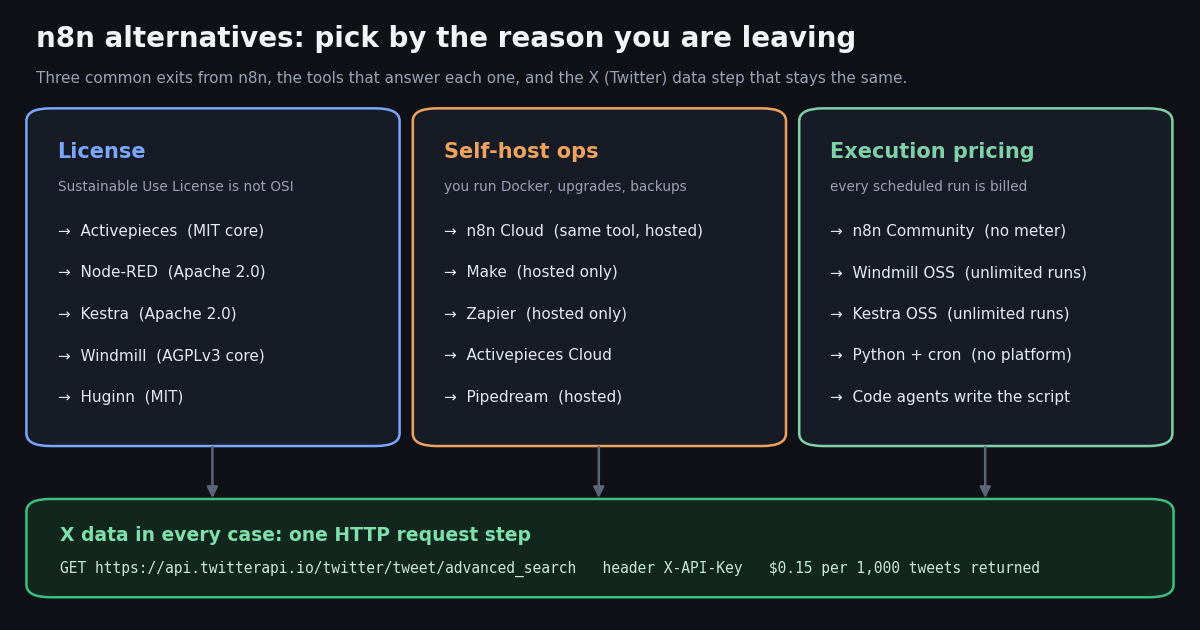
Unlike our Zapier alternatives guide, which compares replacements for a hosted tool, this page is for people leaving n8n itself, so it is organized around the three reasons builders give for leaving it: the license, the work of self-hosting, and execution-based pricing.
For each reason we name the alternatives that actually fix it, with the license read from each project's own LICENSE file and prices read from each vendor's pricing page during this review. Where a price did not render on the vendor's page, we say so instead of guessing. We also checked how each tool handles X (Twitter) today, because X workflows are where migrations most often break: native X integrations depend on the official X API and on the vendor keeping its X app alive.
To see what builders say in public, we read 1,063 X search results and kept 504 posts that talk about replacing, switching from or comparing n8n. The numbers in this guide come from that sample.
n8n alternatives compared: license, price, self-hosting and X (Twitter) support
Every row below was checked against the project's own license file and the vendor's own pricing or docs page during this review. Prices are shown in the currency and billing period the vendor shows.
How to read the X column. A native X integration that still exists runs on the official X API, so you bring an X developer app and pay X's rates. The last two sections show the route that needs neither, and it is the same request on every platform in the table.
What is not in the table. AI-agent builders such as Dify, Flowise, Langflow, Gumloop and Lindy also show up in the n8n conversation (see the study below). They overlap with n8n's AI Agent node more than with its integration catalog, so judge them as agent frameworks, not as workflow engines.
Why people leave n8n: what X posts actually say
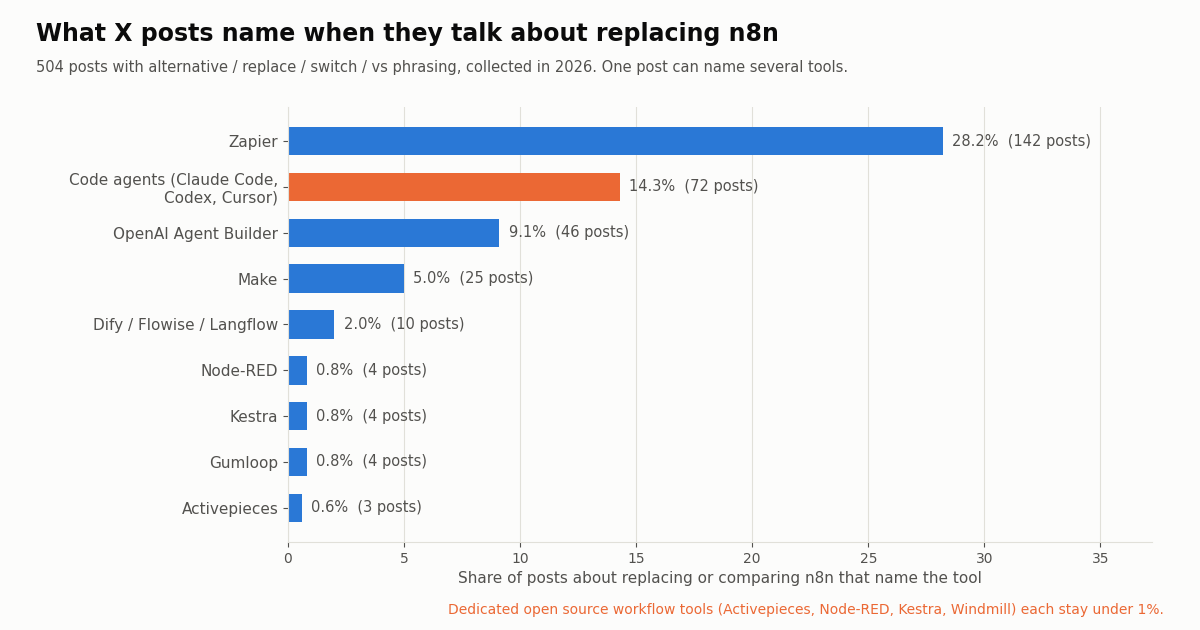
We searched X for posts that compare n8n with something else or talk about replacing it (phrases such as "n8n alternative", "instead of n8n", "replace n8n", "switched from n8n", "n8n vs" and "n8n killer"), removed vendor accounts, and counted the reasons each post mentions. The sample is 504 posts; one post can mention several reasons.
Agents dominate the conversation, not the exits. 36.9% of posts mention agents or MCP, but many of those compare n8n's own AI Agent node with a newer agent builder rather than leaving n8n. The operational reasons, self-hosting (28.2%) and price (25.4%), are the ones that line up with the alternatives in this guide.
Few posts name a dedicated open source replacement. Activepieces (0.6%), Node-RED (0.8%), Kestra (0.8%) and Windmill (0.2%) are each named in fewer than 1 in 100 posts, even though 18.8% of posts raise the license or open source question. Builders who leave over the license tend to say so without naming where they went.
Zapier is named most, mostly as a comparison. Zapier appears in 28.2% of posts (142 posts), largely in "n8n vs Zapier" comparisons and tool lists rather than as a destination. Make follows at 5.0%.
The "n8n killer" posts. 8.1% of posts (41) declare n8n dead, killed or replaced by a new launch. In our sample that wave peaked with OpenAI's Agent Builder, which OpenAI introduced as part of AgentKit at DevDay on October 6, 2025.
2025 vs 2026: from agent builders to code agents
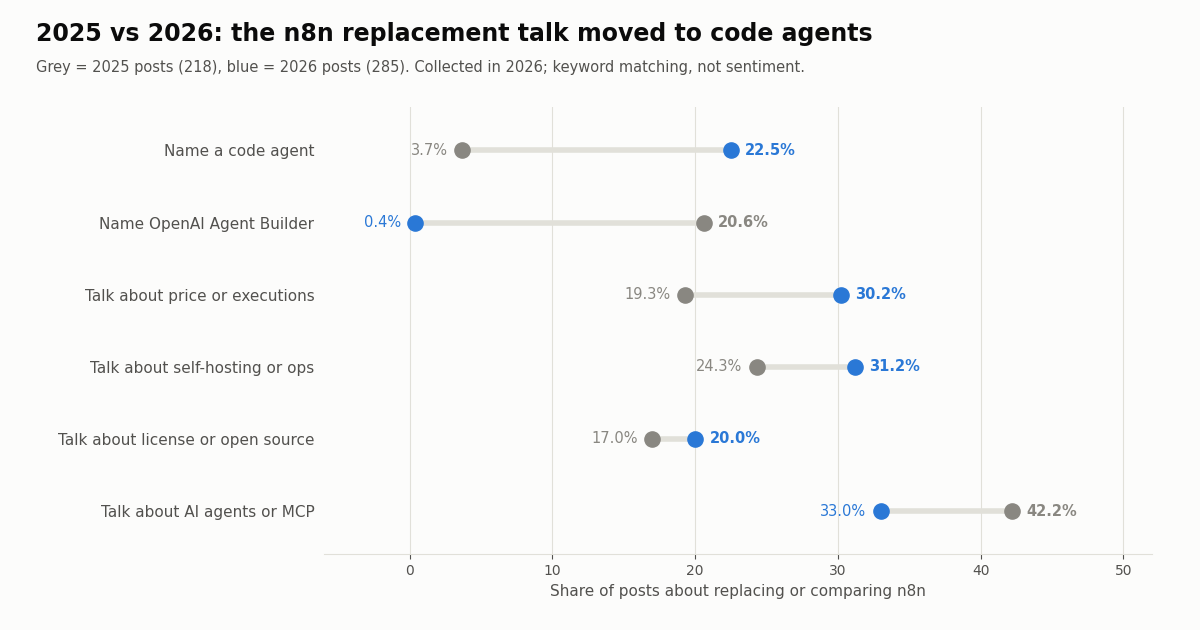
Splitting the sample by the year each post was written shows a clear shift. The 218 posts from 2025 and the 285 posts from 2026 talk about leaving n8n for different reasons.
Agent Builder was a moment, not a migration. 20.6% of 2025 posts named OpenAI's Agent Builder, almost all around its launch; in 2026 the share is 0.4%.
Code agents are the 2026 alternative. The share of posts naming Claude Code, Codex or Cursor grew about sixfold, from 3.7% to 22.5%. The argument in these posts is that a coding agent can write the script a workflow would have been, so the platform and its execution meter are no longer needed for simple jobs.
Cost moved up the list. Price and execution talk rose from 19.3% to 30.2% of posts, and self-hosting from 24.3% to 31.2%. Both point at the same trade-off: pay n8n per execution, or run something yourself.
Reason 1: the license. Open source n8n alternatives (and what each license allows)
n8n's LICENSE.md on GitHub puts the code under the Sustainable Use License. Its limitations say: "You may use or modify the software only for your own internal business purposes or for non-commercial or personal use" and "You may distribute the software or provide it to others only if you do so free of charge for non-commercial purposes." Running n8n for your own company is fine; reselling hosted n8n to clients or embedding it in a product you sell is what the license restricts. If that is your plan, these are the alternatives under OSI licenses.
Activepieces (MIT core). The repository LICENSE says content outside packages/ee/ and packages/server/api/src/app/ee "is available under the MIT Expat license"; the enterprise directories have their own license. MIT is the most permissive option here: you can embed and resell the community core. The hosted plans are Free (1,000 credits a month, unlimited flows, up to 5 users, MCP and API access), Plus at a flat $20 and Team at a flat $200, both billed monthly, and a custom Ultimate plan, with Embed priced from $36k a year.
Node-RED (Apache 2.0). The flow-based tool is under the Apache License 2.0 and is free. It is strongest for IoT, MQTT and local event flows; it has fewer ready-made SaaS integrations than n8n, so expect to use its HTTP request node for most APIs.
Kestra (Apache 2.0). Kestra's repository is Apache 2.0. Its pricing page lists the Open Source edition at 0 USD with "Unlimited Flows & Executions", 2,600+ plugins, "Business Logic in Any Language", code and no-code editors and an MCP server for AI agents. Its declarative workflows suit data and platform teams more than marketers. Enterprise is an annual per-instance subscription priced by sales, and Kestra Cloud shows no public price.
Windmill (AGPLv3 core). Windmill's LICENSE puts backend/ and frontend/ under AGPLv3, its Python, Deno, Go and PowerShell clients and OpenFlow spec under Apache 2.0, and code behind the enterprise flag under a proprietary license. The README calls it an "open-source, self-hostable code-first platform for workflows, apps and AI agents" with scripts in "Python, TypeScript, Go, Bash, SQL, GraphQL, PowerShell, Rust, and more". AGPL is OSI open source but has a network clause: if you modify Windmill and offer it to users over a network, you must publish your changes.
Huginn (MIT). The project describes itself as "a hackable version of IFTTT or Zapier on your own server" and is MIT-licensed. It is self-host only and agent-based (watchers that create events), good for scraping and alerting, light on modern SaaS connectors.
Which one to pick. Need to resell or embed: Activepieces. Declarative data pipelines: Kestra. Developers who want scripts with a UI: Windmill. Device and event flows: Node-RED. Personal watchers on a small server: Huginn.
Reason 2: self-hosting work. Hosted n8n alternatives, and when n8n Cloud is the answer
Self-hosting n8n Community is free in license fees but not in time: you own Docker, upgrades, database backups, TLS and uptime. If that is the reason you are leaving, the first alternative to price is n8n's own cloud, because it keeps your workflows unchanged.
n8n Cloud. The pricing page lists Starter at EUR 20 a month billed annually (2.5K workflow executions), Pro at EUR 50 a month billed annually (10K executions) and Enterprise by sales; annual billing saves 17%. Business (EUR 667 a month billed annually, 40K executions) is self-hosted only for now, with the cloud version on a waitlist. Our n8n pricing guide breaks down monthly prices, execution math and the Business license.
Make. Hosted only. The pricing FAQ says the Free plan has 1,000 credits a month and that each action in a scenario usually costs 1 credit; the paid plan prices (Core, Pro, Teams) did not render on the page we fetched, so check make.com/en/pricing in your region. For X, Make's help center states that the X app was removed on April 3, 2025 and that existing scenarios using it stopped working on May 30, 2025.
Zapier. Hosted only. Free is 100 tasks a month with two-step Zaps and 15-minute polling; Pro starts at $19.99 a month billed annually for 750 tasks ($29.99 billed monthly); Team starts at $69 a month billed annually for 2,000 tasks. Zapier's Twitter page says the integration "has stopped working (effective August 31, 2023)." The Zapier alternatives guide has the full per-platform X status table, so we do not repeat it here.
Activepieces Cloud and Pipedream. Activepieces is the hosted option that keeps an open source exit (same MIT core). Pipedream's pricing page now frames it as an integration layer: Free is for development only, and production starts with Startup at $99 a month billed annually ($150 billed monthly) with 10,000 usage credits, then $0.012 per credit, where one credit is 30 seconds of compute.
The trade-off to measure. Hosted tools bill per unit of work (executions, credits, tasks); self-hosted ones bill in server and time. A schedule that runs every 5 minutes is about 8,640 runs in a 30-day month whether or not anything happened, which is why the next section matters.
Reason 3: execution pricing. Free alternatives with no execution meter
On n8n Cloud, pricing "is based on monthly workflow executions, regardless of complexity", so a polling workflow pays for every empty run. Three ways out keep your workflows on a schedule without a per-run fee.
Self-host n8n Community. The least disruptive: same workflows, same nodes, no execution meter. You take on the ops work from the previous section.
Windmill or Kestra open source. Both pricing pages list unlimited executions for the self-hosted open source edition. Windmill's free edition has limits on other things (for example 3 workspaces, up to 50 users, 10 users with SSO and 30 days of job run details), not on runs.
A script on cron. For one-trigger, few-step jobs (search something, filter, post to Slack), a 60-line Python script on cron or a scheduled container replaces the platform entirely. This is the route the 2026 posts in our study point to: a code agent writes and maintains the script, and the only meter left is the API you call. The code example on this page is exactly that script for an X keyword watch.
When to stay on a platform anyway. Many integrations with OAuth you do not want to maintain, non-developers who edit flows, audit logs and retries with a UI: those are what n8n, Activepieces and Windmill are for. A script wins when the workflow is small, stable and owned by a developer.
How each n8n alternative handles X (Twitter) data today
X workflows are the most common thing to break in a migration, because every native integration rides on the official X API and on the vendor keeping its X app alive. Here is what we found on each vendor's own pages.
n8n. The X node can create a direct message, create or reply to a tweet, delete, search, like and retweet, get a user and add a list member, with no trigger node. Its credentials page requires an X developer account and an X app with OAuth2 Client ID and Client Secret (OAuth 1.0a was deprecated from n8n 0.236.0), and notes that limits depend on "your developer access plan level". Reads through that node are billed on X's rate card.
Activepieces. The Twitter piece lists two actions, Create Tweet and Create Reply, and zero triggers. There is no read or search action.
Node-RED. The node-red-node-twitter package page shows version 1.2.0, last updated about six years ago, and still refers only to Twitter. Treat it as unmaintained.
Windmill and Kestra. No dedicated X step; both run code or a generic HTTP request (Kestra's core HTTP Request task supports custom headers such as X-API-KEY).
Make and Zapier. No X integration: Make's ended on May 30, 2025 and Zapier's on August 31, 2023.
How often it comes up. In our sample, only 2.2% of the posts about replacing n8n mention Twitter or X workflows at all, so do not expect alternative roundups to warn you. Check your X steps before you migrate.
The X data step that works on every n8n alternative
Every tool in this guide can make an HTTP request: n8n's HTTP Request node, Activepieces' HTTP piece, Kestra's HTTP Request task, a Windmill script, Node-RED's HTTP request node, Make's HTTP module, or requests in a cron script. Point it at TwitterAPI.io and X reads need no X developer account and no X app, and they keep working when you switch platforms again.
The request. GET https://api.twitterapi.io/twitter/tweet/advanced_search with the header X-API-Key: <your key> and the parameters query (X search syntax, including since_time:<unix seconds>) and queryType (Latest or Top). The response has tweets[], has_next_page and next_cursor. For an account's own posts, use /twitter/user/last_tweets with userName.
Cost of the data. Tweet endpoints cost 15 credits per tweet returned, $0.15 per 1,000 tweets. The official X API pay-per-usage rate card (docs.x.com/x-api/getting-started/pricing) charges $0.005 per post read, $5 per 1,000, so about 33x more per tweet, and caps pay-per-usage at 3 million post reads a month before Enterprise. X adds $20 of credits when you save a first card and matches a first auto-recharge up to $50.
Cost of polling. A check that finds nothing costs the 15-credit minimum, $0.00015. Polling every 5 minutes for a month is $1.30; every 60 seconds is 43,200 checks, $6.48. On a self-hosted platform or a cron script that is the whole bill; on n8n Cloud the executions are on top.
Push instead of poll. /oapi/tweet_filter/add_rule (activated with /oapi/tweet_filter/update_rule) sends matching tweets to a webhook you host, such as an n8n or Activepieces webhook trigger, so the workflow only runs when there is a match.
Posting. Writes run through an authenticated session: one /twitter/user_login_v2 login ($0.10, with a proxy you supply) returns login_cookies, and each /twitter/create_tweet_v2 post is then 60 credits, $0.0006, billed per HTTP 200 call. The call acts as that account, so X can rate-limit, lock or suspend it; keep a human pace, and expect the session to need re-login from time to time.
AI agents. If your replacement is a code agent or an agent builder, the hosted MCP server at https://mcp.twitterapi.io/mcp exposes the same endpoints as tools; send your API key as a Bearer token in the Authorization header.
Rate limits and sign-up. Requests run at 0.2 per second before the first payment and 20 per second once paid, far above what a schedule needs. New accounts that pass the automatic bot check get up to $1 of free credits (at most 100,000 credits, no card, one per person or network, expiring after 31 days); purchased credits never expire. Subscriptions run from Starter at $29 to Business at $1,499 a month; see the pricing page.
# The same call your n8n HTTP Request node, Activepieces HTTP piece or Kestra HTTP task makes
curl -s -G "https://api.twitterapi.io/twitter/tweet/advanced_search" \
  -H "X-API-Key: $TWITTERAPI_IO_API_KEY" \
  --data-urlencode 'query=("n8n alternative" OR "alternative to n8n") -filter:retweets' \
  --data-urlencode 'queryType=Latest'
# -> {"tweets": [...], "has_next_page": true, "next_cursor": "..."}How we collected this
Question. When people on X talk about replacing or comparing n8n, which tools do they name, which reasons do they give, and did that change between 2025 and 2026?
Query. TwitterAPI.io /twitter/tweet/advanced_search, reposts excluded: a precise query ("n8n alternative", "alternatives to n8n", "instead of n8n", "replace n8n", "switched from n8n", "ditched n8n", "n8n competitor", "n8n vs") in Latest and Top order, plus a broader n8n query with words such as alternative, switching, replacing, ditching and "n8n killer" in Latest order.
Sample and window. 1,063 results, 809 unique posts that mention n8n after removing vendor accounts, of which 504 use replace, switch, alternative or comparison phrasing (the sample used on this page). Nearly all are from 2025 (218) and 2026 (285). Collected in 2026 with 56 API requests, about $0.16 at $0.15 per 1,000 tweets.
Method. Tools and reasons are matched with case-insensitive keyword patterns (for example "open source", "license", "fair-code" for the license family; "self-host", "docker", "vps", "server" for ops). One post can count in several rows.
What it cannot show. Keyword matching does not read sentiment: a post that praises n8n's self-hosting counts in the self-hosting row just like a complaint. X search returns what it indexes for these phrases, not every opinion; listicles and launch posts are included; posts are not weighted by reach. Treat shares as direction, not market share.
Privacy. Aggregates only. Posts by private individuals are counted, never quoted or named; raw search pages were not kept in the repository, and the published sample holds de-identified rows (year, language, flags, engagement counts). 94.9% of the posts are in English.
"""n8n_free_x_watch.py - the "code-first" n8n alternative for one X (Twitter) workflow:
search X for a keyword every few minutes and send new posts to a Slack incoming webhook.
Run it from cron (or any scheduler) instead of an n8n Schedule Trigger + HTTP Request + IF + Slack.

    pip install requests
    export TWITTERAPI_IO_API_KEY=...        # from the twitterapi.io dashboard
    export SLACK_WEBHOOK_URL=https://hooks.slack.com/services/...
    # crontab -e:   */15 * * * *  /usr/bin/python3 /opt/watch/n8n_free_x_watch.py
"""
import json
import os
import time
from pathlib import Path

import requests

BASE = "https://api.twitterapi.io"
HEADERS = {"X-API-Key": os.environ["TWITTERAPI_IO_API_KEY"]}
SLACK = os.environ["SLACK_WEBHOOK_URL"]
QUERY = '("n8n alternative" OR "alternative to n8n") -filter:retweets'
STATE = Path(os.environ.get("WATCH_STATE", "watch_state.json"))
MAX_PAGES = 5  # 20 tweets per page; a burst bigger than 100 tweets waits for the next run


def load_since() -> int:
    if STATE.exists():
        return json.loads(STATE.read_text())["since"]
    return int(time.time()) - 3600  # first run: look back one hour


def fetch_new(since: int) -> list:
    tweets, cursor = [], ""
    for _ in range(MAX_PAGES):
        params = {"query": f"{QUERY} since_time:{since}", "queryType": "Latest", "cursor": cursor}
        r = requests.get(f"{BASE}/twitter/tweet/advanced_search", headers=HEADERS, params=params, timeout=30)
        r.raise_for_status()
        body = r.json()
        tweets.extend(body.get("tweets", []))
        if not body.get("has_next_page"):
            break
        cursor = body.get("next_cursor", "")
    return tweets


def to_slack(t: dict) -> None:
    author = t.get("author") or {}
    text = (t.get("text") or "").replace("\n", " ")[:300]
    msg = f"*@{author.get('userName', '?')}* ({t.get('likeCount', 0)} likes): {text}\n{t.get('url', '')}"
    requests.post(SLACK, json={"text": msg}, timeout=15).raise_for_status()


def main() -> None:
    started = int(time.time())
    since = load_since()
    new = fetch_new(since)
    for t in reversed(new):  # oldest first
        to_slack(t)
    STATE.write_text(json.dumps({"since": started}))
    # billing: 15 credits per tweet returned, 15-credit minimum per request (an empty check is $0.00015)
    print(f"{len(new)} new posts since {since}")


if __name__ == "__main__":
    main()
Questions readers ask
What is the best free alternative to n8n?
If you mean free to run, n8n's own Community Edition is free to self-host, and Windmill and Kestra list unlimited executions on their self-hosted open source editions. If you mean a free hosted plan, Activepieces Free includes 1,000 credits a month with unlimited flows and up to 5 users, Make Free has 1,000 credits a month and Zapier Free has 100 tasks a month.
Is n8n open source?
Not under an OSI definition. n8n's LICENSE.md applies the Sustainable Use License, which allows use "only for your own internal business purposes or for non-commercial or personal use". The source is public and you can self-host it for your own business, but reselling or embedding it commercially is restricted, and files marked .ee. need an enterprise license.
What is the best open source n8n alternative?
Activepieces is the closest in look and feel, with an MIT-licensed core and a hosted option. Kestra (Apache 2.0) suits data and platform teams that want declarative flows, Windmill (AGPLv3 core) suits developers who want scripts with a UI, and Node-RED (Apache 2.0) suits device and event flows.
Can I use n8n commercially for clients?
You can use n8n for your own internal business purposes, including automations that serve your own customers. The Sustainable Use License restricts distributing it or providing it to others except free of charge for non-commercial purposes, so hosting n8n as a paid service for clients needs a commercial agreement with n8n or an alternative under a permissive license such as Activepieces' MIT core.
Is Activepieces better than n8n?
It is more permissive (MIT core versus the Sustainable Use License) and its paid plans are flat ($20 Plus, $200 Team a month) rather than execution-based. n8n has the larger community and a richer X node; Activepieces' Twitter piece has only Create Tweet and Create Reply and no triggers. Pick by license and pricing model, not by feature count.
Which n8n alternatives still support Twitter (X)?
Natively, few: n8n's X node needs your own X developer app, Activepieces can only post and reply, Make's X app stopped working on May 30, 2025, Zapier's on August 31, 2023, and the Node-RED Twitter node has not been updated in about six years. Every platform can call an X data API through an HTTP step instead, for example TwitterAPI.io at $0.15 per 1,000 tweets returned with no X developer account.
Can Claude Code or Codex replace n8n?
For small, stable workflows, yes: a coding agent can write a script that runs on cron, with no platform and no execution meter. That is the trend in our X study, where the share of posts about replacing n8n that name a code agent rose from 3.7% in 2025 to 22.5% in 2026. For many integrations, non-developer editors or audit needs, a workflow platform is still the better fit.
How do I move an n8n X (Twitter) workflow to another tool?
Replace the X node with an HTTP request step that calls /twitter/tweet/advanced_search (or /twitter/user/last_tweets) with an X-API-Key header, store the last run time, and pass since_time in the query so each run only returns new posts. The same request works in Activepieces, Kestra, Windmill, Node-RED, Make or a Python script.
Continue
- n8n LICENSE.md: Sustainable Use License
- Activepieces license (MIT Expat core)
- Windmill license (AGPLv3 core, Apache 2.0 clients)
- Kestra license (Apache 2.0)
- n8n docs: X credentials (developer app, OAuth2)
- X API pricing (official pay-per-usage rate card)
- X (Twitter) API guide and endpoint overview
- Zapier alternatives and each platform's X integration status
- n8n pricing explained: Cloud plans, executions and self-hosting
- build an n8n Twitter API workflow with the HTTP Request node
- connect Make.com to Twitter after the X app shutdown
- hosted Twitter MCP server for AI agents
- Twitter API in Python: complete guide
- TwitterAPI.io pricing: credits per tweet and per profile
- 01What Is Qoder? Plans, Credits, MCP Setup and Twitter (X) Data in Qoder
- 02Cursor vs GitHub Copilot: Plans, Agent Mode, MCP and a Twitter (X) Data Setup in Both
- 03Claude Code hooks: every event, the settings.json shape, and tested recipes (plus an X data budget guard)
- 04Google Antigravity Pricing: Free Tier, Pro and Ultra Quotas, and What X Users Report
- 05OpenRouter Alternatives in 2026: LiteLLM, Vercel AI Gateway, Requesty, Portkey and Direct APIs Compared, With What Developers on Twitter (X) Say
- 06Claude Code Alternatives: Seven Coding Agents Checked for License, Free Use and MCP (Twitter/X Data Included)
- 07n8n Pricing in 2026: Plans, Executions and the Twitter (X) Data Cost
- 08Social Listening via X (Twitter) API — Build vs Buy
Stop reading. Start building.
Starter credits cover real testing on real data. Google sign-in, no card, no application queue.
Get an API keyAlready building with TwitterAPI.io? Publish an honest tutorial or build log about it and earn up to $200 a month in API credits.