Genspark Pricing in 2026: Plans, Credits per Task, and What Twitter (X) Says About the Cost
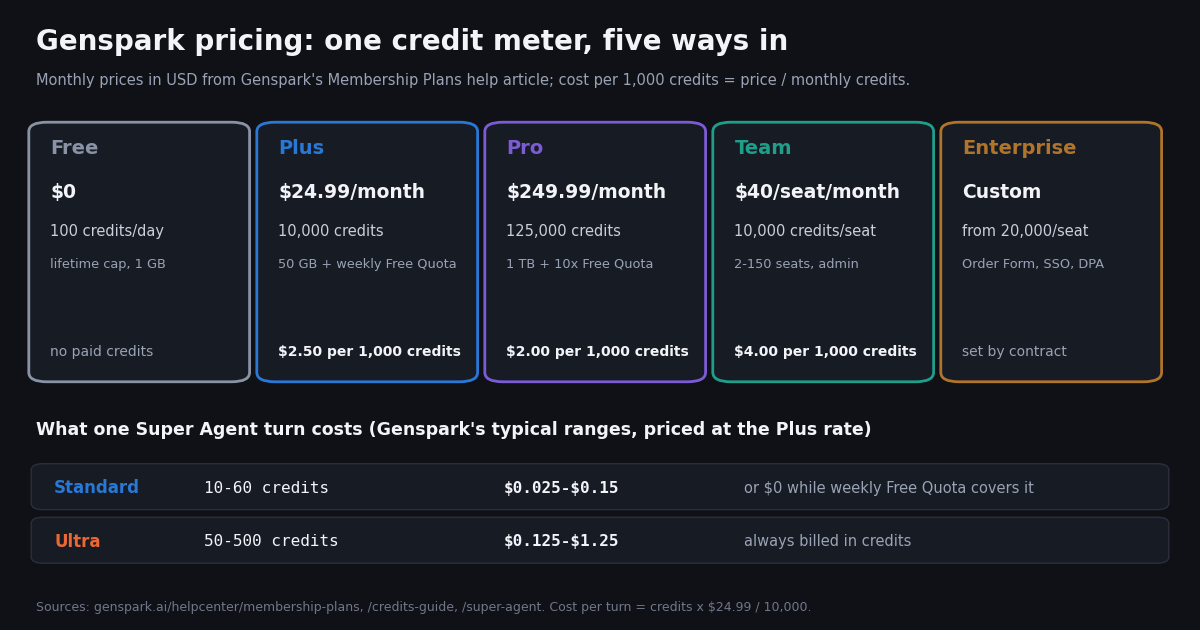
- Plans: Free $0 (100 credits a day, lifetime cap), Plus $24.99/month (10,000 credits), Pro $249.99/month (125,000), Team $40 per seat a month (10,000 credits per seat), Enterprise custom. Annual billing: Plus $19.99, Pro $199.99, Team $35.
- Rate per 1,000 credits: Plus about $2.50, Pro $2.00, Pro annual $1.60, Team $4.00. Bigger plans buy cheaper credits, unlike a flat-rate meter.
- Per task: Genspark puts a Standard Super Agent turn at 10-60 credits ($0.025-$0.15 at the Plus rate) and an Ultra turn at 50-500 ($0.125-$1.25). Video and music always bill credits.
- Weekly Free Quota (added September 18, 2026) covers Standard-mode agent tasks at no credit cost on Plus and Pro (Pro gets 10x the Plus balance). Monthly credits never roll over; top-up credits last 3 months.
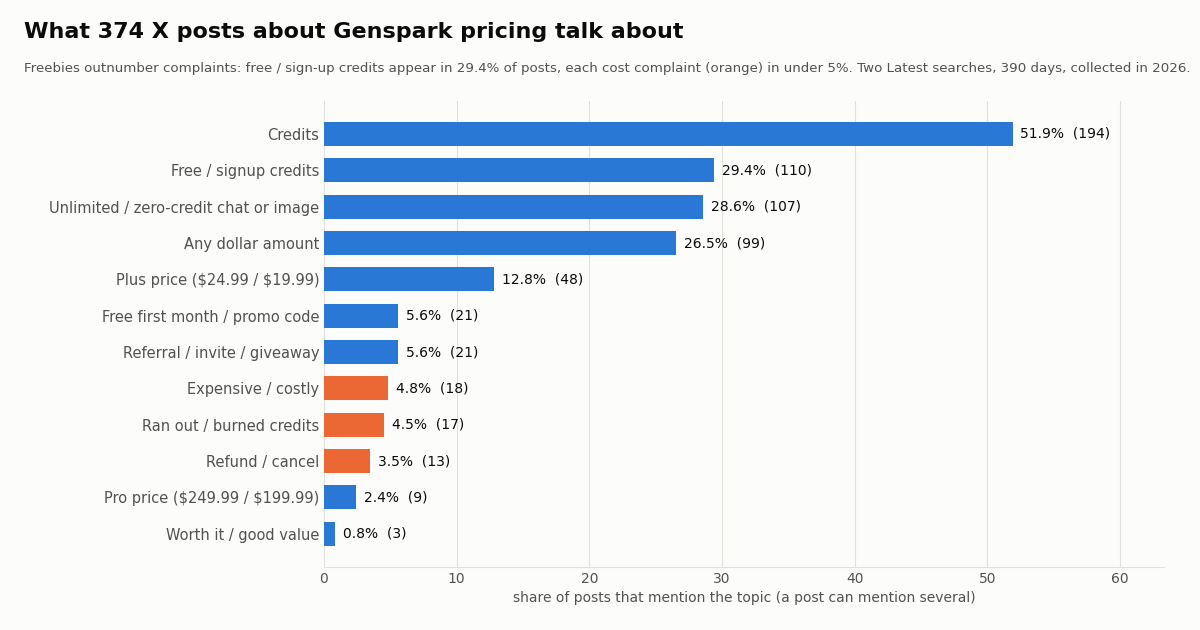
- On X: of 374 posts about Genspark pricing we collected, 29.4% talk about free or sign-up credits and 67.3% of stated credit amounts are promotions, not task costs.
- X data for Genspark: search results cost $0.15 per 1,000 tweets on TwitterAPI.io versus $5 on X's pay-per-use rate card ($0.005 per post read), about 33x; this study's 740 tweets cost $0.111.
Genspark is sold as an AI workspace: Super Agent, AI Slides, AI Sheets, AI Docs, Genspark Code, Media Studio, AI Meeting Notes and Genspark Claw, an always-on assistant that runs on a Genspark Cloud Computer. Everything draws from one credit balance. The public pricing page, genspark.ai/pricing, sits behind a browser challenge that returned HTTP 403 to every automated fetch we made, so this page uses the other primary sources we could read in full: Genspark's own Help Center articles on Membership Plans, Credits, Team and Enterprise Plans, and Super Agent, plus the Genspark AI Workspace listing on Apple's App Store, which shows the in-app prices.
This page is about what Genspark costs: the plans, the credit rules, what a task really costs in dollars and what changed on September 18, 2026. If you are deciding between Genspark and another super agent, our Manus pricing and Manus alternatives pages cover that comparison, including Genspark as an alternative. The last part of this page is for builders who want Genspark to work with live X (Twitter) data: a measured study of how people on X talk about Genspark's price, and what X data costs when you feed it to an agent.
67.3%
Genspark plans and prices: Free, Plus, Pro, Team and Enterprise
The figures below come from the Prices table in Genspark's Membership Plans help article (genspark.ai/helpcenter/membership-plans), which states that all prices are in USD. The article says the membership benefits it describes are valid through June 30, 2027.
What each plan adds. Free has 1 GB of AI Drive storage, limited model and agent access and Speakly voice input capped at 4,000 words a week. Plus adds 50 GB of storage, full access to AI Slides and Genspark Code, commercial use of generated content, AI Meeting Notes up to 24 hours a day, Speakly without a weekly limit and the weekly Free Quota. Pro adds 1 TB of storage, a Free Quota 10 times the Plus balance and a higher AI Chat limit.
Team and Enterprise. Team is self-serve for 2 to 150 seats with central admin and billing, 10,000 credits per seat a month and 60 GB of storage per member, according to the Team and Enterprise Plans article. Enterprise is contracted (Order Form plus Master Subscription Agreement), starts at 20,000 credits per seat, and adds SCIM provisioning, a custom DPA, invoice billing and a Customer Success Manager. Team is a separate subscription: buying it does not cancel or prorate an existing Plus or Pro plan.
Higher Plus tiers. Both Plus and Pro come in multiple credit tiers; the help article says you can choose a tier when subscribing or switch at any time, but it does not print the tier prices. The App Store listing does: Plus Monthly 21K Credits at $49.99, Plus Monthly 32K Credits at $74.99 and Plus Monthly 44K Credits at $99.99, next to the $24.99 base Plus plan and the $249.99 Pro plan. Web prices for higher tiers render only inside the signed-in plan page, so check that page before you pick a tier.
What a Genspark credit costs on each plan, and which plan fits
Unlike a meter with one flat rate, Genspark's credit price falls as the plan grows. Dividing each plan's price by its monthly credits gives the effective price per 1,000 credits:
Team pays the most per credit. A Team seat costs $40 for the same 10,000 credits a Plus subscriber gets for $24.99. The extra $15.01 buys admin, central billing, usage analytics, connector management and organization controls, not more compute. Team seats also have no Free Quota, according to the Super Agent article, so every turn bills credits.
Pro only pays off with volume. Pro's 125,000 credits cost $2.00 per 1,000, 20% less than base Plus, but only if you spend most of them: monthly credits reset each billing period and unused Pro credits do not carry to a lower plan. A user who spends 20,000 credits a month pays less on the Plus 21K tier ($49.99) than on Pro ($249.99).
Top-ups. The Credits Guide says separately purchased top-up credits are valid for 3 months and carry across billing cycles. The App Store lists a Credits Pack at $19.99 and a Credits Mega Pack at $39.99 but does not show the credit amounts, and we could not read top-up sizes on Genspark's own pages, so we do not quote a per-credit top-up rate.
Free suits trying the product. 100 daily credits cover a few Standard turns a day until the lifetime allowance runs out, and there is no Free Quota.
Plus at $24.99/month suits one person making slides, documents and research reports. Standard-mode work in the covered agents can run on the weekly Free Quota, which leaves the 10,000 credits for Ultra mode, flagship models, video and music. Annual billing at $19.99/month saves 20%.
A higher Plus tier suits someone who keeps running out: on the App Store prices, 21,000 credits cost $49.99 a month, far below Pro.
Pro at $249.99/month suits heavy media generation or agents running on schedules, where monthly spend passes the largest Plus tier on the App Store list (44,000 credits for $99.99). Below that, the bigger Plus tiers cost less.
Team at $40 per seat suits companies that need central billing, admin and connector controls. It costs more per credit than Plus and has no Free Quota, so budget per seat.
Genspark's terms also limit what you can automate: its Fair Use section prohibits programmatic bulk extraction of data, sharing accounts and reselling access. Treat any unofficial "Genspark as an API" gateway shared on social media as a risk to your account.
How many credits a Genspark task uses, in dollars
Genspark does not publish a fixed price list per task. The Credits Guide says cost scales with the model tier (Standard or Ultra), output length, image resolution, video duration, audio length, the number of versions generated and task complexity. The one concrete range it publishes is in the Super Agent help article: the mode picker shows Standard as typically 10 to 60 credits per message and Ultra as typically 50 to 500 credits per message, where a message is one turn of the agent's work.
How far 10,000 credits go. At those ranges, Plus's 10,000 monthly credits cover 166 to 1,000 Standard turns or 20 to 200 Ultra turns. Pro's 125,000 cover 2,083 to 12,500 Standard turns or 250 to 2,500 Ultra turns. The article warns that long chats, retries and big files cost more than the range suggests.
Scheduled work multiplies. The Genspark Claw article gives its own worked example: a task that costs 10 credits run once a day costs 300 credits a month; run hourly it costs 7,200 credits, 24 times as much. At the Plus rate, that hourly job alone is about $17.99 of credits a month, most of the base Plus allowance. Claw's Heartbeat check-ins and scheduled tasks also consume credits in the background.
When credits are not charged. Prompts blocked by the safety filter before generation are refunded automatically. Output that completes and is then flagged is still charged. Browsing AI Drive files and editing Dashboards and CRM notes cost nothing. Quality disputes do not get automatic refunds.
Before a run. New images, video and music are confirm-first: the agent shows the model and its price before generating, and video and audio show a price card. A text job's cost shows only after the turn, in the credit history on the /credit-usage page, which the Credits Guide says can take a few hours to catch up.
Free Quota, zero-credit chat and the September 18, 2026 change
On September 18, 2026 Genspark changed the Plus and Pro benefits. The official @genspark_ai account announced it that day as a new weekly balance on the same plan at the same price, and the Membership Plans article now describes three layers on paid plans.
Free Quota. A weekly balance for Standard-mode text and image tasks in Super Agent, AI Slides, AI Sheets, AI Docs, Deep Research, Fact Check and SecondBrain, at no credit cost. The 7-day window starts with your first message. While it applies, a bar above the composer reads "Using free quota at no credit cost". Ultra mode and generated video or audio always use credits. When the quota runs out, tasks switch to credits automatically unless you turn on Ask First. Genspark does not state the weekly balance in credits; Pro's is 10 times Plus's.
AI Chat and AI Image. Core models are included at no credit cost up to a limit; flagship models use credits. A separate limit based on model spend over a fixed 5-hour window can stop heavy chat use even with credits left, and buying credits does not lift it.
Older subscribers. If your Plus or Pro subscription started on or before September 18, 2026 and stays active without interruption, the unlimited AI Chat and AI Image usage you had continues through December 31, 2026. From January 1, 2027 everyone follows the current terms. Canceling and resubscribing counts as an interruption; upgrading, changing billing interval or changing credit tier does not.
Free accounts. Free has no Free Quota. Every turn bills the daily credits, and once an account has used its lifetime allowance of free credits the daily refill stops for good.
Upgrades, downgrades, cancellation and refunds
Upgrading takes effect immediately with a prorated charge; the difference in monthly credits is added at once and the full new allocation applies from the next renewal. If you change billing interval at the same time (for example Plus monthly to Pro annual), unused credits from the old plan are revoked and a full set of new-plan credits is issued.
Downgrading waits until the end of the billing period, and the balance then resets to the lower plan's amount. Unused credits from the higher plan are lost, so spend them before the renewal date. Annual plans grant credits month by month, not the whole year up front.
Canceling keeps the plan active until the period ends, then the account reverts to Free. Canceling is not a refund, and subscriptions cannot be paused or transferred to another account.
Refunds. Genspark processes one refund per customer. The window is 14 days in the EU, UK and Turkey, 7 days in Korea and 72 hours everywhere else, measured from the charge. Within the window a refund is available if you used less than 50% of the subscription or quota; above that Genspark may offer credits instead. Each renewal charge gets its own window. App Store and Google Play purchases are refunded by the store, and mobile and web subscriptions are managed separately.
Final price. Genspark says it charges no fees beyond the listed price; sales tax, VAT or GST and bank currency-conversion fees can add to the total.
What people on X say about Genspark's price
We searched X for posts that name Genspark together with credits, pricing, plan, subscription or price terms, and kept 374 posts from people other than the official account, spanning 390 days. The pattern is clear: most posts are about getting Genspark for less, not about what it costs.
Promotions dominate. Free and sign-up credits come up in 29.4% of posts, and 54.5% of posts carry a link. A cluster of posts promotes a code that, they say, makes the first Plus month free with 10,000 credits; we could not confirm that offer on Genspark's own pages, so treat it as a claim. Complaints are a small minority: 4.8% call Genspark expensive and 4.5% describe credits burning fast, including posts about Claw and Build Preview.
Who else gets named. ChatGPT or OpenAI appear in 27.3% of these posts, Claude in 25.7% and Gemini in 17.9%, usually because posts list the models Genspark bundles. Manus appears in 5.6% and Perplexity in 5.3%.
Reach. The median post got 4 likes and 634 views; the top 10% passed 9,461 views. 59.1% of posts came from accounts with more than 10,000 followers, which fits promotion-style posting. English made up 84.0% of posts and Japanese 12.0%.
Why credit numbers on X are not task costs, and what changed after September 18
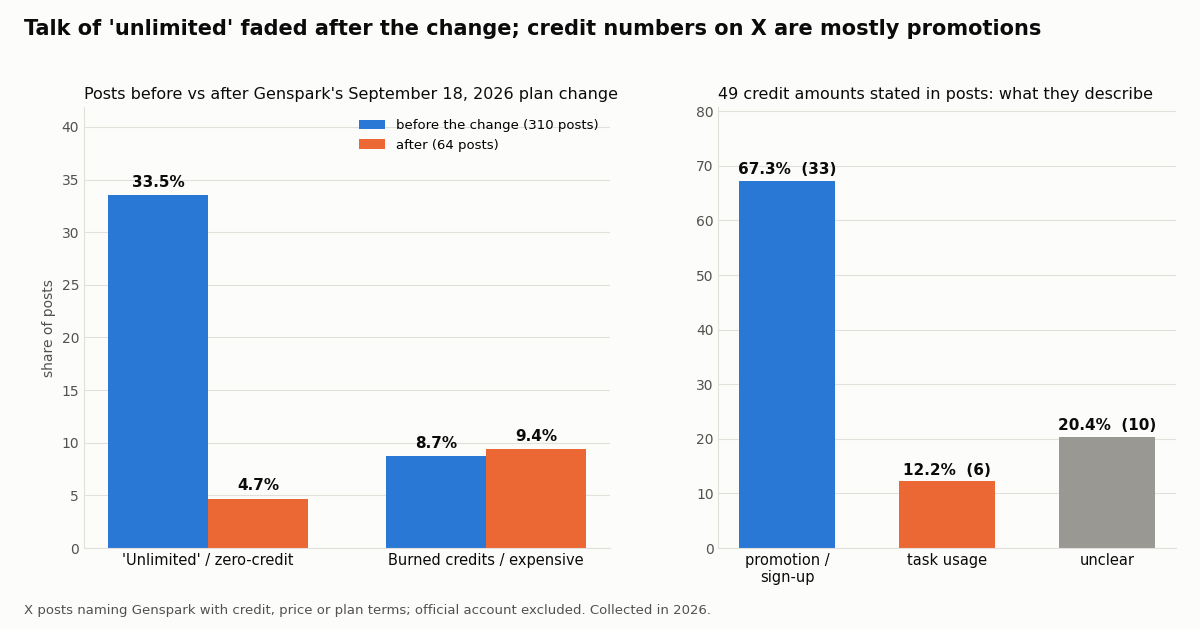
If you search X to learn what a Genspark task costs, most numbers you find are not task costs. We extracted every number followed by the word credits: 49 amounts. 33 of them (67.3%) sit in sign-up, giveaway, ambassador or event-promotion context, 6 (12.2%) describe what a task or month actually used, and 10 are unclear. The median promotional amount is 10,000, the size of a Plus month. Six usage mentions are too few for a typical task cost, which is why the Super Agent ranges above are the better guide.
The plan change shows up in the conversation. Before September 18, 2026, 33.5% of posts mentioned unlimited or zero-credit use, the old pitch for AI Chat and AI Image on paid plans. In the 64 posts after the change, that fell to 4.7%. Posts about burned credits or high cost stayed level at 8.7% before and 9.4% after. None of the posts after the change mention the new Free Quota by name. The post-change sample is small, so read this as a direction, not a precise rate.
What Genspark itself posts about price. The official @genspark_ai account (62,317 followers at collection time) posted 160 times over 118 days, 1.36 posts a day. 19 posts (11.9%) are about plans, credits or membership: the September 18 Free Quota announcement, credit giveaways for members, a 50% credit discount on a new video model and service-credit apologies after an outage. Another 11 (6.9%) mention a model's price, not Genspark's. Pricing posts drew a median 31 likes and 5,719 views, against 20.5 likes and 3,034 views for all its posts.
Giving Genspark live X (Twitter) data, and what the data costs
A common Genspark job is X research: what people say about a launch, which accounts drive a topic, how a competitor's posts perform. Genspark can browse, but every browsing step spends agent credits. A data source returns the posts themselves as structured fields (text, time, likes, views, author), so the agent spends its credits on analysis, not on page loads. There are three routes.
Option 1, Genspark's own X connector. The Connectors and Integrations article lists X (Twitter) as an API Call connector with OAuth 2.0 and PKCE that can search and publish posts. It acts as the X account you sign in with, so anything it publishes is posted by that account. Genspark's help pages do not say what X read volume it allows or how it is billed beyond agent credits.
Option 2, an MCP server. Genspark's connectors can call tools on an MCP server, authenticated by OAuth, an API key, an access token or a dedicated server URL; the article notes that custom and community MCP servers are governed by your organization's custom MCP policy. TwitterAPI.io runs a hosted MCP server at https://mcp.twitterapi.io/mcp with 12 read-only tools (search tweets, profiles, timelines, replies, followers, trends) and accepts a Bearer key, as in the config above. We could not confirm a self-serve custom-MCP form for individual Plus accounts in Genspark's help pages, so check the Connectors tab in Skills for the option.
Option 3, a script. Super Agent and Claw run code on a cloud computer, so you can give them the Python example on this page, or run it yourself and upload the CSV to AI Drive or AI Sheets. Reads need no X account.
That is about 33 times cheaper per 1,000 posts on TwitterAPI.io, on the rates published at docs.x.com/x-api/getting-started/pricing and our /pricing page. X's pay-per-use plan is capped at 3 million post reads a month, with Enterprise above that. Profiles cost $0.18 per 1,000 on TwitterAPI.io against $0.010 per user read on X.
This study as a bill. The 39 requests behind this page returned 740 tweets and one profile, which cost $0.111 on TwitterAPI.io. The same reads at X's pay-per-use prices would be $3.71. Both are small next to the Genspark side: analyzing the result in a few Standard turns is 10 to 60 credits each.
Monitoring on a schedule. If Claw checks X on a schedule, remember that the Genspark credits are the larger cost: the 10-credit hourly task in Genspark's own example costs 7,200 credits a month. On the data side, a check that finds no new posts costs $0.00015 on TwitterAPI.io, so polling every 5 minutes for a month costs $1.30 and every 60 seconds costs $6.48. New accounts that pass the automatic bot check get up to $1 of free credits (at most 100,000 credits, no card, one per person or network, expiring after 31 days); purchased credits never expire.
{
  "name": "twitterapi-io",
  "url": "https://mcp.twitterapi.io/mcp",
  "headers": { "Authorization": "Bearer your_key_here" }
}How we collected this
Question. How do people on X talk about what Genspark costs, and how much of Genspark's own timeline is about plans and credits?
Accounts and queries. The official @genspark_ai account (verified by profile lookup) and two Latest searches, retweets excluded: Genspark with credit or credits, and Genspark or @genspark_ai with pricing, price, subscription, membership, plan names, the Plus and Pro dollar prices, expensive, unlimited, per month or /mo.
Window and sample. The newest matching posts at collection time, collected in 2026: 500 unique search posts, of which 374 name Genspark and are not from the official account, spanning 390 days; plus the newest 160 posts of @genspark_ai covering 118 days. 39 requests in total.
Method. Posts were deduplicated by ID and tagged by keyword rules for each topic (credits, free credits, unlimited use, dollar amounts, complaints, refunds, other AI products). Credit numbers were classified as promotion, usage or unclear from the 90 characters around them. The before and after split uses each post's timestamp against September 18, 2026.
What the sample cannot show. Keyword rules miss sarcasm and posts in languages the rules do not cover. Latest search returns what X serves for a query, not every post. Promotion-heavy accounts post more than ordinary users, so the shares describe the conversation, not Genspark's user base. Six usage mentions are not a measure of typical task cost.
Privacy. Aggregates only. Search authors are private individuals: their raw pages were never stored in our repository, and the de-identified sample keeps no IDs, URLs, text or handles. Only the organization account @genspark_ai is named.
"""Collect recent X posts about a product or topic and save a CSV you can upload to Genspark AI Drive,
or ask Genspark Super Agent / Claw to run this script in its cloud computer.
TwitterAPI.io bills $0.15 per 1,000 tweets returned; no X account needed for reads."""
import csv
import os
import time

import requests

BASE = "https://api.twitterapi.io"
HEADERS = {"X-API-Key": os.environ["TWITTERAPI_IO_KEY"]}
QUERY = '(genspark OR @genspark_ai) (credits OR pricing OR plan) -filter:retweets'


def search(query, max_pages=10):
    """Yield tweets newest first, following next_cursor while has_next_page is true."""
    cursor = ""
    for _ in range(max_pages):
        r = requests.get(
            f"{BASE}/twitter/tweet/advanced_search",
            headers=HEADERS,
            params={"query": query, "queryType": "Latest", "cursor": cursor},
            timeout=30,
        )
        r.raise_for_status()
        body = r.json()
        yield from body.get("tweets", [])
        if not body.get("has_next_page"):
            break
        cursor = body.get("next_cursor", "")
        time.sleep(0.2)


def official_profile(user_name):
    """One profile lookup: 18 credits ($0.00018)."""
    r = requests.get(f"{BASE}/twitter/user/info", headers=HEADERS, params={"userName": user_name}, timeout=30)
    r.raise_for_status()
    body = r.json()
    if body.get("status") == "error":
        raise SystemExit(body.get("msg"))
    return body["data"]


def main():
    profile = official_profile("genspark_ai")
    print(f"@{profile['userName']}: {profile['followers']:,} followers, {profile['statusesCount']:,} posts")
    rows = []
    for t in search(QUERY):
        author = t.get("author") or {}
        rows.append({
            "created": t["createdAt"],
            "lang": t.get("lang"),
            "likes": t.get("likeCount", 0),
            "views": t.get("viewCount", 0),
            "replies": t.get("replyCount", 0),
            "author_followers": author.get("followers", 0),
            "text": (t.get("text") or "").replace("\n", " "),
            "url": t["url"],
        })
    with open("genspark_pricing_posts.csv", "w", newline="") as fh:
        writer = csv.DictWriter(fh, fieldnames=list(rows[0]) if rows else ["created"])
        writer.writeheader()
        writer.writerows(rows)
    print(f"{len(rows)} posts saved, about ${len(rows) * 0.00015:.4f} at $0.15 per 1,000 tweets")


if __name__ == "__main__":
    main()
Researching this?Free starter credits cover end-to-end testing — Google sign-in, no card. Get a key.
Questions readers ask
How much does Genspark cost?
Free is $0 with 100 credits a day up to a lifetime limit. Plus is $24.99/month (or $19.99/month billed annually) from 10,000 monthly credits, Pro is $249.99/month (or $199.99/month annually) from 125,000 credits, and Team is $40 per seat a month (or $35 annually) with 10,000 credits per seat. Enterprise is custom. All prices are in USD, per Genspark's Membership Plans help article.
Is Genspark free?
Yes, the Free plan costs nothing and gives 100 credits a day and 1 GB of AI Drive storage, but only up to a lifetime allowance of free credits. Once an account has used that allowance the daily refill stops. Free accounts have no weekly Free Quota.
How many credits does a Genspark task use?
Genspark's Super Agent article puts a Standard turn at typically 10 to 60 credits and an Ultra turn at 50 to 500. At the Plus rate of about $2.50 per 1,000 credits that is $0.025 to $0.15 and $0.125 to $1.25. Long chats, retries, big files, video and music cost more, and Standard turns can run on the weekly Free Quota at no credit cost.
Do Genspark credits roll over?
No. Plus and Pro credits reset at the start of each billing period, and on a downgrade unused credits from the higher plan are lost. Separately purchased top-up credits are valid for 3 months and carry across billing cycles. Annual plans issue credits monthly, not all at once.
What is Genspark Free Quota?
A weekly balance on Plus and Pro, added on September 18, 2026, that covers Standard-mode text and image tasks in Super Agent, AI Slides, AI Sheets, AI Docs, Deep Research, Fact Check and SecondBrain at no credit cost. It resets 7 days after your first message. Pro's balance is 10 times Plus's. Ultra mode, video and audio still use credits.
Can I get a refund from Genspark?
Genspark grants one refund per customer: within 14 days in the EU, UK and Turkey, 7 days in Korea and 72 hours elsewhere, if you used less than 50% of the subscription or quota. App Store and Google Play purchases are refunded by the store.
Is Genspark Pro worth it over Plus?
Only for heavy use. Pro costs $2.00 per 1,000 credits against about $2.50 on Plus, but credits do not roll over, and higher Plus tiers (21,000 credits for $49.99 a month on the App Store) cost far less than Pro for users who need 20,000 to 44,000 credits.
How can Genspark read Twitter (X) data?
Through its X connector (OAuth with your own X account), through an MCP server such as TwitterAPI.io's hosted server at mcp.twitterapi.io/mcp where your organization's MCP policy allows it, or by running a script in Super Agent or Claw. TwitterAPI.io bills $0.15 per 1,000 tweets returned versus $0.005 per post read on X's pay-per-use API.
Continue
- Genspark Help Center: Membership Plans (prices, plan comparison, Free Quota, refunds)
- Genspark Help Center: Credits Guide (what drives cost, replenishment, top-ups)
- Genspark Help Center: Team and Enterprise Plans
- Genspark Help Center: Super Agent (Standard and Ultra credits per turn)
- Apple App Store: Genspark AI Workspace in-app purchase prices
- X API pricing: pay-per-use rates and the 3M post-read cap
- X (Twitter) API guide: endpoints, pricing and access
- Manus pricing: plans, credits and cost per task
- Manus alternatives, including Genspark, compared
- Claude Code pricing: plans, usage limits and API keys
- What an MCP server is and how agents use one
- TwitterAPI.io hosted MCP server setup for AI agents
- TwitterAPI.io pricing: $0.15 per 1,000 tweets
- 01Pipedream Pricing in 2026: Connect Plans, Credits and the Workflows Shutdown
- 02Cloudflare Pay per Crawl: How the HTTP 402 Handshake Works, and What It Means for Twitter (X) Data
- 03ScrapingBee Pricing in 2026: Plans, Credit Costs and Alternatives
- 04Firecrawl Pricing: Plans, Credit Costs and What an X (Twitter) URL Costs
- 05LunarCrush API: What It Returns, What It Costs, and When Raw Twitter (X) Data Is the Better Input
- 06Google Antigravity Pricing: Free Tier, Pro and Ultra Quotas, and What X Users Report
- 07Zapier Pricing in 2026: Plans, Tasks per Month, Overage and a Worked Twitter (X) Zap Bill
- 08Apify Pricing in 2026: Plans, Compute Units and What Twitter (X) Data Really Costs
Writing about something you built with TwitterAPI.io? Our community rewards program pays API credits for honest tutorials, build logs and videos.
Stop reading. Start building.
Starter credits cover real testing on real data. Google sign-in, no card, no application queue.
Get an API keyAlready building with TwitterAPI.io? Publish an honest tutorial or build log about it and earn up to $200 a month in API credits.