Manus Pricing in 2026: Plans, Credits per Task, and What People on Twitter (X) Say It Costs
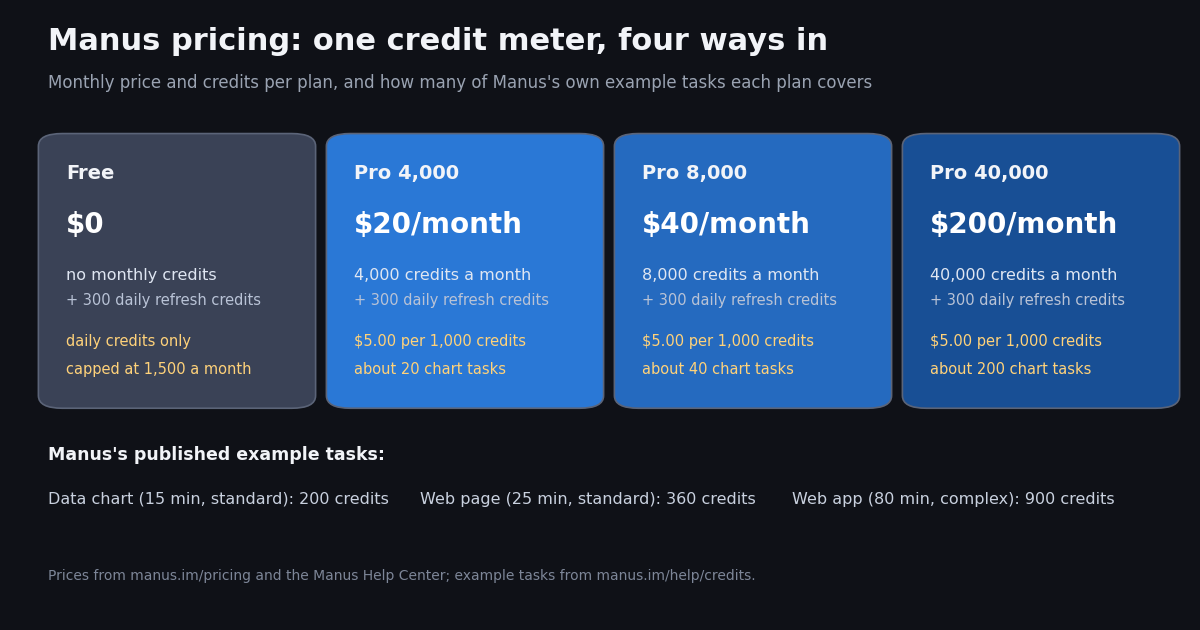
- Plans: Free $0 (300 daily credits, 1,500 a month cap), Pro $20/month (4,000 credits), $40/month (8,000), $200 monthly (40,000), Team from $20 per seat a month. Annual billing saves 17%.
- One rate: every Pro level is $5.00 per 1,000 credits; a higher level buys more credits, not cheaper ones.
- Per task: Manus's own examples cost 200, 360 and 900 credits ($1.00, $1.80, $4.50 at Pro prices). There is no pre-task estimate.
- Extras outside the plan: Cloud Computer $30/month or $50/month, website hosting past free allowances, and add-on credits (price shown only in the app).
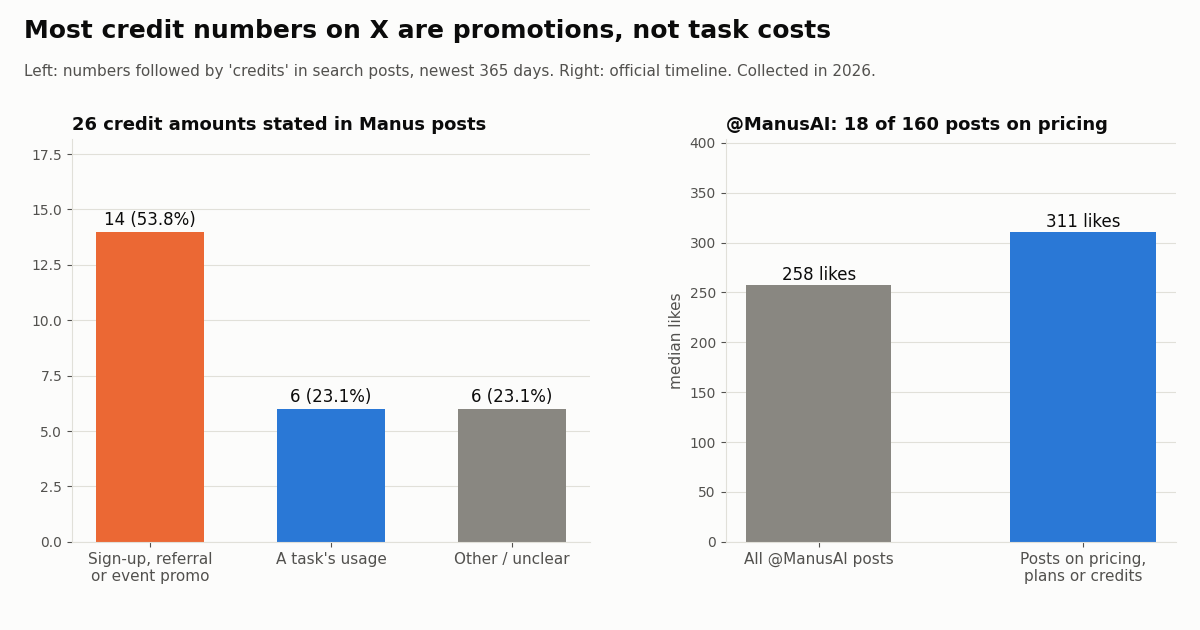
- X study: of 468 recent X posts about Manus pricing (collected in 2026), 43.6% mention credits, and 53.8% of the credit amounts people state are sign-up or referral promos, not task costs.
- X data for Manus: add
https://mcp.twitterapi.io/mcpas a custom MCP server; tweets cost $0.15 per 1,000 vs $5.00 per 1,000 post reads on X's pay-per-usage rate card.
Manus is a general AI agent: you describe a goal, and it plans and runs the work in its own virtual computer. On December 29, 2025 the Singapore-based team announced that Manus was joining Meta. Its blog post on the deal said Manus would keep selling and running its subscription through its own app and website, and that is still where the plans live: manus.im/pricing. Many pages that rank for Manus pricing still list the 2025 names (Starter, Basic, Plus, a $199 Pro). Manus's Help Center says the old Basic and Plus plans were both renamed Pro, and existing members keep renewing at their old price.
This guide reads the live pricing page and the Help Center billing articles line by line, turns the credit system into dollars per task using Manus's own examples, and then looks at what people on X actually say about Manus's cost, from a study of 1,040 posts collected in 2026. If you are comparing agents for coding rather than general tasks, the plan detail for those lives on our Claude Code and Devin pricing pages; this page covers Manus only and ends with the cost of giving Manus live X (Twitter) data.
53.8%
Manus plans and prices: Free, Pro (three credit levels) and Team
The figures below come from manus.im/pricing (monthly billing toggle) and Help Center article 11711111, What is the current membership pricing for Manus. Prices are in US dollars, as the pricing page shows them.
Pro is one plan, not three. The three cards share the same feature list (advanced research, website deployment, slide generation, Wide Research, beta access) and the same task limits; only the monthly credit allowance changes. The pricing page labels them base monthly usage, customizable monthly usage and usage for productivity.
Annual billing takes 17% off every paid level, according to both the pricing page toggle and the Help Center.
Team includes everything in Pro and adds single sign-on, an opt-out from data training, team usage analytics, internal access controls and shared slide templates. Manus documents SSO pricing for Team in a separate Help Center article, and larger contracts go through manus.im/contact-sales.
Old plan names. If a review quotes Starter, Basic, Plus or a $199 Pro tier, it describes an earlier price sheet. The Help Center says existing members on those plans keep auto-renewing at unchanged prices and can move to the new plans.
How Manus credits work: what burns them, refresh rules and the spending order
Manus bills everything in credits. Help Center article 11711097 lists three things that consume them: LLM tokens for planning, decisions and output; virtual machines for file operations, browser automation and code; and third-party APIs, such as financial data and professional databases. Credits are only consumed while a task is actively running. Finished tasks, stored files and deployed outputs cost nothing, so deleting old tasks saves nothing.
Daily credits. Every account gets 300 credits a day, granted when you log in and reset at 00:00 UTC. They do not roll over. Free users can draw at most 1,500 daily credits a month; paid users have no such cap. Manus says daily credits can only be used with Manus 2.0 lite.
Monthly credits arrive on your subscription date and reset on the same date the next month. Manus's own example: a $20 Pro membership bought on January 1 gives 4,000 credits that must be used before February 1.
Spending order. Manus spends event credits first, then daily, monthly, add-on and finally free credits. Event credits come from Manus events and expire when the event ends.
Negative balances. Manus deducts the cost of each action at the start of the next action, so a task can finish an action that costs a little more than you have left. The balance can show a negative number until the next refresh, and you cannot start new tasks while it is at or below zero.
Refunds. Manus says it refunds the credits consumed by a task that fails because of a technical problem on its side.
No pre-task estimate. Help Center article 13185575 says Manus cannot yet judge or regulate the credits a task will use, and that statements the agent makes about how many credits a task will cost should be regarded as hallucinations. Manus's Plans and Pricing doc does say the dashboard gives estimates before a task starts, so the two pages disagree; the same doc's usage history, which lists past tasks and their credit consumption, is the reliable way to learn your own costs.
How many credits a Manus task uses, in dollars
Manus publishes three worked examples on manus.im/help/credits. Because every Pro level is priced at the same $5.00 per 1,000 credits ($20 for 4,000, $40 for 8,000, $200 for 40,000), each example converts to dollars directly.
What a plan buys. At those rates the $20 level covers about 20 chart-sized tasks or 11 web-page-sized tasks a month, the $40 level twice that, and the $200 level about 200 chart-sized tasks or 44 complex app builds. The 300 daily credits add up to 9,000 a month for a paid user who logs in every day, but only on the lite model.
What makes a task expensive. Manus's own optimization advice is to be specific at the start, split large jobs into smaller tasks, and avoid long conversations, because the more context the agent carries, the higher the execution cost. Wide Research, which Manus describes as a parallel multi-agent system, runs many agents at once, so plan for it to use more credits than a single-agent task.
When you run out. Free users upgrade; members move to a higher level. Add-on credits can be bought from the Add credits menu, but Help Center article 13570051 says this applies to accounts on the highest monthly tier, and no add-on price is published outside the app, so we do not quote one. Add-on credits only stay usable while a paid subscription is active.
Costs outside the plan: Cloud Computer, website hosting and Manus Flex
Three Manus features are billed separately from the credit allowance, and they are easy to miss on the pricing cards.
Cloud Computer. A persistent Ubuntu Server 24.04 machine with a public IP that keeps running between sessions. Help Center article 15392078 lists Standard at $30/month (2 vCPUs, 4 GB RAM, 70 GB storage) and Advanced at $50/month (2 vCPUs, 8 GB RAM, 120 GB storage). If you stop paying, the machine is shut down and the files on it are deleted.
Website hosting. Building and editing a site uses credits; running it uses a separate usage balance. Manus's web-app billing doc gives every account free monthly allowances of $10 for cloud, $1 for AI and $1 for API usage, and its own estimates range from subscription-only for a creator landing page to about $248 extra a month for a busy e-commerce site.
Manus Flex. Flex lets you run the agent on your own inference provider's API key. Your provider then bills the model tokens, the temporary cloud sandbox is covered by Manus, and images, video, Cloud Computer and hosting still use Manus credits. Manus advises setting a spending limit with your provider, because agent tasks can run many steps.
Manus API. The developer API at https://api.manus.ai runs the same agent from your own code. Its documentation page does not list separate prices, so check the dashboard before building on it.
Is Manus worth it? Who each level suits
Free suits trying the agent: 1,000 sign-up credits cover a handful of standard tasks, and the 300 daily credits cover quick questions on the lite model. One concurrent task makes it slow for real work.
Pro at $20/month suits someone who runs a few research reports or slide decks a week. At Manus's example rates, 4,000 credits is about 20 chart-sized tasks.
Pro at $40/month is the level with the 7-day free trial, which makes it the lowest-risk way to test paid features. Cancel before the charge and nothing is billed; Manus does not refund after the charge.
Pro at $200 monthly only pays off if you would otherwise buy add-on credits; it carries the same features and task limits as the $20 level.
Team makes sense once two or more people need shared credits, SSO or a data-training opt-out.
When a credit plan is the wrong tool. Manus is priced per unit of agent effort, not per unit of data. For a repeatable job, such as pulling every post that mentions your brand each hour, a script that calls a data API directly costs a fixed, predictable amount per result and does not spend agent credits on browsing. The last section of this page shows that comparison for X data.
What people on X say about Manus's cost
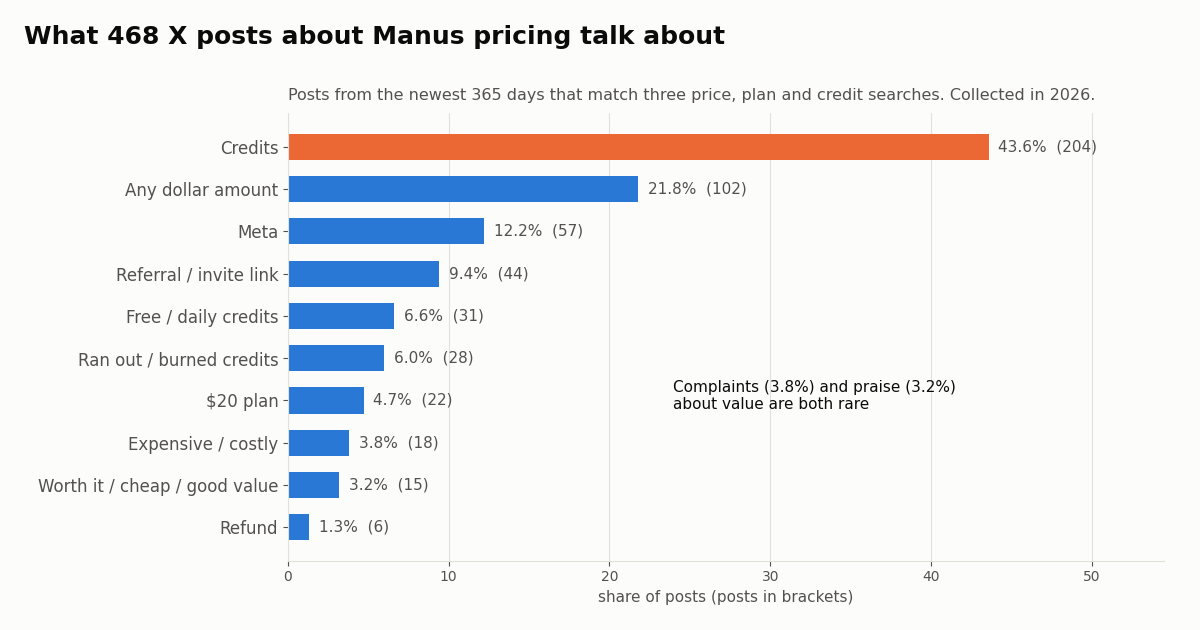
We searched X for posts that mention Manus with credit, plan or price terms, kept the 559 posts that are about the agent (Manus is also a Latin word, a glove brand and a common surname), and analyzed the 468 from the newest 365 days. Credits dominate: 43.6% of the posts mention them, against 21.8% that mention any dollar amount and only 4.7% that name the $20 price.
Value verdicts are rare in both directions. Only 3.8% of posts call Manus expensive and 3.2% call it worth it or good value. The more common complaint is the meter itself: 6.0% describe running out of credits or a task burning through them.
The conversation is international. 63.5% of the posts are in English, 16.0% in Japanese and 12.0% in Chinese. 35.0% come from accounts with more than 10,000 followers; the median post has 6 likes and 865 views.
Why credit numbers you see on X are not task costs
If you search X to learn how many credits a Manus task costs, most numbers you find are promotions. We extracted every amount written next to the word credits. Of 26 amounts, 14 (53.8%) are sign-up bonuses, referral offers or event giveaways, such as 500 credits for an invite or 8,000 for hackathon attendees. Only 6 (23.1%) describe what a task actually used, too few to estimate a typical cost. We also set aside 12 posts that compare Manus with another tool's credits, mostly marketing from rival agents, because their credit units are not Manus credits.
Use Manus's own examples instead. The 200, 360 and 900-credit examples on manus.im/help/credits, plus your own usage history, are better guides than numbers on social media.
Other agents in the same posts. Manus pricing posts often name other tools: Claude in 43.8%, ChatGPT or OpenAI in 42.5%, Gemini in 29.1%, Perplexity in 15.4%, Lovable in 12.4% and Genspark in 11.1%. 29.1% name three or more other tools, which mostly marks list posts of AI tools rather than head-to-head comparisons.
What Manus itself posts. Over 344.3 days the official @ManusAI account (about 257,000 followers) published 160 posts, 0.46 a day. 18 of them (11.2%) are about pricing, plans, credits or offers, and those get a median 311 likes against 258 for the account overall. Most of the timeline is product launches, not price changes, so the pricing page and Help Center remain the place to check.
Giving Manus live X (Twitter) data: custom MCP or a script, and the bill
A common Manus task is X research: what people say about a launch, which accounts drive a topic, how a competitor's posts perform. Manus can browse, but browsing X page by page spends agent credits on every step. A data source returns the posts themselves as structured fields: text, time, likes, views and author.
Option 1, custom MCP server. Manus's docs describe adding your own MCP server under Settings, Integrations, Custom MCP Servers, Add Server, with a server name, a server URL and authentication such as a Bearer token. Use the server URL https://mcp.twitterapi.io/mcp and send your key as Authorization: Bearer your_key_here. Manus tests the connection and lists the tools, after which a prompt like "pull the last 500 posts that mention our product and group the complaints" calls search directly.
Option 2, a script. For a repeatable job, ask Manus to write and run the Python script below, or run it yourself and hand Manus the output to analyze. A fixed script costs the same every time, which a credit-metered agent run does not.
The X data bill. TwitterAPI.io charges per result returned: tweets are $0.15 per 1,000 (15 credits per tweet, minimum 15 credits per request) and profiles $0.18 per 1,000. X's own pay-per-usage rate card on docs.x.com/x-api/getting-started/pricing charges $0.005 per post read and $0.010 per user read, which is $5.00 per 1,000 posts, about 33 times more per 1,000 tweets. Reads need no X account.
This page's study read 1,040 tweets in 56 requests for about $0.16; the same reads at X's rate card would be about $5.22. For comparison, Manus's smallest published example task is 200 credits, or $1.00 at Pro prices. Sign-up gives up to $1 of free credits (at most 100,000 credits, no card, one per person or network, expiring after 31 days) for new accounts that pass the automatic bot check; paid plans start at Starter, $29 a month, and purchased credits never expire.
If the Manus task needs to post on X rather than read, writes run through an authenticated session: one /twitter/user_login_v2 login ($0.10, with a proxy you supply) returns login_cookies, and each post, like or follow through /twitter/create_tweet_v2 and its siblings is 60 credits ($0.0006), billed per HTTP 200 call. The call acts as that account, so X can rate-limit, lock or suspend it; keep a human pace and expect to log in again when the session expires.
{
  "name": "TwitterAPI.io",
  "url": "https://mcp.twitterapi.io/mcp",
  "headers": {
    "Authorization": "Bearer your_key_here"
  }
}How we collected this
Question. How do people on X talk about what Manus costs, and how much of Manus's own timeline is about pricing?
Accounts and queries. The official @ManusAI account (verified by profile lookup) and three Latest searches: Manus with credits, Manus with pricing, plan, subscription, Pro or membership phrases, and Manus with dollar amounts ($19, $20, $39, $40, $199), expensive, per month or /mo. Retweets excluded.
Window and sample. The newest matching posts at collection time, collected in 2026: 856 unique search posts after removing duplicates, 559 about the Manus agent, 468 of them from the newest 365 days, plus 160 official posts covering 344.3 days. 56 requests returned 1,040 tweets for about $0.16.
Method. Topics, prices and other tools were matched with keyword patterns on the post text; credit amounts were classified as promotion, usage or unclear from the words around them. All shares use the 365-day subset.
What it cannot show. Search returns what X indexes for these phrases, not every post about Manus; keyword matching misses sarcasm and posts in languages that do not use these words; and a few usage reports are not a measurement of typical task cost.
Privacy. Aggregates only. Search posts come from private individuals, so their raw pages were never stored with this page, and the de-identified sample keeps no IDs, links, text or handles. Only the organization account @ManusAI is named.
"""Pull recent X posts about a topic with TwitterAPI.io and summarize them, the kind of script you can ask Manus
to run, or run yourself and hand the CSV to Manus. Tweets cost $0.15 per 1,000 returned."""
import csv
import os
import time

import requests

BASE = "https://api.twitterapi.io"
HEADERS = {"X-API-Key": os.environ["TWITTERAPI_IO_KEY"]}
QUERY = '(manus OR @ManusAI) (credits OR pricing OR "pro plan") -is:retweet'


def search(query, max_pages=10):
    """Yield tweets newest first, following next_cursor."""
    cursor = ""
    for _ in range(max_pages):
        r = requests.get(
            f"{BASE}/twitter/tweet/advanced_search",
            headers=HEADERS,
            params={"query": query, "queryType": "Latest", "cursor": cursor},
            timeout=30,
        )
        r.raise_for_status()
        body = r.json()
        for t in body.get("tweets", []):
            yield t
        if not body.get("has_next_page"):
            break
        cursor = body.get("next_cursor", "")
        time.sleep(0.2)


def main():
    rows = []
    for t in search(QUERY):
        text = (t.get("text") or "").replace("\n", " ")
        rows.append({
            "created": t["createdAt"],
            "lang": t.get("lang"),
            "likes": t.get("likeCount", 0),
            "views": t.get("viewCount", 0),
            "mentions_credits": "credit" in text.lower(),
            "url": t["url"],
            "text": text,
        })
    with open("manus_posts.csv", "w", newline="") as f:
        w = csv.DictWriter(f, fieldnames=list(rows[0].keys()) if rows else ["created"])
        w.writeheader()
        w.writerows(rows)
    print(f"{len(rows)} posts, about ${len(rows) * 0.00015:.3f} in tweet reads")
    print("mention credits:", sum(r["mentions_credits"] for r in rows))
    for r in sorted(rows, key=lambda r: -r["likes"])[:5]:
        print(r["likes"], r["views"], r["url"])


if __name__ == "__main__":
    main()
Researching this?Free starter credits cover end-to-end testing — Google sign-in, no card. Get a key.
Questions readers ask
How much does Manus cost?
On manus.im/pricing, Free is $0 with 300 daily refresh credits. Pro costs $20/month for 4,000 monthly credits, $40/month for 8,000 (with a 7-day free trial) or $200 monthly for 40,000. Team starts at $20 per seat a month. Annual billing saves 17%.
Is Manus free?
Yes, there is a Free plan. New users get 1,000 credits on sign-up and 300 daily refresh credits that reset at 00:00 UTC and do not roll over. Free users can use at most 1,500 daily credits a month, run one task at a time and set two scheduled automations. Daily credits work only with Manus 2.0 lite.
How many credits does a Manus task use?
It depends on the task's complexity and length. Manus's own examples are 200 credits for a 15-minute data chart, 360 for a 25-minute web page and 900 for an 80-minute web app. At Pro prices that is $1.00, $1.80 and $4.50. Manus says it cannot estimate a task's cost before it runs.
Do Manus credits roll over?
Monthly credits reset on your billing date each month and do not roll over. Daily credits expire after 24 hours. Add-on credits carry over between cycles, but only while you have an active paid subscription; if you drop to Free they become inactive. Event credits expire when the event ends.
What happened to Manus Plus, Basic and Starter?
Manus's Help Center says the old Basic and Plus plans were both renamed Pro. Members on old plans keep auto-renewing at their original price and can switch to a current level. Reviews that quote Starter, Plus or a $199 Pro describe an earlier price list.
Does Manus refund credits?
Manus refunds the credits used by a task that fails because of a technical problem on its side. If you cancel a paid plan after being charged, Manus does not refund that charge; it cancels the next renewal. Cancelling the $40 trial before it converts costs nothing.
Did Meta buy Manus, and did pricing change?
Manus announced on December 29, 2025 that it was joining Meta. Its post said it would keep selling and running its subscription through its own app and website, and the plans are still sold on manus.im/pricing.
How do I give Manus Twitter (X) data?
Add a custom MCP server in Manus (Settings, Integrations, Custom MCP Servers) with the URL https://mcp.twitterapi.io/mcp and your key as a Bearer token, or have Manus run a Python script against the TwitterAPI.io REST API. Tweets cost $0.15 per 1,000 returned, against $0.005 per post read on X's official pay-per-usage API.
Continue
- Manus: Plans and pricing
- Manus Help Center: current membership pricing
- Manus Help Center: rules for credit consumption
- Manus: Credits usage and example tasks
- Manus docs: Custom MCP servers
- X API pricing (pay-per-usage rate card)
- X (Twitter) API guide: endpoints, pricing and access
- Claude Code pricing: plans, usage limits and API keys
- Devin pricing: plans, quotas and ACUs
- Lovable pricing and its credit system
- Personal AI agents compared: which can read Twitter (X)
- TwitterAPI.io MCP server setup for AI agents
- TwitterAPI.io pricing: pay per tweet returned
- Get a TwitterAPI.io API key on the dashboard
- 01Warp Pricing in 2026: Plans, Dollar Usage, Add-ons and the Real Monthly Bill
- 02Roo Code vs Cline in 2026: After the Shutdown, Which One to Run
- 03What Is x402? How the HTTP 402 Payment Protocol Works, With a Real 402 Offer Decoded
- 04Windsurf (now Devin Desktop) vs Cursor in 2026: plans, agents, MCP and what X users say
- 05Gemini CLI vs Claude Code in 2026: Access, Quotas, MCP and Pricing for Twitter (X) Data Agents
- 06Claude Code Pricing in 2026: Plans, Usage Limits and the Real Cost of an Always-On Agent
- 07Sprout Social Pricing: Plans, Seats, Listening and the Nonprofit Rate
- 08Devin Pricing in 2026: Plans, Quotas, ACUs and What X Users Actually Pay
Writing about something you built with TwitterAPI.io? Our community rewards program pays API credits for honest tutorials, build logs and videos.
Stop reading. Start building.
Starter credits cover real testing on real data. Google sign-in, no card, no application queue.
Get an API keyAlready building with TwitterAPI.io? Publish an honest tutorial or build log about it and earn up to $200 a month in API credits.