The Library of Congress Twitter (X) Archive: What Happened and Can You Access It?
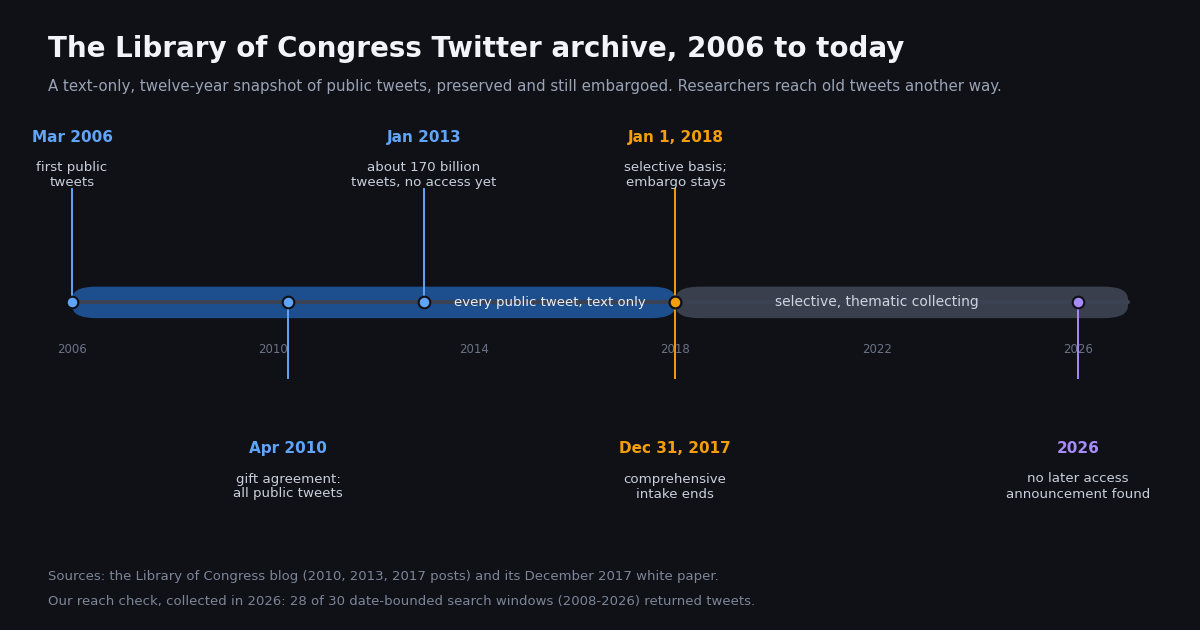
- What it is: a gift of public tweet text from Twitter to the Library of Congress (April 2010 agreement), covering March 2006 through December 31, 2017.
- Did it stop? Yes, comprehensive collecting ended on December 31, 2017. From January 1, 2018 the Library collects tweets on a selective, thematic and event-based basis.
- Can you search it? No. The collection is embargoed; the December 2017 white paper gave no projected timetable for public access.
- What was never in it: deleted tweets, private (protected) accounts, images, video and linked content. The Library itself said so in its FAQ, its white paper and in replies on X.
- Our study: 30 archive-topic posts by @librarycongress (2010-2018) and 30 date-bounded search windows from 2008 to 2026; 28 returned tweets.
- Practical route:
/twitter/tweet/advanced_searchwithsince_time:/until_time:and/twitter/tweetslookup by id, at $0.15 per 1,000 tweets returned (X's pay-per-use rate card: $0.005 per post read).
In April 2010 the Library of Congress announced it would preserve every public tweet ever posted. For years afterwards, people asked the Library on X whether their tweets were being saved, whether deleted tweets were kept, and when researchers could search the collection. This page answers those questions from the Library's own words: its blog posts from 2010, 2013 and 2017, the December 2017 white paper, and the replies @librarycongress posted on X.
It also answers the follow-up question the archive raises: if the Library's copy is closed, how do you get old public tweets for research, journalism or a personal project today? We measured how far back date-bounded search reaches, window by window from 2008 to 2026, and show the exact request that pulls a week of 2008 tweets.
28 of 30, every returned tweet inside its window; the Library of Congress archive itself returns 0 because it is embargoed (collected in 2026)
What the Library of Congress Twitter archive is
The archive began as a gift. In April 2010 the Library and Twitter signed an agreement giving the Library "the public tweet text from the company's inception through the date of the agreement", meaning tweets from 2006 through April 2010, and Twitter agreed to keep delivering tweets on an ongoing basis under the same terms. The Library did not pay for it. Its stated aim, in the December 2017 white paper, was to "document the emergence of online social media for future generations".
The Library set itself three first objectives: acquire and preserve the 2006-2010 archive, build a secure and sustainable process for receiving a daily stream of new tweets, and organize the whole archive by date. By the January 4, 2013 update, written by the Library's Director of Communications, those were described as nearly complete. The archive then held about 170 billion tweets, and daily intake had grown from about 140 million tweets in February 2011 to nearly half a billion a day by October 2012.
Text only. The white paper is explicit: "The Library only receives text. It does not receive images, videos or linked content." A tweet in the archive is its words plus the link strings it contained, not the photo or the page a link pointed to. In a 2011 reply on X, @librarycongress put it this way: the links inside tweets are captured, and if the linked content stays in place, access remains, "but not otherwise".
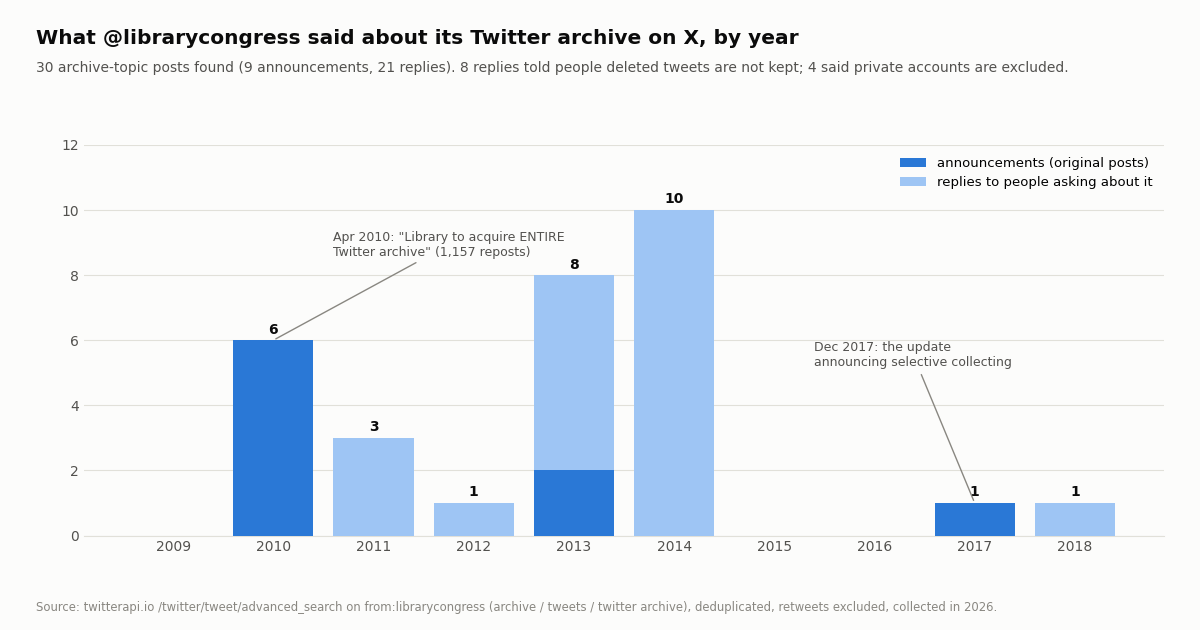
Public only, deletions excluded. The Library's April 2010 FAQ, "The Library and Twitter: An FAQ", says private account information and deleted tweets are not part of the archive. The Library repeated this on X many times: our search found 8 replies from @librarycongress telling people that deleted tweets are not kept and 4 saying private accounts are excluded. One 2013 reply adds that the Library does not even receive deleted tweets from Twitter.
Timeline: the archive's milestones from the Library's own sources
Every row below comes from a Library of Congress publication: the blog at blogs.loc.gov, the white paper attached to the December 2017 post, or the Library's own post on X. Volumes and dates are the Library's figures as published at the time; we did not repeat numbers from secondary news coverage.
Two dates in December 2017 are worth separating. The blog post published on December 26, 2017 says the change takes effect January 1, 2018. The white paper describes the same moment as a change to "receipt of tweets on December 31, 2017". Both describe one boundary: everything public through the end of 2017 is in the snapshot, and only selected tweets after it.
Did the Library of Congress stop archiving tweets?
Partly. It stopped archiving every public tweet, and it kept collecting some. The December 26, 2017 blog post, "Update on the Twitter Archive at the Library of Congress", announced that effective January 1, 2018 the Library "will acquire tweets on a selective basis", similar to how it collects websites. The white paper says the tweets collected from then on "will be thematic and event-based, including events such as elections, or themes of ongoing national interest, e.g. public policy".
The white paper lists the factors behind the decision. Volume: "The volume of tweets and related transactions has evolved and increased dramatically since the initial agreement was signed." Format: the Library receives text only, while tweets had become "often more visual than textual, limiting the value of text-only collecting". Length: Twitter was expanding the size of tweets beyond what was described at the start of the effort. Coverage: the Library already had the first twelve years. Policy: the Library "generally does not collect comprehensively" and had made an exception for public tweets while social media's direction was unknown.
The Library announced the change on X too. Its post of December 26, 2017 linking the update drew 150 likes and 161 reposts, against 1,157 reposts for the April 2010 announcement that it would acquire everything. The white paper also mentions an open issue that never went away: the Library said it would work with Twitter on "managing transactions that generate deletions of tweets".
Can you access or search the archive?
No. The white paper states: "The Twitter collection will remain embargoed until access issues can be resolved." It names three priorities guiding access: respect the intent of the people who wrote the content, honor Twitter's access requirements as the donor, and manage taxpayer-provided resources wisely. It adds: "There is no projected timetable for providing public access at this time."
We could find no later statement from the Library announcing that access has opened. The Library's posts on X about the archive stop in 2018 in our sample, and searches for newer coverage this session surfaced nothing after the 2017 change. Treat that as the absence of an announcement, not as proof; the Library's reference staff are the authority on the collection's status.
The pressure for access was real from the start. By January 2013 the Library reported about 400 inquiries from researchers worldwide, on topics such as citizen journalism, elected officials' communications, vaccination rates and stock market prediction, while researchers still had no access. That gap is why historical tweet research moved to other routes: Twitter's own developer programs at the time, and today paid full-archive search and third-party data APIs.
What @librarycongress said about the archive on X
A primary source that tends to be overlooked is the Library's own account. We searched @librarycongress posts for the archive (three queries, deduplicated, retweets excluded) and found 30 posts on the topic: 9 announcements and 21 replies to people asking about it, from 2010 to 2018.
The announcements cluster around the three moments in the timeline: April 2010 (acquisition), January 2013 (the status update) and December 2017 (the selective-collecting change). The replies peak in 2013 and 2014 and keep returning to the same three answers: yes, all public tweets; no, deleted tweets are not kept; no, private accounts are not included. In a 2013 reply the account also pointed out that public tweets are visible to everyone, not just the Library, which is the clearest one-line summary of what the archive was.
Two limits of this sample. Search finds posts whose text matches the query words, so a reply that discussed the archive without words like "tweets" or "archive" is missed. And replies addressed to private individuals are counted here, but their handles and texts are not reproduced.
How far back can you search public tweets today? Our measurement
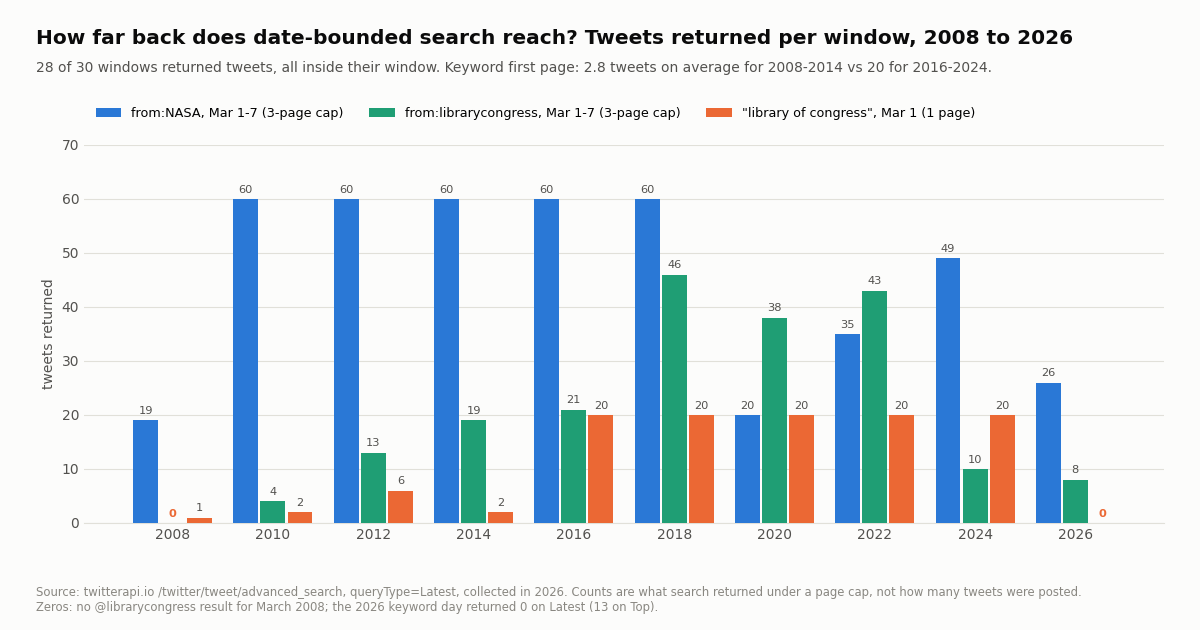
The archive's closure leaves a practical question: can you still reach a public tweet from 2008 or 2012? We ran 30 date-bounded searches through /twitter/tweet/advanced_search, one window per probe year from 2008 to 2026: the first week of March for two long-running organization accounts (@NASA and @librarycongress, both created in 2007), and March 1 for the phrase "library of congress" across all public posts.
A plus sign means the search had more pages left when our page cap stopped it. Reach: 28 of 30 windows returned tweets, and every returned tweet carried a createdAt inside its window, so the date bounds held. The earliest tweet returned was from 2008, and @NASA's March 2008 week returned 19 tweets.
Thin pages for old windows. The keyword's first page held 2.8 tweets on average for 2008-2014 windows, against 20 for 2016-2024, while still reporting more pages. Old windows return sparse pages, so plan for more requests per 1,000 tweets when you go back before about 2015. Each request that returns nothing is billed at the 15-credit minimum ($0.00015).
The two zeros. @librarycongress returned nothing for its March 2008 week, also on a Top retry; its earliest archive-topic post we found is from 2009, so the account may not have posted that week. The 2026 keyword day returned 0 on Latest but 13 results on Top, of which 92.3% fell inside the window (Top results can include a promoted post, which you should filter out by date and author). If a window comes back empty, retry it on the other queryType before concluding there is nothing there.
The practical route: old public tweets through an API
The Library's archive and an API answer different needs. The archive is a preserved, complete-at-the-time snapshot (embargoed). A search API answers "which public tweets still exist on X that match this query in this window?" Deleted tweets, tweets from accounts that went private, and suspended accounts' tweets are absent from it, just as deleted and private tweets were absent from the Library's copy.
Date-bounded search. /twitter/tweet/advanced_search takes the same operators as X's search box (from:, keywords, lang:, -filter:replies) plus a time window. The documentation at docs.twitterapi.io recommends since_time: and until_time: with Unix seconds; each page holds up to 20 tweets and can hold fewer, and you follow next_cursor while has_next_page is true. The five lines below pull @NASA's first week of March 2008:
Lookup by id. If you already have tweet ids, for example from a paper's replication data or a dataset of ids, /twitter/tweets takes a comma-separated tweet_ids list and returns each tweet that is still public. Ids that come back missing were deleted or made private, which is itself a finding for a replication study. The full script in the code section below does both and writes a CSV.
No X account needed for any of this: reads use an API key in the X-API-Key header.
import requests
r = requests.get("https://api.twitterapi.io/twitter/tweet/advanced_search",
                 headers={"X-API-Key": "YOUR_API_KEY"},
                 params={"query": "from:NASA since_time:1204329600 until_time:1204934400", "queryType": "Latest"})
for t in r.json()["tweets"]: print(t["createdAt"], t["url"])Cost: TwitterAPI.io vs the official X API for historical tweets
X's own route to old tweets is full-archive search, GET /2/tweets/search/all, which docs.x.com describes as searching "the complete archive back to 2006" and makes available to pay-per-use and Enterprise customers. X's pay-per-use rate card (docs.x.com/x-api/getting-started/pricing) charges $0.005 per post read, with pay-per-usage capped at 3 million post reads per monthly billing cycle and Enterprise above that.
That is about 33x less per 1,000 tweets on our side ($5.00 / $0.15). Our whole study, 79 requests returning 944 tweets plus two profile lookups, cost about $0.14. A 100,000-tweet historical pull is $15 on TwitterAPI.io and $500 at X's per-post rate. New accounts that pass the automatic bot check get free starter credits (no card, one per person or network, expiring after 31 days); purchased credits never expire, and the current amounts are on the pricing page.
Throughput matters for backfills: our API allows 0.2 requests per second before the first payment and 20 once paid (50 on Scale, 500 on Business, up to 1,000 on request). At 20 requests per second a historical pull is rarely limited by the API.
How we collected this
Question. What did the Library of Congress say about its Twitter archive on X, and how far back does date-bounded search reach public tweets today?
Accounts and queries. Library posts: from:librarycongress tweets, from:librarycongress archive and from:librarycongress twitter archive (Latest and Top), deduplicated by tweet id, retweets excluded, classified as archive-topic by keyword match and checked by hand. Reach probes: from:NASA and from:librarycongress for March 1-7 and the phrase "library of congress" for March 1, in 2008, 2010, 2012, 2014, 2016, 2018, 2020, 2022, 2024 and 2026, with up to 3 pages per account window and 1 page per keyword window.
Sample and window. 79 requests, 944 tweets returned, collected in 2026 through /twitter/tweet/advanced_search and /twitter/user/info, for about $0.14. The study used the since:YYYY-MM-DD_HH:MM:SS_UTC operator form; the documentation now recommends since_time: / until_time: Unix seconds, which the code on this page uses.
What the sample cannot show. Counts are what search returned under a page cap, not how many tweets were posted that week. Deleted, protected and suspended accounts' tweets are absent. Two accounts and one phrase are not every query; a quiet account or a rare keyword will look emptier. It says nothing about the contents of the Library's embargoed collection, which nobody outside the Library can query.
Privacy. Aggregates only. The Library of Congress and NASA are organization accounts; the keyword probe's authors are private individuals, so only per-window counts were kept and their posts were not stored with the study. Library replies to individuals are counted, never quoted with a handle.
"""old_tweets.py - pull public tweets from a past date window through TwitterAPI.io.

The Library of Congress archive (2006-2017) is embargoed, so this is the practical route
to historical public tweets: date-bounded search plus lookup by tweet id.
pip install requests
"""
import csv
import time
from datetime import datetime, timezone

import requests

BASE = "https://api.twitterapi.io"
HEADERS = {"X-API-Key": "YOUR_API_KEY"}


def unix(day: str) -> int:
    """'2008-03-01' -> seconds since epoch, UTC."""
    return int(datetime.strptime(day, "%Y-%m-%d").replace(tzinfo=timezone.utc).timestamp())


def search_window(query: str, start: str, end: str, max_pages: int = 25):
    """Yield tweets matching `query` posted in [start, end). Billed per tweet returned."""
    q = f"{query} since_time:{unix(start)} until_time:{unix(end)}"
    cursor = ""
    for _ in range(max_pages):
        resp = requests.get(f"{BASE}/twitter/tweet/advanced_search",
                            headers=HEADERS,
                            params={"query": q, "queryType": "Latest", "cursor": cursor},
                            timeout=30)
        resp.raise_for_status()
        page = resp.json()
        for tweet in page.get("tweets", []):
            yield tweet
        if not page.get("has_next_page"):
            break
        cursor = page.get("next_cursor") or ""
        time.sleep(0.5)  # stay well under your account's requests-per-second limit


def lookup_ids(ids):
    """Re-fetch known tweets (for example ids cited in a paper) by id, 20 or fewer per call."""
    out = []
    for i in range(0, len(ids), 20):
        resp = requests.get(f"{BASE}/twitter/tweets",
                            headers=HEADERS,
                            params={"tweet_ids": ",".join(ids[i:i + 20])},
                            timeout=30)
        resp.raise_for_status()
        out.extend(resp.json().get("tweets", []))
    return out


if __name__ == "__main__":
    rows = []
    for t in search_window("from:NASA", "2008-03-01", "2008-03-08"):
        rows.append({
            "id": t["id"],
            "created_at": t["createdAt"],
            "author": t["author"]["userName"],
            "text": t["text"],
            "likes": t.get("likeCount", 0),
            "reposts": t.get("retweetCount", 0),
            "url": t["url"],
        })
    with open("nasa_march_2008.csv", "w", newline="", encoding="utf-8") as f:
        writer = csv.DictWriter(f, fieldnames=["id", "created_at", "author", "text", "likes", "reposts", "url"])
        writer.writeheader()
        writer.writerows(rows)
    print(f"{len(rows)} tweets saved; cost about ${len(rows) * 0.00015:.4f} at $0.15 per 1,000 tweets")

    if rows:
        again = lookup_ids([rows[0]["id"]])
        print("re-fetched by id:", again[0]["createdAt"] if again else "not returned (deleted or protected)")
Researching this?Free starter credits cover end-to-end testing — Google sign-in, no card. Get a key.
Questions readers ask
Does the Library of Congress still archive every tweet?
No. Comprehensive collecting ended on December 31, 2017. The Library announced on December 26, 2017 that from January 1, 2018 it would acquire tweets on a selective basis, thematic and event-based (for example elections and public policy), like its web archiving.
Can I search the Library of Congress Twitter archive?
No. The Library's December 2017 white paper says the collection stays embargoed until access issues can be resolved in a cost-effective and sustainable way, with no projected timetable. We found no later Library announcement opening it. For old public tweets, use date-bounded search through an API instead.
Are my deleted tweets in the Library of Congress archive?
According to the Library, no. Its April 2010 FAQ says deleted tweets and private account information are not part of the archive, and @librarycongress repeated in replies on X that it does not store deleted tweets and does not even receive them from Twitter.
Does the archive include photos and videos?
No. The white paper states that the Library only receives text and does not receive images, videos or linked content. Link strings inside tweets are part of the text, but not the pages they point to.
How many tweets are in the Library of Congress archive?
The last count the Library published was about 170 billion tweets, in its January 4, 2013 update, when intake was nearly half a billion tweets a day. The Library did not publish a final total for the 2006-2017 snapshot in the December 2017 white paper.
Did the Library of Congress pay Twitter for the archive?
No. It was a gift under an April 2010 agreement covering public tweets from 2006 through April 2010, plus ongoing tweets under the same terms. The agreement is linked from the Library's December 2017 post.
How can researchers get historical tweets today?
Through full-archive search: X's own GET /2/tweets/search/all (pay-per-use at $0.005 per post read) or a third-party API such as TwitterAPI.io's /twitter/tweet/advanced_search with since_time: / until_time: ($0.15 per 1,000 tweets returned). In our 2026 check, search reached back to 2008 for @NASA.
Continue
- Library of Congress blog: Update on the Twitter Archive at the Library of Congress (December 26, 2017)
- Library of Congress white paper: Update on the Twitter Archive (December 2017)
- Library of Congress blog: Update on the Twitter Archive (January 4, 2013)
- Library of Congress blog: The Library and Twitter, an FAQ (April 2010)
- X developer docs: recent and full-archive search
- TwitterAPI.io docs: advanced search endpoint and time operators
- Twitter (X) API overview and endpoints
- Historical Twitter data through an API: full guide
- Find a tweet in your own Twitter archive
- Export a Twitter dataset for research
- Search tweets by date range with an API
- Tweet timestamp tool: read the date inside a tweet id
- Get a TwitterAPI.io API key
- 01Twitter (X) Account Locked: Why It Happens and How to Unlock It
- 02Databricks Twitter (X) Pipeline: Load Tweets into a Delta Table in 2026
- 03Twitter (X) CRM: Sync X Profiles and Buying Signals into HubSpot or Salesforce
- 04Twitter (X) Likes API: What You Can Read, Like and Unlike in 2026
- 05Twitter (X) in Looker Studio: Build the Dashboard Without a Paid Connector
- 06Twitter (X) Archive — A Developer's Guide to Building Your Own Tweet Archive Search
- 07Historical Twitter (X) Data + Archive API — Complete Guide
- 08Twitter (X) Ads Library: What the X Ads Repository Shows, and What It Misses
Writing about something you built with TwitterAPI.io? Our community rewards program pays API credits for honest tutorials, build logs and videos.
Stop reading. Start building.
Starter credits cover real testing on real data. Google sign-in, no card, no application queue.
Get an API keyAlready building with TwitterAPI.io? Publish an honest tutorial or build log about it and earn up to $200 a month in API credits.