Grok Bot vs Claude: which agent can read and act on Twitter (X) data, and what it costs
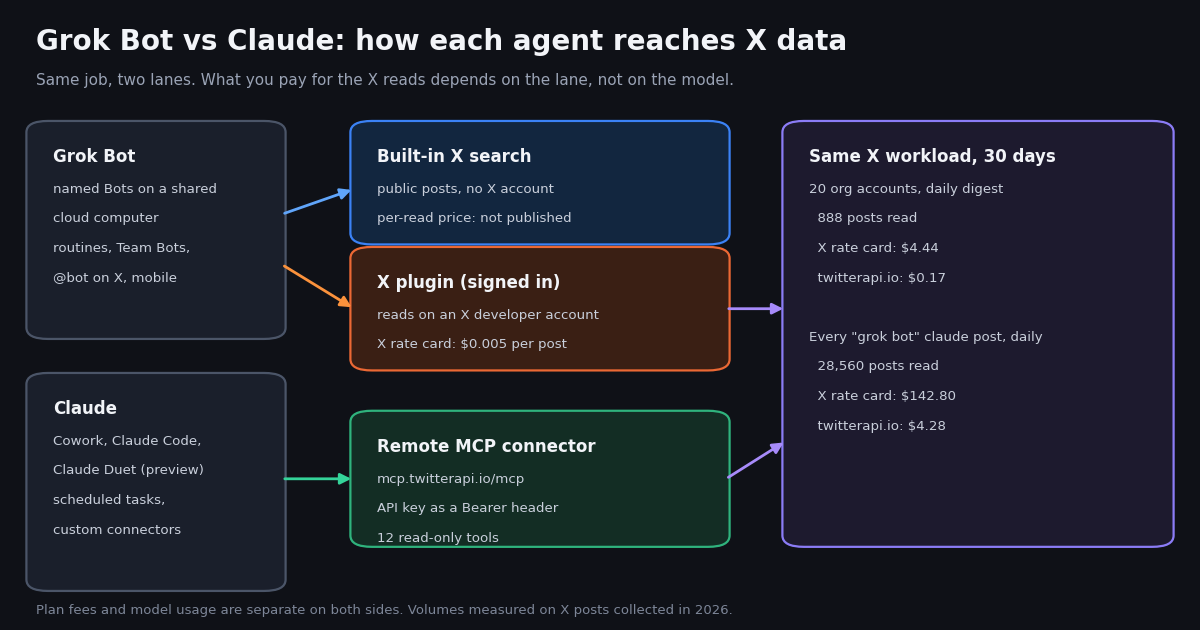
Our Grok Bot guide explains what Grok Bot is and what its X connector costs on its own. This page is the head-to-head: Grok Bot against Claude (Cowork, Claude Code and the Claude Duet preview) on the things you choose an agent by, with one deciding row most comparisons skip, which is how each agent gets X (Twitter) data and what that data costs for the same job.
Every feature claim below comes from vendor pages read for this page: xAI's Grok Bot docs at docs.x.ai, Cursor's Grok Bot plans page, X's API pricing page, Claude's pricing page, Anthropic's support and Claude Code docs, and the official @bot and @claudeai accounts. Where a vendor publishes no number (Grok Bot's per-task usage, the free X API credits it grants, Claude's usage allowances) we say so instead of guessing.
The cost half is measured, not modeled from guesses. We read the timelines of 20 organization accounts to see how many posts a realistic monitoring job touches, and 500 recent X posts comparing the two agents to see what people actually weigh. All of it was collected in 2026 through our own API, in 62 requests, for about $0.16 in credits.
Grok Bot vs Claude at a glance: the feature matrix
The two products overlap more than their names suggest. Grok Bot is a set of named Bots that work on a cloud computer; Claude's closest equivalents are Cowork (tasks you hand off from the Claude apps), Claude Code (the coding agent, with cloud scheduled tasks) and Claude Duet, a proactive agent app Anthropic opened as a research preview on October 21, 2026. Here is how they line up, row by row, from each vendor's own pages.
How to read the matrix. Grok Bot is built around persistent Bots that act like teammates, including one your whole team can share. Claude spreads the same idea across three surfaces, and the strongest one for builders is still Claude Code. If you want an agent your team pings in Slack, Grok Bot has the documented feature; if you want an agent that writes and ships code on a schedule, Claude Code's cloud scheduled tasks are the more direct fit.
One limit worth knowing on each side. Grok Bot's docs warn that all your Bots share one computer, so a credential placed there is available to every Bot you run. Claude Code's scheduled tasks reject cron expressions that run more often than once an hour and allow 100 scheduled runs per hour per account, with no overage on those hourly limits.
How each agent reads X data
This is the row the rest of the internet's comparisons leave out, and it decides both what an agent can see on X and who bills you for it.
Grok Bot, lane 1: built-in X search. xAI's "Use the computer and apps" page says Bots "can search and read what's public on X without you connecting an X account": search posts, open a post from its link, read an account's posts and mentions, see who quoted or reposted a post, count recent posts on a topic, check trends. It is read-only and does not sign in as you. xAI publishes no per-read price or quota for it; it runs inside your Grok Bot usage.
Grok Bot, lane 2: the X plugin. For your DMs, bookmarks, home timeline or who liked your posts, you add the X plugin and sign in with X. xAI's announcement "Grok Bot now works with X" (August 29, 2026) says connecting X creates a developer account for you if you lack one, and that "paid Grok Bot users get free X API credits to start". The amount of those credits is not published. Once they run out, reads are X API usage on X's pay-per-usage card.
Claude: a connector you add. Claude's pricing page lists web search and connectors, and we found no built-in X source in the Anthropic pages we read. Claude gets X data the way it gets any outside data: through a connector. Anthropic's support article on custom connectors says remote MCP connectors work on Free, Pro, Max, Team and Enterprise (Free is limited to one), connect from Anthropic's cloud rather than your device, and can send a fixed API key as a request header. The twitterapi.io MCP server at mcp.twitterapi.io/mcp takes your twitterapi.io key as a Bearer token and exposes 12 read-only tools such as search_tweets, get_user_last_tweets and get_user_mentions.
Grok Bot can use the same connector. xAI's Team Bots page lists "Custom MCP server, Remote HTTPS" as a plugin type, so a Bot can call a remote MCP server too. We did not test whether Grok Bot's form accepts a custom Authorization header; the twitterapi.io server needs the key sent as a Bearer token. The other route on Grok Bot is a small script on the Bot's computer, which our Grok Bot guide walks through.
Plans and pricing: what each agent costs before any X data
Neither vendor sells the agent by the task. Both include it in a subscription with a usage allowance, and neither publishes what one task uses. These are the list prices on the vendors' own pages.
Other ways into Grok Bot. Cursor's plans page says legacy paid Cursor plans (Pro, Pro+, Ultra, Teams) include Grok Bot, and an individual SuperGrok, SuperGrok Plus, SuperGrok Heavy or X Premium+ subscription can be linked as a usage grant. Grants do not stack: Grok Bot uses whichever one grants more weekly usage. Past the weekly pool, extra usage runs on prepaid top-ups (The X Subscription) or on-demand billing through Cursor (legacy plans).
How Claude meters it. Anthropic's Claude Code docs say scheduled tasks "draw down subscription usage the same way interactive sessions do", and the Duet announcement says its background checks count toward the same plan limits, which is why Duet checks connected accounts every few hours rather than continuously. Usage credits can keep scheduled tasks running past the limit where they are turned on.
The practical entry price. For one person the lowest documented entry price for each agent is Claude Pro at $20 a month and The X Subscription Premium at $30 a month. Neither price includes the X data an agent reads through the X API; that is the next section.
The same X workload, priced three ways
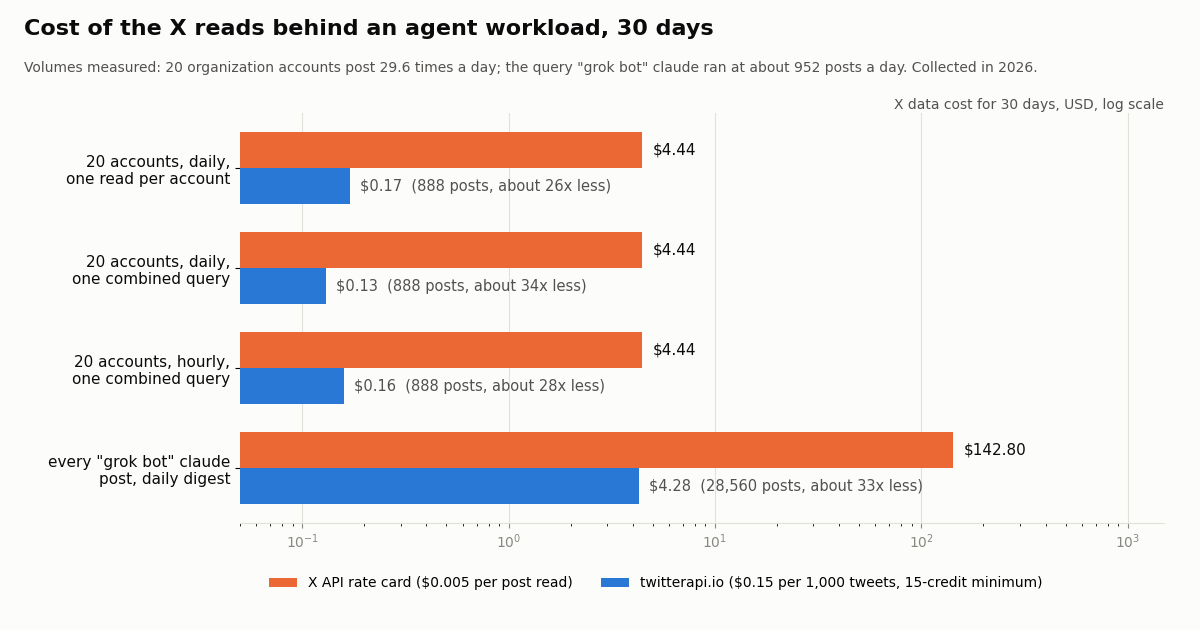
To price X access fairly you need real volumes, so we measured one. We read the timelines of 20 organization accounts an AI-tools team would plausibly watch and counted their posts over the last seven days. Together they posted 29.6 times a day. A daily digest of all 20 therefore reads about 888 posts in 30 days, and an hourly check reads the same posts, just sooner.
How the columns are computed. X rate card: posts read multiplied by $0.005, X's Posts: Read line on its pay-per-usage pricing page (docs.x.com/x-api/getting-started/pricing). That is what Grok Bot's X plugin bills once its starter credits are gone; it assumes the agent reads each post once and nothing outside the window. twitterapi.io: 15 credits per tweet returned ($0.15 per 1,000 tweets) with a 15-credit minimum per request. For accounts that post less than once a day, some daily reads return nothing and cost the $0.00015 minimum, so we add the expected number of empty reads (a Poisson estimate from each account's measured rate). Per 1,000 posts the two cards are $5 against $0.15, about 33x.
The small job is small on any lane. A 20-account digest is a few dollars a month even on the X rate card. If that is your whole X workload, choose the agent on features; the X line will not decide it. The combined from:a OR from:b query is the lowest-cost shape on our side because one request covers all 20 accounts, so quiet days cost a single minimum instead of twenty. Add -filter:replies: our first live run without it returned only @grok's replies. With it, the query for the previous 24 hours returned 14 posts, below the seven-day average, so the table reads as an upper bound for a typical day.
Topic tracking is where the lane matters. A keyword digest reads the public conversation, not a handful of accounts. The phrase pair "grok bot" claude alone ran at about 952 posts a day in our sample, so reading all of it daily is 28,560 posts a month: $142.80 on the X rate card against $4.28 through twitterapi.io. Broader terms run far higher, and X caps pay-per-usage plans at 3 million post reads a month, with Enterprise above that.
What the table leaves out. It does not price Grok Bot's built-in X search, because xAI publishes no per-read price; if built-in search covers your job, the X column for Grok Bot may be zero beyond your plan's usage. It also leaves out model usage on both sides and the plan fees in the previous section.
How much the 20 accounts actually post
The workload above rests on these counts. Each account's rate is its timeline posts (replies excluded) in the seven days before collection, read with /twitter/user/last_tweets.
Three accounts are half the feed. @OpenAIDevs, @huggingface and @nvidia produced 54.1% of the daily volume. The other ten not shown (@bot, @claudeai, @AIatMeta, @MistralAI, @perplexity_ai, @vercel, @SpaceXSI, @XDevelopers, @grok and @cursor_ai) each posted less than once a day; @cursor_ai posted once in the week.
Much of it is someone else's post. @huggingface's week was 97.4% reposts or quotes and @OpenAIDevs' 79.1%. On a per-post meter you pay for those reads either way, so a digest prompt should tell the agent to label reposts instead of crediting the reposting account with the content.
Two accounts we planned to read returned nothing. @xai and @ChatGPTapp returned empty timelines at collection time, so we replaced them with @bot (Grok Bot's own account) and @Google. An agent watching a fixed list needs the same check: an empty read can mean a renamed or quiet account, not a quiet day.
What people on X say when they compare Grok Bot and Claude
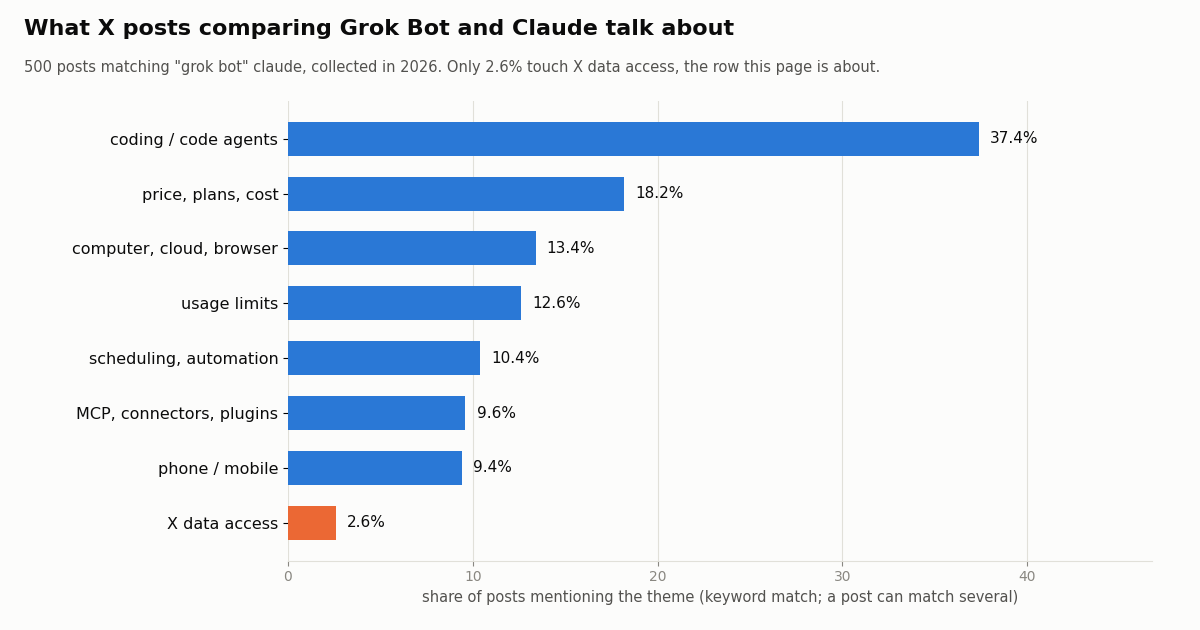
We read the 500 most recent posts matching "grok bot" claude. They covered 12.6 hours, about 952 posts a day, and the search still had more pages, so this is a recent slice, not the whole conversation. 61.8% were in English, 14.6% in Japanese and 10.4% in Chinese; 39.6% were replies.
Coding dominates; X access barely registers. 37.4% of posts touch coding and 20.8% name Claude Code specifically, while only 2.6% discuss reading X data. That gap is why this page exists: buyers compare the agents on code and price, and find out about the X meter later.
It is a four-way race now. 33.6% of the posts also name ChatGPT or its dots agent, 23.6% name Claude Duet, 22.4% name Meta's Muse and 15.0% name Codex. Claude Cowork appears in only 0.6%, which fits Anthropic folding Cowork into the main Claude app.
Few posts pick a side. Keyword cues for a stated preference matched only 23 posts (4.6%). Of the 16 with one clear direction, 11 leaned Grok Bot and 5 leaned Claude; 7 more praised each for different things. Reading those, a recurring pattern is a split: Claude (or Claude Code) for writing code, Grok Bot for orchestration and automations. Sixteen posts is far too few to call a winner.
Engagement is low and skewed. The median post had 1 like and 61 views; 47.4% had no likes, while the 90th percentile reached 841 views. Most of this is people thinking out loud, not reviews.
Connect Claude to X data in two minutes
If you choose Claude, X data is one connector away. Two setups, both verified against Anthropic's docs and our server's own handshake.
Claude apps (Cowork, chat, and Duet through your account's connected apps). In Customize, Connectors, click Add and then Add custom connector with the URL mcp.twitterapi.io/mcp (over HTTPS), choose no sign-in, and under Request headers add Authorization with the value Bearer followed by your twitterapi.io API key. Anthropic connects from its cloud, so the server must be public, which this one is. The Duet announcement says Duet carries over connected apps from your Claude account; we have not tested the connector inside the Duet preview.
Claude Code. Add the server over HTTP with a header, as Anthropic's MCP docs show, then reference it in a cloud scheduled task as a connector.
Or run the script. If you would rather have the agent run code than call tools, the Python example on this page reads all 20 accounts with one combined advanced_search query and prints JSON for the agent to summarize. It works the same from a Claude Code session or a terminal on Grok Bot's computer.
Keys and spend. Both agents act with whatever key you give them. Use a dedicated twitterapi.io key and watch the dashboard for the first few runs. New accounts that pass the automatic bot check get up to $1 of free credits (at most 100,000 credits, no card, one per person or network, expiring after 31 days); purchased credits never expire. Before the first payment the API allows 0.2 requests a second, and 20 once paid, which is plenty for a scheduled digest.
# Claude Code: add the twitterapi.io MCP server over HTTP (12 read-only X tools)
claude mcp add --transport http twitterapi-io https://mcp.twitterapi.io/mcp \
  --header "Authorization: Bearer $TWITTERAPI_IO_API_KEY"

# check it is connected
claude mcp listWhich one should you pick?
Pick Grok Bot if your work starts on X or in a team chat: tagging @bot from a post, a shared Team Bot in Slack, routines that run every few minutes, or reading your own DMs and bookmarks through the X plugin. Budget for X API credits if the plugin does heavy public reading, or point the Bot at a cheaper source for the bulk reads.
Pick Claude if the job is mostly code, documents and analysis with X as one input: Claude Code for building and maintaining the scraper, dashboard or bot, Cowork scheduled tasks for the daily brief, and Duet (once you are off the waitlist) for a proactive assistant. Add the twitterapi.io connector and the X line becomes cents for account digests.
Many people use both. The posts we read keep describing the same split: Claude for writing code, Grok Bot for orchestrating and automating. Since both can call a remote MCP server or run a script, the X data source does not have to change when the agent does.
Write actions are a separate decision. Grok Bot's X plugin signs in as you. On twitterapi.io, posting, liking or following runs through an authenticated session: one /twitter/user_login_v2 login ($0.10, with a proxy you supply) returns login_cookies, then each action such as /twitter/create_tweet_v2 is $0.002, billed per HTTP 200 call. Either way the call acts as that account, so X can rate-limit, lock or suspend it; keep a human pace and expect the session to need a re-login now and then. The MCP server itself is read-only.
How we collected this
Question. How much does the X data behind a realistic agent workload cost on the X API rate card versus twitterapi.io, and what do people on X weigh when they compare Grok Bot and Claude?
Accounts and query. Timelines of 20 organization accounts (@OpenAIDevs, @huggingface, @nvidia, @github, @Google, @OpenAI, @GeminiApp, @GoogleDeepMind, @AnthropicAI, @Microsoft, @bot, @claudeai, @AIatMeta, @MistralAI, @perplexity_ai, @vercel, @SpaceXSI, @XDevelopers, @grok, @cursor_ai) via /twitter/user/last_tweets, replies excluded, read until each sample reached past seven days. The query "grok bot" claude via /twitter/tweet/advanced_search (Latest), 25 pages.
Window and size. Collected in 2026: the seven days before collection for timelines (580 posts read), and the most recent 12.6 hours for the search (500 posts). 62 requests including a live check of the code sample, about $0.16 in credits.
Method. Themes, product names and stated preferences are keyword matches (regular expressions in English, Japanese and Chinese, published in the study's analyze.py), so they over- and under-count; treat them as directional. Costs are computed, not billed: X column at $0.005 per post read, twitterapi.io column at 15 credits per tweet with the 15-credit minimum, empty reads estimated with a Poisson model.
What the sample cannot show. It cannot show what Grok Bot's built-in X search or a Claude task costs in plan usage (neither is published), how many free X API credits the X plugin grants, or how either agent performs on a real task. One week of 20 accounts and half a day of one query are snapshots; news weeks run higher.
Privacy. Aggregates only. Organization accounts are named. The comparison posts were written by private individuals: their raw pages were never stored with the study, and the published sample keeps only de-identified rows (hour, language, counts, matched themes).
"""x_digest.py - the X-data half of an agent workload: a daily digest of 20 organization
accounts, read through twitterapi.io. Run it from a Claude Code scheduled task, a Cowork task
with code execution, or a terminal on Grok Bot's computer, then let the agent summarize the JSON.

    pip install requests
    export TWITTERAPI_IO_API_KEY=...      # from twitterapi.io/dashboard
    python x_digest.py > digest.json
"""
import json
import os
import time
from datetime import datetime, timedelta, timezone

import requests

BASE = "https://api.twitterapi.io"
HEADERS = {"X-API-Key": os.environ["TWITTERAPI_IO_API_KEY"]}
ACCOUNTS = [
    "OpenAIDevs", "huggingface", "nvidia", "github", "Google", "OpenAI", "GeminiApp",
    "GoogleDeepMind", "AnthropicAI", "Microsoft", "bot", "claudeai", "AIatMeta", "MistralAI",
    "perplexity_ai", "vercel", "SpaceXSI", "XDevelopers", "grok", "cursor_ai",
]


def search(query, max_pages=20):
    """Page through /twitter/tweet/advanced_search (Latest) until has_next_page is false."""
    tweets, cursor = [], ""
    for _ in range(max_pages):
        params = {"query": query, "queryType": "Latest"}
        if cursor:
            params["cursor"] = cursor
        r = requests.get(f"{BASE}/twitter/tweet/advanced_search", headers=HEADERS, params=params, timeout=30)
        if r.status_code == 429:          # rate limited: back off and retry the same page
            time.sleep(5)
            continue
        r.raise_for_status()
        body = r.json()
        tweets.extend(body.get("tweets", []))
        if not body.get("has_next_page"):
            break
        cursor = body.get("next_cursor", "")
    return tweets


def main():
    since = int((datetime.now(timezone.utc) - timedelta(days=1)).timestamp())
    # One combined query for all 20 accounts: 1 request when the day is quiet, not 20.
    # -filter:replies matters: from:grok alone would otherwise return its endless replies.
    query = "(" + " OR ".join(f"from:{a}" for a in ACCOUNTS) + f") since_time:{since} -filter:replies"
    tweets = search(query)
    rows = [{
        "account": t["author"]["userName"],
        "created_at": t["createdAt"],
        "text": t["text"],
        "url": t["url"],
        "likes": t.get("likeCount", 0),
        "views": t.get("viewCount", 0),
        "is_repost_or_quote": bool(t.get("retweeted_tweet") or t.get("quoted_tweet")),
    } for t in tweets]
    # 15 credits per tweet returned, 15-credit minimum per request ($1 = 100,000 credits)
    cost = max(len(rows), 1) * 15 / 100_000
    print(json.dumps({"posts": len(rows), "est_cost_usd": round(cost, 5), "items": rows}, indent=2))


if __name__ == "__main__":
    main()
Questions readers ask
Is Grok Bot better than Claude?
It depends on the job. Grok Bot has documented features Claude lacks, such as tagging @bot on X, Team Bots shared in Slack and routines as often as every five minutes. Claude is stronger where coding is central, through Claude Code, and its scheduled tasks are included on every paid plan. In 500 X posts comparing them, only 16 stated a clear preference (11 for Grok Bot, 5 for Claude), too few to call a winner.
What is the difference between Grok Bot and Claude Cowork?
Grok Bot gives you named Bots that share one persistent cloud computer with a browser, files and a terminal. Cowork is Claude's hand-off mode: sessions run in an isolated cloud environment, reach local files or your browser through the Claude Desktop app, and can be scheduled hourly, daily or weekly. Anthropic is folding Cowork and chat into one Claude experience.
Grok Bot vs Claude Code: which is better for coding?
Claude Code is a coding agent first, running in your terminal or in cloud sessions, with scheduled tasks tied to your repositories. Grok Bot is a general agent; @bot's own posts say Bots can hand coding tasks off to Cursor and manage pull requests through GitHub plugins. xAI's dedicated coding agent is Grok Build, a terminal coding agent started with grok, which is the closer match for Claude Code.
Can Claude read Twitter (X) data?
Yes, through a connector. Anthropic documents remote MCP custom connectors on every plan, Free included (one connector). Add twitterapi.io's server at mcp.twitterapi.io/mcp with your API key as a Bearer header, and Claude can search posts, read timelines, mentions, replies, quotes and trends. No X account or X developer account is needed.
Does Grok Bot's X connector cost extra?
Built-in X search reads public posts with no X account and has no published per-read price. The signed-in X plugin, per xAI's announcement, creates an X developer account for you and runs on X API credits, with free starter credits for paid users in an amount xAI does not publish. After those, X's pay-per-usage card applies: $0.005 per post read.
How much does Grok Bot cost compared with Claude?
Grok Bot is included on The X Subscription Premium ($30 a month), Super ($100) and Ultra ($200), on legacy paid Cursor plans, or through a linked SuperGrok or X Premium+ subscription; Plus ($8) does not include it. Claude Pro is $20 a month billed monthly ($17 a month billed annually) and Max starts at $100. Both include usage allowances; neither publishes a per-task price.
What is Claude Duet?
A proactive agent app Anthropic opened as a research preview on October 21, 2026. It sends a morning brief, checks your connected apps every few hours, works on a virtual machine with its own browser and asks before sending, paying, signing or deleting. It is included in Pro and Max, by waitlist, starting in the US, and shares the plan's usage limits.
Can Grok Bot use the twitterapi.io MCP server?
Grok Bot supports custom MCP servers over Remote HTTPS, per xAI's Team Bots docs, but we did not test whether its setup form accepts the Authorization header our server needs. The tested route on Grok Bot is a script on the Bot's computer that calls the API with your key.
Continue
- xAI docs: Grok Bot overview (shared cloud computer, platforms, plans)
- xAI docs: Use the computer and apps (Search and read X, X plugin)
- SpaceXSI news: Grok Bot now works with X (developer account, free X API credits)
- X API pay-per-usage pricing ($0.005 per post read, 3M cap, deduplication)
- Claude Help Center: custom connectors using remote MCP (plans, request headers)
- Anthropic: Introducing Claude Duet (research preview, plans, usage)
- Twitter (X) API hub: endpoints, pricing and guides
- Grok Bot explained: what it reads on X and what the X connector costs
- How to connect Claude to the Twitter (X) API with MCP
- twitterapi.io MCP server: 12 read-only X tools for AI agents
- Grok connectors and custom MCP servers
- Using Codex with Twitter (X) data
- twitterapi.io pricing: pay per tweet returned
- 01Grok for Startups: what the xAI credits cover, who qualifies, and where Twitter (X) data fits
- 02X Chat API: Building on Encrypted Twitter (X) DMs with the Chat XDK
- 03Grok Bot API: Every Way to Drive a Grok Bot From Code, and How to Feed Your Own Agent Twitter (X) Data
- 04Grok Bot Alternatives: Open-Source and Hosted Agents for Twitter (X)
- 05Muse Connectors: What Exists, Custom Connectors, MCP, and Live Twitter (X) Data
- 06Grok Bot pricing, limits and the Twitter (X) API: plans, weekly usage, what X reads cost, and how to give it cheaper X data
- 07Grok Bot Marketplace: the templates, which ones read Twitter (X), and how to build on them
- 08Build a Polymarket Bot That Tracks Twitter (X) Tweet-Count Markets
Stop reading. Start building.
Starter credits cover real testing on real data. Google sign-in, no card, no application queue.
Get an API keyAlready building with TwitterAPI.io? Publish an honest tutorial or build log about it and earn up to $200 a month in API credits.