Perplexity vs Claude for research, and how to give either one live Twitter (X) data
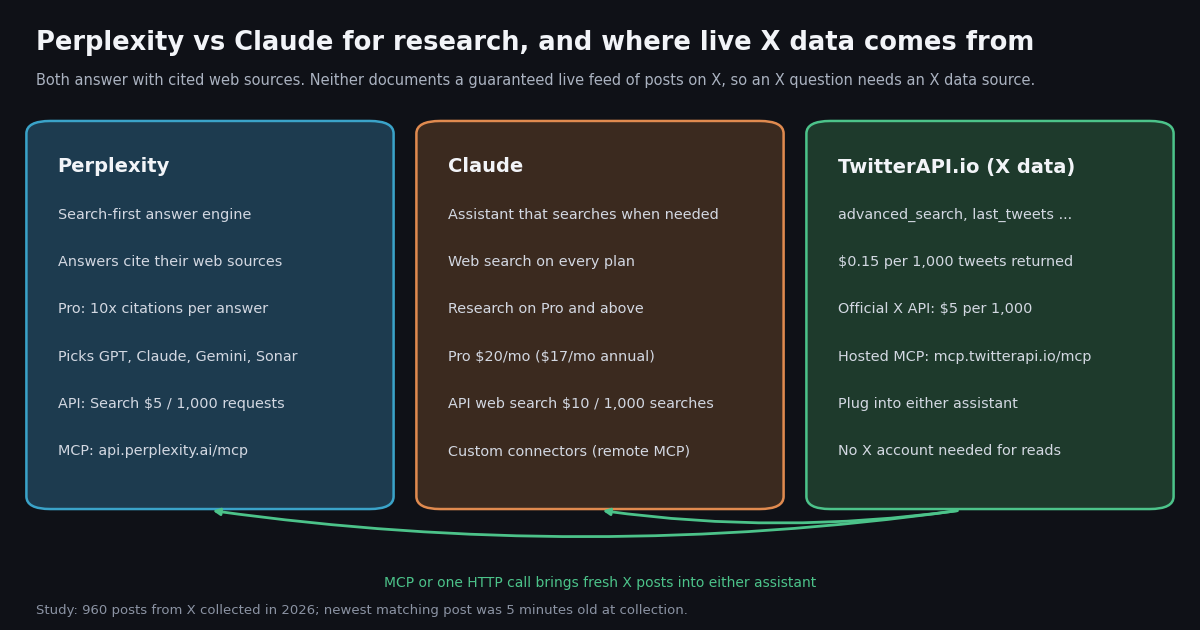
This page compares the two consumer and developer products for research work: how each one cites, how fresh its web results are, what the plans cost, what the APIs charge and how each connects to outside tools over MCP. If you only need to call Perplexity from code, our Perplexity API guide covers the Search API and Agent API request by request; this comparison is the step before that, choosing which assistant your research runs through.
Every vendor fact below comes from the vendor's own pages read this session: Perplexity's help center and API docs, and Claude's pricing page, platform docs and support center. We did not run side-by-side prompts in either product, so there are no head-to-head answer scores here. What we did measure is the thing both products are weakest at: what is being said on X right now. We pulled 960 posts from X in 2026 (four official AI-brand timelines plus the live conversation that compares Perplexity with Claude) and report what that data shows, what it cost, and how to wire the same feed into either assistant.
Perplexity vs Claude at a glance
The short version is that the two products start from opposite ends. Perplexity starts from a search and writes an answer around the sources it found. Claude starts from the question and decides whether it needs to search at all; its platform docs say Claude searches for recent events, current prices and things that might have changed, and answers directly for stable knowledge, math, code and analysis of material already in the conversation.
How to read the table. Perplexity's model list and citation claim come from its "What is Perplexity Pro?" help article; Claude's plan grid and model access come from claude.com/pricing. Perplexity's Pro price is shown on perplexity.ai/pro, which blocked our fetch this session, so we do not quote it; Perplexity Max is $200 monthly or $2,000 a year per its Max help article.
Citations and source handling
Citations are where Perplexity built its reputation, and the product still leads with them. Its help center lists "10x as many citations per answer for greater reference depth and transparency" as the first Pro benefit, and it describes Research mode as automatically choosing a combination of models to produce a report on complex topics. In practice that means a Perplexity answer reads like a short literature review: a paragraph, a bracketed source number, and a source list you can open.
Claude cites differently because it searches differently. On the API side, Anthropic's web search tool docs say citations are always enabled for web search, and each citation carries the source url, title and the cited_text it is grounded in. Those three citation fields do not count toward input or output tokens. In the Claude apps, answers that used web search show their sources inline; answers that did not search show none, because Claude chose to answer from what it already knows.
What this means for research work. If your task is a source hunt (find the five best references on a topic, check who reported a claim first), Perplexity's default behavior matches it. If your task is to read sources you already have and reason over them (compare three contracts, summarize a 200-page report, write the analysis), Claude's long context and its file and code tools are the reason people pick it. Many practitioners use both: Perplexity to gather, Claude to think.
One caveat applies to both. A citation tells you where a sentence came from, not that the source is right or current. When the claim is about something happening right now, including what people are saying on X, the freshness of the index behind the citation matters more than the number of citations.
Web freshness: what each can see right now
Both products search the live web, but neither is a firehose. Claude's web search docs describe the loop plainly: Claude decides when to search, the API runs the searches and returns results, and this can repeat several times in one request before Claude writes the final cited answer. Newer tool versions add dynamic filtering, where Claude writes and runs code to filter results before they enter the context window, and a max_uses setting caps the number of searches per request.
Perplexity's Pro Search applies automatically to multi-step questions up to the plan's limit, and its API offers controls such as domain, language and date filters on the Search API. Both depend on what their search indexes have crawled. Posts on X are a special case: much of X is behind a login, posts appear and disappear by the minute, and neither vendor documents a guaranteed live feed of X posts in its search tool.
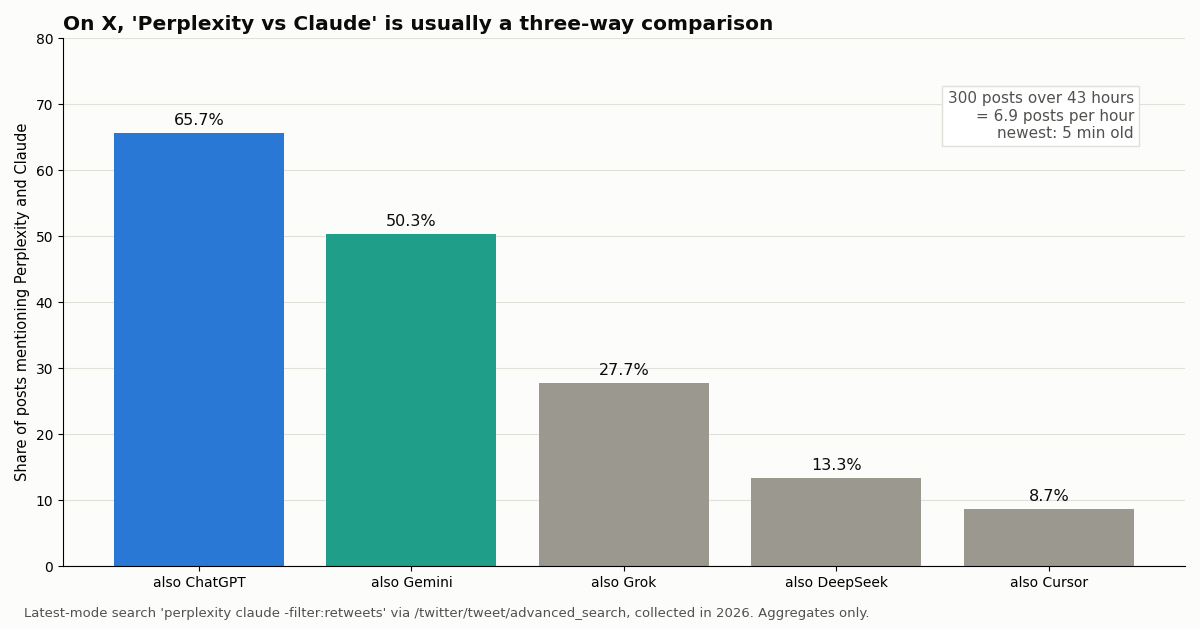
What we measured. We searched X directly for posts that mention both Perplexity and Claude, newest first. The 300 matching posts spanned 43 hours, an average of 6.9 posts an hour, with as many as 16 in a single clock hour. The newest one was 5 minutes old when we collected it, and 164 of the 300 were from the previous 24 hours. That is the window a general web search index is least likely to have caught up with.
The practical rule. For "what is the consensus on X" questions, treat Perplexity and Claude as the analysts, not the data source. Feed them the posts; let them summarize, cluster and cite. The last section shows the two ways to do that.
Plans and prices compared
Consumer pricing is close at the entry tier and diverges above it. Claude's pricing page lists Free at $0, Pro at $17 a month with annual billing ($200 up front) or $20 billed monthly, Max at $100 a month for 5x Pro usage, and Ultra at $200 monthly for 10x Pro weekly usage with no 5-hour limit for verified accounts. Max and Ultra also carry $100 and $200 of monthly API credits on the Claude Platform. Team seats are $20 a seat a month billed annually or $25 monthly (standard), and Enterprise is $20 a seat a month billed annually with a 20-seat minimum plus usage.
Perplexity's help center lists Standard (free), Pro, Max and Education Pro ($10 a month with SheerID verification) for individuals, and Enterprise Pro and Enterprise Max for organizations. Max costs $200 monthly or $2,000 a year, with annual billing only on the web app. Enterprise Pro starts at $40 a seat a month or $400 a seat a year. The Max help article adds an important limit: its higher model access applies within Perplexity's web product and does not apply to programmatic access through the API, which is billed separately.
Usage limits apply on both. Claude's page says how fast you reach a limit depends on the model, chat length and file sizes; Perplexity's says Advanced AI model queries may be limited in weeks of heavy usage. Neither subscription includes API usage beyond the credits named above.
API and MCP: what builders actually get
The developer offerings are different products, not two versions of the same thing. Perplexity's Search API returns ranked web results as JSON with extracted page text, no model and no generated answer: $5.00 per 1,000 requests, or $1.00 per 1,000 with Fast Search. Its Agent API runs a model with tools, billing web_search at $0.0025 per call ($0.001 Fast) and fetch_url at $0.0005, plus model tokens; Perplexity's MCP docs note that Claude models can be selected through the Agent API by their Anthropic model IDs.
Claude's API web search is a tool inside a Claude model call: $10 per 1,000 searches plus standard token costs, and the retrieved results count as input tokens in that turn and later turns. Model prices on Claude's pricing page include Sonnet 5.5 at $2 input and $10 output per million tokens, Opus 5.5 at $4 and $20, and Haiku 5.5 at $0.10 and $0.50 (up to 100K tokens). Batch processing saves 50%.
MCP on both sides. Perplexity hosts a remote MCP server at https://api.perplexity.ai/mcp over Streamable HTTP, with sign-in by OAuth or an API key sent as a Bearer token, and four tools: perplexity_search, perplexity_ask, perplexity_research and perplexity_reason. Its docs give the Claude Code command directly. Claude, in turn, connects to remote MCP servers as custom connectors; Anthropic's support article notes the connection originates from Anthropic's cloud, so the server must be reachable on the public internet.
Using them together is common. Because Perplexity ships an MCP server and Claude is an MCP client, you can put Perplexity's search inside Claude Code with the one-line command below, then add an X data server next to it.
# Perplexity's hosted MCP server inside Claude Code (from docs.perplexity.ai)
claude mcp add --transport http perplexity https://api.perplexity.ai/mcp \
  --header "Authorization: Bearer $PERPLEXITY_API_KEY"

# TwitterAPI.io's hosted MCP server next to it, for live X posts
claude mcp add --transport http twitterapi-io https://mcp.twitterapi.io/mcp \
  --header "Authorization: Bearer $TWITTERAPI_IO_KEY"

# then, inside Claude Code: /mcp (lists both servers and their tools)Perplexity vs ChatGPT vs Claude: what X itself compares
The keyword data says people also search "perplexity vs chatgpt vs claude", and the posts on X agree. Of the 300 posts that mention both Perplexity and Claude, 65.7% also mention ChatGPT and 50.3% also mention Gemini. Grok appears in 27.7%, DeepSeek in 13.3% and Cursor in 8.7%. On X, the two-way comparison is mostly a three- or four-way one.
Who is talking. The posts came from 269 distinct accounts, 21.7% were replies, and 203 of 300 were in English, with Japanese (25) and Chinese (20) next. The median post earned 1 like and 108 views, and 36.7% earned no likes at all: this is a long tail of everyday users comparing tools, not a handful of viral threads. That is exactly the material a summary needs to read in bulk, and exactly what neither assistant's web search promises to have.
How the brands themselves post on X
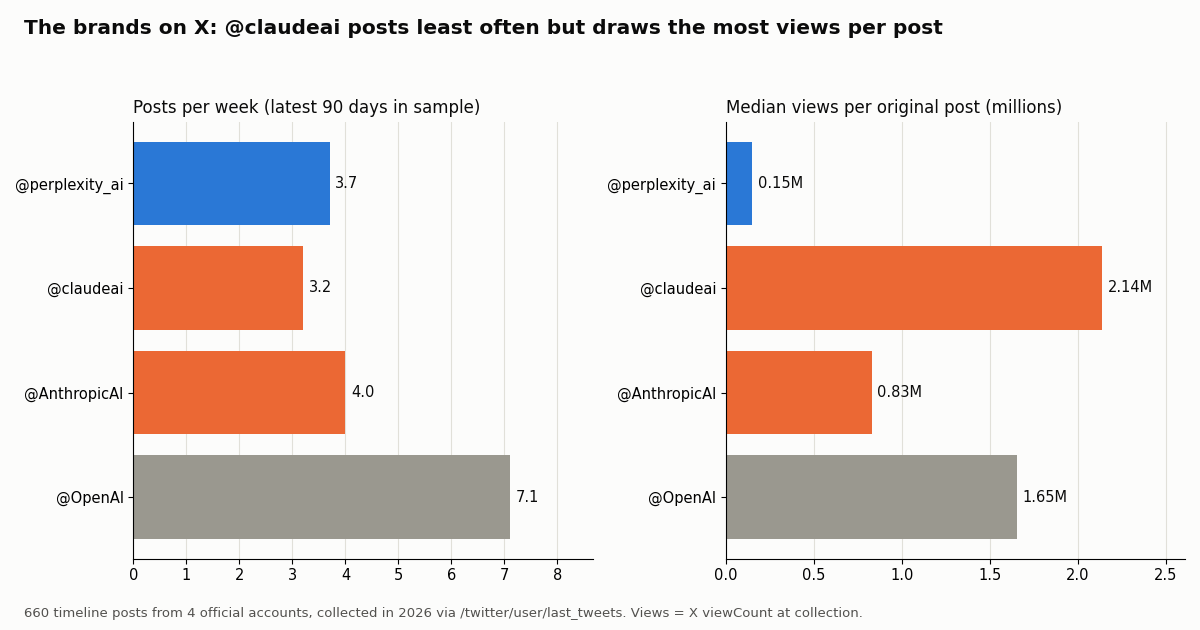
For context we also read the latest posts of the official accounts: @perplexity_ai, @claudeai, @AnthropicAI and, for the three-way comparison, @OpenAI (660 posts in total; @claudeai returned 60 posts, the others 200 each). Over the latest 90 days in each sample, @OpenAI posted 7.1 times a week, @AnthropicAI 4.0, @perplexity_ai 3.7 and @claudeai 3.2. None of the four posted replies in the sample.
What stands out. @claudeai posts the least often but has the highest median views per original post, 2.14 million, against 0.15 million for @perplexity_ai. @AnthropicAI is the link-heavy account (68.5% of posts carry a link, mostly to research and announcements), while @perplexity_ai and @claudeai lean on video (42% and 55%). Views and likes are X's own counters at collection time, not reach estimates.
Why a builder cares. Release notes, outage notices and plan changes land on these timelines first. Watching them with /twitter/user/last_tweets (20 posts per page) is a cheap way to keep a research assistant current on the tools it is comparing.
Giving Perplexity or Claude live X data
There are two routes, and both work with either assistant. Route 1, paste a digest. Run one search against an X data API, format the newest posts as a short list with their URLs, and paste it into Perplexity or Claude with your question. The assistant then summarizes and cites real posts instead of guessing. The script in the code section below does exactly this for the last hour of posts.
Route 2, connect an MCP server. In Claude Code or any MCP client, add TwitterAPI.io's hosted server at https://mcp.twitterapi.io/mcp with your API key as the Bearer token (the command is in the API and MCP section above). The assistant can then call the search and timeline tools itself when a question is about X. In the Claude apps, the same URL can be added as a custom connector, subject to the plan rules in Anthropic's connector article.
What it costs. TwitterAPI.io tweet endpoints bill 15 credits per tweet returned, which is $0.15 per 1,000 tweets; a full 20-post page costs $0.003, and a search that finds nothing costs the 15-credit minimum ($0.00015). The official X API's pay-per-usage rate card (docs.x.com/x-api/getting-started/pricing) bills $0.005 per post read, or $5 per 1,000, about 33x more per 1,000 tweets, and caps pay-per-usage at 3 million post reads a month. Reads need no X account.
Our study as a worked example. This page's study pulled 960 posts in 50 requests. At $0.15 per 1,000 tweets that is about $0.14; the same 960 post reads on the official X API's pay-per-usage rate card would be $4.80. A research assistant that checks one topic every 5 minutes and finds nothing new most of the time pays the polling floor: about $1.30 a month at the $0.00015 minimum per empty check.
Start building. New accounts that pass the automatic bot check get up to $1 of free credits (at most 100,000 credits, no card, one per person or network, expiring after 31 days); purchased credits never expire. Get a key on the dashboard, and use the docs for every endpoint's parameters and response fields.
How we collected this
Question. How fresh and how large is the X conversation comparing Perplexity with Claude, and how do the official AI-brand accounts post, measured from X directly rather than through a search index.
Accounts and query. Timelines of @perplexity_ai, @claudeai, @AnthropicAI and @OpenAI via /twitter/user/last_tweets (up to 10 pages each; @ChatGPTapp returned no posts, so @OpenAI stood in for the three-way comparison). Search: perplexity claude -filter:retweets via /twitter/tweet/advanced_search with queryType=Latest, 15 pages.
Window and sample. Collected in 2026. 660 timeline posts (each account's most recent posts; per-account spans differ) and 300 search results spanning 43 hours: 960 posts from 50 requests, about $0.14 at $0.15 per 1,000 tweets.
What the sample cannot show. It does not measure answer quality in Perplexity or Claude; we did not run prompts in either product. A keyword search catches posts that use both product names, not every relevant post, and Latest mode returns the newest matches rather than the most influential. Views and likes are X counters at one moment. Brand-account numbers describe recent posting, not long-run averages.
Privacy. Aggregates only. The four timelines are organization accounts and may be named. Authors in the keyword search are private individuals: their raw pages were never committed, and the published sample is de-identified (no IDs, URLs, text or handles). No TwitterAPI.io customer data was used.
Files. Protocol, analysis script, results and de-identified sample are in the repository under data/studies/perplexity-vs-claude/.
import os, time, requests
from datetime import datetime, timezone

BASE = "https://api.twitterapi.io"
HEADERS = {"X-API-Key": os.environ["TWITTERAPI_IO_KEY"]}
FMT = "%a %b %d %H:%M:%S %z %Y"   # createdAt, e.g. "Thu Oct 16 12:34:56 +0000 2026"

def recent_posts(query, minutes=60, max_pages=5):
    """Posts on X matching `query` from the last `minutes`, newest first."""
    since = int(time.time()) - minutes * 60
    q = f"{query} -filter:retweets since_time:{since}"
    posts, cursor = [], ""
    for _ in range(max_pages):
        r = requests.get(f"{BASE}/twitter/tweet/advanced_search", headers=HEADERS, timeout=30,
                         params={"query": q, "queryType": "Latest", "cursor": cursor})
        r.raise_for_status()
        data = r.json()
        for t in data.get("tweets", []):
            posts.append({
                "url": t["url"],
                "text": t["text"],
                "created": datetime.strptime(t["createdAt"], FMT),
                "likes": t.get("likeCount", 0),
                "views": t.get("viewCount", 0),
                "lang": t.get("lang"),
            })
        if not data.get("has_next_page"):
            break
        cursor = data["next_cursor"]
    return posts

def digest(posts, top=10):
    """A compact, citable block you can paste into Perplexity or Claude."""
    now = datetime.now(timezone.utc)
    posts = sorted(posts, key=lambda p: p["likes"], reverse=True)[:top]
    lines = []
    for p in posts:
        age = int((now - p["created"]).total_seconds() // 60)
        text = " ".join(p["text"].split())[:220]
        lines.append(f"- [{age} min ago, {p['likes']} likes] {text} ({p['url']})")
    return "\n".join(lines)

if __name__ == "__main__":
    posts = recent_posts("perplexity claude", minutes=60)
    print(f"{len(posts)} posts in the last hour")   # 15 credits per post returned
    print(digest(posts))
Questions readers ask
Is Perplexity better than Claude for research?
For finding and citing sources, Perplexity's search-first design is the better fit: answers are built from web results with citations, and Pro raises citation depth (10x citations per answer per its help center). For reasoning over material you already have, such as long documents, data or code, Claude is the usual pick. Many researchers gather with Perplexity and analyze with Claude.
Can Perplexity use Claude models?
Yes. Perplexity's Pro help article lists Claude Sonnet 4.6 among the models Pro subscribers can choose, alongside Sonar, GPT-5.2 and Gemini 3.1 Pro, and its API docs say Claude models can be selected in the Agent API by their Anthropic model IDs. Claude's own apps only run Claude models.
Does Claude have web search?
Yes. Claude's pricing page lists web search on every plan, including Free; the deeper Research mode starts on Pro. On the API, the web search tool costs $10 per 1,000 searches plus token costs, and citations are always enabled for its results.
How much do Perplexity Pro and Claude Pro cost?
Claude Pro is $20 a month, or $17 a month billed annually ($200 up front), per claude.com/pricing. Perplexity lists its Pro price on perplexity.ai/pro, which we could not load this session; its help center gives Max at $200 monthly or $2,000 a year and Education Pro at $10 a month.
Perplexity vs ChatGPT vs Claude: which should I use?
Perplexity for cited web answers, Claude for long-context reasoning and coding, and ChatGPT as the general-purpose option most people compare against: 65.7% of the X posts we collected that mention Perplexity and Claude also mention ChatGPT. Pick by the job, not the brand, and check each vendor's current plan page before buying.
Can Perplexity or Claude see what people are posting on X right now?
Neither vendor documents a guaranteed live feed of posts on X in its search tool. For live X questions, pull the posts from an X data API, for example TwitterAPI.io's /twitter/tweet/advanced_search at $0.15 per 1,000 tweets, and paste them in or connect the hosted MCP server at mcp.twitterapi.io/mcp.
Does Perplexity have an MCP server?
Yes. Perplexity hosts a remote MCP server at https://api.perplexity.ai/mcp with OAuth sign-in or an API key as a Bearer token, exposing perplexity_search, perplexity_ask, perplexity_research and perplexity_reason. Its docs include setup for Claude Code, Cursor, VS Code, Google Antigravity and the Anthropic API.
Is the Perplexity API cheaper than Claude's web search?
They bill different things. Perplexity's Search API is $5 per 1,000 requests for raw ranked results with no model. Claude's web search tool is $10 per 1,000 searches plus the tokens of the model call that uses the results. If you only need results, Perplexity's Search API is the lower line item; if you need the answer written, compare full request costs.
Continue
- Claude pricing: plans, feature grid and API model prices
- Claude platform docs: web search tool (citations, max_uses, $10 per 1,000 searches)
- Perplexity Help Center: What is Perplexity Pro? (citations, models)
- Perplexity API docs: pricing (Search API, Agent API tool fees)
- Perplexity API docs: MCP server (remote endpoint, tools, Claude Code setup)
- X API pay-per-usage pricing ($0.005 per post read)
- X (Twitter) API hub: endpoints, pricing and guides
- Perplexity API guide: Search API, Agent API and pricing
- How to use Claude with the Twitter (X) API
- Grok vs Claude for X data questions
- MCP server explainer for Twitter (X) data
- TwitterAPI.io hosted MCP server setup
- Claude API pricing reference
- Get a TwitterAPI.io API key on the dashboard
- TwitterAPI.io API documentation
- 01Google AI Studio Free Tier Limits: What the Gemini API Allows in 2026
- 02Best Claude Model for Coding in 2026: Opus vs Sonnet vs Haiku vs Fable, Priced on Real Twitter (X) Data
- 03Zapier Alternatives in 2026: Prices, Self-Hosting and Which Ones Still Connect to Twitter (X)
- 04Antigravity vs Cursor: Plans, Models and a Twitter (X) MCP Setup in Both
- 05Claude Code Alternatives: Seven Coding Agents Checked for License, Free Use and MCP (Twitter/X Data Included)
- 06How to Use Claude with the Twitter (X) API
- 07OpenClaw vs Claude Code: which agent should run your Twitter (X) jobs?
- 08Claude Code Channels: Telegram, Discord and Twitter (X) Alerts in Your Session
Stop reading. Start building.
Starter credits cover real testing on real data. Google sign-in, no card, no application queue.
Get an API keyAlready building with TwitterAPI.io? Publish an honest tutorial or build log about it and earn up to $200 a month in API credits.