Claude Code Alternatives: Seven Coding Agents Checked for License, Free Use and MCP (Twitter/X Data Included)
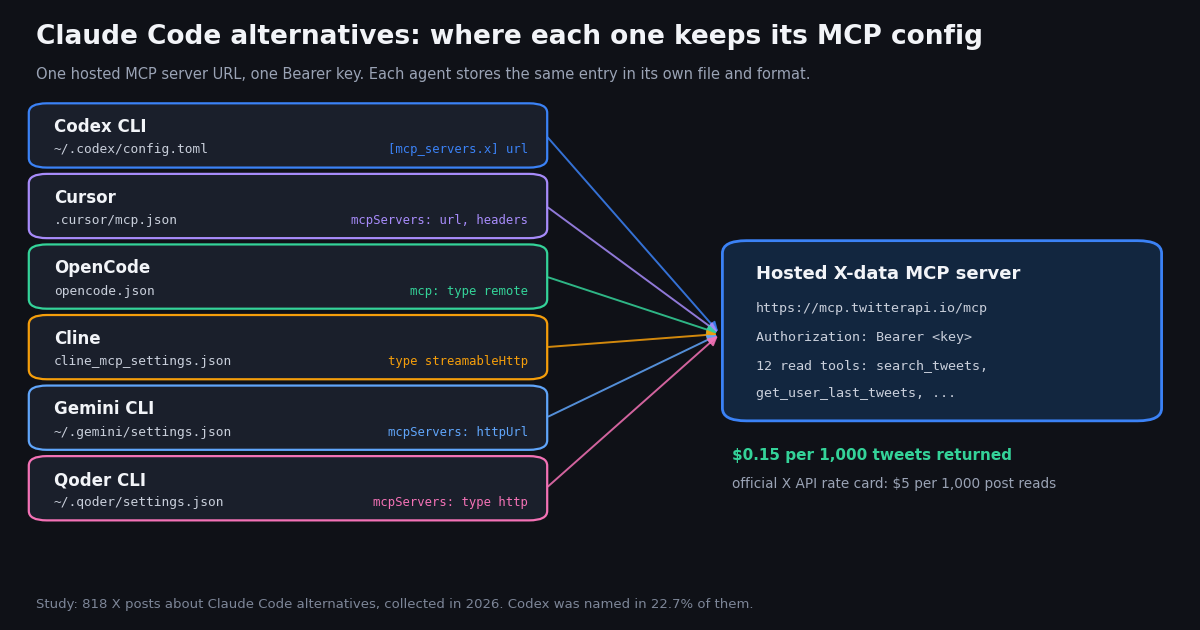
This page is a shortlist, not a duel: if you already know you are choosing between Codex and Claude Code, the head-to-head in our Codex vs Claude Code guide goes deeper on instruction files, skills and headless runs. Here we cover the wider field of Claude Code alternatives, seven of them, and check each on the three things people ask about most: the license, whether there is a free way to use it, and whether it can attach a Model Context Protocol (MCP) server so the agent can reach live data from outside your repository.
Every license, plan and config path below was read from the vendor's own README, docs or pricing page this year, and the files are quoted rather than paraphrased where it matters. We did not install or benchmark the agents, so there are no speed or quality scores here. What we did measure is the conversation: we collected X posts that discuss alternatives to Claude Code and counted which tools people name and what they care about. That study, the config snippets, and a working Python example for pulling Twitter (X) data into any of these agents are the parts you will not find on a generic list.
The shortlist at a glance
The table compresses what each vendor documents. "Free route" means a way to run the agent without paying the agent vendor; model usage can still cost money unless you run a local model.
How to read it. If you left Claude Code because of the bill, the first three open source rows are the honest answer: the harness is free and you choose the model. If you left because you want a different model family inside a polished product, Codex CLI (OpenAI models) and Cursor (several model vendors in one editor) are the usual picks. Gemini CLI is now aimed at organizations on Gemini Code Assist; individuals who want Google's models for free are pointed to Antigravity CLI, which we compare separately in Antigravity vs Cursor.
What the table cannot tell you. Code quality depends far more on the model than on the harness, and model rankings move monthly. None of these agents is "best" in general; pick on the constraints you can verify (license, price, data access) and test two of them on your own repository for a day.
Codex CLI: the alternative people name most
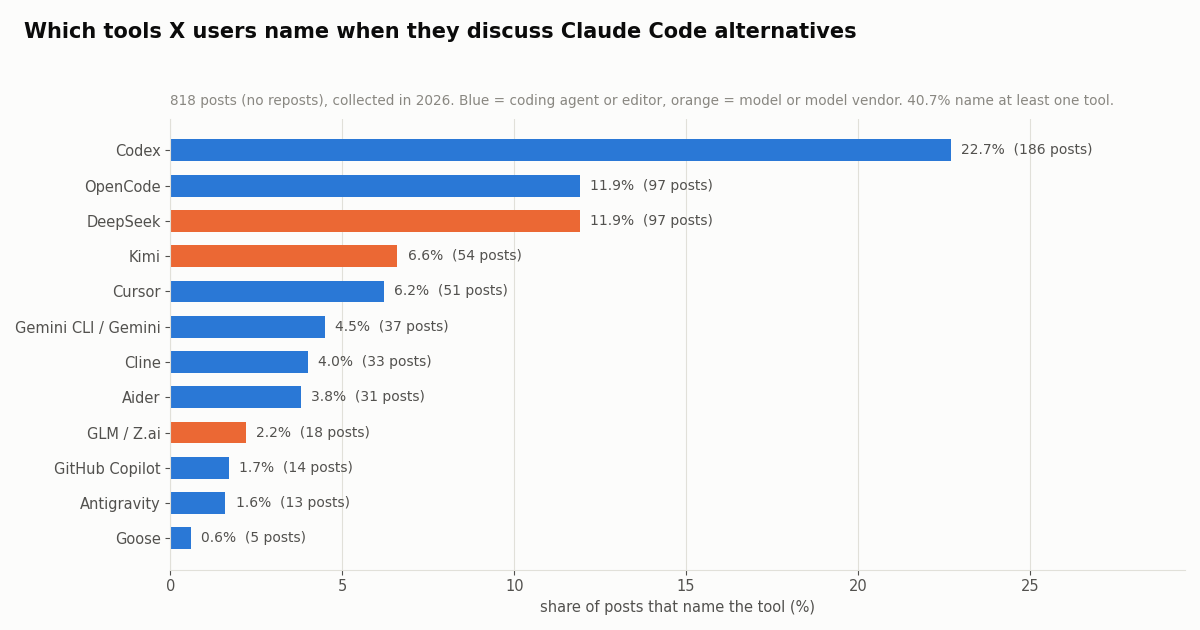
OpenAI describes Codex CLI as "a coding agent from OpenAI that runs locally on your computer". The repository is Apache-2.0. You install it with the standalone installer, npm install -g @openai/codex or brew install --cask codex, then sign in with ChatGPT; the README recommends using it "as part of your Plus, Pro, Business, Edu, or Enterprise plan" and notes that an API key works with additional setup. It is also the alternative X users bring up most often: 22.7% of the posts in our sample name it, roughly twice as often as the next tool.
MCP. Codex stores servers in config.toml: ~/.codex/config.toml by default, or .codex/config.toml for trusted projects. Each server is a [mcp_servers.<server-name>] table. Remote servers take url plus either bearer_token_env_var (the name of an environment variable whose value is sent as the bearer token) or http_headers / env_http_headers. That bearer option is the cleanest of the seven: the key never sits in the file. codex mcp add <name> --url <url> writes the table for you.
Pick it when you already pay for ChatGPT, you want OpenAI models, and you like a terminal agent that also has IDE and desktop surfaces. Our Codex MCP guide walks through enabled_tools, timeouts and the local stdio variant.
OpenCode, Cline and Aider: the free and open source alternatives
OpenCode is MIT licensed. Its provider docs say it uses the AI SDK and Models.dev "to support 75+ LLM providers and it supports running local models". Keys added with /connect are stored in ~/.local/share/opencode/auth.json. MCP servers go under an mcp object in opencode.json; a remote server is "type": "remote" with a url, an optional headers object and an enabled flag. In our X sample it is the second most named tool at 11.9%, and posts naming it drew a median of 1,355 views, above the sample median of 559. Our OpenCode vs Claude Code page compares the two config formats and plugin systems line by line.
Cline is Apache-2.0 (copyright Cline Bot Inc.) and ships as a CLI (npm i -g cline), a VS Code extension, a JetBrains plugin and an SDK. Its README says you can "use MCPs to connect to databases, query APIs" and manage servers with cline mcp. The docs put the CLI's settings at ~/.cline/data/settings/cline_mcp_settings.json and warn that omitting type falls back to the legacy SSE transport, so set "type": "streamableHttp" explicitly for a modern remote server. Named in 4.0% of posts.
Aider is Apache-2.0 and the oldest of the three. Its docs list free API providers ("OpenRouter offers free access to many models, with limitations on daily usage") and local models through Ollama or any OpenAI-compatible endpoint, and it commits each change to git automatically. We found no MCP support in Aider's README, its LLM docs or its release history, so treat it as a pure editing agent: if it needs live data, you fetch that data with a script (like the Python example on this page) and hand the output to it. Named in 3.8% of posts.
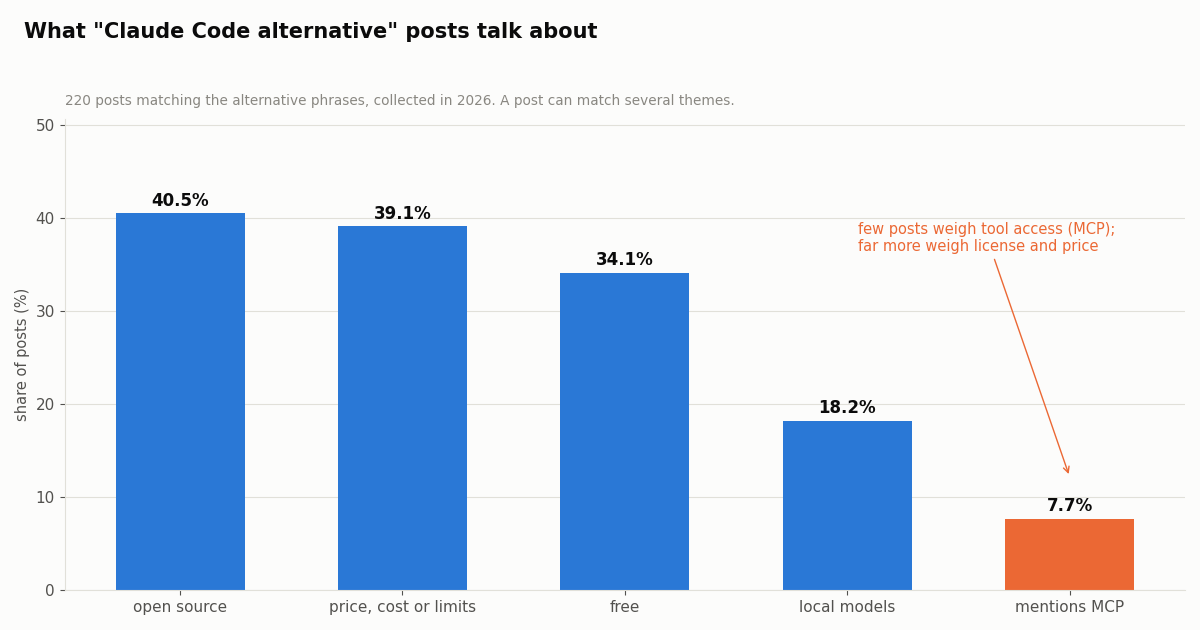
The catch with free. A free harness plus a paid frontier model can cost as much as a subscription once you use it all day; a local model costs nothing per token but needs a capable machine and is usually weaker at multi-file edits. The posts in our sample reflect that trade: local models come up in 18.2% of them.
Cursor, Qoder and Gemini CLI: the product options
Cursor is an editor rather than a terminal agent. Its pricing page lists a Free plan at $0 a month with limited agent and Chat requests, then Plus ($8), Premium ($30), Super ($100) and Ultra ($200) a month, plus Teams from $30 per user. MCP servers are installed from the Customize page or written to mcp.json (.cursor/mcp.json in a project); the docs say variables are resolved in command, args, env, url and headers, so the key can come from your environment. Our Cursor vs Claude Code page goes further on agent modes.
Qoder offers an IDE and a CLI (qodercli). Its pricing page lists a Free plan with a two-week Pro trial and 300 credits, then Lite ($10, bring your own API key), Pro ($20) and Pro+ ($60) a month. The CLI reference puts MCP servers under mcpServers in ~/.qoder/settings.json (or <project>/.qoder/settings.json, which needs approval before use); an HTTP server is "type": "http" with url and headers. It barely registers on X so far: one post in our sample.
Gemini CLI is still Apache-2.0 and still reads MCP servers from ~/.gemini/settings.json (httpUrl for Streamable HTTP, headers for auth, trust to skip confirmations). But its README now opens with a notice: "No free tier or Google AI plans: Free individual access and Google AI Pro / Ultra (Google One) moved to Antigravity CLI on June 18, 2026." It is now pitched at organizations with Gemini Code Assist Standard or Enterprise. If you found an older list recommending Gemini CLI as the free Claude Code alternative, that advice is out of date.
What X users say when they look for a Claude Code alternative
We searched X for posts that use the alternative phrases ("claude code alternative", "alternative to claude code" and close variants) or describe a switch ("instead of claude code", "switched from claude code", "replace claude code", "free claude code"), and kept 818 unique original posts across 208 days. 40.7% name at least one specific tool and 19.8% name two or more, which is what comparison posts look like.
Models show up as often as harnesses. DeepSeek ties OpenCode at 11.9%, and Kimi (6.6%) and GLM (2.2%) follow. Many of these posts are not about replacing the Claude Code program at all; they describe pointing a harness at a cheaper model. That is the practical meaning of "Claude Code alternative" for a large share of searchers.
Engagement is modest and skewed. The median post drew 5 likes and 559 views; the top tenth passed 70 likes and 11,669 views. Posts naming Cline (median 2,587 views) and Aider (1,355) traveled further than posts naming Codex (809), likely because Codex is mentioned in passing more often.
License and price beat tool access, which is why MCP is easy to overlook
Among the 220 posts that use the alternative phrases themselves, 40.5% mention open source, 39.1% mention price, cost, plans or limits, 34.1% say free, 18.2% mention local models, and only 7.7% mention MCP (across the full sample, 3.5%). We report the free share on this subset because the second query itself contains the word free.
That gap matters after you switch. A coding agent that cannot reach your issue tracker, your database or the outside web is limited to what is in the repository. MCP is the portable way to give it that reach: the same server URL works in six of the seven agents above, so the integration survives the next time you change tools.
Give any alternative live Twitter (X) data with one MCP entry
The hosted TwitterAPI.io MCP server speaks Streamable HTTP at https://mcp.twitterapi.io/mcp. Its initialize response says to paste your API key as the Bearer token, and its tool list has 12 read tools: search_tweets, get_user_info, get_user_about, get_user_followers, get_user_followings, get_user_last_tweets, get_user_mentions, get_tweets_by_ids, get_tweet_replies, get_tweet_quotes, get_tweet_retweeters and get_trends. Reads need no X account.
Below is the same entry written in each agent's documented format. These are built from the vendor docs quoted above; we did not run each agent, so check the field names against your installed version (Qoder's own docs disagree slightly on default scopes, for example). Prefer environment variables for the key wherever the agent supports them (Codex bearer_token_env_var, Cursor ${env:...} interpolation); otherwise keep the file out of version control.
What a task costs. Ask the agent for "the last 20 posts of @OpenAIDevs" and it calls get_user_last_tweets, which maps to /twitter/user/last_tweets: one full page of 20 tweets is 300 credits, $0.003. Tweet endpoints bill 15 credits per tweet returned ($0.15 per 1,000) with a 15-credit minimum per request, so a search that finds nothing costs $0.00015. On the official X API pay-per-usage rate card (docs.x.com/x-api/getting-started/pricing) the same 20 posts are 20 post reads at $0.005, $0.10; per 1,000 tweets that is $5 against $0.15, about 33x.
Profiles and followers. get_user_info is 18 credits per profile ($0.18 per 1,000); follower and following lists are 1 to 3 credits per user returned. The official rate card lists $0.010 per user read and per follower or following read.
Agents without MCP, and checking the server by hand. For Aider, or any agent whose MCP support you do not trust yet, skip the protocol: call the REST API from a short script, write the result to a file, and let the agent read it. The Python example at the end of this page does that with /twitter/user/last_tweets and /twitter/tweet/advanced_search, following has_next_page and next_cursor. To confirm a key works before blaming a config file, send the tools/list JSON-RPC call at the bottom of the code block: a response with the 12 tool names means the server and key are fine.
If the agent writes as well as reads. Posting, liking, following or sending a DM are separate endpoints (for example /twitter/create_tweet_v2 and /twitter/follow_user_v2) that run through an authenticated session: one /twitter/user_login_v2 login ($0.10, with a proxy you supply) returns login_cookies, then each action is 60 credits ($0.0006), billed per HTTP 200 call. The call acts as that account, so X can rate-limit, lock or suspend it; keep a human pace, expect to log in again when the session expires, and do not let an agent loop on write actions unattended.
# Codex CLI: ~/.codex/config.toml (or .codex/config.toml in a trusted project)
[mcp_servers.twitterapi]
url = "https://mcp.twitterapi.io/mcp"
bearer_token_env_var = "TWITTERAPI_IO_API_KEY"

// Cursor: .cursor/mcp.json in the project (headers support ${env:...} interpolation)
{ "mcpServers": { "twitterapi": {
    "url": "https://mcp.twitterapi.io/mcp",
    "headers": { "Authorization": "Bearer ${env:TWITTERAPI_IO_API_KEY}" } } } }

// OpenCode: opencode.json
{ "$schema": "https://opencode.ai/config.json",
  "mcp": { "twitterapi": { "type": "remote", "url": "https://mcp.twitterapi.io/mcp", "enabled": true,
    "headers": { "Authorization": "Bearer YOUR_TWITTERAPI_IO_KEY" } } } }

// Cline: cline_mcp_settings.json (CLI: ~/.cline/data/settings/cline_mcp_settings.json)
{ "mcpServers": { "twitterapi": { "type": "streamableHttp", "url": "https://mcp.twitterapi.io/mcp",
    "headers": { "Authorization": "Bearer YOUR_TWITTERAPI_IO_KEY" }, "disabled": false } } }

// Gemini CLI: ~/.gemini/settings.json
{ "mcpServers": { "twitterapi": { "httpUrl": "https://mcp.twitterapi.io/mcp",
    "headers": { "Authorization": "Bearer YOUR_TWITTERAPI_IO_KEY" } } } }

// Qoder CLI: ~/.qoder/settings.json (project: <project>/.qoder/settings.json, needs approval)
{ "mcpServers": { "twitterapi": { "type": "http", "url": "https://mcp.twitterapi.io/mcp",
    "headers": { "Authorization": "Bearer YOUR_TWITTERAPI_IO_KEY" } } } }

# Claude Code, for comparison
claude mcp add --transport http twitterapi https://mcp.twitterapi.io/mcp \
  --header "Authorization: Bearer YOUR_TWITTERAPI_IO_KEY"

# What every agent above sends under the hood (JSON-RPC over Streamable HTTP)
curl -sS -X POST https://mcp.twitterapi.io/mcp \
  -H "Content-Type: application/json" \
  -H "Accept: application/json, text/event-stream" \
  -H "Authorization: Bearer $TWITTERAPI_IO_API_KEY" \
  -d '{"jsonrpc":"2.0","id":1,"method":"tools/list","params":{}}'
# -> search_tweets, get_user_info, get_user_about, get_user_followers, get_user_followings,
#    get_user_last_tweets, get_user_mentions, get_tweets_by_ids, get_tweet_replies,
# get_tweet_quotes, get_tweet_retweeters, get_trendsHow we collected this
Question. When people on X discuss alternatives to Claude Code, which tools do they name, and what do they care about (open source, price, free use, local models, MCP)?
Query. Two searches on /twitter/tweet/advanced_search with queryType=Latest: the alternative phrases ("claude code alternative(s)", "alternative(s) to claude code") and the switch phrases ("instead of claude code", "switched from claude code", "replace claude code", "claude code replacement", "free claude code"). Reposts were dropped and posts deduplicated by ID.
Window and sample. The most recent matching posts at collection time, collected in 2026: 820 posts returned, 818 unique originals over 208 days; 22.4% are replies and most are in English. 42 requests, about $0.123 at 15 credits per tweet returned.
Method. Case-insensitive word-boundary matching on post text for each tool name (Codex, Cursor, Gemini, OpenCode, Cline, Aider, Qoder and others) and for each theme. "Gemini" counts both the model and the CLI. A post can name several tools and match several themes.
What it cannot show. Mentions are not usage or market share, and a mention can be negative. The quoted-phrase search returns a narrow slice of the conversation (people who say "alternative"), and the first query returned only 220 posts. Keyword matching misses misspellings and screenshots. Nothing here measures code quality.
Privacy. Search results are written by private individuals, so raw pages were not kept; we publish aggregates and de-identified rows only (no IDs, URLs, text or handles), and no individual is profiled.
Which Claude Code alternative should you pick?
You want free and open source: start with OpenCode (MIT, 75+ providers, remote MCP in opencode.json); try Cline if you live in VS Code or JetBrains; use Aider if you want git-first, minimal edits and do not need MCP.
You already pay for ChatGPT: Codex CLI, with your plan sign-in and the bearer_token_env_var MCP option.
You want an editor, not a terminal: Cursor (Free plan to try, then $8 a month and up) or Qoder (Free plan with a two-week Pro trial).
You wanted Gemini for free: that route is now Antigravity CLI, not Gemini CLI.
You want your agent to know what is happening on X: whichever you choose, add the hosted MCP entry above or run the Python script. Create a key in the dashboard; new accounts that pass the automatic bot check get up to $1 of free credits (at most 100,000 credits, no card, one per person or network, expiring after 31 days), enough for about 6,600 tweets at $0.15 per 1,000. Purchased credits never expire, and the endpoint reference lives at docs.twitterapi.io.
import os
import requests

BASE = "https://api.twitterapi.io"
HEADERS = {"X-API-Key": os.environ["TWITTERAPI_IO_API_KEY"]}


def last_posts(user_name, limit=20):
    """Newest posts of one account via /twitter/user/last_tweets (20 per page)."""
    out, cursor = [], ""
    while len(out) < limit:
        params = {"userName": user_name}
        if cursor:
            params["cursor"] = cursor
        r = requests.get(f"{BASE}/twitter/user/last_tweets", headers=HEADERS, params=params, timeout=30)
        r.raise_for_status()
        body = r.json()
        if body.get("status") == "error":
            raise RuntimeError(body.get("msg"))
        data = body.get("data") or {}
        out.extend(data.get("tweets", []))
        if not body.get("has_next_page"):
            break
        cursor = body.get("next_cursor", "")
    return out[:limit]


def search(query, pages=2):
    """Latest posts matching an X search query via /twitter/tweet/advanced_search."""
    out, cursor = [], ""
    for _ in range(pages):
        params = {"query": query, "queryType": "Latest"}
        if cursor:
            params["cursor"] = cursor
        r = requests.get(f"{BASE}/twitter/tweet/advanced_search", headers=HEADERS, params=params, timeout=30)
        r.raise_for_status()
        body = r.json()
        out.extend(body.get("tweets", []))
        if not body.get("has_next_page"):
            break
        cursor = body.get("next_cursor", "")
    return out


if __name__ == "__main__":
    # The same task you would give any coding agent: "pull the last 20 posts of an account"
    for t in last_posts("OpenAIDevs"):
        print(t["createdAt"], t["likeCount"], t["viewCount"], t["text"][:80].replace("\n", " "))

    # And: "what are people saying about Claude Code alternatives right now?"
    hits = search('"claude code alternative" OR "alternative to claude code" -filter:retweets')
    print(len(hits), "recent posts;", sum(1 for t in hits if "codex" in t["text"].lower()), "mention Codex")
    # Cost: 15 credits per tweet returned = $0.15 per 1,000 tweets; a full 20-tweet page is $0.003.
Questions readers ask
What is the best free alternative to Claude Code?
For a fully free harness, OpenCode (MIT), Cline (Apache-2.0) and Aider (Apache-2.0) are the closest; you pay only your model provider, or nothing with a local model. OpenCode supports 75+ providers and local models; Aider lists free OpenRouter models and Ollama. Gemini CLI is no longer the free option: its free individual access moved to Antigravity CLI on June 18, 2026.
Is there an open source Claude Code alternative?
Yes. OpenCode is MIT licensed; Cline, Aider, Codex CLI and Gemini CLI are Apache-2.0. Codex CLI and Gemini CLI are open source code but are designed around a vendor plan (ChatGPT, Gemini Code Assist). Cursor and Qoder are commercial products.
Is Codex better than Claude Code?
Neither is better in general; the model and your workflow decide. Codex is the alternative X users name most (22.7% of the posts in our sample), and it uses OpenAI models through a ChatGPT plan or an API key. Our Codex vs Claude Code guide compares them feature by feature.
Which Claude Code alternatives support MCP servers?
Codex CLI (~/.codex/config.toml), Cursor (mcp.json), OpenCode (opencode.json), Cline (cline_mcp_settings.json), Gemini CLI (~/.gemini/settings.json) and Qoder (~/.qoder/settings.json) all document remote MCP servers with auth headers. We found no MCP support documented for Aider.
Can I use Claude Code alternatives with cheaper models like DeepSeek or Kimi?
Yes, that is a large part of the conversation: DeepSeek was named in 11.9% and Kimi in 6.6% of the posts we collected. Model-agnostic harnesses such as OpenCode, Cline and Aider let you pick the provider; check each provider's own pricing.
How do I get Twitter (X) data into Codex, Cursor or OpenCode?
Add the hosted MCP server https://mcp.twitterapi.io/mcp with your TwitterAPI.io key as the Bearer token, using the config format for your agent shown on this page. The agent can then call tools such as search_tweets and get_user_last_tweets. Tweets cost $0.15 per 1,000 returned; a full 20-tweet page is $0.003.
Is pulling X data through an agent cheaper than the official X API?
On published prices, yes: TwitterAPI.io bills $0.15 per 1,000 tweets returned, while the official X API pay-per-usage rate card lists $0.005 per post read, which is $5 per 1,000, about 33x more. Profiles are $0.18 per 1,000 versus $0.010 per user read.
Do I need an X account to read tweets this way?
No. Reads through the REST API or the MCP server need only a TwitterAPI.io API key. Write actions (posting, following) are separate endpoints that act as a logged-in X account.
Continue
- openai/codex README: Codex CLI install, ChatGPT plan sign-in, Apache-2.0
- OpenAI Codex docs: MCP configuration in config.toml (url, bearer_token_env_var, http_headers)
- google-gemini/gemini-cli README: status notice (no free tier, Antigravity CLI), MCP in settings.json
- OpenCode docs: remote MCP servers in opencode.json
- Cline docs: MCP settings file and streamableHttp remote servers
- X API pay-per-usage pricing ($0.005 per post read, $0.010 per user read)
- X (Twitter) API overview: endpoints and pricing
- Codex vs Claude Code: the head-to-head comparison
- OpenCode vs Claude Code: config, MCP and plugins
- Cursor vs Claude Code: editor or terminal agent
- OpenClaw vs Claude Code compared
- Claude Code pricing: plans and usage limits
- Antigravity vs Cursor
- Add an MCP server to Codex CLI
- Hosted Twitter (X) MCP server setup
- Get a TwitterAPI.io API key in the dashboard
- 01Google AI Studio Free Tier Limits: What the Gemini API Allows in 2026
- 02Best Claude Model for Coding in 2026: Opus vs Sonnet vs Haiku vs Fable, Priced on Real Twitter (X) Data
- 03Zapier Alternatives in 2026: Prices, Self-Hosting and Which Ones Still Connect to Twitter (X)
- 04Antigravity vs Cursor: Plans, Models and a Twitter (X) MCP Setup in Both
- 05OpenCode vs Claude Code: config, plugins, models and one Twitter (X) MCP server in both
- 06OpenClaw vs Claude Code: which agent should run your Twitter (X) jobs?
- 07Claude Code Channels: Telegram, Discord and Twitter (X) Alerts in Your Session
- 08Codex vs Claude Code: Setup, MCP, Headless Runs and Pricing Compared for Twitter (X) Data Agents
Stop reading. Start building.
Starter credits cover real testing on real data. Google sign-in, no card, no application queue.
Get an API keyAlready building with TwitterAPI.io? Publish an honest tutorial or build log about it and earn up to $200 a month in API credits.