Antigravity vs Cursor: Plans, Models and a Twitter (X) MCP Setup in Both
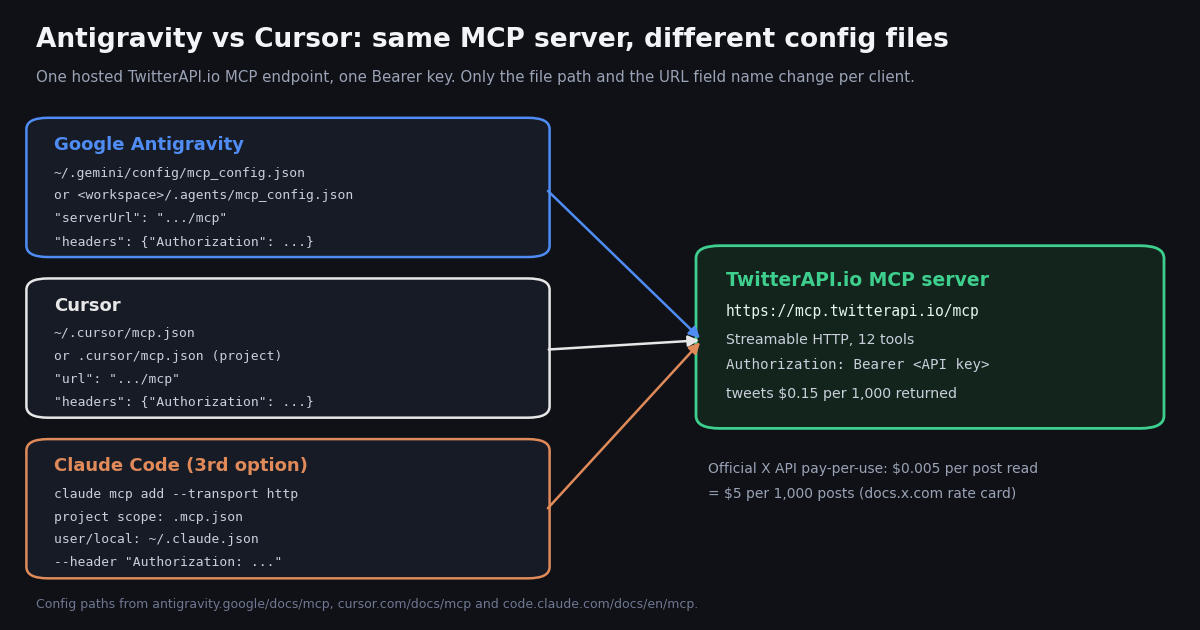
This page compares two editors head to head, Google Antigravity and Cursor, and adds Claude Code as the third column because most people asking the question are weighing it too. If you only want the Cursor and Claude Code pairing, our Cursor vs Claude Code page goes deeper on that one; if you already chose Cursor and just need Twitter (X) data inside it, the Cursor + Twitter API guide is the step-by-step setup. Here the focus is the choice itself: plans, models, how each one connects to outside tools through MCP, and what that means once you point both at the same live data source.
Every plan, model and config path below was read this session from antigravity.google/docs, cursor.com/docs and code.claude.com/docs. We did not install or run either editor for this page, so there are no benchmark scores or speed claims. What we did measure is X data: the official accounts of both products and a sample of recent posts where developers compare them, collected with TwitterAPI.io in 2026. Those numbers, the charts and the config blocks are the parts you cannot get from a feature table.
Antigravity vs Cursor at a glance
The short version: Antigravity is Google's agent-first platform and leans on Gemini, with a real free tier; Cursor is now a SpaceX product bundled with Grok and X, with its own models in the subscription and everyone else's models billed by usage. Both accept MCP servers through almost the same JSON file.
How to read the table. Antigravity's own pricing page lists the plans (Individual $0, Google AI Pro, Google AI Ultra, Business via Google Cloud) without printing the Pro and Ultra prices; Google sells those through one.google.com/about/google-ai-plans, where the price depends on country, so check there for your region. The Cursor prices come from cursor.com/docs/models-and-pricing, and the Claude Code prices from claude.com/pricing, where Claude Code is included in Pro ($20 a month, or $17 a month billed annually), Max ($100) and Ultra ($200) but not in the free plan.
Plans and limits: a free weekly quota vs a shared Grok pool
Antigravity. The plans page says every plan gets Gemini 3.8 Flash as a core agent model, unlimited Tab completions and access to all product features, including scheduled tasks and the CLI. Accounts without Google AI Pro or Ultra get "a meaningful quota, refreshed weekly" plus a weekly rate limit. Pro gets a quota refreshed every five hours until a weekly limit is reached; Ultra gets the highest quota, also refreshed every five hours, and access to third-party models. Google states that the limits track how much work the agent does, so short tasks stretch further than long ones, and that the limits can change.
Antigravity overages. Pro and Ultra users can spend purchased Google AI credits once the baseline quota runs out, at Gemini Enterprise consumption pricing, controlled by an AI Credit Overages setting (Never or Always). The same page says there is no bring-your-own-key option and no custom-contract organizational tier for individuals; teams go through Gemini Enterprise, where the pricing page lists Standard and Plus plans from $30 per seat per month and a pay-as-you-go plan with a $0 seat fee.
Cursor. Since the SpaceX acquisition, Cursor is sold as part of The X Subscription, one subscription for Grok, Cursor and X. Free has limited Agent and Chat usage. Plus at $8 a month runs only Cursor's own models (Grok 4.7, Grok 4.6, Grok 4.5 and Composer 2.5) at fixed settings and excludes third-party models and your own API keys. Premium ($30), Super ($100) and Ultra ($200) give 4x, 15x and 50x the Plus usage, and Teams seats cost $30, $100 or $200 per seat a month. Annual billing is $80, $300, $1,000 and $2,000 a year for the four paid individual tiers.
The pool is shared and weekly. Cursor's docs say each paid plan includes one pool for Cursor models, shared across Agent in the editor, the CLI, Cloud Agents, Grok Bot and the Grok apps, refreshed weekly. Claude, GPT and Gemini are outside that pool: on Premium and above they bill at the model's API list price from the first request, paid from prepaid credit with an optional monthly cap. If your team standardizes on Claude or Gemini models, budget for that usage separately from the subscription.
Models: Gemini first vs Grok first
Antigravity's models page lists which reasoning models each plan can pick, with a thinking level of Low, Medium or High. Gemini 3.8 Flash is available on every plan. Gemini 4 Argon needs paid Google AI Pro or Ultra. Claude Sonnet 5.5 and Claude Opus 5.5 (thinking) are available on Ultra and on non-trial Pro subscriptions. The page also marks Claude Sonnet 4.6, Claude Opus 4.6 and GPT-OSS-120b for removal on November 2, 2026, so the free tier's non-Gemini options were shrinking at the time of writing. Image generation inside Antigravity uses Nano Banana 2 and is not configurable.
Cursor's included models are its own: Grok 4.7, 4.6 and 4.5 plus Composer 2.5. Third-party models listed in its pricing docs include Claude Opus 5.5, Sonnet 5.5 and Haiku 5.5, GPT-5.6 variants and Gemini 3.1 Pro, 3.8 Flash and 4 Argon, all charged per token from prepaid credit on Premium and above. Teams and Enterprise pay an extra Cursor Token Rate of $0.25 per million tokens on eligible third-party models; individual plans do not.
Practical read. If you want Gemini 4 Argon or Claude 5.5 inside the subscription quota, Antigravity on Pro or Ultra covers it. If you are happy on Grok and Composer, Cursor Plus at $8 is the lowest paid Cursor tier. If you want Claude models without per-token billing in an editor, neither is the obvious fit and Claude Code on a Claude plan is the more direct route, which is why the third column keeps showing up.
MCP side by side: the same server in Antigravity and Cursor
Both tools read a JSON object with an mcpServers map, so a server definition moves between them with one edit. Antigravity's docs name serverUrl as the field for a remote Streamable HTTP server (and accept url as an alias), and Cursor's docs use url. Both send custom headers with remote requests, which is all a Bearer-key server needs.
Antigravity specifics. In the IDE, open the ... menu at the top of the agent side panel, choose MCP Servers, then Manage MCP Servers and View raw config. The CLI has an interactive /mcp manager. Each server can carry enabledTools or disabledTools, and timeoutSeconds (default 300 seconds to connect and 180 seconds per tool call). Unconfigured MCP tools run in Ask mode, and you can allow them with patterns such as mcp(twitterapi-io/*). OAuth tokens are stored in ~/.gemini/antigravity/mcp_oauth_tokens.json.
Cursor specifics. Cursor resolves ${env:NAME}, ${userHome} and ${workspaceFolder} inside command, args, env, url and headers, so you can keep the key out of the file. It supports MCP tools, prompts, resources, roots, elicitation and the MCP Apps extension, and static OAuth client credentials for servers without dynamic client registration. Team admins can distribute MCP servers through a team marketplace.
Step by step: add the TwitterAPI.io MCP server to Antigravity
TwitterAPI.io hosts an MCP server at https://mcp.twitterapi.io/mcp. Its initialize response, which we requested this session, describes 12 tools (tweet search, user lookup, followers, replies, trends and more) and says to paste your TwitterAPI.io API key as the Bearer token. You get a key from a Google sign-in, with no X developer account; new accounts that pass the automatic bot check get up to $1 of free credits (at most 100,000 credits, no card, one per person or network, expiring after 31 days).
Step 1. Copy your API key from the dashboard. Step 2. In Antigravity, open View raw config (IDE) or edit ~/.gemini/config/mcp_config.json directly; use <workspace>/.agents/mcp_config.json if only one project should see the server. Step 3. Paste the block below and save. Step 4. Back in MCP Servers, refresh and check that twitterapi-io lists its tools. Step 5. Optionally allow the read tools with mcp(twitterapi-io/*) so the agent does not stop for approval on every search.
The timeoutSeconds line is optional: 120 seconds is plenty for a paginated search, and a value set here replaces both the connect and the per-call limit. Do not commit a file that contains the raw key; the workspace file is meant to be shared, so keep keyed servers in the global file.
{
  "mcpServers": {
    "twitterapi-io": {
      "serverUrl": "https://mcp.twitterapi.io/mcp",
      "headers": {
        "Authorization": "Bearer YOUR_TWITTERAPI_IO_KEY"
      },
      "timeoutSeconds": 120
    }
  }
}Step by step: the same server in Cursor and Claude Code
In Cursor, create or open ~/.cursor/mcp.json (all projects) or .cursor/mcp.json (one project) and add the block below. The only differences from Antigravity are the field name url and the ${env:...} interpolation, which reads the key from your environment so the file can be shared. Then open Customize and confirm the server shows as connected with its tools listed.
For Claude Code, one command registers the same endpoint; Claude Code's MCP docs list claude mcp add --transport http <name> <url>, with project-scoped servers stored in .mcp.json and local or user-scoped servers in ~/.claude.json.
claude mcp add --transport http twitterapi-io https://mcp.twitterapi.io/mcp --header "Authorization: Bearer YOUR_TWITTERAPI_IO_KEY"
Once connected, the prompts are identical in all three tools. Examples: "Search the latest 100 X posts mentioning antigravity and cursor, and tell me which other coding tools they name", or "Pull the last 40 posts from @cursor_ai and list every pricing or plan change they announce". The MCP tools return tweets as JSON, and each tweet returned is billed at 15 credits, so a 100-tweet answer costs about $0.015.
{
  "mcpServers": {
    "twitterapi-io": {
      "url": "https://mcp.twitterapi.io/mcp",
      "headers": {
        "Authorization": "Bearer ${env:TWITTERAPI_IO_API_KEY}"
      }
    }
  }
}What developers comparing the two tools actually talk about
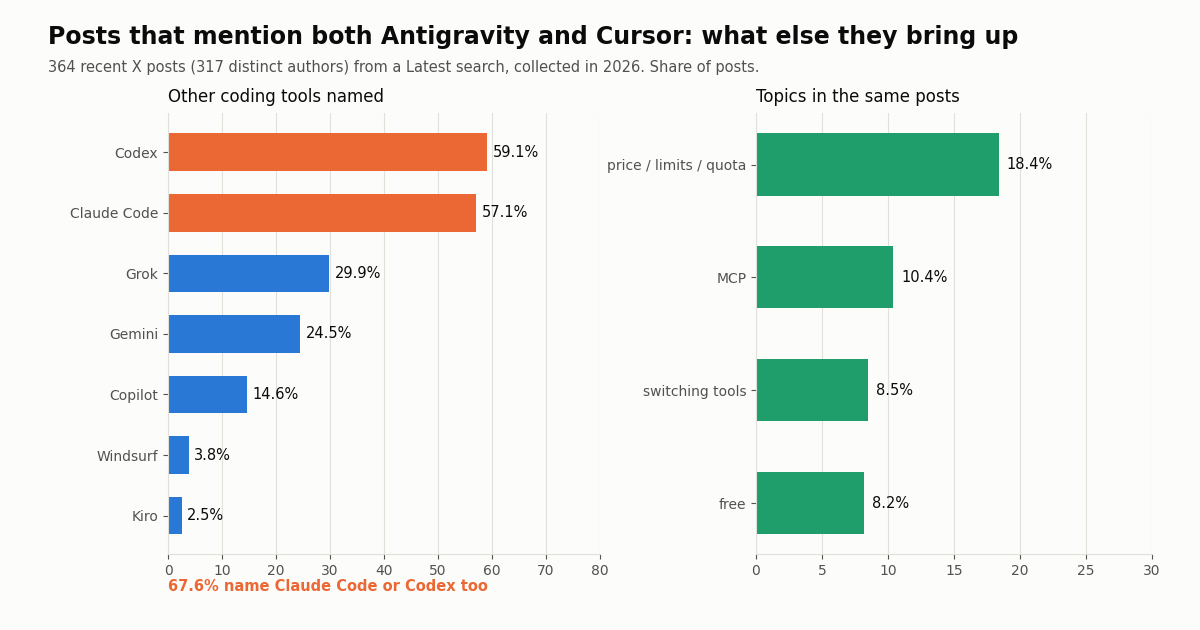
We searched X for recent posts containing both "antigravity" and "cursor" (Latest, reposts excluded) and kept the 364 posts whose text names both tools. They came from 317 distinct authors over about 9 days, roughly 40 posts a day. The striking result is that the comparison is rarely two-way: 59.1% of the posts also mention Codex, 57.1% mention Claude Code, and 67.6% mention at least one of them.
Money and limits come up, MCP less so. 18.4% of the posts use price, plan, limit, quota, credit or usage terms, 10.4% mention MCP, 8.5% talk about switching, moving or canceling, and 8.2% say "free". The audience is international: 59.1% of the posts are in English, 19.0% in Chinese and 10.4% in Japanese. Engagement is modest (median 1.5 likes, median 168 views, 33.2% with zero likes), which is what you expect from working developers rather than launch posts.
How the official accounts differ on X
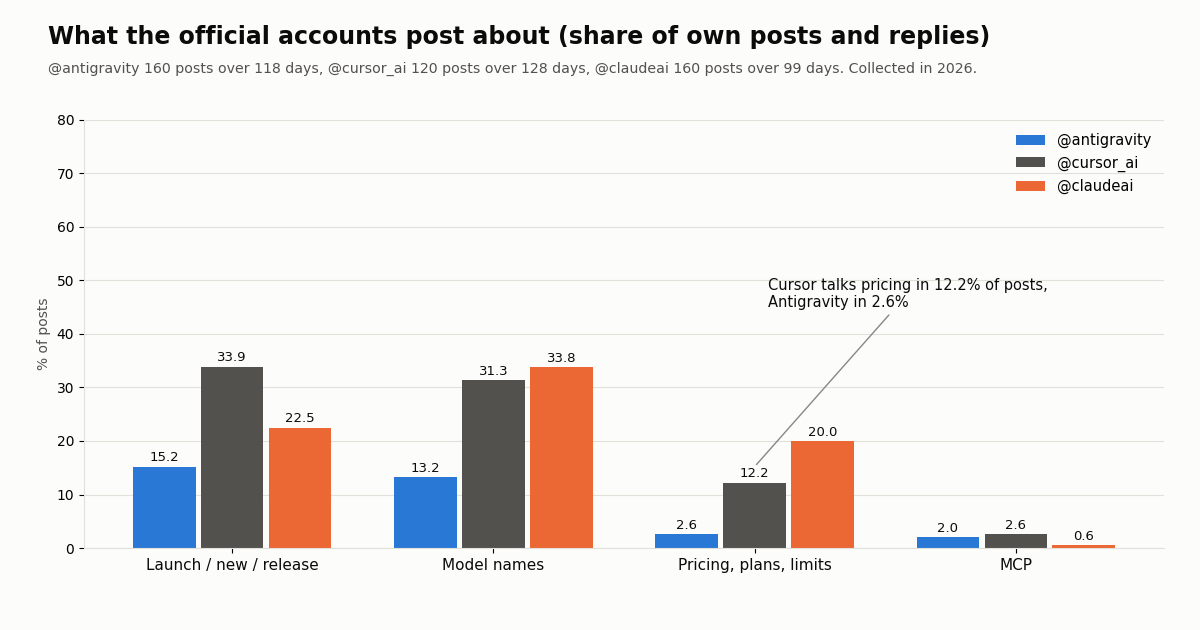
The official accounts tell you what each company wants you to notice. We pulled the most recent posts, replies included, from @antigravity, @cursor_ai and, for the third column, @claudeai. Cursor's account mentions pricing, plans or limits in 12.2% of its posts against 2.6% for Antigravity. Antigravity posts more often (1.35 a day vs 0.93) but spends most of that on conversation: 65.0% of its posts are replies and 21.2% are quotes.
Cursor's original posts get a median of 4,114 likes against 1,244 for Antigravity, on roughly 2.4x the followers. Per view, though, Antigravity's audience engages more: a median of 11.47 likes per 1,000 views vs 8.7 for Cursor and 5.56 for Claude. Video carries Antigravity's launches (59.6% of its original posts include video, against 37.0% for Cursor). MCP itself is a minor topic for all three accounts (2.0%, 2.6% and 0.6% of posts).
How we collected this, what it cost, and which one to pick
Question. What do the official Antigravity and Cursor accounts post about, and what else do developers bring up when they compare the two? Accounts and query. /twitter/user/last_tweets for @antigravity (160 posts over 118 days), @cursor_ai (120 over 128 days) and @claudeai (160 over 99 days), plus /twitter/tweet/advanced_search with antigravity cursor -filter:retweets (Latest, 400 posts returned, 364 naming both tools). Window. The most recent posts at collection time, in 2026. Method. Case-insensitive keyword matching on post text; topic shares count a post once per topic.
What the sample cannot show. Keyword matching misses sarcasm and posts that refer to a tool without naming it, the search covers about nine days only, and X posting is not the same as usage or market share. Engagement on official accounts reflects follower counts and paid promotion as much as product quality. Privacy. Aggregates only; the three named accounts are organization accounts, and search results were reduced to de-identified counts with no handles, ids or text kept.
Cost. The study took 46 requests and returned 840 tweets and 3 profiles, which costs about $0.13 on TwitterAPI.io (tweets at $0.15 per 1,000 returned, profiles at $0.18 per 1,000). The same reads on the official X API pay-per-use rate card at docs.x.com/x-api/getting-started/pricing ($0.005 per post read, $0.010 per user read) come to about $4.23, roughly 33x more per 1,000 tweets. Write actions (post, reply, like, DM) are also available through an authenticated session: a /twitter/user_login_v2 login ($0.10, using a proxy you supply) and then 60 credits ($0.0006) per call such as /twitter/create_tweet_v2. Those calls act as that account, so X can rate-limit, lock or suspend it; keep a human pace, expect occasional re-login, and note every HTTP 200 call is billed.
Which one to pick. Choose Antigravity if you want a usable free tier, Gemini 4 Argon or Claude 5.5 inside a subscription quota, and Google Cloud billing for a team. Choose Cursor if you live in a VS Code-style editor, are happy with Grok and Composer in the pool, or already pay for The X Subscription. Choose Claude Code if Claude models in a terminal are the point. For live X data the decision does not matter: the same MCP block works in all three. Grab a key from the dashboard, read the endpoint reference at docs.twitterapi.io, and paste the server into whichever tool wins.
import os
import re
import requests

BASE = "https://api.twitterapi.io"
HEADERS = {"X-API-Key": os.environ["TWITTERAPI_IO_API_KEY"]}

TOOLS = {
    "Claude Code": r"claude\s*code",
    "Codex": r"codex",
    "Grok": r"grok",
    "Gemini": r"gemini",
    "Windsurf": r"windsurf",
}


def search_latest(query, max_pages=10):
    """Yield tweets from advanced_search, newest first, following next_cursor."""
    cursor = ""
    for _ in range(max_pages):
        params = {"query": query, "queryType": "Latest", "cursor": cursor}
        r = requests.get(f"{BASE}/twitter/tweet/advanced_search", headers=HEADERS, params=params, timeout=30)
        r.raise_for_status()
        body = r.json()
        for tweet in body.get("tweets", []):
            yield tweet
        if not body.get("has_next_page") or not body.get("next_cursor"):
            break
        cursor = body["next_cursor"]


def main():
    tweets = [t for t in search_latest("antigravity cursor -filter:retweets")
              if re.search("antigravity", t["text"], re.I) and re.search("cursor", t["text"], re.I)]
    print(f"{len(tweets)} posts mention both Antigravity and Cursor")
    if not tweets:
        return
    for name, rx in TOOLS.items():
        hits = sum(1 for t in tweets if re.search(rx, t["text"], re.I))
        print(f"  also mention {name:<12} {100 * hits / len(tweets):5.1f}%")
    top = sorted(tweets, key=lambda t: t.get("likeCount", 0), reverse=True)[:5]
    for t in top:
        print(t["createdAt"], t.get("likeCount", 0), "likes", t["url"])
    # Cost: 15 credits per tweet returned = $0.15 per 1,000 tweets.
    print(f"approx cost: ${len(tweets) * 0.00015:.4f} for the tweets kept")


if __name__ == "__main__":
    main()
Questions readers ask
Is Google Antigravity free?
Yes, for individuals. Antigravity's pricing page lists a $0 plan with access to several agent models, unlimited Tab completions, unlimited Command requests and basic weekly rate limits. The plans page describes it as a meaningful quota refreshed weekly. Google AI Pro and Ultra raise the limits, refresh them every five hours, and unlock models such as Gemini 4 Argon and Claude Opus 5.5.
How much does Cursor cost now?
Cursor's docs list Free ($0, limited), Plus $8 a month (Grok and Composer models only), Premium $30, Super $100 and Ultra $200, sold as part of The X Subscription after Cursor joined SpaceX on August 14, 2026. Third-party models such as Claude, GPT and Gemini are billed at API list price from prepaid credit on Premium and above. Teams seats cost $30, $100 or $200 per seat a month.
Where is the MCP config file in Antigravity?
Globally at ~/.gemini/config/mcp_config.json, or per workspace at <workspace>/.agents/mcp_config.json. In the IDE you reach it from the ... menu in the agent side panel: MCP Servers, Manage MCP Servers, View raw config. Remote servers use the serverUrl field (with url accepted as an alias) and a headers object for API keys.
Can I use the same MCP server in Antigravity and Cursor?
Yes. Both read an mcpServers JSON map and both support remote Streamable HTTP servers with custom headers. The TwitterAPI.io server at https://mcp.twitterapi.io/mcp needs only an Authorization: Bearer header with your API key; in Antigravity the URL goes in serverUrl, in Cursor in url.
Does Antigravity have Claude models?
Its models page lists Claude Sonnet 5.5 and Claude Opus 5.5 (thinking) on Google AI Ultra and on non-trial Google AI Pro subscriptions. Claude Sonnet 4.6 and Opus 4.6, previously on the free tier, are marked for removal on November 2, 2026. Antigravity does not support bring-your-own-key.
Antigravity vs Cursor vs Claude Code: which is best for working with Twitter (X) data?
None has built-in X data; all three reach it through an MCP server or code. The same TwitterAPI.io server works in each, so pick the editor on plans and models, then add one MCP block. Tweets cost $0.15 per 1,000 returned, against $0.005 per post read ($5 per 1,000) on the official X API pay-per-use rate card, and reads need no X account.
Can Antigravity or Cursor post to X for me?
Not through the hosted MCP server, which exposes read tools. Posting goes through TwitterAPI.io's write endpoints such as /twitter/create_tweet_v2 after a /twitter/user_login_v2 login ($0.10, with a proxy you supply), at 60 credits ($0.0006) per call. Each call acts as that account, so X can rate-limit, lock or suspend it; keep a human pace and expect occasional re-login.
Continue
- Google Antigravity docs: Model Context Protocol (config paths, serverUrl, headers, timeouts)
- Google Antigravity docs: Plans and rate limits
- Google Antigravity docs: Choose a model
- Cursor docs: Model Context Protocol (mcp.json locations and fields)
- Cursor docs: Models and pricing
- X API pricing (official pay-per-use rate card)
- Twitter (X) API hub: endpoints, pricing and guides
- Cursor vs Claude Code: plans, MCP and headless runs
- How to use Cursor with the Twitter API (MCP setup guide)
- Codex vs Claude Code compared
- Claude Code alternatives with MCP support
- TwitterAPI.io hosted Twitter MCP server
- What an MCP server is and how the Twitter one works
- Get a TwitterAPI.io API key in the dashboard
- 01Google AI Studio Free Tier Limits: What the Gemini API Allows in 2026
- 02Best Claude Model for Coding in 2026: Opus vs Sonnet vs Haiku vs Fable, Priced on Real Twitter (X) Data
- 03Zapier Alternatives in 2026: Prices, Self-Hosting and Which Ones Still Connect to Twitter (X)
- 04Claude Code Alternatives: Seven Coding Agents Checked for License, Free Use and MCP (Twitter/X Data Included)
- 05OpenCode vs Claude Code: config, plugins, models and one Twitter (X) MCP server in both
- 06How to Use Cursor with the Twitter (X) API
- 07Cursor vs Claude Code: Plans, MCP Setup and Headless Runs Compared for Twitter (X) Data Work
- 08Usernames for Twitter (X): The Rules, 48 Ideas, and How to Check Availability in 2026
Stop reading. Start building.
Starter credits cover real testing on real data. Google sign-in, no card, no application queue.
Get an API keyAlready building with TwitterAPI.io? Publish an honest tutorial or build log about it and earn up to $200 a month in API credits.