RapidAPI Pricing in 2026: How Plans, Overages and the 25% Fee Work, and What Twitter (X) APIs Cost There
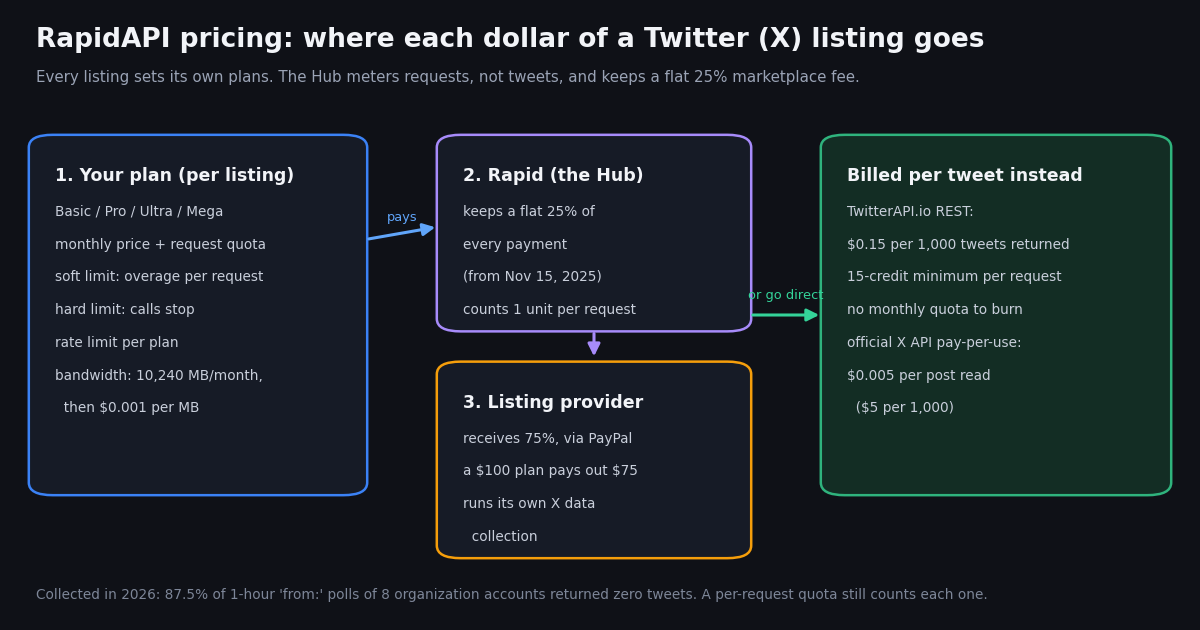
- Every listing prices itself. Up to four public plans per API (Basic, Pro, Ultra, Mega), each a monthly price plus a request quota; Basic defaults to $0. You subscribe per API, and usage is counted account-wide across your apps.
- Soft vs hard limits. A soft limit bills an overage per extra request; a hard limit stops your calls until the quota resets. Rapid emails you at 85% and 100% of quota.
- One request = one unit, except 5xx errors. Empty results, 4xx errors and partial pages all count. Providers can also charge several units per call with the
X-RapidAPI-Billingheader. - 25% marketplace fee on every payment through the Hub since November 15, 2025 (it was 20%), paid out to providers via PayPal only. A $100 plan pays the provider $75.
- Twitter listings, collected in 2026: four live listings charge $0 to $490/month for 75 to 10,000,000 requests, with rate limits from 5 requests per minute to 20 per second, and a bandwidth fee above 10,240 MB/month.
- Our study: 87.5% of 1-hour
from:polls of 8 organization accounts returned zero tweets. On a per-request quota each still costs a unit; on TwitterAPI.io's per-tweet rate a month of 5-minute polling has a floor of $1.30.
People search "rapidapi pricing" for two reasons. Developers who found an API on the RapidAPI Hub want to know what Basic, Pro, Ultra and Mega mean, what happens when they pass the quota, and why a free plan asks for a card. Providers who list an API want to know how much of each payment they keep. Both answers sit in Rapid's documentation and on each listing's pricing tab, not on one price sheet, because Rapid is a marketplace where every provider sets its own plans.
This page explains the RapidAPI pricing model end to end from Rapid's own documentation, then answers the question most of our readers bring with them: what do Twitter (X) APIs listed on RapidAPI actually cost, and how does a per-request quota compare with paying per tweet returned. We read the pricing tabs of four live Twitter listings and measured, on 62 real X requests collected in 2026, how many tweets a request actually returns. The angle here is the pricing model; if you have already decided to move a RapidAPI Twitter integration, the step-by-step migration guide linked below covers the code change, and this page does not repeat it.
A note on names: RapidAPI now operates under the name Rapid. Nokia announced on 13 November 2024 that it had acquired Rapid's technology assets, including the API Hub, and its R&D unit; the Hub at rapidapi.com still runs, and the listing pages now carry Nokia's cookie and privacy notices.
87.5% (7 of 8, collected in 2026). On a RapidAPI per-request quota each empty poll costs a full unit; a month of 5-minute checks has a $1.30 floor at $0.15 per 1,000 tweets returned.
How RapidAPI pricing works: plans are set per API, not by Rapid
The first thing to understand about RapidAPI pricing is that Rapid does not sell API calls itself. It runs the Hub, the gateway, the key and the billing, and each provider decides what its API costs. Rapid's provider documentation (docs.rapidapi.com/docs/hub-listing-monetize-tab) describes the levers every provider has, and they explain every price you will see on a listing:
Up to four public plans. A provider can publish four public plans, named BASIC, PRO, ULTRA and MEGA, plus any number of private plans offered to specific customers. The default BASIC plan has a subscription price of $0, and Rapid subscribes you to it automatically when you use Test Endpoint on a listing.
Three plan types. A Monthly Subscription plan charges a recurring fee. A Pay per Use plan has no monthly fee and bills only what you use. A Tiers plan sets volume-based prices with either flat-tier or graduated-tier pricing, where the last tier has no upper bound.
Quota objects. Every plan has a default Requests quota. Providers can add up to four custom quotas (Rapid's examples: videos, messages, downloads, items returned) and tie each to specific endpoints, so one plan can allow 100,000 calls overall but only 1,000 to an expensive endpoint.
Rate limits. Each plan sets its own rate limit per second, minute or hour. Exceeding it returns HTTP 429 Too Many Requests.
A free-usage ceiling. On rapidapi.com, free plan usage is capped at one million requests a month (the Enterprise Hub has no such cap).
So when someone asks "how much does RapidAPI cost", the honest answer is: the Hub itself is free to join and browse, and the cost is whatever the plans of the specific APIs you subscribe to say. Two listings that look alike can differ by more than ten times in price for the same quota, as the Twitter table further down shows.
Basic, Pro, Ultra, Mega: what the plan names actually mean
The four plan names are conventions, not fixed tiers. Rapid's older pricing guide (docs.rapidapi.com/docs/api-pricing) gives an example ladder of Basic free, Pro $25, Ultra $75 and Mega $150, and recommends that providers keep a free plan so developers can test, but nothing forces a provider to follow it. One Twitter listing we read charges $1/month for Basic; another stops at $125 for Mega; a third goes to $490.
The same guide groups APIs into four pricing models, and the model decides whether you need a card:
That card requirement is the most common surprise. A freemium API's Basic plan costs nothing, but because you could pass its quota on a soft-limit plan, Rapid wants a card on file before you subscribe. The pricing tab on every listing also carries a short FAQ ("Why do you require a credit card for a freemium API?", "What if I exceed my plan limits?") that points to the same rule.
Plans are also versioned. When a provider edits a plan, new subscribers see the new version immediately, while existing subscribers stay on the version they bought. When a provider disables a plan, it disappears from the listing but current subscribers keep it. That protects you from silent price changes, but it also means a price you read on a listing today is not necessarily the price an older subscriber pays.
Quotas, overages and hard limits: what you are billed for
RapidAPI bills per unit of quota, and by default one request is one unit. Rapid's documentation is specific about the exception: if the API answers with an error code of 500 or higher, the request does not count. Everything else does, including HTTP 200 responses with an empty result list and 4xx errors such as a bad parameter. That detail matters more than any plan price for workloads like monitoring, where most checks find nothing new.
Soft limit. You keep calling past the quota and pay the overage fee for each extra request. Rapid requires a soft-limit plan to carry a non-zero overage fee, and its older guide advises providers to keep overages at $1 or less per call for most APIs. Overage fees are not refunded unless the provider explicitly agrees.
Hard limit. Calls stop at the quota until the period resets. You cannot run up an overage bill, but your integration goes dark mid-month if you misjudge volume.
Weighted calls. A provider can make one call count as several units by returning the X-RapidAPI-Billing response header, for example X-RapidAPI-Billing: Messages=10. Rapid recommends that providers say so in the plan description, so read each object's description on the pricing tab before you estimate volume.
Account-wide usage. Each app in your RapidAPI account gets its own X-RapidAPI-Key, but Rapid's key documentation warns that pricing is based on account-wide usage: two projects calling the same API share one quota and one overage bill.
Alerts and billing. Rapid emails you at 85% and 100% of quota. Your card is charged when you first subscribe, at each monthly renewal, and when an overage occurs. Invoices under 50 US cents are not charged immediately; they accumulate on your balance until it passes 50 cents. Transaction history, invoices and quota usage live under the Billing pages of the developer dashboard.
The 25% marketplace fee and how providers get paid
If you are on the other side of the Hub, the number you want is the marketplace fee. Rapid's payouts page (docs.rapidapi.com/docs/payouts-and-finance) states it plainly: "Rapid takes a flat 25% marketplace fee on all payments made through the API Hub." Its own example: price a plan at $100 and you receive $75. The fee is described as covering payment processing, site infrastructure and administrative costs, and the same page says it does not cover the fees of payouts processed through PayPal.
The 25% rate is recent. The same page carries a notice that, starting November 15, 2025, transaction fees were updated "to cover processing costs that the platform has been absorbing until now". Rapid's older v2.0 documentation describes a flat 20% fee, which is why third-party write-ups still quote both numbers.
PayPal only. Rapid currently pays providers only via PayPal, and only after it receives final settlement from the subscriber's card issuer. Payments are processed at the end of the following month.
Refunds and chargebacks are offset against your future payouts.
For a buyer, the fee is invisible but not irrelevant: every dollar you spend on a RapidAPI listing passes a quarter to the marketplace before it reaches whoever runs the data collection. When you compare a listing with a provider that bills you directly, you are comparing two different cost structures, not just two price tags.
What Twitter (X) APIs on RapidAPI cost: four live listings
We opened the pricing tabs of four Twitter listings that are live on the Hub and recorded each plan exactly as shown. A fifth listing path we checked, twitter154, now returns "API not found". We did not call any listing, so the table shows list prices only; it does not tell you how many tweets each request returns, how fresh the data is, or how often a listing is available.
Prices are per month and quotas are requests per month, as each pricing tab shows them; "+$0.0001" is the overage per extra request on a soft-limit plan, "hard" means calls stop at the quota.
Rate limits vary widely. Twitter AIO allows 5 requests per minute on Basic and 3, 10 and 20 requests per second on Pro, Ultra and Mega. Twitter Data allows 5 per second on every plan. Twttr API allows 5 per second on Basic and 10 on paid plans. Twitter API (twitter-api45) shows 1,000 requests per hour on Basic and no limit listed on paid plans.
The bandwidth platform fee. Every one of the four pricing tabs lists a "Bandwidth Platform Fee" of 10,240 MB a month included, then $0.001 per 1 MB. Twitter responses are not small: the 20-tweet search pages we collected had a median JSON size of 100.9 KB. If a listing's responses were that size, 1,000,000 requests would move about 98,535 MB and add roughly $88.30 to the bill, and 2,000,000 requests about $186.83. We cannot measure a listing's own payload size without calling it, so treat those figures as an illustration of how the fee scales, not as a quote.
Support is part of the plan. Twitter AIO, for example, states there is no support on Basic, a 72-hour response on Pro, 48 hours on Ultra and under 24 hours on Mega.
Per request vs per tweet: what a quota unit buys on X (our study)
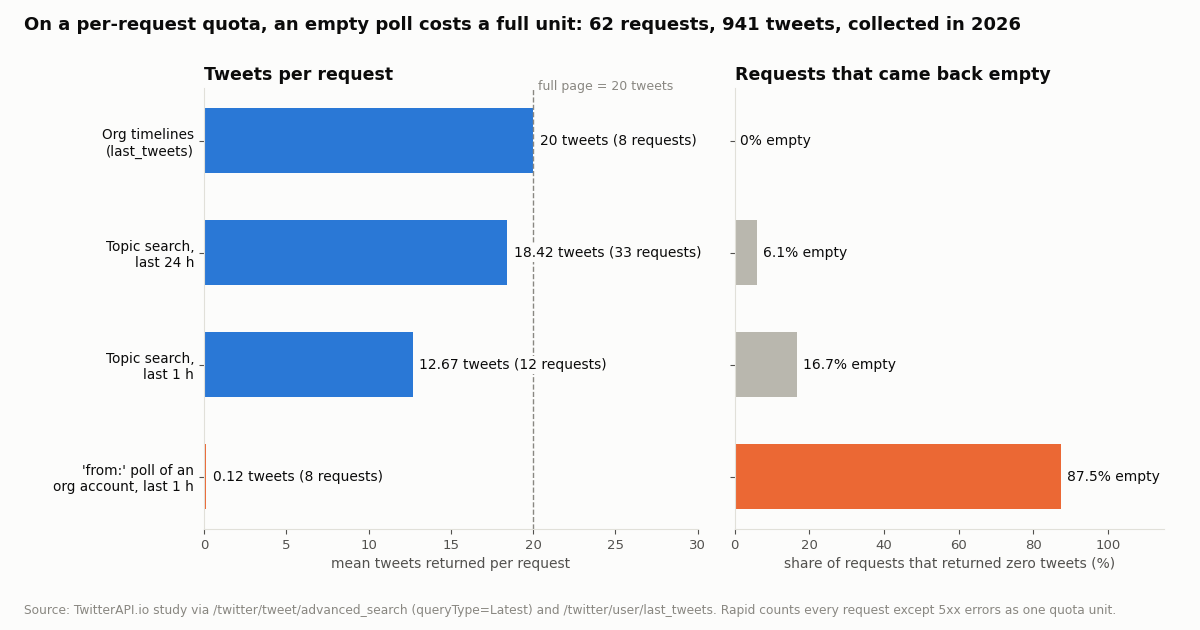
A per-request price only becomes a per-tweet price once you know how many tweets each request returns. On TwitterAPI.io's search and timeline endpoints a page holds at most 20 tweets, but real requests often return fewer, and a monitoring poll usually returns none. We measured this on those endpoints: 62 requests, 941 tweets, collected in 2026, across four realistic workloads.
Timelines and day-wide searches come close to the full 20 tweets per request, so a per-request quota converts cleanly into tweets there. Hour-wide searches already drop to 12.67 tweets per request on average, and monitoring polls of organization accounts (the classic "alert me when @account posts" job) came back empty 7 times out of 8. Across all 61 response pages, 42 were full, 3 held 10 to 19 tweets, 5 held 1 to 9, and 11 were empty.
On a RapidAPI plan, every one of those 61 pages is one quota unit. On a per-tweet rate card, the empty ones cost only the minimum. The whole study cost $0.1428 on TwitterAPI.io's rate: 15 credits per tweet returned, with a 15-credit minimum when a request returns nothing.
Even "rapidapi" itself is a quiet topic on X: the 20 most recent posts mentioning it spanned 20.7 days, and a 24-hour search found none. A per-request plan bought to track mentions like that would spend nearly all of its quota on empty answers.
When paying per tweet costs less than a RapidAPI plan
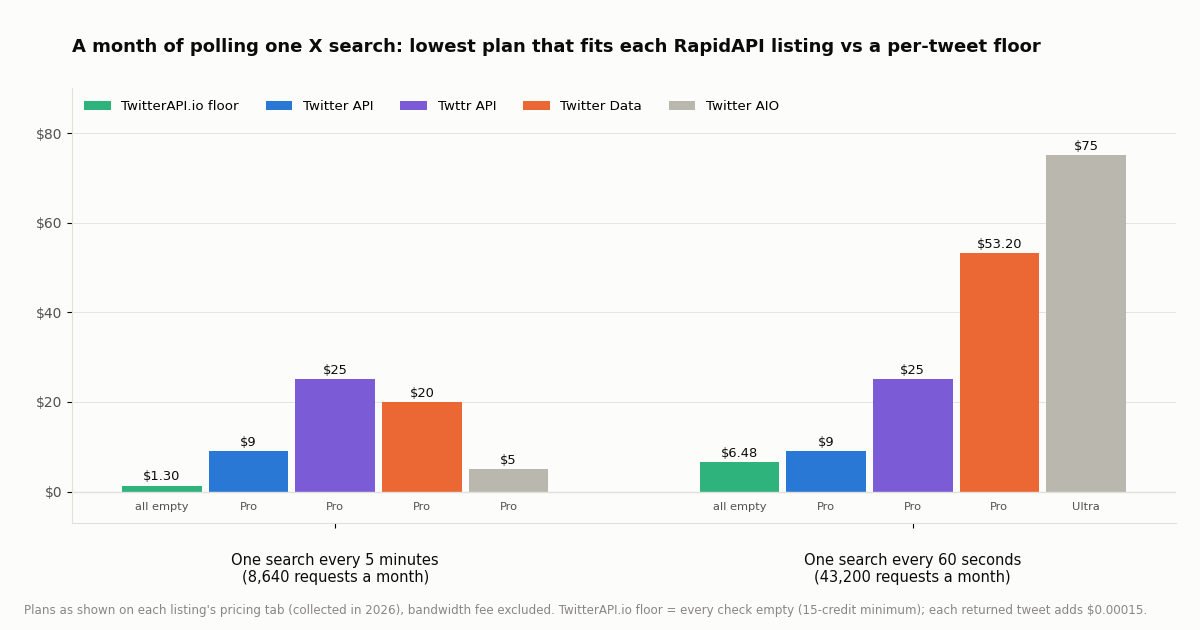
Put the study and the listing prices together and two scenarios stand out where a per-tweet rate card costs less than any of the four Twitter listings' fitting plans.
Polling and monitoring. Checking one search every 5 minutes for a month is 8,640 requests; every 60 seconds is 43,200. On a RapidAPI listing that is 8,640 or 43,200 quota units whatever comes back, which needs at least a paid plan on every listing we read. On TwitterAPI.io, a check that finds nothing costs the 15-credit minimum, so a month of empty 5-minute checks has a floor of $1.30 and a month of 60-second checks $6.48, plus $0.00015 for each tweet that does come back.
Low and uneven monthly volume. A plan fee is owed whether or not you use the quota. At $0.15 per 1,000 tweets returned, the same money buys a fixed number of tweets: $5 buys 33,333, $9 buys 60,000, $20 buys 133,333 and $25 buys 166,667. If your project needs fewer tweets than that in a month, or needs them in bursts, paying per tweet costs less than the corresponding plan. Prepaid credits never expire, so a quiet month carries no wasted quota.
A neutral note for heavy, steady use. If every request returns a full page and you use nearly all of a paid quota every month, compare the listing's plan against your own measured volume before you choose. List prices do not show how many tweets each request of a listing returns, whether the bandwidth fee applies to its payloads, what happens at a hard limit, or the rate limit you will run at, so test those on the listing's free plan first.
Against the official X API, the comparison is simpler. X's pay-per-usage rate card (docs.x.com/x-api/getting-started/pricing) charges $0.005 per post read, $5 per 1,000 posts, capped at 3 million post reads a month before Enterprise. TwitterAPI.io charges $0.15 per 1,000 tweets returned, about 33 times less per 1,000 tweets.
The X-RapidAPI-Key header and switching to a direct key
The variant query "x rapidapi key" is about authentication. Every RapidAPI call carries your app's key in the X-RapidAPI-Key request header; Rapid generates one key per app in your developer dashboard, and you can add, rotate or delete keys from the app's Authorization page without losing analytics. Rotate immediately if a key ends up in a public repository, because usage on that key is billed to your account.
A provider you pay directly uses its own key instead. On TwitterAPI.io that is a single X-API-Key header against https://api.twitterapi.io, with no X account needed for reads. Requests return up to 20 tweets per page with has_next_page and next_cursor for pagination, and errors carry their text in msg. Only the header, host and response field names change in your client; the snippet below shows the shape of the switch, and the migration guide linked at the end walks through it endpoint by endpoint.
Rate limits differ too. On TwitterAPI.io the limit is 0.2 requests per second before the first payment, 20 once paid, 50 on the Scale subscription and 500 on Business, and up to 1,000 on request. New accounts that pass the automatic bot check get up to $1 of free credits (at most 100,000 credits, no card, one per person or network, expiring after 31 days); purchased credits never expire.
import os
import requests

# Before: a RapidAPI listing (host and path depend on the listing you subscribed to)
# requests.get("https://<listing-host>/search",
#              headers={"X-RapidAPI-Key": os.environ["RAPIDAPI_KEY"]},
#              params={"query": "from:NASA"})

# After: TwitterAPI.io, one header, billed per tweet returned
BASE = "https://api.twitterapi.io"
r = requests.get(
    f"{BASE}/twitter/tweet/advanced_search",
    headers={"X-API-Key": os.environ["TWITTERAPI_IO_API_KEY"]},
    params={"query": "from:NASA", "queryType": "Latest"},
    timeout=30,
)
body = r.json()
for t in body.get("tweets", []):
    print(t["createdAt"], t["likeCount"], t["url"])
print("more pages:", body.get("has_next_page"), body.get("next_cursor"))How we collected this
Question. RapidAPI Twitter listings bill per request; a per-result rate card bills per tweet returned. How many tweets does a real X request return, how often is it empty, and what does that do to the comparison?
Listing prices. We read the pricing tabs of four live Twitter listings on the RapidAPI Hub (Twitter API twitter-api45, Twttr API twitter241, Twitter Data twitter-data1, Twitter AIO twitter-aio) and Rapid's provider and consumer documentation, collected in 2026. We did not subscribe to or call any listing.
Requests and window. 62 read requests on TwitterAPI.io: /twitter/tweet/advanced_search with queryType=Latest for 12 developer-topic queries over the last hour (1 page each) and the last 24 hours (up to 3 pages each); 1-hour from: polls of 8 organization accounts (OpenAI, Vercel, GitHub, NASA, NVIDIA, Docker, Stripe, Hugging Face); and /twitter/user/last_tweets for 4 organization accounts (2 pages each); plus one page of the most recent posts mentioning "rapidapi". Total: 941 tweets, collected in 2026.
What the sample cannot show. It measures X's page sizes and how often requests come back empty for these queries at one point in time; quieter or busier queries will differ. It cannot show how many tweets a RapidAPI listing returns per request, how fresh its data is, or its payload size, so the bandwidth figures are an illustration.
Privacy. We kept counts only. Topic-search pages, which contain private individuals, stayed out of the repository; only per-page tweet counts were kept. No individual account is named or profiled.
"""poll_cost.py - price your own X polling job per request vs per tweet.

Runs N checks of one search with since_time, counts tweets returned per check,
then prints the bill on a per-request plan you enter and on a per-tweet rate.

    pip install requests
    export TWITTERAPI_IO_API_KEY=...
    python poll_cost.py "from:NASA OR from:SpaceX" 12 300
"""
import os
import sys
import time

import requests

BASE = "https://api.twitterapi.io"
KEY = os.environ["TWITTERAPI_IO_API_KEY"]
PER_TWEET = 0.00015   # $0.15 per 1,000 tweets returned (15 credits per tweet)
MIN_CALL = 0.00015    # 15-credit minimum when a request returns nothing

# Enter the RapidAPI plan you are comparing (price per month, requests per month)
PLAN_PRICE = 9.0
PLAN_QUOTA = 100_000


def check(query, since_time, max_pages=3):
    """Return (requests made, tweets returned) for one check."""
    calls, tweets, cursor = 0, 0, None
    for _ in range(max_pages):
        params = {"query": f"{query} since_time:{since_time}", "queryType": "Latest"}
        if cursor:
            params["cursor"] = cursor
        r = requests.get(f"{BASE}/twitter/tweet/advanced_search",
                         headers={"X-API-Key": KEY}, params=params, timeout=30)
        if r.status_code == 429:
            time.sleep(5)
            continue
        r.raise_for_status()
        body = r.json()
        calls += 1
        tweets += len(body.get("tweets") or [])
        if not body.get("has_next_page") or not body.get("next_cursor"):
            break
        cursor = body["next_cursor"]
    return calls, tweets


def main():
    query = sys.argv[1]
    checks = int(sys.argv[2]) if len(sys.argv) > 2 else 12
    interval = int(sys.argv[3]) if len(sys.argv) > 3 else 300
    since = int(time.time()) - interval
    per_check = []
    for i in range(checks):
        start = int(time.time())
        calls, n = check(query, since)
        per_check.append((calls, n))
        print(f"check {i + 1}: {calls} request(s), {n} tweet(s)")
        since = start
        if i < checks - 1:
            time.sleep(interval)

    reqs = sum(c for c, _ in per_check)
    tweets = sum(n for _, n in per_check)
    empty = sum(1 for _, n in per_check if n == 0)
    per_tweet_bill = sum(max(MIN_CALL, n * PER_TWEET) for _, n in per_check)
    month_factor = (30 * 86400 / interval) / checks
    month_requests = reqs * month_factor
    print(f"\n{checks} checks: {reqs} requests, {tweets} tweets, {empty} empty")
    print(f"per-tweet rate, projected month: ${per_tweet_bill * month_factor:,.2f}")
    print(f"per-request plan: {month_requests:,.0f} of {PLAN_QUOTA:,} requests -> "
          f"${PLAN_PRICE:,.2f} if within quota")


if __name__ == "__main__":
    main()
Researching this?Free starter credits cover end-to-end testing — Google sign-in, no card. Get a key.
Questions readers ask
Is RapidAPI free?
Joining the Hub and browsing is free, and many listings have a $0 Basic plan; on rapidapi.com free plan usage is capped at one million requests a month. But most APIs are freemium or paid, a freemium API asks for a credit card even for its free plan, and passing a soft-limit quota bills overage per request. The cost depends entirely on the plans of the APIs you subscribe to.
What do Basic, Pro, Ultra and Mega mean on RapidAPI?
They are the four public plan slots each provider can fill. Each is a monthly price plus a request quota, a rate limit and either a soft limit (overage per extra request) or a hard limit (calls stop at the quota). Basic defaults to $0. The prices are set per API, so a Pro plan on one listing can cost $5/month and on another $25/month.
How much is the RapidAPI marketplace fee?
Rapid takes a flat 25% marketplace fee on all payments made through the API Hub, effective November 15, 2025; older documentation shows 20%. A $100 plan pays the provider $75. The fee does not cover PayPal payout fees, and PayPal is the only payout method.
Does RapidAPI charge for failed or empty requests?
By default every request counts as one quota unit except responses with an error code of 500 or higher. A 200 response with an empty result and a 4xx error both count. In our study, 87.5% of 1-hour from: polls of organization accounts returned no tweets, and each would still use a unit.
What happens when I go over my RapidAPI quota?
On a soft-limit plan you keep calling and pay the overage fee for each extra request, billed to your card when it occurs; overages are not refunded unless the provider agrees. On a hard-limit plan your calls stop until the quota resets. Rapid emails you at 85% and 100% of quota.
What is the X-RapidAPI-Key?
It is the request header that carries your RapidAPI app key. Rapid creates one key per app in your developer dashboard and lets you rotate it from the app's Authorization page. Usage is billed account-wide, so every app and key on your account draws from the same subscription quota.
How much does a Twitter API on RapidAPI cost?
The four live listings we read, collected in 2026, range from $0 to $490/month: Twitter API (twitter-api45) $0 to $490, Twttr API (twitter241) $1 to $150, Twitter Data (twitter-data1) $0 to $300 and Twitter AIO (twitter-aio) $0 to $125, for quotas from 75 to 10,000,000 requests, plus a bandwidth fee above 10,240 MB a month. All bill per request, not per tweet.
Is RapidAPI still run by RapidAPI?
The company now operates as Rapid, and Nokia announced on 13 November 2024 that it had acquired Rapid's technology assets, including the API Hub, and its R&D unit. The Hub at rapidapi.com still operates, and listing pages carry Nokia's cookie and privacy notices.
Continue
- X API pricing: pay-per-usage, $0.005 per post read, 3M post reads monthly cap
- TwitterAPI.io pricing: credits, per-tweet and per-profile rates, subscriptions
- TwitterAPI.io API reference: advanced_search (query, queryType, cursor, up to 20 tweets per page)
- TwitterAPI.io API reference: user last_tweets (timeline pages of 20)
- Nokia press release: Nokia acquires Rapid technology and R&D unit (13 November 2024)
- Twitter (X) advanced search operators reference (from:, since_time:)
- X (Twitter) API hub: endpoints, pricing and guides
- Migrating a RapidAPI Twitter integration to TwitterAPI.io
- Third-party Twitter APIs: how the options differ
- X API cost breakdown: the official rate card in detail
- Apify pricing: plans, compute units and X data costs
- X API key headers explained
- TwitterAPI.io pay-per-use pricing per tweet returned
- 01Pipedream Pricing in 2026: Connect Plans, Credits and the Workflows Shutdown
- 02Cloudflare Pay per Crawl: How the HTTP 402 Handshake Works, and What It Means for Twitter (X) Data
- 03ScrapingBee Pricing in 2026: Plans, Credit Costs and Alternatives
- 04Firecrawl Pricing: Plans, Credit Costs and What an X (Twitter) URL Costs
- 05LunarCrush API: What It Returns, What It Costs, and When Raw Twitter (X) Data Is the Better Input
- 06Lovable pricing in 2026: plans, credits, and what an app that pulls Twitter (X) data really costs
- 07Replit pricing in 2026: plans, credits, effort-based Agent costs, and what an app that reads Twitter (X) data really costs
- 08Apify Pricing in 2026: Plans, Compute Units and What Twitter (X) Data Really Costs
Writing about something you built with TwitterAPI.io? Our community rewards program pays API credits for honest tutorials, build logs and videos.
Stop reading. Start building.
Starter credits cover real testing on real data. Google sign-in, no card, no application queue.
Get an API keyAlready building with TwitterAPI.io? Publish an honest tutorial or build log about it and earn up to $200 a month in API credits.