Lovable pricing in 2026: plans, credits, and what an app that pulls Twitter (X) data really costs
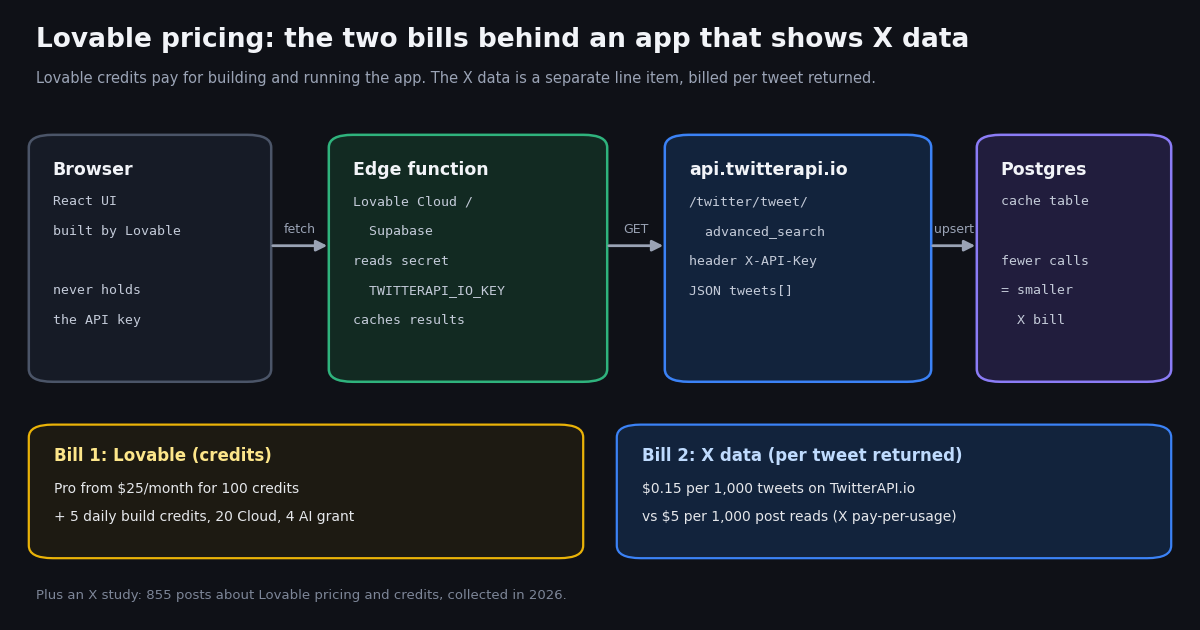
Lovable's pricing looks simple on the plan card and gets harder the moment you build something real. The credit you buy pays for prompts, chat, hosting and the AI features inside your app, a message's cost moves with how much work it does, and the plan card hides a dropdown of eleven credit tiers. This guide lays out every tier and rule from Lovable's own pricing page and docs, read for this article, and puts Bolt.new and v0 next to it as their vendors show them.
Then it does two things other Lovable pricing guides do not. It measures what 855 posts on X actually say about Lovable's credits and prices, and it prices the line item most Lovable builders forget: the data bill when your app shows live posts from X, with an edge function you can paste into a Lovable project today.
Lovable pricing at a glance: Free, Pro, Business, Enterprise
Lovable sells four plans: Free, Pro, Business and Enterprise. Pro and Business are not single prices; each comes in credit tiers from 100 to 10,000 credits a month, and you pick the tier from a dropdown on the plan card. Lovable's docs state prices in USD and say annual billing "gives you two months free compared with paying monthly".
One honest caveat about the source. When we loaded lovable.dev/pricing for this article, the plan cards are drawn by JavaScript and did not appear in the page's server HTML; the FAQ did. The tier prices below are copied from Lovable's own Subscription plans page in the docs (docs.lovable.dev/introduction/subscription-plans), which publishes the full table for both paid plans.
Free is for trying the product: it includes Git sync, workspace-private projects, unlimited workspace members and custom connectors, but not code editing, code download, custom domains or removing the "Edit with Lovable" badge. Those four arrive with Pro. Business adds team governance: single sign-on, role-based access, design templates, personal projects inside a workspace, the Lovable API, a security center, and workspace data excluded from AI model training by default. Enterprise adds SCIM, audit logs, organizations across several workspaces, publishing controls and EU inference, with credit terms set by contract.
Lovable does not charge per seat. Its pricing FAQ says workspaces support unlimited members on every plan, and "plans are priced by the credits they include, not by seats". Five people on one Pro workspace share one credit pool; inviting more people changes how fast the pool empties, not the invoice.
Every Lovable Pro and Business credit tier, monthly and annual
This is the full tier table as Lovable's docs publish it. Pro and Business carry the same credit counts; Business costs twice as much per credit at most tiers because it bundles the governance features above. The annual column is the yearly charge with the equivalent monthly rate in brackets.
Two things fall out of the table. First, the price per credit drops at the top of the range on Pro: 100 credits cost $25 (25 cents each), 10,000 cost $2,250 (22.5 cents each). Second, Business annual pricing mirrors Pro annual pricing one tier up: Business 100 annual is $500, the same as Pro 200 annual.
Lovable's pricing FAQ also explains why Business credits cost more without making apps more expensive to run: "The cost for running their app and for AI features built into apps is the same for Business and Pro subscribers". Because a Business credit is worth more, the same hosting and AI usage shows up as fewer credits on a Business plan.
Students and teachers get 50% off the Pro plan with 100 credits a month, billed monthly, for up to 12 months, after verifying an academic email on lovable.dev/students while the workspace is on Free. The discount does not apply to higher tiers, annual billing or top-ups.
How Lovable credits are spent, topped up and run out
Since the move to one balance, a Lovable credit pays for four kinds of usage: building (Plan mode and Build mode messages), chatting with Lovable, hosting the app on Lovable Cloud, and AI features inside your deployed app. Usage-specific grants are spent first; general credits (your monthly plan credits, top-ups and referral bonuses) cover whatever is left.
Plan mode. 1 credit per message, plus the cost of any subagent research Lovable runs while planning. Plan mode never edits code, which makes it the predictable way to scope a change before paying for it.
Build mode. Usage-based: the cost depends on the complexity of the request and the work done. Lovable's illustrative examples are 0.50 credits to make a button gray, 0.90 to remove a footer, 1.20 to add authentication, and 2.00 for a landing page with generated images (the pricing page FAQ lists the same landing page at 1.70, so treat the figures as examples, not a rate card). Long Build messages pause at a check-in, 20 credits by default, adjustable from 20 to 100,000.
Chat. Messages in Chats and Chat mode, including Lovable in Slack and Telegram, follow their own per-message price and draw from a daily chat allowance first, then daily build credits, then general credits. Lovable's docs label this chat pricing model a temporary offering that "applies through October 31, 2026"; check the Credits and usage page for whatever replaces it.
Cloud. The built-in backend (database, auth, storage, edge functions, realtime) is metered by database server and storage, network, file storage, compute and realtime traffic. Each plan includes a 20-credit monthly Cloud grant; Lovable's FAQ says most small or new apps are "fully covered by the included grant".
AI gateway and connectors. AI features in your app are billed per model call (tokens, images, seconds of video or voice), from a 4-credit monthly AI grant first. Connectors that are "Managed by Lovable" (Perplexity, Firecrawl, Parallel) draw from a 1-credit monthly connector grant, then general credits.
Unused monthly plan credits roll over while the subscription stays active, but they still expire on the schedule above. Grants (daily chat, daily build, monthly Cloud, AI and connector) never roll over.
Top-ups and running out. Top-ups exist only on Pro and Business. Lovable's top-up page prices them at $15 per 50 credits ($0.30 per credit) on Pro and $30 per 50 credits ($0.60 per credit) on Business, the same on monthly and annual billing, in packs from 50 to 10,000 credits. Auto top-up buys credits when the balance falls below a threshold you set, up to an optional monthly limit, and pauses itself when you move from Pro to Business because the per-credit price changes.
Compare that with the tier table: Pro 200 costs $50 a month (25 cents a credit) while a 100-credit top-up on Pro 100 costs $30 (30 cents a credit). Lovable's own docs say so plainly: if you need more credits every month, a higher tier is usually better value than repeated top-ups.
Running out matters more once your app is live. Lovable's docs list what stops at zero: building stops, AI features in deployed apps fail with an error, and "apps that use the built-in backend (Cloud) pause". Published pages keep serving and Chat mode keeps working while the daily chat allowance lasts. A Build message that hits zero mid-run pauses rather than ending, with Add credits and Finish up options.
Credits are not refundable or redeemable for cash, per the pricing FAQ. If you cancel, you keep your credits until the end of the billing period, then drop to Free; unused paid credits reactivate if you resubscribe before they expire.
Lovable vs Bolt.new vs v0 pricing, as each vendor shows it
The three app builders meter different things, so a straight price comparison misleads. Lovable sells credits that move with task complexity; Bolt sells tokens; v0 sells dollar-denominated credits that pay for model tokens. Here is what each pricing page showed when we fetched it for this article (Bolt at bolt.new/pricing, v0 at v0.app/pricing), with billing periods written as the vendors write them.
Bolt.new. Free has a 300K-token daily limit and 1M tokens a month with Bolt branding; Pro removes the daily limit, starts at 10M tokens a month, and rolls unused tokens over to the next month. Bolt advertises "save up to 28%" with yearly billing; yearly prices were not in the page text we fetched.
v0. Plus and Business both include "$30 of included monthly credits per user" and "$2 of free daily credits on login per user"; Business lists $100/user/month. The Plus card's rendered text showed both a $30 and a $90 figure next to "/user/month" and we could not tell from the page text which is the current charge, so check the live card before you budget. v0 also publishes per-model token rates, from v0 Mini at $0.20 input and $1.20 output per 1M tokens to v0 Max Fast at $10 and $50; prices exclude VAT and GST.
If your app is a dashboard that also needs a backend, the line that matters most is not the entry price but what the backend costs once traffic arrives. Lovable bundles a Supabase-based backend metered from the same credit balance; the X study below shows Cloud, Supabase and hosting came up in 10.9% of Lovable pricing posts, more than outright price complaints.
For the coding-agent side of the same budget question (Claude Code, Cursor, Codex), we priced those plans separately and link them at the end rather than repeat them here.
What X says about Lovable pricing and credits
We pulled 899 recent posts from X that mention Lovable together with a pricing word (credits, pricing, plan, subscription, expensive, cost), kept the 855 posts dated after Lovable's launch under that name that carry a pricing term, and tagged each with transparent keyword rules. The posts come from 677 distinct accounts; 80.2% were written in 2026 and 64.8% tag the official @Lovable account.
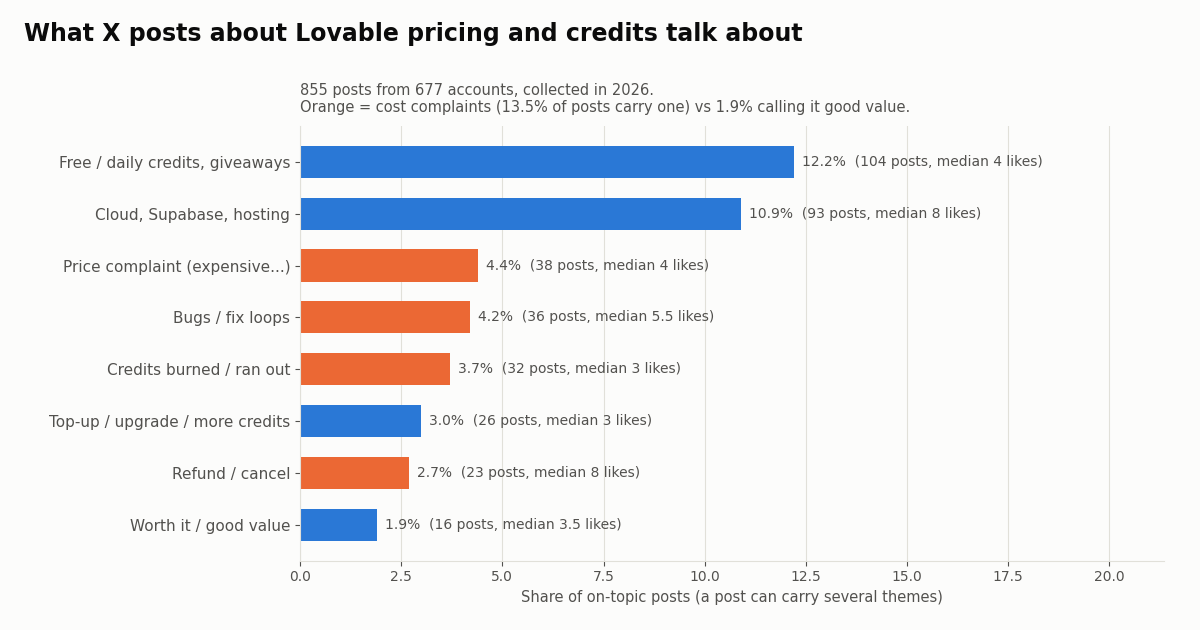
Free credits dominate the conversation. The largest theme, at 12.2%, is free and daily credits: event giveaways, promo days, partner credit programs, and people asking for credits. The official account feeds this: 5.0% of its last 200 posts mention something free, and its posts that touch credits, pricing or plans drew a median of 196 likes against 146.5 for all its posts.
Complaints outnumber praise about 7 to 1, but both are small. 13.5% of posts carry at least one cost complaint (price, burned credits, bug-fix loops, refunds), against 1.9% calling Lovable worth it or good value, a ratio of 7.2 to 1. Most posts (64.9%) match no theme at all: they mention a plan or a price in passing, announce a build, or reply to Lovable support.
Refund and cancel posts travel furthest. Only 23 posts mention refunds or canceling, yet their median view count (663) is the highest of any theme, ahead of price complaints (442.5) and Cloud posts (533). The posts about running out of credits are the quietest, with a median of 141.5 views: a common frustration, rarely amplified.
Fix loops are a recurring cost story. 4.2% of posts tie spending to bugs, errors or prompts that keep failing. That lines up with how Build mode bills: every fix attempt is a new usage-based message, so a loop of failed fixes costs credits each round. Plan mode, at a flat 1 credit per message plus any research, is the predictable way to diagnose before you build.
Which other builders people compare Lovable with
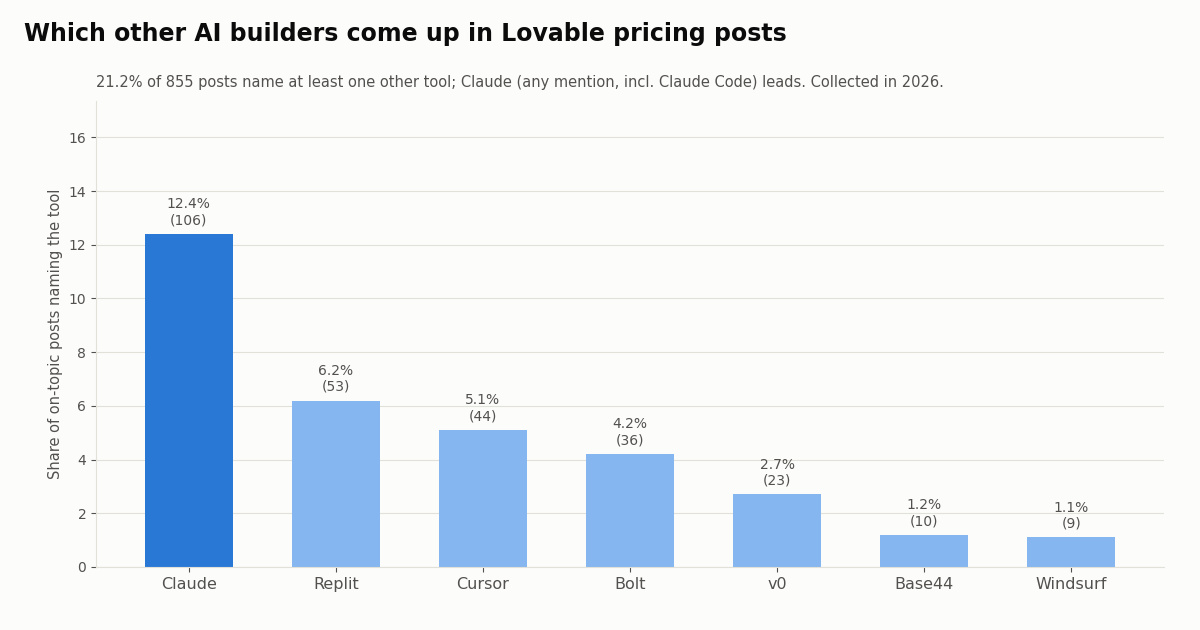
21.2% of the posts name at least one other AI builder or coding tool. Claude leads by a wide margin (12.4%, 106 posts; the rule counts any Claude mention, including Claude Code and Lovable's Anthropic co-hosted events), followed by Replit (6.2%), Cursor (5.1%), Bolt (4.2%) and v0 (2.7%). Base44 and Windsurf each appear in about 1% of posts.
The pattern in the posts is a stack, not a switch: people describe building the interface in Lovable and moving to a coding agent for the hard parts, or comparing a month of Lovable credits with a month of a coding-agent subscription. If you are weighing that split, the Claude Code and Cursor pricing pages linked below carry the plan tables.
Build a Lovable app that shows live X data (and keep the API key server-side)
A common Lovable project is a dashboard that shows posts from X: brand mentions, a competitor's launches, a hashtag wall. The one rule that matters is where the API key lives. Anything prefixed VITE_ in a Lovable project is a build-time, browser-exposed value, so an X data key placed there is readable by every visitor. Lovable's Secrets docs say secrets are encrypted, injected into Edge Functions at runtime, and "never reach the browser".
Step 1. Add the secret. In the project's Secrets panel (Lovable Cloud) or your Supabase project's Edge Functions settings, add TWITTERAPI_IO_KEY with your key from the TwitterAPI.io dashboard. Reads need no X account and no X developer app.
Step 2. Ask Lovable for an edge function, or paste the one below. It calls /twitter/tweet/advanced_search with the X-API-Key header, returns tweets[] plus has_next_page and next_cursor, and only accepts feed names from a server-side allow-list. That allow-list is the cost control: a public function that forwards any query lets anyone spend your data credits.
Step 3. Call it from the UI with supabase.functions.invoke("x-feed") (second snippet below), render text, author and createdAt, and use next_cursor for a Load more button.
Step 4. Cache. Write each page of results to a table and serve the dashboard from the table, refreshing on a schedule (Lovable's Jobs feature or a cron in Supabase). Ten visitors then cost one API call, not ten. The cache also uses Cloud database credits, which the 20-credit monthly Cloud grant is designed to absorb for small apps.
If you would rather let an AI agent query X directly instead of writing a function, our hosted MCP server at mcp.twitterapi.io/mcp takes the same API key as a Bearer token; the MCP guide linked below has the setup for Claude Code, Cursor and other clients.
// supabase/functions/x-feed/index.ts  (Lovable Cloud or your own Supabase project)
// Secret TWITTERAPI_IO_KEY is added in Lovable's Secrets panel; it never reaches the browser.
const CORS = {
  "Access-Control-Allow-Origin": "*",
  "Access-Control-Allow-Headers": "authorization, x-client-info, apikey, content-type",
};

// Server-side allow-list: the browser picks a feed name, never a raw query,
// so nobody can spend your X data credits on searches you did not plan.
const FEEDS: Record<string, string> = {
  lovable: '(@Lovable OR "lovable credits" OR "lovable pricing") -filter:retweets',
  launches: 'from:Lovable -filter:replies',
};

Deno.serve(async (req) => {
  if (req.method === "OPTIONS") return new Response("ok", { headers: CORS });
  const { feed = "lovable", cursor = "" } = await req.json().catch(() => ({}));
  const query = FEEDS[feed];
  if (!query) return new Response(JSON.stringify({ error: "unknown feed" }), { status: 400, headers: CORS });

  const url = new URL("https://api.twitterapi.io/twitter/tweet/advanced_search");
  url.searchParams.set("query", query);
  url.searchParams.set("queryType", "Latest");
  if (cursor) url.searchParams.set("cursor", cursor);

  const r = await fetch(url, { headers: { "X-API-Key": Deno.env.get("TWITTERAPI_IO_KEY") ?? "" } });
  const body = await r.json();
  if (!r.ok || body.status === "error") {
    return new Response(JSON.stringify({ error: body.msg ?? body.detail ?? r.status }), { status: 502, headers: CORS });
  }
  const tweets = (body.tweets ?? []).map((t: any) => ({
    id: t.id,
    url: t.url,
    text: t.text,
    createdAt: t.createdAt,
    likeCount: t.likeCount,
    viewCount: t.viewCount,
    author: t.author?.userName,
  }));
  return new Response(
    JSON.stringify({ tweets, has_next_page: body.has_next_page, next_cursor: body.next_cursor }),
    { headers: { ...CORS, "Content-Type": "application/json" } },
  );
});

// In a Lovable React component: call the function through the Supabase client.
import { supabase } from "@/integrations/supabase/client";

const { data, error } = await supabase.functions.invoke("x-feed", {
  body: { feed: "lovable" },
});
if (error) throw error;
setTweets(data.tweets);          // [{ id, url, text, createdAt, likeCount, ... }]
setCursor(data.has_next_page ? data.next_cursor : null);The X data bill for a Lovable app, next to the Lovable bill
The X data is a separate line item from Lovable credits, and on most dashboards it is the smaller one if you pick the rate card carefully. TwitterAPI.io bills 15 credits per tweet returned, which is $0.15 per 1,000 tweets, with a minimum of 15 credits per request; $1 buys 100,000 credits. A full 20-tweet page costs $0.003; a search that finds nothing costs the $0.00015 minimum.
The official X API pay-per-usage rate card at docs.x.com/x-api/getting-started/pricing lists $0.005 per post read and $0.010 per user read, capped at 3 million post reads a month before Enterprise. Per 1,000 posts that is $5 against $0.15, about 33 times more.
Read the polling rows as the worst case: every 5-minute check for a month is 8,640 calls, and if each one found nothing, the $0.00015 minimum per call adds up to $1.30. Checks that return tweets are billed per tweet instead. A cached dashboard that refreshes every 5 minutes and shows about 3,000 new tweets a month therefore lands under $2 of X data on TwitterAPI.io, next to a Lovable Pro plan from $25 a month.
For scale, the whole X study on this page (899 search results, 200 official-account posts and three profile lookups, 58 requests) cost 16,539 credits, about $0.17.
Paid accounts get 20 requests per second (0.2 before the first payment), enough for a dashboard with many feeds. New accounts that pass the automatic bot check get up to $1 of free credits (at most 100,000 credits, no card, one per person or network, expiring after 31 days); purchased credits never expire. Subscriptions start at Starter $29 a month if you want a monthly plan; see the pricing page for details.
How we collected this
Question. When people on X talk about Lovable pricing and credits, what do they say, how often do they complain versus praise, which other tools do they name, and what does the official account post about plans and credits?
Query and accounts. One /twitter/tweet/advanced_search query (Latest) matching @Lovable, lovable.dev or phrases like "lovable credits" and "lovable pricing" together with a pricing word, retweets excluded, 899 posts over 45 pages. The official @Lovable timeline via /twitter/user/last_tweets (200 posts) and its profile via /twitter/user/info (159,764 followers). The handle @lovable_dev, which we tried first, returned user not found.
Window and sample. Collected in 2026. X search returns recent matches first but not strictly by date; we dropped 13 posts dated before Lovable launched under that name and kept 855 posts containing a pricing term, from 677 accounts, 80.2% of them from 2026.
Method. Each post was tagged with keyword rules (the regular expressions are published in results.json next to the numbers). A post can carry several themes. Keyword rules miss sarcasm and catch some off-topic uses, so read the shares as indicative, not as a sentiment score; 64.9% of posts matched no theme.
What the sample cannot show. It reflects people who post on X, in mostly English (97.5% of posts), and the accounts X search surfaces for one query. It says nothing about how many Lovable users are satisfied, and engagement medians are low (median 4 likes) so single posts can move a theme.
Privacy. Aggregates only. The authors of search results are private individuals: their raw posts stayed out of the published dataset, and the published sample has no ids, URLs, text or handles. Only the official @Lovable organization account is named.
"""Reproduce a small version of our Lovable pricing study and price it.
pip install requests ; export TWITTERAPI_IO_KEY=...
"""
import os
import re
import requests

BASE = "https://api.twitterapi.io"
HEADERS = {"X-API-Key": os.environ["TWITTERAPI_IO_KEY"]}
QUERY = ('(@Lovable OR "lovable credits" OR "lovable pricing" OR "lovable pro") '
         '(credits OR pricing OR price OR plan OR expensive OR cost) -filter:retweets')
THEMES = {
    "credits ran out": r"ran out|run out|out of credits|used up|no credits left",
    "price complaint": r"too expensive|expensive|overpriced|pricey|can'?t afford",
    "fix loops": r"bug|error loop|keeps? (breaking|failing)|wasted? (credits|money)",
    "free credits": r"free credits|daily credits|free plan|free tier|giveaway",
    "good value": r"worth (it|every)|good value|great value|affordable",
}


def search(query, pages=5):
    tweets, cursor = [], ""
    for _ in range(pages):
        params = {"query": query, "queryType": "Latest", "cursor": cursor}
        r = requests.get(f"{BASE}/twitter/tweet/advanced_search", headers=HEADERS, params=params, timeout=30)
        r.raise_for_status()
        body = r.json()
        tweets += body.get("tweets", [])
        if not body.get("has_next_page"):
            break
        cursor = body.get("next_cursor", "")
    return tweets


def main():
    tweets = search(QUERY, pages=5)
    n = len(tweets) or 1
    print(f"{len(tweets)} posts")
    for name, rx in THEMES.items():
        hits = [t for t in tweets if re.search(rx, t["text"].lower())]
        likes = sorted(t.get("likeCount", 0) for t in hits)
        med = likes[len(likes) // 2] if likes else 0
        print(f"{name:16} {len(hits):4}  {100 * len(hits) / n:5.1f}%  median likes {med}")
    # 15 credits per tweet returned, $1 = 100,000 credits
    print(f"X data cost of this run: ${len(tweets) * 15 / 100000:.4f}")
    print(f"Same reads at $0.005 per post read (X pay-per-usage): ${len(tweets) * 0.005:.2f}")


if __name__ == "__main__":
    main()
Questions readers ask
How much does Lovable cost per month?
Free costs $0. Pro starts at $25 a month for 100 credits and Business at $50 a month for 100 credits; both scale to 10,000 credits a month ($2,250 on Pro, $4,300 on Business). Annual billing gives two months free, so Pro 100 is $250 a year. Enterprise is priced by contract.
Is Lovable free?
Yes, there is a Free plan. It gives 5 build credits a day up to 30 a month, a daily chat allowance, a 20-credit monthly Cloud grant and a 4-credit AI grant. It does not include code editing, code download, custom domains or removing the Edit with Lovable badge, and you cannot buy top-ups on Free.
How many credits does a Lovable message use?
A Plan mode message costs 1 credit plus any subagent research. Build mode is usage-based: Lovable's examples range from 0.50 credits for making a button gray to 2.00 for a landing page with generated images. You can see the exact cost of any response under Credits used in its More options menu.
Do Lovable credits roll over or expire?
Unused monthly plan credits roll over while your subscription is active, but expire 2 months after they are issued on monthly plans, or 1 month after the annual period ends on annual plans. Top-up credits last 12 months. Daily build credits and the monthly Cloud, AI and connector grants never roll over.
How much are Lovable top-up credits?
On Pro, $15 per 50 credits ($0.30 per credit); on Business, $30 per 50 credits ($0.60 per credit), in packs from 50 to 10,000 credits. If you top up every month, moving to a higher credit tier is usually better value.
What happens when my Lovable credits run out?
Building stops, AI features in deployed apps fail with an error, and apps on the built-in Cloud backend pause. Published pages keep serving and Chat mode works while the daily chat allowance lasts. On Pro and Business you can top up or turn on auto top-up to avoid it.
Is Lovable more expensive than Bolt.new or v0?
Entry prices are close: Lovable Pro and Bolt Pro both start at $25 a month, and v0 Plus includes $30 of monthly credits per user. The units differ (Lovable credits, Bolt tokens, v0 dollar credits for model tokens), so the real comparison is how many of your prompts and how much hosting each plan covers.
How do I show X (Twitter) data in a Lovable app without exposing my API key?
Store the key as a secret in Lovable Cloud or Supabase, call the X data API from an edge function, and have the React UI call that function. Never put the key in a VITE_ variable, which ships to the browser. Restrict the function to a server-side list of queries and cache results so visitors do not each trigger a paid call.
Continue
- Lovable docs: Subscription plans (plan features, Pro and Business tier prices in USD, student discount)
- Lovable docs: Credits and usage (credit sources, expiry, rollover, build, chat, Cloud and AI costs)
- Lovable docs: Credit top-ups ($15 per 50 credits on Pro, $30 on Business)
- Lovable docs: Secrets (injected into Edge Functions, never reach the browser; VITE_ variables are public)
- X developer docs: API pricing (pay-per-usage rate card, 3M post read cap)
- TwitterAPI.io docs: advanced search endpoint and X-API-Key auth
- X (Twitter) API guide: endpoints, access and pricing
- Claude Code pricing: plans, limits and API-key costs
- Cursor vs Claude Code compared for real projects
- n8n pricing: cloud vs self-hosted costs for X workflows
- How the hosted X (Twitter) MCP server works
- Rendering tweets in a React app: three approaches
- TwitterAPI.io vs the official X API, side by side
- TwitterAPI.io pricing: $0.15 per 1,000 tweets
- 01What Is Qoder? Plans, Credits, MCP Setup and Twitter (X) Data in Qoder
- 02Cursor vs GitHub Copilot: Plans, Agent Mode, MCP and a Twitter (X) Data Setup in Both
- 03Claude Code hooks: every event, the settings.json shape, and tested recipes (plus an X data budget guard)
- 04Google Antigravity Pricing: Free Tier, Pro and Ultra Quotas, and What X Users Report
- 05OpenRouter Alternatives in 2026: LiteLLM, Vercel AI Gateway, Requesty, Portkey and Direct APIs Compared, With What Developers on Twitter (X) Say
- 06n8n Pricing in 2026: Plans, Executions and the Twitter (X) Data Cost
- 07Claude Code Pricing in 2026: Plans, Usage Limits and the Real Cost of an Always-On Agent
- 08Codex Pricing in 2026: ChatGPT Plans, Usage Limits, Credits and API-Key Costs
Stop reading. Start building.
Starter credits cover real testing on real data. Google sign-in, no card, no application queue.
Get an API keyAlready building with TwitterAPI.io? Publish an honest tutorial or build log about it and earn up to $200 a month in API credits.