Replit pricing in 2026: plans, credits, effort-based Agent costs, and what an app that reads Twitter (X) data really costs
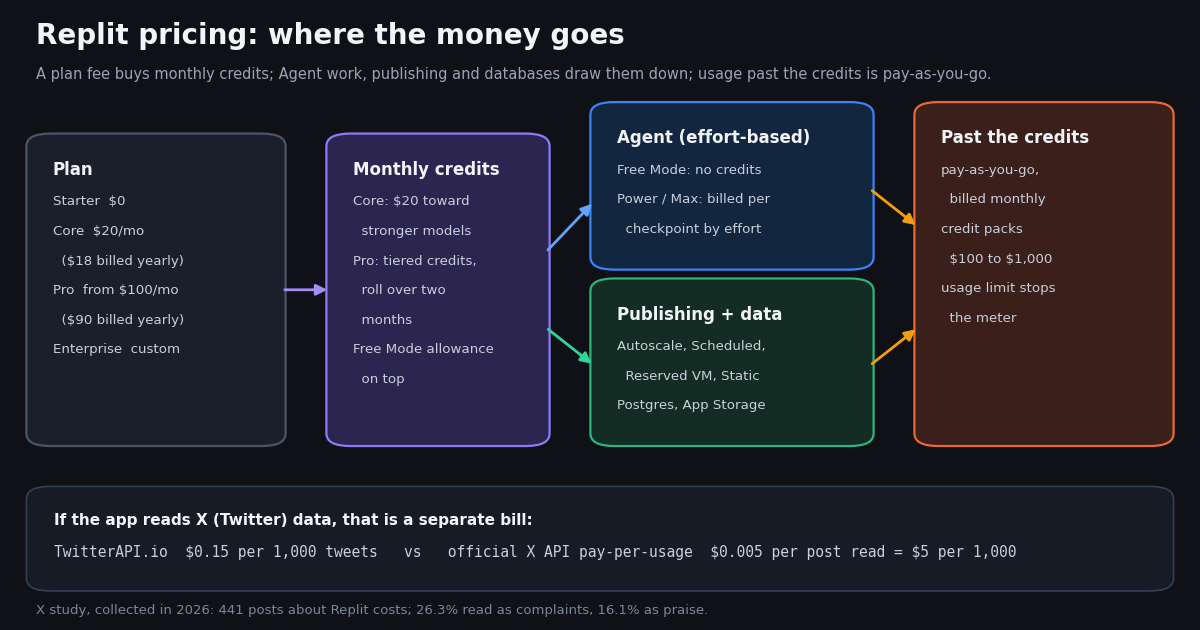
- Starter is free (daily Agent credits, 1 published app for 30 days); Core is $20/month or $18/month billed annually; Pro starts at $100/month ($90 billed annually); Enterprise is custom.
- Core includes $20 toward more powerful models; Pro credit tiers run $90 to $2,000 a month billed annually, and unused Pro credits roll over for two months.
- Agent in Free Mode costs no credits within an allowance that refreshes every five hours on Core and Pro; Power and Max bill each checkpoint by effort, and Replit asks before a paid action starts.
- Publishing and databases draw from the same credits: Scheduled and Autoscale deployments carry a monthly base fee plus $0.60 per million compute units, and a shared Reserved VM is $15 a month.
- Our worked estimate: an hourly tweet-fetch bot on a Scheduled Deployment costs about $2.10 a month in Replit compute and about $0.11 to $0.16 in X data on TwitterAPI.io.
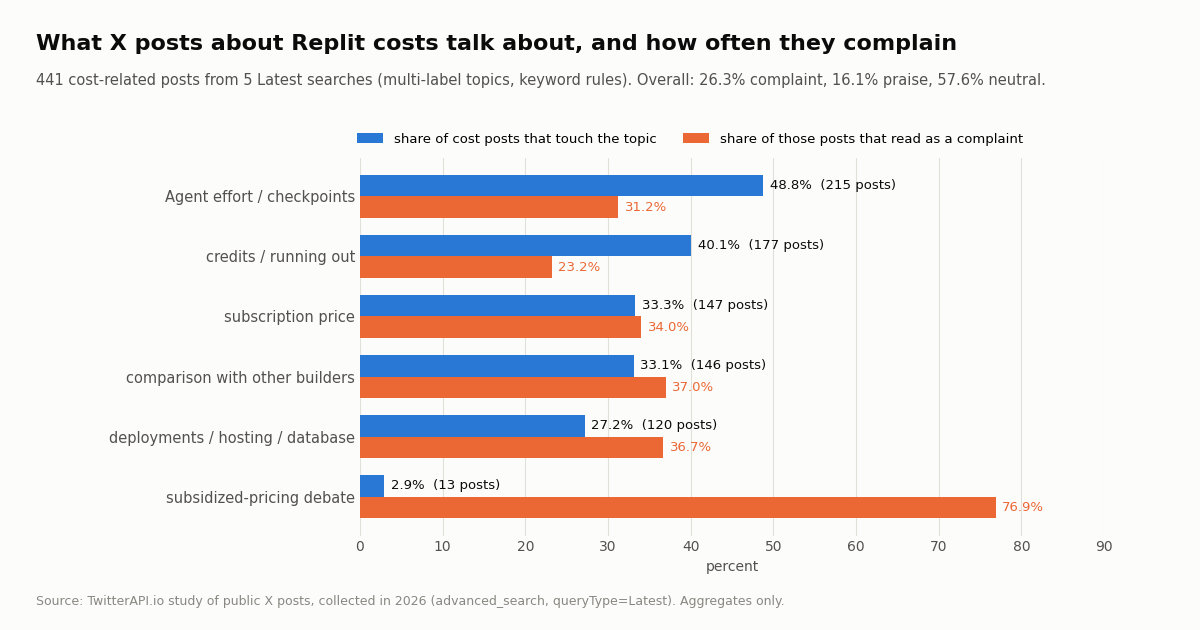
- On X, 48.8% of 441 posts about Replit costs (collected in 2026) talk about Agent effort or checkpoints, and 26.3% read as complaints versus 16.1% praise.
Replit's pricing page is short: three cards, a Monthly or Yearly toggle, and a list of FAQ titles. The parts that decide your bill live in Replit's billing docs: what Free Mode covers, how effort-based Agent checkpoints are charged, what publishing and databases cost per unit, and what happens when the monthly credits run out. This page puts both together, with every price taken from replit.com/pricing and docs.replit.com in 2026, written in USD and the billing period exactly as Replit shows them.
We also did two things the pricing page cannot: we priced a real workload end to end (a scheduled bot that fetches new posts from a few X accounts, the kind of small app many people build on Replit), and we read what people on X actually say about Replit costs, with a study of 441 cost-related posts and the official @Replit timeline. If your Replit app needs X data, the last sections show how to call TwitterAPI.io from it with Replit Secrets and what that data costs next to the official X API.
48.8% of 441 X posts about Replit costs discuss Agent effort or checkpoints, more than the subscription price (33.3%); 26.3% read as complaints against 16.1% praise (collected in 2026).
Replit pricing at a glance: Starter, Core, Pro, Enterprise
Replit sells one free plan, two self-serve paid plans and a custom Enterprise plan. The yearly toggle on the pricing page says "Up to 10% off": Core drops from $20 to $18 a month billed annually and Pro from $100 to $90. Prices are shown before tax ("Prices are subject to tax depending on your location").
What Starter leaves out. The Starter plan docs list what needs Core: Full build (Starter is limited to Lite build), Plan Mode, third-party connectors such as Google and Stripe, Replit AI Integrations, converting a Design Canvas design to an app with a backend, removing the "Made with Replit" badge, and any second published app. For a tool you want to keep online, Core is the practical floor.
Where Teams went. Older guides describe a Teams plan. The current pricing page lists only Core, Pro and Enterprise; Pro covers the small-team case (up to 15 builders with pooled credits and no per-user fee), and Enterprise covers organizations. Replit's August 2026 cloud price update still names Teams among the plans that received the new prices, so existing Teams accounts may still exist.
Replit Pro credit tiers and annual billing
Pro is sold in credit tiers. On the pricing page, the Pro card has a tier selector; with yearly billing selected it lists $90, $215, $425, $825 and $2,000 a month, and the selector's underlying tier values are 100, 250, 500, 1,000 and 2,500, which match the base tier's "$100 credits" label. The Pro docs describe the tiers as "multiple tiers with discounts on larger tiers" and say unused credits roll over for two months.
We could not read the monthly-billing price of each higher tier from the page text, so we do not list it; check the toggle on replit.com/pricing before you choose. The credit-to-tier mapping above comes from the page's own selector values, and the base tier is the only one labeled in plain text.
Core credits do not roll over. Core receives monthly credits that apply automatically to Agent, publishing, network transfer, database storage and Replit AI Integrations. The publishing docs state plainly that unused monthly credits do not roll over; rollover is a Pro feature. If your usage swings month to month, that difference matters more than the headline price.
Enterprise has a visible floor. Replit's Enterprise docs show the in-product upgrade wizard: you pick either a fixed annual credit commitment or pay-as-you-go, and the commitment slider in Replit's own screenshot runs from $10,000 to $200,000 a year. Enterprise adds unlimited seats with no per-seat cost, SSO and SAML with SCIM, SIEM audit logs, admin governance controls and a named support team.
How Replit's effort-based Agent pricing and checkpoints work
Replit Agent has three modes. Free Mode handles everyday chat and building at no extra cost within an allowance; on Core and Pro that allowance refreshes every five hours, and Starter has a daily cap. Power Mode is the balanced paid mode (it replaced Economy Mode at the same price), and Max Mode uses the most capable models for large codebases and hard problems. Power and Max draw on monthly credits, and Replit says it lets you know before a request shifts from Free Mode to a paid mode.
Paid work uses what Replit calls effort-based pricing. When Agent finishes a request in Build mode it creates one checkpoint, and the checkpoint is what you pay for. A bug fix or small change typically costs less; a complex build (a full feature or an integration) is bundled into one checkpoint that may cost more, "reflecting the total effort involved". You can see the cost of each checkpoint by hovering the usage icon in the Agent tab. Replit does not publish a per-checkpoint price list; its docs link an interactive demo at agent-pricing.replit.app for sample apps.
Two details catch people out. First, in the paid path Plan Mode can perform billable reasoning even when it does not change code, so planning is cheaper than building but not free once you leave Free Mode. Second, some Agent features call third-party AI APIs behind the scenes (Replit names Claude, ChatGPT and Nano Banana / Gemini); those calls are billed "at the provider's public API rate" and deducted from your Replit credits.
Practical cost controls from Replit's own docs. Start in Free Mode and keep requests small and testable; plan the change before switching to Power or Max; set a usage limit in Settings so pay-as-you-go stops at a number you choose; and check the Usage page, which Replit says can take up to 30 minutes to reflect new usage. Our X study below shows why this matters: Agent effort and checkpoints are the single most discussed cost topic.
Replit deployment, database and storage pricing
Publishing is billed from the same monthly credits. Replit's Publishing costs page lists four deployment types and their unit prices. Compute units measure work: 1 CPU-second is 18 units and 1 GB-second of memory is 2 units. Static deployments use no compute units.
Replit cut cloud prices on August 1, 2026 for all plans: Autoscale and Scheduled compute fell from $3.20 to $0.60 per million compute units, Autoscale requests from $1.20 to $0.40 per million, outbound transfer from $0.10 to $0.05 per GiB, and production database storage from $1.50 to $0.35 per GiB a month (database compute stayed at $0.16 per compute hour). The August update table lists the Autoscale base fee as $1 a month while the Publishing costs page lists $2; we use the higher figure in our estimates.
Databases. Development databases are free; production databases are billed by compute hours (active while serving requests and for 5 minutes after) and by the maximum storage used in the month. An empty PostgreSQL database still uses 33 MB. Production databases go up to 100 GiB on paid plans and 1 GiB on Starter. Core includes 100 GiB of outbound transfer a month.
Replit's own examples put a small business website on Autoscale at about $2.39 a month and a daily Scheduled background job at about $2.03 a month, which is why most small apps on Core never leave the $20 of monthly credits for hosting alone. The expensive part, as the next sections show, is usually Agent work, not hosting.
What happens when your Replit credits run out
Replit does not stop paid services when monthly credits are used up. The billing docs say usage is billed "monthly or once your accumulated costs exceed your monthly credits", and the Core docs describe pay-as-you-go billing as a way to "avoid interruptions in service". The control is yours to set: a usage limit caps spending beyond the monthly credits, and when it is reached usage-based services are blocked until the next cycle or until you raise it. A service shutdown limit suspends services outright. Organizations set budgets in $500 increments; Enterprise admins can set per-user spend limits.
If you would rather prepay, Core and Pro accounts can buy credit packs from Settings, Billing. Packs expire six months after purchase, do not renew automatically and are used earliest-expiring first; auto-reload can buy a new pack when the balance runs low.
One setting worth knowing. Replit's docs note that usage limits apply after credit packs are used. To spend only what you prepaid, set the limit to $0.01. Payment failures are handled separately: continued failures can suspend published apps until payment details are updated.
Worked estimate: what a scheduled tweet-fetch bot costs on Replit
Pricing pages rarely price a real workload, so here is one. The app: a small Python job that checks three to five X accounts for new posts, prints them and forwards each one to a Discord channel or a database. This is a common first Replit project, and it touches every part of the bill: Agent to build it, a deployment to run it, and an X data API to read posts.
Assumptions. Each run takes about 10 seconds and uses 1 vCPU and 2 GB of memory, which is 180 CPU units plus 40 memory units, about 220 compute units per run. The tracked accounts post as often as @Replit did in our sample, 2.49 posts a day each, so five accounts produce about 374 posts a month. X data is read with one combined from: search per run on TwitterAPI.io: 15 credits per tweet returned ($0.15 per 1,000 tweets), with a 15-credit minimum when a check finds nothing ($0.00015).
How to read it. On TwitterAPI.io the X data cost is driven by how often you check, because every check costs at least $0.00015: hourly checks across a month cost $0.108 even if nothing new appears, plus $0.15 per 1,000 posts that do come back. The official X API charges $0.005 per post read on its pay-per-usage rate card (docs.x.com), so the same 374 posts cost about $1.87 there. Per 1,000 tweets the two rate cards are $0.15 and $5, about 33x apart. At this tiny volume either bill is small; the gap matters once an app reads tens of thousands of posts a month (10,000 posts is $1.50 versus $50).
The Replit side fits inside Core. All three hosting setups cost less than Core's $20 of monthly credits, so on Core the bot's hosting is effectively prepaid. The variable you cannot price in advance is Agent: building this bot in Free Mode costs no credits within the allowance, while the same work in Power or Max mode is billed per checkpoint by effort. Build it in Free Mode, publish it as a Scheduled Deployment, and the realistic monthly total on Core is the $20 subscription plus a few cents of X data.
When a Reserved VM makes sense. Only if you need near-real-time delivery. Polling every 60 seconds costs $15 a month on Replit and $6.48 a month in minimum checks on TwitterAPI.io; for most feeds an hourly or 15-minute schedule delivers the same posts for a fraction of that.
What people on X say about Replit pricing
We searched X for posts about Replit pricing, bills, checkpoints, credits and value, and kept the 441 posts that name Replit together with a cost term (67.4% of 654 unique non-Replit posts returned). Topics are multi-label keyword rules, so one post can count in several rows. Tone is a keyword rule too (words like expensive, refund, burned or loop versus worth it, affordable or love), which is a rough signal, not sentiment analysis.
Agent effort is the conversation. 48.8% of the posts mention the Agent, effort or checkpoints, more than mention the subscription price (33.3%). The subscription itself is rarely the issue; what people post about is how fast Agent work draws down credits. Across all posts, 26.3% read as complaints, 16.1% as praise and 57.6% as neutral (news, tutorials, tool lists).
People post their bills. 33.1% of the posts include a dollar figure. Taking the first amount in each post, the median is $48 and the 90th percentile is $700; 44.4% of those first amounts are $100 or more. Many are monthly totals well above the $20 Core price, which is what usage-based Agent billing looks like from the outside.
Replit is compared constantly. 33.1% of cost posts name another builder: Lovable in 17.0%, Cursor in 15.9%, Claude Code in 10.9%, Bolt in 8.4% and Codex in 7.3%. Comparison posts get the most attention, with a median of 687 views against 389 for cost posts overall.
The official account rarely talks price. The @Replit timeline (about 240,031 followers) posted 80 times over 32 days, about 2.49 a day. Only 3 of its 73 original posts (4.1%) mention pricing, credits, Free Mode or a discount, while 34.2% mention the Agent. Pricing questions get answered in the docs, not on the timeline.
Call TwitterAPI.io from a Replit app with Secrets (and what the X data costs)
If your Replit app reads X data, keep the API key out of the code. Replit's Secrets tool encrypts each secret and exposes it to the project as an environment variable; secrets are available to every deployment type except Static, and the published app has its own Production app secrets under Publishing, Adjust settings. One caveat from Replit's docs: organization members without the Owner role cannot view secret values but can read them by printing environment variables, so share the Repl only with people you would trust with the key.
Step 1. Get a key. Sign up at TwitterAPI.io; new accounts that pass the automatic bot check get up to $1 of free credits (at most 100,000 credits, no card, one per person or network, expiring after 31 days). Reads need no X account and no X developer app.
Step 2. Add the secret. In the Replit workspace, open Secrets and add TWITTERAPI_IO_KEY. Add it again under Production app secrets when you publish.
Step 3. Call the API. Send the key in the X-API-Key header to https://api.twitterapi.io. For new posts from a few accounts, one /twitter/tweet/advanced_search call with from:a OR from:b and since_time replaces one call per account; read tweets[], then follow next_cursor while has_next_page is true. For one account's recent posts, /twitter/user/last_tweets returns data.tweets[] 20 per page.
Step 4. Publish as a Scheduled Deployment with a cron expression such as 0 * * * * and set the job's timeout. Scheduled Deployments run the command and stop, so you pay compute only for each run's few seconds, and Replit alerts you if a run fails. The full script is in the code block at the end of this page.
Or let Agent call X for you. If you would rather have an AI agent query X directly, our hosted MCP server at https://mcp.twitterapi.io/mcp takes the same key as Authorization: Bearer <key>; the MCP server guide linked below has the client setup.
The X data bill, side by side. TwitterAPI.io charges 15 credits per tweet returned ($0.15 per 1,000 tweets; $1 = 100,000 credits) with a 15-credit minimum per request, and profiles at $0.18 per 1,000. X's pay-per-usage rate card (docs.x.com/x-api/getting-started/pricing) charges $0.005 per post read and $0.010 per user read, capped at 3 million post reads a month before Enterprise. Per 1,000 tweets that is $0.15 versus $5, about 33x. Paid TwitterAPI.io accounts run at 20 requests per second (0.2 before the first payment), which a scheduled Replit job never comes close to.
# Read the key Replit's Secrets tool exposes as an environment variable
import os
import requests

r = requests.get(
    "https://api.twitterapi.io/twitter/user/last_tweets",
    headers={"X-API-Key": os.environ["TWITTERAPI_IO_KEY"]},
    params={"userName": "Replit"},
    timeout=30,
)
r.raise_for_status()
body = r.json()
for t in body["data"]["tweets"]:
    print(t["createdAt"], t["likeCount"], t["text"][:80])
print("more pages:", body.get("has_next_page"), body.get("next_cursor", "")[:12])
How we collected this
Question. When people on X talk about what Replit costs, what do they talk about (subscription price, credits, effort-based Agent checkpoints, deployments, comparisons), how often is the tone a complaint, and how often does the official @Replit account post about pricing?
Queries and accounts. Five /twitter/tweet/advanced_search queries with queryType Latest, each excluding retweets: "replit pricing"; replit with bill, billed, charged or invoice; replit with checkpoint or checkpoints; replit with credits, "effort-based" or "free mode"; replit with expensive, cheap, "worth it", "$20" or "$100". Up to 8 pages per query, 667 unique posts after de-duplication. Plus the @Replit timeline via /twitter/user/last_tweets (80 posts) and its profile via /twitter/user/info.
Window and sample. The most recent matching posts at collection time; 88.9% of the 441 cost-related posts were posted in 2026, the checkpoint query reaching back into 2025. Collected in 2026. The study used 46 requests and 868 returned posts, about $0.13 of X data at our own prices.
What the sample cannot show. Latest search returns the newest posts, not a random sample of all opinion; keyword rules for topic and tone misread sarcasm and mixed posts; 94.3% of posts are in English, so other markets are thin; people who are happy with a bill post less than people who are not. Treat the shares as the shape of the public conversation, not as customer satisfaction.
Privacy. Aggregates only. Search results come mostly from private individuals, so raw pages were not kept; the published sample holds de-identified rows (language, year, topics, tone, likes, views, follower bucket) with no ids, text, links or handles. The only account named is the official @Replit organization account.
"""Replit Scheduled Deployment: fetch new posts from a few X accounts and price the run.
Add TWITTERAPI_IO_KEY in Replit's Secrets tool (it becomes an environment variable).
Optional: DISCORD_WEBHOOK_URL to forward each post. Schedule: 0 * * * * (hourly).
pip install requests
"""
import os
import time
import requests

BASE = "https://api.twitterapi.io"
HEADERS = {"X-API-Key": os.environ["TWITTERAPI_IO_KEY"]}
ACCOUNTS = ["Replit", "vercel", "github"]
WINDOW_SECONDS = 3600  # match the cron interval so each run reads only new posts
CREDITS_PER_TWEET = 15  # $1 = 100,000 credits; minimum 15 credits per request


def fetch_new(accounts, since_unix, max_pages=5):
    query = "(" + " OR ".join(f"from:{a}" for a in accounts) + f") since_time:{since_unix}"
    tweets, cursor, requests_made = [], "", 0
    for _ in range(max_pages):
        r = requests.get(
            f"{BASE}/twitter/tweet/advanced_search",
            headers=HEADERS,
            params={"query": query, "queryType": "Latest", "cursor": cursor},
            timeout=30,
        )
        r.raise_for_status()
        body = r.json()
        requests_made += 1
        tweets += body.get("tweets", [])
        if not body.get("has_next_page"):
            break
        cursor = body.get("next_cursor", "")
    return tweets, requests_made


def forward(tweet):
    hook = os.environ.get("DISCORD_WEBHOOK_URL")
    if not hook:
        return
    author = tweet.get("author", {}).get("userName", "")
    requests.post(hook, json={"content": f"@{author}: {tweet['text'][:1800]}\n{tweet['url']}"}, timeout=15)


def main():
    since = int(time.time()) - WINDOW_SECONDS
    tweets, calls = fetch_new(ACCOUNTS, since)
    for t in reversed(tweets):  # oldest first
        print(t["createdAt"], t["author"]["userName"], t["likeCount"], t["text"][:80].replace("\n", " "))
        forward(t)
    credits = max(calls * CREDITS_PER_TWEET, len(tweets) * CREDITS_PER_TWEET)
    print(f"{len(tweets)} new posts, {calls} request(s), about ${credits / 100000:.5f} of X data")
    print(f"Same posts at $0.005 per post read (X pay-per-usage): ${len(tweets) * 0.005:.3f}")


if __name__ == "__main__":
    main()
Researching this?Free starter credits cover end-to-end testing — Google sign-in, no card. Get a key.
Questions readers ask
How much does Replit cost per month?
Starter is free. Core is $20 a month, or $18 a month billed annually. Pro starts at $100 a month, or $90 a month billed annually, with higher credit tiers up to $2,000 a month billed annually. Enterprise is custom. Usage beyond your monthly credits (Agent work in Power or Max mode, publishing, databases) is billed pay-as-you-go unless you set a usage limit.
Is Replit free?
Yes, the Starter plan is free. It includes daily Agent credits up to a monthly cap, monthly cloud credits, Lite build and one published app that goes down after 30 days. Full build, Plan Mode, connectors, more published apps and badge removal need Core.
What is Replit's effort-based pricing?
Paid Agent work (Power or Max mode) is billed per checkpoint, one per completed request, and the price reflects how much work the request took: small fixes cost less, full features cost more. Replit asks for confirmation before a paid action starts. Free Mode work costs no credits within its allowance.
Do Replit credits roll over?
Pro credits roll over for two months. Core monthly credits do not roll over to the next month. Credit packs expire six months after purchase.
What happens when I run out of Replit credits?
Usage continues on pay-as-you-go and is billed monthly or once accumulated costs exceed your credits. Set a usage limit in Settings to block usage-based services at a fixed amount, or buy a credit pack ($100 to $1,000, with up to $50 off).
How much does it cost to host an app on Replit?
Autoscale and Scheduled deployments have a small monthly base fee plus $0.60 per million compute units; a shared Reserved VM is $15 a month; static sites are free to host plus $0.05 per GB transferred. Replit's own examples put a small website at about $2.39 a month and a daily background job at about $2.03, both inside Core's monthly credits.
How do I use an API key in a Replit app?
Add it in the Secrets tool, which encrypts it and exposes it as an environment variable (for example os.environ["TWITTERAPI_IO_KEY"]). Add it again under Production app secrets for the published app. Never paste keys into code or client-side files.
Is Replit worth it compared with other AI app builders?
It depends on how much paid Agent work you do. In our X study, cost complaints cluster around Agent effort and checkpoints, not the $20 subscription. If you build in Free Mode and host on Core's credits, the monthly bill stays near the plan price; heavy Power or Max use is where bills grow. Replit is most often compared with Lovable, Cursor and Claude Code.
Continue
- Replit pricing page (Core, Pro and Enterprise prices, yearly discount, Pro tier selector)
- Replit docs: AI billing (effort-based pricing, checkpoints, plan feature matrix)
- Replit docs: Publishing costs (Autoscale, Scheduled, Reserved VM and Static prices, compute units)
- Replit docs: Managing your spend (credit packs, usage limits, Agent modes)
- Replit docs: August 2026 cloud pricing updates
- X developer docs: API pricing (pay-per-usage rate card, 3M post read cap)
- X (Twitter) API guide: endpoints, access and pricing
- Lovable pricing: plans, credits and top-ups compared
- Claude Code pricing: plans, limits and API-key costs
- n8n pricing: cloud vs self-hosted costs for X workflows
- How the hosted X (Twitter) MCP server works
- TwitterAPI.io vs the official X API, side by side
- TwitterAPI.io pricing: $0.15 per 1,000 tweets
- 01Devin Pricing in 2026: Plans, Quotas, ACUs and What X Users Actually Pay
- 02Lovable Alternatives in 2026: Bolt.new, v0, Base44, Replit, Emergent and Cursor Compared
- 03Kiro vs Cursor in 2026: Plans, Spec-Driven vs Agent-First, and X (Twitter) Data via MCP
- 04Langfuse vs LangSmith: Pricing, Self-Hosting, OpenTelemetry and an X-Data Agent Traced in Both
- 05n8n vs Zapier vs Make in 2026: Pricing, Self-Hosting, AI Agents and the Same Twitter (X) Flow Built in All Three
- 06Lovable pricing in 2026: plans, credits, and what an app that pulls Twitter (X) data really costs
- 07Replit alternatives in 2026: free tiers, prices, hosting and what X users switch to
- 08n8n Pricing in 2026: Plans, Executions and the Twitter (X) Data Cost
Writing about something you built with TwitterAPI.io? Our community rewards program pays API credits for honest tutorials, build logs and videos.
Stop reading. Start building.
Starter credits cover real testing on real data. Google sign-in, no card, no application queue.
Get an API keyAlready building with TwitterAPI.io? Publish an honest tutorial or build log about it and earn up to $200 a month in API credits.