Talkwalker Pricing: Plans, What a Quote Covers, and Twitter (X) Alternatives
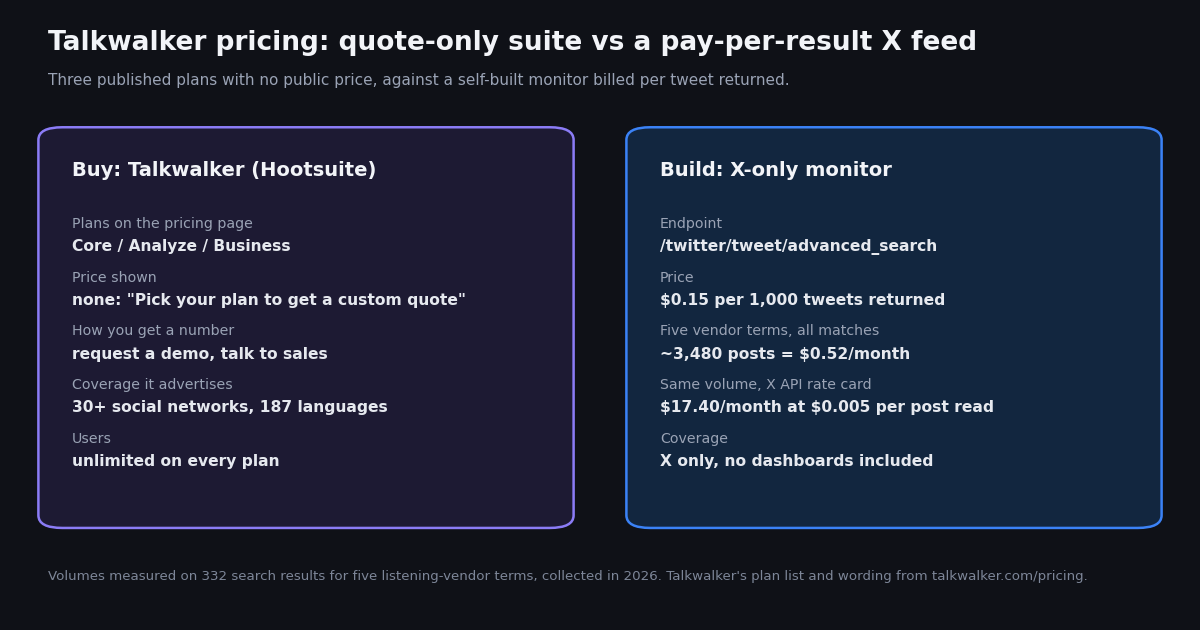
- No public price. talkwalker.com/pricing says "Pick your plan to get a custom quote"; every plan button opens a demo request. A free demo is offered; a free trial is not mentioned.
- Three plans: Core, Analyze, Business. They scale by non-sampled results volume (Analyze 2x Core, Business 6x), topics and channels, history and workspaces. Unlimited users on every plan.
- Owned by Hootsuite since the deal announced on April 8, 2024. Hootsuite's self-serve plans ($99, $199, up to $399 per user/month, annual billing) include a lighter listening feature; Enterprise is custom.
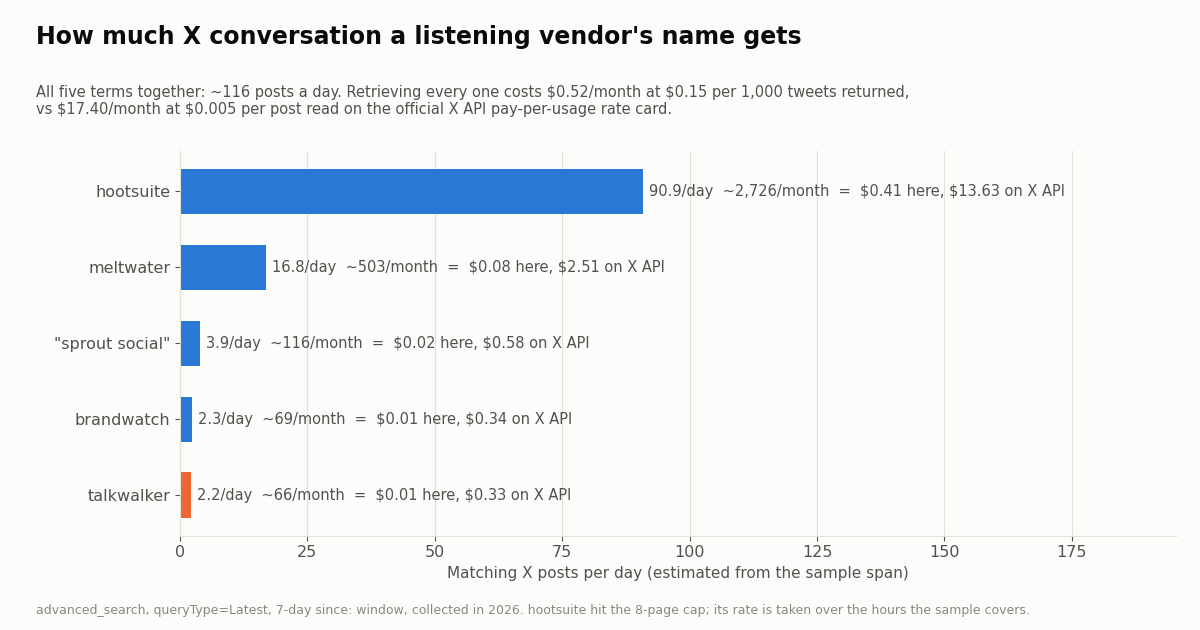
- Measured X volume is small. "talkwalker" itself drew about 2.2 X posts a day in our 2026 sample; five listening-vendor names together about 116 a day.
- X-only listening bill: all 3,480 posts a month for those five terms = $0.52 at $0.15 per 1,000 tweets returned, $17.40 at X's $0.005 per post read. Polling every 5 minutes adds a $1.30/month floor per query.
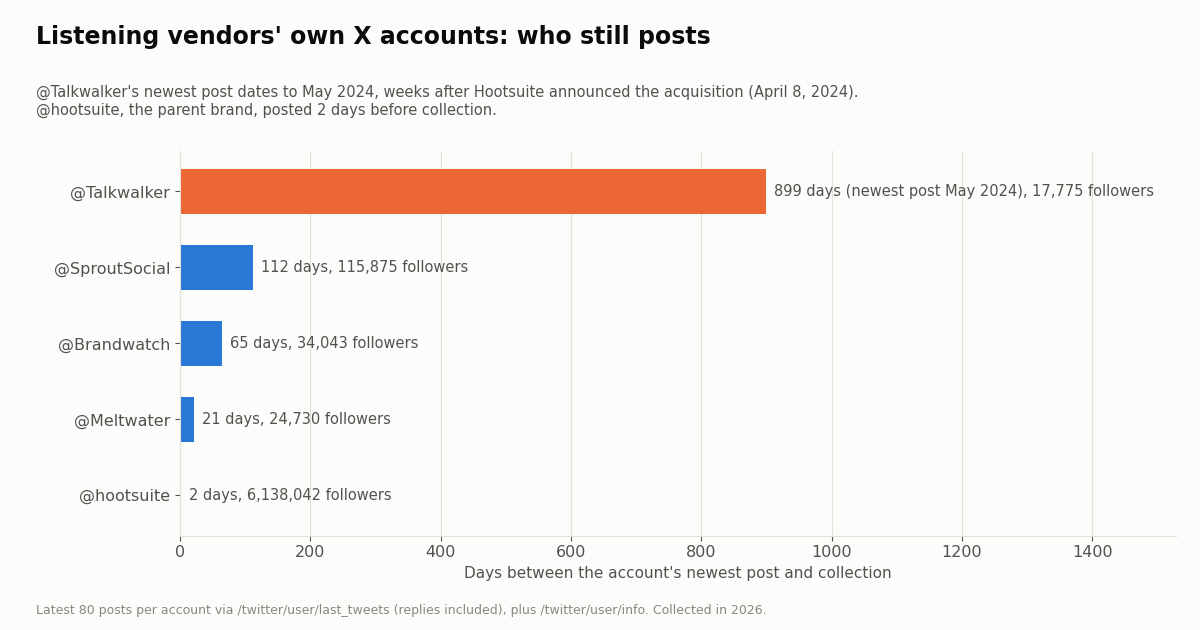
- @Talkwalker has gone quiet on X: its newest post dates to May 2024, 899 days before collection, while @hootsuite posted 2 days before.
Searching "talkwalker pricing" usually means one of two things: you have a Talkwalker demo booked and want a reference point before the call, or you are trying to decide whether a quote-only listening suite is the right shape of product at all. This page answers the first question with what Talkwalker itself publishes, checked on its pricing and data-coverage pages this session, and the second with a measured look at what the X (Twitter) part of social listening actually costs when you collect it yourself.
Its angle is narrow on purpose. For a Brandwatch-specific comparison see our Brandwatch alternative guide, for Meltwater our Meltwater alternative guide, and for a broad survey of X data sources for listening teams our social listening alternatives roundup; this page covers Talkwalker's plans, how the quote is shaped, and the alternatives for teams whose main channel is X.
Nothing here is a guessed Talkwalker price. Where third parties publish estimates we say so and name them in prose, and the only dollar figures we compute are for the X data you can measure yourself, from a study collected in 2026 that is described in full at the end.
About 3,480 posts, which cost $0.52 at $0.15 per 1,000 tweets returned vs $17.40 at the X API's $0.005 per post read (732 posts measured, collected in 2026).
What Talkwalker publishes about pricing
The pricing page at talkwalker.com/pricing carries no dollar amounts and no billing periods. The headline is "Pick your plan to get a custom quote", each plan has a "Select" button that opens a free demo request, and a separate link offers help choosing: "Not sure which plan is best for your needs? We can help you decide." A free demo is offered; the page does not mention a free trial.
The three plans as Talkwalker describes them:
Included on every plan. Unlimited users, professional onboarding, best-practice guides and tutorials, continuous expert-led training, regional customer support and regular strategy reviews. Unlimited users matters for the comparison later: Talkwalker's quote is not a per-seat price, which is the opposite of Hootsuite's and Sprout Social's self-serve plans.
Coverage claims. The same page claims 150 million data sources, 30+ social platforms, 187 languages and 196 countries; the data-coverage page adds 300+ review sites and "over 6.3 petabytes of data stored across five years". None of these figures is broken out by channel, and the pricing page does not mention X or Twitter by name.
What drives the number. Because the tiers are defined by multiples of non-sampled results volume, topics and channels, and history, those are the levers a sales conversation will use. Before the call, it helps to know how many results your topics actually generate, which is exactly what the X study below measures for one channel.
How much does Talkwalker cost? What third parties report, and why it is not a price
Because Talkwalker publishes nothing, review sites and procurement databases fill the gap. In this session's search results, software directories quoted starting figures that ranged from roughly $9,000 a year to roughly $16,000 a year, and a procurement-data site reported a contract range in the low-to-mid five figures per year. These figures disagree with each other, rarely say which plan or volume they describe, and some still list plan names (Listen, Analyze, Business, Premium) that no longer match the vendor's own page.
Treat them as a sign of the order of magnitude, not as a number to budget against. The figure that counts is the one in your quote, and it will move with the three levers Talkwalker publishes: results volume, the number of topics and channels, and how much history you need.
Questions worth asking on the call. Which channels are included at your tier, and is X data full or sampled at that volume? How far back does X history go on your plan? What happens when a viral week pushes you past the results volume: hard cap, overage, or sampling? Is the contract annual, and what is the notice period? Is the price tied to the number of topics, and how is a topic defined (one boolean query, or one brand)? Is API or export access included, or a separate line?
The Hootsuite route. Since the acquisition, Hootsuite also sells listening inside its own plans. Hootsuite's plans page, checked this session, lists Standard at $99 USD per user/month, Professional at $199 USD per user/month and Advanced at up to $399 USD per user/month on annual billing, with Enterprise as custom. Standard includes basic listening ("Monitor your brand and competitors"); Professional adds a 30-day Quick Search, comparing up to five results, export and 90-day trend forecasting; Enterprise adds 13 months of historical data, advanced data sources, alerts and scheduled reports. The plans page does not name Talkwalker.
What Talkwalker says about X (Twitter) data
X is the channel most listening buyers ask about first, so it is worth separating what is documented from what is assumed. On its data-coverage page today, X appears only as a logo in the grid of covered networks, with no stated depth or history. The most specific claim is in a Talkwalker blog post dated January 27, 2024: "As a Twitter Official Partner, Talkwalker has access to the full 'X Firehose,' allowing you to tap into all available X data", including "up to 5 years of historical data, with essential metrics such as engagement and replies."
That post predates the Hootsuite acquisition, and X's API access terms have changed since, so ask for the current terms in writing: whether the firehose access stated in that post still applies to your plan, how far back X history goes, and whether engagement metrics are refreshed after a post is first collected.
Why this matters for the build-or-buy question. A suite is valuable when you need many channels in one dashboard, news and broadcast coverage, review sites, image recognition and a team that will help you set up queries. If 80% of your listening questions are about X, the X part can be collected directly, with known unit prices, and the suite question becomes "what do we need beyond X?"
How much X conversation does a listening vendor's name get? Five terms measured
To give the X side a real number, we searched X for the names of five listening and social-media vendors and measured how many posts each term attracts. These are not customer brands; they stand in for the kind of mid-size B2B brand a team might monitor.
The talkwalker term is quiet. 14 posts over about 153 hours, or 2.2 a day, from 10 distinct authors, with English at 43% and French at 14% of posts. Brandwatch is similar at 2.3 a day, and 67% of its matches were replies rather than standalone posts.
Raw counts need reading, not just summing. The meltwater term (16.8 a day) also matches the ordinary word for glacier melt, so part of that volume is not about the company. The hootsuite term (90.9 a day, the only one that hit our 8-page cap) was 71% Italian, and the top 10% of its authors wrote 41% of posts: a burst from a small group, not a broad conversation. A suite applies noise filters for you; when you build, a negative keyword and a per-author cap do the same job.
The bill is tiny either way. All five terms together came to about 116 posts a day, or 3,480 a month. Retrieving every one costs $0.52 a month at $0.15 per 1,000 tweets returned, and $17.40 a month at the official X API pay-per-usage rate of $0.005 per post read: a 33x difference per post, though both are small next to a listening contract.
What a self-built X monitor really costs: the polling floor
Per-post cost is only half the bill for a monitor that checks for new posts on a schedule. Every check is a request, and a request that finds nothing still costs the 15-credit minimum, $0.00015. For quiet terms, those empty checks are most of the bill.
In our sample, a 5-minute check on the talkwalker term would have come back empty 99% of the time, and a 60-second check 99.9% of the time. Even for hootsuite, the busiest term, 82% of 5-minute checks were empty.
Combine terms into one query. Putting talkwalker, brandwatch, meltwater and "sprout social" into a single OR query cut the 5-minute bill from $5.20 to $1.31 a month, because one check covers all four and the posts themselves cost almost nothing. Split the results by term in your own code afterwards.
Pick the interval from the use case. A crisis desk may want a 60-second loop; weekly share-of-voice reporting is fine with an hourly or daily pull, where the polling floor all but disappears. If you need sub-minute alerts without polling, a server-side filter rule that pushes matches to a webhook you host is the alternative pattern (see our Twitter monitoring guide).
def matches_term(text, term):
    return term.lower().strip('"') in text.lower()


def daily_counts(posts, terms):
    counts = {t: 0 for t in terms}
    for p in posts:
        for t in terms:
            if matches_term(p["text"], t):
                counts[t] += 1
    return counts


def spike(today, baseline_avg, factor=3, floor=10):
    """Flag a term when today's count is 3x its 7-day average and at least 10 posts."""
    return today >= floor and today >= factor * max(baseline_avg, 1)
The vendors' own X accounts: who still posts
A smaller signal, but a telling one for anyone buying X listening: we pulled the latest 80 posts of each vendor's official account.
@Talkwalker stopped posting in May 2024. The account (created 2011, 39,852 posts in total) has not posted since, weeks after the Hootsuite acquisition was announced. Brand communication now runs through @hootsuite, which posted 2 days before collection and whose last 80 posts were 66% replies, a customer-care pattern.
What it means for a buyer. Nothing about the product's quality, but it confirms where the brand now lives. If you are evaluating Talkwalker, expect the commercial conversation to happen inside Hootsuite's sales process, and expect the plans page and the Hootsuite plans page to be the two places where packaging changes first. @Brandwatch's feed, at 88% replies, shows the same customer-care shift.
Talkwalker alternatives: what each one publishes about price
Every pricing page below was checked this session. The pattern is clear: the enterprise listening suites are quote-only, while the social-media-management tools publish per-seat prices and sell listening as an included feature or an add-on.
When to stay with a suite. You need news, broadcast, blogs, forums and review sites alongside social; you need image and logo recognition; non-technical analysts must build their own queries; or procurement prefers one annual contract with onboarding and training. Talkwalker's unlimited-users model also helps when many people need read access.
When an X-only build is enough. Your listening questions are mostly about X, you want raw posts in your own warehouse, you need custom alert logic, or you want to know the exact bill in advance. The X portion we measured above cost under a dollar a month in data, plus a polling floor of about $1.30 per query at a 5-minute interval.
A hybrid is common. Some teams keep a suite for multi-channel reporting and run their own X collector for alerts and research, so a viral X week does not consume the suite's results volume. Ask the vendor whether X results count against your volume at your tier.
Getting X data the API way: endpoints, unit prices and the official comparison
For the X part of listening, three read endpoints cover most of what a suite's X module shows: /twitter/tweet/advanced_search for keyword and boolean queries (the same operators as X's advanced search, including lang:, -filter:retweets, since_time: and min_faves:), /twitter/user/last_tweets for an account's timeline, and /twitter/user/mentions for posts that mention a handle. Each tweet comes back with text, language, likeCount, retweetCount, replyCount, quoteCount, viewCount, bookmarkCount, entities and the author's profile, so share of voice, engagement and language mix are a few lines of code.
Price. Tweet endpoints cost 15 credits per tweet returned, which is $0.15 per 1,000 tweets; a full 20-tweet page is $0.003, and a request that returns nothing costs the 15-credit minimum, $0.00015. Profiles are $0.18 per 1,000. Credits are $1 per 100,000, purchased credits never expire, and new accounts that pass the automatic bot check get up to $1 of free credits (at most 100,000 credits, no card, one per person or network, expiring after 31 days). No X account is needed for reads.
Against the official X API. X's pay-per-usage rate card at docs.x.com/x-api/getting-started/pricing lists $0.005 per post read and $0.010 per user read, with pay-per-usage capped at 3M post reads a month and Enterprise above that. Per 1,000 posts that is $5 against $0.15, about 33x. For the five-term stream above that is the difference between $17.40 and $0.52 a month.
Rate limits and plans. Accounts run at 0.2 requests per second before the first payment and 20 once paid (50 on Scale, 500 on Business). Subscriptions from Starter at $29 to Business at $1,499 a month exist for higher volumes; see the pricing page rather than per-request math.
What you do not get. No dashboards, no sentiment model, no multi-channel coverage, no analyst onboarding. You get raw X data with known unit prices, and you put it in whatever tool your team already uses: a warehouse, a notebook, a BI dashboard or an LLM pipeline. The end-to-end script below is a working starting point.
import os
import time
import requests

API_KEY = os.environ["TWITTERAPI_IO_KEY"]
BASE = "https://api.twitterapi.io"
HEADERS = {"X-API-Key": API_KEY}

# One OR query covers every term, so each poll is one request, not one per brand.
QUERY = 'talkwalker OR brandwatch OR meltwater OR "sprout social" -filter:retweets'


def fetch_new(since_unix, seen):
    """Return posts newer than since_unix that we have not stored yet (newest first)."""
    params = {"query": f"{QUERY} since_time:{since_unix}", "queryType": "Latest"}
    found = []
    while True:
        r = requests.get(f"{BASE}/twitter/tweet/advanced_search", headers=HEADERS, params=params, timeout=30)
        r.raise_for_status()
        body = r.json()
        for t in body.get("tweets", []):
            if t["id"] in seen:
                continue
            seen.add(t["id"])
            found.append({
                "id": t["id"],
                "url": t["url"],
                "created_at": t["createdAt"],
                "lang": t.get("lang"),
                "text": t["text"],
                "likes": t.get("likeCount", 0),
                "views": t.get("viewCount", 0),
                "is_reply": t.get("isReply", False),
                "author": t["author"]["userName"],
                "author_followers": t["author"].get("followers", 0),
            })
        if not body.get("has_next_page"):
            return found
        params["cursor"] = body["next_cursor"]


if __name__ == "__main__":
    seen = set()
    since = int(time.time()) - 3600  # start with the last hour
    while True:
        started = int(time.time())
        for post in fetch_new(since, seen):
            print(post["created_at"], post["lang"], post["likes"], post["url"])
        since = started - 60  # small overlap; the seen set removes duplicates
        time.sleep(300)  # every 5 minutes: about 8,640 checks a month
How we collected this
Question. How much X conversation would a team pay for if it built its own Talkwalker-style X monitor for the social listening category, and how active are the vendors' own X accounts?
Queries and accounts. /twitter/tweet/advanced_search with queryType Latest and a 7-day since: window for the terms talkwalker, brandwatch, meltwater, "sprout social" and hootsuite, up to 8 pages each; /twitter/user/last_tweets with replies included for @Talkwalker, @Brandwatch, @Meltwater, @SproutSocial and @hootsuite (80 posts each); /twitter/user/info for the same five accounts.
Sample. 732 posts (332 search results and 400 timeline posts) plus 5 profiles, collected in 2026 with 53 requests. The data cost of the whole study was about $0.11.
Method. Posts per day = posts in the sample divided by the hours between the oldest matching post and collection, times 24. Four terms returned fewer posts than the cap, so their counts are the complete 7-day result set the search returned; hootsuite hit the 8-page cap, so its rate is taken over the roughly 42 hours its sample covers. Monthly costs multiply the daily rate by 30. Polling costs replay the sample's timestamps against fixed 60-second and 5-minute windows, billing empty windows at the $0.00015 minimum and every post at $0.00015.
What the sample cannot show. One week is not a season: launches, outages and news cycles change these counts by multiples. The terms are vendor names, not your brand, and brand names that are also common words (meltwater) overcount. We did not measure Talkwalker's own X coverage, its sampling or its prices, which are not public; nothing here is a statement about the quality of any vendor's product.
Privacy. Aggregates only. Search results come mostly from private individuals, so those raw pages were kept outside the repository; the published sample holds de-identified rows (term, hour, post type, language, like and view counts) with no IDs, URLs, text or handles. Only the five organization accounts are named.
import os
import time
import requests

API_KEY = os.environ["TWITTERAPI_IO_KEY"]
BASE = "https://api.twitterapi.io"
HEADERS = {"X-API-Key": API_KEY}

# One OR query covers every term, so each poll is one request, not one per brand.
QUERY = 'talkwalker OR brandwatch OR meltwater OR "sprout social" -filter:retweets'


def fetch_new(since_unix, seen):
    """Return posts newer than since_unix that we have not stored yet (newest first)."""
    params = {"query": f"{QUERY} since_time:{since_unix}", "queryType": "Latest"}
    found = []
    while True:
        r = requests.get(f"{BASE}/twitter/tweet/advanced_search", headers=HEADERS, params=params, timeout=30)
        r.raise_for_status()
        body = r.json()
        for t in body.get("tweets", []):
            if t["id"] in seen:
                continue
            seen.add(t["id"])
            found.append({
                "id": t["id"],
                "url": t["url"],
                "created_at": t["createdAt"],
                "lang": t.get("lang"),
                "text": t["text"],
                "likes": t.get("likeCount", 0),
                "views": t.get("viewCount", 0),
                "is_reply": t.get("isReply", False),
                "author": t["author"]["userName"],
                "author_followers": t["author"].get("followers", 0),
            })
        if not body.get("has_next_page"):
            return found
        params["cursor"] = body["next_cursor"]


if __name__ == "__main__":
    seen = set()
    since = int(time.time()) - 3600  # start with the last hour
    while True:
        started = int(time.time())
        for post in fetch_new(since, seen):
            print(post["created_at"], post["lang"], post["likes"], post["url"])
        since = started - 60  # small overlap; the seen set removes duplicates
        time.sleep(300)  # every 5 minutes: about 8,640 checks a month
Researching this?Free starter credits cover end-to-end testing — Google sign-in, no card. Get a key.
Questions readers ask
How much does Talkwalker cost?
Talkwalker does not publish prices. Its pricing page lists Core, Analyze and Business plans under "Pick your plan to get a custom quote", and each plan leads to a demo request. Third-party directories publish estimates in the thousands to tens of thousands of dollars a year, but they disagree and rarely name the plan or volume, so only a quote gives a real number.
Does Talkwalker have a free trial or a free plan?
The pricing page offers a free demo and a personal demo form; it does not mention a free trial or a free plan.
What is the difference between Talkwalker Core, Analyze and Business?
Volume and scope. Analyze adds 2x the non-sampled results volume of Core plus 25 more topics, filters and channels. Business adds 6x the volume, 3x more topics, additional historical data, more AI agent questions and LLM Insights channels, more workspaces and enterprise governance. All three include unlimited users, onboarding and training.
Is Talkwalker part of Hootsuite?
Yes. Talkwalker announced on April 8, 2024 that it was being acquired by Hootsuite, with its Luxembourg headquarters becoming Hootsuite's European headquarters. Hootsuite's self-serve plans include a lighter listening feature; its Enterprise plan adds 13 months of historical data and advanced listening.
Does Talkwalker include X (Twitter) data?
X is listed among its covered networks. A Talkwalker blog post from January 2024 says it has full X Firehose access as an official partner with up to five years of history. That post predates the acquisition and later X API pricing changes, so confirm current X depth, history and sampling for your plan in writing.
What are the main Talkwalker alternatives?
Brandwatch and Meltwater are the closest quote-only suites. Hootsuite (which owns Talkwalker) and Sprout Social publish per-seat prices and sell listening as a feature or add-on. For X-only listening, calling an X data API directly costs $0.15 per 1,000 tweets returned, versus $0.005 per post read on X's official pay-per-usage rate card.
How much would X-only social listening cost if I build it?
In our 2026 sample, every X post mentioning five listening-vendor names came to about 3,480 posts a month: $0.52 at $0.15 per 1,000 tweets returned. Checking every 5 minutes adds about $1.30 a month per query in empty checks, so combine terms into one OR query.
Continue
- X developer docs: X API pricing (pay-per-usage rates, 3M post-read cap)
- TwitterAPI.io docs: Advanced Search endpoint (query, queryType, cursor)
- TwitterAPI.io docs: User last tweets endpoint
- TwitterAPI.io pricing: per-tweet and per-profile credits, subscriptions
- Tech.eu: Hootsuite acquires AI-powered social listening powerhouse Talkwalker (April 2024)
- X Help Center: How to use advanced search (operators)
- X API guide: endpoints, access and pricing
- Brandwatch alternative for X listening
- Meltwater alternative for X mentions
- X data sources for social listening teams compared
- Twitter monitoring: accounts, keywords and alert setups
- Sprout Social pricing and its listening add-on
- TwitterAPI.io pricing: pay per tweet returned
- 01Pipedream Pricing in 2026: Connect Plans, Credits and the Workflows Shutdown
- 02Cloudflare Pay per Crawl: How the HTTP 402 Handshake Works, and What It Means for Twitter (X) Data
- 03ScrapingBee Pricing in 2026: Plans, Credit Costs and Alternatives
- 04Firecrawl Pricing: Plans, Credit Costs and What an X (Twitter) URL Costs
- 05LunarCrush API: What It Returns, What It Costs, and When Raw Twitter (X) Data Is the Better Input
- 06Cursor Pricing in 2026: Plans, the Weekly Usage Pool, Worked Monthly Bills and the Cost of Adding Twitter (X) Data
- 07Codex Pricing in 2026: ChatGPT Plans, Usage Limits, Credits and API-Key Costs
- 08Make.com Pricing in 2026: Plans, Credits and What a Twitter (X) Workflow Really Costs
Writing about something you built with TwitterAPI.io? Our community rewards program pays API credits for honest tutorials, build logs and videos.
Stop reading. Start building.
Starter credits cover real testing on real data. Google sign-in, no card, no application queue.
Get an API keyAlready building with TwitterAPI.io? Publish an honest tutorial or build log about it and earn up to $200 a month in API credits.