Cursor Pricing in 2026: Plans, the Weekly Usage Pool, Worked Monthly Bills and the Cost of Adding Twitter (X) Data
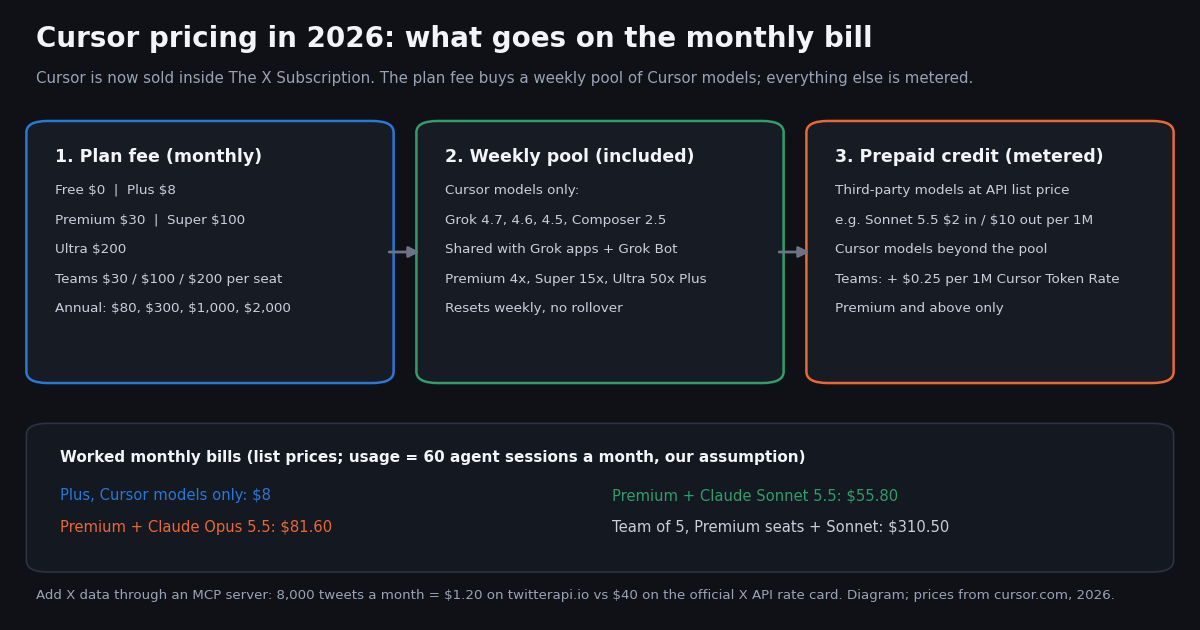
- Plans: Free $0, Plus $8, Premium $30, Super $100, Ultra $200 (monthly); annual $80, $300, $1,000 and $2,000 a year; Teams $30, $100 or $200 per seat; Enterprise custom. Prices exclude tax (
cursor.com/pricing). - One weekly pool, Cursor models only: Grok 4.7, 4.6, 4.5 and Composer 2.5, shared with Grok Chat, Imagine, Voice and Grok Bot. Premium is 4x Plus, Super 15x, Ultra 50x. It resets weekly and does not roll over.
- Third-party models are always extra: Claude, GPT and Gemini bill at API list price from prepaid credit on Premium and above (Claude Sonnet 5.5 is $2 input and $10 output per million tokens). Plus has no third-party models, no Bugbot and no cloud agents.
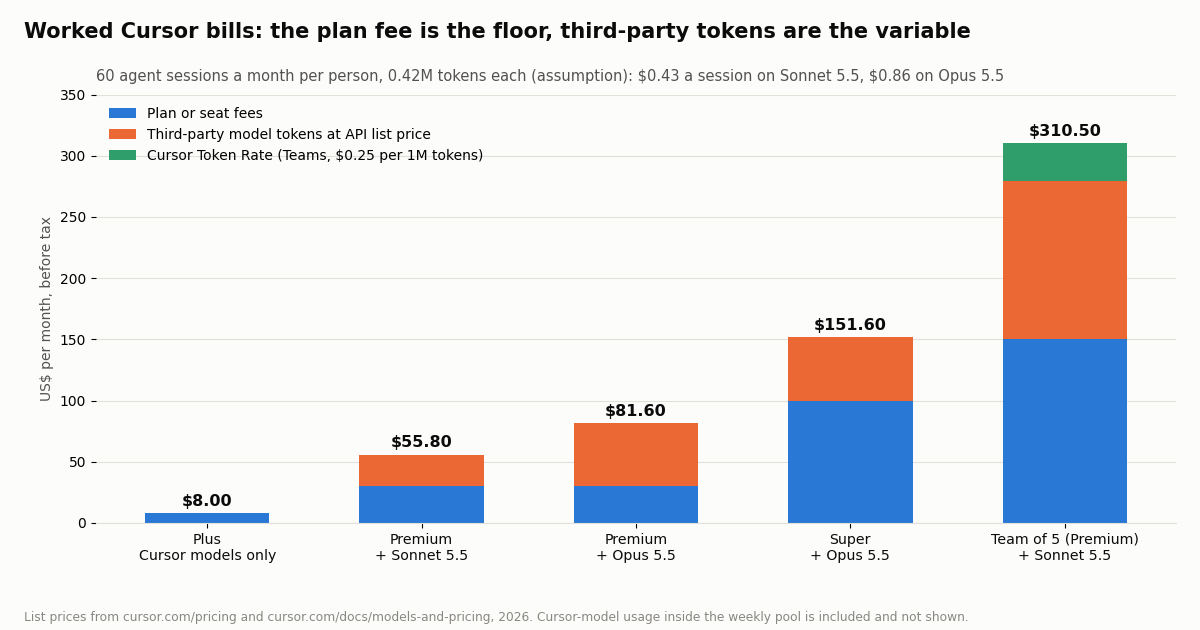
- Worked bills (60 agent sessions a month, our assumption): Plus $8.00; Premium + Sonnet 5.5 $55.80; Premium + Opus 5.5 $81.60; a team of 5 on Premium seats + Sonnet $310.50, of which $31.50 is the Cursor Token Rate.
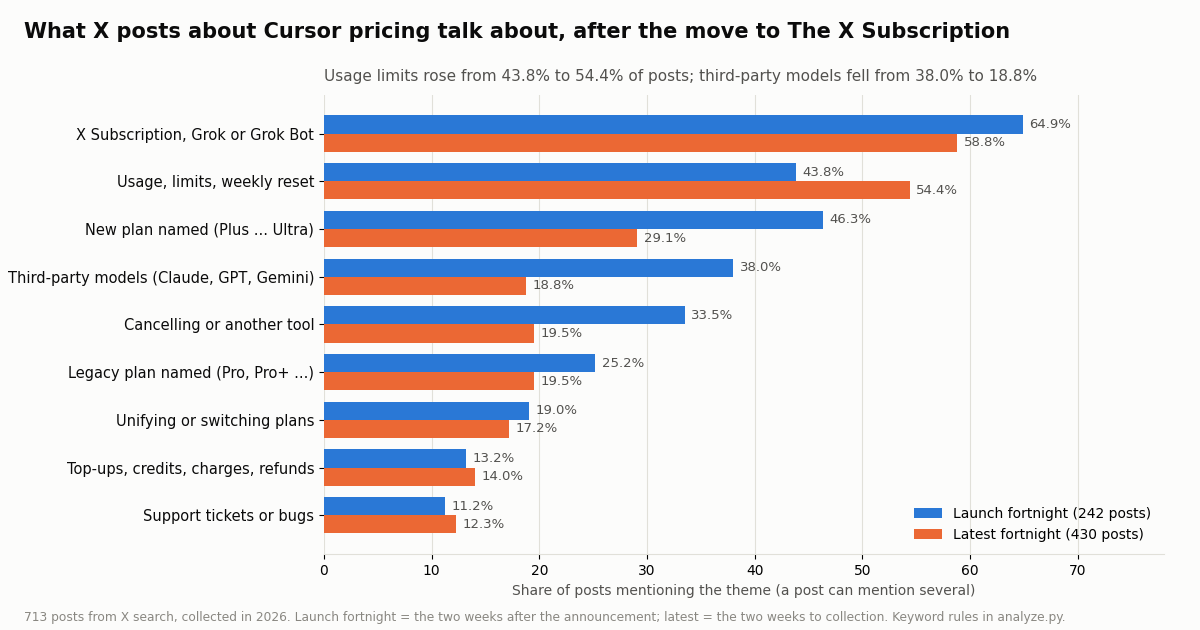
- What X says: in 713 posts about Cursor pricing collected in 2026, 61.4% mention the X Subscription, Grok or Grok Bot and 50.1% mention usage or limits; limits rose from 43.8% of posts in the launch fortnight to 54.4% in the latest fortnight.
- Adding X data to Cursor's agent: 8,000 tweets a month through the twitterapi.io MCP server cost $1.20 ($0.15 per 1,000 tweets returned) versus $40.00 on the official X API pay-per-usage rate card ($0.005 per post read), about 33x more.
Cursor's pricing changed shape twice in 2026. SpaceX completed its acquisition of Cursor on August 14, 2026, and on October 12, 2026 Cursor announced that it is now part of The X Subscription, one plan that bundles Cursor, Grok and X Premium benefits. Most guides that rank for this query still describe the old Pro and Pro+ plans with included third-party model usage. That is now the legacy lineup, still valid for people who subscribed before the switch, but not what a new customer can buy.
This page is the pricing explainer: every current plan and what it includes, how the weekly pool and prepaid credit work, what Teams and Enterprise add, how the legacy plans map to the new ones, and worked monthly bills you can check against your own usage. Head-to-head editor choices are covered on our sibling pages (Cursor vs Copilot, Cursor vs Claude Code, Antigravity vs Cursor and Kiro vs Cursor), so this page does not repeat them; if you already pay for Cursor and want its agent to read X (Twitter) data, the Cursor + Twitter API setup guide is the next step, and the last sections here show what that adds to the bill.
Then the part no pricing table shows: we collected 713 posts about Cursor pricing from X search plus the official @cursor_ai timeline, in 2026, and measured what people actually talk about after the switch: usage limits, the shared pool with Grok, third-party model costs, and which dollar figures they quote.
54.4% in the latest fortnight, up from 43.8% in the two weeks after Cursor joined The X Subscription (713 posts collected in 2026); third-party model mentions fell from 38.0% to 18.8%.
Cursor plans and prices in 2026
Cursor's pricing page (cursor.com/pricing) now lists seven options. Prices are in US dollars and exclude tax; the page adds "Prices subject to change" and asks you to cancel at least 24 hours before renewal to avoid the next charge. Annual prices come from Cursor's pricing help page (cursor.com/help/account-and-billing/pricing).
Free. Agent and Chat with limited usage, plus Tab completions with Cursor's own models. The help page says the legacy Hobby plan works the same way.
Plus ($8). Cursor's "introductory plan". Agent with Cursor's own models only (Grok 4.7, Grok 4.6, Grok 4.5 and Composer 2.5) at fixed settings: Fast mode off, medium effort, and Grok 4.7 at its 256k context window. No Auto, Cloud Agents, Automations, Bugbot, Origin code hosting, third-party models or your own API keys. It also includes Grok Chat, Voice, Imagine, Build and Grok API access, and on the X side a Premium checkmark.
Premium ($30). The tier Cursor marks "Most popular" and recommends "for new AI users". Everything in Plus with 4x the usage, and it adds Cloud Agents and Automations, code hosting on Origin, AI code review with Bugbot, Grok Bot, third-party models at API list price, and Fast mode and effort levels.
Super ($100). 15x Plus usage and priority model access at peak times; Cursor recommends it "for daily agent users".
Ultra ($200). 50x Plus usage and earliest access to new products and models; recommended "for power users".
Bugbot pricing. Cursor no longer shows a separate Bugbot price on its pricing page: AI code review via Bugbot is a feature of Premium, Super, Ultra, Teams and Enterprise, and is absent from Free and Plus. On legacy plans it is included in Pro, Pro+ and Ultra.
One detail that surprises people coming from other editors: the multiples (4x, 15x, 50x) are the only published measure of the pool. Cursor does not state the weekly pool in tokens or dollars, so the only way to know how far yours goes is the usage meter in editor settings or under Usage at grok.com/dashboard.
How the weekly usage pool, top-ups and spending caps work
Every paid plan includes one pool of usage for Cursor models, and it is shared across everything on the subscription: Agent in the editor, the CLI, Cloud Agents, Grok Bot, and the Grok apps (Chat, Imagine, Voice). Cursor's docs say it "refreshes weekly, so one heavy day doesn't use up your month". Unused usage does not roll over. The Grok API is billed separately and does not draw from the pool.
Different models drain the pool at different rates. When you go past the pool, Cursor models bill at the per-million-token rates below, paid from prepaid credit. The same table tells you the relative cost of each model inside the pool: Composer 2.5 is a quarter of Grok 4.7 on input, and Fast variants cost about twice as much.
What a pool overrun costs. Ten million input tokens on Grok 4.7 with 80% of them served from cache, plus half a million output tokens, is 2 x $2 + 8 x $0.50 + 0.5 x $6 = $11.00 beyond the pool. Agent sessions re-send the conversation on each step, so cache reads dominate long sessions; the cache-read price matters more than the headline input price.
Top-ups and Auto Top-up. Top-ups add prepaid credit, which pays for third-party models from the first request and for Cursor models beyond the weekly pool. Auto Top-up refills the balance when it drops below a threshold you set. Prepaid credit does not reset with the weekly pool; each top-up stays available until used or until it expires, currently 365 days after purchase.
The spending cap. A monthly additional usage limit caps how much paid additional usage you can consume each month, regardless of how much credit you hold. All three settings live under Additional usage credits at grok.com/dashboard/billing; on Teams an admin manages one shared balance and one cap.
When the pool runs out, you can wait for the weekly reset, keep working from prepaid credit at the same per-model rates, or upgrade. Cursor's docs state requests are never downgraded in quality or speed.
Auto is not always pool usage. Auto now has three modes. Cost mode (classic Auto, the only mode on individual plans) bills as a Cursor-model request from the pool whatever model serves it. On Teams and Enterprise with Cursor Router on, Balance and Intelligence bill at the routed model's list price, so a route to a third-party model is paid from credit. Subagents can also run a named third-party model while the picker still shows Auto, Grok or Composer, and those requests bill as third-party usage.
Third-party models: Claude, GPT and Gemini at API list price
The biggest change for existing users is that no plan on The X Subscription includes third-party model usage. Cursor's announcement on X put it directly: "To make room for more Grok usage, third-party models in Cursor move to API pricing on the new plans." On Premium and above you can still pick Claude, GPT or Gemini in Cursor, billed at the model's API list price from the first request, from prepaid credit. Plus and Free cannot use them.
These are the rates on Cursor's models and pricing page (cursor.com/docs/models-and-pricing), which lists more models behind a "Show more models" toggle. Claude and GPT models also have a cache-write price (Sonnet 5.5 is $2.50, Opus 5.5 $5 per million). Opting in to regional data residency adds a 10% uplift on eligible models.
Your own API key. On individual plans, requests made with your own provider key do not draw from the pool or from prepaid credit: the provider bills you directly. On Teams and Enterprise, BYOK requests still carry the Cursor Token Rate where it applies.
Legacy Max Mode. Max Mode, which extended a model's context window, exists only on legacy request-based plans and bills at the model's API rate plus 20%. Current plans do not include it.
If most of your work runs on Claude, compare this with Anthropic's own plans on our Claude Code pricing page, and with OpenAI's on the Codex pricing page: on Cursor's new plans the Claude tokens are metered on top of the plan fee, not inside it.
Teams and Enterprise pricing, and the Cursor Token Rate
Teams is priced per seat. Each member gets a Premium, Super or Ultra seat at the same price ($30, $100 or $200 a seat a month) and with the same weekly usage as the matching individual plan, and you can mix seat tiers on one team. Plus is not available for teams. Team plans add centralized billing and administration, a team marketplace for internal rules, skills and plugins, usage analytics, team-wide privacy mode, custom Chat data retention and SAML/OIDC SSO.
Enterprise is custom-priced and adds pooled usage across Grok and Cursor, invoice/PO billing, SCIM seat management, granular and group-level spend controls, audit logs and service accounts, repository, model and MCP access controls, and priority support. Cursor's FAQ steers anyone who needs invoicing, pooled usage or advanced security there.
The Cursor Token Rate. On Teams and Enterprise, eligible third-party model requests carry an extra $0.25 per million tokens on top of the model's API price, counted on input, output and cached tokens, and also on BYOK usage. Individual plans do not pay it. It does not apply to Cursor models (Grok, Composer) or to Cost mode requests, and it does not apply to third-party models whose cache-read price is strictly below $0.10 per million tokens across every pricing tier.
That exemption has a practical edge: in the table above, Claude Haiku 5.5 ($0.01 cache read), Gemini 3.8 Flash ($0.075) and GPT-5.6 Luna ($0.02) are exempt, while Claude Sonnet 5.5 sits exactly at $0.10, which is not strictly below, so it pays the rate. On a team that runs most agent work on Sonnet, the Token Rate is a real line item, not a rounding error (see the team bill below).
Legacy Teams seats. Teams Standard ($40 a user a month) and Teams Premium ($120, with 5x the Standard allowance) continue for existing teams, with both legacy pools allocated per seat. Existing teams can still add seats or change a seat's type without switching.
Legacy Cursor plans vs The X Subscription: should you switch?
If you subscribed before October 12, 2026 you are on a legacy plan, and nothing changes unless you act. Cursor's help pages say switching is optional, the change is permanent ("It can't be undone, and Support can't undo it for you"), and your old Cursor, SuperGrok and paid X Premium subscriptions are cancelled at checkout with a prorated refund.
What you gain. Cursor says each paid plan on The X Subscription "includes at least twice as much coding usage with Cursor models as the legacy plan it replaces", and it adds the Grok apps and X Premium benefits. Usage is one weekly pool instead of two monthly ones.
What you lose. The legacy Other Models pool, which covered third-party models at their API price inside the plan on Pro, Pro+, Ultra and Teams. After switching, every Claude, GPT or Gemini token is paid from prepaid credit. On-demand usage (billed monthly in arrears) is replaced by top-ups and a monthly additional usage limit, and billing moves from cursor.com/dashboard/billing to grok.com/dashboard/billing. Any on-demand usage not yet invoiced is billed in one final invoice before the switch completes.
A simple test before you switch. Open your legacy usage dashboard and look at the split between the Cursor Models pool and the Other Models pool. If most of your usage is Grok or Composer, the new plan's larger pool is likely to go further. If most of it is Claude or GPT, price that third-party usage at the list prices above and add it to the new plan fee; that sum, not the plan fee, is what you will pay. Our X study below shows this is the comparison people get wrong most often.
Worked monthly bills: what Cursor really costs
Plan fees are fixed; third-party tokens are not. To make the variable part concrete we priced one agent session at 0.42 million tokens (100,000 fresh input tokens, 300,000 cache-read tokens and 20,000 output tokens) and assumed 60 such sessions a month per person (three a working day). These usage numbers are our assumption, not a measurement; scale them to your own meter. Prices are Cursor's list prices, before tax.
Per session: Claude Sonnet 5.5 = 0.1 x $2 + 0.3 x $0.10 + 0.02 x $10 = $0.43. Claude Opus 5.5 = 0.1 x $4 + 0.3 x $0.20 + 0.02 x $20 = $0.86.
Read the table this way. Moving from Premium to Super does not make Opus cheaper: the bigger plan buys a bigger pool of Cursor models, and third-party tokens cost the same on every tier. Upgrade when you run out of Grok or Composer usage; buy credit when you use Claude or GPT. For the team, the Cursor Token Rate is 300 sessions x 0.42 million tokens x $0.25 = $31.50, about a tenth of the bill, because Sonnet 5.5 is not exempt.
For comparison, the legacy bill. A legacy Pro subscriber ($20) had third-party usage drawn from the Other Models pool inside the plan until it ran out, then on-demand usage at the same API rates. Cursor's docs do not publish the dollar size of that pool, so we cannot price the legacy side of this table honestly; check your own Spending tab.
What people on X say about Cursor pricing: 713 posts
Cursor announced the change on X, and the reaction played out there too. The @cursor_ai post of October 12, 2026 ("Cursor is now part of The X Subscription") had 6,466 likes, 605 replies, 372 quotes and 787,056 views when we collected it, 2.0x the median likes of the account's other recent posts in our sample. To see what the conversation is about, we pulled 713 posts about Cursor's plans, prices and limits from X search, collected in 2026, and tagged each by keyword rules.
The bundle and the limits dominate. 61.4% of posts mention the X Subscription, Grok or Grok Bot, and 50.1% mention usage, limits or the weekly reset. 26.6% mention Claude, GPT, Gemini or third-party pricing, 24.7% talk about cancelling or another tool, and 21.5% name a legacy plan such as Pro or Pro+.
The conversation moved from prices to limits. In the two weeks after the announcement (242 posts), 46.3% named a new plan and 38.0% discussed third-party models. In the latest two weeks (430 posts), plan names fell to 29.1% and third-party models to 18.8%, while usage and limits rose from 43.8% to 54.4%. Posts that quote a dollar figure halved, from 36.0% to 18.6%. Read this as a shift from choosing a plan to living with the weekly pool.
Which prices people quote. Across all 713 posts, the most-cited figures were $100 (48 posts), $200 (47), $30 (45), $20 (43, the legacy Pro price), $60 (22, legacy Pro+) and $8 (19). The Plus price is the least discussed of the paid tiers; the old $20 Pro still comes up almost as often as the new $30 Premium, which is the comparison readers are making in their heads.
Third-party model posts travel further. In the Top-ranked part of the sample (133 posts), the median post had 0 likes and 33 views, but posts that mention Claude, GPT or Gemini had a median of 342 views (29 posts). The question "do I now pay separately for Claude?" is the one people stop to read. Most posts are conversational: 42.8% are replies and 40.7% tag @cursor_ai directly.
Adding Twitter (X) data to Cursor's agent, and what it adds to the bill
A common reason to pay for an agent tier is to let the agent pull outside data while it works: a research prompt, a feature that reads posts, or a dashboard you are building. For X (Twitter) data, the twitterapi.io MCP server plugs into Cursor with one entry in ~/.cursor/mcp.json (or .cursor/mcp.json in a project), and the agent can then search tweets and read profiles, timelines, replies, followers and trends. Per the twitterapi.io docs (docs.twitterapi.io/integrations/cursor), all 12 tools are read-only and no X account is needed; you authenticate with an API key from the dashboard or with OAuth on the first tool call.
Two bills, not one. The X data is billed by twitterapi.io per result: 15 credits per tweet returned, which is $0.15 per 1,000 tweets ($1 = 100,000 credits), with a 15-credit minimum ($0.00015) when a search comes back empty, and $0.18 per 1,000 profiles. The tweets the tool returns then enter the model's context, so Cursor bills the tokens: from the weekly pool if the agent runs on Grok or Composer, from prepaid credit at API list price if it runs on Claude, GPT or Gemini.
Worked example. An agent that runs 20 X research prompts a working day, each pulling one 20-tweet page, reads 8,000 tweets a month. On twitterapi.io that is $1.20. The same reads on the official X API pay-per-usage rate card ($0.005 per post read, docs.x.com/x-api/getting-started/pricing) would be $40.00, about 33x more ($5 vs $0.15 per 1,000), and need a paid developer account before the first request. The median post in our sample is 257 characters, so the tweet text alone is roughly 0.51 million tokens a month at the common 4-characters-per-token rule of thumb, at least $1.03 of Claude Sonnet 5.5 input; the tool's JSON fields add more. In other words the X data costs about as much as the tokens it takes to read it.
New twitterapi.io accounts that pass the automatic bot check get up to $1 of free credits (at most 100,000 credits, no card, one per person or network, expiring after 31 days), which covers about 6,600 tweets; purchased credits never expire. The step-by-step Cursor setup, worked prompts and error fixes are in our Cursor + Twitter API guide.
{
  "mcpServers": {
    "twitterapi-io": {
      "url": "https://mcp.twitterapi.io/mcp",
      "headers": {
        "Authorization": "Bearer ${env:TWITTERAPI_IO_API_KEY}"
      }
    }
  }
}How we collected this
Question: what do people on X talk about when they talk about Cursor's pricing after the move to The X Subscription: plans, the shared weekly pool, third-party models, top-ups, switching or cancelling, and which prices they quote.
Query: an X advanced search for posts naming Cursor (@cursor_ai, "cursor ai", "cursor pricing", "cursor plan", "cursor pro", "cursor ultra", "cursor premium", "cursor subscription", "cursor usage" or "cursor limits") together with a pricing word (pricing, price, plan, subscription, usage, limit, per month, $, premium, ultra, super, plus), English, reposts excluded. We ran it newest-first in six weekly windows and once as Top over the period since the announcement, and read the last 20 posts of the official @cursor_ai account.
Sample: 715 unique posts, of which 713 mention Cursor by name (618 from the weekly windows, 133 from the Top query, some in both), collected in 2026 through a rate-limited, read-only client: 71 requests including one test page and 24 pages from a malformed first run that we discarded, about $0.16 in API reads. Periods are set by each post's own timestamp: 41 posts before the announcement, 242 in the two weeks after it, 430 in the latest two weeks.
Method: each post is tagged by keyword rules (published in the study's analyze.py); a post can carry several tags. Engagement figures come from the Top query only. The official account's post metrics are as returned at collection time.
What the sample cannot show: search returned uneven coverage across windows (one weekly window returned no posts and another only 41 posts), so we report shares within each period, not posting volume or a trend in how many people talk about Cursor. Only 41 posts predate the announcement, too few for a before/after comparison, so the table compares the two fortnights after it. Keyword tags are a proxy for topic, not for sentiment, and a post can mention Grok or a plan name for reasons other than Cursor's pricing. The worked bills use assumed usage, not anyone's measured bill.
Aggregates only. The only account named is Cursor's official account; no individual's posts are quoted or profiled, and the search pages, which come mostly from private individuals, were not kept. The de-identified sample (period, theme flags, likes and views, no ids, text or handles) and the analysis script are kept with the study.
"""cursor_pricing_pulse.py - what is X saying about Cursor pricing this week?
Searches recent posts, tags each by theme with the same keyword rules as the study on this page,
and prints the share of posts per theme plus the most-quoted dollar figures.

    pip install requests
    export TWITTERAPI_IO_API_KEY=...      # twitterapi.io dashboard; no X developer account needed
    python cursor_pricing_pulse.py --pages 10

Cost: $0.15 per 1,000 tweets returned (15 credits each); 10 pages of 20 posts = 200 tweets = $0.03.
"""
import argparse
import os
import re
import time
from collections import Counter
from datetime import datetime, timedelta, timezone

import requests

API = "https://api.twitterapi.io"
HEADERS = {"X-API-Key": os.environ["TWITTERAPI_IO_API_KEY"]}

THEMES = {
    "x_grok_bundle": r"x subscription|xpass|x premium|supergrok|\bgrok\b|grok bot|spacex",
    "usage_limits": r"\blimit|\bweekly\b|\breset|\bquota|ran out|run out|\busage\b",
    "third_party_models": r"claude|opus|sonnet|\bgpt|gemini|third[- ]party|api (?:list )?pric",
    "topups_and_charges": r"top[- ]?ups?\b|on[- ]demand|prepaid|\bcredits?\b|charged|refund",
    "cancel_or_alternative": r"\bcancel|switch(?:ed|ing)? (?:to|from)|alternative|claude code|\bcodex\b|copilot",
    "legacy_plan_names": r"\bcursor\s+pro\b|\bpro\+|\bpro plan\b|\blegacy\b|\bold (?:plan|pricing)\b",
}
DOLLAR = re.compile(r"\$\s?(\d{1,4}(?:\.\d{1,2})?)(?!\d)")


def build_query(days):
    since = (datetime.now(timezone.utc) - timedelta(days=days)).strftime("%Y-%m-%d")
    who = '(@cursor_ai OR "cursor ai" OR "cursor pricing" OR "cursor plan" OR "cursor pro" OR "cursor ultra" OR "cursor premium")'
    what = '(pricing OR price OR plan OR subscription OR usage OR limit OR "per month" OR premium OR ultra)'
    return f"{who} {what} lang:en -filter:retweets since:{since}"


def search(query, pages):
    """Newest first; follows has_next_page / next_cursor. Tweets are in the top-level tweets[] list."""
    tweets, cursor = [], None
    for _ in range(pages):
        params = {"query": query, "queryType": "Latest"}
        if cursor:
            params["cursor"] = cursor
        r = requests.get(f"{API}/twitter/tweet/advanced_search", headers=HEADERS, params=params, timeout=30)
        if r.status_code == 429:          # 0.2 requests/s before the first payment, 20 once paid
            time.sleep(5)
            continue
        r.raise_for_status()
        body = r.json()
        page = body.get("tweets") or []
        tweets.extend(page)
        if not page or not body.get("has_next_page") or not body.get("next_cursor"):
            break
        cursor = body["next_cursor"]
    return tweets


def main():
    ap = argparse.ArgumentParser()
    ap.add_argument("--days", type=int, default=7)
    ap.add_argument("--pages", type=int, default=10)
    args = ap.parse_args()

    seen, rows = set(), []
    for t in search(build_query(args.days), args.pages):
        text = t.get("text") or ""
        if t["id"] in seen or "cursor" not in text.lower():
            continue
        seen.add(t["id"])
        rows.append(t)
    if not rows:
        print("no posts found")
        return

    themes = Counter()
    dollars = Counter()
    for t in rows:
        low = t["text"].lower()
        for name, rx in THEMES.items():
            if re.search(rx, low):
                themes[name] += 1
        for v in set(DOLLAR.findall(t["text"])):
            dollars["$" + v] += 1

    print(f"{len(rows)} posts about Cursor pricing in the last {args.days} days")
    for name, n in themes.most_common():
        print(f"  {name:24s} {100 * n / len(rows):5.1f}%")
    print("most-quoted dollar figures:", ", ".join(f"{k} ({n})" for k, n in dollars.most_common(6)))
    top = sorted(rows, key=lambda t: t.get("likeCount") or 0, reverse=True)[:5]
    print("most-liked posts (likes, views, createdAt):")
    for t in top:
        print(f"  {t.get('likeCount', 0):>6} {t.get('viewCount', 0):>9}  {t['createdAt']}  {t.get('url')}")


if __name__ == "__main__":
    main()
Researching this?Free starter credits cover end-to-end testing — Google sign-in, no card. Get a key.
Questions readers ask
How much does Cursor cost per month in 2026?
Free is $0, and the monthly prices are Plus $8, Premium $30, Super $100 and Ultra $200; billed annually they are $80, $300, $1,000 and $2,000 a year. Teams seats are $30, $100 or $200 per seat a month, and Enterprise is custom. Prices exclude tax. Third-party models such as Claude and GPT are billed on top at API list price on Premium and above.
What happened to Cursor Pro at $20 a month?
Pro ($20), Pro+ ($60), the old Ultra and Teams Standard and Premium are now legacy plans. They keep working for people who subscribed before Cursor joined The X Subscription on October 12, 2026, and you can still move between legacy plans. New customers cannot buy them. Cursor maps Pro to Premium ($30) and Pro+ to Super ($100).
Are Claude and GPT included in Cursor's plans?
Not on the new plans. Every plan on The X Subscription includes a weekly pool for Cursor's own models only (Grok 4.7, 4.6, 4.5 and Composer 2.5). On Premium and above, Claude, GPT and Gemini are available at the model's API list price from prepaid credit, from the first request; for example Claude Sonnet 5.5 is $2 input and $10 output per million tokens. Plus and Free cannot use third-party models.
How does Cursor's usage limit work, and what happens when I hit it?
Each paid plan has one weekly pool shared with the Grok apps and Grok Bot; Premium is 4x Plus, Super 15x and Ultra 50x. It refreshes weekly and does not roll over. When it runs out you can wait for the reset, keep working from prepaid credit at the per-model rates (Grok 4.7 is $2 input and $6 output per million tokens), or upgrade. A monthly additional usage limit caps paid extra usage.
What is the Cursor Token Rate?
An extra $0.25 per million tokens on eligible third-party model requests on Teams and Enterprise plans, counted on input, output and cached tokens, including requests made with your own API key. Individual plans do not pay it. Cursor models, Cost mode requests and third-party models whose cache-read price is strictly below $0.10 per million tokens are exempt; Claude Sonnet 5.5 is at exactly $0.10, so it is not.
Is Bugbot included in Cursor pricing?
Yes, on Premium, Super, Ultra, Teams and Enterprise: the pricing page lists AI code reviews via Bugbot as a plan feature and shows no separate Bugbot price. It is not available on Free or Plus. Legacy Pro, Pro+ and Ultra also include it.
Should I switch my legacy Cursor plan to The X Subscription?
It depends on your model mix. The new plans include at least twice the Cursor-model usage of the legacy plan they replace plus Grok and X benefits, but drop the included third-party allowance. If you mostly use Grok or Composer, switching likely stretches further; if you mostly use Claude or GPT, add those tokens at list price to the new plan fee before deciding. The switch is permanent.
What does it cost to give Cursor's agent access to X (Twitter) data?
With the twitterapi.io MCP server, X data is billed per result: $0.15 per 1,000 tweets returned, so 8,000 tweets a month is $1.20, versus $40 on the official X API pay-per-usage rate card ($0.005 per post read). No X developer account is needed. The tokens the agent spends reading those tweets are billed by Cursor separately.
Continue
- Cursor pricing page: Free, Plus, Premium, Super, Ultra, Teams and Enterprise, feature comparison and FAQ
- Cursor docs, Models & Pricing: annual prices, weekly pool, Cursor-model and third-party token rates, top-ups, Cursor Token Rate
- Cursor help, Pricing and plans: legacy plans and how they map to The X Subscription
- Cursor help, What is The X Subscription: shared pool, switching rules and refunds
- twitterapi.io docs: Cursor integration with the hosted MCP server (mcp.json entry, authentication)
- X API pay-per-usage pricing ($0.005 per post read), the official and pricier route for X data
- Cursor + Twitter (X) API: MCP setup guide
- Twitter (X) API overview and endpoints
- Cursor vs GitHub Copilot compared
- Cursor vs Claude Code compared
- Antigravity vs Cursor compared
- Kiro vs Cursor compared
- Claude Code pricing: plans and limits
- Codex pricing: plans, limits and API cost
- Twitter (X) MCP server for AI agents
- TwitterAPI.io pay-per-use pricing
- 01Zapier Pricing in 2026: Plans, Tasks per Month, Overage and a Worked Twitter (X) Zap Bill
- 02LlamaIndex vs LangChain: Which to Use, With the Same Twitter (X) RAG Pipeline Built in Both
- 03Agentic Payments: How AI Agents Pay, and Which Protocol Does What
- 04Kiro Pricing in 2026: Plans, Credits, Model Multipliers and Worked Monthly Bills
- 05Cline vs Cursor in 2026: Cost, Models, Plan/Act and MCP Compared
- 06Codex Pricing in 2026: ChatGPT Plans, Usage Limits, Credits and API-Key Costs
- 07Antigravity vs Cursor: Plans, Models and a Twitter (X) MCP Setup in Both
- 08Zed vs Cursor in 2026: Speed, Agents, Models, Pricing and MCP Compared
Writing about something you built with TwitterAPI.io? Our community rewards program pays API credits for honest tutorials, build logs and videos.
Stop reading. Start building.
Starter credits cover real testing on real data. Google sign-in, no card, no application queue.
Get an API keyAlready building with TwitterAPI.io? Publish an honest tutorial or build log about it and earn up to $200 a month in API credits.