Sprout Social Pricing: Plans, Seats, Listening and the Nonprofit Rate
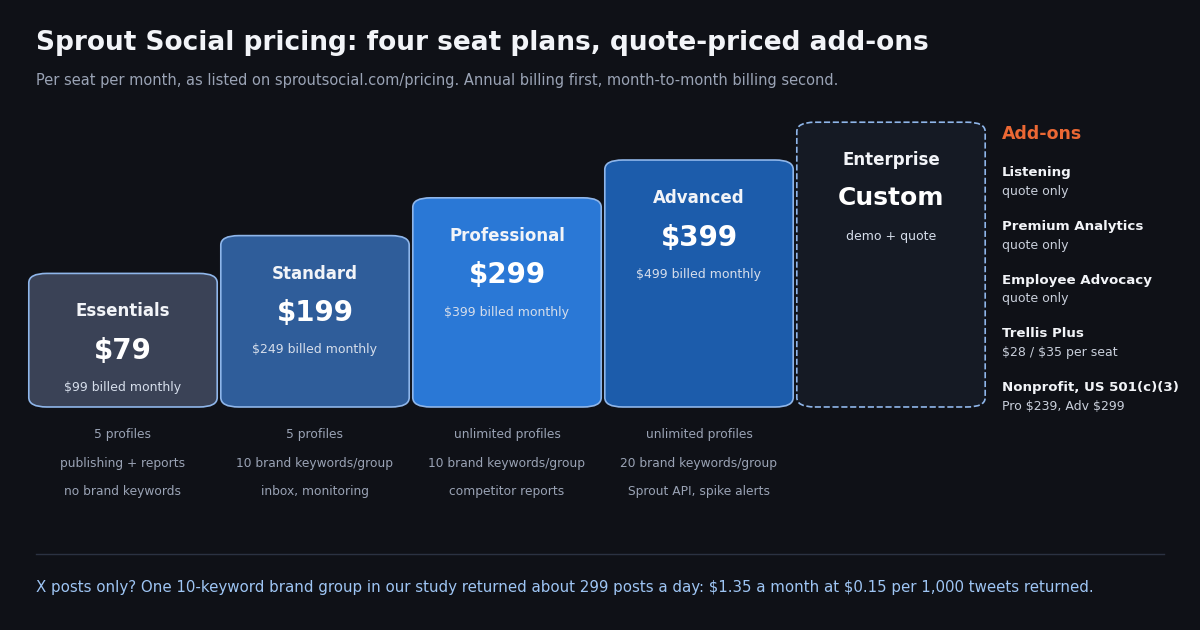
- Annual billing, per seat a month: Essentials $79, Standard $199, Professional $299, Advanced $399; Enterprise is custom.
- Monthly billing costs more: $99, $249, $399 and $499, a 25% to 33% premium, listed only in Sprout's pricing FAQ.
- Listening has no list price: it is an add-on for Standard and up, sold through a demo; Essentials has no brand keywords at all, Standard and Professional allow 10 per group, Advanced 20.
- Nonprofits (US 501(c)(3) only): Professional $239 and Advanced $299 per seat a month, annual, at least two seats.
- Our study: one 10-keyword brand group returned about 299 X posts a day; Hootsuite alone was 92% of it, and most of those only matched a
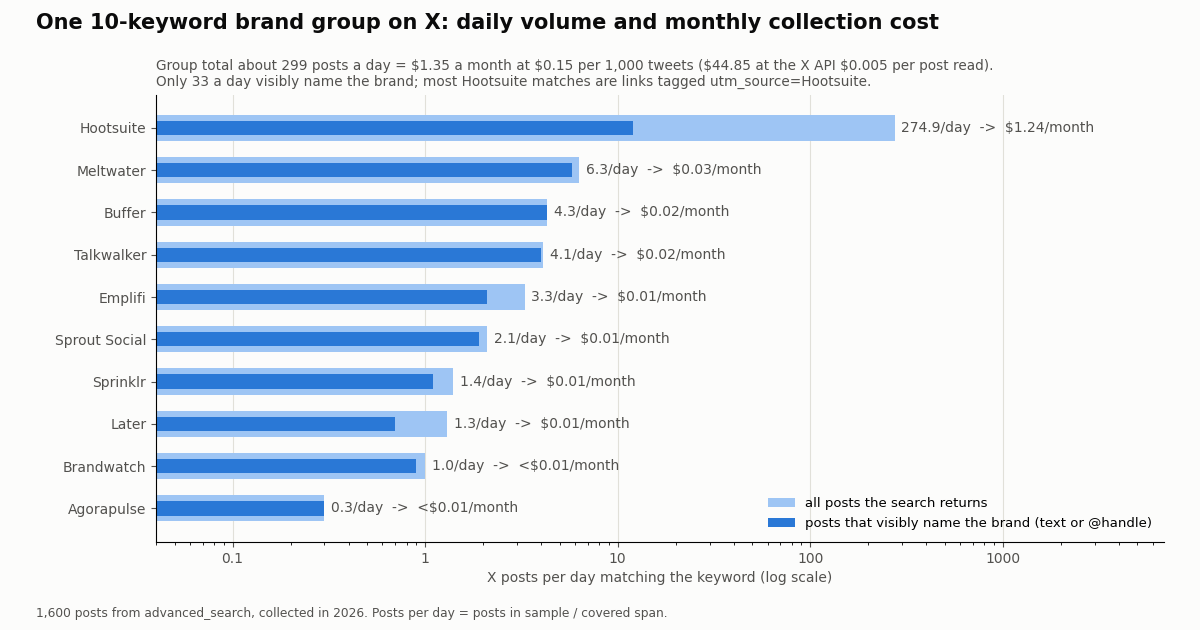
utm_source=Hootsuitelink tag. About 33 a day visibly named a brand. - X data only: collecting all of it costs about $1.35 a month at $0.15 per 1,000 tweets returned, or $44.85 at the X API's $0.005 per post read.
Sprout Social is a social media management suite: publishing, a shared inbox, reports and, as a paid add-on, listening across X, Instagram, Facebook, LinkedIn, TikTok and other networks. Its pricing page shows four seat plans, and most of what moves the final bill sits outside the headline numbers: the billing term, the number of seats, the brand keyword cap and the add-ons that are sold only through sales.
This page covers Sprout's plans, seat math, add-ons and the nonprofit rate. Questions about Sprout's Public API (which plan unlocks it and what it returns) are answered on our Sprout Social API page, linked below, so they are not repeated here.
We also measured the part of the bill that is easy to price on its own: the X (Twitter) posts behind one brand keyword group. That number helps a team decide whether it needs a full suite with Listening, or only a feed of X mentions it can pull itself.
About 299 posts a day (8,970 a month): $1.35 a month at $0.15 per 1,000 tweets vs $44.85 at the X API's $0.005 per post read. 1,600 posts, collected in 2026.
Sprout Social plans and prices
Sprout Social lists four self-serve plans and an Enterprise tier on sproutsocial.com/pricing. The prices on the plan cards are per seat, per month, on annual billing. A separate FAQ entry on the same page, titled "What is the difference between annual and monthly billing?", lists the month-to-month prices.
Essentials ($79 annual, $99 monthly). Labeled new on the page and aimed at publishing workflows: up to 5 social profiles, optimal send times, profile and post-level reporting, and Trellis, Sprout's AI agent. The compare table lists brand keywords as "Not included", so Essentials does no keyword monitoring.
Standard ($199 annual, $249 monthly). 5 social profiles, the consolidated inbox and collaboration tools, keyword and location monitoring, Trellis and review management. This is the lowest plan that can take the Listening, Premium Analytics, Employee Advocacy and Professional Services add-ons.
Professional ($299 annual, $399 monthly). Marked "Most popular". Unlimited social profiles, message tagging, competitor, tag and paid insights, and AI Assist for posts. Competitor reports cover Facebook Pages, X profiles and Instagram profiles.
Advanced ($399 annual, $499 monthly). Adds sentiment in the Smart Inbox and reviews, AI Assist for replies, Message Spike Alerts, team productivity and customer care reports, Helpdesk integrations and the Sprout API. It doubles the brand keyword cap to 20 per group.
Enterprise (custom). Everything in Advanced plus white-glove onboarding, SSO setup service, priority support and a plan tailored by sales. No price is shown; it starts with a demo.
Each seat includes 100 Trellis AI credits a month on every plan. The profile limit counts X, Instagram, Facebook, LinkedIn pages and personal profiles, TikTok, YouTube, Pinterest, WhatsApp and several review sites; Google Analytics and ad accounts do not count against it, per the tooltip on the compare table.
Annual vs monthly billing: the hidden premium
The plan cards show annual prices. Sprout's FAQ explains that annual billing is a one-time upfront payment for the whole term, while month-to-month terms "have a higher cost per month". The gap is not small:
On Professional the monthly premium is $100 per seat a month, or $1,200 per seat over a year. A team that is not sure it will stay a full year pays for that flexibility; a team that is sure pays a year up front. Sprout also notes that billing options with multiple payments during a term do not get the same discount as the single upfront payment.
Payment is by major credit card or PayPal online; prepayment arrangements go through sales. The 30-day free trial needs no credit card, and Sprout says you can switch plans at any time, including during the trial.
Seat math: what a team actually pays
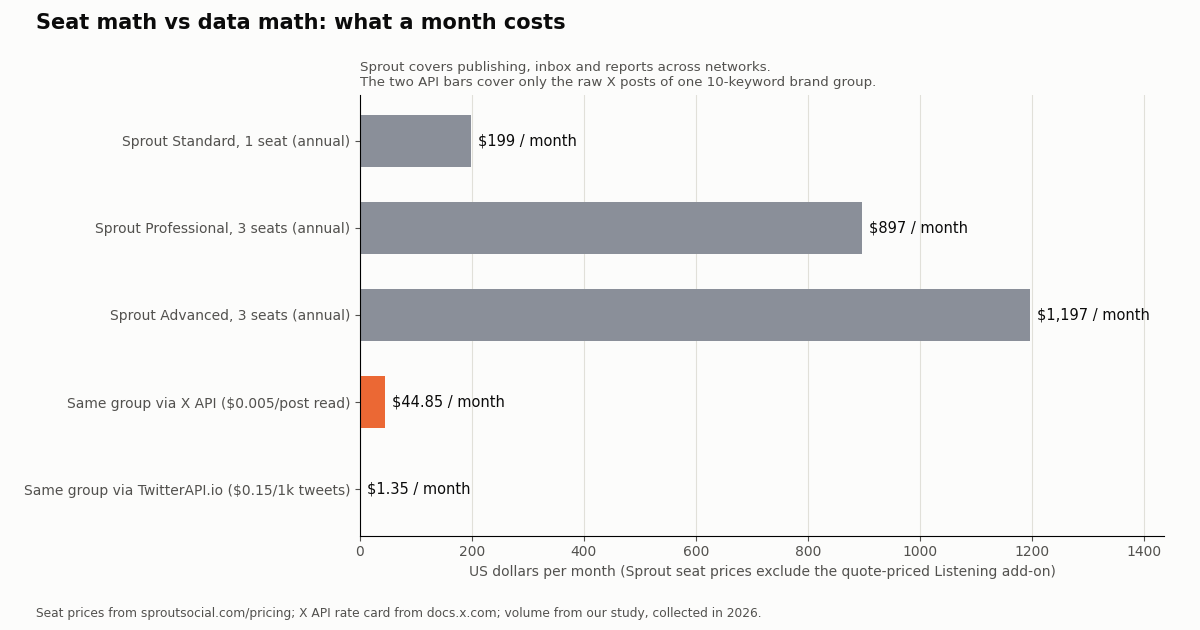
Every Sprout price is per seat, and a seat is one user. The base subscription scales linearly with headcount before any add-on:
A three-person social team on Professional with annual billing pays $897 a month, $10,764 a year. The same team on monthly billing pays $1,197 a month. On Advanced, three seats cost $1,197 a month annual and $1,497 monthly.
Add-ons are priced on top of these numbers. Trellis Plus, the 1,000-credit AI allowance, is a flat $28 per seat a month on annual billing or $35 monthly, and can be bought for only some seats. Listening, Premium Analytics and Employee Advocacy have no published price at all (next section).
The practical rule: count who needs to log in, not who needs to see reports. Sprout's compare table lists scheduled report delivery by email as PDF and PDF/CSV downloads, so stakeholders who only read results may not need a seat; confirm which plan includes scheduled delivery during the trial.
Sprout Social Listening pricing and the other add-ons
Sprout sells three add-ons that change the bill the most, and none has a public price on sproutsocial.com/pricing. Each card ends with "Schedule a demo" or "Schedule a consultation":
Listening. AI topic categories, sentiment tracking and scoring, spike alerts and machine-learning filters over public conversations. Available as an add-on to Standard and up. Price: by quote.
Premium Analytics. Custom report filters, interactive charts, custom benchmarks and shareable report links. Add-on to Standard and up. Price: by quote.
Employee Advocacy. A curated content feed for employees to share, with UTM tracking and earned media value. Add-on to Standard and up. Price: by quote.
Professional Services. Strategy reviews, training and listening consultations in several package levels. Standard and up. Price: by quote.
Trellis Plus. The one add-on with a list price: $28 per seat a month on annual billing, $35 monthly, for 1,000 Trellis credits per seat instead of 100.
Influencer Marketing and NewsWhip are separate products that need no Sprout plan, also sold through a demo.
Several third-party pricing guides quote a Listening figure, but Sprout itself publishes none, and the figures we found were estimates rather than list prices, so we do not repeat them here. The honest way to budget Listening is to get a quote that names the number of topics, the keyword volume and the networks covered, because those are the levers sales will price on.
Before asking for that quote, check whether the plan's own keyword monitoring is enough. Standard and Professional include real-time keyword and brand monitoring in the Smart Inbox with 10 brand keywords per group; Advanced allows 20. Listening is the add-on for topic-level analysis on top of that.
Sprout Social nonprofit pricing
Sprout's nonprofit page (sproutsocial.com/pricing/nonprofit-pricing/) lists a discount on two plans only:
Who qualifies. US organizations with 501(c)(3) status. Nonprofits outside the US, and US nonprofits under other 501(c) categories, are not covered by the published offer.
Conditions. At least two seats, on an annual subscription. A single-seat nonprofit, or one that wants monthly billing, pays the list price.
What it is worth. Two Professional seats at the nonprofit rate cost $478 a month instead of $598, a saving of $1,440 a year. Two Advanced seats cost $598 a month instead of $798, a saving of $2,400 a year.
Essentials and Standard have no nonprofit rate, so a small nonprofit choosing between Standard at the list price and Professional at the nonprofit price is comparing $199 with $239 per seat. Sign-up runs through Sprout's sales team.
Study: how many X posts sit behind one 10-keyword brand group
Standard and Professional cap a brand group at 10 keywords. To see what that cap holds on X, we built one realistic group, the social media management category itself, and pulled the latest matching posts for each brand: Sprout Social, Hootsuite, Buffer, Later, Agorapulse, Brandwatch, Meltwater, Sprinklr, Talkwalker and Emplifi. Each query matched the brand name or its @handle and excluded the brand's own posts. We collected 1,600 posts in 2026.
One keyword was mostly noise. 96% of the Hootsuite matches never named Hootsuite to a reader: the word sat only inside a link, as a utm_source=Hootsuite tag that typically marks links shared through Hootsuite, here mostly by news outlets. Just 20 accounts produced all 160 of those posts, the busiest one 18% of them. Counting only posts where the brand is visible in the text or a mentioned @handle, the whole group drops from about 299 to about 33 posts a day.
The volume is uneven. The group totals about 299 posts a day, or about 8,970 a month. Hootsuite alone accounts for 92% of that, while Agorapulse produced 0.3 a day. The median keyword in the group produced 2.7 posts a day. One noisy brand name decides most of the bill and most of the reading load.
Most of it is conversation, not news. Across all 1,600 posts, 29% were replies and 65% were standalone posts. 17% had no likes, reposts, replies or quotes at all, and 26% came from accounts with fewer than 1,000 followers.
Languages. The top languages in the pooled sample were en 74%, it 9%, fr 4%, es 2%. A listening setup that only reads English would miss part of every brand's mentions.
What X data costs on its own
If a team already publishes from another tool and only wants the X posts that mention its brands, the bill is a data bill, not a seat bill. Using the study volume:
Per 1,000 tweets, the official X API rate card is $5 and TwitterAPI.io is $0.15, about 33x apart. The X API pay-per-usage plan is capped at 3 million post reads a month, with Enterprise above that.
Polling adds a small floor. A search that finds nothing is billed at the 15-credit minimum, $0.00015. Checking all 10 keywords every 5 minutes for a month, with every check empty, costs $12.96; every 60 seconds costs $64.80. Checks that do return posts are billed per tweet returned instead, and those tweets are already counted in the volume above.
This is not a like-for-like replacement. Sprout's seat price buys publishing, an inbox with reply workflows, approval flows, cross-network reports, review management and sales-led support. The data bill buys raw X posts and nothing else: you store them, filter them and decide what to alert on. For a team whose only gap is X mentions, the data route costs dollars a month; for a team that needs the workflow, the seat is what it is paying for.
New accounts that pass the automatic bot check get up to $1 of free credits (at most 100,000 credits, no card, one per person or network, expiring after 31 days); purchased credits never expire. Rate limits are 0.2 requests per second before the first payment and 20 once paid. Reads need no X account.
Which Sprout Social plan fits, and when to skip it
Publishing only, one or two people: Essentials at $79 a seat (annual) covers scheduling and reports for 5 profiles but has no keyword monitoring.
Small team that answers mentions: Standard at $199 a seat adds the inbox and 10 brand keywords per group, still with a 5-profile limit.
Agencies or brands with many profiles: Professional at $299 a seat removes the profile limit and adds competitor reports. It is also the first plan with a nonprofit rate.
Customer care and integrations: Advanced at $399 a seat adds sentiment, spike alerts, Helpdesk integrations and the Sprout API, with 20 brand keywords per group.
Only X mentions feed a dashboard, a data warehouse or an alert channel: a seat plan is more than the job needs. A scheduled search per keyword, billed per tweet returned, covers it; the code below is the whole collector.
Run the free trial with your real keyword list first. Watch how many matches each keyword brings in a week: our study shows that one brand name can produce most of the volume, and that much of it can be noise (link tags, unrelated uses of a common word). Volume and topic count are what a Listening quote is priced on, so clean keywords lower the quote as well as the reading load.
How we collected this
Question. How many X posts does one 10-keyword brand group produce, how many of them visibly name the brand, what share is replies and low-engagement chatter, and what does collecting all of it cost per month when billed per post?
Visible match. A post counts as visibly naming the brand when the brand term or handle appears in its text or its mentioned handles. Posts that matched only through a link URL (for example a utm_source tag) are counted separately. We added this split after the first look at the raw Hootsuite pages.
Accounts and query. Ten public organization accounts in the social media management category: SproutSocial, hootsuite, buffer, latermedia, Agorapulse, Brandwatch, Meltwater, Sprinklr, Talkwalker and emplifi_io (each confirmed with a profile lookup). One search per brand: the brand name or the @handle, excluding the brand's own posts, latest first.
Window and sample. Up to 8 pages (about 160 posts) per keyword, 1,600 posts in total, collected in 2026. Posts per day = posts in the sample divided by the span from the oldest to the newest post, so busy keywords cover hours and quiet ones cover weeks. The study used 92 requests and cost $0.24.
What the sample cannot show. It is one snapshot per keyword, not a full month; volume moves with launches, outages and news. Short brand names collide with ordinary words ("later", "buffer"), so we used quoted phrases or handles, which undercounts mentions that use neither. It says nothing about Sprout's own data coverage or listening quality.
Privacy. Aggregates only. Raw search pages stayed off the repository because most authors are private individuals; the committed sample holds de-identified rows (no IDs, links, text or handles). Only the ten organization accounts are named.
Sprout prices come from sproutsocial.com/pricing and sproutsocial.com/pricing/nonprofit-pricing/, and X API prices from docs.x.com, all read this year.
import os
import time
import requests

BASE = "https://api.twitterapi.io"
HEADERS = {"X-API-Key": os.environ["TWITTERAPI_IO_KEY"]}

# One brand group: up to 10 keywords, the same cap Sprout's Standard plan uses.
KEYWORDS = {
    "Sprout Social": '("sprout social" OR @SproutSocial) -from:SproutSocial',
    "Hootsuite": "(hootsuite OR @hootsuite) -from:hootsuite",
    "Brandwatch": "(brandwatch OR @Brandwatch) -from:Brandwatch",
}


def search(query, max_pages=5):
    """Yield tweets newest first, following next_cursor until has_next_page is false."""
    cursor = ""
    for _ in range(max_pages):
        r = requests.get(
            f"{BASE}/twitter/tweet/advanced_search",
            headers=HEADERS,
            params={"query": query, "queryType": "Latest", "cursor": cursor},
            timeout=30,
        )
        r.raise_for_status()
        body = r.json()
        for t in body.get("tweets", []):
            yield t
        if not body.get("has_next_page"):
            break
        cursor = body.get("next_cursor", "")
        time.sleep(5)  # 0.2 requests/s before the first payment


def since(query, hours=24):
    """Restrict a query to the last N hours with X search operators."""
    start = int(time.time()) - hours * 3600
    return f"{query} since_time:{start}"


for label, q in KEYWORDS.items():
    tweets = list(search(since(q, 24)))
    replies = sum(1 for t in tweets if t.get("isReply"))
    media = sum(1 for t in tweets if (t.get("extendedEntities") or {}).get("media"))
    likes = sorted(t.get("likeCount", 0) for t in tweets)
    print(f"{label}: {len(tweets)} posts in 24h, {replies} replies, {media} with media, "
          f"median likes {likes[len(likes) // 2] if likes else 0}, "
          f"cost ${len(tweets) * 0.00015:.4f}")
    for t in tweets[:3]:
        a = t.get("author", {})
        print("  ", t["createdAt"], a.get("userName"), a.get("followers"), t["text"][:80].replace("\n", " "))
Researching this?Free starter credits cover end-to-end testing — Google sign-in, no card. Get a key.
Questions readers ask
How much does Sprout Social cost per month?
Per seat: Essentials $79, Standard $199, Professional $299, Advanced $399 on annual billing; $99, $249, $399 and $499 on monthly billing. Enterprise is custom. Multiply by the number of users who need to log in.
Is Sprout Social Listening included in any plan?
No. Listening is an add-on for Standard and up, sold through a demo with no published price. Standard and Professional do include keyword and brand monitoring with 10 brand keywords per group (20 on Advanced); Essentials has none.
How much is Sprout Social Listening?
Sprout does not publish a price. The pricing page lists Listening as an add-on and sends you to schedule a demo. Ask for a quote that states the number of topics, keyword volume and networks, because those drive the price.
Does Sprout Social have nonprofit pricing?
Yes, for US 501(c)(3) organizations: Professional at $239 and Advanced at $299 per seat a month, billed annually, with a minimum of two seats. Essentials and Standard have no nonprofit rate.
Is there a free plan or free trial?
There is no free plan. Sprout offers a 30-day free trial with no credit card, after which you pick a plan and enter payment details. You can also request a guided demo.
Why is Sprout Social more expensive on monthly billing?
Annual billing is one upfront payment for the term and gets the lower rate. Month-to-month terms cost 25% to 33% more per seat; on Professional that is $100 per seat a month.
Can I get only Twitter (X) mentions without a Sprout seat?
Yes, if you only need the posts and will build the alerting yourself. Our study of one 10-keyword brand group found about 299 X posts a day, about $1.35 a month at $0.15 per 1,000 tweets returned, or $44.85 at the official X API's $0.005 per post read. You lose Sprout's inbox, publishing and reporting.
Which Sprout Social plan includes the API?
The pricing page lists the Sprout API and Helpdesk integrations on Advanced and above. Our Sprout Social API guide covers what that API returns and its limits.
Continue
- X developer docs: X API pricing (pay-per-usage rate card, 3M post read cap)
- TwitterAPI.io docs: Advanced Search endpoint
- TwitterAPI.io API documentation
- X developer docs: building a search query (operators, exact phrases, -from:)
- TwitterAPI.io pricing and credit packs
- X (Twitter) API overview: endpoints and pricing
- Sprout Social API: what it returns and which plan unlocks it
- Brandwatch alternative for X listening, priced per post
- X API options for social listening compared
- Twitter (X) monitoring tools for brands and developers
- How to search mentions on Twitter (X)
- TwitterAPI.io pricing: $0.15 per 1,000 tweets returned
- 01Warp Pricing in 2026: Plans, Dollar Usage, Add-ons and the Real Monthly Bill
- 02Roo Code vs Cline in 2026: After the Shutdown, Which One to Run
- 03What Is x402? How the HTTP 402 Payment Protocol Works, With a Real 402 Offer Decoded
- 04Windsurf (now Devin Desktop) vs Cursor in 2026: plans, agents, MCP and what X users say
- 05Gemini CLI vs Claude Code in 2026: Access, Quotas, MCP and Pricing for Twitter (X) Data Agents
- 06Sprout Social Alternatives: What to Use Instead, by Job, With a Twitter (X) Data Study
- 07Sprout Social API in 2026: What It Returns, What It Costs, and Where Twitter (X) Data Runs Out
- 08Devin Pricing in 2026: Plans, Quotas, ACUs and What X Users Actually Pay
Writing about something you built with TwitterAPI.io? Our community rewards program pays API credits for honest tutorials, build logs and videos.
Stop reading. Start building.
Starter credits cover real testing on real data. Google sign-in, no card, no application queue.
Get an API keyAlready building with TwitterAPI.io? Publish an honest tutorial or build log about it and earn up to $200 a month in API credits.