Twitter (X) Retweet API: List Who Retweeted a Tweet, Retweet and Undo by API
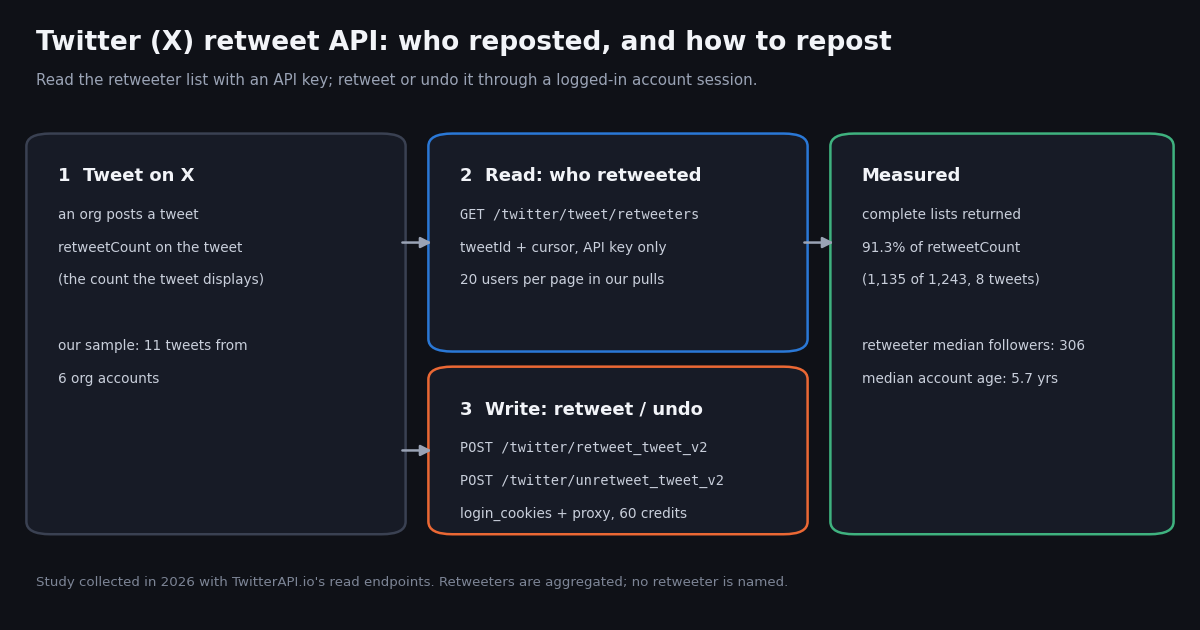
This guide covers the full retweet surface of the X (Twitter) API for one tweet at a time: who retweeted it, how to retweet it from code, and how to undo that retweet. If you need to undo hundreds of your own old retweets and likes in one cleanup run, that is a different job with its own ID-collection problem, covered in the bulk unlike and unretweet guide; quote posts (retweets with a comment) also have their own endpoint and guide.
The read side is where most developers start: a brand wants to know which accounts amplified a launch post, a researcher wants the follower profile of everyone who reposted a claim, a giveaway host needs the list of entrants who retweeted. X calls the official endpoint Get Reposted By. Below you get both routes with working code, what each returns and costs, and a measurement nobody else publishes: how much of the retweet count on a tweet a retweeter pull actually gives back, and what the retweeting accounts look like in aggregate.
All numbers on this page come from one study collected in 2026 on public tweets from @NASA, @SpaceX, @nvidia, @github, @vercel and @OpenAIDevs. Retweeters are mostly private individuals, so we report only aggregates and never name a retweeter.
What a Twitter retweet API covers: three jobs, two providers
"Retweet API" is used for three different calls. Reading the list of accounts that retweeted a tweet is a plain data read. Retweeting and undoing a retweet are write actions that run as a specific X account. The two providers developers usually compare split them the same way.
Retweet count vs retweeter list. Every tweet object already carries retweetCount (and quoteCount, likeCount, replyCount). If you only need the number, read it from /twitter/tweets?tweet_ids=... or any search result. You need the retweeter list only when you need the accounts themselves.
Retweets vs quotes. A quote post is a retweet with added text and is counted in quoteCount, not retweetCount. Quotes come back as tweets from the quotes endpoint, so they are priced and handled like any other tweet; this page is about plain retweets (X now labels them reposts).
Get the retweeters of a tweet with TwitterAPI.io
Send GET https://api.twitterapi.io/twitter/tweet/retweeters with one required query parameter, tweetId, and your key in the X-API-Key header. No X account, OAuth app or developer approval is involved. The response is a top-level users array plus has_next_page and next_cursor; pass next_cursor back as cursor to get the next page. The documentation at docs.twitterapi.io/api-reference/endpoint/get_tweet_retweeter states the order: newest retweet first ("Order by retweet time desc").
Page size. Each page returns about 20 retweeters, and in our 128 retweeter requests every full page held exactly 20 users, so budget pages as retweetCount / 20. The end of the list is signaled by has_next_page: false; in all 8 lists we read to the end, the final page was an empty users array with has_next_page false.
Fields you get per user. The objects we received carried: canDm, coverPicture, createdAt, description, favouritesCount, followers, following, id, location, mediaCount, name, profilePicture, protected, statusesCount, url, userName, verified. Note verified (not isBlueVerified) on these objects, and createdAt in ISO 8601 form (2022-07-22T12:28:28.000000Z), which differs from the Thu Oct 16 12:34:56 +0000 2026 format on tweet objects. Parse both if you join retweeters with tweet data.
Duplicates. Across 2,345 records we saw 29 repeated user ids inside the same tweet's list (cursor pages can overlap slightly while new retweets arrive). Deduplicate on id, as the code below does.
Price. Retweeter lists are billed at the tweet-endpoint rate: 15 credits per retweeter returned, $0.15 per 1,000, with a 15-credit minimum per request. A full 20-user page costs $0.003; the empty closing page costs the $0.00015 minimum. Listing everyone who retweeted a tweet with 1,000 retweets is about 50 full pages plus one empty page, roughly $0.15.
curl -s "https://api.twitterapi.io/twitter/tweet/retweeters?tweetId=2116636372073087124" \
  -H "X-API-Key: $TWITTERAPI_IO_KEY"
# {"users": [{"id": "...", "userName": "...", "followers": 306, "createdAt": "...", "verified": false, ...}],
#  "has_next_page": true, "next_cursor": "..."}
# Next page: add &cursor=<next_cursor>The official X API: Get Reposted By (/2/tweets/:id/retweeted_by)
X documents the official endpoint as Get Reposted By: "Retrieves a list of Users who reposted a specific Post by its ID" (docs.x.com/x-api/posts/get-reposted-by). It is GET https://api.x.com/2/tweets/{id}/retweeted_by and accepts an OAuth 2.0 user token or an app Bearer token.
Parameters. max_results takes 1 to 100 (default 100); pagination_token carries the next page; user.fields, expansions and tweet.fields choose which fields come back. The response has data (users), includes, errors and meta. The reference page lists no total cap on how many reposters you can page through.
Rate limits. The rate-limit table at docs.x.com/x-api/fundamentals/rate-limits lists GET /2/tweets/:id/retweeted_by at 75 requests per 15 minutes per app and 75 per 15 minutes per user. At 100 users per page that is at most 7,500 reposters per 15-minute window per app. The write side, POST /2/users/:id/retweets and DELETE /2/users/:id/retweets/:tweet_id, is 50 requests per 15 minutes per user.
Price. X's pay-per-usage rate card (docs.x.com/x-api/getting-started/pricing) charges reads per resource returned: User: Read is $0.010 per resource and Posts: Read is $0.005. Reposters come back as user objects, so a 1,000-reposter list is about $10 on that card, versus about $0.15 on TwitterAPI.io (roughly 67x). New paying X accounts get $20 in credits on a first card purchase plus a match of the first auto-recharge up to $50, and pay-per-usage is capped at 3 million post reads per monthly billing cycle, with Enterprise above that.
Reposts of me. X also offers GET /2/users/reposts_of_me (75 requests per 15 minutes per user, 100 max results), which returns reposts of the authenticated user's own posts. It needs that user's token, so it only helps when the tweets are yours.
# Official X API v2: Get Reposted By (users who reposted a post)
curl "https://api.x.com/2/tweets/2116636372073087124/retweeted_by?max_results=100&user.fields=created_at,public_metrics" \
  -H "Authorization: Bearer $X_BEARER_TOKEN"
# Next page: add &pagination_token=<meta.next_token from the previous response>How complete is a retweeter list? Measured on 11 tweets
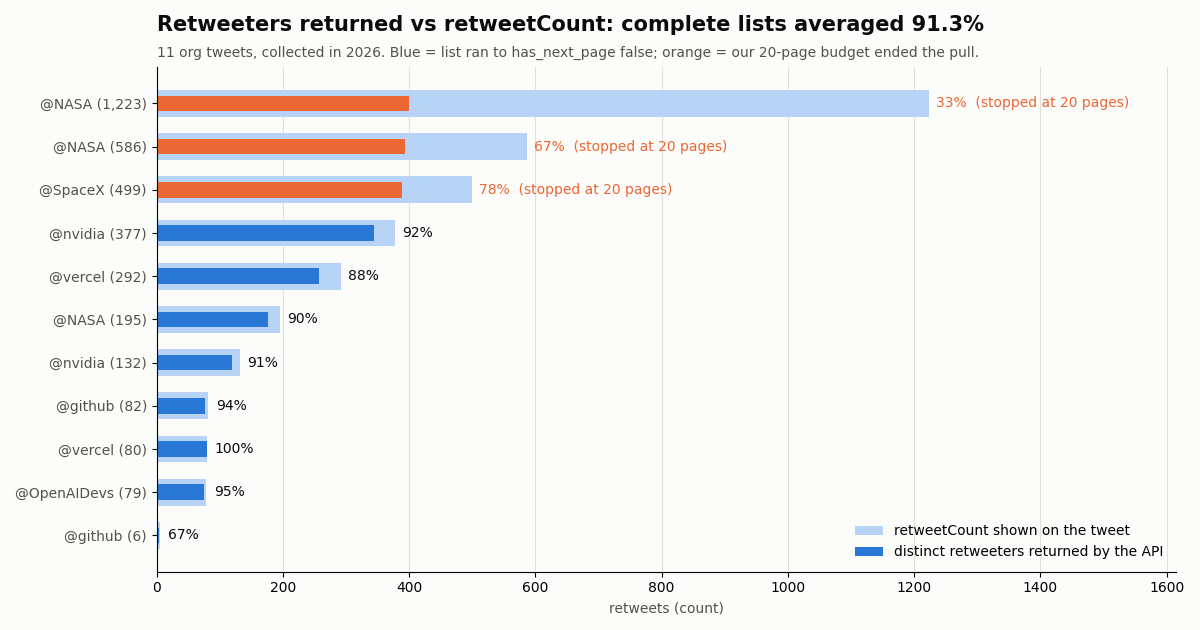
We pulled the retweeter list of 11 recent original tweets from six organization accounts and compared the number of distinct accounts returned with the retweetCount on the tweet at collection time. Eight lists ran to the end (has_next_page: false); for three larger tweets our 20-page study budget ended the pull first, so their percentages are a floor, not a measured ceiling.
The headline. Across the 8 complete lists the API returned 1,135 of 1,243 counted retweets, 91.3% pooled (median 91.2%). The low point, 66.7%, is a tweet with only 6 retweets where 2 missing accounts swing the ratio.
Why the list is shorter than the count. The count is a running total; the list is the accounts that can be shown now. Plausible gaps are retweets from protected accounts (none of the 2,178 accounts we received was protected, which is consistent with protected reposts not being listed publicly), suspended or deactivated accounts, and retweets undone after the count updated. In our complete lists, roughly one in eleven counted retweets had no account we could retrieve.
Large tweets need a budget. @NASA's 1,223-retweet tweet returned 400 accounts in the 20 pages we allowed (32.7% of the count, still climbing). At 20 users per page a full pull would need about 62 pages. Plan retweetCount / 20 + 1 requests per tweet.
Who actually retweets: follower counts and account age of retweeters
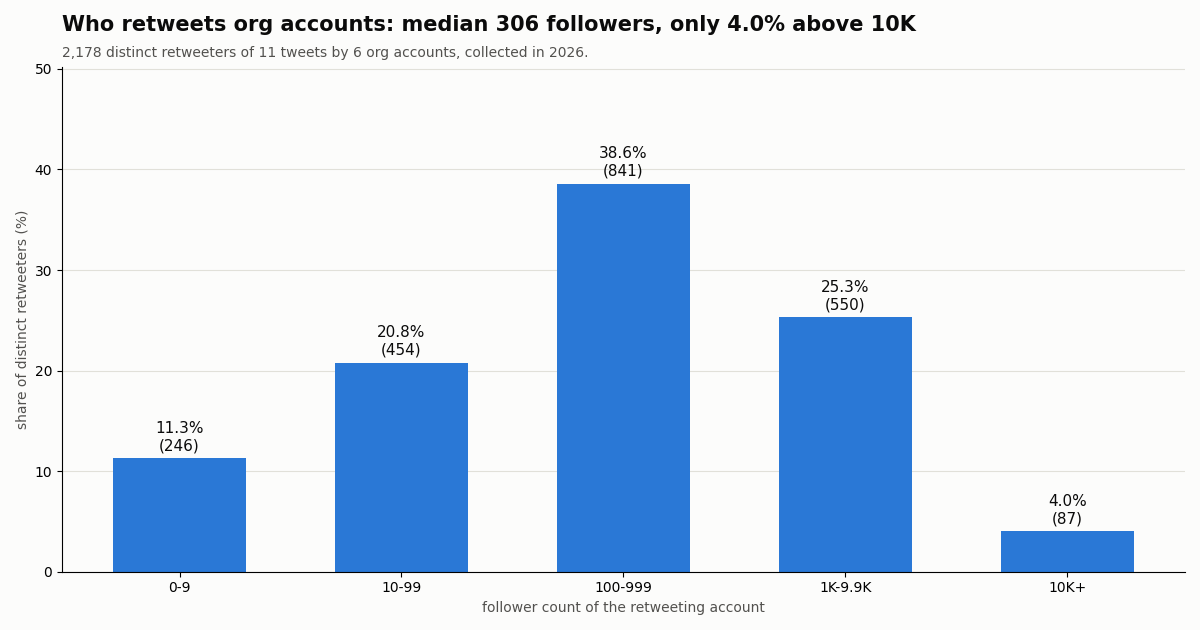
The 2,178 distinct retweeters in the sample are mostly ordinary accounts, not influencers. The median retweeter had 306 followers; 90% had 4,023 or fewer; only 87 accounts (4.0%) had 10,000 or more.
Account age. The median retweeting account was 5.7 years old. 41.6% were older than 8 years and 12.9% were created within the last year; a giveaway or campaign that sees a much higher share of very new accounts is worth a closer look for signs of automation.
Flags. 31.1% of the user objects carried verified: true, and 0% were protected. One record had no createdAt, so the age table covers 2,177 accounts.
What to do with it. Sort by followers to find the few large accounts that drove reach, bucket by createdAt to spot a wave of fresh accounts, and join the ids against your own customer or community list. For deeper profiles of the top accounts, batch their ids into /twitter/user/batch_info_by_ids, which costs 1 credit per user at 100 or more ids per call.
Retweet and undo a retweet by API
Writes on TwitterAPI.io run through an authenticated session for an X account you control. Log in once with POST /twitter/user_login_v2 (body: user_name, email, password, optional totp_secret, and a proxy you supply; 10,000 credits = $0.10). The response contains login_cookies. Then send login_cookies, tweet_id and proxy as JSON to POST /twitter/retweet_tweet_v2 to retweet, or to POST /twitter/unretweet_tweet_v2 to undo. Each call is 60 credits = $0.0006.
Behavior from the docs. Retweeting a tweet the account already retweeted returns success; if X rejects the retweet, status is error with X's reason in the response. Unretweeting a tweet the account never retweeted is a no-op on X's side and still returns success. Billing is per HTTP 200 call, so a call that comes back with X's rejection still counts.
Account safety. Every write acts as that account. X can rate-limit, lock or suspend an account that retweets in bursts, so keep a human pace (seconds between actions, not milliseconds), keep volumes modest, and expect the session to need a fresh login from time to time. Use a high-quality residential proxy you control; the docs warn against free proxies.
Official route. On X's API, retweeting is POST /2/users/:id/retweets with a JSON body {"tweet_id": "..."} and undoing is DELETE /2/users/:id/retweets/:tweet_id, both with a user-context token and both limited to 50 requests per 15 minutes per user. X's write table prices User Interaction: Create at $0.015 per request and Interaction: Delete at $0.010; check your Developer Console usage view to confirm which line your reposts land on.
Bulk undo. If you need to remove many old retweets, list them first (a retweet on your timeline carries a retweeted_tweet object) and loop the unretweet call; the bulk unlike and unretweet guide walks through that run end to end.
import os
import requests

BASE = "https://api.twitterapi.io"
HEADERS = {"X-API-Key": os.environ["TWITTERAPI_IO_KEY"]}
PROXY = os.environ["MY_PROXY"]  # your own residential proxy: http://user:pass@host:port

# 1) Log in once (10,000 credits = $0.10). Keep login_cookies; reuse it until it expires.
login = requests.post(f"{BASE}/twitter/user_login_v2", headers=HEADERS, json={
    "user_name": os.environ["X_USER"], "email": os.environ["X_EMAIL"],
    "password": os.environ["X_PASSWORD"], "totp_secret": os.environ.get("X_TOTP", ""),
    "proxy": PROXY,
}, timeout=60).json()
cookies = login["login_cookies"]

# 2) Retweet (60 credits = $0.0006 per call, billed per HTTP 200 even if X rejects it).
TWEET_ID = "2116636372073087124"
rt = requests.post(f"{BASE}/twitter/retweet_tweet_v2", headers=HEADERS, json={
    "login_cookies": cookies, "tweet_id": TWEET_ID, "proxy": PROXY,
}, timeout=60).json()
print("retweet:", rt.get("status"), rt.get("msg"))

# 3) Undo it later (same body, same price). Keep a human pace between actions.
undo = requests.post(f"{BASE}/twitter/unretweet_tweet_v2", headers=HEADERS, json={
    "login_cookies": cookies, "tweet_id": TWEET_ID, "proxy": PROXY,
}, timeout=60).json()
print("unretweet:", undo.get("status"), undo.get("msg"))
Cost of a retweeter pull: TwitterAPI.io vs the official X API
Both providers bill reads per item returned. The comparison below uses TwitterAPI.io's published tweet-endpoint rate (15 credits per item, $1 = 100,000 credits) and X's pay-per-usage rate card at docs.x.com/x-api/getting-started/pricing (User: Read $0.010 per resource).
Throughput. On TwitterAPI.io the limit is per account, not per endpoint: 0.2 requests per second before your first payment, 20 once paid, 50 on Scale, 500 on Business, and up to 1,000 on request. At 20 requests per second and 20 users per page that is about 400 retweeters a second. X's endpoint allows 75 requests per 15 minutes per app.
Getting started. New accounts that pass the automatic bot check get up to $1 of free credits (at most 100,000 credits, no card, one per person or network, expiring after 31 days), enough for several thousand retweeters. Purchased credits never expire. Subscriptions (Starter $29, Builder $99, Pro $199, Scale $499, Business $1,499 a month) add bonus credits; see the pricing page for the details.
How we collected this
Question. When you ask an API who retweeted a tweet, how much of the tweet's retweet count do you get back, how fast does the list fill page by page, and what do the retweeting accounts look like in aggregate?
Accounts and tweets. One page of recent posts (/twitter/user/last_tweets) from @NASA, @SpaceX, @nvidia, @github, @vercel and @OpenAIDevs, then 11 original (non-repost) tweets chosen to span retweet counts from 6 to 1,223.
Method. /twitter/tweet/retweeters with tweetId, following next_cursor until has_next_page was false or 20 pages were read. Coverage = distinct user ids returned divided by the tweet's retweetCount from the timeline read moments earlier. 134 requests in total (128 retweeter pages), 2,345 records, 2,178 distinct accounts, collected in 2026.
What the sample cannot show. Eleven tweets from six well-known accounts are not a census: retweeters of a small personal account or of a viral post may look different, coverage can drift as counts update, and three of the eleven lists were cut by our page budget, so their coverage is a lower bound. We did not test the official X endpoint with a paid key; its limits and prices above are quoted from X's documentation.
Privacy. Retweeters are mostly private individuals. Raw retweeter pages were kept out of the published dataset; only aggregates and de-identified buckets (no ids, handles, names, bios or links) are published. Only the organization accounts that posted the tweets are named.
Build it: from a tweet ID to a retweeter report
The script below is the whole read workflow: fetch the tweet with /twitter/tweets to get retweetCount, page through /twitter/tweet/retweeters with deduplication, print coverage and follower stats, and write a CSV you can sort or join. It needs only an API key.
Useful extensions. Run it for every tweet in a campaign (read the IDs from /twitter/user/last_tweets), store each tweet's retweeter ids to see which accounts repost you again and again, or schedule it daily for a launch post to watch the list grow. To collect quote posts as well, add the quotes endpoint; to collect replies, see the reply API tutorial.
Next step. Create a key on the dashboard (new accounts that pass the automatic bot check get up to $1 of free credits (at most 100,000 credits, no card, one per person or network, expiring after 31 days)), then read the endpoint reference at docs.twitterapi.io for the full parameter list.
"""who_retweeted.py - list everyone who retweeted (reposted) a tweet, measure how much
of the tweet's retweetCount the list covers, and summarize the retweeting accounts.

    pip install requests
    export TWITTERAPI_IO_KEY=...      # from https://twitterapi.io/dashboard
    python who_retweeted.py 2116636372073087124
"""
import csv
import os
import statistics
import sys
import time

import requests

BASE = "https://api.twitterapi.io"
HEADERS = {"X-API-Key": os.environ["TWITTERAPI_IO_KEY"]}


def get_tweet(tweet_id):
    """Tweet by ID: returns the tweet dict (retweetCount, likeCount, author, ...) or None."""
    r = requests.get(f"{BASE}/twitter/tweets", headers=HEADERS,
                     params={"tweet_ids": tweet_id}, timeout=30)
    r.raise_for_status()
    tweets = r.json().get("tweets") or []
    return tweets[0] if tweets else None


def get_retweeters(tweet_id, max_pages=100):
    """Follow next_cursor until has_next_page is false. Dedupes by user id."""
    users, cursor, pages = {}, "", 0
    while pages < max_pages:
        params = {"tweetId": tweet_id}
        if cursor:
            params["cursor"] = cursor
        r = requests.get(f"{BASE}/twitter/tweet/retweeters", headers=HEADERS,
                         params=params, timeout=30)
        r.raise_for_status()
        body = r.json()
        pages += 1
        for u in body.get("users") or []:
            users.setdefault(u["id"], u)
        if not body.get("has_next_page") or not body.get("next_cursor"):
            break
        cursor = body["next_cursor"]
        time.sleep(0.1)  # stay well under your account's requests-per-second limit
    return list(users.values()), pages


def main(tweet_id):
    tweet = get_tweet(tweet_id)
    if tweet is None:
        sys.exit("tweet not found (deleted, protected, or wrong id)")
    users, pages = get_retweeters(tweet_id)
    shown = tweet["retweetCount"]
    print(f"@{tweet['author']['userName']}: retweetCount {shown}, "
          f"retweeters returned {len(users)} in {pages} pages "
          f"({100 * len(users) / shown:.1f}% coverage)" if shown else "no retweets")
    if users:
        followers = sorted(u.get("followers") or 0 for u in users)
        print("median followers:", statistics.median(followers))
        print("accounts with 10K+ followers:", sum(f >= 10_000 for f in followers))
    with open(f"retweeters_{tweet_id}.csv", "w", newline="") as f:
        w = csv.writer(f)
        w.writerow(["id", "userName", "followers", "following", "statusesCount", "createdAt"])
        for u in users:
            w.writerow([u["id"], u.get("userName"), u.get("followers"), u.get("following"),
                        u.get("statusesCount"), u.get("createdAt")])


if __name__ == "__main__":
    main(sys.argv[1])
Questions readers ask
Is there an API to see who retweeted a tweet?
Yes. On TwitterAPI.io call GET /twitter/tweet/retweeters?tweetId=<id> with an API key and page with cursor; on the official X API call GET /2/tweets/:id/retweeted_by. In our study a complete retweeter list returned 91.3% of the tweet's retweetCount.
Why does the retweeter list have fewer accounts than the retweet count?
The count is a running total, while the list holds accounts that can be shown now. Retweets by protected, suspended or deactivated accounts and retweets undone later are the likely gaps. In our sample complete lists covered 66.7% to 100% of the count, 91.3% pooled.
How many retweeters does each page return?
Every full page in our 128 retweeter requests held 20 users, matching the documented page size of about 20. The list ends when has_next_page is false; in every complete list we read, the last page was empty. X's retweeted_by returns up to 100 per page via max_results.
How much does it cost to get the retweeters of a tweet?
On TwitterAPI.io, 15 credits per retweeter returned ($0.15 per 1,000) with a 15-credit minimum per request, so 1,000 retweeters cost about $0.15. On the official X API, reposters are user reads at $0.010 each, about $10 per 1,000.
Can I retweet with the API?
Yes. On TwitterAPI.io log in once with /twitter/user_login_v2 ($0.10) to get login_cookies, then call POST /twitter/retweet_tweet_v2 with login_cookies, tweet_id and proxy (60 credits, $0.0006 per call). The call acts as that account, so keep a human pace; X can rate-limit, lock or suspend accounts that act in bursts.
How do I undo a retweet with the API?
Call POST /twitter/unretweet_tweet_v2 with the same login_cookies, tweet_id and proxy body ($0.0006 per call). If the account never retweeted the tweet, X treats it as a no-op and the call returns success. On the official API it is DELETE /2/users/:id/retweets/:tweet_id.
What are the rate limits for the X API retweeted_by endpoint?
X's rate-limit table lists 75 requests per 15 minutes per app and 75 per 15 minutes per user for GET /2/tweets/:id/retweeted_by, and 50 per 15 minutes per user for retweeting or undoing. TwitterAPI.io limits by account instead: 20 requests per second once paid.
Do quote tweets show up in the retweeter list?
No. Quote posts are counted in quoteCount and returned as tweets by the quotes endpoint. The retweeter list covers plain retweets (reposts) only.
Continue
- X API docs: Get Reposted By (GET /2/tweets/{id}/retweeted_by, max_results 1-100, pagination_token)
- X API docs: rate limits (retweets lookup 75/15min; manage retweets 50/15min per user)
- X API docs: pay-per-usage pricing (User: Read $0.010, Posts: Read $0.005, write actions)
- X API docs: Retweets endpoints overview (retweet, undo, retweeting users, reposts of me)
- TwitterAPI.io docs: Get Tweet Retweeters (tweetId, cursor, order by retweet time desc)
- TwitterAPI.io docs: Retweet Tweet v2 (login_cookies, tweet_id, proxy; 60 credits)
- X (Twitter) API overview: endpoints, pricing and access
- Bulk unlike and unretweet on X with the API
- Quote retweet by API: a programmatic guide
- Twitter reply API tutorial: read and post replies
- Track Twitter followers over time with the API
- Find a tweet or user ID with the Twitter ID finder
- TwitterAPI.io pricing: credits per tweet, profile and write action
- TwitterAPI.io API reference documentation
- 01Twitter (X) API License: The Developer Agreement in Plain English
- 02n8n Pricing in 2026: Plans, Executions and the Twitter (X) Data Cost
- 03Claude Managed Agents: What It Is, What It Costs, and a Twitter (X) Monitoring Agent Built on It
- 04Cursor vs Claude Code: Plans, MCP Setup and Headless Runs Compared for Twitter (X) Data Work
- 05Codex Pricing in 2026: ChatGPT Plans, Usage Limits, Credits and API-Key Costs
- 06How to Quote Retweet via Twitter (X) API — Programmatic Guide
- 07twitter-api-v2 (npm) Quick Start: the Twitter (X) API from Node.js and TypeScript in 2026
- 08GetXBot: What the Twitter (X) Video Bot Is, Whether It Is Safe, and Alternatives
Stop reading. Start building.
Starter credits cover real testing on real data. Google sign-in, no card, no application queue.
Get an API keyAlready building with TwitterAPI.io? Publish an honest tutorial or build log about it and earn up to $200 a month in API credits.