Base44 vs Lovable in 2026: which AI app builder to pick, and what Twitter (X) users say about both
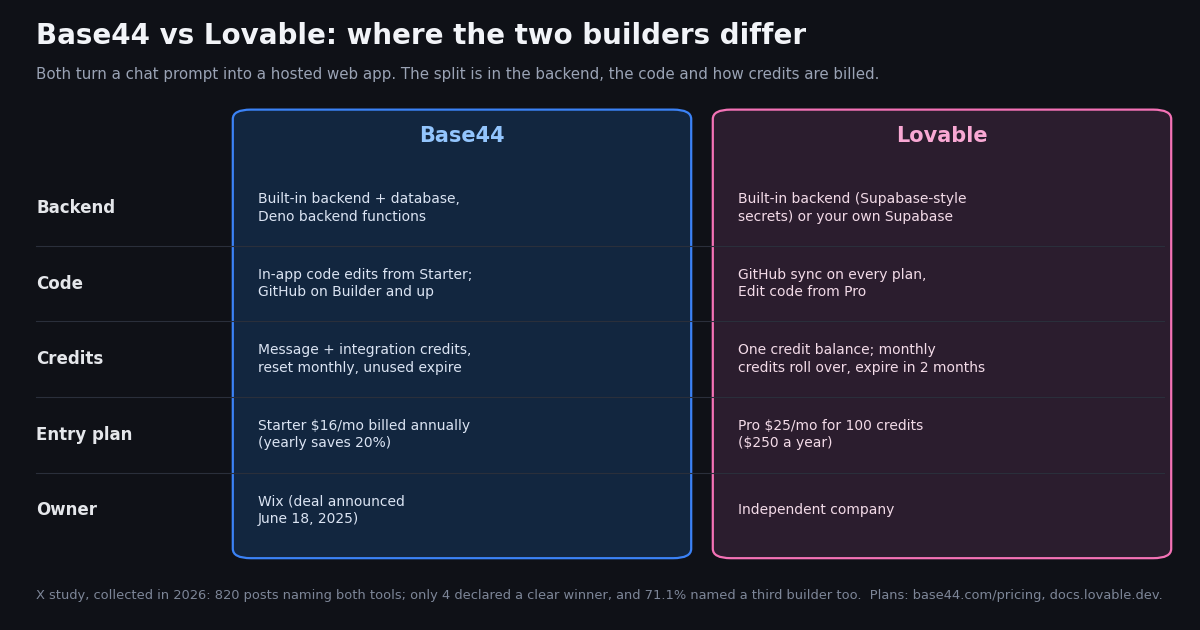
- Base44 = all-in-one. Built-in backend, database, auth and hosting; message credits for building and separate integration credits for your app's built-in services; Starter $16/mo billed annually (100 message credits), Builder $40, Pro $80, Elite $160.
- Lovable = code you own. Git sync on every plan, built-in backend or your own Supabase, one credit balance for building, Cloud hosting and AI features; Pro from $25/mo for 100 credits ($250 a year), tiers up to 10,000 credits.
- Credits behave differently. Base44 credits reset monthly and unused ones expire. Lovable monthly credits roll over and expire two months after issue; top-ups cost $0.30 a credit on Pro and last 12 months.
- X verdict: there isn't one. Of 820 posts naming both tools (639 authors, collected in 2026), only 4 declared a clear winner (2 each); 10.1% asked which one to pick.
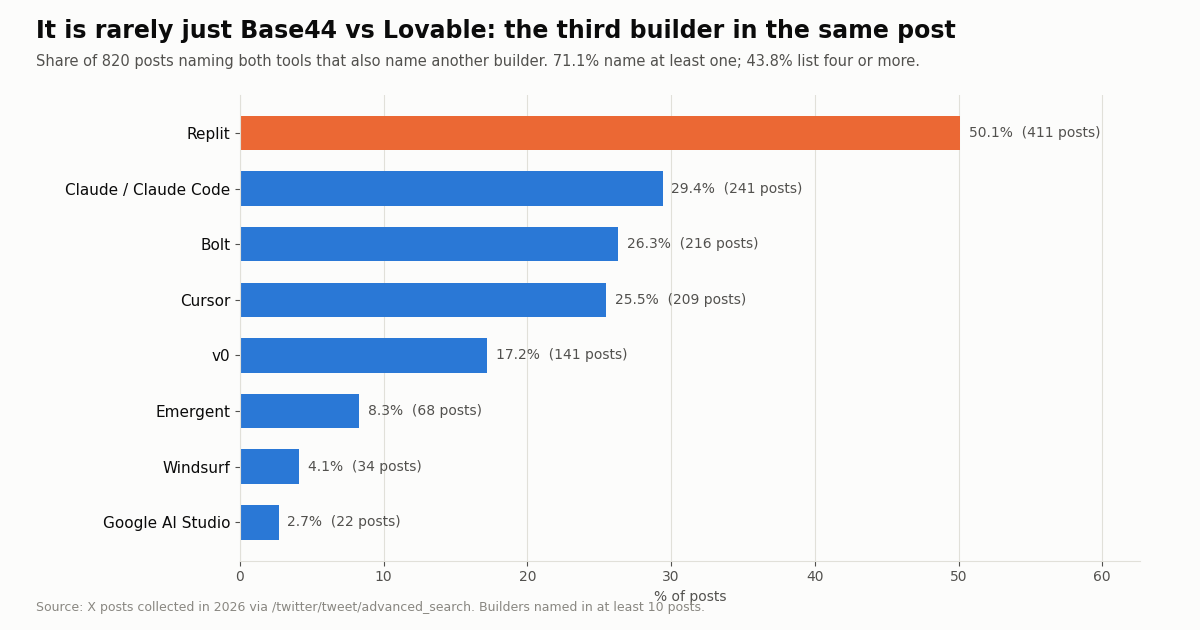
- It is a three-way race on X. 71.1% of those posts name a third builder: Replit in 50.1%, Claude or Claude Code 29.4%, Bolt 26.3%, Cursor 25.5%. Code and GitHub posts drew the highest median likes (12 vs 4 overall).
- Live X data costs the same in either builder. One Deno function calls
/twitter/tweet/advanced_search; TwitterAPI.io bills $0.15 per 1,000 tweets returned against $5 per 1,000 post reads on the official X API pay-per-usage rate card.
Base44 and Lovable sell the same promise: describe an app in a chat box and get a working, hosted web app back, with sign-in and a database, without writing the code yourself. That makes most comparisons read like two copies of the same feature list. The differences that matter show up later, when the app has real users: where the backend lives, whether you can walk away with the code, and how each tool turns your monthly payment into building and hosting capacity.
This page decides between the two. It does not repeat every plan tier; for that, read our Base44 pricing breakdown and Lovable pricing breakdown, and if neither fits, the Lovable alternatives comparison covers Bolt.new, v0, Replit and others. Here you get the decision table, a cost-per-credit comparison computed from both vendors' own numbers, a same-function test of wiring live data into each, and something no other comparison has: what 820 posts on X that name both tools actually say, plus how the two official accounts compare.
Every price below was read from base44.com/pricing, docs.base44.com, lovable.dev/pricing and docs.lovable.dev this year. Where a vendor page did not render a number, we say so instead of guessing.
4 of 820 (2 each), collected on X in 2026; 71.1% of the same posts named a third builder, Replit in 50.1%.
Base44 vs Lovable at a glance: the decision table
The table compares what each vendor publishes, not what reviewers report. Prices are US dollars per month as each vendor shows them.
Read it this way. If the deciding question is 'can I leave with my code at any time, even on the free plan', Lovable answers yes and Base44 answers yes from Builder ($40/mo billed annually) upward. If the deciding question is 'do I want to think about a backend at all', Base44's pitch is that you don't: every plan includes the backend, database, auth and analytics, and the FAQ on base44.com/pricing says apps run on production infrastructure. Lovable gives you the same out of the box through Cloud, with the option to point the project at a Supabase project you control.
Both say you own what you build. Base44's pricing FAQ says you own your code, data and users and that two-way GitHub sync exports the full source; Lovable's FAQ says you own your code, projects and customer data, subject to third-party rights in the underlying AI models.
Pricing head-to-head: what a dollar buys in each builder
Both tools sell credits, so the honest comparison is price per credit, with a warning: a Base44 message credit and a Lovable credit are not the same unit of work. The table divides each plan's price by its monthly building credits. Base44's yearly price is the one shown by default on base44.com/pricing; its FAQ says yearly billing saves 20%, which puts monthly billing at $20, $50, $100 and $200.
What a credit buys. Base44's credits docs estimate about 0.5 credits for a simple visual or text change, 1 for a small feature, 2 for a complex module and 3 to 4 for a large app-wide change, and manual visual edits in the editor cost nothing. Lovable's pricing FAQ lists 0.50 credits to make a button gray, 0.90 to remove a footer, 1.20 to add sign-up and login, 1.70 for a five-section landing page with three generated images, and 1 credit per message in Plan mode. For small edits the two scales line up; Base44 is cheaper per credit on every listed plan.
What the credit has to cover. This is where the per-credit table misleads if you stop there. A Base44 message credit only pays for building; your live app's built-in services (email, image generation, LLM calls, in-app agents) draw on a separate integration-credit pool, 2,000 a month on Starter. A Lovable credit pays for building, Cloud hosting and AI features from one balance, on top of included monthly grants of 20 Cloud and 4 AI credits. A Lovable app with real traffic can therefore eat into the same credits you build with; a Base44 app with real traffic eats integration credits instead.
What happens to unused credits. Base44's docs say paid message and integration credits reset on the same day each month and unused ones expire at the reset. Lovable keeps unused monthly credits for two months while you stay subscribed, keeps top-ups for 12 months, and reactivates unused paid credits if you resubscribe before they expire. If your building comes in bursts (one heavy week, then nothing), Lovable's rollover wastes less; if you build steadily, Base44's lower price per credit wins on paper.
Full tier lists, annual totals and the large Lovable credit tiers (up to 10,000 credits at $2,250 a month) are in the Base44 pricing guide and the Lovable pricing guide.
Backend, data and code ownership: where the two really differ
Base44: the backend is the product. Base44 apps get authentication, a database, file storage and analytics without any setup, and custom server code runs in backend functions: Deno functions with their own HTTP endpoint at https://<your-app-domain>/functions/<function-name>, secrets set with the secrets set CLI command and read with secrets.get() inside the handler (docs.base44.com/developers/backend/resources/backend-functions/overview). Invoking a function costs about 1 credit per 100 runs, and calling an outside service with your own API key uses no integration credits, per Base44's credits docs.
Lovable: the backend is Supabase-shaped. Lovable's Secrets docs say secrets are encrypted per project, injected into Edge Functions as environment variables (Deno.env.get(...)), and never reach the browser. The reserved SUPABASE_URL, SUPABASE_ANON_KEY and SUPABASE_SERVICE_ROLE_KEY secrets are filled in when the built-in backend or a connected Supabase project is enabled. In practice that means the backend you outgrow Lovable with is a standard Supabase project you can keep running elsewhere.
The exit path. Lovable's Git sync is on every plan, so a Free user can push the full project to GitHub, open it in Cursor or Claude Code, and keep building there. Base44 offers two-way GitHub sync too, but only from the Builder plan; on Free and Starter you edit code inside Base44. Exporting is half the story, though: a Base44 app's backend calls go through Base44's own SDK and runtime, so moving it off Base44 means replacing those calls, while a Lovable app on your own Supabase keeps its database and functions where they are.
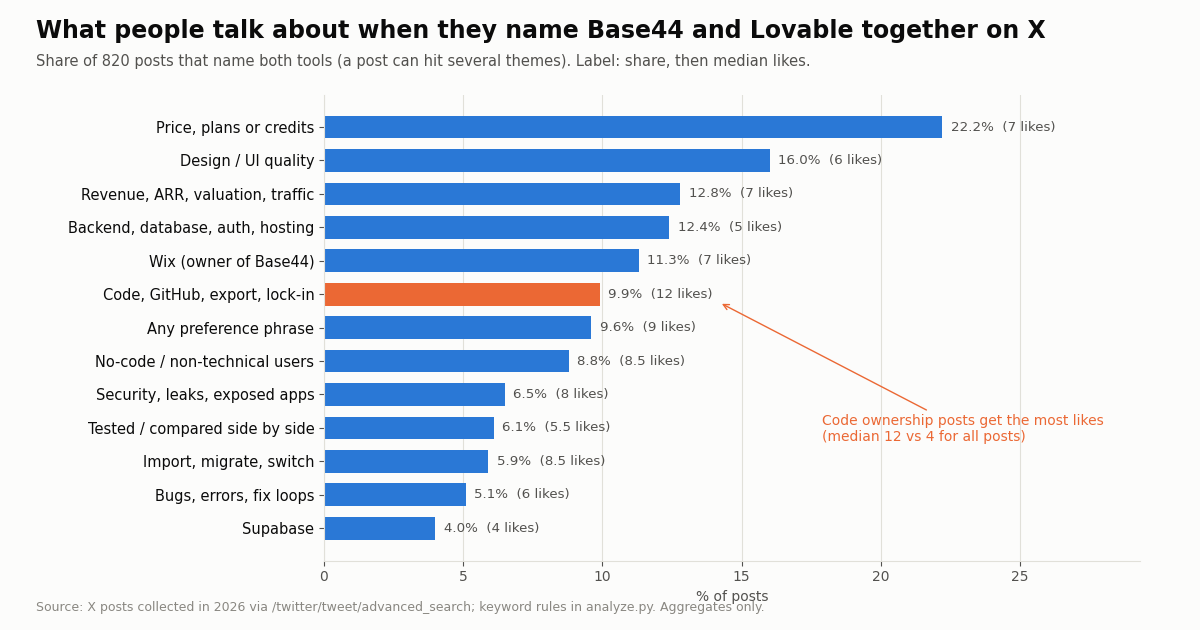
On X, ownership is the topic that travels. In our study, posts about code, GitHub, export or lock-in were 9.9% of the 820 head-to-head posts but drew a median of 12 likes, three times the median of 4 for all posts. Security posts (exposed apps, leaked data, missing auth across vibe-coded apps) were 6.5% with a median of 8 likes. Neither number says which tool is more secure; they say what readers react to.
Which one fits your project
Choose Base44 when you are not a developer and do not want to become one for this project; the app is an internal tool, a client portal or a data-heavy CRUD app where a built-in database and auth cover most of the work; you build at a steady pace each month; and paying $16 to $40 a month billed annually for 100 to 250 message credits beats paying $25 for 100. Base44's separate integration credits also make a busy app's built-in AI and email usage easy to see apart from your building.
Choose Lovable when you expect to hand the code to a developer, an agency or your own coding agent later; you care about the front end and want to iterate on design with Git history; you already use Supabase or want your data in a project you control; or your building comes in bursts that Lovable's two-month rollover absorbs. Lovable's unlimited workspace members on every plan also suit small teams.
Check both outputs first when the app needs a specific framework, native mobile code or a self-hosted stack: both builders generate their own project structure, so confirm what you get on the free plan before paying. For a different shape of tool, our Replit pricing guide covers a cloud IDE with an agent, and the Lovable alternatives comparison covers Bolt.new, v0 and code editors.
A cheap way to decide. Both free plans give about 5 building credits a day. Give both the same three prompts on the same day (a data model, a sign-in flow, a dashboard), then export or inspect the code each produced. That costs nothing and answers the question no review can: which output you would rather keep maintaining.
What 820 posts on X say when they name Base44 and Lovable together
We searched X for every recent post that mentions both products and kept the 820 whose text names both (79 replies that only tagged an account were dropped). They come from 639 distinct authors over a 360-day window; 744 are from 2026. The volume is steady: 217 posts in the first quarter of 2026, 199 in the second, 196 in the third.
Almost nobody declares a winner. Our rule counted a post as leaning one way only when it carried an explicit preference phrase next to one name ('prefer Lovable', 'Base44 is better', 'switched to Base44', 'Lovable > Base44'). Only 4 of 820 did, 2 for each tool. Another 83 posts (10.1%) asked the question instead: which one should I use. The head-to-head people search for is mostly being asked, not answered, on X.
Price is the first topic, then design. 22.2% of posts mention price, plans or credits and 16.0% mention design or UI quality. Business talk is close behind: 12.8% cite revenue, ARR, valuations or traffic, and 11.3% mention Wix, Base44's owner.
How to read it. The themes describe what gets said, not who is right. A price post can praise or complain; we did not score sentiment, because short posts that compare several tools rarely carry one clear tone. Use the table as a map of the questions buyers bring, and the decision table above for the answers.
It is rarely just Base44 vs Lovable: the third builder in the room
Only 28.9% of the posts name Base44 and Lovable alone. 71.1% bring in at least one other tool, and 43.8% are roundups that list four or more builders; the median post names three. Replit appears in half of all posts (50.1%), which is why searchers who type 'base44 vs lovable' are so often also weighing Replit.
The coding-agent split. Claude or Claude Code (29.4%) and Cursor (25.5%) show up almost as often as Bolt. Those are not prompt-to-app builders; they appear in posts that ask whether a builder is needed at all once a coding agent can write the app. That is the same ownership question as above, from the other side: Lovable's Git sync makes a later move to a coding agent straightforward, Base44's is available from Builder up.
For Replit's plans and agent pricing, see the Replit pricing guide; this page does not cover the Base44 vs Replit question in depth.
@base44 vs @Lovable: how the official accounts compare
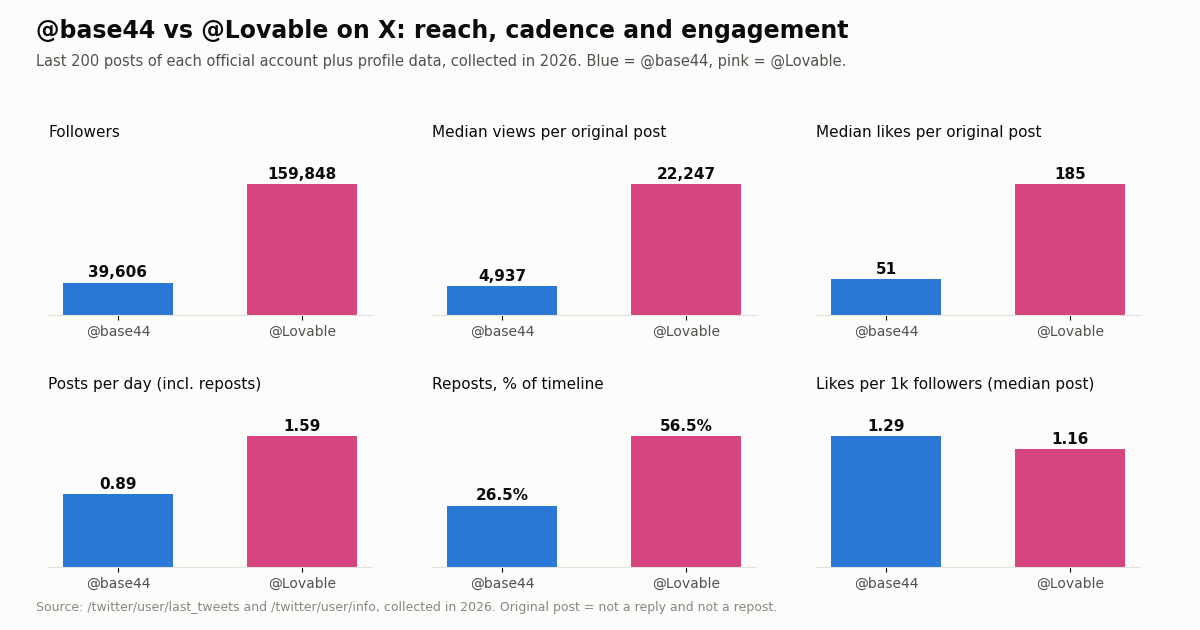
Both brands put a lot into X, so the official timelines are a fair read on how each company talks to builders. We pulled the latest 200 posts and the profile of each account.
Reach vs pull. @Lovable has about 4 times the followers and about 4.5 times the median views per original post. Scaled by audience, though, the two land close: a median @base44 post draws 1.29 likes per 1,000 followers against 1.16 for @Lovable. @Lovable reposts more than half of what appears on its timeline; @base44 posts more of its own material (73.5% of its timeline is not a repost).
Pricing talk is a small share for both. 11.6% of @base44's original posts and 10.3% of @Lovable's mention credits, plans, pricing, free offers or discounts. Neither brand talks about the other: @base44 named Lovable once in 200 posts, and @Lovable never named Base44.
Wiring live X (Twitter) data into either builder, and what it costs
A common first app in both tools is a dashboard of posts: brand mentions, a competitor watch, a feed of launches. Both builders run server code on Deno, so the call to an X data API is the same function in each; only the secret lookup and the export line differ. Keep the API key in Base44 secrets or Lovable Secrets, never in a VITE_ variable, which Lovable's docs describe as build-time values exposed to the browser.
Base44. Set the key with base44 secrets set TWITTERAPI_IO_KEY=..., read it with secrets.get() inside the handler, export the handler, and call it from the app with base44.functions.invoke(). Because the function calls an outside service with your own key, Base44's credits docs say it uses no integration credits beyond the invocation itself (about 1 credit per 100 runs).
Lovable. Add the key in the Secrets panel, read it with Deno.env.get(), serve the handler as an Edge Function, and call it with supabase.functions.invoke(). Small apps usually stay inside the monthly Cloud grant, per Lovable's pricing FAQ.
The function asks /twitter/tweet/advanced_search for the latest posts matching a query from a server-side allow-list, follows has_next_page and next_cursor, and returns slim objects (text, url, createdAt, likeCount, viewCount, author.userName). No X developer account is needed for reads. If you later move the code to a coding agent, our hosted X MCP server (https://mcp.twitterapi.io/mcp with an Authorization: Bearer header) lets Claude Code or Cursor query the same data while you build.
The X data bill. TwitterAPI.io bills 15 credits per tweet returned, which is $0.15 per 1,000 tweets, pay only for the data returned; $1 buys 100,000 credits. A full 20-tweet page costs $0.003 and a search that finds nothing costs the 15-credit minimum, $0.00015. The official X API pay-per-usage rate card (docs.x.com/x-api/getting-started/pricing) lists $0.005 per post read, which is $5 per 1,000 posts, about 33 times more, and caps pay-per-usage at 3 million post reads a month before Enterprise.
The refresh rows are the floor: 8,640 checks a month at 5 minutes, or 43,200 at 60 seconds, that each find nothing. Checks that return tweets are billed per tweet instead. Either way the X data is a line item of a few dollars next to a $16 to $25 builder plan. The whole study on this page, 1,299 posts and two profiles over 67 requests, cost about 19,500 credits, roughly $0.20.
New accounts that pass the automatic bot check get up to $1 of free credits (at most 100,000 credits, no card, one per person or network, expiring after 31 days); purchased credits never expire. Requests run at 0.2 per second before the first payment and 20 per second once paid. Subscriptions start at Starter $29 a month; see TwitterAPI.io pricing.
// One handler, two builders. Both run server functions on Deno, so the X call is identical.
// Base44:  functions/xFeed/entry.ts, key set with `base44 secrets set TWITTERAPI_IO_KEY=...`
// Lovable: supabase/functions/x-feed/index.ts, key added in the Secrets panel
import { secrets } from "base44:runtime"; // Base44 only; delete this line in Lovable

const BASE = "https://api.twitterapi.io";

// Server-side allow-list: the browser picks a feed name, never a raw query.
const FEEDS: Record<string, string> = {
  compare: "(base44 OR @base44) (lovable OR @Lovable) -filter:retweets",
  launches: "from:base44 OR from:Lovable -filter:replies",
};

function apiKey(): string {
  // Base44: secrets.get() must run inside the request, not at module load.
  // Lovable: return Deno.env.get("TWITTERAPI_IO_KEY") ?? "";
  return secrets.get("TWITTERAPI_IO_KEY") ?? "";
}

async function handler(req: Request): Promise<Response> {
  const { feed = "compare", cursor = "" } = await req.json().catch(() => ({}));
  const query = FEEDS[feed];
  if (!query) return Response.json({ error: "unknown feed" }, { status: 400 });

  const url = new URL(`${BASE}/twitter/tweet/advanced_search`);
  url.searchParams.set("query", query);
  url.searchParams.set("queryType", "Latest");
  if (cursor) url.searchParams.set("cursor", cursor);

  const r = await fetch(url, { headers: { "X-API-Key": apiKey() } });
  const body = await r.json();
  if (!r.ok || body.status === "error") {
    return Response.json({ error: body.msg ?? body.detail ?? r.status }, { status: 502 });
  }
  const tweets = (body.tweets ?? []).map((t: any) => ({
    url: t.url,
    text: t.text,
    createdAt: t.createdAt,
    likeCount: t.likeCount,
    viewCount: t.viewCount,
    author: t.author?.userName,
  }));
  return Response.json({ tweets, has_next_page: body.has_next_page, next_cursor: body.next_cursor });
}

export default handler;        // Base44 backend function export
// Deno.serve(handler);        // Lovable / Supabase Edge Function: use this line instead

// Frontend call
// Base44:  const { data } = await base44.functions.invoke("xFeed", { feed: "compare" });
// Lovable: const { data } = await supabase.functions.invoke("x-feed", { body: { feed: "compare" } });How we collected this
Question: when people on X name Base44 and Lovable in the same post, do they pick a side, why, and which other builders do they bring in? And how do the two official accounts compare on reach, cadence and engagement?
Query and accounts: (base44 OR @base44) (lovable OR @Lovable OR lovable.dev) -filter:retweets on /twitter/tweet/advanced_search (Latest, 45 pages, 899 posts returned, 820 kept because their text names both tools). The official organization accounts @base44 and @Lovable: /twitter/user/last_tweets (10 pages each, 200 posts each, replies excluded by default) and /twitter/user/info.
Window and size: collected in 2026; the search sample spans 360 days from oldest to newest post, 639 distinct authors, 83.4% in English. 67 requests and 1,299 posts in total, through a rate-limited, read-only client.
Method: transparent keyword rules (listed in the study's analyze.py and results.json) tag each post with themes, other builders named, and an explicit lean. A lean needs a preference phrase next to one product name, so the rule undercounts subtle preferences and sarcasm; we did not score sentiment.
What the sample cannot show: X is not the whole market. Posts that name both tools skew toward roundups, investors and builders who post in public, not the quiet majority of users. Search returns recent posts first, so the window is the latest year, not the full history of either product. The official-account numbers are the last 200 posts, not a full year.
Privacy: aggregates only. Raw search pages stayed on the collecting machine and were not published; the study's sample.json holds de-identified rows (no IDs, URLs, text or handles). Only the two official organization accounts are named.
"""Re-run the Base44 vs Lovable X study on your own key.

Counts posts that name both builders, which third builders appear next to them,
and compares the two official accounts. Needs: pip install requests
"""
import os
import re
from collections import Counter

import requests

BASE = "https://api.twitterapi.io"
HEADERS = {"X-API-Key": os.environ["TWITTERAPI_IO_KEY"]}
QUERY = "(base44 OR @base44) (lovable OR @Lovable OR lovable.dev) -filter:retweets"
B = re.compile(r"base\s?44|@base44", re.I)
L = re.compile(r"lovable(?:\.dev)?|@lovable", re.I)
THIRD = {
    "Replit": r"replit", "Claude": r"claude", "Bolt": r"\bbolt(?:\.new)?\b|@boltdotnew",
    "Cursor": r"cursor", "v0": r"\bv0\b", "Emergent": r"emergent",
}


def search(query, max_pages=10):
    """Yield tweets from advanced_search, following next_cursor."""
    cursor = ""
    for _ in range(max_pages):
        r = requests.get(
            f"{BASE}/twitter/tweet/advanced_search",
            headers=HEADERS,
            params={"query": query, "queryType": "Latest", "cursor": cursor},
            timeout=30,
        )
        r.raise_for_status()
        body = r.json()
        yield from body.get("tweets", [])
        if not body.get("has_next_page"):
            break
        cursor = body.get("next_cursor", "")


def last_tweets(user, max_pages=5):
    cursor = ""
    for _ in range(max_pages):
        r = requests.get(
            f"{BASE}/twitter/user/last_tweets",
            headers=HEADERS,
            params={"userName": user, "cursor": cursor},
            timeout=30,
        )
        r.raise_for_status()
        body = r.json()
        data = body.get("data") or {}
        yield from data.get("tweets", [])
        if not body.get("has_next_page"):
            break
        cursor = body.get("next_cursor", "")


def followers(user):
    r = requests.get(f"{BASE}/twitter/user/info", headers=HEADERS, params={"userName": user}, timeout=30)
    r.raise_for_status()
    body = r.json()
    if body.get("status") == "error":
        raise SystemExit(body.get("msg"))
    return body["data"]["followers"]


posts = [t for t in search(QUERY) if B.search(t["text"]) and L.search(t["text"])]
third = Counter(k for t in posts for k, rx in THIRD.items() if re.search(rx, t["text"], re.I))
print(f"{len(posts)} posts name both builders")
for name, n in third.most_common():
    print(f"  also name {name}: {100 * n / max(len(posts), 1):.1f}%")

for account in ("base44", "Lovable"):
    tl = [t for t in last_tweets(account) if not t.get("retweeted_tweet") and not t.get("isReply")]
    views = sorted(t.get("viewCount") or 0 for t in tl)
    median = views[len(views) // 2] if views else 0
    print(f"@{account}: {followers(account):,} followers, median views per original post {median:,}")
Researching this?Free starter credits cover end-to-end testing — Google sign-in, no card. Get a key.
Questions readers ask
Is Base44 better than Lovable?
Neither is better across the board. Base44 suits non-developers who want a built-in backend, database and auth with no setup and a lower price per credit ($16 a month billed annually for 100 message credits). Lovable suits builders who want their code in GitHub from the free plan and a backend on Supabase they can keep. On X, only 4 of 820 posts naming both tools declared a winner.
Which is cheaper, Base44 or Lovable?
Per credit, Base44: its plans work out to $0.16 per message credit on Starter and Builder (yearly billing) against $0.25 on Lovable Pro monthly or $0.21 billed annually. But Base44 credits expire at each monthly reset while Lovable's roll over for two months, and a Lovable credit also pays for Cloud hosting and AI features, which Base44 bills from a separate integration-credit pool.
Can I export my code from Base44 and Lovable?
Yes, with a plan difference. Lovable's Git sync (GitHub, GitLab, Bitbucket) is on every plan including Free. Base44 lists two-way GitHub sync on Builder, Pro and Elite; Free and Starter users edit code inside Base44. A Base44 app's backend calls use Base44's SDK, so running it elsewhere means replacing them.
Does Lovable use Supabase?
Lovable's docs say the reserved SUPABASE_ secrets are filled in when the built-in backend or a connected Supabase project is enabled, and Edge Functions read secrets with Deno.env.get(). You can run on Lovable's built-in backend or connect a Supabase project you own.
Who owns Base44?
Wix. The acquisition was announced on June 18, 2025, with an initial payment reported at about $80 million plus performance-based payments. Base44's site footer carries a Wix.com Ltd. copyright, and its pricing FAQ says you own your code, data and users.
Do Base44 and Lovable have free plans?
Yes. Base44 Free gives 25 message credits a month (at most 5 a day) plus 100 integration credits and up to 5 apps. Lovable Free gives 5 build credits a day, capped at 30 a month, plus monthly grants of 20 Cloud and 4 AI credits. Either is enough to test the same prompts in both.
What about Base44 vs Replit?
Replit came up in 50.1% of the X posts that name Base44 and Lovable, so many buyers weigh all three. Replit is a cloud IDE with an agent rather than a pure prompt-to-app builder; its plans are covered in our Replit pricing guide, and Base44's in our Base44 pricing guide.
Can a Base44 or Lovable app show live tweets?
Yes. Put the call in a server function (a Base44 backend function or a Lovable Edge Function), keep the API key in secrets, and call /twitter/tweet/advanced_search. TwitterAPI.io bills $0.15 per 1,000 tweets returned; the official X API pay-per-usage rate is $5 per 1,000 post reads.
Continue
- Base44: Plans and pricing (Free, Starter, Builder, Pro, Elite; message and integration credits; FAQ on ownership and GitHub sync)
- Base44 docs: Credits (message vs integration credits, per-message estimates, monthly reset, backend function cost)
- Base44 docs: Backend functions (Deno runtime, secrets.get, functions.invoke)
- Lovable docs: Subscription plans (Pro and Business credit tiers, annual billing, feature matrix)
- Lovable docs: Secrets (Edge Function environment variables, VITE_ variables, Supabase secrets)
- X API docs: pay-per-usage pricing (the official rate card, $0.005 per post read)
- X (Twitter) API guide: endpoints, access and pricing
- Base44 pricing: plans, message and integration credits
- Lovable pricing: every credit tier, top-ups and rollover
- Lovable alternatives compared: Bolt.new, v0, Base44, Replit
- Replit pricing: plans, credits and Agent costs
- How the hosted X (Twitter) MCP server works
- TwitterAPI.io pricing: $0.15 per 1,000 tweets
- 01Zapier Pricing in 2026: Plans, Tasks per Month, Overage and a Worked Twitter (X) Zap Bill
- 02LlamaIndex vs LangChain: Which to Use, With the Same Twitter (X) RAG Pipeline Built in Both
- 03Agentic Payments: How AI Agents Pay, and Which Protocol Does What
- 04Kiro Pricing in 2026: Plans, Credits, Model Multipliers and Worked Monthly Bills
- 05Cline vs Cursor in 2026: Cost, Models, Plan/Act and MCP Compared
- 06Base44 pricing in 2026: plans, credits, and what an app with Twitter (X) data really costs
- 07Lovable Alternatives in 2026: Bolt.new, v0, Base44, Replit, Emergent and Cursor Compared
- 08Base44 alternatives in 2026: Lovable, Bolt.new, Replit, v0, Emergent, open-source Dyad and coding agents compared
Writing about something you built with TwitterAPI.io? Our community rewards program pays API credits for honest tutorials, build logs and videos.
Stop reading. Start building.
Starter credits cover real testing on real data. Google sign-in, no card, no application queue.
Get an API keyAlready building with TwitterAPI.io? Publish an honest tutorial or build log about it and earn up to $200 a month in API credits.