Base44 alternatives in 2026: Lovable, Bolt.new, Replit, v0, Emergent, open-source Dyad and coding agents compared
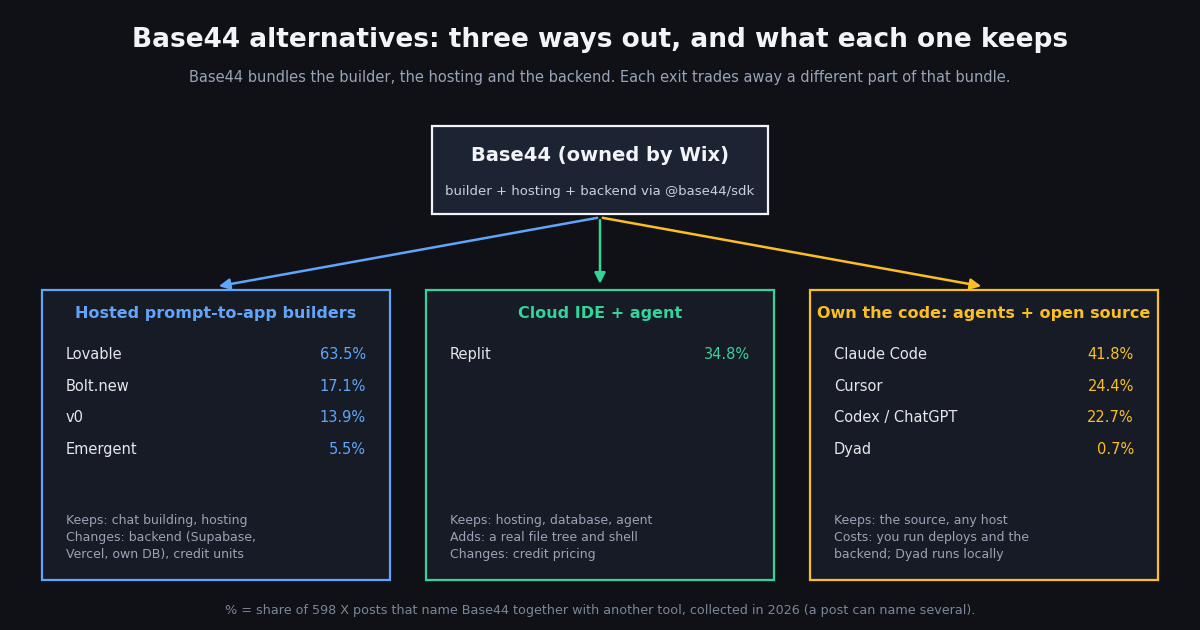
- Three exits: a hosted builder like Base44 (Lovable, Bolt.new, v0, Emergent), a cloud IDE with an agent (Replit), or owning the code (Claude Code, Cursor, Codex, or the open-source Dyad and bolt.diy).
- Entry prices as each vendor shows them: Base44 Starter $16 a month billed annually; Lovable Pro $25 a month; Bolt.new Pro $25 a month; Replit Core $20 a month; Emergent Standard $20 a month; v0 Plus $30 per user a month; Dyad and bolt.diy are free software, you pay your AI provider.
- The backend is the real switching cost: Base44 runs data, auth and functions as a backend-as-a-service reached through
@base44/sdk; exporting the code to GitHub does not by itself move that layer. - What X compares Base44 with (598 posts, collected in 2026): Lovable 63.5%, Claude / Claude Code 41.8%, Replit 34.8%, Cursor 24.4%, Codex / ChatGPT 22.7%, Bolt.new 17.1%, v0 13.9%, Dyad 0.7%.
- Why people bring it up: cost and credits in 19.9% of those posts, backend / database / auth in 12.7%, export and lock-in in 10.0%, Wix ownership in 8.7%.
- X data in whichever tool you pick: one server-side GET to
/twitter/tweet/advanced_searchwith anX-API-Keyheader; tweet reads cost $0.15 per 1,000 tweets returned on TwitterAPI.io vs $5 per 1,000 on X's pay-per-usage rate card ($0.005 per post read), about 33x.
Base44 is a prompt-to-app builder: you describe an app in chat and it generates the front end, a database, user login and server functions, then hosts the result. Wix bought it in June 2025 for about $80 million up front plus milestone payments, and the base44.com footer now reads Wix.com Ltd. People look for Base44 alternatives for four recurring reasons: the credit bill, wanting to own and move the code, needing a backend they control, or simply preferring a tool their team already uses.
This page answers one question: if you are on Base44 or about to choose it, what else is there and what does each option keep or change. For Base44's own plans and credit math, see our Base44 pricing breakdown; for a list centered on Lovable, see Lovable alternatives; for leaving Replit, see Replit alternatives. Here Lovable is one option among several, not a head-to-head.
Every price below was read from the vendor's own pricing page or docs this year and is quoted as shown, in US dollars. Then the part no other list has: we collected 598 X posts that name Base44 together with another builder or coding tool, plus every post we could find that announces leaving Base44 or asks for an alternative, and the official X accounts of Base44 and six alternatives, all in 2026, to see what people actually weigh it against.
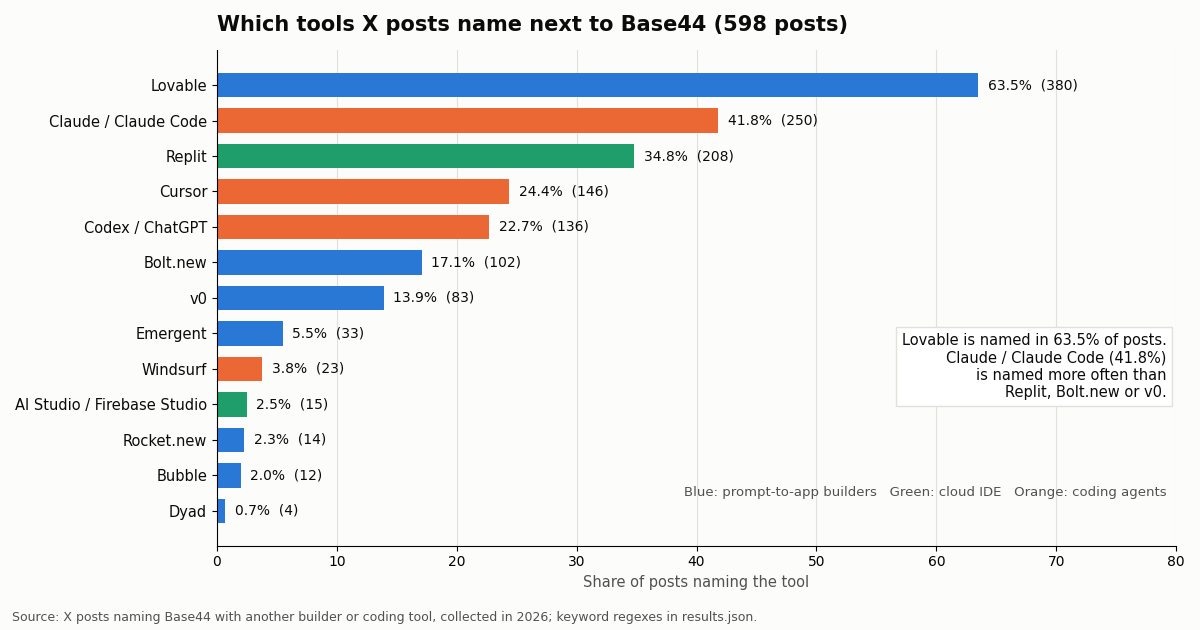
63.5% of 598 X posts that name Base44 next to another builder or coding tool also name Lovable; Claude / Claude Code 41.8%, Replit 34.8% (collected in 2026)
Base44 alternatives at a glance: free tier, entry plan, where the backend lives
The table reads each vendor's own pricing page as it rendered for us this year. Prices are in US dollars, per month, before tax. Where a page shows only the annual-billing figure we say so. The last column matters more than the price for anyone leaving Base44, because it decides how much of your app moves with you.
How to read the units. Base44 meters two separate pools: message credits for building in chat and integration credits for what the running app does (AI calls, email, file uploads). Lovable and Emergent meter credits, Bolt.new meters raw tokens, and v0 puts a dollar value on its credits. A $25 plan on one tool and a $20 plan on another are not the same amount of building, so compare on a realistic week of your own prompts, not on the sticker price.
Where the pages are incomplete. Base44's pricing page shows yearly prices by default; the monthly-billing figures ($20, $50, $100, $200) come from the toggle we documented on the Base44 pricing page. Lovable's pricing page did not render its plan cards for us, so the Lovable row comes from its subscription-plans docs. Replit's pricing page has no free-plan card; its free allowance is described in Replit's billing docs. v0's Plus card shows $30 next to a struck-through $90 per user a month. We quote what is printed and flag the rest.
Coding agents are not in the table on purpose. Claude Code, Cursor and Codex are priced as subscriptions or usage on top of a model provider and they do not host your app; our Claude Code pricing page and the Cursor vs Claude Code comparison cover that side.
Lovable, Bolt.new, v0 and Emergent: hosted builders that work like Base44
If what you like about Base44 is typing a sentence and getting a running app, these four keep that workflow. What changes is the backend and the billing unit.
Lovable. The tool X names most often next to Base44. Pro starts at $25 a month for 100 credits ($250 a year, about $21 a month) and Business at $50 a month; the Free plan gives 5 build credits a day, capped at 30 a month, plus monthly grants of 20 Cloud credits and 4 AI credits. Monthly plan credits expire two months after they are issued and top-up credits last twelve months, according to its pricing FAQ. Lovable meters its hosted backend (Lovable Cloud) in separate Cloud credits. Our Lovable alternatives and Lovable pricing pages go deeper.
Bolt.new. Pro is $25 a month, billed monthly, starting at 10M tokens with no daily limit, and unused tokens roll over; the Free plan gives 1M tokens a month with a 300K daily limit and no rollover. Hosting is included (up to 333K web requests on Free, 1M on Pro), with unlimited databases and a custom domain on Pro. Teams is $30 per member a month. Yearly billing saves up to 28%, per the page.
v0 by Vercel. Free gives 7 messages a day, GitHub sync and deploys to Vercel. Plus is $30 per user a month with $30 of monthly included credits and $2 of daily login credits per user; Business is $100 per user a month. Because the app lands in a normal Vercel project, the back end is whatever you add there (route handlers, a database from the Vercel marketplace), which is more work than Base44 but leaves nothing proprietary in the middle.
Emergent. Free gives 10 credits a month. Standard is $20 a month ($17 billed annually) with 100 credits, GitHub integration and web plus mobile app building; Pro lists $200 billed monthly ($167 billed annually) with 750 credits and a 1M context window. It advertises mobile apps on the pricing page itself, which matters because mobile came up in 6.5% of the Base44 comparison posts we collected.
What carries over from Base44. Your prompts and product spec do; your data does not move by itself. Export Base44 entities as data first, then ask the new builder to recreate the schema and import it.
Replit or a coding agent (Claude Code, Cursor, Codex): when you outgrow chat-only building
Replit sits between a builder and a code editor. Its agent builds from a prompt like Base44, but the project is a real file tree with a shell, packages and a database, and you can open any file. Core is $20 a month ($18 billed annually) and includes $20 toward more capable models; Pro is $100 a month ($90 billed annually) with $100 in credits, up to 15 collaborators and database rollback up to 28 days. The pricing page also lists Pro price points of $215, $425, $825 and $2,000 a month without saying what each adds.
Replit is the third most-named tool next to Base44 on X (34.8% of 598 posts) and, after Lovable, the builder people bring up most. The practical difference from Base44: a Replit project can run any backend code you write, where a Base44 app runs on Base44's backend. Our Replit alternatives page covers the other direction, people leaving Replit.
The second most-named tool next to Base44 on X is not a builder at all: Claude or Claude Code appears in 41.8% of the 598 posts, Cursor in 24.4% and Codex or ChatGPT in 22.7%. One plausible reading, which the keyword counts cannot prove: people use a builder to get the first version up and a coding agent once the app needs changes the builder cannot make cleanly.
What you gain. The code is plain files in your own repository, any framework, any host, any database, and no credit pool between you and an edit. What you take on. Deploys, the database, auth, secrets and upgrades are now yours. If you have never shipped a web app, that is a real cost, and a hosted builder is the more honest choice.
A common hybrid. Export the Base44 front end to GitHub, open it in Claude Code or Cursor, and decide separately whether the backend stays on Base44 or moves to something you run. Our Claude Code alternatives page and the Cursor vs Claude Code comparison compare the agents themselves.
Open-source Base44 alternatives: Dyad and bolt.diy
For the "base44 alternatives open source" search, two projects are active and genuinely open source. Both are free software: you pay only the AI provider whose key you plug in, and nothing is hosted for you.
Dyad describes itself as a "local, open-source AI app builder for power users" and an alternative to v0, Lovable, Replit and Bolt. It runs on your machine, so the code is on your disk from the first prompt, and it had commits pushed within the last day when we checked. Note the split license: code outside src/pro is Apache 2.0, code inside it is fair-source under the Functional Source License 1.1.
bolt.diy is the open-source sibling of Bolt.new from StackBlitz Labs, under the MIT license: "Prompt, run, edit, and deploy full-stack web applications using any LLM you want." You host it yourself and choose the model.
What open source does not give you. Neither project is a backend. You still need a database, auth and a host, which is exactly the part Base44 bundles. On X, open source is a small slice of the conversation: Dyad appears in 0.7% of the Base44 comparison posts (4 posts) and its official account has 1,493 followers, against 39,606 for Base44. Star counts and releases are read from the GitHub API this year and change daily.
Leaving Base44: export, the @base44/sdk backend and the Wix question
Base44's pricing FAQ says "You own everything you build on Base44: your code, your data, your users" and that "Two-way GitHub sync exports the full source code to your own repo at any time." GitHub is listed on the Builder plan ($40 a month billed annually) and above, not on Free or Starter. Its GitHub integration docs point code syncing to a feature called Base Code.
The part that does not move by itself. Base44's developer docs describe its backend as a "backend-as-a-service built with AI agents in mind", and generated apps reach it through the @base44/sdk package on npm ("JavaScript SDK for Base44 API", version 0.8.59 when we checked). Exported code therefore still calls Base44 for data, login and server functions unless you replace those calls. That gives you two honest paths: keep Base44 as the backend and move only the front end, or rebuild the data layer (Supabase, a Postgres host, your own API) and migrate the records.
A migration checklist. First, export the data from every entity and note each field and relation. Second, list every backend function and integration (email, file uploads, AI calls) and where its secrets live. Third, list the auth providers in use, because user accounts rarely migrate without a password reset or a fresh sign-in. Fourth, sync the code to GitHub on a paid plan. Fifth, rebuild or re-point the backend calls, then switch the domain last.
The Wix question. Wix announced the acquisition in June 2025 (an initial payment of about $80 million plus milestone payments, per Globes). Wix ownership came up in 8.7% of the Base44 comparison posts and in 6 of the 30 posts that announce leaving Base44 or ask for an alternative. Base44's FAQ says apps stay live after a plan change or cancellation.
What X compares Base44 with, and why
We collected the 698 most recent X posts that contain "base44" and the name of another builder or coding tool, kept the 598 that really name Base44 in the text, and counted tools and topics with keyword rules published in results.json. They come from 467 distinct accounts, 83.4% are in English, and they span about 156 days of 2026. 56.2% name two or more other tools, so shares add up to more than 100%.
Lovable is the default comparison. It appears in 63.5% of posts, ahead of every other option. Coding agents are next. Claude / Claude Code (41.8%) is named more often than Replit (34.8%), Bolt.new (17.1%) or v0 (13.9%). Among the five most-named tools, posts that name Cursor have the top median views (715 views against 396 for Lovable).
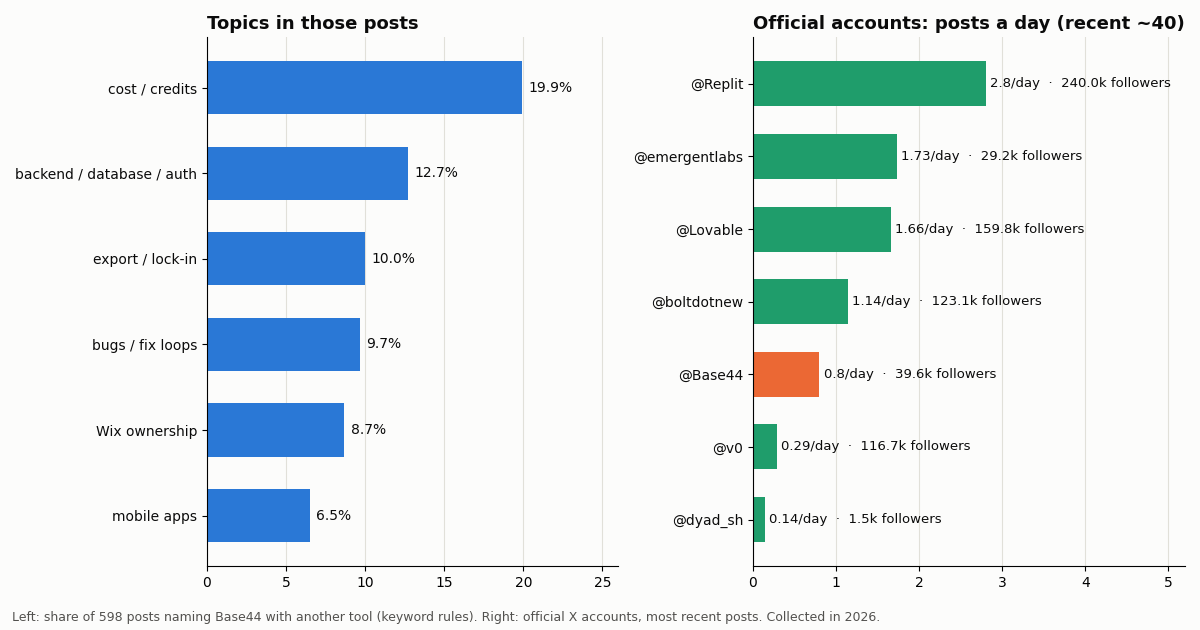
Cost leads, the backend follows. Credits and pricing come up in 19.9% of posts, the backend, database or auth in 12.7%, export and lock-in in 10.0%, and bugs or fix loops in 9.7%. These are keyword matches, not sentiment: a post that praises Base44's built-in auth counts toward the backend topic too.
Very few people announce leaving. A separate search for explicit switching phrases ("base44 alternative", "switched from base44", "instead of base44", "base44 vs" and twelve more) returned only 30 posts from 27 accounts across about 567 days. 5 of them name Lovable, 3 Replit and 3 Claude; 6 raise export or lock-in, 6 the Wix ownership and 5 the cost. That is too few for percentages to mean much, so we report counts. Most of the talk is comparison while choosing, not churn.
How loud each alternative is on X: official accounts
A tool's official account is where launches, outages and pricing changes land first, so it is worth following the ones you shortlist. We read the profile and the 40 most recent posts of each official account (30 for Dyad, which had fewer in reach).
@Replit posts most often (2.8 a day over its recent posts), @Lovable and @emergentlabs post more than once a day, and @Base44 about 0.8 a day. @v0 posts rarely but gets the highest median views (15,773). These are cadence snapshots of the most recent posts, not a ranking of the products.
Carry your X data feature to any Base44 alternative, and what it costs
If your Base44 app shows live X (Twitter) posts (a brand mention feed, a launch tracker, a leaderboard), that feature moves with little work, because it is one REST call with no Base44-specific code in it. The rule is the same everywhere: call the X data API from server-side code with the key stored as a secret, never from browser code.
Where the server side lives. Base44 has backend functions; Lovable has Edge Functions; v0 and Bolt.new generate route handlers; Replit runs your own server; Dyad and bolt.diy produce ordinary projects where you add one. Ask the builder in plain words: "create a server function that calls the TwitterAPI.io search endpoint with the key from a secret named TWITTERAPI_IO_API_KEY, and have the page call that function."
The request. One GET to /twitter/tweet/advanced_search with the header X-API-Key, a query in X search syntax and queryType of Latest or Top. The response carries tweets[], has_next_page and next_cursor; each tweet has text, createdAt, likeCount, viewCount and an author object with userName and followers. Reads need no X account.
If your tool speaks MCP. Claude Code, Cursor and other MCP clients can connect to our hosted MCP server at https://mcp.twitterapi.io/mcp with the header Authorization: Bearer <your key>, so the agent can query X while you build. The deployed app should still call the REST endpoint from its own server code; our MCP server page has setup for each client.
The builder plan pays for building and hosting. X data is a separate bill from whichever source you call. On TwitterAPI.io, tweet endpoints cost 15 credits per tweet returned, which is $0.15 per 1,000 tweets, with a minimum of 15 credits per request: a full 20-tweet page costs $0.003 and a search that finds nothing costs the $0.00015 minimum. On X's official pay-per-usage rate card (docs.x.com/x-api/getting-started/pricing), a post read costs $0.005, which is $5 per 1,000, about 33x more per 1,000 tweets, and pay-per-usage is capped at 3M post reads a month with Enterprise above that. Profiles cost $0.18 per 1,000 on TwitterAPI.io against $0.010 per user read on X.
What this study cost. The 998 posts and 7 profiles behind this page took 59 requests and cost about $0.15 on TwitterAPI.io; the same reads on X's rate card ($0.005 per post read, $0.010 per user read) would be about $5.06.
Keeping the bill flat. Cache results in your app's database and refresh on a schedule rather than on every page view; a mention feed that refreshes every 5 minutes and usually finds nothing costs about $1.30 a month in empty checks. New accounts that pass the automatic bot check get up to $1 of free credits (at most 100,000 credits, no card, one per person or network, expiring after 31 days), and purchased credits never expire. Rate limits start at 0.2 requests per second before the first payment and rise to 20 once paid. Plans and credit packs are on the pricing page.
// x-mentions.ts: one server-side function that works in a Base44 backend function (Deno),
// a Lovable / Supabase Edge Function, a v0 or Bolt.new route handler, or a Replit server.
// The key lives in the platform's secrets as TWITTERAPI_IO_API_KEY and never reaches the browser.
const BASE = "https://api.twitterapi.io";

export async function xMentions(query: string, maxPages = 2, apiKey: string) {
  const tweets: Array<Record<string, unknown>> = [];
  let cursor = "";
  for (let i = 0; i < maxPages; i++) {
    const url = new URL(`${BASE}/twitter/tweet/advanced_search`);
    url.searchParams.set("query", `${query} -filter:retweets`);
    url.searchParams.set("queryType", "Latest");
    if (cursor) url.searchParams.set("cursor", cursor);
    const r = await fetch(url, { headers: { "X-API-Key": apiKey } });
    if (!r.ok) throw new Error(`twitterapi.io HTTP ${r.status}`);
    const body = await r.json();
    for (const t of body.tweets ?? []) {
      tweets.push({ text: t.text, createdAt: t.createdAt, likes: t.likeCount,
                    views: t.viewCount, author: t.author?.userName, url: t.url });
    }
    if (!body.has_next_page) break;
    cursor = body.next_cursor;
  }
  return tweets;
}How we collected this
Question. When people on X talk about Base44 next to other tools, or say they are leaving it, which alternatives do they name and what topics come with them? And how active are the official accounts of Base44 and its main alternatives?
Queries and accounts. (1) base44 (lovable OR bolt OR replit OR v0 OR emergent OR cursor OR claude OR dyad OR rocket OR "ai studio" OR windsurf OR bubble OR softgen OR anything) -filter:retweets, Latest, 35 pages: 698 posts, 598 kept after requiring "base44" in the text. (2) Sixteen explicit switching phrases such as "base44 alternative", "switched from base44" and "instead of base44", Latest: 30 posts, all returned in 3 pages. (3) /twitter/user/info and the 40 most recent posts of @Base44, @Lovable, @boltdotnew, @Replit, @v0, @emergentlabs and @dyad_sh.
Window and size. The most recent matching posts at collection time, collected in 2026; the comparison set spans about 156 days, the switching set about 567 days. 59 requests, 998 posts billed.
Method. Tools and topics are counted with transparent keyword regexes listed in results.json; a post can name several tools and carry several topics. "Bolt" also matches bolt.diy. Keyword topics are not sentiment: a post can mention credits approvingly.
What the sample cannot show. It is X only, English-heavy, and skewed toward people who post about tools; it says nothing about revenue, retention or which tool is better for your app. The search returns what X's search index surfaces, not every post ever written. The switching set is small, so we give counts, not percentages.
Privacy. Aggregates only. The search authors are private individuals: their raw posts were kept outside the repository and the published sample.json holds de-identified rows (no ID, URL, text, author ID or handle). Only organization accounts are named.
"""base44_alternatives_pulse.py - count which tools X posts name next to Base44.
Run it server-side (cron, a Replit deployment, a backend function); never ship the key to a browser.

    pip install requests
    export TWITTERAPI_IO_API_KEY=...   # from the twitterapi.io dashboard
    python base44_alternatives_pulse.py

Cost: 15 credits per tweet returned ($0.15 per 1,000 tweets); 5 full pages = 100 tweets = $0.015.
"""
import os
import re
from collections import Counter

import requests

BASE = "https://api.twitterapi.io"
HEADERS = {"X-API-Key": os.environ["TWITTERAPI_IO_API_KEY"]}
QUERY = "base44 (lovable OR bolt OR replit OR v0 OR emergent OR cursor OR claude OR dyad) -filter:retweets"
TOOLS = {
    "Lovable": r"\blovable\b",
    "Bolt.new": r"\bbolt(\.new|\.diy)?\b",
    "Replit": r"\breplit\b",
    "v0": r"\bv0\b",
    "Emergent": r"\bemergent\b",
    "Cursor": r"\bcursor\b",
    "Claude / Claude Code": r"\bclaude\b",
    "Dyad": r"\bdyad\b",
}


def search(query, max_pages=5):
    cursor = ""
    for _ in range(max_pages):
        params = {"query": query, "queryType": "Latest"}
        if cursor:
            params["cursor"] = cursor
        r = requests.get(f"{BASE}/twitter/tweet/advanced_search", headers=HEADERS, params=params, timeout=30)
        r.raise_for_status()
        body = r.json()
        yield from body.get("tweets", [])
        if not body.get("has_next_page"):
            break
        cursor = body.get("next_cursor", "")


def main():
    counts, total = Counter(), 0
    for tweet in search(QUERY):
        text = (tweet.get("text") or "").lower()
        if not re.search(r"\bbase\s?44\b", text):
            continue
        total += 1
        for name, rx in TOOLS.items():
            if re.search(rx, text):
                counts[name] += 1
    print(f"{total} posts naming Base44")
    for name, n in counts.most_common():
        print(f"{name:22} {n:4}  {100 * n / max(total, 1):5.1f}%")


if __name__ == "__main__":
    main()
Researching this?Free starter credits cover end-to-end testing — Google sign-in, no card. Get a key.
Questions readers ask
What is the best alternative to Base44?
It depends on what you want to keep. If you want the same chat-to-app workflow with hosting, Lovable, Bolt.new, v0 and Emergent are the closest; Lovable is the tool X posts name most often next to Base44 (63.5% of 598 posts we collected in 2026). If you want to see and run the code, Replit adds a real file tree. If you want to own everything, a coding agent such as Claude Code or Cursor, or the open-source Dyad, gives you plain files and leaves hosting to you.
Is there an open-source Base44 alternative?
Yes. Dyad is a local, open-source app builder (Apache 2.0 outside its src/pro folder, which is under the Functional Source License 1.1) that runs on Mac or Windows with your own AI keys. bolt.diy, from StackBlitz Labs, is MIT-licensed and self-hosted with any LLM you configure. Neither includes a hosted backend, so you bring your own database and auth.
Is there a free Base44 alternative?
Every hosted option on this page has a free tier: Lovable gives 5 build credits a day (capped at 30 a month), Bolt.new 1M tokens a month, v0 7 messages a day and Emergent 10 credits a month. Dyad and bolt.diy are free software, though you pay the AI provider whose key you use. Base44's own Free plan gives 25 message and 100 integration credits a month for up to 5 apps.
Can I export my Base44 app and move it?
You can export the code: Base44's pricing FAQ says two-way GitHub sync exports the full source code, and GitHub is listed on the Builder plan and above. The backend is the hard part. Data, login and server functions run on Base44's backend-as-a-service and the app reaches them through the @base44/sdk package, so either keep Base44 as the backend or rebuild that layer and migrate the records.
Is Base44 owned by Wix?
Yes. Wix announced the acquisition of Base44 in June 2025, with an initial payment of about $80 million plus milestone payments, and the base44.com footer reads Wix.com Ltd. Base44 continues as its own product. Wix ownership came up in 8.7% of the Base44 comparison posts we collected on X.
Which Base44 alternative is good for mobile apps?
Emergent advertises web and mobile app building on its pricing page (Standard $20 a month, $17 billed annually). If an app-store release matters, confirm the current export and publishing path with the vendor before you commit.
What do people on Reddit and X recommend instead of Base44?
We did not study Reddit. On X, in 598 posts collected in 2026 that name Base44 together with another tool, the most named are Lovable (63.5%), Claude / Claude Code (41.8%), Replit (34.8%), Cursor (24.4%), Codex / ChatGPT (22.7%), Bolt.new (17.1%) and v0 (13.9%).
How do I add live X (Twitter) data to an app built in one of these tools?
Create a server-side function in the tool (a Base44 backend function, a Lovable Edge Function, a v0 or Bolt.new route handler, a Replit server) that calls /twitter/tweet/advanced_search on https://api.twitterapi.io with the header X-API-Key, with the key stored as a secret. Tweet reads cost $0.15 per 1,000 tweets returned, against $5 per 1,000 on X's official pay-per-usage rate card.
Continue
- Base44 pricing (plans, message and integration credits, ownership and GitHub FAQ)
- Lovable docs: subscription plans (Pro, Business, Free)
- Dyad on GitHub: local, open-source AI app builder
- bolt.diy on GitHub (MIT)
- @base44/sdk on npm (JavaScript SDK for the Base44 API)
- X API pay-per-usage pricing
- Twitter (X) API overview and endpoints
- Base44 pricing: plans, message and integration credits
- Lovable alternatives compared
- Replit alternatives and free tiers
- Claude Code alternatives for coding agents
- Cursor vs Claude Code comparison
- TwitterAPI.io MCP server setup
- TwitterAPI.io pricing and credit packs
- 01Zapier Pricing in 2026: Plans, Tasks per Month, Overage and a Worked Twitter (X) Zap Bill
- 02LlamaIndex vs LangChain: Which to Use, With the Same Twitter (X) RAG Pipeline Built in Both
- 03Agentic Payments: How AI Agents Pay, and Which Protocol Does What
- 04Kiro Pricing in 2026: Plans, Credits, Model Multipliers and Worked Monthly Bills
- 05Cline vs Cursor in 2026: Cost, Models, Plan/Act and MCP Compared
- 06n8n Alternatives in 2026: Pick by Why You Are Leaving, and Keep Your Twitter (X) Workflows
- 07Replit alternatives in 2026: free tiers, prices, hosting and what X users switch to
- 08Claude Code Alternatives: Seven Coding Agents Checked for License, Free Use and MCP (Twitter/X Data Included)
Writing about something you built with TwitterAPI.io? Our community rewards program pays API credits for honest tutorials, build logs and videos.
Stop reading. Start building.
Starter credits cover real testing on real data. Google sign-in, no card, no application queue.
Get an API keyAlready building with TwitterAPI.io? Publish an honest tutorial or build log about it and earn up to $200 a month in API credits.