Lovable Alternatives in 2026: Bolt.new, v0, Base44, Replit, Emergent and Cursor Compared
- Same workflow, different vendor: Bolt.new (Free 1M tokens a month; Pro $25 a month), v0 (Free 7 messages a day; Plus with $30 of monthly credits per user), Base44 (Free 25 message credits; Starter $16 a month billed annually) and Emergent (Free 10 credits; Standard $20 a month).
- More runtime control: Replit has a free Starter plan, Core at $20 a month ($18 billed annually) and Pro at $100 a month, with credits that also pay for databases and publishing.
- Own the code: Cursor (Free, Plus $8, Premium $30 a month) and coding agents are where people go when generated apps need real engineering.
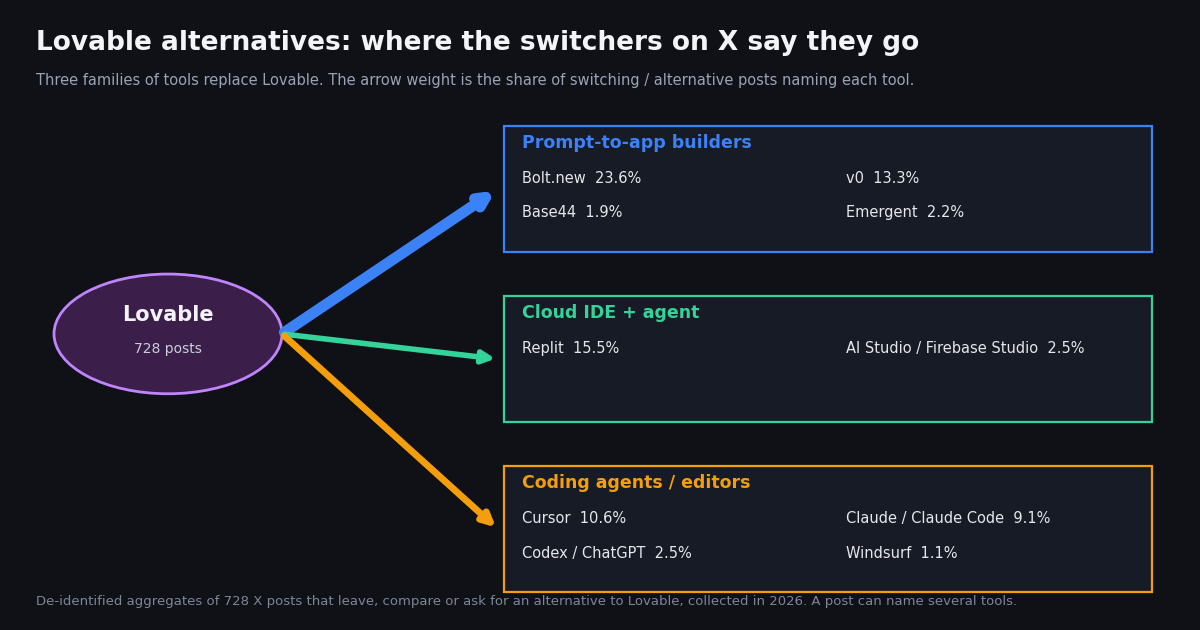
- What X says: across 728 switching and alternative posts, 54.9% name another tool; Bolt.new leads at 23.6%, then Replit 15.5%, v0 13.3% and Cursor 10.6%.
- Why they switch: cost and credit words appear in 16.5% of those posts, design in 14.6%, code ownership and export in 9.8%.
- X data in any of these apps: call
/twitter/tweet/advanced_searchfrom a server function with the key in a secret, never in browser code; it costs $0.15 per 1,000 tweets versus $5 per 1,000 post reads on X's pay-per-usage rate card.
Lovable turned "describe an app, get an app" into a mainstream workflow, and the alternatives have caught up fast. Some copy the workflow almost exactly and compete on price and polish. Others trade some of the magic for a real runtime, or hand you the code and an agent inside an editor. Which one is right depends on why you are looking.
This page compares the six alternatives searchers ask about most, with the free tier, entry paid plan and unit of usage taken from each vendor's own pricing page this year. We do not repeat Lovable's own plan breakdown here: that lives on our Lovable pricing page, linked below. What we add is a study of what X users actually name when they leave or compare Lovable, and a section on wiring live X (Twitter) data into an app you build in any of these tools without leaking your API key.
We sell an X data API, not an app builder, so we have no horse in the builder race. Every builder number below is quoted as the vendor shows it; where a pricing page is ambiguous, we say so instead of guessing.
23.6%
Lovable alternatives at a glance: free tier, entry plan, unit of usage
Each row is read from the vendor's own pricing page this year. Prices are in US dollars as the pages show them, before tax. Annual prices are marked where the vendor shows only the annual figure.
How to read the units. A token, a message credit and a dollar credit are not the same size, so the monthly price alone does not tell you how much app you can build. Bolt.new meters raw tokens; Base44 and Emergent meter credits per AI message; v0 and Replit put a dollar value on their credits and bill model usage against it; Cursor sells a usage pool expressed as a multiple of its Plus plan. Lovable itself meters credits, and its own breakdown is on the Lovable pricing page.
Where the pages are unclear. v0's Plus card shows both "$30" and "$90" per user per month next to "$30 of included monthly credits per user", without saying which figure applies when. Replit's pricing page lists Pro tiers at $215, $425, $825 and $2,000 a month without labels, and its free Starter plan appears in the billing docs rather than on the pricing page. Base44 shows annual-billing prices only and says yearly billing saves 20%. We quote what is printed and flag the rest.
Bolt.new: the closest like-for-like alternative (and the top bolt.new alternatives)
Bolt.new is the tool people put next to Lovable most often. It runs the same loop: describe the app in chat, watch it build in the browser, deploy. Its pricing page meters everything in tokens, which Bolt spends when it reads your prompt and project files, plans and writes code.
Free. $0 a month, no card required, with a 300K token daily limit and 1M tokens a month, Bolt branding on websites and a 10MB file upload limit. Free tokens do not roll over.
Pro. $25 a month billed monthly, starting at 10M tokens a month with no daily token limit. Unused tokens from the monthly allowance stay in your balance for up to two months. Yearly billing saves "up to 28%" according to the page, which does not list the yearly price.
Teams. $30 a month per member, billed monthly: everything in Pro plus centralized billing and team access management. Enterprise is custom.
Who should pick it. If you like Lovable's workflow but want a different meter, Bolt.new is the shortest move. If you are looking for bolt.new alternatives instead, the X posts point back the other way: in a second query of 40 posts that leave or compare Bolt.new, 57.5% name Lovable, and Cursor (20.0%), v0 (15.0%) and Windsurf (12.5%) follow. That sample is small, so read it as direction, not ranking.
v0 by Vercel: best when the front end matters most
v0 is Vercel's builder. It began as a UI generator and now describes itself on X as a "full stack vibe coding platform". Apps deploy to Vercel and sync with GitHub, and the free plan includes Design Mode for visual edits.
Free. $0 a month with a 7 message a day limit, deploys to Vercel, visual editing and GitHub sync.
Plus. The card shows "$30" and "$90" per user per month and includes $30 of monthly credits per user plus $2 of free daily credits on login per user, with access to all models and extra credits for purchase. Business is $100 per user per month with the same credit grants, training opt-out and priority access. A banner offers new users $5 in one-time credits.
Unit. Credits are dollars, and model usage is priced per million tokens: v0 Mini at $0.20 input and $1.20 output, v0 Pro at $2 and $10, v0 Max at $5 and $25, v0 Max Fast at $10 and $50. That makes v0 the most transparent meter in this list: you can estimate a session from tokens.
Who should pick it. Teams already on Vercel, and anyone whose app is mostly interface. v0 drew the highest median views of the big three builders in our X sample, which fits its following among front-end developers.
Base44, Replit, Emergent and Cursor: built-in backend, more runtime, or the code itself
Base44. An all-in-one builder that bundles the backend: its pricing page lists authentication, database functionality and analytics, and says you own your app and can export the code. Free is $0 with 25 message credits and 100 integration credits a month. Paid plans, shown billed annually: Starter $16 a month (100 message credits, 2,000 integration credits), Builder $40 (250 and 10,000), Pro $80 (500 and 20,000), Elite $160 (1,200 and 50,000); the page says yearly billing saves 20%. Usage "varies based on the action and the selected AI model". It is named in only 1.9% of the switching posts we collected, so it is less discussed on X than its marketing reach suggests.
Replit. A cloud IDE with an agent, and the second most named tool in our sample. The pricing page shows Core at $20 a month ($18 billed annually) with $20 toward more powerful models, up to 30 hours of chat and 60 projects on Free Mode; and Pro at $100 a month ($90 billed annually) with $100 of credits, up to 15 collaborators and database rollback up to 28 days. Replit's billing docs describe a free Starter plan with daily Agent credits up to a monthly cap, Lite build only and one published app that goes down after 30 days. Credits also pay for production databases, storage and publishing, so a running app keeps drawing on them.
Emergent. A prompt-to-app builder for web and mobile. Free is $0 a month with 10 credits; Standard shows $20 a month and $17 a month on the annual toggle ("Save $36") with 100 credits a month and GitHub integration; Pro shows $200 and $167 ("Save $396") with 750 monthly credits and a 1M context window. Business and Enterprise are custom.
Cursor. A code editor with an agent, for people who want to own and edit the code. Its pricing page now lists Free ($0, limited agent and chat requests), Plus at $8 a month (a shared usage pool, Grok models only), Premium at $30 a month (4x Plus usage), Super at $100 (15x) and Ultra at $200 (50x), with third-party models billed separately at API list price. Teams start at $30 per user per month. Cursor's plans now bundle X features, which our Cursor comparison pages cover in depth.
Coding agents. Claude Code and Codex are named in 9.1% and 2.5% of the switching posts; they are not app builders, but people describe exporting a Lovable project to GitHub and continuing there. Our Claude Code pricing and alternatives pages carry those plans, so we do not repeat them here.
What X users name when they leave Lovable
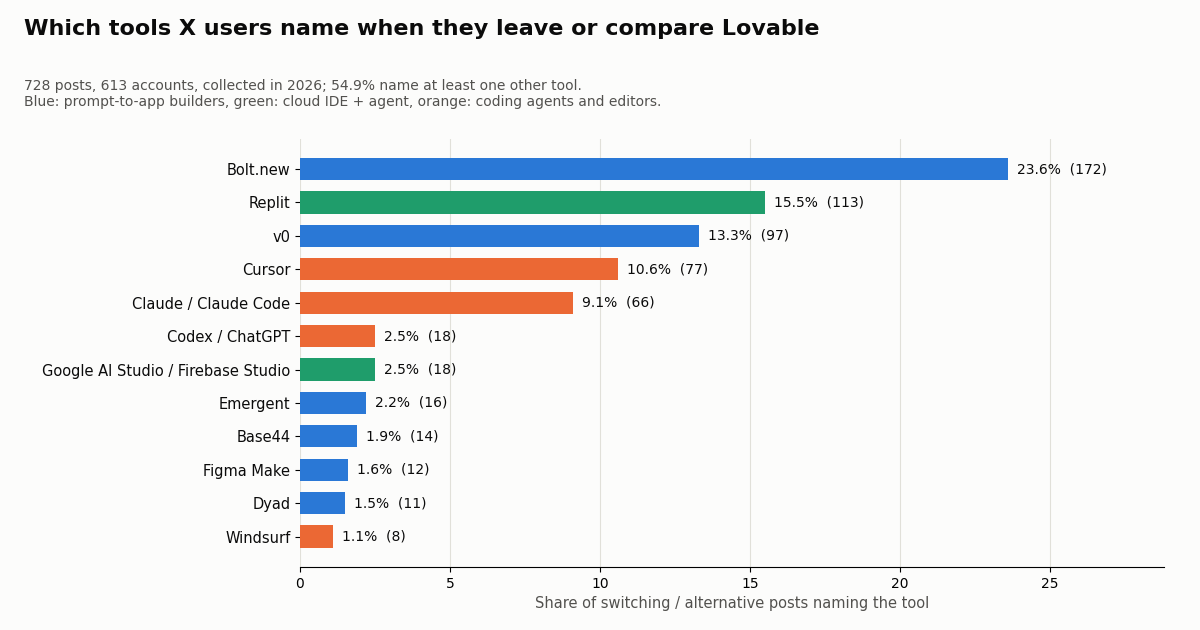
We collected 728 recent X posts that say they switched from, left, canceled or migrated off Lovable, ask for a Lovable alternative, or set Lovable against another tool ("lovable vs", "better than lovable", "instead of lovable"). They come from 613 distinct accounts. 54.9% name at least one other tool, and 21.4% name two or more, which is what a shortlist looks like.
Bolt.new is the default comparison. It appears in 23.6% of the posts, well ahead of anything else, and most of those posts set the two side by side rather than announcing a move.
Replit and v0 form the second tier. Replit (15.5%) and v0 (13.3%) add up to more mentions than Bolt.new (a post can name both). v0 posts draw a higher median view count (621) than Bolt.new posts (463.5).
The coding-agent exit is real. Cursor (10.6%) and Claude (9.1%) together sit close to Bolt.new. These are the posts where people describe outgrowing generated code. Codex and ChatGPT posts are rare (2.5%) but get the widest reach of any tool, a median of 1347.5 views.
The long tail is small. Emergent (2.2%), Base44 (1.9%), Figma Make (1.6%) and Dyad (1.5%) each show up in about 2% of posts or less.
Why people say they switch, and what the official accounts post
We tagged the same posts with keyword rules for the reason words they contain. A post can carry several reasons, and keyword rules miss sarcasm, so read these as indicative.
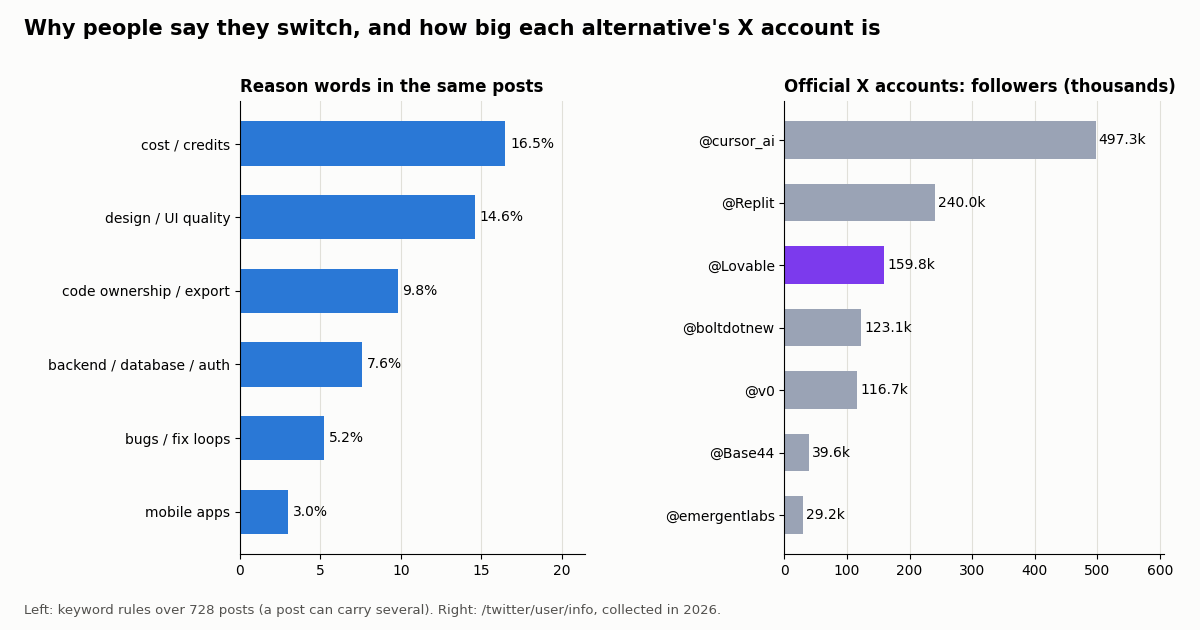
Cost leads, but only just. Credit and price words are in 16.5% of posts, design and UI words in 14.6%. Code ownership words (GitHub, export, lock-in, open source, local) appear in 9.8%, which matches the exit toward Cursor and coding agents. Bug and fix-loop words are in only 5.2%.
The official accounts. The handle @lovable_dev returns user not found; Lovable's account is @Lovable. Its last 160 posts span 94.1 days, about 1.7 posts a day, with a median of 140.5 likes and 16136.5 views; 22.5% read as launches or new features, and none name a competitor. The alternatives' own accounts differ widely in size:
Follower counts measure audience, not product quality or user numbers. Cursor's account has the largest following with the fewest posts; Replit's has posted the most.
Calling TwitterAPI.io from an app built in Lovable, Bolt.new, v0, Base44 or Replit
Every tool on this list can generate an app that shows live X (Twitter) data: a brand mention feed, a launch tracker, a leaderboard of posts about your product. The one rule that matters is where the API key lives. Call the X data API from server-side code with the key stored as a secret, and never put the key in browser code. A key in a React component ships to every visitor and can be copied from the network tab.
Where the server side is in each tool. Lovable stores secrets encrypted and injects them into Edge Functions; its docs say secrets "never reach the browser", and warn that VITE_ variables are built into the client bundle and are public. Bolt.new, v0 and Replit generate projects with server routes (for example a Next.js route handler on v0, or a Node or Python server on Replit) where you read the key from an environment variable. Base44 and Emergent have backend functions for the same job. Ask the builder in plain words: "create a server function that calls the TwitterAPI.io search endpoint with the key from a secret named TWITTERAPI_IO_API_KEY, and have the page call that function."
The request. One GET to /twitter/tweet/advanced_search with the header X-API-Key, a query in X search syntax and queryType of Latest or Top. The response carries tweets[], has_next_page and next_cursor, and each tweet has text, createdAt, likeCount, viewCount and an author object with userName and followers. Reads need no X account. The function below is the shape of a Lovable Edge Function (Deno); the same body works in a v0 or Bolt.new server route.
If your tool speaks MCP. Cursor and other MCP clients can connect to our hosted MCP server at https://mcp.twitterapi.io/mcp with the header Authorization: Bearer <your key>, so the agent can query X while you build. The deployed app should still call the REST endpoint from its own server code.
// supabase/functions/x-search/index.ts  (Lovable Edge Function, Deno)
// The key lives in Lovable Secrets as TWITTERAPI_IO_API_KEY and never reaches the browser.
const BASE = "https://api.twitterapi.io";

Deno.serve(async (req) => {
  const { query = "lovable OR bolt.new", pages = 1 } = await req.json().catch(() => ({}));
  const key = Deno.env.get("TWITTERAPI_IO_API_KEY");
  if (!key) return new Response(JSON.stringify({ error: "missing secret" }), { status: 500 });

  const out: unknown[] = [];
  let cursor = "";
  for (let i = 0; i < Math.min(Number(pages), 5); i++) {
    const url = new URL(`${BASE}/twitter/tweet/advanced_search`);
    url.searchParams.set("query", `${query} -filter:retweets`);
    url.searchParams.set("queryType", "Latest");
    if (cursor) url.searchParams.set("cursor", cursor);
    const r = await fetch(url, { headers: { "X-API-Key": key } });
    if (!r.ok) return new Response(JSON.stringify({ error: r.status }), { status: 502 });
    const body = await r.json();
    for (const t of body.tweets ?? []) {
      out.push({ text: t.text, createdAt: t.createdAt, likes: t.likeCount, views: t.viewCount,
                 author: t.author?.userName, url: t.url });
    }
    if (!body.has_next_page) break;
    cursor = body.next_cursor;
  }
  return new Response(JSON.stringify({ tweets: out }), { headers: { "Content-Type": "application/json" } });
});The X data bill next to the builder bill
The builder plan pays for building and hosting; the X data is a separate bill from whichever X data source you call. On TwitterAPI.io, tweet endpoints cost 15 credits per tweet returned, which is $0.15 per 1,000 tweets, with a minimum of 15 credits per request: a full 20-tweet page costs $0.003 and a search that finds nothing costs the $0.00015 minimum. On X's official pay-per-usage rate card (docs.x.com/x-api/getting-started/pricing), a post read costs $0.005, which is $5 per 1,000, about 33x more per 1,000 tweets, and pay-per-usage is capped at 3M post reads a month with Enterprise above that.
What this study cost. The 1,260 posts and 7 profiles behind this page took 71 requests and cost about $0.19 on TwitterAPI.io; the same reads on X's rate card ($0.005 per post read, $0.010 per user read) would be about $6.37.
Keeping the bill flat. Cache results in your app's database and refresh on a schedule instead of calling the API on every page view; a mention feed that refreshes every 5 minutes and usually finds nothing costs about $1.30 a month in empty checks. New accounts that pass the automatic bot check get up to $1 of free credits (at most 100,000 credits, no card, one per person or network, expiring after 31 days), and purchased credits never expire. Rate limits start at 0.2 requests per second before the first payment and rise to 20 once paid.
How we collected this
Question. When people on X leave Lovable or Bolt.new, or ask for an alternative, which tools do they name, which reasons appear with them, and how large are the alternatives' official accounts?
Queries and accounts. Two /twitter/tweet/advanced_search queries (Latest, retweets excluded): one for phrases such as "switched from lovable", "lovable alternative", "instead of lovable", "lovable vs" and "canceled lovable" (40 pages, 800 posts), and one for the same phrasing about Bolt.new (15 pages, 300 posts). The @Lovable timeline via /twitter/user/last_tweets (8 pages) and the profiles of @Lovable, @boltdotnew, @base44, @Replit, @v0, @emergentlabs and @cursor_ai via /twitter/user/info; @lovable_dev returned user not found.
Window and sample. Collected in 2026. X search returns recent matches first but not strictly by date, so we kept posts from November 2024 on (Lovable launched under that name in late 2024; earlier hits are the ordinary English word) that contain the word Lovable: 728 posts, 32.1% of them from 2026 and 94.8% in English. For Bolt.new we kept only posts with a building or coding context, which removed sprinters and lightning and left 40 posts.
Method. Tool names and reason words were matched with keyword rules; the exact regular expressions are published in results.json next to the numbers. The source tool is never counted as its own alternative. A post can name several tools and carry several reasons.
What the sample cannot show. It reflects people who post on X, in mostly English, and the posts X search surfaces for these phrases. A post that names a tool may praise or criticize it. It says nothing about how many people actually switched, how satisfied anyone is, or market share, and the Bolt.new sample is too small to rank tools.
Privacy. Aggregates only. The authors of the search results are private individuals: their raw posts stayed out of the published dataset, and the published sample has no ids, URLs, text or handles. Only organization accounts are named.
"""lovable_alternatives_pulse.py - count which app builders X posts name next to Lovable.
Run it server-side (cron, a Replit deployment, a backend function); never ship the key to a browser.

    pip install requests
    export TWITTERAPI_IO_API_KEY=...   # from the twitterapi.io dashboard
    python lovable_alternatives_pulse.py

Cost: 15 credits per tweet returned ($0.15 per 1,000 tweets); 5 full pages = 100 tweets = $0.015.
"""
import os
import re
from collections import Counter

import requests

BASE = "https://api.twitterapi.io"
HEADERS = {"X-API-Key": os.environ["TWITTERAPI_IO_API_KEY"]}
QUERY = '("lovable alternative" OR "switched from lovable" OR "instead of lovable" OR "lovable vs") -filter:retweets'
TOOLS = {
    "Bolt.new": r"\bbolt(\.new)?\b",
    "Replit": r"\breplit\b",
    "v0": r"\bv0\b",
    "Base44": r"\bbase\s?44\b",
    "Emergent": r"\bemergent\b",
    "Cursor": r"\bcursor\b",
    "Claude Code": r"\bclaude\b",
}


def search(query, max_pages=5):
    cursor = ""
    for _ in range(max_pages):
        params = {"query": query, "queryType": "Latest"}
        if cursor:
            params["cursor"] = cursor
        r = requests.get(f"{BASE}/twitter/tweet/advanced_search", headers=HEADERS, params=params, timeout=30)
        r.raise_for_status()
        body = r.json()
        yield from body.get("tweets", [])
        if not body.get("has_next_page"):
            break
        cursor = body.get("next_cursor", "")


def main():
    counts, total = Counter(), 0
    for tweet in search(QUERY):
        total += 1
        text = (tweet.get("text") or "").lower()
        for name, rx in TOOLS.items():
            if re.search(rx, text):
                counts[name] += 1
    print(f"{total} posts")
    for name, n in counts.most_common():
        print(f"{name:12} {n:4}  {100 * n / max(total, 1):5.1f}%")


if __name__ == "__main__":
    main()
Researching this?Free starter credits cover end-to-end testing — Google sign-in, no card. Get a key.
Questions readers ask
What is the best alternative to Lovable?
It depends on why you are leaving. For the same chat-to-app workflow, Bolt.new is the closest match and the one X users name most (23.6% of 728 switching posts we collected). For front-end heavy apps on Vercel, v0. For a real runtime and database, Replit. For full control of the code, Cursor or a coding agent such as Claude Code.
Is there a free alternative to Lovable?
Every tool here has a free tier: Bolt.new gives 1M tokens a month (300K a day), v0 allows 7 messages a day, Base44 gives 25 message credits a month, Emergent 10 credits a month, Replit has a free Starter plan with daily Agent credits, and Cursor has a free plan with limited agent requests.
Is Bolt.new cheaper than Lovable?
Both entry plans are listed at $25 a month, but they meter different units: Bolt.new Pro starts at 10M tokens a month, while Lovable Pro starts at 100 credits. Which is cheaper depends on how many tokens or credits your builds consume; our Lovable pricing page covers how Lovable credits are spent.
What are the best bolt.new alternatives?
In the X posts that leave or compare Bolt.new, 57.5% name Lovable, followed by Cursor, v0 and Windsurf. Lovable, v0 and Base44 keep the prompt-to-app workflow; Cursor and Windsurf move you into an editor.
Can I export my Lovable project and continue in another tool?
Yes. Lovable links a project to a GitHub repository and syncs changes both ways on one branch, and that is the path many switching posts describe: connect the repository, then open it in Cursor, Replit or a coding agent. Code ownership and export words appear in 9.8% of the switching posts we collected.
How do I show tweets in an app built with Lovable or Bolt.new?
Create a server-side function (a Lovable Edge Function, or a server route in Bolt.new, v0 or Replit) that calls /twitter/tweet/advanced_search with the X-API-Key header, store the key as a secret, and have the page call your function. Never put the key in front-end code. It costs $0.15 per 1,000 tweets on TwitterAPI.io versus $5 per 1,000 post reads on X's pay-per-usage rate card.
Is Replit an alternative to Lovable?
Yes, and the second most named one in our X sample (15.5% of posts). Replit is a cloud IDE with an agent: Core is $20 a month ($18 billed annually) and Pro $100 a month, with a free Starter plan in its billing docs. It gives you a real runtime and database at the cost of a less guided workflow.
Continue
- Bolt.new pricing (Free, Pro, Teams; token allowances)
- v0 pricing (Free, Plus, Business; credits and model rates)
- Base44 pricing (message and integration credits)
- Replit pricing (Core, Pro) and billing docs
- Lovable docs: Secrets stay server-side in Edge Functions
- X API pay-per-usage pricing
- X (Twitter) API guide: endpoints, pricing and access
- Lovable pricing: every plan, credit tier and top-up
- Cursor vs Claude Code compared
- Claude Code alternatives for coding agents
- How to use Cursor with the Twitter (X) API
- TwitterAPI.io MCP server setup
- TwitterAPI.io pricing: pay only for the data returned
- 01Devin Pricing in 2026: Plans, Quotas, ACUs and What X Users Actually Pay
- 02Kiro vs Cursor in 2026: Plans, Spec-Driven vs Agent-First, and X (Twitter) Data via MCP
- 03Langfuse vs LangSmith: Pricing, Self-Hosting, OpenTelemetry and an X-Data Agent Traced in Both
- 04n8n vs Zapier vs Make in 2026: Pricing, Self-Hosting, AI Agents and the Same Twitter (X) Flow Built in All Three
- 05Replit pricing in 2026: plans, credits, effort-based Agent costs, and what an app that reads Twitter (X) data really costs
- 06OpenRouter Alternatives in 2026: LiteLLM, Vercel AI Gateway, Requesty, Portkey and Direct APIs Compared, With What Developers on Twitter (X) Say
- 07Grok Bot Alternatives: Open-Source and Hosted Agents for Twitter (X)
- 08Zapier Alternatives in 2026: Prices, Self-Hosting and Which Ones Still Connect to Twitter (X)
Writing about something you built with TwitterAPI.io? Our community rewards program pays API credits for honest tutorials, build logs and videos.
Stop reading. Start building.
Starter credits cover real testing on real data. Google sign-in, no card, no application queue.
Get an API keyAlready building with TwitterAPI.io? Publish an honest tutorial or build log about it and earn up to $200 a month in API credits.