Devin Pricing in 2026: Plans, Quotas, ACUs and What X Users Actually Pay
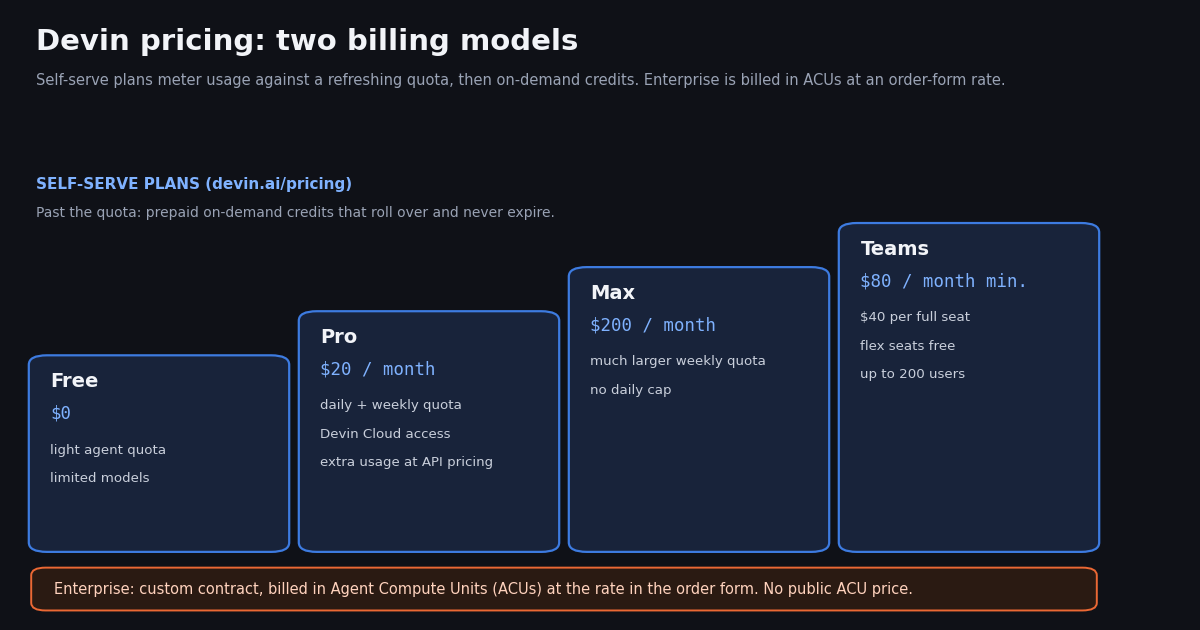
- Self-serve plans: Free $0, Pro $20/month, Max $200 monthly, Teams $80/month minimum with full seats at $40/month each (flex seats are free). Source:
devin.ai/pricingand Cognition's self-serve billing docs. - Enterprise is a custom contract billed in ACUs (Agent Compute Units) at the rate in the order form. Cognition publishes no ACU price.
- Past the quota you pay with prepaid on-demand credits, consumed at API pricing; purchased credits roll over and never expire.
- What burns usage: the number and complexity of Devin's actions plus VM time. Sleeping sessions cost nothing; Windows sessions use about 9% more than Linux.
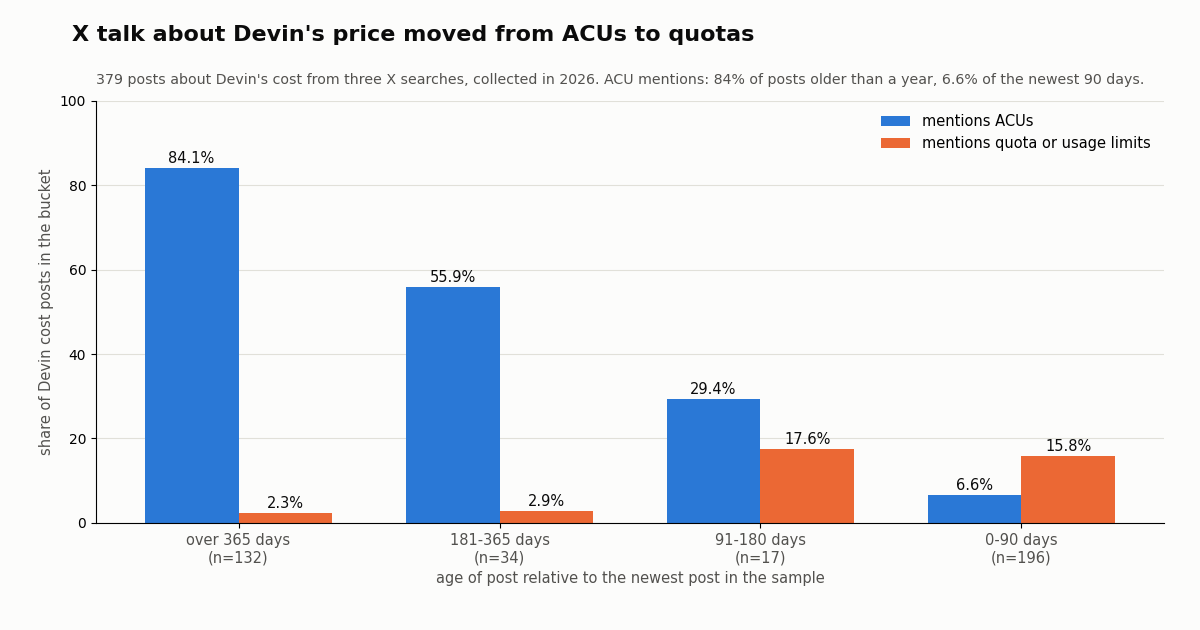
- X study: in 379 posts about Devin's cost (collected in 2026), ACU talk fell from 84.1% of posts older than a year to 6.6% of the newest 90 days, while quota talk rose to 15.8%.
- Giving Devin X data: add
https://mcp.twitterapi.io/mcpas a custom HTTP MCP server, or call the REST API with a key stored as a Devin secret. Tweets cost $0.15 per 1,000 vs $5.00 per 1,000 post reads on X's pay-per-usage rate card.
Most pages that rank for Devin pricing still describe an older model: a plan that bundled a fixed number of ACUs and a published price for each extra one. Cognition's own pages now say something different. The public pricing page lists five plans with a monthly price and a usage quota, and the word ACU does not appear on it at all. ACUs survive, but only as the billing unit in Enterprise contracts, at a rate set in each customer's order form.
This guide reads the current plan cards and Cognition's billing documentation line by line, works out what a team actually pays under each Teams combination, explains what consumes usage, and shows how X users talk about Devin's cost, from a study of 379 posts and both official Cognition accounts. If you are comparing agents, our Claude Code pricing and Codex pricing guides cover the other two meters; this page does not repeat them.
84.1% to 6.6%
Devin plans and prices: Free, Pro, Max, Teams and Enterprise
Cognition splits Devin into individual plans and team plans. The prices below are copied from devin.ai/pricing and the self-serve plans page of Cognition's docs (docs.devin.ai/admin/billing/self-serve). Prices are shown in US dollars with no tax line.
Free. The plan card promises a light quota to code with agents, limited model availability, and unlimited inline edits and Tab completions. The docs add access to Devin Review and DeepWiki.
Pro. Everything in Free plus increased quotas with frontier models from OpenAI, Anthropic's Claude, Google's Gemini and SpaceXAI, plus leading open source models; free use of SWE-2, Cognition's own model; access to cloud agents (Devin Cloud); and the option to purchase extra usage at API pricing. The docs say the Pro quota covers Devin sessions, the Devin CLI and Devin Desktop, and that Pro includes Slack, Linear and MCP integrations. Pro is single-user: you cannot invite teammates.
Max. Everything in Pro with a significantly larger weekly quota and no daily cap, shared across Devin sessions, the CLI and Devin Desktop. Also single-user.
Teams. $80 a month for the team plan plus $40 a month per full dev seat, up to 200 users, with shared collaboration, centralized billing, an admin dashboard with analytics and priority support. The compare table on the pricing page lists unlimited concurrent sessions for Teams and Enterprise, against up to 10 on Pro and Max.
Enterprise. Custom pricing with dedicated account management, SAML/OIDC SSO, centralized admin controls, a dedicated deployment option and VPC deployment. Cognition's billing docs state that Enterprise customers are billed in Agent Compute Units at the rate set in their order form, and send you to sales for that rate.
What a Devin ACU is in 2026, and why self-serve plans no longer price it
An ACU, or Agent Compute Unit, is Cognition's unit for the work Devin performs. Older third-party guides quote a fixed price per ACU on self-serve plans. That figure is not on Cognition's current pages: the pricing page never mentions ACUs, and the billing overview in the docs says there are two pricing models, self-serve (included quota plus on-demand credits) and Enterprise (ACUs at the order-form rate).
The Enterprise docs go further: Enterprise ACUs "represent the work performed by Devin for customers on the Enterprise plan, which adheres more strictly to task planning and end-to-end testing. They are distinct from self-serve quota and on-demand credits." In other words, an ACU is no longer something a Pro or Max user buys, and a per-ACU price you find on a review site describes a plan structure Cognition has since replaced.
The history is consistent with this. Cognition's Devin 2.0 announcement of April 3, 2025 introduced "a flexible new plan starting at $20". Third-party guides from that period describe ACU-based plans; Cognition's own pages today describe quotas. If you need an ACU rate for budgeting an Enterprise rollout, the only source is a quote from Cognition sales.
What Enterprise admins get for ACUs. Consumption views at the enterprise and organization level, a per-session ACU cost in Session Insights, and Budgets: a tree of ACU limits with shared pools and per-user tiers. When a budget runs out, new work billed to it is blocked until an admin raises the limit or the monthly window resets.
How Devin usage is metered: quotas, on-demand credits and what burns them
Cognition's usage docs say the metering mechanics are the same on both pricing models; only the unit differs. Usage accrues from the number and complexity of actions Devin takes (planning, context gathering, task execution, browser actions, code execution) and from virtual machine time, which the docs call typically a small fraction of the total.
What does not burn usage. Apart from the few units needed to keep the VM running, Devin does not consume usage while waiting for your reply, waiting for a test suite, or setting up and cloning repositories. Sleeping sessions consume nothing. Sessions sleep after 30 minutes of inactivity by default, and after 5 minutes for Lite sessions and sessions created through the Devin API.
Operating system. Windows sessions use about 9% more than equivalent Linux sessions. macOS sessions currently cost the same as Linux, which the docs label promotional launch pricing.
Quota windows. Pro and Teams full seats have a daily and a weekly allowance; the daily allowance is more than one seventh of the weekly, so weekend work does not cost you capacity. Max has only a weekly allowance. When the allowance runs out, on-demand credits keep sessions running.
On-demand credits. Prepaid, topped up from Settings, optionally on auto-reload, and they roll over: purchased credits never expire. On Teams they are one shared pool for all members. Automations and Devin Review on Teams draw from that pool rather than from full-seat quota, and reviews of public GitHub pull requests on devinreview.com cost nothing.
ChatGPT token sharing. Pro, Max and Teams users can link a ChatGPT Go, Plus or Pro subscription so the GPT-model part of their Devin usage bills to the ChatGPT plan instead of the Devin quota. Cloud sessions still need some Devin quota or credits to start, and non-GPT models still bill to Devin.
The plan cards give no per-message or per-task price. The FAQ says only that cost per message "varies based on the model used, the task size and complexity, and the reasoning required", and suggests smaller models such as Haiku, GPT 5.2 Mini or Kimi K2.5 to stretch the quota.
Worked costs: what a solo developer or a team actually pays
Because Cognition does not say how many tasks a quota covers, the honest way to cost Devin is from the fixed parts of the bill. The Teams arithmetic below comes straight from the docs: every Teams account pays at least $80 a month, and any part of that minimum not covered by full seats is charged as prepaid on-demand credits the whole team can use.
A flex seat costs nothing but has no quota of its own and no Devin Desktop access; it spends the shared credit pool. A full seat costs $40 and carries a Pro-equivalent quota. Two full seats already clear the minimum, so from the third seat on the bill is simply seats times $40, plus any credits you top up.
For an individual, the price per task depends on how many tasks fit inside the quota, which Cognition does not publish. The table is plain arithmetic, plan price divided by tasks completed inside the quota, to show where Max starts to make sense; it is not a Cognition figure.
Max only pays off once your work no longer fits in Pro's quota and the overflow, billed as on-demand credits at API pricing, would cost more than the $180 difference. Session Insights shows per-session usage, so a week of real sessions on Pro is the simplest way to find out which side of that line you are on.
Devin vs Claude Code vs Codex: how the three meters compare
All three agents now sell a $20 entry plan with a usage window and a higher tier for heavy users, so the headline prices look alike. The differences are in what the meter counts and what happens when it runs out. The Claude Code and Codex columns come from our Claude Code pricing and Codex pricing guides, which were checked against claude.com and OpenAI's pages for those articles; follow the links for the full detail.
Devin's distinguishing cost features are the shared-credit Teams pool with free flex seats, credits that never expire, and sleep that stops the meter while a session waits. Claude Code and Codex let you switch the whole bill to an API key; Devin's equivalent is buying credits at API pricing on top of a plan. Our Claude Code alternatives guide covers the open source agents that cost nothing beyond model tokens.
What X users say about Devin's cost
We ran three X searches for posts about Devin's price (ACU terms, pricing phrases, and Devin plus dollar or limit terms), collected 896 unique posts and kept the 379 that are about Devin the coding agent rather than people named Devin. They come from 271 accounts and span about 695 days back from the newest post.
ACU talk is fading. Among posts older than a year, 84.1% mention ACUs. In the newest 90 days that drops to 6.6%, while mentions of quotas and usage limits rise from 2.3% to 15.8%. The conversation followed the move from ACU plans to quota plans.
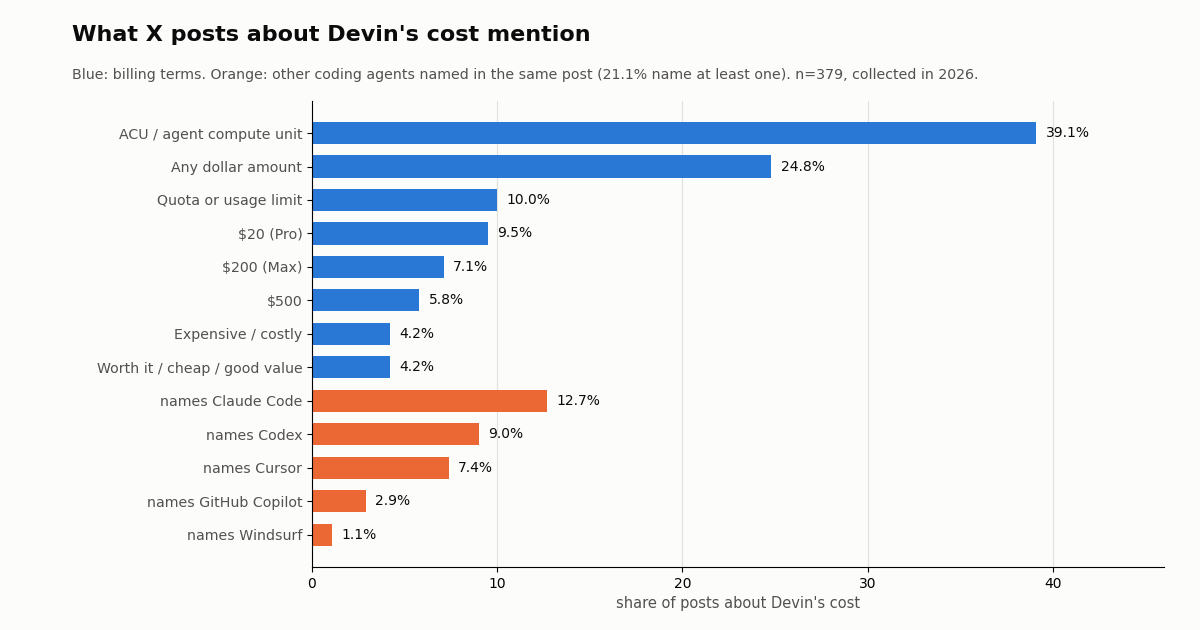
Prices people quote. 24.8% of the posts carry a dollar figure: $20 appears in 9.5%, $200 in 7.1%, and $500, the figure X users tie to Devin's earlier team pricing, in 5.8%. Only 5 posts cite $2.25, the per-ACU price older review sites still repeat.
Sentiment is split, and quiet. 4.2% of posts call Devin expensive or costly and the same 4.2% call it worth it, cheap or good value. Most posts simply state a price or a limit.
Japanese users are a large share. 23.2% of the posts are in Japanese and 66.0% in English, so pricing questions about Devin are not only an English-language conversation.
Reach. The median post got 4 likes and 819 views; the top tenth reached 62 likes and 8,517 views. 36.9% of posts come from accounts with more than 10,000 followers.
Which agents people compare Devin with, and what Cognition posts about plans
21.1% of the posts name at least one other coding agent. Claude Code leads at 12.7%, then Codex at 9.0%, Cursor at 7.4% and GitHub Copilot at 2.9%. Windsurf, which Cognition agreed to acquire on July 14, 2025, appears in only 1.1%: on X it is rarely discussed as part of Devin's price, even though Cognition's docs now link Devin Desktop to windsurf.com and let legacy Windsurf Enterprise accounts sign in to the Devin CLI on Windsurf's credit model.
We also read the two official accounts. Cognition's own posts are about models, launches and funding far more than about plans.
@cognition never says ACU. None of its 120 recent posts mention ACUs. Its pricing-related posts are about using a ChatGPT plan inside Devin, model price cuts on Devin Desktop and the CLI, and a startup program with $65k in credits. Those posts did well: a median of 650 likes against 448.5 for all its posts.
@DevinAI is the product's own voice, posting about 0.32 times a day in the sample. Its one ACU mention is a joke about users asking it to use fewer ACUs.
Giving Devin live X (Twitter) data: MCP or REST, and the X data bill
A common Devin task is building something that reads X: a mention monitor, a competitor feed, a research script. Devin needs a data source for that, and it is the one cost line on such a task that Devin's plan does not include.
Option 1, MCP. Devin supports custom MCP servers over STDIO, SSE and Streamable HTTP; Cognition recommends HTTP for new integrations. An org admin with the Manage MCP Servers permission opens Customize, then MCPs, chooses Add custom MCP, picks HTTP, enters the server URL https://mcp.twitterapi.io/mcp, sets the authentication method to Auth Header with header key Authorization and value Bearer your_key_here, and clicks Test tools. Every Devin session in the organization can then search tweets, read timelines and look up profiles as tools.
Option 2, REST. For code Devin writes and ships, store the key as a Devin secret and let the code read it from the environment. Cognition offers personal, organization, repository and session-scoped secrets, all encrypted at rest. Its docs warn not to put secret values in blueprint YAML, setup commands or committed .env files, and note that secrets are not exported into every shell: tell Devin which environment variable your script reads (for example TWITTERAPI_IO_KEY) and it binds the secret to that command. A personal secret is the right scope while you prototype; a repository secret fits once the code lives in a repo.
The X data bill. TwitterAPI.io charges per item returned: tweets are $0.15 per 1,000 (15 credits per tweet, minimum 15 credits per request) and profiles $0.18 per 1,000. X's own pay-per-usage rate card on docs.x.com/x-api/getting-started/pricing charges $0.005 per post read and $0.010 per user read, which is $5.00 per 1,000 posts, about 33 times more per 1,000 tweets. Reads need no X account.
This page's own study read 1,100 tweets in 59 requests for about $0.17. The same reads at $0.005 per post would be about $5.50. Sign-up gives up to $1 of free credits (at most 100,000 credits, no card, one per person or network, expiring after 31 days) for new accounts that pass the automatic bot check; paid plans start at Starter, $29 a month.
If the Devin task needs to post rather than read, writes run through an authenticated session: one /twitter/user_login_v2 login ($0.10, with a proxy you supply) returns login_cookies, and each post, like or follow through /twitter/create_tweet_v2 and its siblings is 60 credits ($0.0006), billed per HTTP 200 call. The call acts as that account, so X can rate-limit, lock or suspend it; keep a human pace and expect to log in again when the session expires.
{
  "transport": "HTTP",
  "url": "https://mcp.twitterapi.io/mcp",
  "auth_method": "auth_header",
  "headers": {
    "Authorization": "Bearer your_key_here"
  }
}How we collected this
Question. How do people on X talk about what Devin costs, and how much of Cognition's own posting is about plans and pricing?
Accounts and queries. Timelines of @cognition and @DevinAI, both verified as Cognition's accounts with a profile lookup first. Three Latest advanced searches: Devin with ACU terms; Devin pricing, price, cost, plan, subscription, quota or usage phrases; and Devin or @cognition with $20, $200, $500, per month, expensive or usage-limit terms. Reposts were excluded from the searches.
Sample. 896 unique search posts after dedupe, of which 379 are about Devin the coding agent; 120 own posts from @cognition and 20 from @DevinAI. 59 requests, 1,100 tweets returned, about $0.17. Collected in 2026.
Method. Keyword rules flag billing terms (ACU, quota or limit, dollar figures, cost sentiment) and other agents named in the same post. Age buckets are measured back from the newest post in the sample.
What the sample cannot show. Shares reflect what our queries match: one of the three searches targets ACU terms, which raises the overall ACU share, so read the age buckets rather than the total. Keyword rules miss sarcasm and posts that describe cost without these words. X search returns a subset of posts, older buckets are thinner, and nothing here measures what Devin actually costs any one user.
Privacy. Aggregates only. Only the two organization accounts are named; search results from private individuals were not stored in the repository, and the published sample keeps de-identified rows without ids, handles, URLs or text.
"""Pull recent X posts about Devin's pricing with TwitterAPI.io, the kind of script you can hand to Devin.
Store the key as a Devin secret and tell Devin it is read from TWITTERAPI_IO_KEY."""
import os
import time

import requests

BASE = "https://api.twitterapi.io"
HEADERS = {"X-API-Key": os.environ["TWITTERAPI_IO_KEY"]}
QUERY = '("devin pricing" OR "devin plan" OR "devin quota") -is:retweet'


def search(query, max_pages=5):
    """Yield tweets newest first, following next_cursor. Each tweet costs $0.15 per 1,000."""
    cursor = ""
    for _ in range(max_pages):
        r = requests.get(
            f"{BASE}/twitter/tweet/advanced_search",
            headers=HEADERS,
            params={"query": query, "queryType": "Latest", "cursor": cursor},
            timeout=30,
        )
        r.raise_for_status()
        body = r.json()
        for t in body.get("tweets", []):
            yield t
        if not body.get("has_next_page"):
            break
        cursor = body.get("next_cursor", "")
        time.sleep(0.2)


def main():
    rows = []
    for t in search(QUERY):
        text = t.get("text") or ""
        rows.append({
            "created": t["createdAt"],
            "likes": t.get("likeCount", 0),
            "views": t.get("viewCount", 0),
            "mentions_quota": any(w in text.lower() for w in ("quota", "limit")),
            "mentions_acu": "acu" in text.lower(),
            "url": t["url"],
        })
    print(f"{len(rows)} posts")
    print("mention quota or limits:", sum(r["mentions_quota"] for r in rows))
    print("mention ACUs:", sum(r["mentions_acu"] for r in rows))
    for r in sorted(rows, key=lambda r: -r["likes"])[:5]:
        print(r["likes"], r["views"], r["url"])


if __name__ == "__main__":
    main()
Researching this?Free starter credits cover end-to-end testing — Google sign-in, no card. Get a key.
Questions readers ask
How much does Devin cost?
On devin.ai/pricing: Free is $0, Pro is $20 per month, Max is $200 monthly, Teams is $80 a month for the team plan plus $40 a month per full dev seat (up to 200 users), and Enterprise is custom. Usage past a paid plan's quota is bought as on-demand credits at API pricing.
What is an ACU in Devin, and how much does one cost?
An ACU (Agent Compute Unit) measures the work Devin performs. Cognition's billing docs now use ACUs only for Enterprise, billed at the rate in each customer's order form, and publish no public ACU price. Self-serve plans use a quota plus on-demand credits instead, so per-ACU prices on older review sites no longer describe the self-serve plans.
Is Devin free?
There is a Free plan at $0 with a light quota to code with agents, limited model availability, unlimited inline edits and unlimited Tab completions, plus Devin Review and DeepWiki. Devin Cloud, the cloud agents, starts at Pro.
What is the difference between Devin Pro and Max?
Both are single-user plans. Pro ($20 a month) has a daily and weekly quota and up to 10 concurrent sessions. Max ($200 monthly) has a significantly larger weekly quota with no daily cap. Max makes sense only when Pro's overflow, billed as credits at API pricing, would cost more than the $180 difference.
How does Devin Teams pricing work?
Every Teams account pays at least $80 a month. Full seats cost $40 a month each and include a Pro-equivalent quota and Devin Desktop; flex seats are free but draw from the team's shared on-demand credits. With fewer than two full seats, the rest of the $80 is charged as prepaid credits the team can use.
What uses up Devin's quota?
The number and complexity of actions Devin takes (planning, context gathering, code and browser actions) plus virtual machine time. Waiting for your reply, test suites or repo setup costs almost nothing, and sleeping sessions cost nothing. Windows sessions use about 9% more than Linux.
Do Devin credits expire?
No. Cognition's docs say purchased on-demand credits roll over month to month and never expire. On Teams they form one shared pool for all members.
How do I give Devin access to Twitter (X) data?
Add https://mcp.twitterapi.io/mcp as a custom HTTP MCP server in Devin with an Authorization: Bearer header, or store a TwitterAPI.io key as a Devin secret and call the REST API from code. Tweets cost $0.15 per 1,000, against $0.005 per post read on X's pay-per-usage rate card.
Continue
- Devin: Plans and Pricing
- Devin docs: Self-serve plans (quotas, Teams seats, on-demand credits)
- Devin docs: Enterprise billing in ACUs
- Devin docs: Usage, what counts toward consumption
- Devin docs: MCP servers and custom HTTP servers
- X API pricing (pay-per-usage rate card)
- X (Twitter) API guide: endpoints, pricing and access
- Claude Code pricing: plans, usage limits and API keys
- Codex pricing: ChatGPT plans, credits and API cost
- Claude Code alternatives, free and open source
- What an MCP server is and how to connect one
- Codex vs Claude Code compared side by side
- TwitterAPI.io pricing: pay per tweet returned
- Get a TwitterAPI.io API key on the dashboard
- 01Lovable Alternatives in 2026: Bolt.new, v0, Base44, Replit, Emergent and Cursor Compared
- 02Kiro vs Cursor in 2026: Plans, Spec-Driven vs Agent-First, and X (Twitter) Data via MCP
- 03Langfuse vs LangSmith: Pricing, Self-Hosting, OpenTelemetry and an X-Data Agent Traced in Both
- 04n8n vs Zapier vs Make in 2026: Pricing, Self-Hosting, AI Agents and the Same Twitter (X) Flow Built in All Three
- 05Replit pricing in 2026: plans, credits, effort-based Agent costs, and what an app that reads Twitter (X) data really costs
- 06Claude Code Pricing in 2026: Plans, Usage Limits and the Real Cost of an Always-On Agent
- 07Base44 pricing in 2026: plans, credits, and what an app with Twitter (X) data really costs
- 08Codex Pricing in 2026: ChatGPT Plans, Usage Limits, Credits and API-Key Costs
Writing about something you built with TwitterAPI.io? Our community rewards program pays API credits for honest tutorials, build logs and videos.
Stop reading. Start building.
Starter credits cover real testing on real data. Google sign-in, no card, no application queue.
Get an API keyAlready building with TwitterAPI.io? Publish an honest tutorial or build log about it and earn up to $200 a month in API credits.