Kiro vs Cursor in 2026: Plans, Spec-Driven vs Agent-First, and X (Twitter) Data via MCP
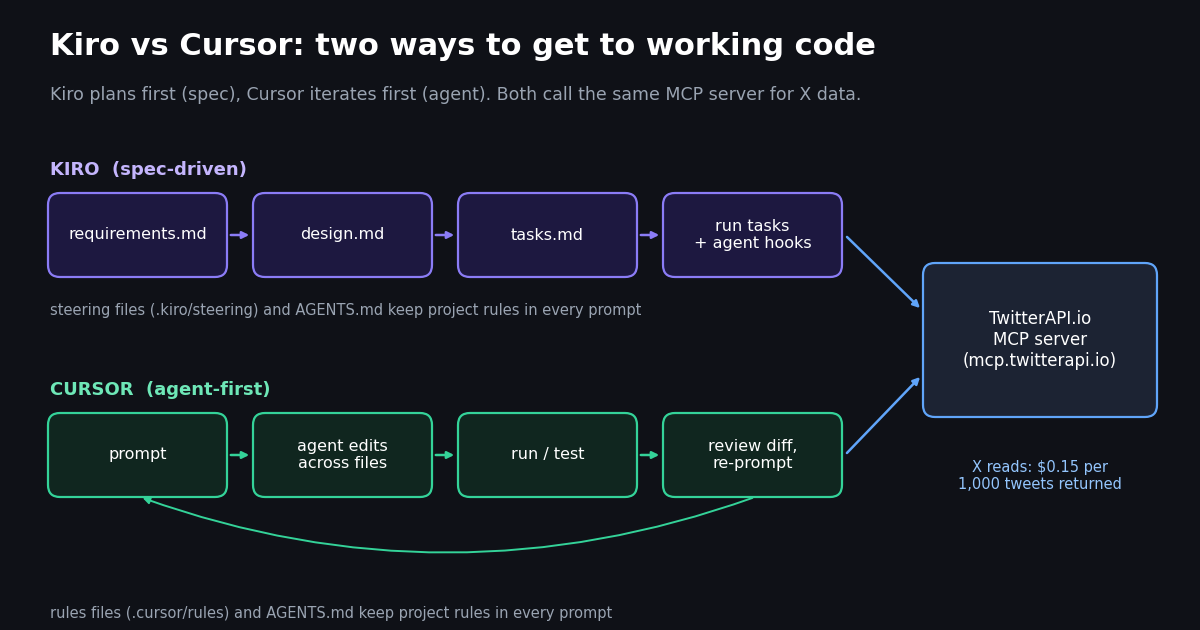
- Workflow: Kiro plans first (specs: requirements, design, tasks); Cursor acts first (agent loop, review the diff). Both read AGENTS.md and support hooks.
- Kiro plans: Free 50 credits, Pro $20 (1,000), Pro+ $40 (2,000), Pro Max $100 (5,000), Power $200 (10,000), all monthly; add-on credits $0.04 each.
- Cursor plans: Free, Plus $8 (Grok models only), Premium $30, Super $100, Ultra $200, all billed monthly, sold as part of The X Subscription; pool refreshes weekly; Claude, GPT and Gemini cost extra at API list price.
- MCP: same server in both:
.kiro/settings/mcp.jsonin Kiro,.cursor/mcp.jsonin Cursor, each with aurland anAuthorizationheader. - X study: of 479 X posts naming both tools, only 82 (17.1%) name just the two; 66.0% list 4 or more coding tools, and only 1 states a switch in either direction (collected in 2026).
- X data bill: through our MCP server or REST API, X reads cost $0.15 per 1,000 tweets returned vs $5.00 at the official X API's $0.005 per post read, about 33x less.
Most Kiro vs Cursor comparisons were written when Kiro was a free preview and Cursor Pro was a flat $20. Neither is true now. Kiro sells credits on five individual tiers and lets you pick Claude, GPT-5.6 or open-weight models; Cursor is sold as part of The X Subscription, with a weekly usage pool that covers Grok and Cursor's own Composer models and bills third-party models separately. This page compares the two as they are today, from each vendor's own pricing page and docs, read this session.
We also did what the comparison posts skip: we pulled 479 recent X posts that name both tools and the latest posts of @kirodotdev and @cursor_ai, to see how developers actually talk about the pair. And because both editors are MCP clients, we show the exact config that gives either one live X (Twitter) data, with the read bill next to the official X API's rate card.
If you are choosing between Cursor and other agents, our siblings cover the neighbors: Antigravity vs Cursor for Google's editor and Cursor vs Claude Code for the terminal agent. This page stays on Kiro and Cursor.
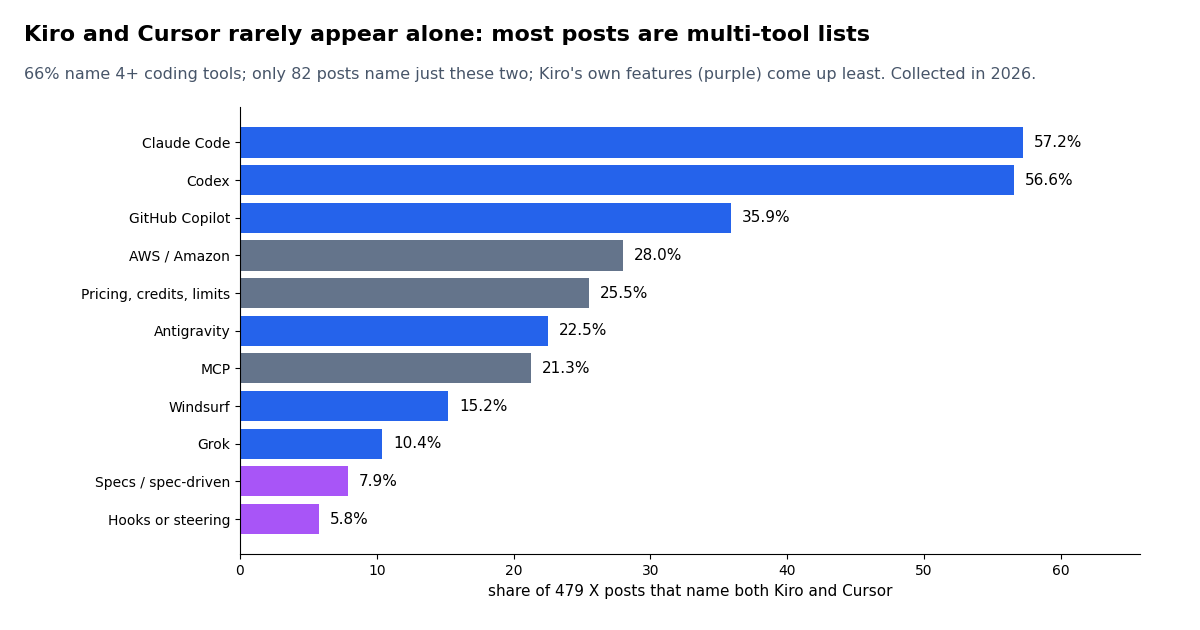
1 of 479 recent X posts (collected in 2026). 66.0% of the posts list four or more coding tools and only 17.1% name Kiro and Cursor alone; Claude Code (57.2%) and Codex (56.6%) are the usual companions.
Kiro vs Cursor at a glance
The short version: the editors look alike (both are VS Code descendants; Kiro states it "is based on Code OSS" and imports VS Code settings and Open VSX extensions), but they differ in where the agent starts, which models the subscription pays for, and how usage is metered.
How to read the table. If the deciding question is "which models does my monthly fee actually cover", the answer flips the usual assumption: Kiro's credits buy Claude and GPT-5.6 usage, while Cursor's pool buys Grok 4.7, 4.6, 4.5 and Composer 2.5, and anything from Anthropic, OpenAI or Google is a separate meter.
Pricing and models: Kiro credits vs Cursor's weekly pool
Both vendors moved away from simple request counts, but in opposite directions. Kiro meters every prompt in credits against a monthly allowance; Cursor gives each tier a usage pool that refreshes weekly and lets you buy top-ups. Prices below are copied from kiro.dev/pricing and cursor.com/pricing as shown this session (US dollars, per user, per month).
What a Kiro credit buys. Kiro calls a credit "a unit of work": a simple prompt can cost less than one, executing a spec task usually costs more, and prompts, spec refinement, task execution and agent hook execution all draw credits. The default "Auto" agent mixes models; picking a model applies a multiplier (Kiro's own example: a task costing X credits on Auto costs 1.3X on Sonnet 4.6). Plan credits reset monthly and do not roll over. New Pro upgrades get the rest of the month free plus 500 trial credits.
What Cursor's pool buys. "Every tier includes a pool of AI usage shared across Cursor and Grok", and the docs list Grok 4.7, Grok 4.6, Grok 4.5 and Composer 2.5 as the pool models. "Third-party models like Claude, GPT, and Gemini aren't part of the included pool": on Premium and up they are billed at the model's API list price from prepaid credit, and Plus and Free cannot use them. Cursor publishes multipliers (4x, 15x, 50x of Plus) rather than dollar pool sizes, so you cannot convert a Cursor tier into a fixed number of agent runs.
The practical comparison. At $20, Kiro Pro is a defined monthly budget with Claude available inside it. At $30, Cursor Premium buys a weekly Grok-family pool plus cloud agents and code reviews, and every Claude or GPT call is extra. If your team standardizes on Claude models, Kiro's price is the all-in number; in Cursor, budget the API list price on top. If Grok and Composer are good enough for your code, Cursor's $8 Plus is the lowest paid entry of the two. Annual Cursor billing is $80, $300, $1,000 and $2,000 a year for Plus through Ultra.
Kiro. Prompts go to "Auto" by default, which Kiro describes as an agent that mixes frontier and specialized models to balance quality, latency and cost. You can also pick a model: OpenAI GPT-5.6 variants; Anthropic Claude Opus 5, Opus 4.8, Sonnet 5, Sonnet 4.6, Sonnet 4.5 and Haiku 4.5; and open-weight models (DeepSeek 3.2, MiniMax M2.5, GLM-5, Qwen3 Coder Next). Each model has a credit multiplier listed on Kiro's models page. The free tier gets open-weight models and Claude Sonnet 4.5 with limits.
Cursor. The included pool covers Grok 4.7, Grok 4.6, Grok 4.5 and Composer 2.5; Cursor's docs describe Grok 4.7 and related models as jointly trained by Cursor and SpaceXAI. Plus runs Grok models only. Premium and up can call Claude, GPT and Gemini at each model's API list price, and Teams pays a Cursor Token Rate of $0.25 per million tokens on eligible third-party requests.
What that means for a choice. The model question used to be a tie (both editors ran Claude). Now it is a real difference: Kiro is the one where Claude sits inside the subscription, and Cursor is the one where Grok does. Our X study shows how much of the conversation already runs through Claude: 68.7% of the posts naming both Kiro and Cursor also mention Claude, Sonnet or Opus.
Workflow: Kiro specs, hooks and steering vs Cursor's agent, rules and hooks
Kiro specs. A spec is a set of files Kiro writes before code: requirements.md (user stories and acceptance criteria; bugfix.md for a bugfix spec), design.md (architecture, sequence diagrams) and tasks.md (discrete, trackable implementation tasks). Feature specs can start requirements-first or design-first, bugfix specs diagnose before patching, and a Quick Spec writes all three in one pass without approval gates. The point is a reviewable plan: you edit the requirements before the agent has touched the repo.
Kiro agent hooks. Hooks pair a trigger with a shell command or an agent prompt, stored as JSON in .kiro/hooks/. Kiro's hook types include Prompt Submit, Agent Stop, Session Start, Pre Tool Use (which can block the tool), Post Tool Use, File Create, File Save, File Delete, and Pre and Post Task Execution around spec tasks. A File Save hook that runs your linter, or a Post Task hook that runs tests after each spec task, is the typical use. Hook runs that call the agent consume credits.
Kiro steering. Steering files are markdown in .kiro/steering/ (workspace) or ~/.kiro/steering/ (global). Kiro can generate product.md, tech.md and structure.md, and each file can be always included, included on a fileMatch pattern, manual (#file-name in chat) or auto (by description). AGENTS.md files are read too and are always included.
Cursor's equivalents. Cursor has no spec phase, but it has the other two pieces. Rules live in .cursor/rules as .mdc files with four modes (Always Apply, Apply to Specific Files, Apply Intelligently, Apply Manually), and a plain AGENTS.md works as well. Hooks live in .cursor/hooks.json and observe the agent loop: sessionStart, beforeSubmitPrompt, preToolUse, beforeShellExecution, beforeMCPExecution, afterFileEdit, stop and more. The beforeMCPExecution hook is useful for X data: you can log or gate every MCP tool call before it runs.
Same feature, two routes. Ask both editors for a small X monitor (the script in this page's code block). In Kiro, the request becomes a spec: requirements such as "print each new post matching the query once" and "an empty check must not crash", a design that picks /twitter/tweet/advanced_search with a since_time: operator and a seen-ids set, and four or five tasks you approve one by one. In Cursor, you describe the script, the agent writes it in one pass, you run it and re-prompt on what breaks. Kiro front-loads the review; Cursor back-loads it. For a 60-line script, Cursor is likely faster to a first run; for a feature that touches several services, Kiro's written acceptance criteria are the thing you would otherwise write by hand.
Carrying conventions across both. Since both read AGENTS.md, a team that uses both editors can keep shared instructions ("never call the X API without X-API-Key", "page with next_cursor") in one AGENTS.md and keep tool-specific detail in .kiro/steering/ or .cursor/rules.
What developers on X actually say about Kiro and Cursor
We searched X for recent posts containing both "kiro" and "cursor" (latest and top results, reposts excluded, the two official accounts removed) and kept 479 posts from 374 distinct authors. The first finding is volume: the latest 30 pages reached back 479 days, so posts naming both tools run at roughly 1.0 per day. This is not a crowded head-to-head debate on X.
Almost nobody posts a switch. We looked for explicit migration phrasing ("switched from Cursor to Kiro", "Kiro > Cursor", "back to Cursor" and their mirrors). Exactly 1 of 479 posts stated a direction, and it was toward Cursor. Only 25 posts (5.2%) used words like switch, migrate or ditch at all, and most of those were about switching between many tools or models. The data does not support the "everyone is leaving Cursor for Kiro" or the reverse framing that comparison blogs often imply.
Kiro and Cursor appear inside lists. 82.9% of the posts name at least one more coding tool, 66.0% name four or more, and only 82 posts (17.1%) mention Kiro and Cursor alone. Claude Code (57.2%) and Codex (56.6%) are the usual companions, followed by GitHub Copilot (35.9%) and Antigravity (22.5%). The typical post is a launch note for a plugin, memory layer or MCP server that "works with Claude Code, Codex, Cursor, Kiro", not a review.
Kiro's signature features are rarely the topic. Specs come up in 7.9% of posts and hooks or steering in 5.8%, below MCP (21.3%) and pricing, credits or limits (25.5%). When people put the two editors side by side on X, they talk about cost and integrations more than about the workflow difference that defines Kiro.
Engagement is modest and non-English heavy. Median likes are 6 (p90 60) and median views 851 (p90 9,860). Posts that name only the two tools get fewer likes (median 4) than four-plus-tool lists (median 6.5). English accounts for 68.7% of the posts, Chinese 12.3% and Japanese 10.4%; 147 of the 479 posts came from accounts with 10,000 or more followers.
How the official accounts differ: @kirodotdev vs @cursor_ai
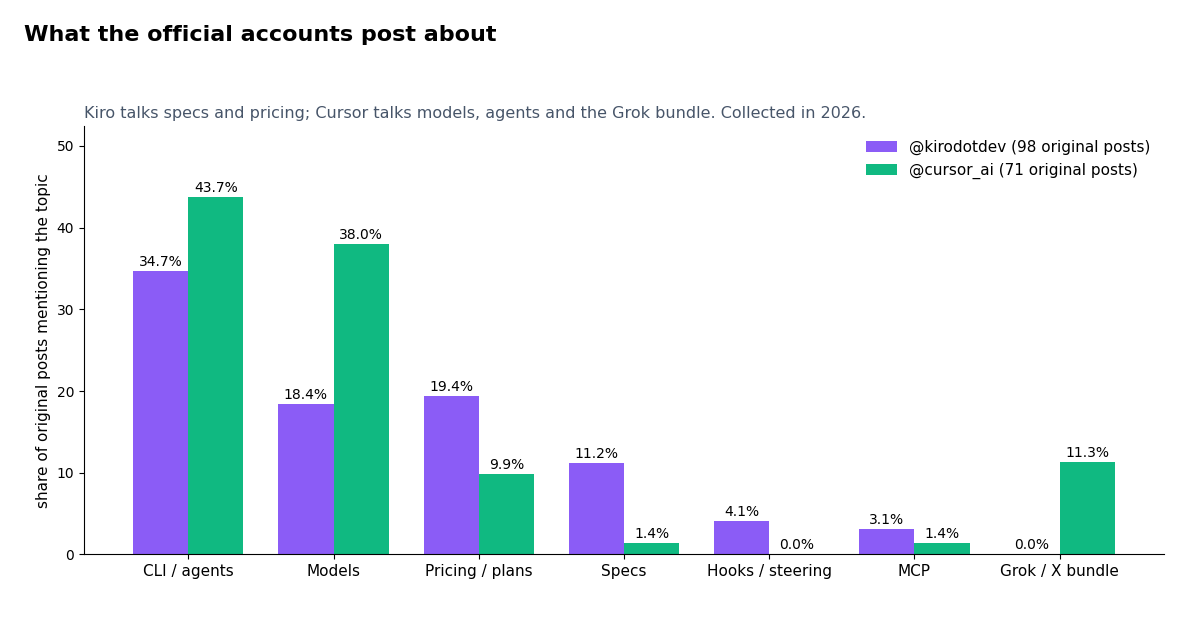
We read the latest 160 posts of each official account, replies included. The audience gap is large: @cursor_ai has 497,284 followers to @kirodotdev's 22,660 (21.9x), and the median original Cursor post gets 421,933 views to Kiro's 6,910.5 (61.1x).
Two different jobs. Kiro's account is a product-education feed: almost every original post carries media, half carry video, and specs and pricing get more airtime than on Cursor's feed. Cursor's account answers people (51.2% of its posts are replies) and announces models and agent features, and 11.3% of its original posts mention Grok or the X bundle. Neither account talks much about MCP (3.1% and 1.4%), even though MCP shows up in 21.3% of the developer posts naming both tools.
Wiring X (Twitter) data into Kiro and Cursor with our MCP server
Both editors are MCP clients that accept a remote server with a url and headers, so the TwitterAPI.io hosted server (https://mcp.twitterapi.io/mcp, API key sent as a Bearer token) drops into either one with the same JSON. Reads need no X account; you only need a twitterapi.io API key from the dashboard.
Kiro. Save the block below as .kiro/settings/mcp.json in the workspace (or ~/.kiro/settings/mcp.json for every project). To keep the key out of the file, Kiro expands ${VARIABLE_NAME} in headers, but only for environment variables you explicitly approve, so "Bearer ${TWITTERAPI_IO_API_KEY}" works once approved.
Cursor. Save the same block as .cursor/mcp.json in the project or ~/.cursor/mcp.json globally. Cursor's interpolation syntax is different: "Bearer ${env:TWITTERAPI_IO_API_KEY}". Copying a Kiro config into Cursor without changing ${...} to ${env:...} is the most common reason the server connects but every call returns an auth error.
Using it in a spec. In Kiro, mention the server in the requirements ("fetch posts with the twitterapi-io MCP search tool, not a scraper") so the design and tasks are built around real fields such as likeCount, viewCount and author.followers. A steering file with fileMatch on your data scripts is a good place for the field list. In Cursor, put the same instruction in a rule with Apply Intelligently, and use a beforeMCPExecution hook if you want to log each X call the agent makes.
A prompt that works in both. "Using the twitterapi-io tools, get the latest 100 posts that mention both kiro and cursor, and tell me which other coding tools they name most often." That is a five-page search (20 tweets per page), which returns 100 tweets for $0.015.
For more depth on the Cursor side (stdio vs hosted transport, error fixes), see How to use Cursor with the Twitter API; for building a whole Kiro project around X data, see Build Twitter apps with the Kiro AI IDE.
{
  "mcpServers": {
    "twitterapi-io": {
      "url": "https://mcp.twitterapi.io/mcp",
      "headers": { "Authorization": "Bearer your_key_here" }
    }
  }
}The X data bill, in either editor
The editor subscription pays for the model. The X data is a separate bill, and it is identical in Kiro and Cursor because the MCP server and the REST API price the same way: 15 credits per tweet returned, which is $0.15 per 1,000 tweets. A request that returns nothing still costs the 15-credit minimum ($0.00015), and a full 20-tweet page costs $0.003. Profiles cost 18 credits each ($0.18 per 1,000). A search polled every 60 seconds for a month that never finds anything is 43,200 checks, or $6.48 in minimums. $1 buys 100,000 credits, and purchased credits never expire.
Named rate card. The official prices are from the X API pay-per-usage card at docs.x.com/x-api/getting-started/pricing: $0.005 per post read, $0.010 per user read, capped at 3 million post reads a month before Enterprise. Per 1,000 tweets that is $5.00 against $0.15, about 33x. New TwitterAPI.io accounts that pass the automatic bot check get up to $1 of free credits (at most 100,000 credits, no card, one per person or network, expiring after 31 days); see the pricing page for plans.
Agent loops multiply calls. An agent that re-runs a search while iterating can spend ten pages where a script spends one. In Kiro, a Pre Tool Use hook can block a tool call; in Cursor, beforeMCPExecution can log or deny it. Either is a cheap guard on both bills: your editor credits and your X reads.
Posting from the agent. Writes are available too: one /twitter/user_login_v2 login ($0.10, with a proxy you supply) returns login_cookies, then each post, like, follow or retweet through /twitter/create_tweet_v2 and its siblings is 60 credits ($0.0006), billed per HTTP 200 call. The call acts as that account, so X can rate-limit, lock or suspend it; keep a human pace, and expect the session to need a re-login from time to time.
Which should you pick?
Pick Kiro if you want a plan before code (requirements and tasks you can review and hand to a teammate), your team already standardizes on Claude models and wants them inside the subscription price, you want hooks around spec tasks (run tests after each task), or you work inside AWS and like a single vendor. Budget: Pro $20 for 1,000 credits, with $0.04 add-ons.
Pick Cursor if you iterate by prompting and reviewing diffs, Grok 4.7 or Composer 2.5 are good enough for most of your work, you want cloud agents and code reviews (Premium and up), or you already pay for The X Subscription. Budget: Premium $30, plus API list price for any Claude, GPT or Gemini calls.
Use both if you plan large features in Kiro and do quick fixes in Cursor. Keep shared instructions in AGENTS.md, and point both at the same MCP server so X data behaves identically.
What the X data says about the choice. Developers on X do not frame Kiro and Cursor as a two-way race: 66.0% of posts naming both list four or more tools, and Claude Code and Codex appear in more than half. If you are still shortlisting, compare the terminal agents too: our Cursor vs Claude Code and Antigravity vs Cursor pages use the same method.
How we collected this
Question. When developers on X mention both Kiro and Cursor, which way do they say they are moving, what else do they bring up, and what do the two official accounts post about?
Accounts and query. Official accounts @kirodotdev and @cursor_ai (profile plus the latest 160 posts each, replies included). Search: kiro cursor -filter:retweets, 30 pages of Latest results and 5 pages of Top results, deduplicated, then kept only posts containing both words and not from the two official accounts.
Window and sample. The most recent posts at collection time, collected in 2026. 632 unique search posts were returned and 479 kept (374 distinct authors); the official timelines gave 98 and 71 original posts. 53 requests in total, about 952 tweets and 2 profiles returned, roughly $0.143 at our rates.
Method. Topics and switch direction were matched with case-insensitive regular expressions on post text; switch phrasing included "switched from X to Y", "X -> Y", "left X for Y" and "Y > X". The analysis script and results are in our repository under data/studies/kiro-vs-cursor/.
What the sample cannot show. Keyword matching misses sarcasm and posts that name a tool without the exact word ("the AWS IDE"). X search returns a sample, not every post. X posts are not a measure of usage, satisfaction or market share; many developers choose an editor without posting about it. Engagement depends heavily on who posts.
Privacy. Aggregates only. Search authors are private individuals: their raw posts were not stored in the repository, and the de-identified sample keeps only language, counts, topics and a follower bucket (no ids, URLs, text or handles). Only the two organization accounts are named.
"""watch_x.py - the small X monitor both IDEs build in this comparison.

Polls X (Twitter) search for new posts that match a query and prints them.
pip install requests
export TWITTERAPI_IO_API_KEY=...   # from the twitterapi.io dashboard
"""
import os
import time

import requests

API_KEY = os.environ["TWITTERAPI_IO_API_KEY"]
BASE = "https://api.twitterapi.io"
QUERY = "(kiro OR cursor) (mcp OR spec) -filter:retweets"
INTERVAL = 300      # seconds between checks; an empty check is billed the 15-credit minimum
MAX_PAGES = 5       # safety cap per check; a full page holds up to 20 tweets


def search_page(query, cursor=None):
    params = {"query": query, "queryType": "Latest"}
    if cursor:
        params["cursor"] = cursor
    r = requests.get(
        f"{BASE}/twitter/tweet/advanced_search",
        headers={"X-API-Key": API_KEY},
        params=params,
        timeout=30,
    )
    if r.status_code != 200:
        # error bodies explain themselves (bad key, bad query, no credit ...)
        raise RuntimeError(f"HTTP {r.status_code}: {r.text[:300]}")
    return r.json()


def new_posts(since_unix, seen):
    """Newest-first pages since the last check; skip ids already printed."""
    query = f"{QUERY} since_time:{since_unix}"
    found, cursor = [], None
    for _ in range(MAX_PAGES):
        page = search_page(query, cursor)
        for t in page.get("tweets", []):
            if t["id"] not in seen:
                seen.add(t["id"])
                found.append(t)
        if not page.get("has_next_page"):
            break
        cursor = page.get("next_cursor")
    return found


def main():
    seen = set()
    since = int(time.time()) - 3600          # first run: the last hour
    while True:
        started = int(time.time())
        for t in reversed(new_posts(since, seen)):   # print oldest first
            a = t.get("author") or {}
            print(f"{t['createdAt']}  @{a.get('userName')}  "
                  f"likes={t.get('likeCount', 0)} views={t.get('viewCount', 0)}")
            print("   ", t["text"].replace("\n", " ")[:200])
            print("   ", t["url"])
        since = started - 60                  # small overlap; the seen set removes repeats
        time.sleep(INTERVAL)


if __name__ == "__main__":
    main()
Researching this?Free starter credits cover end-to-end testing — Google sign-in, no card. Get a key.
Questions readers ask
Is Kiro better than Cursor?
Neither wins on every axis. Kiro is better when you want a written spec (requirements, design, tasks) before code and Claude models inside the plan price. Cursor is better for fast prompt-and-review iteration, cloud agents, and if Grok or Composer models suit you. On X, developers rarely frame it as a two-way race: only 1 of 479 posts naming both stated a switch.
How much does Kiro cost compared with Cursor?
Kiro: Free (50 credits a month), Pro $20 (1,000 credits), Pro+ $40, Pro Max $100 and Power $200, all monthly, with extra credits at $0.04 each. Cursor: Free, Plus $8 (Grok models only), Premium $30, Super $100 and Ultra $200, all billed monthly, with a weekly pool and separate API list pricing for Claude, GPT and Gemini.
Can I use Claude in Kiro and in Cursor?
Yes in both, but the billing differs. In Kiro, Claude Opus, Sonnet and Haiku models draw on your plan credits with a per-model multiplier. In Cursor, Claude is not in the included pool; on Premium and up it is billed at Anthropic's API list price from prepaid credit, and Plus cannot use it.
Does Cursor have specs like Kiro?
Not as a built-in workflow. Cursor has rules (.cursor/rules, AGENTS.md) and hooks (.cursor/hooks.json), and you can ask its agent to write a plan file, but there is no requirements, design and tasks pipeline with approval gates the way Kiro specs work.
Do Kiro and Cursor both support MCP servers?
Yes. Kiro reads .kiro/settings/mcp.json or ~/.kiro/settings/mcp.json; Cursor reads .cursor/mcp.json or ~/.cursor/mcp.json. Both accept a remote server with url and headers. Environment variables use ${NAME} in Kiro (approved variables only) and ${env:NAME} in Cursor.
Is Kiro free?
Kiro has a perpetual free tier with 50 credits a month and access to open-weight models and Claude Sonnet 4.5, with limits. Upgrading to Pro for the first time makes the rest of that month free and adds 500 trial credits.
How do I get Twitter (X) data into Kiro or Cursor?
Add the TwitterAPI.io hosted MCP server (https://mcp.twitterapi.io/mcp, with your API key as a Bearer token in the Authorization header) to the editor's MCP config. Reads need no X account and cost $0.15 per 1,000 tweets returned, against $5.00 at the official X API's $0.005 per post read.
Do agent hooks and MCP calls use up credits?
In Kiro, agent hook executions that run the agent consume credits, like prompts and spec tasks. X data calls made through our MCP server are billed separately in TwitterAPI.io credits (15 per tweet returned, 15 minimum per request), whichever editor makes them.
Continue
- Kiro pricing: plans, credits, add-ons and model access
- Kiro docs: specs (requirements, design, tasks)
- Kiro docs: agent hook types
- Cursor docs: models and pricing (pool models, third-party billing, Teams)
- Cursor docs: Model Context Protocol configuration
- X API pricing (pay-per-usage rate card)
- Twitter (X) API overview: endpoints, pricing and limits
- Antigravity vs Cursor: plans, models and MCP compared
- Cursor vs Claude Code: plans, rules files and headless runs
- How to use Cursor with the Twitter API via MCP
- Build Twitter apps with the Kiro AI IDE
- TwitterAPI.io MCP server quickstart for every client
- TwitterAPI.io pricing and plans
- 01Devin Pricing in 2026: Plans, Quotas, ACUs and What X Users Actually Pay
- 02Lovable Alternatives in 2026: Bolt.new, v0, Base44, Replit, Emergent and Cursor Compared
- 03Langfuse vs LangSmith: Pricing, Self-Hosting, OpenTelemetry and an X-Data Agent Traced in Both
- 04n8n vs Zapier vs Make in 2026: Pricing, Self-Hosting, AI Agents and the Same Twitter (X) Flow Built in All Three
- 05Replit pricing in 2026: plans, credits, effort-based Agent costs, and what an app that reads Twitter (X) data really costs
- 06How to Use Cursor with the Twitter (X) API
- 07Cursor vs Claude Code: Plans, MCP Setup and Headless Runs Compared for Twitter (X) Data Work
- 08Cursor vs GitHub Copilot: Plans, Agent Mode, MCP and a Twitter (X) Data Setup in Both
Writing about something you built with TwitterAPI.io? Our community rewards program pays API credits for honest tutorials, build logs and videos.
Stop reading. Start building.
Starter credits cover real testing on real data. Google sign-in, no card, no application queue.
Get an API keyAlready building with TwitterAPI.io? Publish an honest tutorial or build log about it and earn up to $200 a month in API credits.