Roo Code vs Cline in 2026: After the Shutdown, Which One to Run
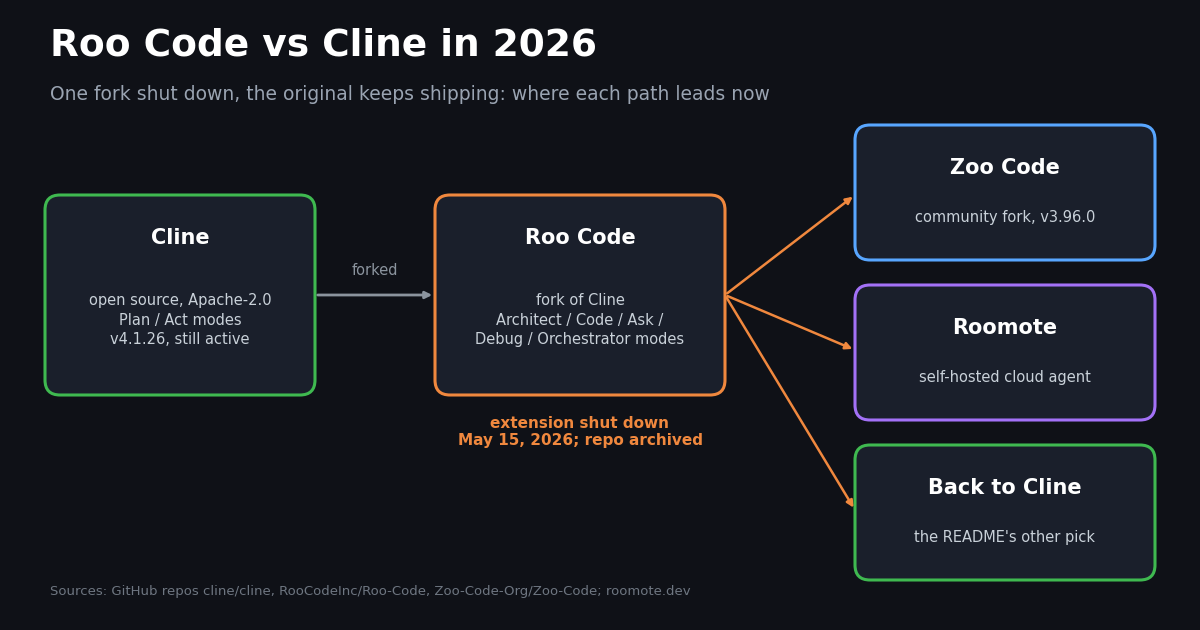
- Status: Roo Code's extension was shut down on May 15, 2026 (README), the repo is archived and the Marketplace listing is unpublished; Cline is active at v4.1.26.
- Successors: the Roo README points to Zoo Code (community fork, v3.96.0) and Cline; the Roo team moved to Roomote, free for up to 10 users, then $249/month for 11-50.
- Workflow: Roo-style modes scope tools per mode (
read,edit,command,mcp); Cline has two modes, Plan (read and discuss only) and Act, each with its own model if you want. - MCP: Cline uses
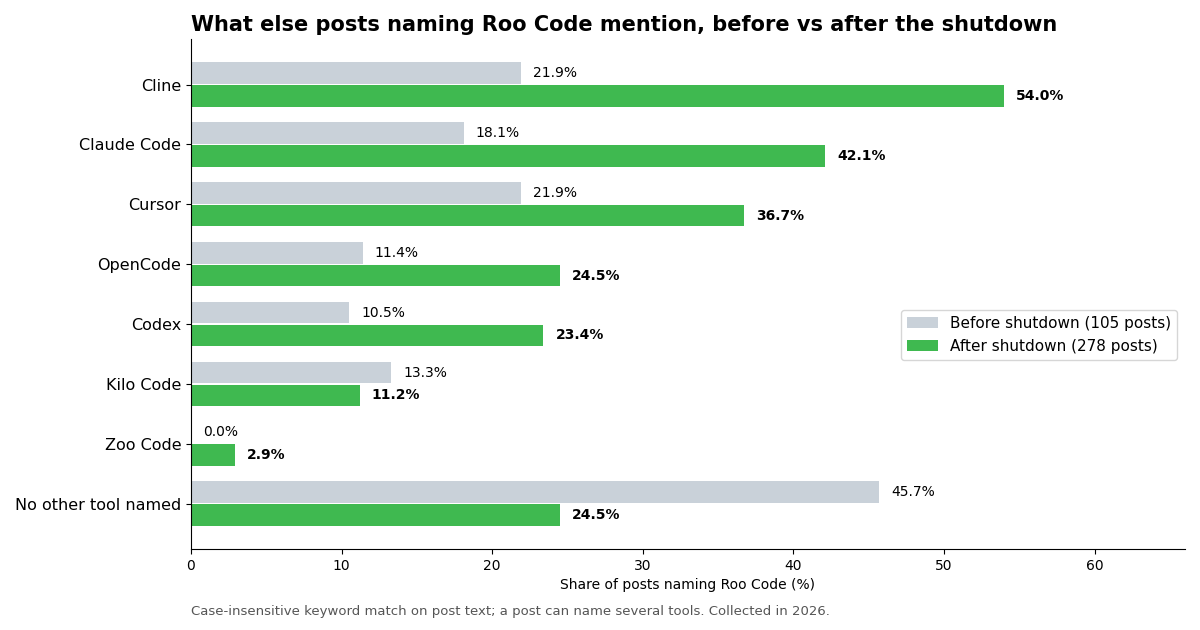
"type": "streamableHttp"andautoApprove; Roo-style configs use"type": "streamable-http"andalwaysAllow, inmcp_settings.jsonor.roo/mcp.json. - On X: posts naming Roo Code dropped to 59% of their pre-shutdown daily rate, and the share that also name Cline rose from 21.9% to 54.0%.
- X data in either agent: the same hosted MCP server works in both; reads cost $0.15 per 1,000 tweets returned vs $5.00 on the official X API pay-per-use rate card.
Most comparisons of Roo Code and Cline were written when both were shipping weekly, so they compare features of a product you can no longer install from the VS Code Marketplace. This page starts from the status that the primary sources show today, then compares what still matters: Roo-style modes versus Cline's Plan/Act, the MCP configuration of each, the cost model, and where the Roo user base actually went, measured on X.
For Cline's own pricing, model list and a worked per-task token cost, see our Cline vs Cursor comparison, which covers them in depth; this page links to it rather than repeating it and focuses on the Roo Code side and the migration decision.
The X study behind the charts covers 383 posts naming Roo Code (before and after the shutdown), 171 recent posts naming Cline in a coding context and the official @cline timeline, collected in 2026.
54.0% (up from 21.9%)
Roo Code vs Cline at a glance: status first
The short version: Cline is a maintained product and Roo Code is an archived codebase. Every row below was checked this session against GitHub's API, the VS Code Marketplace API or the vendor's own page.
What "shut down" means in practice. The Roo Code README now opens with a disclaimer: "The Roo Code Extension was shut down on May 15th." It points users who want an alternative to ZooCode, "a fork started by the Roo Code community", and to Cline, "from where Roo Code originated", and gives billing@roocode.com for former paying users. The domain roocode.com now answers with a 301 redirect to roomote.dev, and at collection time the official @roocode X account returned "user not found".
Can you still run an old copy? An installed copy keeps whatever it had, and the archived source is still Apache-2.0, so nothing stops you from building it. What you lose is the update stream: new model IDs, provider API changes and security fixes stop arriving, and the Roo Cloud and Roo Router services that depended on the company are gone. For an agent that runs shell commands in your workspace, an unmaintained release is a real risk, not just a missing feature.
What happened to Roo Code, and where its users can go
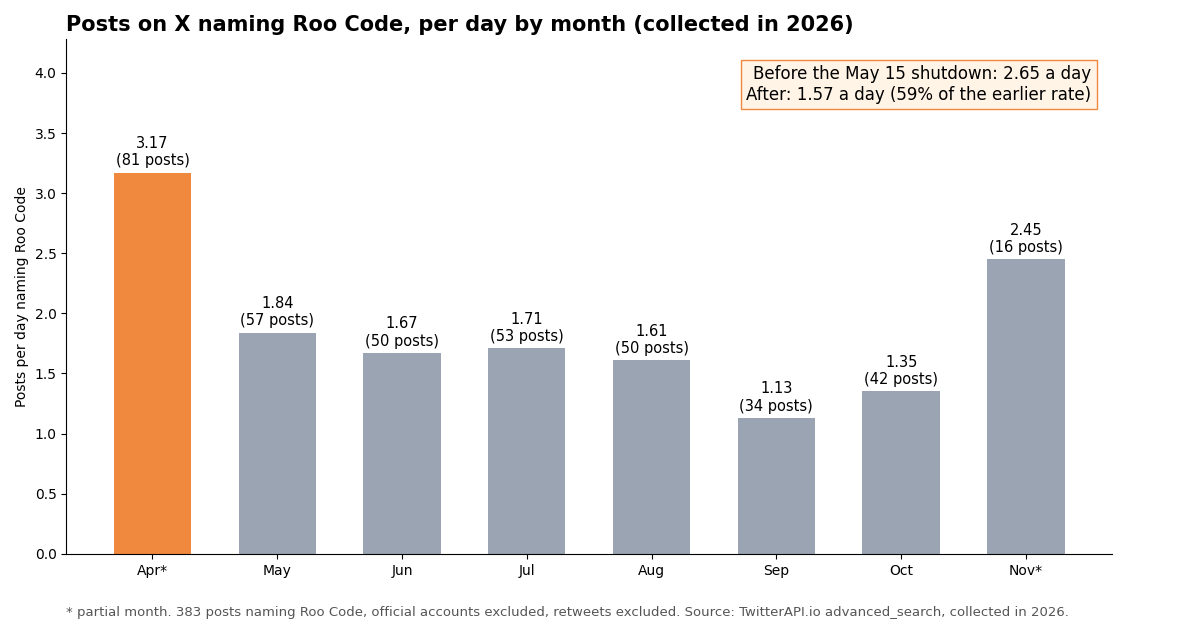
Roo Code started as a fork of Cline and grew its own identity around modes: role-specific agents with their own prompts and tool permissions, plus an Orchestrator that splits a task into subtasks. The team announced in April 2026 that it would end the extension and move to Roomote; our X sample shows the announcement as a spike to 16 posts a day naming Roo Code on April 21 and 22, against a typical 1 to 4. The final release, v3.54.0, and the archive both landed on May 15, 2026.
Zoo Code (closest to Roo). Zoo Code's README says it "continues development of this project after the Roo team wound down active Roo Code work to focus on Roomote", run by developers who contributed to Roo. The repository (Zoo-Code-Org/Zoo-Code) was created in April 2026, is Apache-2.0, has 2,096 stars and shipped v3.96.0 in November 2026; the Marketplace extension ZooCodeOrganization.zoo-code shows 116,920 installs. It keeps the same five built-in modes and custom modes, and lists additions such as semantic code search, Orchestrator improvements, a Destructive Command Guard and per-mode MCP restrictions. Its migration guide moves settings in two steps: export a file from Roo Code, then import it in Zoo Code, which "merges the settings into your current setup"; it warns the file "can include sensitive settings, including API keys". The guide does not say whether .roomodes or .roo/mcp.json files are read, so check them after the switch.
Cline (the original). Cline is the larger, older project: 71,450 stars against Zoo Code's 2,096, and 5,863,348 Marketplace installs. You give up Roo's five-mode structure and get a two-mode Plan/Act loop, a CLI, an MCP Marketplace and a company behind it with an Enterprise plan.
Roomote (the Roo team's new product). Roomote is not an editor extension. Its site describes "your own cloud coding agent" that is self-hosted and source-available, runs in your own infrastructure and returns pull requests for review. Pricing on roomote.dev: free with no license for 1-10 users, $249/month for 11-50 users, $499/month for 51-100 users, custom above that; "You pay your infrastructure and inference providers directly." It fits teams that want an agent working on repositories in the background, not someone looking for a VS Code sidebar.
Other agents people name. In our X sample, posts naming Roo Code after the shutdown also name Claude Code (42.1%), Cursor (36.7%), OpenCode (24.5%), Codex (23.4%) and Kilo Code (11.2%). Those are mentions, not migrations, but they show which tools people put on the same shortlist.
Modes vs Plan/Act: how the two agents organize work
This is the comparison most people searching "roo code vs cline" care about, and it still applies if you pick Zoo Code, which inherits the Roo design.
Roo-style modes. The archived source defines five default modes, each with a tool allowlist. Architect can read, use MCP and edit Markdown files only (fileRegex: \.md$), so it writes plans and specs, never code. Code and Debug get read, edit, command and mcp. Ask gets read and mcp only. Orchestrator gets no tool groups at all and works by delegating subtasks to the other modes. Debug's built-in instruction is to "Reflect on 5-7 different possible sources of the problem" and ask you to confirm the diagnosis before fixing it.
Custom modes. A project-level .roomodes file (YAML) adds modes with a slug, name, roleDefinition, whenToUse and groups; an edit group can carry a fileRegex so, for example, a documentation mode can only touch Markdown. The Roo repository itself ships custom modes such as a translation mode limited to source, JSON and Markdown files. This is the feature Roo users most often miss after a switch.
Cline's Plan/Act. Cline keeps two modes. In Plan, Cline "can read your codebase, run searches, and discuss strategy" but "cannot modify any files or execute commands". In Act it "can now modify files, run commands, and execute your strategy", keeping the planning context. A setting, "Use different models for Plan and Act", switches the model with the mode, so a strong reasoning model can plan and a cheaper one can execute. Cline's equivalent of mode instructions is its rules files; there is no per-mode tool allowlist like Roo's groups.
Which design fits. If your team relies on narrow roles (a reviewer that cannot run commands, a docs writer that cannot touch code) and on subtask delegation, the Roo design in Zoo Code maps to that directly. If you mainly want a safe read-only step before an agent edits, Cline's Plan mode gives you that with less configuration.
# .roomodes (project root) - a Roo-style custom mode, YAML
customModes:
  - slug: x-research
    name: X Research
    roleDefinition: You research what developers post on X about a library before we adopt it.
    whenToUse: Use when a task needs recent X (Twitter) posts about a tool or package.
    groups:
      - read
      - mcp
      - - edit
        - fileRegex: \.md$
description: Markdown notes onlyCost: both bill the model, not a seat
Neither extension charges individuals a subscription. Cline's pricing page lists one individual plan, "Open Source" at "Free", with "Purchase and Model Inference at Cost or BYOK" and "no subscriptions or seat fees for the open source version"; Enterprise is "Custom" and adds a JetBrains extension, SSO, an SLA, centralized billing, role-based access control and a setting to limit inference providers. Zoo Code, like Roo before it, is free software that calls the provider you configure.
So the cost of the same task in either agent is the provider's token bill: fresh input tokens times the input price, plus cached input times the cache-hit price, plus output tokens times the output price. Two things move it in practice. First, how much context each agent resends per turn, which depends on the system prompt, the mode's instructions and the number of MCP tool definitions loaded. Second, the edit format: diff-style edits write fewer output tokens than rewriting whole files. We did not run a controlled token benchmark between the two agents, so this page does not claim one is cheaper; vendor comparisons that do are estimates under their own assumptions.
Measure it yourself. Run the same task in both agents on the same model and read the token counts from your provider's usage dashboard (both agents also show a per-task cost estimate). Our Cline vs Cursor page has a worked per-task example for Claude Sonnet 5.5 with the cache math spelled out.
Keep MCP tool lists lean. Every connected MCP server adds its tool definitions to the context of each turn. Disable servers you are not using ("disabled": true in either format) and, in Roo-style configs, hide unused tools with disabledTools.
MCP setup side by side: the same Twitter (X) data server in both
Both agents read a JSON object with an mcpServers map, so a server definition moves between them with small edits. The differences are in field names and in what happens when type is missing.
Cline. Open the MCP settings from the Configure tab and add the block below. Cline's docs say that omitting type "defaults to the legacy sse transport for backward compatibility", so a modern Streamable HTTP server needs the explicit streamableHttp value or the connection fails. Keep autoApprove empty at first; the docs advise you to "Limit autoApprove to safe tools."
Roo-style configs (Zoo Code, or an old Roo install). Use the second block in mcp_settings.json ("Edit Global MCP") or in .roo/mcp.json at the project root; when the same server name is in both, "the project-level configuration takes precedence". The Roo docs list streamable-http as the modern remote transport and sse as legacy, allow a per-server timeout from 1 to 3600 seconds (default 60), and support disabledTools to hide tools you never want called. Zoo Code's migration guide does not document whether its MCP file names changed, so confirm the location in its MCP settings panel.
// Cline
{
  "mcpServers": {
    "twitterapi-io": {
      "type": "streamableHttp",
      "url": "https://mcp.twitterapi.io/mcp",
      "headers": { "Authorization": "Bearer your_key_here" },
      "disabled": false,
      "autoApprove": []
    }
  }
}

// Roo Code / Zoo Code
{
  "mcpServers": {
    "twitterapi-io": {
      "type": "streamable-http",
      "url": "https://mcp.twitterapi.io/mcp",
      "headers": { "Authorization": "Bearer your_key_here" },
      "alwaysAllow": [],
      "timeout": 120,
      "disabled": false
    }
  }
}What the X data costs inside either agent
The server above is TwitterAPI.io's hosted MCP server at https://mcp.twitterapi.io/mcp, authenticated with a bearer header carrying your TwitterAPI.io key. Once connected, either agent can search recent posts, read a user's timeline or profile, and pull replies while it works, for example to check what developers report about a library version before upgrading it. No X account is needed for reads.
Billing is per result, the same in both agents: 15 credits per tweet returned, which is $0.15 per 1,000 tweets, and 18 credits per profile, $0.18 per 1,000 profiles. A request that finds nothing still costs the 15-credit minimum, $0.00015, and a full page of 20 tweets costs $0.003. The official X API pay-per-use rate card on docs.x.com lists $0.005 per post read and $0.010 per user read, so 1,000 tweets cost $5.00 there against $0.15 here, about 33x.
Rate limits and sign-up. New accounts get up to $1 of free credits (at most 100,000 credits, no card, one per person or network, expiring after 31 days) for new accounts that pass the automatic bot check; purchased credits never expire. Requests run at 0.2 per second before the first payment and 20 per second once paid, with higher limits on Scale and Business plans. Plans and limits are on the pricing page.
What this study cost. The 60 requests behind this page returned 1,060 tweets and 22 user records, about $0.16 in credits.
What X shows about Roo Code after the shutdown
We searched X for posts naming Roo Code ("roo code" OR roocode, Latest, reposts excluded) and kept the 383 posts whose text names it, excluding official accounts. The sample runs continuously from shortly before the announcement to collection time, so it spans the shutdown: 105 posts in the 39.6 days before May 15 and 278 in the 176.5 days after.
Conversation shrank but did not stop. Posts naming Roo Code averaged 2.65 a day before the shutdown (inflated by the announcement spike) and 1.57 a day after, 59% of the earlier rate. The last 30 days ran at 1.57 a day, so people still bring it up months later, mostly in comparisons.
Roo became a list item. Before the shutdown, 45.7% of posts named Roo Code alone; after it, only 24.5% did. The share also naming Cline rose from 21.9% to 54.0%, Claude Code from 18.1% to 42.1%, and Cursor from 21.9% to 36.7%. Words about switching (migrate, switched to, alternative, instead of) appear in 17.3% of post-shutdown posts against 5.7% before.
The fork is barely visible yet. Only 2.9% of post-shutdown posts naming Roo Code also name Zoo Code, and a separate search found 25 posts naming Zoo Code since the shutdown, 8 of which name Roo Code. Its 116,920 Marketplace installs suggest more users than posts, but on X, Cline is the name that travels with Roo.
Who posts. The post-shutdown sample comes from 219 distinct authors; 71.2% carry a paid verification badge. English leads, with a notable share of Japanese and Chinese posts, which matches Roo's localized README.
Cline's side: how much more it is discussed
Cline is a common word in other contexts (it is a surname, and a plain cline search on X was mostly unrelated posts: only 12.0% of 100 matched a coding term), so we searched cline together with coding words (vscode, "vs code", agent, mcp, coding, "roo code") and kept posts that name Cline as a word. That returned 171 posts in 7.86 days, about 21.8 a day, and only 6.4% of them name Roo Code. The two queries are not identical, so read the ratio as an order of magnitude: Cline is discussed many times more often than Roo Code now, and Cline posts rarely look back at Roo.
The official @cline account. It has 81,650 followers. Its latest 100 posts (replies included) span 37.0 days, 2.71 a day, and 55.0% are replies, so much of its activity is answering users. Its 38 original posts in that window have a median of 21,092 views.
How we collected this, and which one to pick
Question. After the Roo Code extension shut down, how did conversation about it on X change, which tools do those posts name, and how does that compare with Cline? Accounts and queries. /twitter/tweet/advanced_search (Latest) for "roo code" OR roocode -filter:retweets (20 pages) plus the same query with an until: date (5 pages) to reach back before the announcement; cline with coding words (10 pages); plain cline (5 pages, used only as a noise check); "zoo code" OR zoocode (3 pages); /twitter/user/info and /twitter/user/last_tweets (replies included, 5 pages) for @cline; a lookup of @roocode. Window. From shortly before the shutdown announcement to collection time for Roo Code; the latest 7.86 days for Cline; collected in 2026. Sample. 383 posts naming Roo Code, 171 naming Cline, 100 @cline posts. Cost. 60 requests, 1,060 tweets returned, about $0.16.
What the sample cannot show. Keyword matching is coarse: a post that lists five tools is not an opinion on any of them, and "switched to" does not say from what. Search returns the latest matching posts, not a random sample of developers, and paid-badge accounts are over-represented. A pre-shutdown search with until: for Cline returned too sparse a sample to compare, so we report Cline only for the latest window. Nothing here measures code quality, token use or how many people actually use either agent. Privacy. Aggregates only; only the organization accounts are named, no individual author is.
Pick Cline if you are choosing today and want the maintained original, a read-only Plan step, the model of your choice per mode, a CLI, and a company with an Enterprise plan behind it.
Pick Zoo Code if your workflow depends on Roo's mode system: Architect, Orchestrator delegation, custom modes in .roomodes with per-mode tool groups and file patterns. Export your Roo settings first and re-check MCP and custom-mode files after importing.
Pick Roomote if you are a team that wants a self-hosted agent that works on repositories in the background and opens pull requests, rather than an editor sidebar.
Do not stay on Roo Code for active work: it gets no fixes, no new model IDs and no security updates, and its cloud services are gone.
"""roo_vs_cline_pulse.py - reproduce the core of this study: pull recent X posts
naming a coding tool and count which other tools they mention.

    pip install requests
    export TWITTERAPI_IO_API_KEY=...   # from the twitterapi.io dashboard
    python roo_vs_cline_pulse.py '"roo code" OR roocode -filter:retweets' 10

Cost: 15 credits per tweet returned ($0.15 per 1,000 tweets). A full page of 20 posts
is $0.003, so 10 pages (about 200 posts) is about $0.03. No X account needed.
"""
import os
import re
import sys
from collections import Counter
from datetime import datetime

import requests

API = "https://api.twitterapi.io"
HEADERS = {"X-API-Key": os.environ["TWITTERAPI_IO_API_KEY"]}
TOOLS = {
    "Cline": r"\bcline\b",
    "Roo Code": r"roo ?code",
    "Zoo Code": r"zoo ?code",
    "Claude Code": r"claude ?code",
    "Cursor": r"\bcursor\b",
    "Codex": r"\bcodex\b",
    "OpenCode": r"\bopen ?code\b",
    "Kilo Code": r"kilo ?code",
}


def search(query, max_pages):
    """Yield tweets from advanced_search (Latest), following next_cursor."""
    cursor = ""
    for _ in range(max_pages):
        resp = requests.get(
            f"{API}/twitter/tweet/advanced_search",
            headers=HEADERS,
            params={"query": query, "queryType": "Latest", "cursor": cursor},
            timeout=30,
        )
        resp.raise_for_status()
        body = resp.json()
        for tweet in body.get("tweets", []):
            yield tweet
        if not body.get("has_next_page") or not body.get("next_cursor"):
            break
        cursor = body["next_cursor"]


def main():
    query = sys.argv[1] if len(sys.argv) > 1 else '"roo code" OR roocode -filter:retweets'
    pages = int(sys.argv[2]) if len(sys.argv) > 2 else 5
    tweets = list(search(query, pages))
    if not tweets:
        print("no posts matched (that request still cost the 15-credit minimum)")
        return
    named = Counter()
    for t in tweets:
        text = t.get("text", "")
        for tool, pattern in TOOLS.items():
            if re.search(pattern, text, re.I):
                named[tool] += 1
    stamps = [datetime.strptime(t["createdAt"], "%a %b %d %H:%M:%S %z %Y") for t in tweets]
    days = max((max(stamps) - min(stamps)).total_seconds() / 86400, 1 / 24)
    print(f"{len(tweets)} posts over {days:.1f} days = {len(tweets) / days:.2f} a day")
    for tool, n in named.most_common():
        print(f"{tool:12s} {n:4d}  {100 * n / len(tweets):5.1f}%")
    print(f"approx cost: ${len(tweets) * 15 / 100000:.4f}")


if __name__ == "__main__":
    main()
Researching this?Free starter credits cover end-to-end testing — Google sign-in, no card. Get a key.
Questions readers ask
Is Roo Code dead?
The official extension is. The Roo Code README says "The Roo Code Extension was shut down on May 15th", the RooCodeInc/Roo-Code repository is archived with v3.54.0 as its final release, and the VS Code Marketplace listing is unpublished. The code remains Apache-2.0, and the community fork Zoo Code continues it.
Should I use Roo Code or Cline in 2026?
For new setups, Cline: it is maintained (v4.1.26), free for individuals and has a read-only Plan mode. If you need Roo's mode system, use Zoo Code, the community continuation, rather than the archived Roo Code.
What is the difference between Roo Code and Cline?
Roo Code was a fork of Cline that replaced its two-mode Plan/Act loop with five built-in modes (Architect, Code, Ask, Debug, Orchestrator) plus custom modes, each with its own tool permissions. Both read mcpServers JSON, with different field names for the remote transport and auto-approval.
What is Zoo Code?
Zoo Code is a community fork that "continues development of this project after the Roo team wound down active Roo Code work". It is Apache-2.0, keeps Roo's modes, and its Marketplace extension ZooCodeOrganization.zoo-code imports settings exported from Roo Code.
What is Roomote?
Roomote is the Roo team's new product: a self-hosted, source-available cloud coding agent that works on your repositories and returns pull requests. It is free for 1-10 users, $249/month for 11-50 users and $499/month for 51-100 users; you pay infrastructure and inference separately.
How do I move my MCP servers from Roo Code to Cline?
Copy each entry from mcp_settings.json or .roo/mcp.json into Cline's MCP settings, change "type": "streamable-http" to "streamableHttp", and rename alwaysAllow to autoApprove. Do not leave type out in Cline: it then falls back to the legacy SSE transport.
Is Cline free?
For individuals, yes: Cline's pricing page lists the Open Source plan as Free with no subscriptions or seat fees, and you pay for model inference with your own key or through Cline's provider at cost. Enterprise pricing is custom.
Can Roo Code or Cline read Twitter (X) data?
Yes, through an MCP server. Adding TwitterAPI.io's hosted server (https://mcp.twitterapi.io/mcp) lets either agent search posts and read profiles, billed at $0.15 per 1,000 tweets returned, against $5.00 per 1,000 post reads on the official X API pay-per-use rate card.
Continue
- RooCodeInc/Roo-Code on GitHub (archived; README shutdown notice)
- Cline releases on GitHub
- Zoo-Code-Org/Zoo-Code on GitHub
- Cline docs: configuring MCP servers
- Cline docs: Plan and Act
- X API pricing (official rate card)
- Twitter (X) API hub: endpoints, pricing and guides
- Cline vs Cursor: Cline pricing, models and a worked task cost
- Claude Code alternatives with MCP support
- OpenCode vs Claude Code: open-source agent comparison
- Kiro vs Cursor: spec-driven agent vs AI editor
- TwitterAPI.io hosted Twitter MCP server quickstart
- TwitterAPI.io pricing and rate limits
- 01Warp Pricing in 2026: Plans, Dollar Usage, Add-ons and the Real Monthly Bill
- 02What Is x402? How the HTTP 402 Payment Protocol Works, With a Real 402 Offer Decoded
- 03Windsurf (now Devin Desktop) vs Cursor in 2026: plans, agents, MCP and what X users say
- 04Gemini CLI vs Claude Code in 2026: Access, Quotas, MCP and Pricing for Twitter (X) Data Agents
- 05Manus Pricing in 2026: Plans, Credits per Task, and What People on Twitter (X) Say It Costs
- 06Claude Code hooks: every event, the settings.json shape, and tested recipes (plus an X data budget guard)
- 07Kimi Code and Twitter (X): Accounts, and How to Add an X MCP Server
- 08Cline vs Cursor in 2026: Cost, Models, Plan/Act and MCP Compared
Writing about something you built with TwitterAPI.io? Our community rewards program pays API credits for honest tutorials, build logs and videos.
Stop reading. Start building.
Starter credits cover real testing on real data. Google sign-in, no card, no application queue.
Get an API keyAlready building with TwitterAPI.io? Publish an honest tutorial or build log about it and earn up to $200 a month in API credits.