Windsurf (now Devin Desktop) vs Cursor in 2026: plans, agents, MCP and what X users say
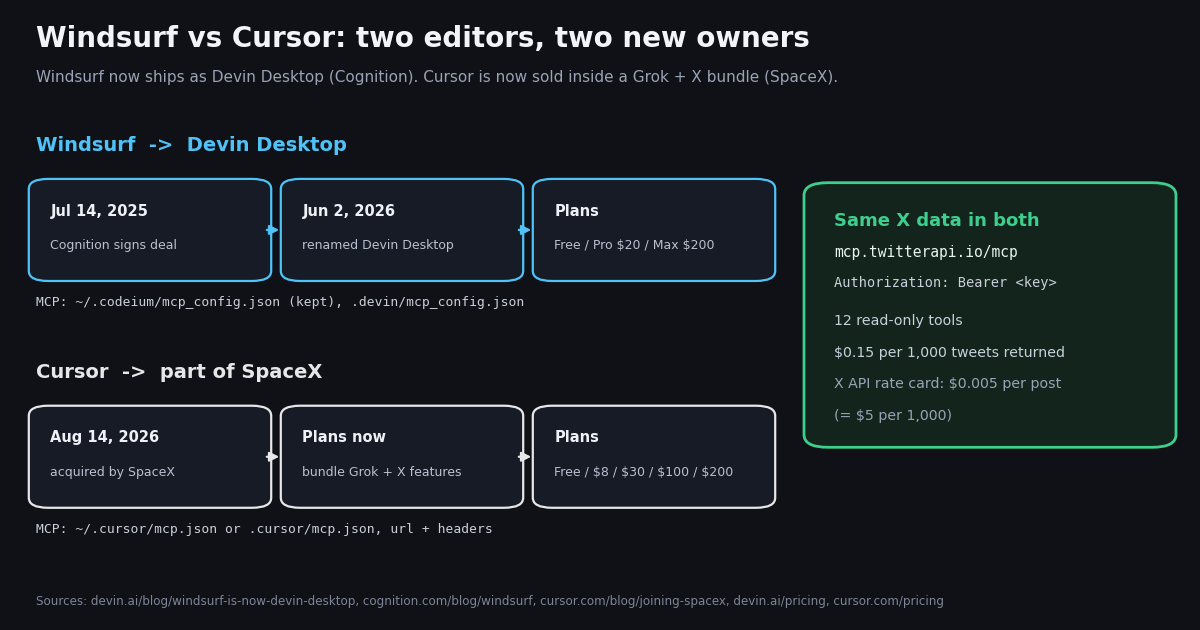
- Windsurf is Devin Desktop now. Cognition renamed it on June 2, 2026;
windsurf.com/pricingredirects todevin.ai/pricing, and existing Windsurf plans keep working unchanged. - Devin Desktop plans: Free $0, Pro $20/month, Max $200 monthly, Teams $80/month plus $40/month per full seat. Plan detail lives in our Devin pricing guide.
- Cursor plans: Free, Plus $8/month (Grok only), Premium $30/month, Super $100/month, Ultra $200 monthly, Teams from $30/user/month; third-party models bill at API list price.
- Same MCP format. Devin Desktop reads
.devin/mcp_config.json(and the old~/.codeium/mcp_config.json); Cursor reads~/.cursor/mcp.json. Both usemcpServerswithurlandheaders. - On X the old name wins. Of 473 posts naming Windsurf and Cursor, 0.4% say "Devin Desktop"; 71.0% are roundups that list five or more AI tools.
- The X data bill is the same in both editors: $0.15 per 1,000 tweets returned through TwitterAPI.io, against $5 per 1,000 on X's pay-per-usage rate card.
Most "Windsurf vs Cursor" comparisons still on the web were written for a 2025 duel between two VS Code forks at $15 and $20 a month. Both products have changed hands since. Cognition signed a deal to acquire Windsurf in July 2025 and, on June 2, 2026, shipped it as Devin Desktop. SpaceX completed its acquisition of Cursor on August 14, 2026, and Cursor's pricing page now sells plans that bundle Grok and X features with the editor. This page compares the two products as they exist now, using the vendors' own pages, fetched for this article.
The angle here is the head-to-head: what changed for Windsurf users, how the two editors' plans, agents and MCP setup line up, and how developers on X talk about the pair. For Devin's plan mechanics (quotas, on-demand credits, ACUs) read our Devin pricing guide; for a three-way view with Google's editor read our Antigravity vs Cursor comparison. We link to both rather than repeat them.
We also ran a real-data study: two X searches and two official timelines, 999 tweets in 55 requests, collected in 2026. Every number in the study sections comes from that sample.
0.4% (2 of 473)
Windsurf (Devin Desktop) vs Cursor at a glance
The table compares the two products on the facts their vendors publish. Prices are monthly in US dollars as shown on devin.ai/pricing and cursor.com/pricing; both exclude tax.
The shortest honest summary: both are VS Code-derived editors with an agent, a cloud agent and an MCP client. Devin Desktop puts Cognition's agents and models inside a daily and weekly quota. Cursor puts its own agent and Grok models inside a weekly pool shared with the Grok apps, and charges for Claude, GPT and Gemini by usage on top.
What happened to Windsurf: the rename to Devin Desktop
Cognition's announcement, titled "Windsurf is now Devin Desktop", and the Devin Desktop FAQ at docs.devin.ai/desktop/devin-desktop-faq describe the change. The FAQ opens with "Devin Desktop is the new name for Windsurf", effective June 2, 2026, delivered as a regular over-the-air update. On disk the app name changes from Windsurf to Devin, which matters if your company's device policies match on application names.
What stays. The editor, extensions, keybindings, language servers and workflows carry over. Settings are ported on first run through a "Migrate from Windsurf" step that copies the per-user data and extensions directories (caches, logs and local history are skipped). Pricing is unchanged, including legacy Windsurf Enterprise plans, and users on prompt-based credits stay on that model.
What changes. Devin Local replaces Cascade as the local agent; Cognition says it is token-efficient, supports subagents and runs the same architecture as the Devin CLI. The announcement kept the legacy Cascade agent available through July 1 for a gradual move. The surf shell command is replaced by devin-desktop, though surf and windsurf still ship in ~/.codeium/windsurf/bin/ for compatibility.
Rules and ignore files. Devin Desktop still reads .windsurfrules at the workspace root and .windsurf/rules/ as a fallback; .devin/rules/ is the preferred location and takes precedence. It also reads AGENTS.md, and it can import Cursor's .cursor/rules files (.mdc) into .devin/rules/, which is useful if you are moving from Cursor. .devinignore is the new ignore file; .windsurfignore and .codeiumignore are still read.
JetBrains users. The Windsurf JetBrains plugin is in maintenance mode, and Cognition warns that newer JetBrains releases can break it. Its recommended path is Devin over the Agent Client Protocol (ACP).
The domain. windsurf.com now answers with a 308 redirect to devin.ai/desktop, and windsurf.com/pricing redirects to devin.ai/pricing. Legacy plan holders can still manage settings on windsurf.com, per the FAQ.
Plans and prices side by side
Devin Desktop is not sold on its own. It is included in Devin's plans, which also cover Devin Cloud and the Devin CLI. Our Devin pricing guide explains the quota windows, on-demand credits and Enterprise ACUs in full; the short version is below.
Cursor's current plans come from cursor.com/pricing. The page now mixes coding and X features in one subscription: every plan lists "Post, reply, and follow", and the paid tiers add X Premium benefits such as a checkmark and fewer timeline ads alongside Cursor and Grok.
How the meters differ. Cursor's allowance refreshes weekly and is shared across Cursor and the Grok apps; past it you buy top-offs or wait for the refresh, and third-party models are billed by exact usage with optional spending caps. Devin's paid plans carry a daily and weekly quota (Max is weekly only), and work past it draws on prepaid on-demand credits at API pricing. Our Cursor pricing guide works through real monthly bills, including legacy Cursor plans and the Teams token surcharge.
Where each costs less. At the entry point, Cursor Plus is $8/month but runs Grok models only; Devin Pro at $20/month includes frontier models from several providers inside the quota. If you want Claude or GPT inside Cursor, the floor is Premium at $30/month plus the tokens you use. For a team of five full users, Devin Teams is $200 monthly ($40 x 5, which clears the $80 minimum) and Cursor Teams starts at $150/month ($30 x 5), before third-party usage.
Agents and models: Devin Local and SWE-2 vs Cursor Agent and Grok
Devin Desktop. The local agent is Devin Local, which shares its architecture with the Devin CLI and supports subagents. Cloud work runs in Devin Cloud, available from Pro. Cognition's own model, SWE-2, is listed on the pricing page as included at no extra cost on Pro, alongside frontier models from other providers. The Agent Command Center is the main view for managing agents, which is the clearest sign of where Cognition wants the editor to go: from autocomplete with a chat panel to a dashboard for several agents at once.
Cursor. The Cursor Agent runs on every plan. Premium and above add cloud agents and automations, code hosting, and AI code reviews through Bugbot. The included pool covers Cursor's own models and Grok; Plus is limited to Grok models, and Claude, GPT and Gemini are available on Premium and above at API list price, billed separately. SpaceX's announcement of the acquisition frames the plan as using SpaceX's GPU capacity to train stronger, cheaper models, citing Grok 4.6 as early work.
What this means in practice. If your team standardizes on Claude or GPT models, Devin's plan quota covers them up to the limit, while on Cursor they are a separate usage bill from the first request. If you are happy with Grok and Cursor's own models, Cursor's pool covers them, and the $8 Plus plan is the lowest paid entry of the two products. Both vendors publish usage multiples or quota windows rather than token counts, so the only reliable comparison for your workload is a week of real use on each.
MCP side by side: one server in Devin Desktop and Cursor
Both editors are MCP clients and both read a JSON map called mcpServers, so the same remote server works in each with a URL and a header.
Devin Desktop. Cognition's MCP page for the desktop app lists three config files: .devin/mcp_config.json for the project (checked into version control), .devin/mcp_config.local.json as a gitignored local override, and ~/.config/devin/mcp_config.json for the user. The Devin Desktop FAQ adds that the legacy Windsurf file, ~/.codeium/mcp_config.json, keeps its location during the transition. Devin Local supports stdio, Streamable HTTP and SSE, with OAuth for each. The Devin CLI docs, which describe the same agent architecture, list url, transport and headers as the fields for a remote server and recommend the .local.json file for personal API keys.
Cursor. Cursor reads .cursor/mcp.json in a project and ~/.cursor/mcp.json globally, supports stdio, SSE and Streamable HTTP, and resolves ${env:NAME} variables inside url and headers. It asks for approval before running MCP tools by default.
The TwitterAPI.io MCP server is hosted at https://mcp.twitterapi.io/mcp and takes your API key as Authorization: Bearer <key>; our docs list 12 read-only tools. The snippet below writes the same entry for both editors. Put the Devin entry in the local override so the key never lands in git, and let Cursor read the key from your environment.
# Devin Desktop (formerly Windsurf): project-local, gitignored override
mkdir -p .devin
cat > .devin/mcp_config.local.json <<'EOF'
{
  "mcpServers": {
    "twitterapi-io": {
      "url": "https://mcp.twitterapi.io/mcp",
      "transport": "http",
      "headers": { "Authorization": "Bearer your_key_here" }
    }
  }
}
EOF

# Cursor: global config, key read from the environment
mkdir -p ~/.cursor
cat > ~/.cursor/mcp.json <<'EOF'
{
  "mcpServers": {
    "twitterapi-io": {
      "url": "https://mcp.twitterapi.io/mcp",
      "headers": { "Authorization": "Bearer ${env:TWITTERAPI_IO_API_KEY}" }
    }
  }
}
EOF
# Note: this overwrites ~/.cursor/mcp.json; merge by hand if you already have servers there.What X posts that compare Windsurf and Cursor talk about
We searched X for recent posts containing both words and kept the 473 whose own text names Windsurf and Cursor (one windsurfing post was dropped). They come from 373 accounts over the 26.3 days before collection, about 18 posts a day.
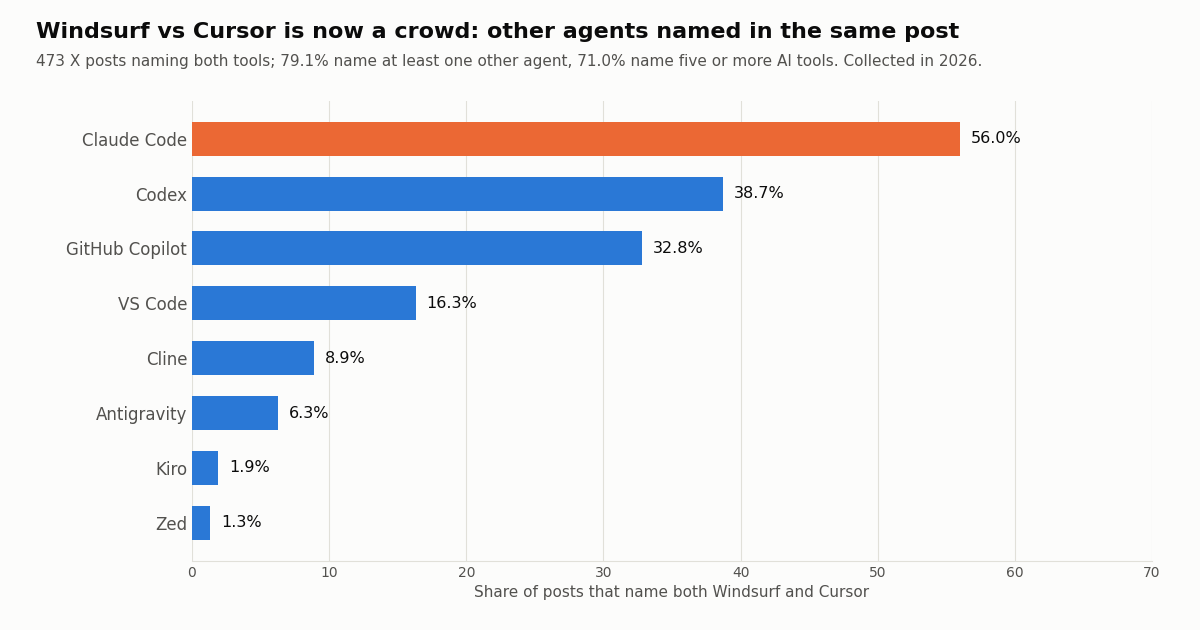
It is rarely a two-horse race. 79.1% of the posts name at least one other coding agent, and 71.0% are roundups that list five or more AI tools; the median post names six. Only 23.7% use comparison wording such as "vs", "versus", "compared" or "better than". Explicit verdicts are almost absent: our preference rules matched one post favoring Cursor and none favoring Windsurf.
Claude Code is the third name. 56.0% of the posts also name Claude Code, 38.7% Codex and 32.8% GitHub Copilot. Antigravity appears in 6.3%, Cline in 8.9%, Kiro in 1.9% and Zed in 1.3%. That matches the search demand for the three-way variants such as "windsurf vs cursor vs claude code": the real question people ask is which agent, not which of two editors.
MCP comes up in about a quarter of the posts, mostly in lists of MCP servers or tools that install into "Claude Desktop, Cursor and Windsurf", which is how the two editors are often grouped as MCP clients.
Reach is modest. The median post got 6 likes and 482 views; the top tenth reached 76.8 likes and 7,012.6 views. 26.8% come from accounts with more than 10,000 followers. 72.7% are in English, 16.7% in Chinese and 4.2% in Japanese.
The rename on X: people still say Windsurf
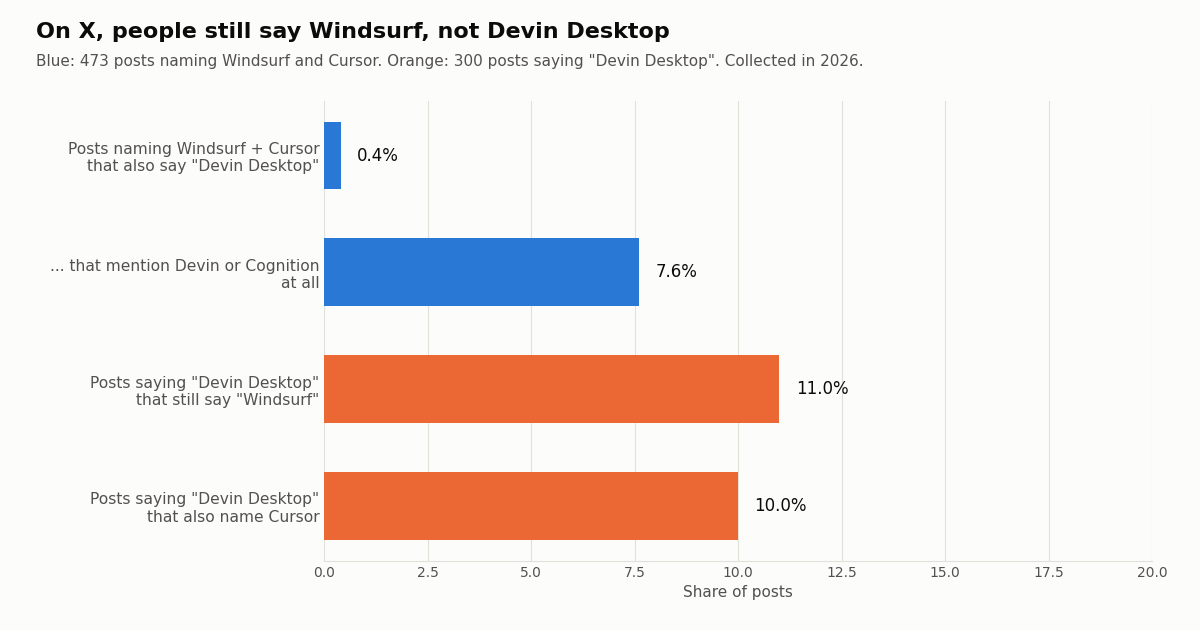
Cognition renamed the product months before our sample, yet the new name has barely reached the comparison. Of the 473 posts naming Windsurf and Cursor, 2 (0.4%) say "Devin Desktop" and 7.6% mention Devin or Cognition at all. By week, the Devin or Cognition share was 10.5% in the newest seven days, 8.4% the week before, 2.9% and 5.8% in the two older periods, so it is drifting up from a low base rather than replacing the old name.
A second search for "Devin Desktop" returned 300 posts from 215 accounts over 57.3 days, about 5.2 a day against 18 a day for posts naming Windsurf and Cursor. 11.0% of them still say Windsurf, 10.0% name Cursor and 10.7% Claude Code, and a third (33.3%) talk about price, plans, limits or free usage.
The official accounts. The @windsurf profile now reads "Windsurf (retired)" with the bio "The product formerly known as Windsurf. Now you can find us @devindesktop, a product by @cognition!" and had 168 followers when we looked it up; a lookup of @devindesktop returned "user not found" at collection time, so we read @DevinAI instead.
Neither account mentions the other product in its recent posts: @cursor_ai never says Windsurf, and @DevinAI never says Devin Desktop. 17.2% of @cursor_ai posts touch prices, plans or limits and 6.5% mention Grok, against 1.6% plan posts for @DevinAI. For search traffic the practical lesson is simple: the old name is what people type, so this page uses it, and states the new name in the first sentence.
Giving either editor live X (Twitter) data, and what it costs
A common reason to wire an MCP server into a coding agent is to build something that reads X: a mention monitor, a competitor feed, a research script like the one at the end of this page. The editor's plan pays for the model; the X data is a separate line, and it is the same in both editors.
MCP. Add the server with the config above; the agent can then call search, timeline and profile tools in chat. REST. For code the agent writes and ships, call https://api.twitterapi.io with an X-API-Key header, for example /twitter/tweet/advanced_search or /twitter/user/last_tweets. Reads need no X account.
TwitterAPI.io charges per item returned: $0.15 per 1,000 tweets (15 credits per tweet, minimum 15 credits per request) and $0.18 per 1,000 profiles. X's own pay-per-usage rate card on docs.x.com/x-api/getting-started/pricing charges $0.005 per post read and $0.010 per user read, which is $5.00 per 1,000 posts, about 33 times more per 1,000 tweets, and caps pay-per-usage at 3 million post reads a month.
New accounts that pass the automatic bot check get up to $1 of free credits (at most 100,000 credits, no card, one per person or network, expiring after 31 days); purchased credits never expire. Plans start at Starter, $29/month, and the request rate goes from 0.2 per second before the first payment to 20 per second once paid. See the pricing page for the rest.
Which to pick, and how we collected this
Pick Devin Desktop (Windsurf) if you already use Windsurf (nothing to migrate, the plan carries over), you want Claude, GPT and other frontier models inside one quota instead of a separate token bill, or you also want Devin Cloud and the Devin CLI on the same plan. Teams that only need a few editor users pay $40 per full seat above an $80 minimum.
Pick Cursor if you want the $8 entry plan and are fine with Grok models, you want Bugbot reviews and cloud automations from Premium, or you also use Grok and X Premium features, which the same subscription now covers. Budget third-party models separately; our Cursor vs Claude Code comparison covers the case where Claude is the model you care about.
Question. How do X posts that compare Windsurf and Cursor talk about the two editors, and how much has the Devin Desktop name entered that conversation?
Accounts and queries. Two Latest advanced searches: windsurf cursor -is:retweet (25 pages) and "devin desktop" -is:retweet (15 pages). Timelines of @cursor_ai and @DevinAI (5 pages each), after profile lookups of @windsurf, @windsurf_ai, @devindesktop, @cursor_ai and @DevinAI.
Sample and cost. 499 posts returned by the first search, of which 473 name both tools in their own text; 300 Devin Desktop posts; 93 own posts from @cursor_ai and 61 from @DevinAI. 55 requests, 999 tweets and 5 profiles returned, $0.15 through TwitterAPI.io against $5.04 at X's pay-per-usage rates. Collected in 2026.
Method. Keyword rules flag other agents, topics, comparison wording and the Devin or Cognition names. A roundup is a post naming five or more AI tools. Age buckets are measured back from the newest post.
What the sample cannot show. X search returns a subset of matching posts, and the window is under a month for the first search. Keyword rules miss sarcasm, screenshots and posts that describe a tool without naming it. Nothing here measures which editor writes better code or how many people use either one.
Privacy. Aggregates only. Only organization accounts are named; search results from private individuals were not stored in the repository, and the published sample keeps de-identified rows without ids, handles, URLs or text.
"""windsurf_cursor_pulse.py - how X posts that name Windsurf and Cursor talk about them.

    pip install requests
    export TWITTERAPI_IO_API_KEY=...   # from the twitterapi.io dashboard
    python windsurf_cursor_pulse.py

Cost: $0.15 per 1,000 tweets returned (a 20-tweet page is $0.003).
"""
import os
import re
import requests

BASE = "https://api.twitterapi.io"
HEADERS = {"X-API-Key": os.environ["TWITTERAPI_IO_API_KEY"]}

OTHERS = {
    "Claude Code": r"claude\s*code",
    "Codex": r"\bcodex\b",
    "Copilot": r"copilot",
    "Antigravity": r"antigravity",
    "Devin / Cognition": r"\bdevin\b|cognition",
}


def search_latest(query, max_pages=10):
    """Yield tweets from advanced_search, newest first, following next_cursor."""
    cursor = ""
    for _ in range(max_pages):
        params = {"query": query, "queryType": "Latest", "cursor": cursor}
        r = requests.get(f"{BASE}/twitter/tweet/advanced_search", headers=HEADERS, params=params, timeout=30)
        r.raise_for_status()
        body = r.json()
        for tweet in body.get("tweets", []):
            yield tweet
        if not body.get("has_next_page") or not body.get("next_cursor"):
            break
        cursor = body["next_cursor"]


def main():
    seen, posts = set(), []
    for t in search_latest("windsurf cursor -is:retweet"):
        text = (t.get("text") or "").lower()
        if t["id"] in seen or "windsurf" not in text or "cursor" not in text:
            continue
        seen.add(t["id"])
        posts.append(t)
    print(f"{len(posts)} posts name both Windsurf and Cursor")
    if not posts:
        return
    for name, rx in OTHERS.items():
        hits = sum(1 for t in posts if re.search(rx, t["text"], re.I))
        print(f"  also name {name:<18} {100 * hits / len(posts):5.1f}%")
    renamed = sum(1 for t in posts if re.search(r"devin\s*desktop", t["text"], re.I))
    print(f"  say 'Devin Desktop'        {100 * renamed / len(posts):5.1f}%")
    top = sorted(posts, key=lambda t: t.get("likeCount", 0), reverse=True)[:5]
    for t in top:
        print(t["createdAt"], t.get("likeCount", 0), "likes", t.get("viewCount", 0), "views", t["url"])


if __name__ == "__main__":
    main()
Researching this?Free starter credits cover end-to-end testing — Google sign-in, no card. Get a key.
Questions readers ask
Is Windsurf still available?
Yes, under a new name. Cognition renamed Windsurf to Devin Desktop on June 2, 2026 and delivered it as a regular update. The editor, extensions, settings and rules carry over, existing plans keep working at the same price, and windsurf.com now redirects to devin.ai/desktop.
Is Windsurf (Devin Desktop) cheaper than Cursor?
It depends on the plan and the models. Cursor's lowest paid plan, Plus, is $8/month but runs Grok models only. Devin Pro is $20/month and includes frontier models from several providers inside its quota, while Cursor charges API list price for Claude, GPT and Gemini on Premium ($30/month) and above. For five team members, Devin Teams is $200 monthly and Cursor Teams starts at $150/month before third-party usage.
What replaced Cascade in Windsurf?
Devin Local. Cognition describes it as the local agent in Devin Desktop, token-efficient, with subagents, running the same architecture as the Devin CLI. The announcement kept the legacy Cascade agent available through July 1 for a gradual migration.
Do my .windsurfrules and Cursor rules still work?
Devin Desktop still reads .windsurfrules and .windsurf/rules/, prefers .devin/rules/, reads AGENTS.md, and can import Cursor's .cursor/rules .mdc files into .devin/rules/. Cursor keeps its own .cursor/rules format.
Where is the MCP config file in Devin Desktop and Cursor?
Devin Desktop uses .devin/mcp_config.json for a project, .devin/mcp_config.local.json for a gitignored override and ~/.config/devin/mcp_config.json for the user; the legacy Windsurf file ~/.codeium/mcp_config.json keeps its location. Cursor uses .cursor/mcp.json and ~/.cursor/mcp.json. Both use an mcpServers map with url and headers for remote servers.
Who owns Cursor and Windsurf now?
Cognition, the company behind Devin, signed a definitive agreement to acquire Windsurf on July 14, 2025, including its IP, product, trademark and brand. Cursor announced on August 14, 2026 that it had been acquired by SpaceX, and its plans now bundle Grok and X features.
Windsurf vs Cursor vs Claude Code: which should I use?
On X the three are compared together: 56.0% of the 473 posts we collected that name Windsurf and Cursor also name Claude Code. Claude Code is a terminal-first agent rather than an editor; our Cursor vs Claude Code comparison covers that pair, and the choice usually comes down to whether you want an IDE or an agent that runs in your terminal.
Can I use the same Twitter (X) data source in both editors?
Yes. The TwitterAPI.io MCP server at https://mcp.twitterapi.io/mcp works in both with an Authorization: Bearer header carrying your API key. Tweets cost $0.15 per 1,000 returned, against $0.005 per post read ($5 per 1,000) on X's pay-per-usage rate card.
Continue
- Cognition: Windsurf is now Devin Desktop (announcement, June 2, 2026)
- Devin docs: Devin Desktop FAQ (rename, Devin Local, rules, file paths)
- Devin docs: MCP configuration (config files, url, transport and headers fields)
- Cursor: Pricing (plans, usage pool, third-party models)
- Cursor docs: Model Context Protocol (mcp.json locations, transports, env interpolation)
- X API pricing (official pay-per-usage rate card)
- X (Twitter) API guide and endpoint overview
- Devin pricing: Free, Pro, Max, Teams quotas and ACUs
- Antigravity vs Cursor: plans, models and MCP config
- Cursor pricing in 2026 and real monthly bills
- Cursor vs Claude Code comparison
- How to use Cursor with the Twitter (X) API
- TwitterAPI.io MCP server setup for Cursor and other clients
- TwitterAPI.io pricing and plans
- 01Warp Pricing in 2026: Plans, Dollar Usage, Add-ons and the Real Monthly Bill
- 02Roo Code vs Cline in 2026: After the Shutdown, Which One to Run
- 03What Is x402? How the HTTP 402 Payment Protocol Works, With a Real 402 Offer Decoded
- 04Gemini CLI vs Claude Code in 2026: Access, Quotas, MCP and Pricing for Twitter (X) Data Agents
- 05Manus Pricing in 2026: Plans, Credits per Task, and What People on Twitter (X) Say It Costs
- 06Zed vs Cursor in 2026: Speed, Agents, Models, Pricing and MCP Compared
- 07Antigravity vs Cursor: Plans, Models and a Twitter (X) MCP Setup in Both
- 08Cursor Pricing in 2026: Plans, the Weekly Usage Pool, Worked Monthly Bills and the Cost of Adding Twitter (X) Data
Writing about something you built with TwitterAPI.io? Our community rewards program pays API credits for honest tutorials, build logs and videos.
Stop reading. Start building.
Starter credits cover real testing on real data. Google sign-in, no card, no application queue.
Get an API keyAlready building with TwitterAPI.io? Publish an honest tutorial or build log about it and earn up to $200 a month in API credits.