SerpApi Pricing: Every Plan, the Real Cost per Search, and the Alternatives
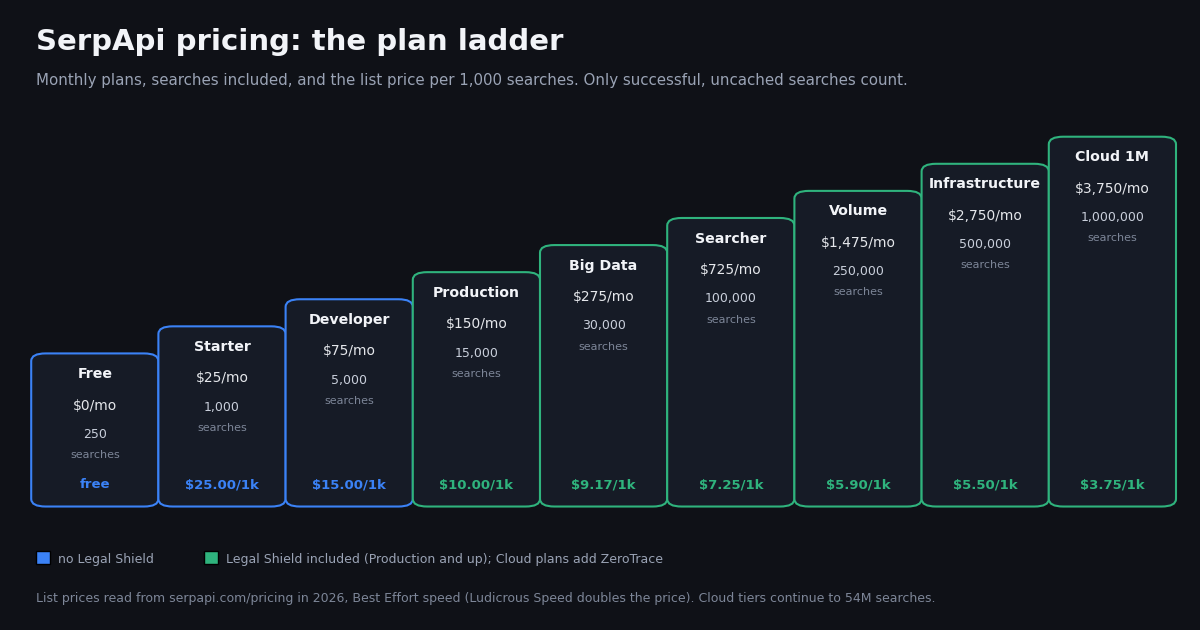
- Plans, not credits. SerpApi sells monthly plans with a fixed search allowance: Free (250), Starter $25 (1,000), Developer $75 (5,000), Production $150 (15,000), Big Data $275 (30,000), up to Cloud 54M at $106,050/month.
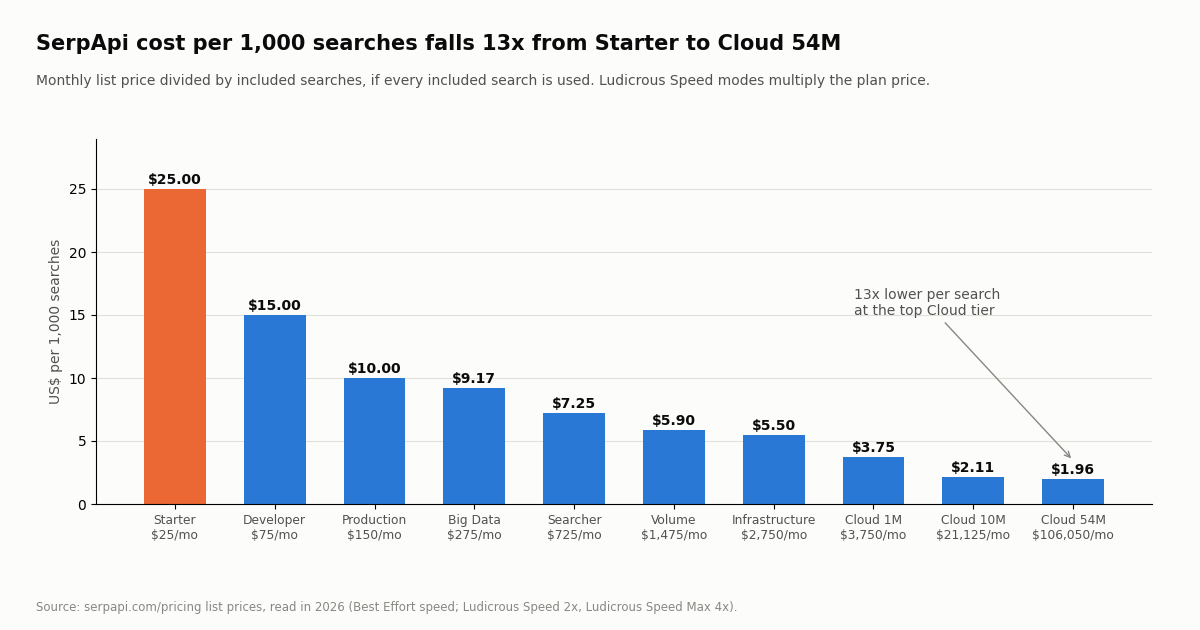
- Cost per 1,000 searches falls from $25 on Starter to $10 on Production, $3.75 on Cloud 1M and $1.96 on Cloud 54M, assuming you use the whole allowance.
- What counts: only successful searches. Cached results (1-hour cache), errors and failures are free; 100 results or zero results both count as 1 search.
- Add-ons by tier: Legal Shield (up to $2 million coverage) from Production; ZeroTrace and priority support on Cloud plans; Ludicrous Speed doubles the price, Ludicrous Speed Max quadruples it.
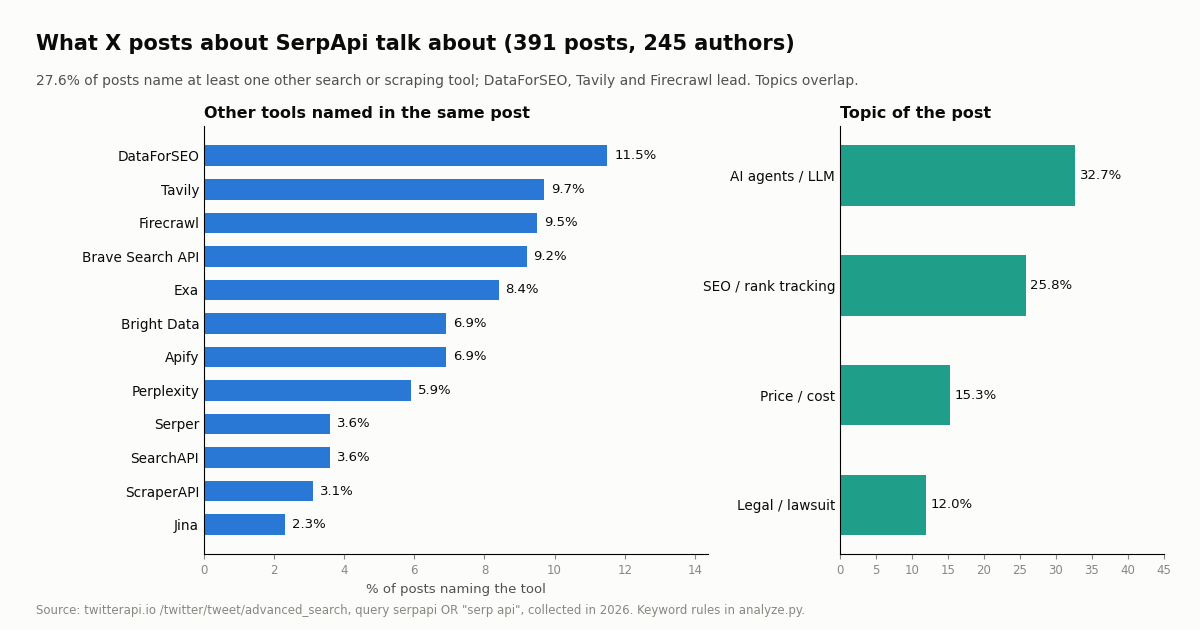
- On X, SerpApi is discussed next to other tools. In our sample of 391 X posts about SerpApi, 27.6% named another search or scraping tool, led by DataForSEO (11.5%), Tavily (9.7%) and Firecrawl (9.5%).
- X data is a separate bill. Collecting the study's 660 posts cost $0.099 at $0.15 per 1,000 tweets returned on TwitterAPI.io, against $3.30 at the official X API's $0.005 per post read.
SerpApi is a search results API: you send a query and an engine name, and it returns the Google (or Bing, YouTube, Amazon and other engine) results page as structured JSON. It is a common tool behind rank trackers, SEO dashboards and AI agents that need fresh web results, which is why the pricing question usually comes down to one number: what does 1,000 searches cost on the plan you would actually buy?
This page answers that from SerpApi's own pricing page and documentation, read this year: every plan with its search allowance and hourly throughput, the cost per 1,000 searches, what is and is not counted, the speed and privacy add-ons, refunds and plan changes, and a compact list of SerpApi alternatives with their list prices. It stays on SerpApi; Exa, Tavily and Perplexity each have their own pricing guide, linked below. The last sections cover the gap many agent builders hit after search: live X (Twitter) data, which SerpApi only sees through Google, with a measured sample of how SerpApi itself is discussed on X.
27.6%
SerpApi plans and prices, tier by tier
SerpApi's pricing page (serpapi.com/pricing) lists every plan in US dollars with three numbers: the monthly price, the searches included each month, and the throughput limit per hour. The table below copies those figures and adds one derived column, the list price per 1,000 searches if the whole allowance is used.
Cloud tiers step by 1M searches. Between Cloud 1M and Cloud 54M SerpApi lists every million: Cloud 2M is $5,675/month, Cloud 5M $11,475/month, Cloud 10M $21,125/month and Cloud 20M $40,425/month, with hourly throughput rising by 10,000 per step from 110,000 to 640,000.
No annual prices are shown. The pricing page describes plans as month-to-month with cancel-anytime terms and lists no annual discount. Enterprise or custom volume deals go through SerpApi's sales address (contact@serpapi.com).
The hourly limit matters as much as the monthly one. Starter allows 200 searches per hour, so a 1,000-search batch takes at least five hours on that plan; Developer raises the ceiling to 1,000 per hour and Production to 3,000. If your job is bursty (a nightly rank check over thousands of keywords), size the plan on the hourly number, not only the monthly total.
What counts as a search (and what is free)
SerpApi bills searches, not results or pages of results. Its pricing FAQ states that only successful searches are counted toward the monthly allowance, and that cached, errored and failed searches are not. Three rules follow from that, and they change real-world cost more than the plan choice does.
One search is one request, whatever it returns. SerpApi's FAQ says a response with 100 results and an empty result set both count as 1 search. If you need positions 1 to 100 for a keyword, asking for 100 results in one request is one search; paging through ten pages of 10 is ten.
Repeat queries within an hour are free. The Search API documentation says the cache expires after 1 hour and that cached searches are free and not counted toward the monthly searches. A dashboard that refreshes the same 500 keywords every 15 minutes pays for the first fetch each hour, not all four. The no_cache=true parameter forces a fresh search, which is then counted.
Errors cost nothing. A blocked, failed or errored search does not use your allowance, so a retry loop does not double-bill. That is different from APIs that charge per HTTP call regardless of outcome.
Engines all draw from the same allowance. Requests go to https://serpapi.com/search with an engine parameter (google by default) and your api_key; a Google search, a Google News search or a YouTube search each count as one search against the plan.
Free tier, refunds, upgrades and running out
Free plan. 250 searches a month with a 50-per-hour throughput limit, and none of the add-ons (no Legal Shield, ZeroTrace or priority support). That is enough to build and test an integration, and to run a small daily job: 8 keywords a day for a 31-day month is 248 searches.
Refund window. SerpApi offers a full refund within 7 days of subscribing to a plan, unless more than 20% of that plan's searches have been used.
Upgrades and downgrades. You can change plans at any time. An upgrade charges only the price difference and keeps your renewal date; a downgrade keeps the renewal date, renews at the lower price, and moves the remaining searches from the old plan into an Extra Credits balance.
Running out mid-cycle. When the allowance is used up you can renew manually or turn on Automatic Early Renewal, which renews the plan as soon as all searches are used. Either way the searches are replenished and the renewal date and billing cycle reset, so a heavy month effectively pays for the plan twice.
Cancellation. Cancelling stops the next renewal; the remaining searches stay usable until the renewal date.
Legal Shield, ZeroTrace and Ludicrous Speed: what the add-ons cost
Three features change the effective price, and each is tied to a tier or a multiplier rather than sold as a line item.
The Legal Shield step is a pricing decision in itself. The jump from Developer ($75/month) to Production ($150/month) buys 10,000 more searches and 2,000 more per hour, and Production is the lowest-priced plan that includes Legal Shield. Teams whose legal review asks for indemnity on scraped search data tend to land on Production even if 5,000 searches would be enough.
Speed multiplies everything. On Ludicrous Speed, Production costs $300/month for the same 15,000 searches, so $20 per 1,000 instead of $10. Measure whether the default Best Effort latency is a real problem for your workload before paying for it; batch and overnight jobs rarely need it.
Worked examples: what common SerpApi workloads cost each month
The plan price is fixed, so the useful question is which plan fits a workload. These examples use list prices and assume no cache hits; repeat queries inside an hour would lower the count.
Check the hourly ceiling too. The 150-keyword daily check fits Developer's 1,000 per hour easily; the 3,000-keyword daily job needs the Searcher plan's 20,000 per hour only if it runs in one burst, but its 93,000 monthly total already lands on Searcher anyway.
Mind the boundary. 5,001 searches does not cost a little more than Developer; it needs Production at twice the price, or an early renewal of Developer. When you sit near a boundary, the 1-hour cache and deduplicating queries are the simplest savings.
SerpApi alternatives and how their pricing works
Searches for SerpApi alternatives usually come from one of two places: a SERP-data buyer who wants a lower price per 1,000 Google queries, or an AI agent builder who wants an LLM-ready search API instead of a raw results page. The list prices below were read from each vendor's own pricing page or docs this year; vendors that also sell social media scraping are named without links.
Serper sells credit packs rather than monthly plans: $50 for 50,000 credits ($1.00 per 1,000), $375 for 500,000, $1,250 for 2.5M and $3,750 for 12.5M, each expiring after 6 months, with throughput from 50 to 300 queries per second by pack. It returns Google results as JSON, the same kind of output as SerpApi.
Brave Search API bills per request rather than by plan. Its Search plan is $5 per 1,000 requests with $5 of credits applied each month and a 50 queries-per-second limit; an Answers plan charges $4 per 1,000 requests plus $5 per million input and output tokens.
Tavily and Exa are search APIs built for LLM agents: they return cleaned page content instead of a results page. Tavily bills 1 credit per basic search and 2 per advanced search, with 1,000 free credits a month; Exa bills per endpoint. Both have full pricing guides on this site, linked below.
Google Custom Search JSON API is the official Google route at $5 per 1,000 queries after 100 free a day, capped at 10,000 a day, but Google's overview page says it is closed to new customers and that existing customers have until January 1, 2027 to move to another solution.
Scraping platforms such as Bright Data, Apify, DataForSEO and ScraperAPI also sell SERP endpoints, usually priced per result or per credit; they appeared in X posts about SerpApi (see the study below), but their SERP products are priced on different units, so compare them on a sample of your own queries rather than list price alone.
Can SerpApi get X (Twitter) posts? What live X data costs instead
SerpApi documents a Google Twitter Results API (serpapi.com/twitter-results). It is not an X engine: it is the block of tweets that Google decides to show on a Google results page, returned under a twitter_results key with a title, a link and a short tweets list (each with link, snippet, thumbnail and published_date). SerpApi notes that Google sometimes shows only a single tweet between organic results. You get the handful of posts Google chose to surface, not a searchable stream of X, and each such Google query uses one search from your plan.
Agent builders who need the X conversation itself (every recent post matching a query, a brand's timeline, replies, follower lists) use an X data API next to their search API. Two published rate cards apply:
About 33x apart per post read. $5 per 1,000 on X's own pay-per-usage card against $0.15 per 1,000 tweets returned on TwitterAPI.io. The official card caps pay-per-usage at 3 million post reads a month (Enterprise above) and gives $20 of credits on a first card plus a match of up to $50.
Pay only for the data returned. On TwitterAPI.io a search page that returns 20 tweets costs $0.003; a search that finds nothing costs the 15-credit minimum of $0.00015. So 10,000 X searches that each return a full 20-tweet page are 200,000 tweets, or $30; the same 10,000 searches finding nothing cost $1.50. Profiles are $0.18 per 1,000. No X account is needed for reads.
Starting out. New accounts that pass the automatic bot check get up to $1 of free credits (at most 100,000 credits, no card, one per person or network, expiring after 31 days); purchased credits never expire. Paid subscriptions start at Starter $29 monthly (full list on the pricing page), and the rate limit rises from 0.2 requests per second before the first payment to 20 once paid.
For agents, the same data is on MCP. The hosted MCP server at https://mcp.twitterapi.io/mcp takes an Authorization: Bearer header with your key, so the X search sits next to SerpApi as another tool in the agent's toolbox.
import os
import requests

# One X search page on TwitterAPI.io: $0.003 for 20 tweets returned, $0.00015 if none.
r = requests.get(
    "https://api.twitterapi.io/twitter/tweet/advanced_search",
    headers={"X-API-Key": os.environ["TWITTERAPI_IO_KEY"]},
    params={"query": "serpapi -filter:retweets", "queryType": "Latest"},
    timeout=30,
)
r.raise_for_status()
body = r.json()
for t in body.get("tweets", []):
    print(t["createdAt"], t["likeCount"], t["text"][:80])
print("more pages:", body.get("has_next_page"), body.get("next_cursor", "")[:12])
What X posts about SerpApi talk about: a measured sample
To see how builders weigh SerpApi in public, we pulled recent X posts that mention it and the timelines of SerpApi's official account and two AI-search peers. The search returned 440 posts; 391 actually mentioned SerpApi in the text or as a tagged account, from 245 distinct authors over a 77-day window, about 5.1 posts a day. 85.2% were in English, 5.6% Japanese and 4.6% Chinese.
AI agents dominate the context. 32.7% of posts mention agents, LLMs, MCP, RAG or a named model, ahead of SEO and rank tracking at 25.8%. Price or cost words appear in 15.3%, and lawsuits or court cases about scraping in 12.0%.
SerpApi rarely appears alone. 27.6% of posts name at least one other search or scraping tool. The most frequent are DataForSEO (11.5%), Tavily (9.7%), Firecrawl (9.5%), Brave (9.2%) and Exa (8.4%); Serper, the closest Google-JSON equivalent, is named in 3.6%. Many of these are tool-stack lists, which is the honest reading: builders pick a search API as one part of an agent stack.
Reach is modest and spread out. The median post had 5 likes and 396 views; the top tenth reached 49 likes and 6,618 views. 44.8% carried a link and 22.5% were replies.
SerpApi posts most often, Exa reaches furthest. SerpApi's account posted about 9.0 times a week, Tavily's 4.6 and Exa's 1.5; Exa's median post drew 63,604 views against 266 for SerpApi. None of the three replied from the main timeline in the sample.
How we collected this
Question. When people talk about SerpApi on X, how much is about price, which alternatives do they name, and how much is about AI agents; and how active are SerpApi's and two peers' official accounts?
Query and accounts. serpapi OR "serp api" -filter:retweets on /twitter/tweet/advanced_search (Latest), run over four back-to-back time windows and deduplicated by post id; posts kept only if the text or a tagged account contained SerpApi. Official timelines via /twitter/user/last_tweets for @SerpApi (100 posts), @tavilyai and @ExaAILabs (60 each).
Window and size. The search covers the 77 days before collection, 391 posts from 245 authors; collected in 2026. Topic and tool shares come from transparent keyword rules (published in the study's analyze.py), so a post can count in several topics, and a short word such as Exa can occasionally match unrelated text.
Cost of the study. 45 requests, 660 tweets returned plus 7 profile lookups: $0.099 for the tweets at $0.15 per 1,000 on TwitterAPI.io, versus $3.30 at the official X API's $0.005 per post read.
What the sample cannot show. It reflects public posts that name SerpApi, not private buying decisions or support tickets; it says nothing about SerpApi's customer count or revenue; and Latest search returns a recent slice, so it is not a complete archive.
Privacy. Aggregates only. Only organization accounts are named; individual authors are not profiled, and the published sample keeps de-identified rows without ids, links, text or handles.
import os
import requests

# An agent research step: Google results from SerpApi plus live X posts from TwitterAPI.io.
# SerpApi bills 1 search per successful, uncached request; TwitterAPI.io bills $0.15 per 1,000 tweets returned.
SERPAPI_KEY = os.environ["SERPAPI_API_KEY"]
TW_HEADERS = {"X-API-Key": os.environ["TWITTERAPI_IO_KEY"]}
BASE = "https://api.twitterapi.io"


def google_results(query):
    r = requests.get(
        "https://serpapi.com/search",
        params={"engine": "google", "q": query, "api_key": SERPAPI_KEY},
        timeout=30,
    )
    r.raise_for_status()
    return [
        {"position": o.get("position"), "title": o.get("title"), "link": o.get("link")}
        for o in r.json().get("organic_results", [])
    ]


def x_posts(query, max_pages=3):
    posts, cursor = [], ""
    for _ in range(max_pages):
        params = {"query": f"{query} -filter:retweets", "queryType": "Latest"}
        if cursor:
            params["cursor"] = cursor
        r = requests.get(f"{BASE}/twitter/tweet/advanced_search", headers=TW_HEADERS, params=params, timeout=30)
        r.raise_for_status()
        body = r.json()
        for t in body.get("tweets", []):
            posts.append({
                "createdAt": t["createdAt"],
                "author": t["author"]["userName"],
                "likes": t.get("likeCount", 0),
                "views": t.get("viewCount", 0),
                "text": t["text"],
            })
        if not body.get("has_next_page"):
            break
        cursor = body.get("next_cursor", "")
    return posts


if __name__ == "__main__":
    topic = "serp api pricing"
    web = google_results(topic)
    x = x_posts(topic)
    print(f"{len(web)} Google results, {len(x)} X posts")
    print(f"X cost: ${len(x) * 0.15 / 1000:.4f} at $0.15 per 1,000 tweets returned")
    for p in sorted(x, key=lambda p: -p["likes"])[:5]:
        print(p["likes"], p["author"], p["text"][:90].replace("\n", " "))
Researching this?Free starter credits cover end-to-end testing — Google sign-in, no card. Get a key.
Questions readers ask
How much does SerpApi cost?
SerpApi's paid plans start at Starter, $25/month for 1,000 searches, then Developer $75/month (5,000), Production $150/month (15,000), Big Data $275/month (30,000), Searcher $725/month (100,000), Volume $1,475/month (250,000) and Infrastructure $2,750/month (500,000). Cloud plans run from $3,750/month for 1M searches to $106,050/month for 54M.
Is SerpApi free?
There is a Free plan with 250 searches a month and a 50-per-hour limit, without Legal Shield, ZeroTrace or priority support. Cached searches (repeats within the 1-hour cache) are also free on every plan and do not count toward the allowance.
How much is SerpApi per 1,000 searches?
If you use the full allowance: $25 on Starter, $15 on Developer, $10 on Production, $9.17 on Big Data, $7.25 on Searcher, $5.90 on Volume, $5.50 on Infrastructure, $3.75 on Cloud 1M and $1.96 on Cloud 54M. Ludicrous Speed doubles those figures and Ludicrous Speed Max quadruples them.
Does SerpApi charge for failed searches or empty results?
It does not charge for failed, errored or cached searches; only successful searches count. A successful search that returns no results still counts as 1 search, the same as one returning 100 results.
What happens when I run out of SerpApi searches?
You can renew manually or enable Automatic Early Renewal, which renews the plan as soon as the searches are used. Both replenish the allowance and reset the renewal date and billing cycle, so the plan is charged again at that point.
Does SerpApi offer refunds or annual plans?
SerpApi offers a full refund within 7 days of subscribing unless more than 20% of the plan's searches were used. Its pricing page lists month-to-month plans with no annual discount; custom volume deals go through sales.
What are the main SerpApi alternatives?
For Google results as JSON, Serper sells credit packs from $50 for 50,000 credits. Brave Search API charges $5 per 1,000 requests. For LLM-ready search, Tavily (1 credit per basic search, 1,000 free a month) and Exa bill per request. Google's Custom Search JSON API is closed to new customers.
Can SerpApi return tweets from X?
Only the tweets Google shows on a results page, through its Google Twitter Results API under a twitter_results key. For full X search, timelines or replies, an X data API is the direct route: TwitterAPI.io charges $0.15 per 1,000 tweets returned, the official X API $0.005 per post read.
Continue
- SerpApi: Pricing (plans, searches, throughput, FAQ)
- SerpApi docs: Search API (cache, no_cache, request format)
- SerpApi docs: Google Twitter Results API
- Google: Custom Search JSON API overview (pricing, closed to new customers)
- X developer docs: pay-per-usage pricing
- TwitterAPI.io API documentation
- X (Twitter) API hub: endpoints, pricing and guides
- Exa pricing: search API costs per endpoint
- Tavily API guide: plans, credits and search depth
- Perplexity API pricing and models for builders
- Apify pricing: plans, compute units and actor costs
- What an MCP server is, with a hosted X example
- TwitterAPI.io pricing: $0.15 per 1,000 tweets returned
- 01Pipedream Pricing in 2026: Connect Plans, Credits and the Workflows Shutdown
- 02Cloudflare Pay per Crawl: How the HTTP 402 Handshake Works, and What It Means for Twitter (X) Data
- 03ScrapingBee Pricing in 2026: Plans, Credit Costs and Alternatives
- 04Firecrawl Pricing: Plans, Credit Costs and What an X (Twitter) URL Costs
- 05LunarCrush API: What It Returns, What It Costs, and When Raw Twitter (X) Data Is the Better Input
- 06n8n Pricing in 2026: Plans, Executions and the Twitter (X) Data Cost
- 07Apify Pricing in 2026: Plans, Compute Units and What Twitter (X) Data Really Costs
- 08Replit pricing in 2026: plans, credits, effort-based Agent costs, and what an app that reads Twitter (X) data really costs
Writing about something you built with TwitterAPI.io? Our community rewards program pays API credits for honest tutorials, build logs and videos.
Stop reading. Start building.
Starter credits cover real testing on real data. Google sign-in, no card, no application queue.
Get an API keyAlready building with TwitterAPI.io? Publish an honest tutorial or build log about it and earn up to $200 a month in API credits.