Twitter (X) Account Suspended: Why It Happened and How to Get It Back
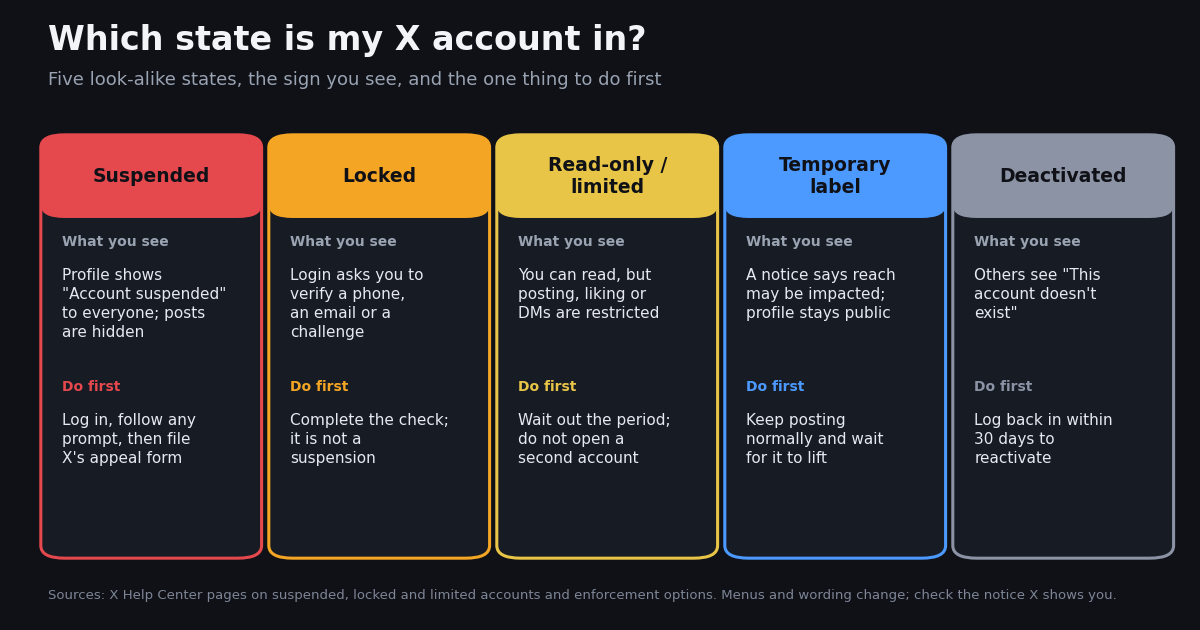
- Suspended means the profile shows "Account suspended" to everyone and posts are hidden. Locked means X wants you to verify a phone, email or challenge. Read-only means you can browse but not post for a period. Only a suspension needs the appeal form.
- X's own list of reasons: spam or fake accounts (the majority of suspensions, it says), suspected hacked or compromised accounts, and abusive behavior such as threats or impersonation, which can be temporary or permanent.
- First move: log in. If X prompts for a phone number or email confirmation, finish it; that alone can lift the suspension. Otherwise file the appeal in a new browser tab while logged in.
- Never open a replacement account during a suspension. X's ban evasion policy permanently suspends accounts made to get around an enforcement.
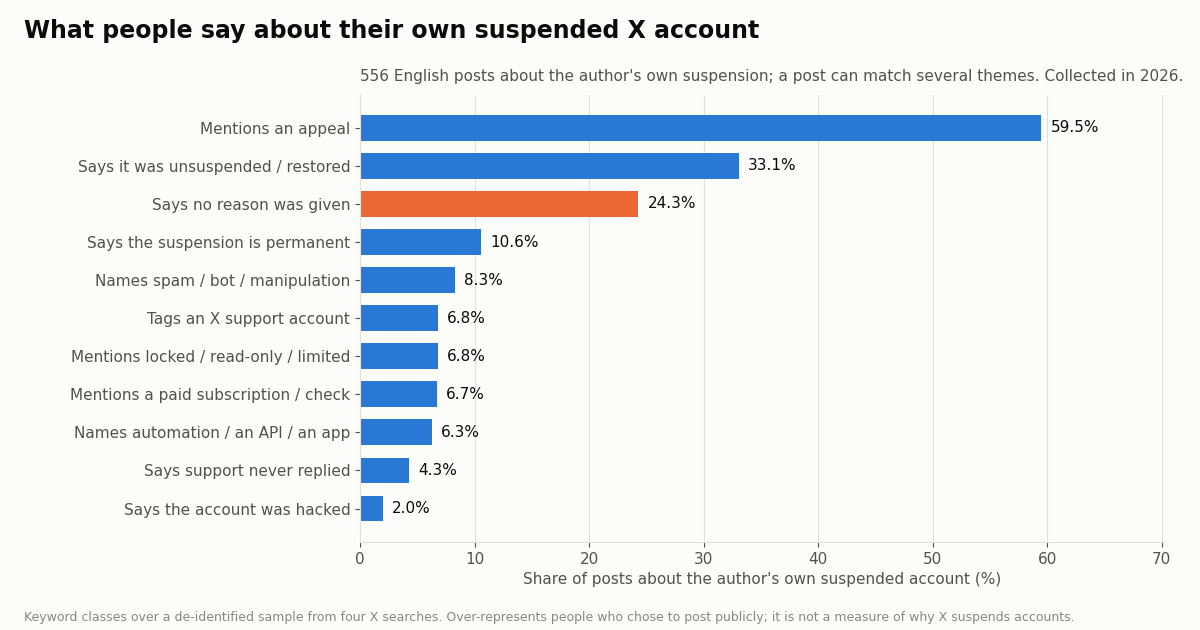
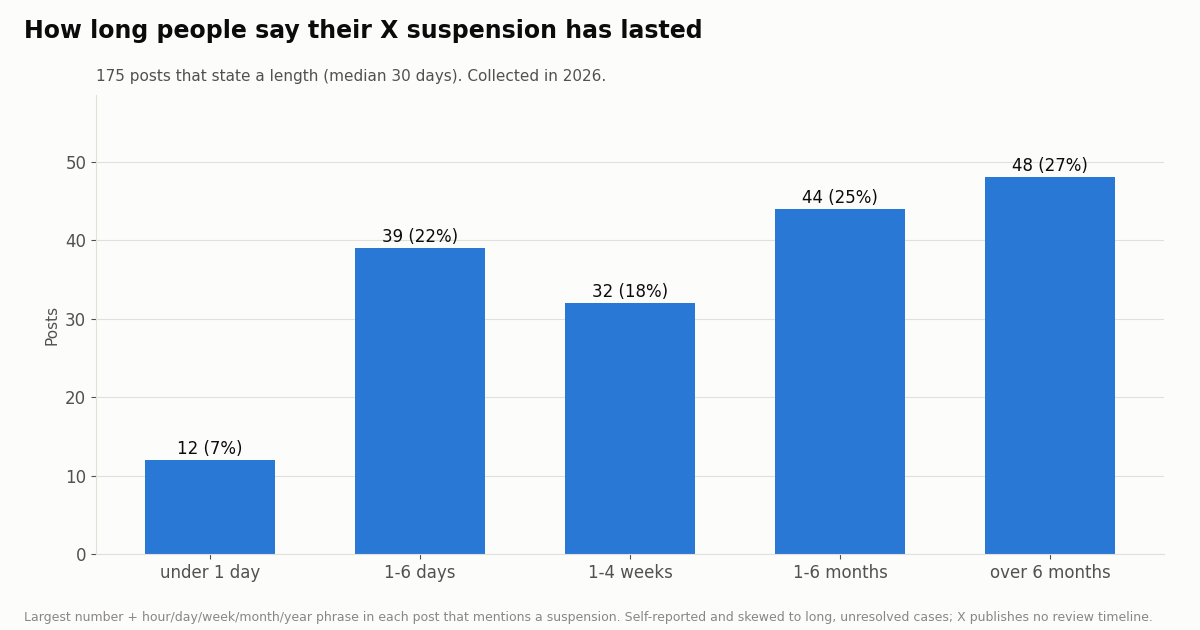
- Our study of 556 owner posts (collected in 2026): 59.5% mention an appeal, 33.1% say they got the account back, 24.3% say no reason was given; of 175 posts that state a length, the median is 30 days.
- To delete a suspended account, X says you must appeal first, then request deactivation through its form. Developers can detect suspensions with
/twitter/user/info, which returnsunavailableReason: "Suspended".
Opening X and finding "Your account is suspended" is alarming, and the notice rarely says much. This page is for the owner of the account: what a suspension actually is, how to be sure you are suspended and not just locked or limited, the reasons X itself gives, how the appeal works, what happens to your posts and followers while you wait, and how to delete the account if you decide not to come back.
If you are instead looking at someone else's suspended profile and want to see what they posted, that is a different question, answered in our guide to viewing a suspended Twitter account (linked below). Here we stay with your own account.
Alongside X's documentation, we collected 1,267 recent public posts in which people describe a suspension, and read what 556 owners said about their own account: how many appealed, how many got it back, how many were never told why, and how long they say it lasted. All of it is aggregated and de-identified; the method is at the end.
33.1% of 556 posts describing the author's own suspension (59.5% mention an appeal; 24.3% say no reason was given). Collected in 2026.
Suspended, locked, read-only or labeled: which state is your account in?
X uses several enforcement actions that feel the same from the inside, and only one of them is a suspension. X's page on its range of enforcement options (help.x.com/en/rules-and-policies/enforcement-options) describes actions at the post level, at the direct message level and at the account level, from requiring a post to be deleted, to placing an account in read-only mode, to suspension. Working out which one you have decides what you do next, so start here.
The decisive test is your public profile. Open it from a logged-out browser or ask a friend to look it up. If the profile shows "Account suspended", you are suspended. If the profile and posts load normally for others, you are in one of the lighter states, and the appeal form is not the right tool.
Locked is a security step, not a penalty decision. X's help page on locked and limited accounts says an account can be locked or limited when it may be compromised or may be breaking the X Rules or Terms of Service, and the unlock flow is to log in, select Start and verify with a phone code, an email code, or a reCAPTCHA check where X suspects automated behavior (help.x.com/en/managing-your-account/locked-and-limited-accounts).
Read-only is time-limited. X's enforcement options page describes read-only mode as a temporary state in which the account can still read its timeline and can only send direct messages to its followers, while posting, reposting and liking are restricted until the period ends. Menu wording and exact limits change, so trust the notice X shows you over any third-party description, including this one.
Temporary labels and shadowbans are not suspensions at all; our separate guide to the X temporary label covers that notice.
Why X suspends accounts: the reasons X documents
X's help page about suspended accounts (help.x.com/en/managing-your-account/suspended-x-accounts) gives three headline reasons, and they map onto the X Rules (help.x.com/en/rules-and-policies/x-rules).
Spam and fake accounts. X says the majority of the accounts it suspends are suspended because they are spammy or fake. Under the platform manipulation and spam policy this covers bulk or aggressive following, liking and reposting, duplicate posts, fake engagement and networks of coordinated accounts. It is also the category where ordinary users are often caught by mistake, because an account that suddenly follows many people or repeats the same reply can look like automation.
Security: a suspected hacked or compromised account. If X suspects someone else has taken over the account, it may suspend it to stop the damage. This kind of suspension usually ends once you prove ownership and secure the account.
Abusive behavior. Threats, targeted harassment, and impersonating other people or accounts. X says that for abusive behavior it may suspend an account temporarily or, in some cases, permanently.
Ban evasion. X's ban evasion policy (help.x.com/en/rules-and-policies/ban-evasion) prohibits attempts to get around a prior enforcement, including creating a new account or repurposing an existing one to replace a suspended one, and says that getting around a permanent suspension this way results in permanent suspension of the new account at first detection. This is why a second account during a suspension is the worst move available.
Other rule categories in the X Rules can also lead to suspension: violent and hateful content, private information, sensitive media involving minors, illegal goods, and accounts belonging to people under the minimum age. The notice X shows on login normally names the category, so read it before anything else.
Scale. In its Global Transparency Report for the first half of 2024, X reported suspending about 5.3 million accounts for rule violations, and separately taking down about 464 million accounts for platform manipulation and spam (transparency.x.com, as reported by Fortune in September 2024). Spam enforcement on that scale is automated, which is part of why so many owners say they were never told a specific reason.
What 556 owners said about their own suspension
To see what the experience is like beyond X's documentation, we searched recent English posts on X for four phrasings people use when this happens ("account suspended", "suspended for no reason", posts about their own account plus "appeal", and posts saying they were "unsuspended" or "reinstated"). Of 1,267 unique posts, 1,009 mention a suspension and 556 describe the author's own account. The chart reads those 556.
Appeals are the norm, and they do sometimes work. Six in ten owners mention an appeal, and a third report the account came back. The sample deliberately includes a search for people announcing that they were reinstated, so the 33.1% overstates the true success rate; read it as proof that reinstatement happens, not as the odds.
"No reason" is a real complaint, not a rumor. Almost a quarter of owners say X never told them why. When the notice is vague, the safest assumption is the largest category X names, spam and platform manipulation, and an appeal that explains how you actually use the account.
Specific causes are rarely named. Only 8.3% of owners name spam or bots, 6.3% name automation, an API or a third-party app, and ban evasion or impersonation each appear in under 1%. Many people do not know or do not say what triggered it.
Locked versus suspended confusion is visible. 6.8% of owner posts also mention being locked, read-only or limited, which supports the first check on this page: confirm the state before you appeal.
How to appeal an X suspension, step by step
X's help page on suspended accounts gives a short procedure, and every reliable guide follows it. These are the steps in order.
Step 1: Log in to the suspended account. Use the official app or the website. You can often still log in; the suspension notice appears after login.
Step 2: Finish any prompt X shows you. X says that if you are asked to add a phone number or confirm your email address, following those prompts may unsuspend the account. Many automated spam suspensions end here, with no appeal at all.
Step 3: Open a new browser tab and file the appeal. X's help page on suspended accounts links its appeal form from the "How to unsuspend your X account" section; follow that link rather than a form address copied from a third-party site, because X moves its forms. File it while logged in to the suspended account, and file it yourself: the form is tied to the account holder.
Step 4: Write a short, factual appeal. Name the account, say which rule you think was applied by mistake, and explain how you actually use the account (for example, that the burst of follows or replies was you, by hand, and why). Mention it if the account was hacked and you have now secured it. Do not paste legal threats or long histories; a reviewer needs to understand the situation in a few lines.
Step 5: Wait, and do not open a new account. X does not publish a review timeline. Keep an eye on the email address on the account, because that is where X replies.
Paid "appeal services" are not needed. The appeal form is free and only the account holder can file it. Nobody outside X can lift a suspension, so treat any offer to do so for a fee as a red flag.
If the account was hacked, secure your email first, then use X's help for compromised accounts before appealing, so the account is not suspended again the day it comes back.
How long does an X suspension last?
X does not publish how long a suspension or an appeal review takes. What it documents is the type: some actions are time-limited (a lock until you verify, read-only mode for a set period), some suspensions are temporary, and some, for abusive behavior or ban evasion, are permanent. The only honest way to look at duration is what people report, so we parsed every post in the sample that both mentions a suspension and states a length ("3 days", "two weeks", "6 months").
Median: 30 days. Of the 1,009 posts that mention a suspension, 175 (17.3%) state a length. The spread is wide: about three in ten under a week, and about half beyond a month.
These numbers skew long. People with a quick resolution rarely post about it; people stuck for months post repeatedly. Treat the table as the range people experience, not as a forecast for your account. A suspension that is still unresolved after a month is common in the sample, not a sign that the appeal was lost.
Permanent suspension: can you recover it?
A permanent suspension means X does not intend to restore the account, and 10.6% of the owners in our sample described theirs that way. X's rules still route every owner through the same appeal form, and X's help page says an account suspended in error may be unsuspended, so an appeal is worth filing once with a clear explanation, especially when you believe the decision was automated.
Recovery after a permanent suspension is not impossible: some owner posts in the sample use both words, describing a suspension they had called permanent and then reporting the account back. What does not work is starting over under a new name. X's ban evasion policy says that getting around a permanent suspension with another account results in that account being permanently suspended at first detection, and the policy also covers letting a suspended person operate someone else's account.
If you rely on the account for work, export what you can while you wait. X's help page lists a form to request a copy of your personal information, which is the route for data from a suspended account.
Your posts and followers while suspended, and how to delete the account
Posts are withheld, not deleted. A suspension hides the profile and its posts from everyone. When a suspension is lifted, the profile and posts come back. Our guide to viewing suspended accounts shows this from the outside: public accounts that were suspended and later restored return with their posts.
Followers and following counts. X does not document what happens to follower counts during a suspension, and we could not verify a rule either way, so we do not claim one. If counts differ after reinstatement, remember that other accounts are removed in spam enforcement all the time.
Your handle. The username stays attached to the suspended account while it exists; X documents the 30-day release of usernames only for deactivated accounts.
Paid subscriptions. About 6.7% of owner posts mention a paid subscription or a check mark, usually asking whether they will be refunded or whether paying protects them. X documents no exemption from the rules for paying accounts; questions about billing go through X's own support forms.
You cannot use the normal Deactivate button while suspended. X's help page on suspended accounts says that to deactivate a suspended account you must first file an appeal, and if you have appealed and still want to close it, you request deactivation through X's deactivation form for account access. X adds that it may keep some information from deactivated accounts for safety and security reasons.
Once deactivated, the usual rules apply: there is a 30-day window in which logging in reactivates the account, after which X deletes it. Our guide to deactivating a Twitter account walks through what persists and what the 30 days mean.
If what you want is your data rather than the account, use the personal information request form linked from the same help page before you deactivate.
For developers: detecting suspended accounts in code
If you track a list of accounts (sources, partners, a research panel), a suspension shows up as a profile that suddenly stops returning data. On TwitterAPI.io the profile endpoint /twitter/user/info makes the state explicit, and we checked it first-hand for this page with three suspended public accounts named on Wikipedia's list of suspensions on X (ElonJet, sci_hub, DDoSecrets), an active control (NASA) and a handle that does not exist.
Branch on data.unavailable first, then on status == "error", and only then read profile fields. Reads need no X account, just an API key. A profile lookup costs 18 credits, $0.18 per 1,000 profiles; checking a 1,000-handle list once is $0.18. On the official X API pay-per-usage rate card a user read is $0.010, so the same 1,000 lookups are $10 (docs.x.com/x-api/getting-started/pricing). If you also re-read recent posts of the accounts that stay active, tweets cost $0.15 per 1,000 returned here against $0.005 per post read, $5 per 1,000, on X's rate card, about 33 times more.
New accounts get up to $1 of free credits (up to 100,000 credits, no card, one per person or network, expiring after 31 days) after the automatic bot check. Requests are limited to 0.2 per second before the first payment, so a checker pauses five seconds between handles; after a payment the limit is 20 per second. The full script is below.
{"status": "success", "msg": "success",
 "data": {"unavailable": true, "message": "User is suspended", "unavailableReason": "Suspended"}}

{"status": "error", "msg": "user not found", "data": null}How we collected this
Question. When people on X post about an account suspension, what do they say: how many describe their own account, how many appeal, how many report getting it back, how many say no reason was given, which causes they name, and how long they say it lasted? And what does /twitter/user/info return for a suspended account?
Searches. Four /twitter/tweet/advanced_search queries, newest first, English, reposts excluded: "account suspended" (437 posts), "suspended for no reason" (300), own-account phrasing plus "appeal" (299), and "unsuspended" or "reinstated" plus own-account phrasing (240). After removing duplicates, 1,267 posts; 1,009 mention a suspension in their text; 556 describe the author's own account. The phrase "account suspended" alone produced about 210 posts a day in its window, the majority of them about other people's accounts.
Method. Keyword classes on the post text (a post can match several), and the largest stated length (a number with hours, days, weeks, months or years) in posts that mention a suspension. Profile probes: five /twitter/user/info lookups of public accounts and one nonexistent handle.
What the sample cannot show. Why X actually suspended anyone, the real appeal success rate, or typical durations: people who post publicly about a suspension are not a random draw, the reinstatement query inflates the comeback share, and long unresolved cases are over-represented. Keyword classes miss sarcasm and some phrasings.
Scale and cost. 70 requests returning 1,276 posts plus five profiles, about 19,230 credits (about $0.19). Collected in 2026.
Privacy. The authors of the posts are private individuals: no post is quoted, no handle is named, and the raw search pages were not kept. The published sample holds only de-identified rows (query, day offset, language, the keyword flags and the parsed length). Only public accounts documented on Wikipedia were looked up by name.
import os
import time
import requests

BASE = "https://api.twitterapi.io"
HEADERS = {"X-API-Key": os.environ["TWITTERAPI_IO_KEY"]}


def account_state(handle):
    r = requests.get(f"{BASE}/twitter/user/info", headers=HEADERS,
                     params={"userName": handle}, timeout=30)
    if r.status_code == 429:
        time.sleep(10)
        return account_state(handle)
    body = r.json()
    data = body.get("data")
    if body.get("status") == "error" or data is None:
        return "not_found", body.get("msg")
    if data.get("unavailable"):
        return (data.get("unavailableReason") or "unavailable").lower(), data.get("message")
    return "active", f"{data.get('followers')} followers, {data.get('statusesCount')} posts"


def last_post(handle):
    r = requests.get(f"{BASE}/twitter/user/last_tweets", headers=HEADERS,
                     params={"userName": handle}, timeout=30)
    tweets = ((r.json().get("data") or {}).get("tweets")) or []
    return tweets[0]["createdAt"] if tweets else None


watchlist = ["NASA", "ElonJet", "sci_hub", "DDoSecrets"]
for handle in watchlist:
    state, detail = account_state(handle)
    line = f"@{handle}: {state} ({detail})"
    if state == "active":
        time.sleep(5)
        line += f", last post {last_post(handle)}"
    print(line)
    time.sleep(5)  # 0.2 requests per second before the first payment
Researching this?Free starter credits cover end-to-end testing — Google sign-in, no card. Get a key.
Questions readers ask
Why is my Twitter account suspended?
X's help page names three main reasons: spam or fake accounts (the majority of suspensions, according to X), a suspected hacked or compromised account, and abusive behavior such as threats or impersonation. Ban evasion, meaning a new account made to replace a suspended one, is another. The notice you see when you log in usually names the rule; in our sample, 24.3% of owners said they were given no reason.
How do I get my suspended X account back?
Log in to the suspended account. If X asks you to confirm a phone number or email address, complete it, because that can unsuspend the account by itself. Otherwise open a new browser tab and file X's appeal form for suspended accounts while logged in, explaining briefly which rule you think was misapplied and how you use the account.
How long does a Twitter suspension last?
X does not publish suspension or appeal review times. Some actions are time-limited (locks, read-only mode), some suspensions are temporary and some are permanent. In 175 public posts that state a length, the median was 30 days, with about three in ten under a week; that sample is self-reported and skews toward long cases.
Is my account suspended or just locked?
Check your profile from a logged-out browser. If it says "Account suspended" to everyone, it is suspended. If others can still see your posts and X is asking you to verify a phone, email or challenge, it is locked; complete the check. If you can browse but not post for a period, it is read-only. Only a suspension needs the appeal form.
Can I make a new account while suspended?
No. X's ban evasion policy prohibits creating or repurposing an account to get around a suspension, and says that doing so after a permanent suspension gets the new account permanently suspended at first detection. It can also hurt the appeal on your original account.
Can a permanently suspended Twitter account be recovered?
Sometimes. X routes permanent suspensions through the same appeal form and says accounts suspended in error may be unsuspended. In our sample 10.6% of owners described a permanent suspension, and some reinstatement posts mention accounts the owner had called permanent. File one clear appeal rather than many.
How do I delete a suspended Twitter account?
X says you must file an appeal first. If you still want the account gone, request deactivation through X's deactivation form; after deactivation there is a 30-day window before deletion. Request a copy of your data first through X's personal information form if you need it.
Do I lose my followers and posts when suspended?
Posts are hidden, not deleted, and return if the suspension is lifted. X does not document what happens to follower counts during a suspension, so expect the counts you see after reinstatement to reflect normal spam cleanup as well.
Continue
- X Help Center: About suspended accounts (reasons, how to unsuspend, appeal, deactivating a suspended account)
- X Help Center: Help with a locked or limited account (phone, email and reCAPTCHA checks)
- X Help Center: Our range of enforcement options (read-only mode, suspension)
- X Help Center: Ban evasion policy (new accounts during a suspension)
- X Transparency Center: Global Transparency Reports (H1 2024 suspension totals)
- TwitterAPI.io docs: Get user info (the unavailable and unavailableReason fields)
- X API guide: data access, pricing and endpoints
- How to view someone else's suspended Twitter account
- Deactivating a Twitter (X) account and the 30-day window
- X temporary label: what it means and how long it lasts
- Fixing the Twitter "Something went wrong" error
- Free Twitter shadowban checker
- TwitterAPI.io pricing per profile and per tweet
- 01How to DM on Twitter (X): send a message on web, iPhone and Android
- 02Twitter (X) API in Pydantic AI: A Typed Search Tool for Your Agent
- 03Twitter (X) API in Java: a typed client with HttpClient and Jackson
- 04Unofficial Twitter (X) API: Access Without a Developer Account
- 05Twitter (X) Verification in 2026: What the Blue, Gold and Grey Checkmarks Mean and How to Get One
- 06How to View a Suspended Twitter (X) Account, and What Still Survives
- 07How Do You Create a Second Twitter (X) Account, and What Does X Allow?
- 08Tracking Twitter (X) Account Views via API — A Developer Guide
Writing about something you built with TwitterAPI.io? Our community rewards program pays API credits for honest tutorials, build logs and videos.
Stop reading. Start building.
Starter credits cover real testing on real data. Google sign-in, no card, no application queue.
Get an API keyAlready building with TwitterAPI.io? Publish an honest tutorial or build log about it and earn up to $200 a month in API credits.