Twitter (X) and the EU Digital Services Act (DSA): What the Commission Found, and What It Means for X Data
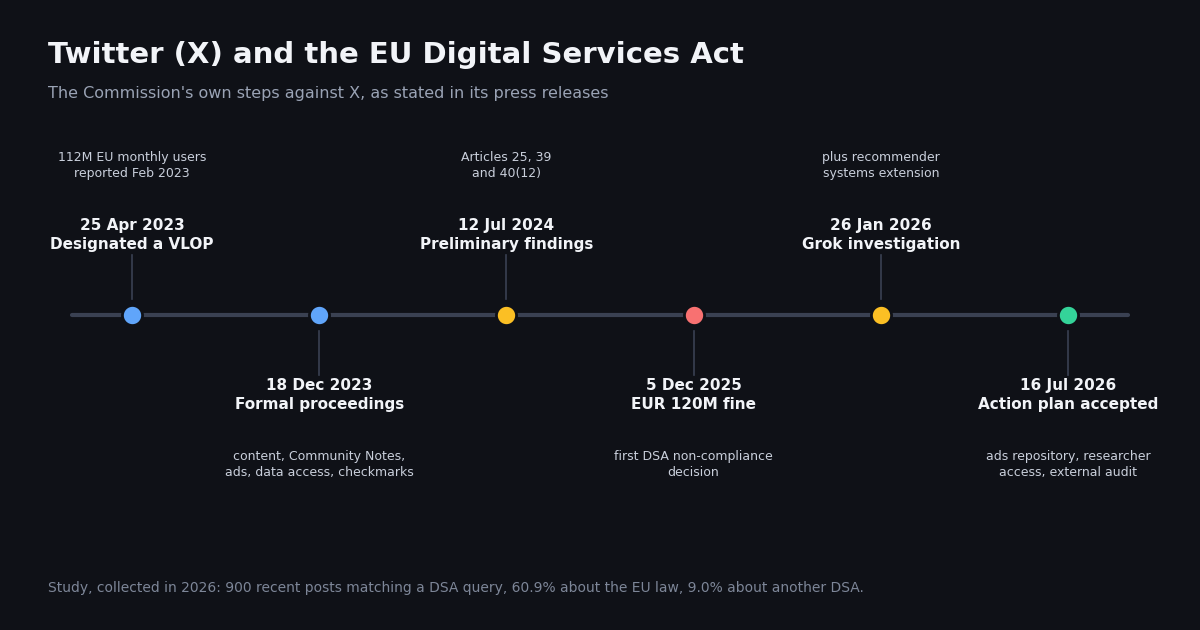
- VLOP since 25 April 2023. X reported 112 million monthly active users in the EU on 17 February 2023 and was designated a Very Large Online Platform two months later.
- First DSA fine: EUR 120 million, 5 December 2025. Three breaches: blue checkmark design, ad repository transparency, researcher access to public data.
- Action plan accepted 16 July 2026. X has six months to fix the ad repository and researcher access, then an independent audit; the Board for Digital Services judged the audit measures insufficient.
- Still open: parts of the December 2023 case (illegal content, Community Notes, recommender systems) and the Grok investigation opened on 26 January 2026.
- Researchers: Article 40 access runs through Digital Services Coordinators and the DSA Data Access Portal (delegated act in force since 29 October 2025). A commercial API is a different route.
- Our study (collected in 2026): of 900 recent posts matching a DSA query, 60.9% were about the EU law, 9.0% about the Democratic Socialists of America, and 30.1% had no clear context. Keyword noise is the first problem any DSA dataset has to solve.
"Twitter DSA" searches usually come from one of three places: someone who read a headline about the X fine and wants the facts in order, a researcher who wants to know whether the DSA gives them a way to get X data, or a team that buys X data and wants to know whether the regulation changes anything for them. This page answers all three, using only what the European Commission has published about X, and adds one thing the news coverage does not have: a measurement of the DSA conversation on X itself.
Everything legal here is a summary of Commission press releases, the Commission's DSA data access FAQ and X's own developer policy, each named in the sources. It is not legal advice. Where we could not open a primary source this session (X's own transparency site refused automated requests), we say so instead of filling the gap from memory.
60.9% of 900
What the DSA is, and why X sits in the strictest tier
The Digital Services Act is Regulation (EU) 2022/2065. It applies to every online intermediary that serves users in the EU, and it scales obligations by size. The top tier is the Very Large Online Platform (VLOP) and Very Large Online Search Engine (VLOSE), for services the Commission designates because of their EU user numbers. The Commission says it has designated 25 VLOPs and 3 VLOSEs so far, and it supervises those services directly instead of leaving them to a national regulator alone.
X was designated on 25 April 2023, in the first batch of designations, after reporting 112 million monthly active users in the EU on 17 February 2023. That designation is the reason X carries extra duties that a small forum does not: yearly assessments of systemic risks (illegal content, effects on elections and civic discourse, harm to minors), independent audits, a public advertising repository, data access for researchers, and stricter transparency reporting.
How enforcement works. The Commission can send requests for information, open formal proceedings, send preliminary findings, accept binding commitments or adopt a non-compliance decision. According to the Commission's enforcement page, a fine for non-compliance shall in no case exceed 6% of a provider's global annual turnover, and incorrect or incomplete replies to information requests can cost up to 1%. Periodic penalty payments are also possible when a decision is not followed.
Who else is involved. National Digital Services Coordinators (DSCs) work alongside the Commission. X's EU establishment is in Ireland, so the Irish regulator, Coimisiun na Mean, is associated with the Commission's X investigations, as the Commission noted when it opened the Grok case.
The Commission's case against X, step by step
The table lists each step the Commission itself announced. Dates are the dates on the Commission's press releases.
What the December 2023 proceedings covered. The opening decision named five areas: X's handling of illegal content and its notice and action mechanism, the effectiveness of Community Notes and related policies against information manipulation, the completeness of the advertising repository, researcher access to publicly available data, and whether the blue checkmarks tied to subscriptions deceive users.
What the preliminary findings narrowed it to. In July 2024 the Commission told X it preliminarily considered three of those areas to be breaches: the checkmark design (Article 25, the rule against deceptive interface design), the advertising repository (Article 39) and access to public data for researchers (Article 40(12)). The illegal content and Community Notes questions were not part of those findings and stayed under investigation.
Why the order matters. A preliminary finding is not a decision. Only the December 2025 decision is a final finding of breach, and only on the three areas it names. When you read that X "broke the DSA", the accurate version is: X was found in breach of three specific obligations, with other questions still open.
The EUR 120 million fine: what the decision says
On 5 December 2025 the Commission announced a EUR 120 million fine on X for breaching its transparency obligations under the DSA, and called it the first non-compliance decision under the DSA. The press release groups the reasons under three headings.
Deceptive design of the blue checkmark. The Commission's position is that the DSA does not require platforms to verify users, but it does prohibit platforms from falsely claiming that users are verified when no such verification took place. Because anyone can pay for the checkmark, the Commission found that it misleads users about the authenticity of accounts. For how the badge types work on X today, see our separate verification guide in the links below.
Lack of transparency of the advertising repository. Article 39 requires VLOPs to keep a searchable repository of the ads they show, with the ad content, the topic, the person on whose behalf the ad was shown and the entity that paid for it. The Commission found access barriers and missing information in X's repository. Our Twitter ads library page covers how that repository works in practice, so we do not repeat it here.
Failure to provide researchers access to public data. The Commission found that X's terms prohibited eligible researchers from independently accessing its public data, including by scraping, and that X's process for researcher access fell short of Article 40(12).
How the amount was set. The Commission says the fine was calculated from the nature of the infringements, their gravity in terms of affected EU users, and their duration. Its press release on the fine does not split the amount by infringement, and we did not find a per-breach breakdown on the Commission's own pages, so we do not give one.
What the decision does not say. It does not decide anything about illegal content moderation, Community Notes, the recommender system or Grok. Those questions are in open proceedings, and the outcome of an open proceeding is not prejudged by its opening.
After the fine: the action plan and the open investigations
The action plan, accepted 16 July 2026. The Commission accepted X's action plan to comply with the December 2025 decision. According to the Commission, X will improve its advertising repository with better search features and faster response times, publish more information about ads and give access to them through an API. For researchers, X will speed up how it screens applications, provide data free of charge and change its terms so that they no longer contractually bar eligible researchers from scraping public data.
Timeline and audit. X has six months to implement the measures. It must then commission an independent external audit of the changes and submit it to the Commission, and fully implement any recommendations the audit makes.
The Board's reservation. The Commission consulted the European Board for Digital Services on 15 June. The Board judged the proposed changes partially adequate, but considered X's audit measures, and therefore the overall plan, insufficient. The Commission accepted the plan anyway and said it will closely monitor progress, in particular on the points the Board raised.
The Grok investigation, opened 26 January 2026. The Commission opened a new formal investigation into whether X properly assessed and mitigated the risks of deploying Grok features in the EU, including the spread of manipulated sexually explicit images, possibly including child sexual abuse material, and harms related to gender-based violence. It also asks whether X produced an ad hoc risk assessment before deploying Grok features with a critical impact on its risk profile. On the same day the Commission extended the December 2023 proceedings to X's recommender systems, including the announced switch to a Grok-based recommender.
Reading the state of play. As of this page, the Commission's own releases show one final decision (the fine), one accepted remedy plan in its implementation period, and open questions on content, Community Notes, recommender systems and Grok. Any claim of a second fine should be checked against the Commission's press corner before you repeat it.
Article 40: how researchers get X data under the DSA
Article 40 is the DSA's researcher data access clause, and it has two different doors. Mixing them up is the commonest mistake in coverage of the X case.
The delegated act and the portal. The rules for Article 40(4) are in Commission Delegated Regulation (EU) 2025/2050, adopted on 2 July 2025. According to the Commission's FAQ it entered into force on 29 October 2025, and researchers can now submit applications through the DSA Data Access Portal (data-access.dsa.ec.europa.eu). The DSC then has 80 working days to send a reasoned request to the platform or explain why it could not; it must give reasons and a new date if it needs longer. Platforms must publish data catalogues so researchers can see what exists.
Where to apply. The FAQ says a researcher can apply to the DSC where their research organization is based or to the DSC of establishment, which for X is the Irish coordinator; the DSC of establishment decides whether to request access on the researcher's behalf.
Public data, Article 40(12). This door was the one the Commission found X had not opened properly. It does not require vetted status, and the FAQ says platforms must provide access without undue delay and in real time where technically possible. If a platform refuses, researchers can turn to a DSC or the Commission.
What X's own terms say. X's developer policy on docs.x.com/developer-terms/policy tells researchers who need to contact X about access under Article 40 to write to EU-Questions@X.com, and states that its content redistribution limits do not apply to researchers with X API access via Article 40, who are instead subject to the DSA procedures and the Developer Agreement. The action plan adds that X will change its terms on scraping by eligible researchers; check the current terms before you rely on either version.
Our study: what the DSA conversation on X looks like
Coverage of the X case is written about the platform. We wanted to know what the conversation looks like on the platform: how much of it there is, who carries it, in which languages, and how clean a keyword sample is. We searched public posts with a DSA query over a 30-day window, once in Latest order and once in Top order, and pulled the recent timelines of two EU institution accounts.
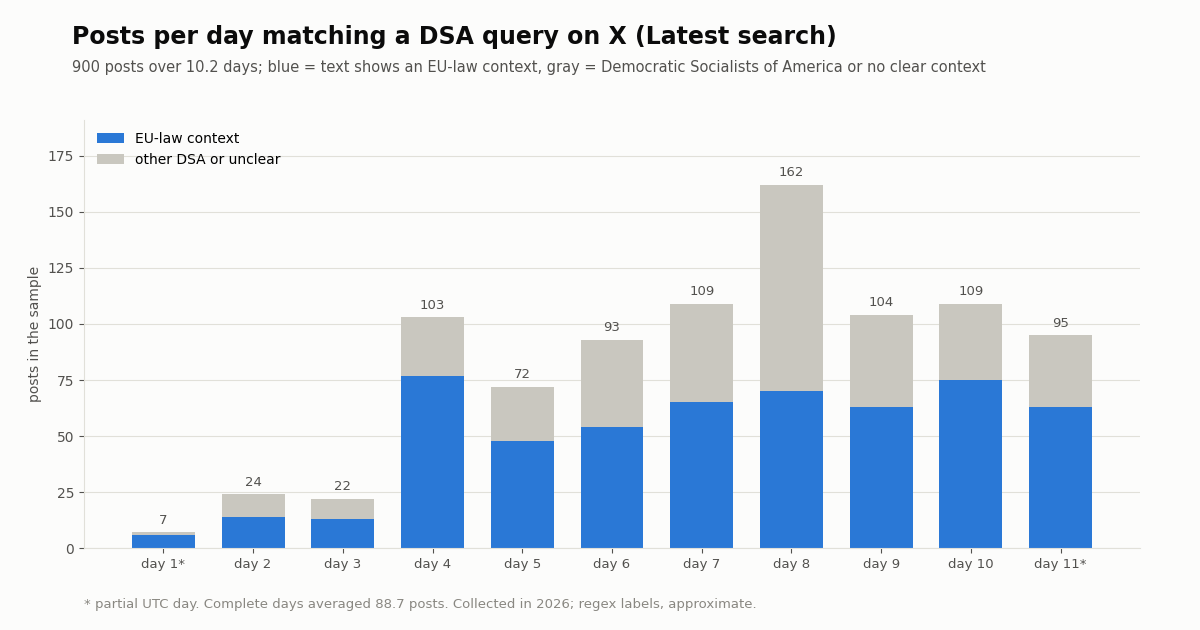
The headline: one in ten DSA posts is about a different DSA. Of 900 Latest posts that matched our query, 60.9% had text with an EU-law context (the Act, the EU, the Commission, Brussels, a regulator, censorship, a euro amount), 9.0% were about the Democratic Socialists of America, and 30.1% had no clear context, usually short replies. In the Top sample the picture was much cleaner: 92.5% EU-law context and 2.3% the US organization. Anyone building a DSA dataset from X should expect to filter, and should report how.
Volume. The 900 Latest posts covered 10.2 days, so the newest 900 posts were roughly the last week and a half of conversation, not the full 30 days. Complete days averaged 88.7 posts, ranging from 22 to 162. A spike from the low 20s to over 100 a day appeared partway through the window; we did not attribute it to an event, because the sample alone cannot show cause.
Who talks. 724 distinct authors wrote the 900 Latest posts (1.24 posts each), and the median author had 1,099 followers. This is a conversation of many small accounts, not a few large ones. The EU institutions themselves barely appear: in 80 recent posts each, the European Commission's account (@EU_Commission, 1,868,486 followers) mentioned the DSA once (1.2%), and Digital EU (@DigitalEU, 143,989 followers) five times (6.2%). Only one of the 900 Latest posts and three of the Top posts came from those two accounts.
What people talk about. Among EU-context Latest posts, 15.9% mention Musk, 19.0% use censorship or free speech words, 18.2% mention a fine, a penalty, millions or a euro sign, 12.2% mention Grok, and only 2.7% mention researchers or data access. The researcher access breach that is a third of the Commission's decision is close to invisible in the public debate.
Languages: the DSA debate on X is mostly not local
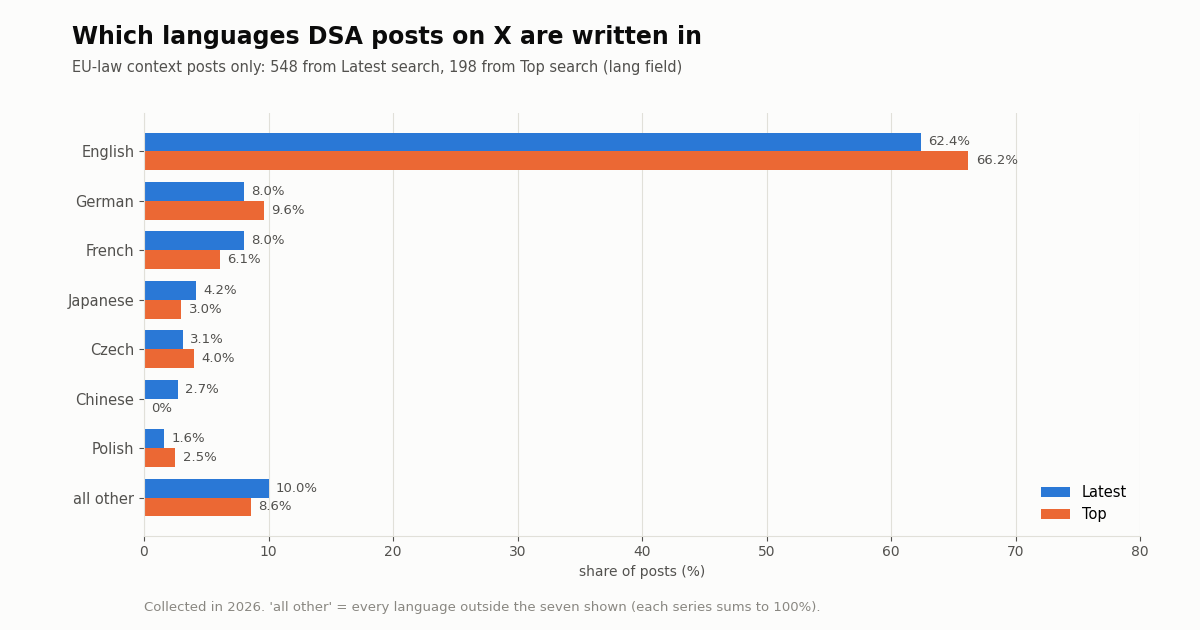
The DSA is an EU law, but the conversation about it on X is overwhelmingly in English. Of the 548 EU-context Latest posts, 62.4% were tagged English, 8.0% German, 8.0% French, 4.2% Japanese, 3.1% Czech, 2.7% Chinese, 1.6% Polish and 1.6% Italian. In the 198 EU-context Top posts, English was 66.2% and German 9.6%.
Why it matters for a study. An English-only query for "Digital Services Act" will miss a real share of the European debate: German posts often write "DSA" next to words like Zensur or Verordnung, French posts next to ARCOM or reglement. If you are studying the EU public sphere, query in the EU languages you care about and filter on the lang field, which every post object carries.
A caveat on the lang field. The tag is X's automatic language detection. Short posts, posts that are only a link, and posts made of hashtags get und or zxx. In our Latest sample, 2.1% of all posts carried zxx, so a language breakdown always has a small unlabeled tail.
DSA research access vs commercial X data access
If your goal is research on systemic risks in the EU and you are eligible, Article 40 is the route the law built for you: free of charge under X's action plan, with the safeguards of DSC vetting. It also takes time (an 80 working day decision window for non-public data) and comes with conditions on independence, data security and publication.
Commercial access is a different thing. Paid APIs, X's own and third-party ones, sell access to public data under their own terms. They are not a DSA research channel, using one does not give you vetted researcher status, and nothing about a commercial API satisfies or replaces the DSA's research rules. TwitterAPI.io is commercial data access in that sense: we make no claim about the DSA status of any project that uses it.
When commercial access fits. Pilot work before an Article 40 application, journalism and monitoring that is not systemic-risk research, teams outside academia, and any work that needs results this week. The study on this page is an example: 75 requests, about 1,270 posts, about $0.19 at $0.15 per 1,000 tweets returned, with no X account needed.
The same posts on two rate cards. At X's published rate card ($0.005 per post read on docs.x.com/x-api/getting-started/pricing), the posts in our study would cost $6.38; at our $0.15 per 1,000 tweets they cost about $0.19, roughly 33 times less per 1,000 tweets ($5 vs $0.15). X's pay-per-usage plan is capped at 3 million post reads a month, with Enterprise above that. New TwitterAPI.io accounts that pass the automatic bot check get free starter credits (no card, one per person or network, expiring after 31 days); see the pricing page for the amount. Purchased credits never expire.
Responsibilities do not move. Whatever the route, the GDPR still applies to personal data in posts, and research ethics still apply to private individuals. Our own study keeps raw search pages off the repository and publishes aggregates only.
How we collected this
Question. How much public conversation about the Digital Services Act happens on X, in which languages, who carries it, and how much of a keyword sample is about a different DSA.
Query. ("Digital Services Act" OR (DSA (EU OR Commission OR Brussels OR Musk OR censorship OR fine))) with since: and until: bounds for a 30-day window, run on /twitter/tweet/advanced_search with queryType=Latest (45 pages, 900 posts) and queryType=Top (20 pages, 217 posts, of which 3 fell outside the window and were dropped). Plus /twitter/user/info and four pages of /twitter/user/last_tweets each for @EU_Commission and @DigitalEU. 75 requests in total, collected in 2026.
Labels. Each post was labeled by a regular expression on its text: EU-law context, Democratic Socialists of America, or unclear. The labels are approximate, not hand-coded; a reply that says "exactly" under an EU post is "unclear" here even if it is on topic, so the EU share is a lower bound for Latest.
What the sample cannot show. Latest returns the newest posts first, so 900 posts covered 10.2 days, not 30; Top is X's own relevance ranking and is not a random sample. Search returns original posts, quotes and replies, not plain reposts, so repost volume is not measured. Deleted, protected and withheld posts are absent. Nothing here measures the effect of the DSA itself.
Privacy. Aggregates only. Raw search pages stayed in a temporary folder and are not published; the repository keeps de-identified rows with no ids, URLs, text or handles. Only the two EU institution accounts are named, and their raw timelines are kept compressed. No TwitterAPI.io customer appears in the data.
# Pull public posts about the DSA from X and label keyword noise.
# Reads need an API key from twitterapi.io, no X account.
import collections
import re
import time

import requests

BASE = "https://api.twitterapi.io"
HEADERS = {"X-API-Key": "YOUR_API_KEY"}
QUERY = '("Digital Services Act" OR (DSA (EU OR Commission OR Brussels))) lang:en'

EU_CONTEXT = re.compile(r"digital services act|(?<![A-Za-z])EU(?![A-Za-z])|europ|commission|brussel|regulation|censor", re.I)
US_DSA = re.compile(r"socialis|DSA[- ]?(LA|NYC|chapter|member|board)", re.I)


def search(query, query_type="Latest", max_pages=10):
    cursor = ""
    for _ in range(max_pages):
        params = {"query": query, "queryType": query_type}
        if cursor:
            params["cursor"] = cursor
        r = requests.get(f"{BASE}/twitter/tweet/advanced_search", headers=HEADERS, params=params, timeout=30)
        r.raise_for_status()
        body = r.json()
        for tweet in body.get("tweets", []):
            yield tweet
        if not body.get("has_next_page"):
            break
        cursor = body.get("next_cursor", "")
        time.sleep(0.5)


def label(text):
    if US_DSA.search(text) and "digital services act" not in text.lower():
        return "us_dsa"
    return "eu" if EU_CONTEXT.search(text) else "unclear"


labels = collections.Counter()
langs = collections.Counter()
for t in search(QUERY):
    tag = label(t.get("text") or "")
    labels[tag] += 1
    if tag == "eu":
        langs[t.get("lang") or "none"] += 1

total = sum(labels.values()) or 1
for tag, n in labels.most_common():
    print(f"{tag:8} {n:5}  {100 * n / total:.1f}%")
print("languages (EU context):", langs.most_common(5))
Researching this?Free starter credits cover end-to-end testing — Google sign-in, no card. Get a key.
Questions readers ask
Why did the EU fine X under the DSA?
On 5 December 2025 the European Commission fined X EUR 120 million for three breaches of its transparency obligations: the deceptive design of the paid blue checkmark, an advertising repository without the required transparency and access, and terms and processes that kept researchers from accessing public data. It was the first non-compliance decision under the DSA.
Is X a Very Large Online Platform under the DSA?
Yes. The Commission designated X a VLOP on 25 April 2023, after X reported 112 million monthly active users in the EU on 17 February 2023. VLOPs carry the DSA's strictest duties and are supervised directly by the Commission.
Did X pay or appeal the DSA fine?
The Commission pages we checked describe the decision and the action plan X submitted to comply with it, which the Commission accepted on 16 July 2026. They do not state whether the fine was paid or challenged in court, so we do not claim either; check the Commission's press corner and the EU courts' register for the current status.
What does X have to change after the decision?
Under the accepted action plan, X has six months to improve its ad repository (better search, faster responses, more ad information, API access), speed up researcher application screening, provide researcher data free of charge, and change its terms so eligible researchers are not contractually barred from scraping public data. An independent external audit follows.
How can a researcher get X data under the DSA?
For non-public data, apply for vetted researcher status through the DSA Data Access Portal; a Digital Services Coordinator vets the application and sends a reasoned request to X, with an 80 working day decision window. For publicly accessible data, Article 40(12) applies without vetted status if you meet the baseline conditions. X's developer policy lists EU-Questions@X.com for Article 40 questions.
Is there still an open DSA investigation into X?
Yes. Parts of the December 2023 proceedings, including illegal content, Community Notes and recommender systems, remain open, and on 26 January 2026 the Commission opened a further investigation into the risks of Grok features on X. An opening does not prejudge the outcome.
Does using a paid X data API count as DSA research access?
No. Commercial APIs, X's own pay-per-usage plan or third-party services such as TwitterAPI.io, are commercial data access under their own terms. They do not give vetted researcher status and do not satisfy or replace the DSA's research rules. They can still be useful for pilots, monitoring and work outside Article 40.
What is the maximum DSA fine?
The Commission's enforcement page says a non-compliance fine shall in no case exceed 6% of a provider's global annual turnover, and fines for incorrect or incomplete information can reach 1%. The X fine of EUR 120 million was set, according to the Commission, by the nature, gravity and duration of the infringements.
Continue
- European Commission: Commission fines X EUR 120 million under the Digital Services Act
- European Commission: Commission accepts X's action plan to comply with the Digital Services Act
- European Commission: Commission opens formal proceedings against X under the Digital Services Act
- European Commission: Commission investigates Grok and X's recommender systems under the DSA
- European Centre for Algorithmic Transparency: FAQs on DSA data access for researchers
- EUR-Lex: Regulation (EU) 2022/2065, the Digital Services Act
- Twitter (X) API hub: endpoints, pricing and guides
- Twitter (X) ads library and the Article 39 ad repository
- Twitter (X) API for academic research
- How to hydrate tweet IDs from a research dataset
- How verification and checkmarks work on X
- TwitterAPI.io pricing per tweet and per profile
- TwitterAPI.io API documentation
- 01How to Translate Tweets on Twitter (X): Auto-Translate, the Gear Icon and Language Settings
- 02How to Turn Off Autoplay on Twitter (X): App, Web and Auto-Advance
- 03Twitter (X) and Firebase: store posts in Firestore with a scheduled Cloud Function
- 04Twitter (X) Network Analysis with Python and networkx: A Real #reInvent Graph
- 05Analyze Twitter (X) Data with pandas: A Worked Example on 1,800 Real Posts
- 06Twitter (X) 2FA: How to Turn On Two-Factor Authentication
- 07Most-Liked Tweets — Build Your Own Leaderboard via API
- 08Free LLM API options in 2026: what is still free, the real limits, and how to feed it Twitter (X) data
Writing about something you built with TwitterAPI.io? Our community rewards program pays API credits for honest tutorials, build logs and videos.
Stop reading. Start building.
Starter credits cover real testing on real data. Google sign-in, no card, no application queue.
Get an API keyAlready building with TwitterAPI.io? Publish an honest tutorial or build log about it and earn up to $200 a month in API credits.