Replit alternatives in 2026: free tiers, prices, hosting and what X users switch to
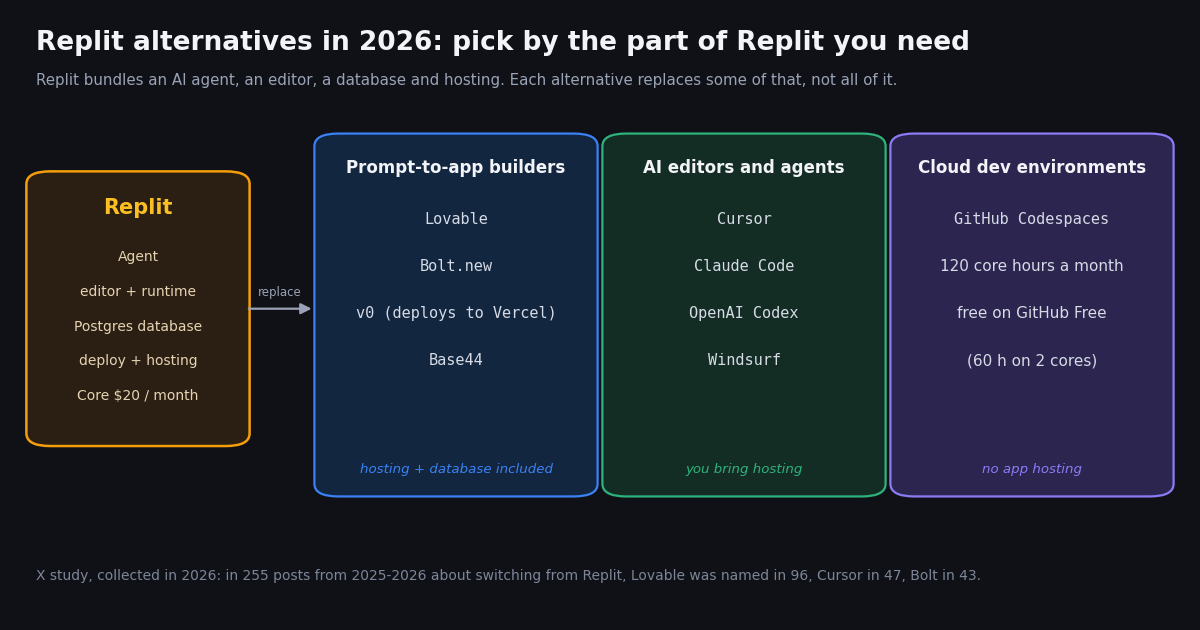
- Closest like-for-like swaps: Lovable, Bolt.new, Base44 and v0 all build, host and deploy from a prompt; Bolt.new's Free plan is the most generous on hosting (website hosting, up to 333k web requests, unlimited databases).
- Free tiers, as each vendor shows them: Bolt.new 1M tokens a month (300K daily), Base44 25 message credits a month, v0 7 messages a day, Lovable 5 build credits a day (up to 30 a month), GitHub Codespaces 120 core hours a month.
- Paid entry prices: Bolt.new Pro
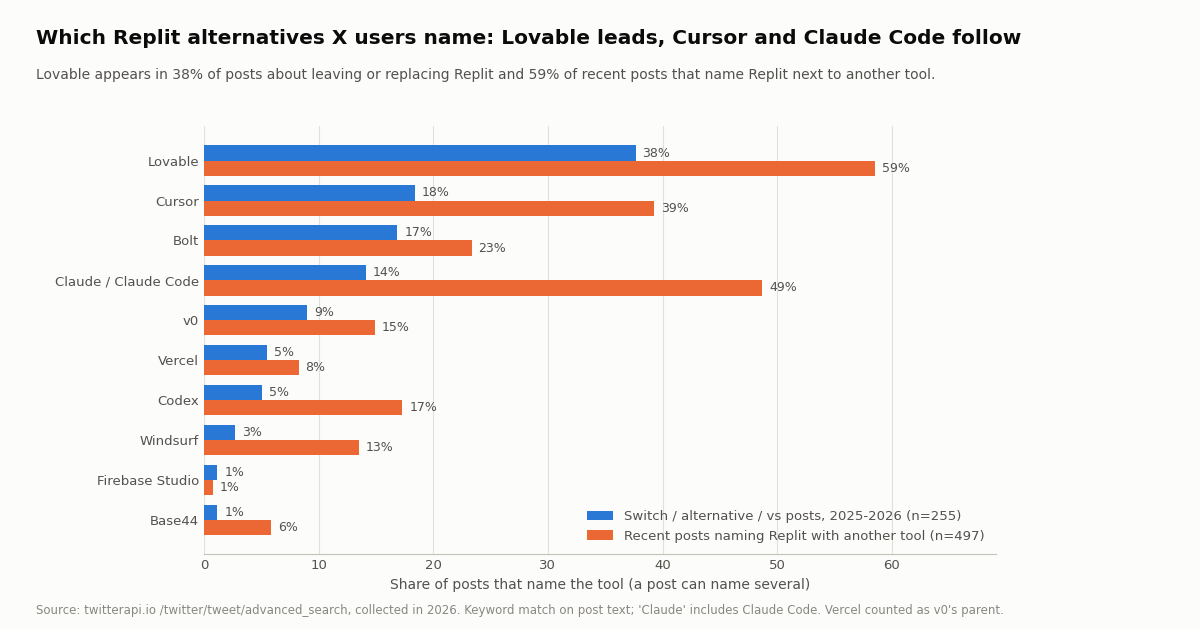
$25 /month, Base44 Starter$16/mobilled annually, v0 Plus$30per user a month, Cursor Premium$30 /month; Replit Core is$20 / month($18 billed annually). - What X users name when leaving Replit: Lovable 38%, Cursor 18%, Bolt 17%, Claude / Claude Code 14% of 255 switch posts from 2025-2026; pricing or credits come up in 18%.
- Agents vs builders: Cursor, Claude Code and Codex write better code for developers but do not host your app; you add Vercel, Netlify, Fly or a VPS.
- If your app shows X (Twitter) data, that is a separate bill on every platform: $0.15 per 1,000 tweets on TwitterAPI.io vs $5 per 1,000 post reads on X's pay-per-usage rate card.
Replit is an all-in-one product: an AI Agent that writes the app, a cloud editor and runtime, a managed Postgres database and one-click publishing. That bundle is why people pick it and also why they leave: when the Agent's effort-based charges add up, when a project outgrows the editor, or when they want a different deploy target, no single product replaces all four parts at once.
This page compares the alternatives builders actually move to, using each vendor's own pricing page fetched for this article (free tier, entry price, hosting, database, AI agent), and a study of X posts that shows which tools people name when they talk about leaving Replit. It does not break down Replit's own plans in detail; for that, see Replit's pricing page at replit.com/pricing.
One more angle most lists skip: many of these apps are dashboards that show posts from X. The last sections show how to wire X data into a Lovable, Bolt, v0 or Cursor project with one REST call or our hosted MCP server, and what that data costs next to the official X API.
38% of 255
Replit alternatives compared: free tier, price, hosting and AI agent
Every price below was read from the vendor's own pricing page for this article and is written the way the vendor shows it. "Hosting" means the product can publish your app to a public URL without another service.
How to read it. The first four rows are prompt-to-app builders: they replace Replit's Agent, database and publishing together. Cursor (and Claude Code or OpenAI Codex, which the table skips because neither has a free hosted tier to compare) replaces the Agent and editor but not hosting. GitHub Codespaces replaces the cloud editor only.
Lovable's prices. The plan cards on lovable.dev/pricing did not render in a server-side fetch for this article; the FAQ on the same page confirms the free grants (5 daily build credits up to 30 a month, 20 monthly Cloud credits, 4 AI credits). Our separate Lovable pricing breakdown lists every credit tier.
Currency. v0 states that all prices are in USD and exclude VAT/GST. Bolt.new, Base44 and Cursor show $ without naming a currency; Replit notes prices are subject to tax depending on location.
Free Replit alternatives: what each free plan really includes
"Replit alternatives free" is the second most common way people phrase this search, so here is what each free tier gives you, quoted from the vendor pages.
Bolt.new Free ($0 /month, "Free forever, no card required"). Public and private projects, a 300K daily token limit and 1M tokens per month, Bolt branding on websites, a 10MB file upload limit, website hosting with up to 333k web requests, and unlimited databases. Custom domains start on Pro. Of the builders here, this is the free tier that covers the most of what Replit's Starter plan covers: build, store data and publish.
Lovable Free. A daily grant of 5 build credits (up to 30 a month), plus 20 Cloud credits a month for hosting and the database and 4 credits for AI features inside your app. Lovable's FAQ says that for most smaller or new apps, hosting is covered by the included grant. The daily cap is the constraint: a credit is spent per message (Plan mode is 1 credit per message; Default mode varies, from 0.50 for a small style change to 1.70 for a landing page with generated images, per Lovable's own examples).
v0 Free ($0/month). Free access to v0, deploy apps to Vercel, Design Mode visual editing, GitHub sync, and a 7 message/day limit. New users also get $5 in one-time credits. Hosting runs on your Vercel account, so the app itself follows Vercel's Hobby plan rules.
Base44 Free ($0). 25 message credits and 100 integration credits a month, up to 5 apps, and the core features: authentication, database functionality and analytics. Connecting a custom domain is listed on paid plans.
Cursor Free ($0 /month). Limited AI usage with limited agent requests and limited chat requests. It is a code editor, so the free tier is useful only if you will deploy the result yourself.
GitHub Codespaces on GitHub Free. 120 core hours of compute and 15 GB-month of storage each month; a 2-core machine uses 2 core hours per hour, so that is 60 hours of a 2-core codespace. There is no built-in AI agent in that quota and no app hosting, but it is the closest free replacement for Replit's "code in a browser tab" part.
Prompt-to-app builders: Lovable, Bolt.new, v0 and Base44
These four are the direct Replit Agent replacements: describe the app, the agent builds it, and the product hosts it. The differences are in the billing unit and where the app runs.
Lovable is the name X users reach for most often when they leave Replit (see the study below). Its strength is polished React front ends with a Supabase-backed database; its limit is the credit meter, which also pays for hosting and in-app AI.
Bolt.new bills in tokens, which makes cost track the size of your project more than the number of prompts. Its Pro plan has no daily token limit, starts at 10M tokens a month, rolls unused tokens into the next month and adds a custom domain. Teams is $30 /month per member.
v0 by Vercel publishes token rates per model on its pricing page (for example v0 Pro at $2/1M input and $10/1M output tokens) and draws them from the included $30 of monthly credits per user plus $2 of free daily credits on login. Business is $100/user/month and adds training opt-out by default. Pick it if you already deploy to Vercel.
Base44 shows annual prices on its card view: Starter $16/mo, Builder $40/mo, Pro $80/mo, Elite $160/mo, all billed annually, with a monthly option available. Every plan includes an integrated backend and database, authentication and user management, and paid plans add a custom domain and a free domain for one year.
AI coding agents instead of an app builder: Cursor, Claude Code, Codex
If you left Replit because the Agent's code was hard to maintain, the move developers describe on X is to a coding agent that works in your own repository, then deploy wherever you like. In our study, Claude or Claude Code appears in 49% of recent posts that name Replit together with another tool and Cursor in 39%.
Cursor. Its pricing page lists Free at $0 /month, an introductory Plus at $8 /month and Premium at $30 /month; two higher individual tiers (Super and Ultra) give 15x and 50x the Plus usage, and Teams starts at $30 per user a month. Plus runs on Grok models only; the Cursor Agent is listed on every tier, and Premium adds cloud agents, third-party models at API list price and code hosting via Origin (source code hosting, not app hosting). The FAQ says subscriptions are sold directly through X Subscription Corp.
Claude Code and OpenAI Codex. Both are terminal and IDE agents that edit a local or cloud repository. Neither hosts the app. Their plan structures and usage limits are covered in our Claude Code pricing and Codex pricing pages, and the trade-offs between them in our Codex vs Claude Code comparison; this page does not repeat those figures.
What you add yourself. A database (Supabase, Neon or a managed Postgres), hosting (Vercel, Netlify, Fly.io, Render or a VPS), and secrets management. That is more setup than Replit, but you own the code and can switch any piece later.
When it is the wrong move. If you do not read code, an agent in an editor will not save you money or time; a prompt-to-app builder from the previous section is the closer fit.
What X users name when they leave Replit
We searched X for posts about replacing Replit ("replit alternative(s)", "alternative to replit", "switched from replit", "leaving replit", "replit vs", "better than replit" and similar) and kept 255 posts from 2025-2026. Separately, we pulled the 497 most recent posts that name Replit together with at least one other builder, an 11.5-day window of about 43.2 posts a day.
Lovable leads both samples. It appears in 38% of the switch posts, about twice as often as Cursor (18%) or Bolt (17%). In the recent co-mention sample, Claude or Claude Code (49%) has moved close to Lovable (59%), which fits a shift from app builders toward coding agents.
Why people talk about switching. In the switch posts, pricing, credits, billing or subscription words appear in 18%, hosting or deploy words in 14%, complaints about bugs, loops or broken code in 11%, and database words in 6%. 36% of switch posts name no specific tool at all; they ask for suggestions.
The topic is recent. Of 292 matching switch posts the search returned, 145 are from 2025 and 110 from 2026, against 16 from 2024, so this list is about the AI-agent era of Replit, not the older classroom IDE.
GitHub Codespaces is almost absent. It is named in 0 switch posts and 2 co-mention posts: people leaving Replit today are leaving an AI builder, not a browser IDE.
How loud each alternative is on X: official accounts compared
We also read the 80 most recent posts on each official account (reposts included in the count, engagement measured on the account's own posts) plus each profile.
Cursor posts least and gets the most attention. @cursor_ai posted about 0.5 times a day in its sample, yet its median own post drew 421,932 views, more than 25 times any other account here. @Replit is the most active (2.5 posts a day) with a median of 7,608 views.
Pricing talk differs a lot. Pricing, credits or plan words appear in 33.9% of @base44's own posts, 21.9% of @cursor_ai's and 21.3% of @boltdotnew's, against 8.2% for @Replit. If you are weighing these tools on cost, the official timelines are where plan changes are announced first.
Follow these accounts with a list or a saved search if you want plan and pricing changes as they ship; the next section shows how to pull them into a dashboard.
Wire X data into whichever Replit alternative you pick
Social dashboards, launch trackers and brand-mention walls are among the most common apps people build on these platforms, and every one of them needs a source of X posts. The pattern is the same on all of them: keep the API key on the server, call one REST endpoint, cache the result.
Lovable, Bolt.new, Base44. Store the key as a secret (Lovable Secrets, Bolt's environment variables or Base44's backend settings), call https://api.twitterapi.io/twitter/tweet/advanced_search with an X-API-Key header from a backend or edge function, and return only text, author, createdAt and counts to the browser. Never put the key in a client-side variable such as VITE_....
v0. Generate the UI in v0, then add a Next.js route handler in the Vercel project that calls the same endpoint; the key lives in Vercel environment variables.
Cursor, Claude Code, Codex. Point the agent at our hosted MCP server, https://mcp.twitterapi.io/mcp, with the header Authorization: Bearer your_key_here, and it can search posts, read timelines and look up profiles while it writes your code. The MCP guide linked below has per-client setup.
Pagination and limits. Each search page returns up to 20 posts with has_next_page and next_cursor. Paid accounts get 20 requests per second (0.2 before the first payment), which is far more than a dashboard needs. Reads need no X account and no X developer app.
The Python script below is a complete example you can run in any of these environments: it counts which Replit alternatives recent X posts name, the same method as our study.
# Any MCP client (Cursor, Claude Code, Codex): remote server + Bearer key
# URL:    https://mcp.twitterapi.io/mcp
# Header: Authorization: Bearer your_key_here

# Plain REST call from a backend function (key stays server-side)
curl -s "https://api.twitterapi.io/twitter/tweet/advanced_search?queryType=Latest&query=from%3AReplit" \
-H "X-API-Key: $TWITTERAPI_IO_KEY" | jq '.tweets[] | {createdAt, text, likeCount}'The X data bill next to the builder bill
X data is a separate line item from your builder's credits or tokens. TwitterAPI.io bills 15 credits per tweet returned, $0.15 per 1,000 tweets, with a minimum of 15 credits per request; $1 buys 100,000 credits. A full 20-tweet page costs $0.003, and a search that finds nothing costs the $0.00015 minimum.
The official X API pay-per-usage rate card at docs.x.com/x-api/getting-started/pricing lists $0.005 per post read and $0.010 per user read, with pay-per-usage capped at 3 million post reads a month before Enterprise. Per 1,000 posts that is $5 against $0.15, about 33 times more.
The polling rows are the worst case: 8,640 checks a month at 5-minute intervals, each finding nothing, at the $0.00015 minimum. Checks that return tweets are billed per tweet instead. A cached dashboard showing about 3,000 new tweets a month therefore stays under $2 of X data, next to a Bolt.new Pro plan at $25 /month or Replit Core at $20 / month.
For scale, the whole study on this page (1,272 posts and 6 profiles in 73 requests) cost 19,188 credits, about $0.19.
New accounts that pass the automatic bot check get up to $1 of free credits (at most 100,000 credits, no card, one per person or network, expiring after 31 days); purchased credits never expire. Monthly subscriptions start at Starter $29; see the pricing page.
How we collected this
Question. When people on X talk about replacing Replit, which tools do they name and why, and how active are the official accounts of the main alternatives?
Queries and accounts. Four /twitter/tweet/advanced_search queries (queryType Latest, retweets excluded): alternative phrasing (29 posts), switch phrasing (63), versus phrasing (200), and Replit named together with another builder (497, the most recent 11.5 days). Then /twitter/user/info and /twitter/user/last_tweets (80 posts each) for @Replit, @Lovable, @boltdotnew, @v0, @cursor_ai and @base44.
Sample. 789 unique search posts and 480 official-account posts, collected in 2026 with 73 requests. Tool mentions are a case-insensitive keyword match on post text, counted once per tool per post; "Claude" includes Claude Code, and reasons are keyword groups (pricing, hosting, database, bugs, free).
What the sample cannot show. Keyword matching cannot tell a recommendation from a complaint, and "cursor" or "bolt" can occasionally mean something else. The co-mention query only returns posts that name a listed tool, so it cannot surface tools we did not list. Search results are the most recent matches, not a random sample of all X posts; 81% are in English.
Privacy. Aggregates only. Raw search pages were not kept; the published sample has year, language, matched tools, matched reasons and counts, with no post id, URL, text or author. Only the six official organization accounts are named. Median engagement on the co-mention posts was 2 likes and 200 views, so most are ordinary users talking to each other.
import os
import re
import requests

BASE = "https://api.twitterapi.io"
HEADERS = {"X-API-Key": os.environ["TWITTERAPI_IO_KEY"]}  # reads need no X account

# Which Replit alternatives are people naming on X right now?
QUERY = ('replit (lovable OR bolt OR v0 OR cursor OR base44 OR "claude code" OR codex) '
         '-filter:retweets')
TOOLS = {
    "Lovable": r"\blovable\b",
    "Bolt": r"\bbolt(\.new)?\b",
    "v0": r"\bv0\b",
    "Cursor": r"\bcursor\b",
    "Claude Code": r"claude code",
    "Codex": r"\bcodex\b",
    "Base44": r"base44",
}


def search(query, max_pages=5):
    """Yield tweets from /twitter/tweet/advanced_search, newest first."""
    cursor = ""
    for _ in range(max_pages):
        params = {"query": query, "queryType": "Latest"}
        if cursor:
            params["cursor"] = cursor
        r = requests.get(f"{BASE}/twitter/tweet/advanced_search",
                         headers=HEADERS, params=params, timeout=30)
        r.raise_for_status()
        body = r.json()
        for tweet in body.get("tweets", []):
            yield tweet
        if not body.get("has_next_page"):
            break
        cursor = body.get("next_cursor", "")


counts = {name: 0 for name in TOOLS}
seen = 0
for t in search(QUERY):
    seen += 1
    text = t["text"].lower()
    for name, rx in TOOLS.items():
        if re.search(rx, text):
            counts[name] += 1

print(f"{seen} posts scanned (about ${seen * 15 / 100000:.4f} of credits)")
for name, n in sorted(counts.items(), key=lambda kv: -kv[1]):
    share = 100 * n / seen if seen else 0
    print(f"{name:12s} {n:4d}  {share:5.1f}%")
Researching this?Free starter credits cover end-to-end testing — Google sign-in, no card. Get a key.
Questions readers ask
What is the best free alternative to Replit?
For building and hosting an app from a prompt for free, Bolt.new's Free plan is the broadest: 1M tokens a month (300K daily), website hosting with up to 333k web requests and unlimited databases, no card required. Lovable (5 build credits a day), Base44 (25 message credits a month) and v0 (7 messages a day, deploys to Vercel) are free too but tighter. For a free cloud editor without an AI agent, GitHub Codespaces gives 120 core hours a month on GitHub Free.
Is Lovable better than Replit?
They overlap: both build, host and store data from a prompt. Lovable is the tool X users name most when they leave Replit (38% of 255 switch posts in our 2026 study), usually for its front-end output. Replit keeps a broader runtime (any language, background jobs). Compare credit costs on the Lovable pricing page against Replit Core at $20 a month.
Is there a Replit alternative that hosts my app for free?
Yes. Bolt.new Free includes website hosting and unlimited databases; Lovable Free's monthly 20 Cloud credits cover hosting for most small apps according to Lovable's FAQ; v0 deploys to your Vercel account; Base44's free plan includes its built-in database and up to 5 apps. Custom domains generally need a paid plan.
Should I use Cursor or Claude Code instead of Replit?
Only if you are comfortable reading and running code yourself. They are coding agents, not hosting platforms, so you add a database and a host such as Vercel or Fly.io. If you want Replit's one-click publishing, a prompt-to-app builder like Lovable or Bolt.new is the closer replacement.
How much does Replit cost compared with the alternatives?
Replit Core is $20 a month ($18 billed annually) and Pro is $100 a month ($90 billed annually), per replit.com/pricing. Bolt.new Pro is $25 a month, v0 Plus is $30 per user a month, Base44 Starter is $16 a month billed annually, and Cursor Premium is $30 a month. Our separate Replit pricing page covers Replit's plans and effort-based charges in detail.
Is GitHub Codespaces a good Replit alternative?
For the editor part, yes: 120 core hours and 15 GB-month of storage a month free on GitHub Free, then $0.18 an hour for a 2-core machine. It has no built-in app hosting, and on X it is almost never named as a Replit replacement in our study.
Can I show live X (Twitter) posts in an app built on these platforms?
Yes. Call TwitterAPI.io's /twitter/tweet/advanced_search from a server-side function with the X-API-Key header, or connect a coding agent to the hosted MCP server at mcp.twitterapi.io/mcp. Data costs $0.15 per 1,000 tweets, against $5 per 1,000 post reads on X's pay-per-usage rate card.
Continue
- Replit pricing (Core and Pro plans)
- Bolt.new plans and pricing
- v0 by Vercel plans and model token rates
- Base44 plans and credits
- GitHub Docs: Codespaces billing and free quota
- X API pay-per-usage pricing
- X (Twitter) API guide: endpoints, access and pricing
- Lovable pricing: every credit tier, monthly and annual
- Claude Code alternatives for AI-assisted coding
- Cursor vs Claude Code compared for real projects
- OpenAI Codex pricing and usage limits
- How the hosted X (Twitter) MCP server works
- TwitterAPI.io vs the official X API, side by side
- TwitterAPI.io pricing: $0.15 per 1,000 tweets
- 01Devin Pricing in 2026: Plans, Quotas, ACUs and What X Users Actually Pay
- 02Lovable Alternatives in 2026: Bolt.new, v0, Base44, Replit, Emergent and Cursor Compared
- 03Kiro vs Cursor in 2026: Plans, Spec-Driven vs Agent-First, and X (Twitter) Data via MCP
- 04Langfuse vs LangSmith: Pricing, Self-Hosting, OpenTelemetry and an X-Data Agent Traced in Both
- 05n8n vs Zapier vs Make in 2026: Pricing, Self-Hosting, AI Agents and the Same Twitter (X) Flow Built in All Three
- 06Replit pricing in 2026: plans, credits, effort-based Agent costs, and what an app that reads Twitter (X) data really costs
- 07Claude Code Alternatives: Seven Coding Agents Checked for License, Free Use and MCP (Twitter/X Data Included)
- 08n8n Alternatives in 2026: Pick by Why You Are Leaving, and Keep Your Twitter (X) Workflows
Writing about something you built with TwitterAPI.io? Our community rewards program pays API credits for honest tutorials, build logs and videos.
Stop reading. Start building.
Starter credits cover real testing on real data. Google sign-in, no card, no application queue.
Get an API keyAlready building with TwitterAPI.io? Publish an honest tutorial or build log about it and earn up to $200 a month in API credits.