Bright Data Alternatives for Twitter (X) Data: Prices, Fit and a Measured Cost Test
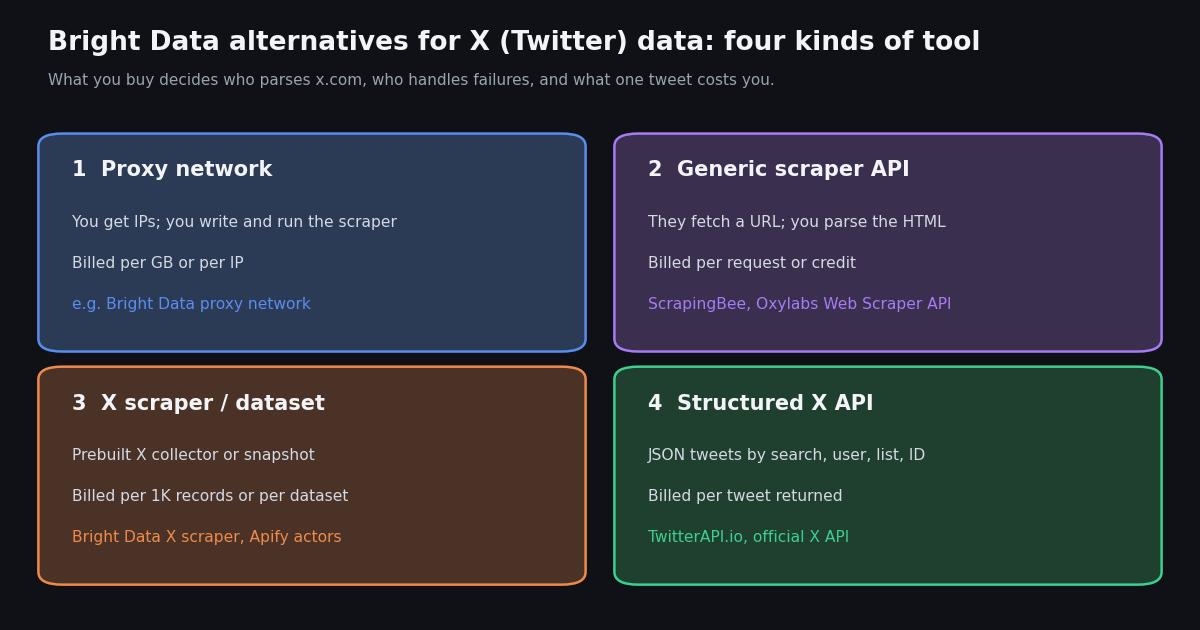
- Four kinds of alternative: structured X API, prebuilt X scraper or dataset, generic scraper API, raw proxies. Pick by who parses x.com and what you are billed for.
- Bright Data's X scraper lists $1.5 per 1K records pay as you go, or $499 a month with 384,000 records and $1.3 per 1K after that; the X dataset starts at $250 per 100K records.
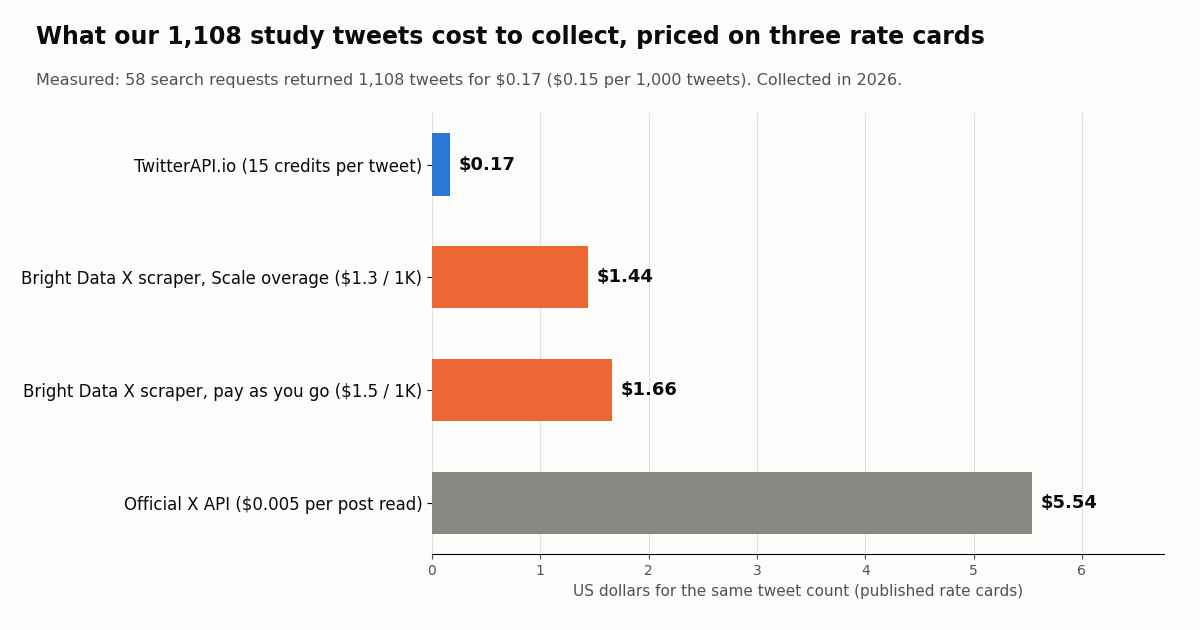
- TwitterAPI.io bills 15 credits per tweet returned, which is $0.15 per 1,000 tweets; the official X API card lists $0.005 per post read ($5.00 per 1,000, about 33x more).
- Measured: 1,108 tweets from 58 search requests cost $0.17; every one carried
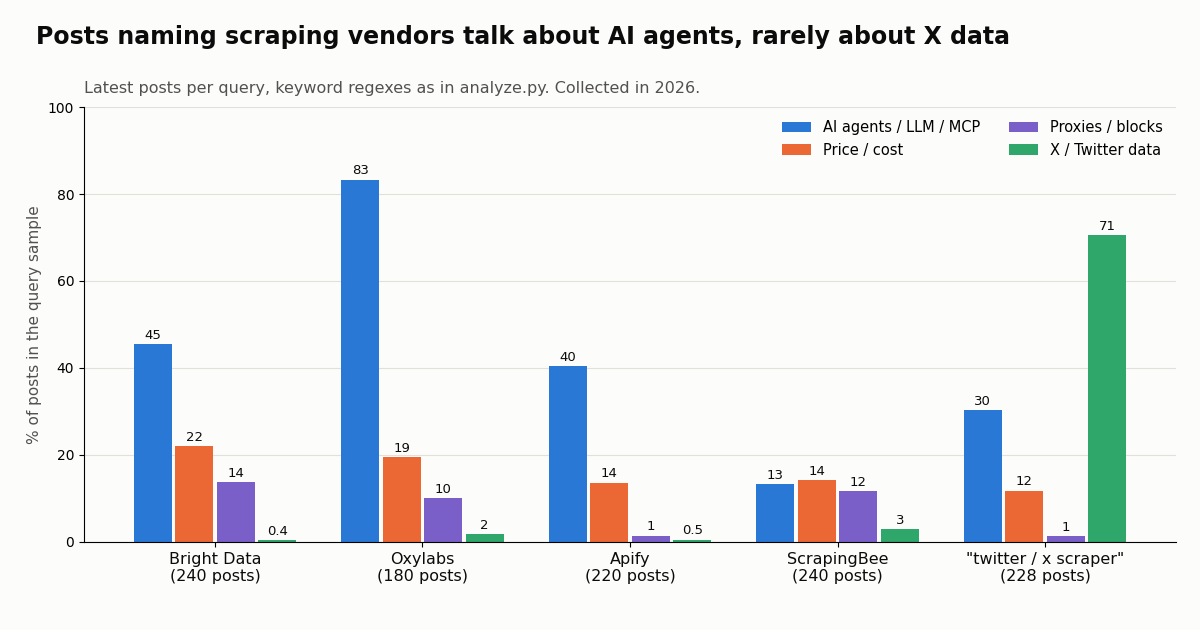
viewCount,likeCount,lang,conversationIdandauthor.followers. - What vendors post about: 83% of Oxylabs posts and 45% of Bright Data posts in our sample talk about AI agents or LLMs; under 3% of either mention X or Twitter data.
- Start free: new TwitterAPI.io accounts that pass the automatic bot check get up to $1 of free credits (at most 100,000 credits, no card, one per person or network, expiring after 31 days).
Most lists of Bright Data alternatives are written for general web scraping: they compare proxy pools, unblocking success rates and how many countries an IP network covers. That is the right lens if you scrape thousands of different websites. It is the wrong lens if the reason you opened Bright Data was its X (Twitter) scraper or its X dataset, because then the question is narrower: which tool gets you tweets, profiles and followers as clean records, at what price per 1,000, with the least pipeline to maintain.
This page answers that narrower question. It lays out Bright Data's own published prices (scraper, dataset, proxies and SERP API, so the pricing searches are covered too), sorts the alternatives into four kinds, puts every vendor's published price per 1,000 tweets side by side, and then shows a small real-data study we ran in 2026: what the public conversation about these vendors on X looks like, and what collecting it through a structured X API actually cost.
Angle versus our sibling pages: this is the decision page for buyers leaving Bright Data for X data. If you are comparing Apify actors, read the Apify alternatives comparison; for Apify's plan and compute-unit math, see the Apify pricing breakdown; for a broad survey of every Twitter scraping method, see the scraper comparison. Links are at the end of the page.
$0.17 vs $1.66
Bright Data pricing: what each product costs
Bright Data sells four things that people evaluate when they search for its pricing: a Web Scraper API with prebuilt collectors (including X), ready-made datasets, a proxy network, and a SERP API. We read each pricing page this session (brightdata.com/pricing/web-scraper, brightdata.com/products/datasets/twitter, brightdata.com/pricing/proxy-network, brightdata.com/pricing/serp). Prices are shown in US dollars.
Web Scraper API. The X page lists two post scrapers (one collects full post data from post URLs, one discovers post URLs) and two profile scrapers (by profile URL or by username, with an optional maximum number of posts per profile); a separate followers scraper is linked. It accepts up to 5,000 target URLs per call and delivers JSON, NDJSON, JSON Lines or CSV. Bright Data says it charges only for successful results. A promotion on the page offered 60% off the Scraper API for three months with a coupon at the time we read it, so check the live page before you budget.
X dataset. The dataset page reads "Up to $0.0025 per record" and "starts at $250 per 100K records", with a $250 minimum order. The page header claims more than 153.4 million records across a posts dataset and a profiles dataset, delivered as JSON, NDJSON, JSON Lines, CSV or Parquet, with one-time, biannual, quarterly or monthly refresh. A dataset is a snapshot: good for research on a fixed population, not for a live feed of new posts.
Proxies. The proxy page shows per-GB plans (the pay-as-you-go row read $4.00/GB, displayed as a 50% discount from $8 with a coupon) and per-IP plans starting at 10 IPs for $14 or $18 a month depending on the proxy type. The page did not label every block with its proxy type and did not list mobile prices, so treat these as the numbers shown that day, not a full price list. Proxies are only the transport: you still write the X scraper, keep it working when x.com changes its markup, and parse every response.
SERP API. $1.5 per 1K successful requests pay as you go, or $499 a month for 380K requests and $1.3 per 1K after that, with a free tier of 5K requests. It returns search engine results pages, not X posts, so it is only relevant here if your workflow searches Google for tweet URLs first.
The four kinds of Bright Data alternative for X data
Generic roundups mix proxy vendors, no-code scrapers and data marketplaces into one list. For X data the useful split is by who does which part of the work: discovering the posts you want, fetching x.com, rendering its JavaScript, parsing the result into records, and absorbing failures.
1. Proxy network. You rent IPs and do everything else. Bright Data sells this, as do several other proxy vendors. It is the most flexible option and the one with the most engineering attached, because your scraper owns discovery, rendering, parsing and every change x.com makes to its pages.
2. Generic scraper API. You send a URL, the vendor fetches it through its own proxies and optionally renders JavaScript, and you get HTML (or a lightly parsed version) back. ScrapingBee and the Oxylabs Web Scraper API work this way. Neither pricing page we read mentions X or Twitter as a supported target, so you would still own discovery and parsing.
3. Prebuilt X scraper or dataset. The vendor maintains an X-specific collector and returns records. Bright Data's X scraper and its X dataset sit here, as do Apify actors such as Tweet Scraper V2. You pay per record, and the input model matters: some collectors start from post or profile URLs you already have, others accept search terms.
4. Structured X API. You call documented endpoints (search, user timeline, followers, tweets by ID, lists) and receive JSON with fixed field names, billed per result. TwitterAPI.io and the official X API work this way. There is no URL collection, no rendering and no HTML parsing on your side, and reads need no X account.
If your project is X only, the structured API column removes the most work. If your project is fifty websites of which X is one, a multi-site vendor can be simpler to procure even if X records cost more there.
Price per 1,000 tweets: every vendor's published card side by side
We read each vendor's pricing page this session and converted the published unit to a price per 1,000 tweets where the vendor sells tweets as records. Generic scraper APIs sell page loads, not tweets, so they get a per-page figure instead. Competitor sites are named with their address in plain text; we do not link them.
How to read the table. TwitterAPI.io at $0.15 per 1,000 tweets against the official X API pay-per-usage rate card at $5.00 per 1,000 is a ratio of about 33x. Against Bright Data's pay-as-you-go X scraper at $1.5 per 1K records it is 10x. Apify's actor adds a minimum of 50 tweets per query, and its free plan runs the actor only in a demo mode (5 runs a month, 10 items each, no API access), per the actor page.
Generic scraper APIs, per page instead of per tweet. ScrapingBee (scrapingbee.com) starts at $19/month for 75,000 credits; a request with JavaScript rendering costs 5 credits, and 25 credits with premium proxies, so the entry plan buys about 3,000 rendered premium-proxy page loads, roughly $0.0063 each. The Oxylabs Web Scraper API (oxylabs.io) lists $0.50 per 1K results at its first volume tier for its /Scrape product, with plans from $15/mo. Neither figure includes the work of finding post URLs, handling failed or partial page loads, or parsing the page into tweets, and how many tweets one page load yields depends on your scraper.
Monthly minimums. TwitterAPI.io is pay as you go: purchased credits never expire, and optional subscriptions start at Starter $29 a month (see the pricing page for plan details). Bright Data's Scale plan is $499/month, ScrapingBee credits expire monthly, and Oxylabs plans are monthly. For a project that pulls 20,000 tweets in a month, the per-tweet price is the whole bill on a pay-as-you-go card: $3.00 at $0.15 per 1,000, $30 at $1.5 per 1K, $100 at $5.00 per 1,000.
Measured: what 1,108 real tweets cost to collect
Published cards are one thing; billed reality includes empty pages, short last pages and minimums. So we ran the study below through TwitterAPI.io and counted. 58 advanced-search requests across five queries returned 1,108 tweets (1,080 unique). At 15 credits per tweet returned, with the 15-credit minimum applied to any page that came back short or empty, the searches used 16,650 credits, which is $0.1665, or $0.15 per 1,000 tweets. Five profile lookups to identify vendor accounts added at most $0.0009.
The comparison is not perfectly like for like, and here is why. Our sample came from keyword searches. Bright Data's X post scraper, as its page describes it, takes post URLs as input, with a separate collector to discover URLs and a profile collector that can return a set number of posts per profile. Getting the same 1,108 posts there could take more than one collector run, so the Bright Data figures above are a floor, not an estimate of the full workflow.
Fields came back filled. Across the 1,080 unique tweets, createdAt, likeCount, viewCount, lang, conversationId, author.followers and author.createdAt were present on 100% of records. 31.3% carried media in extendedEntities.media, and 8.8% embedded a quoted_tweet. The median tweet object was 3,910 bytes of JSON (p90 10,229 bytes), because each record carries the full author object, which matters when you size storage for a large pull.
What the X conversation about these vendors looks like
Before switching vendors, many teams search X for what other users say. We collected the latest posts that name each vendor, plus a query for X scraping in general, and tagged each post with simple keyword patterns (listed in the study's analyze.py): AI agents, LLMs and MCP; price and cost; proxies and blocks; X or Twitter data.
AI agents dominate the vendor talk. 83.3% of the Oxylabs posts, 45.4% of the Bright Data posts and 40.5% of the Apify posts matched the AI agent / LLM / MCP pattern. Price or cost came up in 22.1% of Bright Data posts, and proxies or blocking in 13.8%. Links were common: 55.4% of Bright Data posts and 80.0% of Oxylabs posts carried a URL, consistent with announcements and promoted content rather than user complaints.
X data is almost absent. Only 0.4% of Bright Data posts and 1.7% of Oxylabs posts mentioned X or Twitter. If you are researching an X data vendor on X itself, the vendor-name searches will mostly show you AI marketing; the topic search on X scraping (228 posts over about 315 days, 0.7 a day) is where practitioners actually discuss tools.
Volume differs a lot. Apify is named about 86 times a day (60% of those posts are replies), Bright Data and Oxylabs about 8 to 9, and ScrapingBee 0.3 a day, so its 240 posts stretch back about 763 days. Median views per post were 496 for Bright Data and 31 for Apify.
How to choose: a decision checklist
You need live X data (search, timelines, followers, replies) in your own code. Use a structured X API. It returns JSON with stable field names, paginates with next_cursor, and bills per result. The choice is then between the official X API (X's own product, $0.005 per post read, capped at 3M post reads a month on pay-per-usage) and TwitterAPI.io ($0.15 per 1,000 tweets, no X account needed for reads).
You need a large historical snapshot of X records for research, once. A dataset purchase (Bright Data's X dataset starts at $250 per 100K records) delivers files without running collectors. Check the dataset's fields and refresh date against your question; a snapshot cannot tell you what was posted after it was built. Alternatively, page back through an account's timeline or an advanced-search date range with a structured API and pay only for the data returned.
You scrape many websites and X is one of them. A multi-site vendor (Bright Data, Oxylabs, ScrapingBee) keeps procurement in one place. For the X part, compare the per-record price of its X collector against a structured API and consider splitting: one vendor for the open web, an X API for X.
You already have post URLs and need their current metrics. On TwitterAPI.io, /twitter/tweets takes a comma-separated list of tweet IDs and returns the tweets with fresh likeCount, viewCount, replyCount and author data. On Bright Data, the post scraper takes URLs directly.
You want an AI agent to read X. Plug in an MCP server rather than a scraper. TwitterAPI.io runs a hosted one (configuration below), which lets Claude, Cursor or another MCP host search posts and read profiles as tools.
You need to post, reply or follow, not just read. Scrapers and datasets do not do this. TwitterAPI.io offers write actions through an authenticated session (a login through /twitter/user_login_v2 costs $0.10 and uses a proxy you supply; each post, like, retweet or follow after that is 60 credits, $0.0006). The call acts as that account, so X can rate-limit, lock or suspend it; keep a human pace, expect the session to need a re-login now and then, and note that each HTTP 200 response is billed.
Switching from Bright Data's X scraper to an X API: field mapping
Bright Data's X post scraper lists output such as post ID, poster username, display name, description (the post text), date posted, photos and post URL; the profile scraper lists X user ID, username, profile name, biography, verification status and profile image. Those map onto the TwitterAPI.io tweet and user objects as follows.
Input changes. Instead of a list of URLs, you send a query (/twitter/tweet/advanced_search with X's search operators such as from:, since:, until:, lang: and min_faves:), a username (/twitter/user/last_tweets, 20 tweets per page, newest first) or tweet IDs (/twitter/tweets). Followers come from /twitter/user/followers, about 200 per page, billed at 1 to 3 credits per user returned.
Delivery changes. Bright Data delivers the output of a collection job as files (JSON, NDJSON, JSON Lines or CSV). A REST API answers synchronously, page by page, so you write the loop (shown below) and store the JSON yourself. For profiles, the cost is 18 credits per user, $0.18 per 1,000 profiles.
Throughput. TwitterAPI.io allows 0.2 requests per second before the first payment, 20 once paid, 50 on Scale and 500 on Business, up to 1,000 on request. At 20 requests per second and 20 tweets per page, a paid account can page through up to 400 tweets a second.
import requests

BASE = "https://api.twitterapi.io"
HEADERS = {"X-API-Key": "YOUR_TWITTERAPI_IO_KEY"}

# One profile: 18 credits per user returned
info = requests.get(f"{BASE}/twitter/user/info", headers=HEADERS,
                    params={"userName": "NASA"}, timeout=30).json()
if info.get("status") == "error":
    print(info.get("msg"))            # e.g. "user not found" (HTTP 200, data is null)
else:
    u = info["data"]
    print(u["userName"], u["followers"], u["statusesCount"], u["createdAt"])

# Latest posts of the same account: 15 credits per tweet returned, 20 per page
page = requests.get(f"{BASE}/twitter/user/last_tweets", headers=HEADERS,
                    params={"userName": "NASA"}, timeout=30).json()
for t in page["data"]["tweets"][:3]:
    print(t["createdAt"], t["likeCount"], t["viewCount"], t["text"][:80])
print("more pages:", page.get("has_next_page"), page.get("next_cursor"))
Wiring X data into an AI agent instead of a scraper
Our study shows where the scraping vendors are pointing their marketing: AI agents. If your reason for leaving Bright Data is that you want an agent to read X, the shortest path is an MCP server, not a collector job. TwitterAPI.io's hosted MCP server lives at https://mcp.twitterapi.io/mcp and takes your API key as a bearer token. Add it to any MCP host that supports remote servers with a block like the one below.
Every tool call that returns tweets is billed the same way as the REST API: 15 credits per tweet returned. An agent that runs ten searches a day of 20 tweets each reads 200 tweets, which is $0.03 a day, or about $0.90 over 30 days. The same reads on the official X API pay-per-usage card cost $1.00 a day.
For how MCP servers work and how to build your own, see the MCP server guide linked below; the scraper comparison covers headless-browser and library approaches if you need to evaluate those too.
{
  "mcpServers": {
    "twitterapi": {
      "url": "https://mcp.twitterapi.io/mcp",
      "headers": { "Authorization": "Bearer your_key_here" }
    }
  }
}How we collected this
Question. What does the public conversation on X about Bright Data and three common alternatives (Apify, Oxylabs, ScrapingBee), and about X scraping in general, look like, and what did collecting it through a structured X API cost?
Queries. Five X advanced searches with queryType=Latest: "bright data" OR brightdata, apify, oxylabs, scrapingbee, and "twitter scraper" OR "x scraper" OR "scrape twitter", up to 12 pages (about 240 posts) each, through /twitter/tweet/advanced_search. Five /twitter/user/info lookups checked candidate vendor handles; two did not resolve, so we did not analyze vendor timelines.
Window and sample. The most recent matching posts at collection time, collected in 2026: 1,108 tweets (1,080 unique) from 63 requests. The window differs by query, from about 2.6 days for Apify to about 763 days for ScrapingBee.
What the sample cannot show. Keyword patterns are blunt: "apify" and "bright data" match unrelated uses of the words, the X pattern does not count the phrase "x scraper", and a post can match several topics. Latest search is not a census of every post. Vendor posts include their own marketing. Nothing here measures data quality, success rates or support at any vendor, and rival prices are their published cards on the day we read them, not billed invoices.
Privacy. Aggregates only. Search results were kept out of the repository because most authors are private individuals; the published sample has de-identified rows (query label, language, hour, counts, topic tags) with no IDs, URLs, text or handles. No individual is profiled and no TwitterAPI.io customer is identified. Files: data/studies/bright-data-alternatives/ (protocol, analysis script, results, sample, chart script).
import time
import requests

API_KEY = "YOUR_TWITTERAPI_IO_KEY"  # from https://twitterapi.io/dashboard
BASE = "https://api.twitterapi.io"
HEADERS = {"X-API-Key": API_KEY}


def search_tweets(query, max_pages=5, query_type="Latest"):
    """Collect tweets for an X advanced-search query and track the credits spent."""
    tweets, cursor, credits = [], "", 0
    for _ in range(max_pages):
        params = {"query": query, "queryType": query_type}
        if cursor:
            params["cursor"] = cursor
        r = requests.get(f"{BASE}/twitter/tweet/advanced_search", headers=HEADERS, params=params, timeout=30)
        r.raise_for_status()
        body = r.json()
        page = body.get("tweets") or []
        credits += max(15, 15 * len(page))  # 15 credits per tweet returned, 15 minimum per page
        tweets.extend(page)
        if not body.get("has_next_page"):
            break
        cursor = body.get("next_cursor") or ""
        time.sleep(0.2)
    return tweets, credits


if __name__ == "__main__":
    rows, credits = search_tweets('"web scraping" lang:en -is:retweet', max_pages=3)
    for t in rows[:5]:
        a = t.get("author") or {}
        print(t["createdAt"], a.get("userName"), a.get("followers"),
              t.get("likeCount"), t.get("viewCount"), t["url"])
    print(f"{len(rows)} tweets, {credits} credits = ${credits / 100000:.4f}")
Researching this?Free starter credits cover end-to-end testing — Google sign-in, no card. Get a key.
Questions readers ask
What is the best Bright Data alternative for Twitter data?
It depends on the job. For live X data in your own code (search, timelines, followers), a structured X API is the closest fit because it returns JSON records without URL collection or HTML parsing: TwitterAPI.io lists $0.15 per 1,000 tweets and the official X API $0.005 per post read. For a one-time historical file, a dataset purchase may suit. For many websites at once, a multi-site scraping vendor.
How much does Bright Data's Twitter scraper cost?
Its pricing page lists $1.5 per 1K records pay as you go, or a Scale plan at $499 a month that includes 384,000 records and charges $1.3 per 1K after that, plus a free tier of 5K records a month. The X dataset starts at $250 per 100K records, up to $0.0025 per record. Check the live page for current promotions.
How much is Bright Data proxy pricing?
On the proxy pricing page we read, the per-GB pay-as-you-go row showed $4.00/GB (displayed as a 50% coupon discount from $8), with monthly plans from $499 for 141 GB to $1,999 for 798 GB. Per-IP plans started at 10 IPs for $14 or $18 a month depending on proxy type. Proxies alone do not parse X; you still run the scraper.
What does Bright Data's SERP API cost?
$1.5 per 1K successful requests pay as you go, or $499 a month for 380K requests with $1.3 per 1K beyond that, plus 5K free requests. It returns search engine result pages, not X posts.
Is a Twitter scraper cheaper than the official X API?
Per published card, often yes: the official X API pay-per-usage rate is $0.005 per post read ($5.00 per 1,000), while Bright Data's X scraper lists $1.5 per 1K records, Apify's Tweet Scraper V2 $0.40 per 1,000 tweets and TwitterAPI.io $0.15 per 1,000 tweets. Compare the whole workflow, including URL discovery, failures and minimum plans, not only the unit price.
Do I need an X account to use these alternatives?
Not for reads through TwitterAPI.io: an API key in the X-API-Key header is enough. The official X API requires an X developer account. Write actions on TwitterAPI.io (post, like, follow) run through an authenticated session for an account you control.
Can I try TwitterAPI.io before paying?
Yes. New accounts that pass the automatic bot check get up to $1 of free credits (at most 100,000 credits, no card, one per person or network, expiring after 31 days). Before the first payment the rate limit is 0.2 requests per second; it rises to 20 once paid.
Can I get historical tweets without Bright Data's dataset?
Yes. Advanced search accepts since: and until: operators, and user timelines page back with next_cursor, so you can pull a date range and pay 15 credits per tweet returned instead of buying a fixed snapshot.
Continue
- X API pricing (docs.x.com)
- X API post search introduction (docs.x.com)
- TwitterAPI.io advanced search endpoint reference
- TwitterAPI.io API documentation
- TwitterAPI.io pricing
- Model Context Protocol specification
- X (Twitter) API hub: endpoints, pricing and guides
- Apify Twitter scraper alternatives compared
- Apify pricing: plans, compute units and per-tweet actor costs
- Twitter scraper comparison: libraries, actors and APIs
- Official X API cost breakdown
- What an MCP server is, with the hosted X server as an example
- TwitterAPI.io pricing and plans
- 01Make.com Pricing in 2026: Plans, Credits and What a Twitter (X) Workflow Really Costs
- 02CrewAI vs LangGraph: Which Multi-Agent Framework to Pick, and Where AutoGen Went
- 03Browser Use MCP Server: Setup, CLI and Twitter (X) Reads in 2026
- 04Manus Alternatives in 2026: Hosted, Chat-Plan and Open-Source Agents, and What People on Twitter (X) Switch To
- 05Google ADK vs LangGraph: Which Agent Framework to Use in 2026
- 06Claude Code Alternatives: Seven Coding Agents Checked for License, Free Use and MCP (Twitter/X Data Included)
- 07Replit alternatives in 2026: free tiers, prices, hosting and what X users switch to
- 08Sprout Social Alternatives: What to Use Instead, by Job, With a Twitter (X) Data Study
Writing about something you built with TwitterAPI.io? Our community rewards program pays API credits for honest tutorials, build logs and videos.
Stop reading. Start building.
Starter credits cover real testing on real data. Google sign-in, no card, no application queue.
Get an API keyAlready building with TwitterAPI.io? Publish an honest tutorial or build log about it and earn up to $200 a month in API credits.