Claude Cowork vs Claude Code: Which Anthropic Agent Fits Your Work (and Your Twitter (X) Data)?
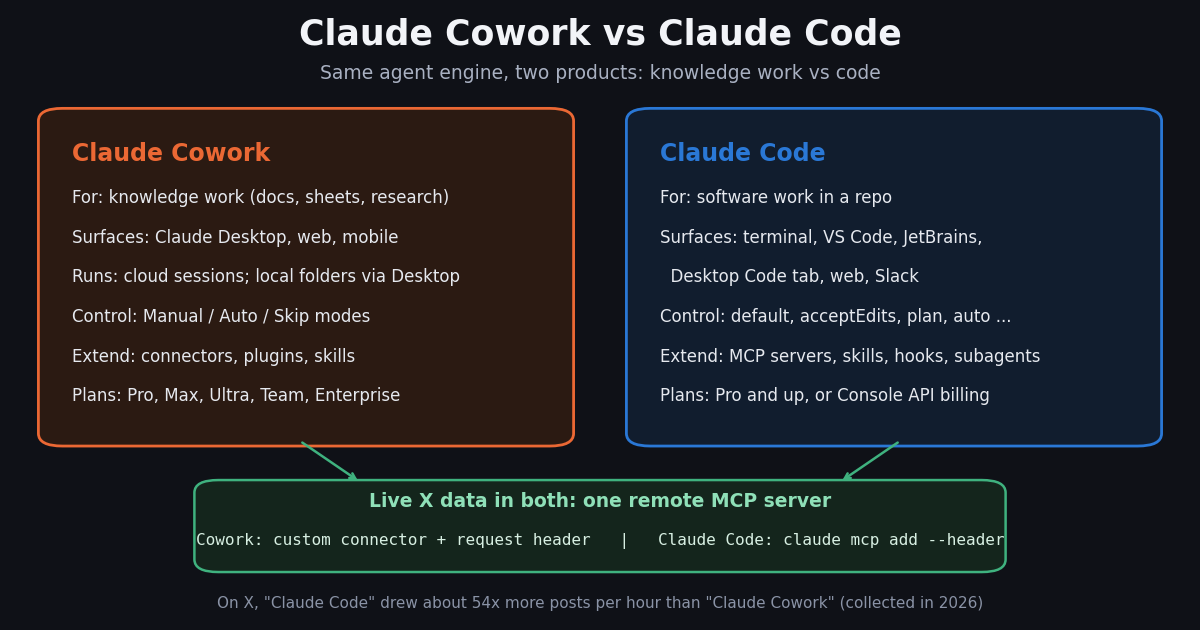
- Different jobs, one engine: Claude Code is for software work in a repo (terminal, IDE, desktop Code tab, web, Slack); Cowork is for non-coding knowledge work (docs, sheets, research) in Claude Desktop, web and mobile.
- Where it runs: Cowork tasks run on Anthropic's servers in an isolated environment and reach local folders only through Claude Desktop; Claude Code in the terminal runs on your machine, with cloud sessions available on the web.
- Control: Cowork has three permission modes (Manual, Auto, Skip); Claude Code has six (
default/Manual,acceptEdits,plan,auto,dontAsk, and a skip-every-check mode started with--dangerously-skip-permissions), cycled with Shift+Tab. - Price: no separate fee for either. Pro is $20 billed monthly ($17/month on annual billing), Max $100/month, Ultra $200 monthly; Team seats include both. Free has neither Cowork nor Claude Code.
- Live X data in both: add
https://mcp.twitterapi.io/mcpas a Cowork custom connector with anAuthorization: Bearerrequest header, or withclaude mcp add --transport httpin Claude Code. Tweets cost $0.15 per 1,000 returned. - What X says: "Claude Code" posts ran at 212.2/hour vs 3.9/hour for "Claude Cowork"; 29.4% of Cowork posts also named Claude Code, while 24.4% used knowledge-work words vs 12.9% of Claude Code posts.
Anthropic now sells two agents that look alike in a demo: both plan, use tools, edit files and run for minutes without supervision. The difference is what they are pointed at. Claude Code was built for developers and lives where code lives. Cowork, which Anthropic launched as a research preview on January 12, 2026 with the line "Cowork brings Claude Code's agentic capabilities to the Claude desktop app for knowledge work," was made for people whose output is a report, a spreadsheet or an inbox, not a pull request.
This page compares the two on the dimensions that decide the choice: who each is for, where each runs, how permissions work, which plans include them, when to pick which, and how each one reads live X (Twitter) data, with a small study of how people on X actually talk about each. It is a different pair from our OpenClaw vs Claude Code comparison, and it links rather than repeats our pages on Claude Code pricing, Claude in Chrome, Claude routines and using Claude with the X API.
Every product fact below was checked this year against Anthropic's own pages (claude.com, support.claude.com and code.claude.com); both products change often, so the sources section lists exactly what we read.
54x
Claude Cowork vs Claude Code at a glance, and who each is for
The short version: the two share an agent engine, so capability is not the dividing line. Audience, surface and the shape of the output are.
Rule of thumb. If the deliverable is a commit, a pull request or a passing test, use Claude Code. If the deliverable is a document, a deck, a spreadsheet, a summary or a filled-in form, use Cowork. Teams that do both usually end up with both, since one paid seat includes each.
Claude Code: developers and anyone who works in a repository. Anthropic's docs describe it as a tool that "helps you build features, fix bugs, and automate development tasks" and "understands your entire codebase." It stages changes, writes commit messages, opens pull requests, and in CI can review code or triage issues through GitHub Actions or GitLab CI/CD. It reads a CLAUDE.md (or an existing AGENTS.md) at the start of every session, so project rules travel with the repo.
Cowork: knowledge workers who never open a terminal. Anthropic's Cowork page calls it the place "where you hand Claude real work" and lists research, analysis, document creation and multi-step tasks. You choose folders and tools, describe the outcome, review the plan Claude shows, and come back to finished files. The target user is an analyst, marketer, operations lead or founder whose work lives in Drive, Microsoft 365, Slack and local folders.
The overlap is real. Cowork can run code inside its isolated environment to produce a chart or clean a CSV, and Claude Code can write a report. The question is not "can it" but "which surface makes the job natural." A data cleanup that ends in a spreadsheet is a Cowork task even though code runs under the hood; a data pipeline that has to live in a repo with tests is a Claude Code task even though its output is a spreadsheet.
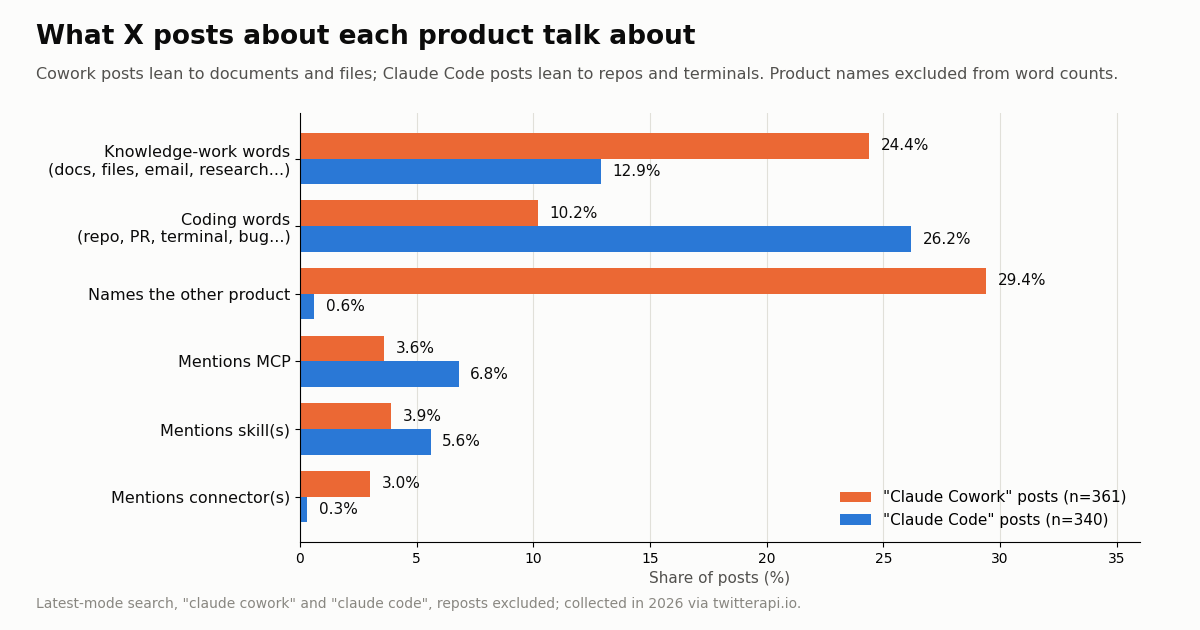
People compare them constantly. In our sample of public X posts that mention "Claude Cowork," 29.4% also name Claude Code; only 0.6% of "Claude Code" posts name Cowork. Cowork is discussed in Claude Code's shadow, which is why this question gets searched.
Surfaces and where the work actually runs
Cowork runs in the cloud and reaches into your computer through the desktop app. Anthropic's support article is explicit: "Cowork runs your tasks in the cloud. Claude's work runs on Anthropic's servers, in an isolated environment." Local file access, browser use and computer use need "the Claude Desktop app for macOS or Windows, open and connected." A separate article adds that on Pro, Max and Ultra new sessions run in the cloud on every surface, that local connectors and plugins with local MCP servers are desktop-only, and that "Desktop is the full Cowork experience."
The Cowork timeline matters for older guides. Per Anthropic's release notes, Cowork started as a macOS research preview for Max on January 12, 2026, reached Pro on January 16, 2026, gained plugins and scheduled tasks in February 2026, became generally available on macOS and Windows on April 9, 2026, arrived on web and mobile on July 7, 2026, and was merged into the main Claude experience on September 16, 2026 ("Claude Cowork and chat are one Claude"). Many comparison posts written early in the year still describe Cowork as a macOS-only, local-VM preview; that is out of date.
Claude Code runs where you start it. The terminal CLI installs with curl -fsSL https://claude.ai/install.sh | bash (macOS, Linux, WSL), irm https://claude.ai/install.ps1 | iex (Windows PowerShell), brew install --cask claude-code or winget install Anthropic.ClaudeCode. In the terminal and IDE it works on your local checkout with your local tools. On the web it runs in Anthropic's cloud against a repository, and sessions move between surfaces: claude --teleport pulls a web task into the terminal, /desktop hands a terminal session to the desktop app, and @Claude in Slack turns a bug report into a pull request.
Practical consequence. Cowork works with your laptop closed for anything that does not need local files, and scheduled Cowork tasks "don't need your computer to be awake or the desktop app open." Claude Code in the terminal stops when the terminal does, unless you use its cloud sessions or cloud scheduled tasks. If your work depends on local build tools, private network access or a specific dev environment, Claude Code on your machine is the natural home.
# Claude Code: install the CLI and start it in a project (from code.claude.com/docs/en/overview)
curl -fsSL https://claude.ai/install.sh | bash   # macOS, Linux, WSL
claude --version
cd your-project
claude

# Non-interactive use in scripts and CI
git diff main --name-only | claude -p "review these changed files for security issues"

# Cowork has no CLI: open Claude Desktop, web or mobile, start a Cowork task,
# pick folders and connectors, review the plan, let it run.Tools, permissions and safety
Cowork permission modes. Cowork offers three: Manual (formerly "Ask before acting"), where "Claude pauses and asks for approval for actions"; Auto, where Claude keeps working and each action is reviewed with unsafe ones blocked; and Skip (formerly "Act without asking"), where "Claude doesn't pause to ask and nothing checks its actions automatically." Regardless of mode, "Cowork requires your explicit permission before permanently deleting any files."
Claude Code permission modes. Claude Code's documentation lists six, set with claude --permission-mode <mode> or cycled with Shift+Tab during a session:
Extending each one. Cowork extends through connectors (Anthropic's directory plus custom remote MCP connectors), plugins that "bundle skills, connectors, and sub-agents into a single package," and skills. Claude Code extends through MCP servers at three scopes (local, project via a shared .mcp.json, user), skills invoked as slash commands, hooks that run shell commands before or after actions, subagents, plugins, and the Agent SDK for building your own agents on the same tools.
Safety surface differs. Cowork's isolation limits where Claude's code runs but, as Anthropic notes, not what Claude can read or do through connected folders and connectors; its safety article warns that "web content is a primary vector for prompt injection attacks" and that local MCP servers run with the same permissions as any other program. Claude Code runs with your shell's permissions, which is why its most permissive mode is documented for isolated containers and VMs only. In both, connect only the folders and servers a task needs, and keep write-capable tools behind approval.
Admin controls. Team and Enterprise owners can turn Cowork on or off for the organization, stream Cowork events to SIEM and observability tools through OpenTelemetry, restrict what connectors may do (for example read but not write), and on Enterprise scan skills and plugins.
Plans and prices: what you pay for each
Neither product has its own price; both come with a Claude plan. The figures below are as shown on claude.com/pricing when we checked, before tax; Anthropic notes they are subject to change.
Usage is the real cost. Anthropic's Cowork page warns that "Claude Cowork consumes limits faster than Chat," and the support article says multi-step tasks "use more of your usage than a quick question." Long Claude Code sessions draw on the same plan limits. Claude Code can also run on an Anthropic Console account billed per token, or through third-party providers on the CLI, VS Code and JetBrains, which Cowork cannot.
For a deeper breakdown of how Claude Code usage maps to plans and API spend, see our Claude Code pricing guide in the related links; this page only compares the two products side by side.
How each reaches live X (Twitter) data
Neither agent reads X on its own in a dependable way: web search sees only what search engines indexed, and X pages need a login for most content. The clean route in both is a remote MCP server that exposes X data as tools. TwitterAPI.io runs one at https://mcp.twitterapi.io/mcp, authenticated with your API key as a Bearer token, with tools such as search_tweets, get_user_info, get_user_last_tweets, get_user_mentions, get_tweet_replies, get_tweet_quotes, get_user_followers and get_trends. Reads need no X account.
In Cowork: a custom connector. Anthropic's connector article says custom remote MCP connectors work "in Claude, Cowork, and Claude Desktop" on every plan, with Free limited to one. Open Customize, then Connectors, then Add, then Add custom connector; enter a name and the URL; choose No sign in under Authentication; and under Request headers add Authorization with the value Bearer <your key>, a fixed credential Claude sends on every request. On Team and Enterprise an Owner adds it under Organization settings, and everyone who uses it shares that key. Local servers in claude_desktop_config.json are not available in Cowork, so the remote URL is the way in.
In Claude Code: one command. The same server is added with claude mcp add, at user scope so every project can use it, and checked with /mcp inside a session. The command is shown below.
What it costs. Tool calls bill like the REST API: tweets $0.15 per 1,000 returned (15 credits each), profiles $0.18 per 1,000, so a Cowork task that reads 400 posts about a launch costs $0.06 in X data. The official X API's pay-per-usage rate card lists $0.005 per post read, which is $5 per 1,000, about 33 times more. New accounts that pass the automatic bot check get up to $1 of free credits (at most 100,000 credits, no card, one per person or network, expiring after 31 days); purchased credits never expire. Paid accounts start at 20 requests per second; plans are on the pricing page.
Writing to X is possible but deliberate. Posting, liking, following or DMs run through an authenticated session (/twitter/user_login_v2, $0.10 per login with a proxy you supply, then 60 credits = $0.0006 per action such as /twitter/create_tweet_v2). Each call acts as that account, X can rate-limit, lock or suspend it, a human pace matters, sessions can need a re-login, and every HTTP 200 call is billed. In either agent, keep write tools behind Manual approval.
# Claude Code: add the TwitterAPI.io MCP server for all your projects
claude mcp add --transport http --scope user twitterapi-io https://mcp.twitterapi.io/mcp \
  --header "Authorization: Bearer your_key_here"

# then, inside a session
/mcp

# Cowork: Customize > Connectors > Add > Add custom connector
#   Name:    twitterapi-io
#   URL:     https://mcp.twitterapi.io/mcp
#   Authentication: No sign in
# Request header: Authorization = Bearer your_key_hereWhat people on X say about each (our study)
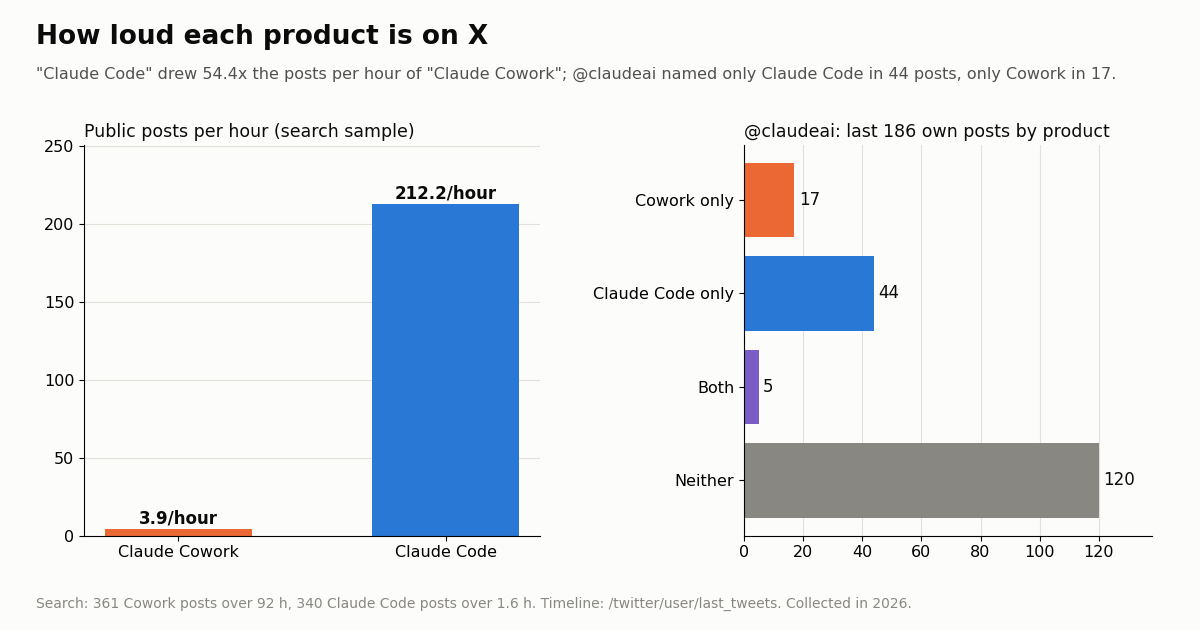
We pulled the latest public posts matching "claude cowork" and "claude code" (reposts excluded) and the last 200 posts of @claudeai and @AnthropicAI. The volume gap is large: 361 Cowork posts covered 92 hours (3.9 per hour), while 340 Claude Code posts covered just 1.6 hours (212.2 per hour), about 54 times the rate.
The audiences split the way Anthropic says they should. With the product names removed, 24.4% of Cowork posts use knowledge-work words against 10.2% coding words; Claude Code posts invert that, 26.2% coding against 12.9% knowledge-work. The extension vocabulary also differs: Cowork posts say "connector" (3.0%) where Claude Code posts say "MCP" (6.8%), the same protocol under two names.
Smaller but more attentive. The median Cowork post drew 95 views against 20.5 for Claude Code, likely because the Claude Code stream is dominated by a long tail of individual developers posting their sessions. Language mix differs too: Cowork posts were en 55.1%, zh 14.4%, ja 13.9%; Claude Code posts were en 57.9%, ja 24.4%, zh 3.2%.
What Anthropic's own accounts post
Of @claudeai's last 186 own posts (reposts excluded), 44 named only Claude Code, 17 named only Cowork, 5 named both and 120 named neither (models, apps and other features). On @AnthropicAI, the company account, 6 of 178 named only Claude Code, 1 named both, and none named only Cowork: product launches live on @claudeai.
Fewer Cowork posts, more reach per post. Anthropic posted about Claude Code about 2.6 times as often as about Cowork, but the median Cowork post drew 2,797,293 views against 1,427,640 for Claude Code, and the handful of posts that announce something for both products reached a median of 13,724,762. Cowork is a mainstream launch story; Claude Code is a steady stream of developer features.
Which one should you pick?
Pick Claude Code if your work lives in a git repository; you want the agent to run your tests, linters and build; you need it in CI, in a script (claude -p) or in Slack-to-PR flows; you want hooks that enforce formatting or checks; or you need to run it on API billing or a third-party provider rather than a Claude plan.
Pick Cowork if your work ends in a document, spreadsheet, deck or message; your inputs are Drive, Microsoft 365, Slack, email or local folders; you want to hand off a task from your phone and come back to finished files; or your team is not technical and should not see a terminal.
Use both if you are a developer who also writes reports, or a team where engineering and operations share a seat type. A common split: Claude Code builds and maintains a small X-data script or MCP-backed workflow in a repo, and Cowork uses the same MCP server through a connector to produce the weekly brief for people who never open that repo.
An X-data example in each. In Claude Code: "write a script that pulls every post mentioning our product this week with /twitter/tweet/advanced_search, saves a CSV and opens a PR with the analysis notebook." In Cowork: "using the X connector, read this week's posts about our product, group them by complaint, and draft a one-page summary in the Reports folder." Same data source, same per-tweet bill, different deliverable.
How we collected this
Question. How does X talk about Claude Cowork compared with Claude Code, and how much do Anthropic's own accounts post about each?
Accounts and queries. /twitter/user/last_tweets for the organization accounts @claudeai and @AnthropicAI (200 posts each, newest first). /twitter/tweet/advanced_search with queryType Latest for "claude cowork" -filter:retweets (361 posts) and "claude code" -filter:retweets (340 posts). 78 requests in total, collected in 2026.
Method. Keyword classes are simple regular expressions over post text with the product names removed first, so the word "code" inside "Claude Code" never counts as a coding word. Posts per hour is sample size divided by the span between the oldest and newest post. Medians are reported because engagement is heavy-tailed.
What the sample cannot show. It is a snapshot of the most recent posts at one moment, not a long-run average; Latest-mode search returns what X indexes, not every post; keyword classes are blunt (a post can match both or neither); and post volume measures conversation, not usage or revenue.
Privacy. Aggregates only. The two Anthropic accounts are organizations and are named; authors in the search samples are private individuals and are never named, quoted or profiled. Raw search pages were kept out of the repository; the published sample holds de-identified rows (no IDs, URLs, text or handles).
"""Compare how X talks about two products, the same way this page's study did.
Run it yourself, or ask Claude Code to extend it; in Cowork use the MCP connector instead.
"""
import os
import re
import requests

BASE = "https://api.twitterapi.io"
HEADERS = {"X-API-Key": os.environ["TWITTERAPI_IO_KEY"]}
CODING = re.compile(r"\b(repo|pr|pull request|terminal|cli|bug|deploy|commit|github)\b", re.I)
KNOW = re.compile(r"\b(docs?|spreadsheets?|excel|slides|files?|email|research|reports?)\b", re.I)
NAMES = re.compile(r"claude[\s_-]*code|co-?work", re.I)


def search(query, max_pages=5):
    """Latest posts for a query; billed per tweet returned ($0.15 per 1,000)."""
    tweets, cursor = [], ""
    for _ in range(max_pages):
        r = requests.get(
            f"{BASE}/twitter/tweet/advanced_search",
            headers=HEADERS,
            params={"query": query, "queryType": "Latest", "cursor": cursor},
            timeout=30,
        )
        r.raise_for_status()
        body = r.json()
        tweets += body.get("tweets", [])
        if not body.get("has_next_page"):
            break
        cursor = body.get("next_cursor", "")
    return tweets


def profile(name, tweets):
    n = len(tweets) or 1
    text = [NAMES.sub(" ", t.get("text") or "") for t in tweets]
    coding = sum(1 for s in text if CODING.search(s))
    know = sum(1 for s in text if KNOW.search(s))
    views = sorted(t.get("viewCount") or 0 for t in tweets)
    print(f"{name:16} posts={len(tweets):4}  coding={100*coding/n:5.1f}%  "
          f"knowledge={100*know/n:5.1f}%  median_views={views[len(views)//2] if views else 0}")


if __name__ == "__main__":
    for label, q in [("Claude Cowork", '"claude cowork" -filter:retweets'),
                     ("Claude Code", '"claude code" -filter:retweets')]:
        profile(label, search(q))
Researching this?Free starter credits cover end-to-end testing — Google sign-in, no card. Get a key.
Questions readers ask
Is Claude Cowork the same as Claude Code?
No. They share an agent engine (Anthropic introduced Cowork as bringing "Claude Code's agentic capabilities to the Claude desktop app for knowledge work"), but Claude Code is a coding tool for terminals, IDEs and repositories, while Cowork is for non-coding knowledge work in Claude Desktop, web and mobile, with tasks running in an isolated cloud environment.
Does Claude Cowork cost extra?
No separate fee. Cowork is included in Pro, Max, Ultra, Team and Enterprise plans; it is not on Free. Pro is $20 billed monthly ($17/month billed annually), Max $100/month, Ultra $200 monthly, per claude.com/pricing. Cowork tasks use plan limits faster than chat.
Can I use Claude Code on the free plan?
Not with a Claude Free account: Anthropic's pricing page lists Claude Code from Pro upward, and the docs say most surfaces need a Claude subscription or an Anthropic Console account. With a Console account you pay API rates per token instead of a plan.
Can Cowork write code?
It can run code inside its isolated environment to produce files, charts or cleaned data, but it is built for deliverables like documents and spreadsheets. For work that has to live in a repository with tests, commits and pull requests, Claude Code is the tool Anthropic designed for it.
Does Cowork run on my computer or in the cloud?
In the cloud. Anthropic's support article says Cowork's work runs on Anthropic's servers in an isolated environment. It reaches your local folders, browser and computer only through the Claude Desktop app while it is open and connected, and only for folders you connected.
Can Cowork and Claude Code use MCP servers?
Yes. Claude Code adds them with claude mcp add at local, project or user scope. Cowork uses remote MCP servers as custom connectors (Customize, Connectors, Add custom connector), including fixed request headers such as an API key; local servers from claude_desktop_config.json are not available in Cowork.
How do I get Twitter (X) data into Cowork or Claude Code?
Add the TwitterAPI.io MCP server at https://mcp.twitterapi.io/mcp with the header Authorization: Bearer <your key>: as a custom connector in Cowork, or with claude mcp add --transport http in Claude Code. Tweets cost $0.15 per 1,000 returned, versus $0.005 per post read on the official X API's pay-per-usage rate card.
Which is better for a non-developer?
Cowork. It needs no terminal, shows its plan before acting, asks before deleting files, and works from desktop, web and phone. Claude Code assumes comfort with a repository and a command line, even in its desktop and web surfaces.
Continue
- Anthropic: Claude Cowork product page (who it is for, plans, connectors, plugins, permissions)
- Claude Help Center: Get started with Claude Cowork (paid plans, cloud execution, permission modes)
- Claude Help Center: custom connectors using remote MCP (Cowork support, request headers)
- Claude Code docs: overview (surfaces, install, MCP, skills, hooks, scheduling)
- Claude Code docs: permission modes
- Anthropic: Claude plans and pricing
- X (Twitter) API hub: endpoints, pricing and guides
- OpenClaw vs Claude Code for X jobs
- Claude Code pricing: plans, limits and API costs
- Claude in Chrome: the browser extension explained
- Claude routines: scheduled cloud tasks for Claude Code
- How to use Claude with the Twitter (X) API
- TwitterAPI.io MCP server: tools and setup
- TwitterAPI.io pay-per-use pricing
- 01Free LLM API options in 2026: what is still free, the real limits, and how to feed it Twitter (X) data
- 02RAG vs MCP: Retrieval vs Live Tools, Measured on Twitter (X) Data
- 03Clay Pricing in 2026: Plans, Data Credits, Actions and the Cost of a Twitter (X) Column
- 04MCP Inspector: How to Test and Debug an MCP Server, Tested on a Live X Data Server
- 05What Is an API Key? Meaning, a Real Request, and How to Keep One Safe
- 06Codex vs Claude Code: Plans, Usage Limits, MCP Setup and Headless Runs for Twitter (X) Data Agents
- 07Cursor vs Claude Code: Plans, MCP Setup and Headless Runs Compared for Twitter (X) Data Work
- 08Claude Code Skills Marketplace: Where Skills Live, How to Install, Publish and Vet Them
Writing about something you built with TwitterAPI.io? Our community rewards program pays API credits for honest tutorials, build logs and videos.
Stop reading. Start building.
Starter credits cover real testing on real data. Google sign-in, no card, no application queue.
Get an API keyAlready building with TwitterAPI.io? Publish an honest tutorial or build log about it and earn up to $200 a month in API credits.