Does Twitter (X) Delete Inactive Accounts? The Policy, the Purge, and What Actually Survives
This page is about X's policy on accounts nobody uses: whether X deletes them, when, and what that means for the username. If you want the step-by-step for shutting down your own account, that procedure lives in our guide to deactivating a Twitter (X) account; this page owns the policy question and what a dormant account looks like from the outside.
The short version is that X keeps the right to remove inactive accounts and has said more than once that it will, but it publishes no timetable, and very old, silent accounts are still everywhere on the platform. We checked that directly: 1,000 random account IDs from the platform's first five years, looked up through an API in 2026, plus the original posts behind the 2022 and 2023 purge announcements.
Below: the policy text, what the purge announcements actually said, the four account states people mix up (inactive, deactivated, suspended, deleted), how each one looks to a visitor and to an API, what happens to the handle, and how to keep an old account from being swept up.
What X's inactive account policy says, word for word
X's Help Center page titled "Inactive account policy" (help.x.com/en/rules-and-policies/inactive-x-accounts) is short. We read it from an archived 2026 copy because the live Help Center blocks automated fetches; the text is the same page search engines show. It makes five points.
Log in at least every 30 days. "We encourage people to actively log in and use X when they register an account. To keep your account active, be sure to log in at least every 30 days."
Removal is possible, not scheduled. "Accounts may be permanently removed due to prolonged inactivity." The policy never defines "prolonged" and never gives a date. Thirty days is the bar for staying safely active, not the point at which deletion starts.
Inactivity means logging in. "Inactivity is based on logging in. Please note that you may not be able to tell whether an account is currently inactive, as not all signs of account activity are publicly visible." An account with no posts for ten years can be fully active by this definition if its owner opens the app.
Trademarks are a separate route. If a seemingly inactive account uses your registered trademark as its username, the policy points you to X's trademark policy rather than the inactive process.
Inactive usernames are not released on request. "We cannot release inactive usernames at this time." X's suggestion is to pick a variation with numbers, underscores or abbreviations. Its username help page repeats this: "Unfortunately, we cannot release inactive usernames at this time."
So the honest answer to "does Twitter delete inactive accounts" is: the policy allows it, the trigger is a lack of logins rather than a lack of posts, and there is no published threshold you can plan around.
The purge announcements: what was actually said
The idea that X mass-deletes dormant accounts comes from three public moments. We pulled the original posts through the API rather than relying on news summaries.
What was never published: a definition of "several years," a start or end date, the number of accounts removed, or how an archived account could be restored. Neither post links to a policy change, and the Help Center policy above still carries the same open-ended wording.
The 2019 attempt. Before the ownership change, Twitter announced a cleanup of long-inactive accounts in November 2019 and then paused it after users pointed out that it would erase the accounts of people who had died; news coverage at the time quoted its support account promising not to remove inactive accounts until it created a way to memorialize them. We could not retrieve those original support posts this session, so treat the details as reported rather than verified.
What the follower-count warning means. If X does remove dormant accounts, every account that followed them loses those followers. A sudden small drop in your follower count around such an announcement is the expected side effect, not a sign that your own account is in trouble.
We checked 1,000 accounts from 2006 to 2010: most silent ones are still there
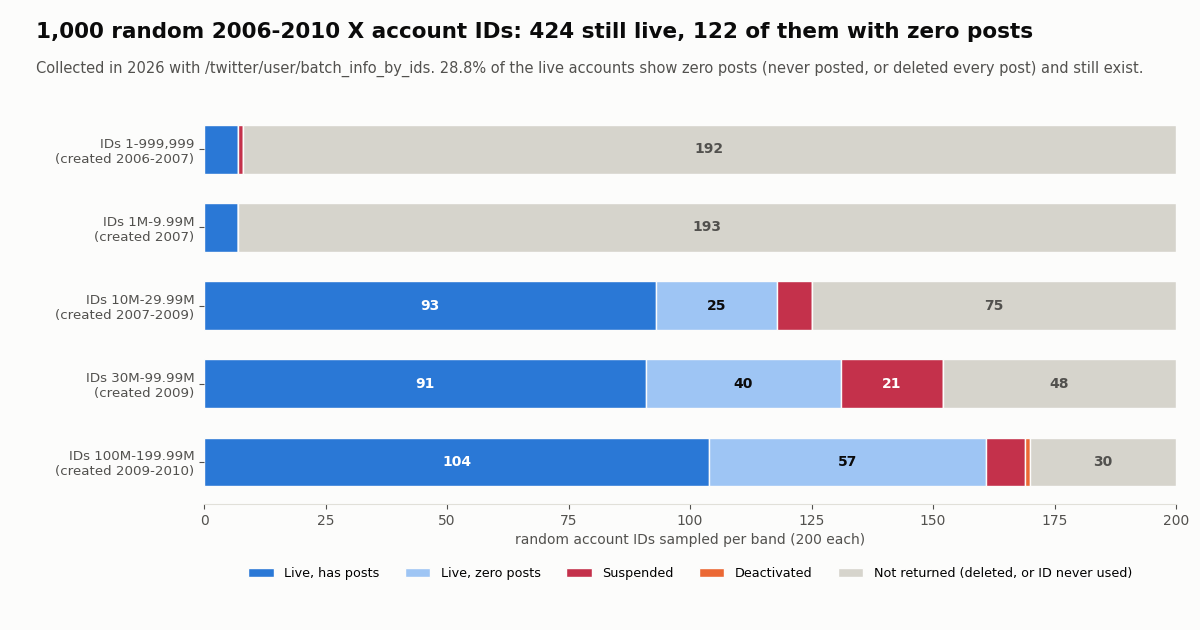
If X routinely deleted accounts that had "no activity at all for several years," the platform's oldest, emptiest accounts would be the first to go. So we sampled them. In the early years account IDs were handed out in rough numeric order (every live account we found in these ranges was created between 2006 and 2010), so a random ID in a low range is a random account from that era. We drew 200 random IDs from each of five ranges and looked them all up in one pass.
The headline. 424 of 1,000 early IDs still resolve to a live profile, and 122 of those show zero posts. In the 2009 range the typical live account has 3 followers and 1 post; in the 2009 to 2010 range it is 3 followers and 2 posts. These are exactly the accounts a "no activity for several years" purge would target, and they are still there.
What it does not prove. Zero posts is not zero logins. Some of these owners may open the app every month and simply never post, which makes them active under X's own definition. The data shows that silence alone does not get an account deleted; it cannot show whether login-dormant accounts were removed, because logins are not public.
The two lowest ranges are mostly empty for a different reason. 192 and 193 of the 200 IDs below 10 million returned nothing. That range covers the platform's first year and a half, and many numbers in it may never have been assigned to an account at all. A missing ID can mean deleted, never created, or removed for another reason; the lookup does not say which, so we do not count those as deletions.
How long do silent old accounts go without posting?
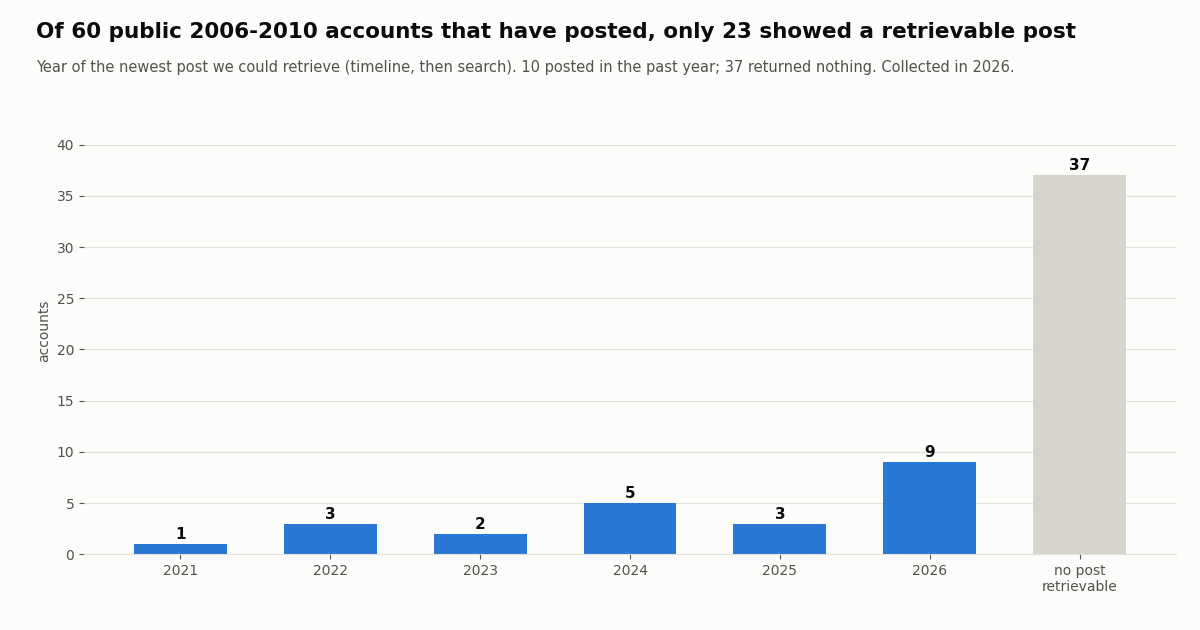
For a second look, we took up to 16 public, live accounts per range that had at least one post (60 in total) and fetched the newest post we could find, first from the account timeline and then, when that came back empty, from a search for posts by that account.
Only 23 of 60 had a retrievable post. The other 37 report a positive post count on their profile, yet neither the timeline nor search returned anything. The likely explanations are posts deleted after the counter was set, or very old posts that are no longer served; we cannot tell which from outside, so we report them as "no post retrievable."
The ones that did show a post are mostly recent. 10 of the 23 posted within the past year, the median gap since the newest visible post is 1.8 years, and the oldest newest-post in the group is from 2021. In other words, an early account that is still live and still has visible posts is usually one that someone is still using.
Put the two checks together and the picture is consistent with the policy wording: X has not swept away old accounts just for being quiet, and a long-silent profile you come across today is more likely to be dormant-but-kept than about to vanish.
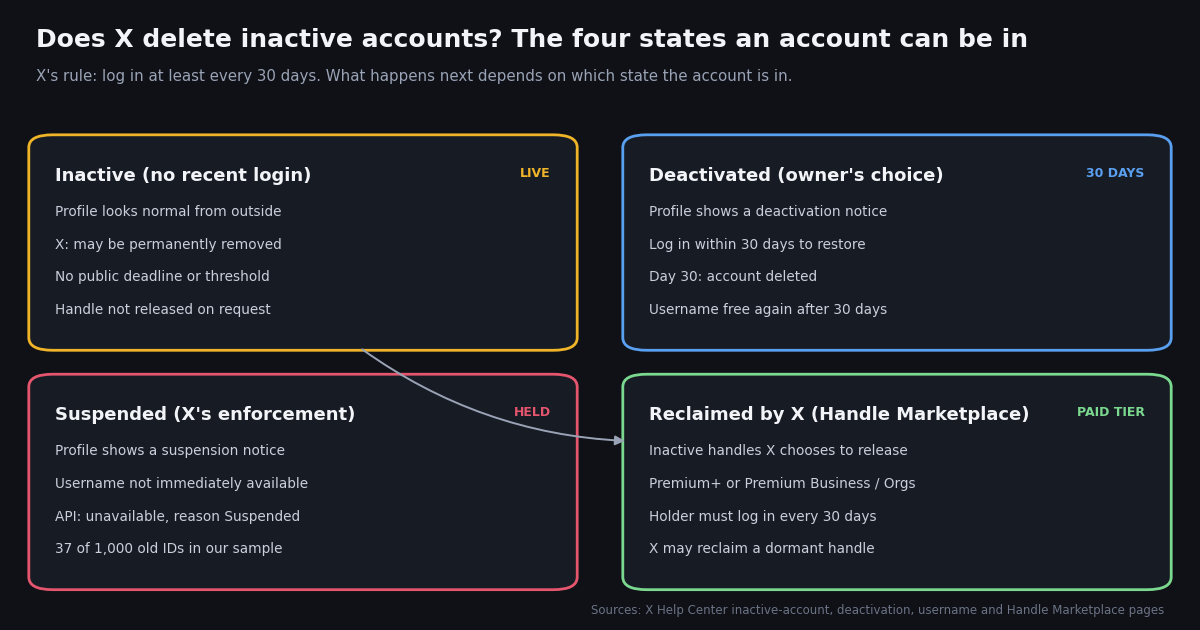
Inactive, deactivated, suspended, deleted: what you see and what the API returns
Most confusion about "deleted" accounts comes from four different states that look alike from the outside. This table is built from the X Help Center pages cited below and from what a profile lookup returned for the accounts in our sample.
What our sample returned. Among the 1,000 early IDs, 37 came back as suspended and exactly 1 as deactivated, with reason NoReason and message "User is deactivated." The 538 IDs with no record at all are the mix of deleted accounts and numbers that were never used.
Deactivated versus deleted. X's deactivation page says deactivating "is the first step to deleting your account permanently. Deactivation lasts 30 days. If you do not access your account within the 30-day deactivation period, your account is deleted and your username will no longer be associated with your account." Its reactivation page adds that the username and email "are available for use on another account 30 days after the account was deactivated." So deactivating is not the same as deleting on day one, but it becomes deleting on day 30 if you do nothing.
Inactive versus deactivated. An inactive account has not been switched off by anyone. It stays visible, keeps its handle, keeps its followers, and can be logged into at any time. Only X can remove it, under the open-ended policy above.
Checking one profile by hand. Our free Twitter account age checker shows when a handle was created; for the full set of on-screen notices and how to find what an account used to post, see our guide to finding deleted Twitter accounts and, for suspended profiles, the guide to viewing suspended accounts.
What happens to the username of an inactive account
A short, memorable handle sitting on an account that has not posted since 2009 is the main reason people search this question. The rules are stricter than most people expect.
You cannot ask X to free it. Both the inactive account policy and the username help page say X cannot release inactive usernames at this time. Support tickets asking for a dormant handle get that answer.
Some inactive handles are redistributed, for subscribers only. X's Help Center describes the X Handle Marketplace (handles.x.com) as a way to "revitalize select handles which are no longer active on the platform." It needs a Premium+ subscription for personal accounts, or Premium Business Full Access or Premium Organizations for organizations; the requesting account must be older than 3 months and show signs of authentic, ongoing content creation. X chooses which handles appear there.
Marketplace handles come with their own activity rule. Holders must create content regularly and log in from a device at least once in any 30-day period, and X "may reclaim the handle" if it goes largely dormant. X also says it owns all handles and grants a "limited, revocable, and non-transferable license."
Deleted accounts are the only automatic release. When an owner deactivates and does not return within 30 days, the username becomes available to anyone. That is the only route by which a handle goes back into the open pool without X's involvement.
X treats handles as its property. The Handle Marketplace page says X owns all handles and may reclaim them, so any arrangement made outside X carries no guarantee. Our X Handle Marketplace guide covers eligibility, prices and request steps in detail.
What about the accounts of people who have died?
This is the question that stopped the 2019 cleanup, and it is still open. X's current Help Center page on a deceased family member's account (help.x.com/en/rules-and-policies/contact-x-about-a-deceased-family-members-account) describes one option: a person authorized to act for the estate, or a verified immediate family member, can request that the account be deactivated. X asks for the requester's ID and a copy of the death certificate, and states that it is "unable to provide account access to anyone regardless of their relationship to the deceased."
The page we read describes no memorialized state. In practice that means the account of someone who has died stays as it is, under the same inactive account policy as everyone else, unless a family member asks X to deactivate it. If keeping the profile visible matters to you, the only sure step is a download of what it contains (screenshots, or an archive request while you still have access), because the policy reserves X's right to remove inactive accounts.
The same process applies to an incapacitated user, with a power of attorney in place of the death certificate.
How to keep an old account from being removed
Because X measures inactivity by logins, keeping an account is simple and does not require posting anything.
Log in at least once every 30 days. That is X's own stated bar. Sign in on the app or at x.com at least once a month; X does not say whether a session that stays signed in for months counts, so an occasional fresh sign-in is the safe habit. A calendar reminder is enough.
Keep the login details current. The most common way an old account is lost is not a purge but a dead email address or phone number. X's reactivation page notes that if you cannot reset your password because you no longer have access to the email or phone on the account, the remedy it offers is to create a new account.
Do not deactivate as a pause unless you will return within 30 days. Deactivation is not a sleep mode. On day 30 the account is deleted and its handle released.
Download your archive if the content matters. The archive is a copy you control, whatever X decides about the account later.
If you run a brand or project account, add a second person who logs in, so the account does not depend on one person's habits.
For developers: auditing a follower list for dormant and removed accounts
If you manage an account and want to know how many of its followers are empty, suspended or gone, you can measure it from the outside with a few calls. This is the same method we used for the study above.
Step 1: list followers. /twitter/user/followers returns about 200 followers per page with statuses_count, followers_count, created_at and protected, plus has_next_page and next_cursor for paging. Zero statuses_count is the closest public signal to "never active" (logins are not public).
Step 2: re-check IDs later. /twitter/user/batch_info_by_ids takes up to 100 numeric IDs per call. Live accounts come back with full profiles; suspended or deactivated ones come back with unavailable, unavailableReason and message; deleted IDs are simply missing from the response. Comparing two runs months apart shows which followers X suspended, which owners deactivated, and which accounts disappeared.
Cost on the two rate cards. On TwitterAPI.io, profile lookups are 18 credits per user ($0.18 per 1,000 profiles) and follower pages are 1 to 3 credits per user returned; reads need no X account. The whole study on this page (1,000 IDs looked up plus timelines and searches, 123 requests) cost about $0.15. On the official X API's pay-per-usage rate card (docs.x.com/x-api/getting-started/pricing), a user read is $0.010 and a follower read is $0.010, which is $10 per 1,000 profiles. New TwitterAPI.io accounts that pass the automatic bot check get up to $1 of free credits (at most 100,000 credits, no card, one per person or network, expiring after 31 days).
Without code. Our Twitter follow checker answers whether one account follows another, and the account age checker shows creation dates for a handle.
import requests

API_KEY = "YOUR_TWITTERAPI_IO_KEY"
BASE = "https://api.twitterapi.io"
HEADERS = {"X-API-Key": API_KEY}

def batch_status(user_ids):
    """Classify up to 100 numeric user IDs: live, suspended, deactivated or not returned."""
    r = requests.get(f"{BASE}/twitter/user/batch_info_by_ids",
                     headers=HEADERS, params={"userIds": ",".join(user_ids)}, timeout=30)
    r.raise_for_status()
    users = r.json().get("users") or []
    seen = {}
    for u in users:
        if u.get("unavailable"):
            seen[u.get("id")] = f"unavailable: {u.get('unavailableReason')} ({u.get('message')})"
        else:
            seen[u["id"]] = f"live, {u.get('statusesCount', 0)} posts"
    return {uid: seen.get(uid, "not returned (deleted or never existed)") for uid in user_ids}

print(batch_status(["12", "13", "20"]))import time
import requests
API_KEY = "YOUR_TWITTERAPI_IO_KEY" # from https://twitterapi.io/dashboard
BASE = "https://api.twitterapi.io"
HEADERS = {"X-API-Key": API_KEY}
def followers(user_name, max_pages=5):
"""Page through an account's followers (newest first, about 200 per page)."""
cursor = ""
for _ in range(max_pages):
r = requests.get(f"{BASE}/twitter/user/followers", headers=HEADERS,
params={"userName": user_name, "cursor": cursor}, timeout=30)
r.raise_for_status()
body = r.json()
for f in body.get("followers") or []:
yield f
if not body.get("has_next_page"):
break
cursor = body.get("next_cursor") or ""
time.sleep(0.5)
def batch_status(user_ids):
"""Return {id: state} for up to 100 IDs: live, suspended, deactivated, or not returned."""
r = requests.get(f"{BASE}/twitter/user/batch_info_by_ids", headers=HEADERS,
params={"userIds": ",".join(user_ids)}, timeout=30)
r.raise_for_status()
seen = {}
for u in r.json().get("users") or []:
if u.get("unavailable"):
seen[u.get("id")] = (u.get("unavailableReason") or "unavailable").lower()
else:
seen[u["id"]] = "live"
return {uid: seen.get(uid, "not returned") for uid in user_ids}
if __name__ == "__main__":
me = "YourHandle" # audit your own follower list
rows = list(followers(me))
zero = [f for f in rows if (f.get("statuses_count") or 0) == 0]
print(f"{len(rows)} followers checked, {len(zero)} have zero posts")
# Months later: re-check the same IDs to see who was suspended, deactivated or removed
ids = [str(f["id"]) for f in rows][:100]
states = batch_status(ids)
summary = {}
for s in states.values():
summary[s] = summary.get(s, 0) + 1
print(summary)Questions readers ask
Does Twitter (X) delete inactive accounts?
It can. X's inactive account policy says accounts "may be permanently removed due to prolonged inactivity" and asks users to log in at least every 30 days. It publishes no deadline or threshold, and in our 2026 check of 1,000 random 2006-2010 account IDs, 424 were still live, many with zero posts, so removal is clearly not automatic.
How long before X deletes an inactive account?
X does not say. The only number in the policy is the advice to log in at least every 30 days. Thirty days is the bar for staying safely active, not a countdown to deletion. The only fixed deletion timer on X is for deactivated accounts: 30 days after deactivation, the account is deleted.
Does X count an account as inactive if I never post?
No. The policy says "inactivity is based on logging in." An account that never posts but whose owner logs in is active. Outsiders cannot see logins, which is why X notes you may not be able to tell whether another account is inactive.
Is deactivating Twitter the same as deleting?
Not on day one. Deactivation hides the account for 30 days and logging in during that window restores it. If you do not log in within 30 days, X deletes the account and the username becomes available to others. So deactivation turns into deletion if you do nothing.
What does a deactivated Twitter account look like?
Visitors see a message indicating the account is deactivated instead of the profile. A profile lookup through an API returns an unavailable record; in our sample it carried the message "User is deactivated." After 30 days the account is deleted and there is no longer a profile to look up.
Can I get the username of an inactive account?
Not by asking. X says it cannot release inactive usernames at this time. Some inactive handles are offered through X's Handle Marketplace to Premium+ and eligible business subscribers, at X's discretion. Otherwise, pick a variation with numbers, underscores or abbreviations.
Why did my follower count suddenly drop?
When X removes or suspends accounts, they stop counting as your followers. Elon Musk's May 8, 2023 post about purging accounts with no activity for several years warned that people would "probably see follower count drop." Followers who deactivate also drop out of your count.
What happens to the account of someone who died?
X's Help Center lets an estate representative or verified immediate family member request deactivation, with ID and a death certificate. X does not give account access to anyone, and the page describes no memorialized state, so the account otherwise stays under the normal inactive policy.
Continue
- X Help Center: Inactive account policy (log in every 30 days; may be permanently removed; inactivity based on logging in; inactive usernames not released)
- X Help Center: How to deactivate your account (deactivation lasts 30 days, then the account is deleted)
- X Help Center: How to reactivate your account (username and email reusable 30 days after deactivation)
- X Help Center: X Handle Marketplace (eligibility, 30-day login rule for holders, reclaiming dormant handles)
- Elon Musk on X, May 8, 2023: purging accounts with no activity for several years
- TwitterAPI.io docs: user info (unavailable, unavailableReason and message fields)
- Twitter (X) API overview: what the data endpoints cover
- How to deactivate a Twitter (X) account, step by step
- X Handle Marketplace: eligibility, prices and requests
- What a Twitter handle is and how usernames work
- How to find a deleted Twitter (X) account
- What a suspended Twitter (X) account shows and how to view it
- Free Twitter account age checker
- Free Twitter follow checker
- TwitterAPI.io pay-per-call pricing
- 01Twitter (X) Clients in 2026: Which Ones Still Work, by Platform
- 02How to Mass Block on Twitter (X): Tools, Block Lists and Safer Options
- 03How to View a Suspended Twitter (X) Account, and What Still Survives
- 04Twitter (X) Temporary Label: What "May Impact Its Reach" Means and What to Do
- 05"Please Use the Official X App" When Signing In to Twitter (X): Why It Happens and How to Get Back In
- 06How to Find Deleted Twitter (X) Accounts: What Still Exists and Where to Look
- 07Mass Delete Tweets — Bulk API Workflow + Free Tool Options
- 08The Best Twitter (X) Accounts to Follow, by Topic
Stop reading. Start building.
Starter credits cover real testing on real data. Google sign-in, no card, no application queue.
Get an API keyAlready building with TwitterAPI.io? Publish an honest tutorial or build log about it and earn up to $200 a month in API credits.