What Is Qoder? Plans, Credits, MCP Setup and Twitter (X) Data in Qoder
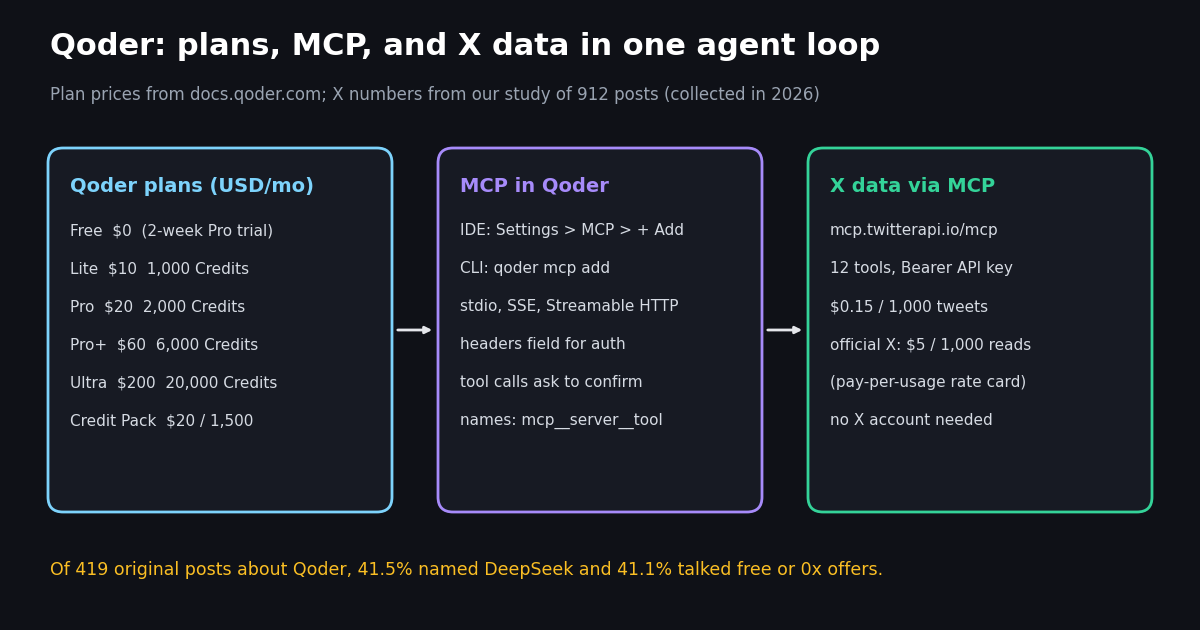
Qoder gets searched three ways: people who saw it in a model provider's integration list and want to know what it is, people comparing it with Cursor or Claude Code, and people checking what a plan actually buys. This page answers all three from Qoder's own pages, fetched this session: docs.qoder.com/account/pricing, docs.qoder.com/Credits, the MCP guides for the IDE and the CLI, and the custom-models guide.
Then it adds what nobody else has measured: how Qoder is discussed on X. We collected 912 posts in 2026, 712 posts about Qoder from 496 accounts plus the latest 200 posts from the official @qoder_ai_ide account, and broke them down by theme, model and rival tool. The last sections show how to give Qoder's agent live X data through an MCP server and what that costs.
What is Qoder? One agent platform, several surfaces
Qoder describes itself as "an agentic platform for real work" (docs.qoder.com/product-series/what-is-qoder). The design idea is a loop rather than an autocomplete box: the agent reads context (code, rules, memory, a Repo Wiki of your project), plans, calls tools, verifies the result and iterates until the deliverable is done. The same account and the same Credits work across every surface.
Qoder versus Qoder IDE. The FAQ is explicit that they are two products side by side: the new Qoder app is for delegating whole tasks, Qoder IDE is for writing and debugging code yourself. Conversation history and memory are stored separately, with an import feature to carry IDE history over.
If you searched "qoder worker". There is no product by that name in Qoder's documentation index. The closest are QoderWork (hand off document, spreadsheet, browser and desktop tasks) and QoderWake ("digital employees called Wakers" for ongoing responsibilities and automations).
Who makes it. Qoder's own documentation calls the product "Alibaba Qoder" in a customer story, Teams and Enterprise seats can be bought through the Alibaba Cloud Chinese and International marketplaces, and the official X account @qoder_ai_ide lists its location as Singapore and links to qoder.com. Prices on docs.qoder.com are for the international service and are shown in USD.
Qoder pricing: every plan, Credit Packs and team seats
Qoder bills in Credits, a unit that measures model compute. Paid individual plans are monthly subscriptions; prices and quotas below are copied from docs.qoder.com/account/pricing as shown this session (USD, per month).
Pro trial. New users get a 14-day Pro trial on first sign-in to the Qoder client with 300 Credits, unlimited completions and Next Edits, Ask and Agent, Experts Mode, Repo Wiki and Knowledge Card. Qoder says it needs the latest client, is not available on virtual machines, and is limited to one account per user (extra trial accounts are frozen).
Credit Packs. Lite, Pro, Pro+ and Ultra subscribers can top up at $20 USD per 1,500 Credits, in 1,500-Credit steps. A pack is valid for one month from purchase and is not refundable. When you hold several sources, Qoder spends the Credits that expire soonest first.
No rollover. Plan Credits expire at the end of the billing period. Upgrades take effect immediately (unused Credits of the old plan are refunded by remaining value); downgrades only take effect at the end of the period, and unused Credits expire.
Teams and Enterprise. docs.qoder.com/account/enterprise/pricing lists Teams at $40 per seat per month with 3,000 Credits per seat (reset monthly, not shareable) and Enterprise at $20 per seat per month with no Credits included; organizations buy Shared Add-on Credits at $40 USD for 3,000. Teams and Enterprise are separate plans with no direct upgrade path between them.
When Credits run out. On Free, and after a paid quota is spent, Qoder keeps serving basic models within daily and monthly limits. Qoder retired its Lite model tier on 18 September 2026 and says paid users can switch to the Efficient tier at a 0.0x multiplier instead.
How fast Credits go: Qoder's own consumption estimates
A plan's Credit count only means something once you know what a request costs. Qoder publishes medians from its own usage data on docs.qoder.com/Credits and warns they are estimates: actual deductions depend on the model, the context size and how many model calls an agent turn makes.
Read against the plans, Pro's 2,000 Credits is roughly 160 Editor Agent requests at the 200K median, or about 40 full desktop-agent tasks at about 50 Credits each. That is arithmetic on Qoder's published medians, not a quota Qoder guarantees; heavy agent use moves people to Pro+ or Ultra, which is what Qoder's own plan guide recommends.
Failed calls are free. Qoder states that failed model requests do not deduct Credits; Credits are consumed only when a model API call succeeds.
Model multipliers matter more than plan size. Each model has a Credit rate. During the DeepSeek-Flash promotion (October 20 to 31, 2026, Singapore time) Qoder cut DeepSeek-V4.1-Flash-1017 from a 0.1x rate to 0.0x within a daily allowance, for Free and paid individual accounts but not Teams or Enterprise. A cheap multiplier stretches the same plan much further than an upgrade does, which is exactly what X users talked about most (see the study below).
Custom models and BYOK: DeepSeek, Kimi, OpenRouter and compatible endpoints
Qoder lets you add third-party models with your own API key under Settings > Models > Add model (docs.qoder.com/qoder/custom-models). Preset providers are Alibaba Cloud Model Studio, DeepSeek, Z.ai, Kimi, MiniMax, Xiaomi MIMO, OpenAI, Google and OpenRouter. For anything else, pick a custom provider of type OpenAI Compatible (Chat Completions or Responses API) or Anthropic Compatible, then enter the base URL, key and at least one model ID.
Billing. Custom model usage bills your provider account directly and does not consume Qoder Credits. The exception is Repo Wiki, which uses a fixed Qoder model and still spends Credits (Qoder shows a prompt before generating).
Capabilities you set yourself. For each model you declare the supported context windows, a default window, whether it accepts images (Vision) and whether it reasons (Thinking, with effort levels). Qoder validates the connection before saving.
Limits. Image and video generation are not available with BYOK models. On the Free plan BYOK is listed as included, which makes Free plus your own key a workable setup for agent use.
This is also why "qoder deepseek" is a search: DeepSeek's API docs list Qoder among their agent integrations, DeepSeek is a preset provider, and Qoder ran a free DeepSeek-Flash window. If you want to compare model routers before wiring a key, our OpenRouter API guide covers that side.
MCP in Qoder IDE and Qoder CLI
Both Qoder IDE and Qoder CLI are MCP clients, so any MCP server can give the agent new tools. The two surfaces configure it differently.
Qoder IDE. Open Qoder IDE Settings (Cmd Shift , on macOS, Ctrl Shift , on Windows), choose MCP, then My Servers > + Add to edit the mcpServers JSON, or install one from the built-in MCP Square tab. The IDE supports STDIO and SSE, and its guide says Streamable HTTP endpoints are configured the same way as SSE and detected automatically. A link icon means the server connected; expand it to see the tools. Before each tool call the IDE asks for confirmation, and you can tick a box to auto-run later calls. Each server also has a Request Timeout setting.
Qoder CLI. Add a local server with qoder mcp add <name> -- <command>, choose transport with -t (stdio, sse, http, ws) and scope with -s (user, local which is the default, or project). Configuration lives in ~/.qoder/settings.json (user), .qoder/settings.local.json (local) and .mcp.json (project, committed). Remote sse and http entries take a url and a headers object, which is where an API key goes. Run /mcp reload in a live session to pick up changes.
Permissions. MCP tools pass through the CLI permission system. Tool names follow mcp__<server>__<tool>, so you can allow one tool or all of a server's tools in the permissions.allow list, or set trust: true on a server to skip prompts. Project-level servers need approval before they load.
Token cost of tools. Qoder's CLI reference notes that many connected servers register every tool schema at startup, which costs prompt tokens on the first turn. Setting mcp.lazyLoad: true (or QODER_MCP_LAZY=1) exposes three meta tools (mcp_list, mcp_get, mcp_call) and loads real tools on demand. If you have read our MCP server explainer, this is the same trade-off every client faces.
Add a Twitter (X) MCP server to Qoder
To let Qoder's agent search X, read profiles, timelines, replies, followers and trends, point it at the hosted TwitterAPI.io MCP server at https://mcp.twitterapi.io/mcp. Its initialize response, which we requested this session, lists 12 tools (search_tweets, get_user_info, get_user_about, get_user_followers, get_user_followings, get_user_last_tweets, get_user_mentions, get_tweets_by_ids, get_tweet_replies, get_tweet_quotes, get_tweet_retweeters, get_trends) and says to paste your TwitterAPI.io API key as the Bearer token.
Step 1, get a key. Sign in with Google at the dashboard; no X developer account is needed. New accounts that pass the automatic bot check get up to $1 of free credits (at most 100,000 credits, no card, one per person or network, expiring after 31 days).
Step 2, IDE. In Settings > MCP > My Servers > + Add, paste the JSON below. The IDE guide documents url for remote servers and auto-detects Streamable HTTP; the headers field is documented in the Qoder CLI reference, which we confirmed this session.
Step 3, CLI. Put the same server in ~/.qoder/settings.json with type: "http", so it is available in every project and the key never lands in a committed .mcp.json (second half of the block below).
For headless or scripted use, the CLI entry in the second half of the block below registers the server at user scope and pre-approves only the two tools you call most, so the agent still asks before anything else (follower pulls, for example, which return many profiles).
Key hygiene. A literal key in ~/.qoder/settings.json stays on your machine. Do not put it in the project .mcp.json, which Qoder describes as "usually committed with the project".
What each call costs. Every MCP tool call costs the same credits as the REST endpoint behind it. Tweet tools bill 15 credits per tweet returned, so a full 20-tweet search page is $0.003 and 1,000 tweets are $0.15; an empty search is billed the 15-credit minimum ($0.00015). Profiles are 18 credits each ($0.18 per 1,000), followers and followings 1 to 3 credits per user returned.
Against the official X API. On the official pay-per-usage rate card (docs.x.com/x-api/getting-started/pricing) a post read is $0.005, so 1,000 tweets cost $5, roughly 33x the $0.15 above, and user reads are $0.010 each. X's pay-per-usage tier is capped at 3M post reads a month before Enterprise.
Rate limits. Before your first payment the API allows 0.2 requests per second; once you have paid it is 20 per second (50 on the Scale plan). For an agent that is plenty. Plan details are on the pricing page.
Step 4, try it. In Agent mode ask something like "What are developers on X saying about Qoder this week? Cite the top posts." The agent should pick search_tweets, ask you to confirm the call, and quote the results.
// Qoder IDE: Settings > MCP > My Servers > + Add
{
  "mcpServers": {
    "twitterapi-io": {
      "url": "https://mcp.twitterapi.io/mcp",
      "headers": {
        "Authorization": "Bearer YOUR_TWITTERAPI_IO_API_KEY"
      }
    }
  }
}

// Qoder CLI: ~/.qoder/settings.json
{
  "mcpServers": {
    "twitterapi-io": {
      "type": "http",
      "url": "https://mcp.twitterapi.io/mcp",
      "headers": {
        "Authorization": "Bearer YOUR_TWITTERAPI_IO_API_KEY"
      },
      "description": "X (Twitter) data: search, profiles, timelines, replies, trends"
    }
  },
  "permissions": {
    "allow": ["mcp__twitterapi-io__search_tweets", "mcp__twitterapi-io__get_user_info"]
  }
}

// then, inside a running session:
//   /mcp reload
// /mcp (shows the server and its 12 tools)Qoder vs Cursor, Claude Code and Antigravity: where it differs
We keep head-to-head plan tables on dedicated pages so they stay current: see Antigravity vs Cursor for those two, and Cursor vs Claude Code for the terminal-first comparison. Here is what is specific to Qoder, from its own docs.
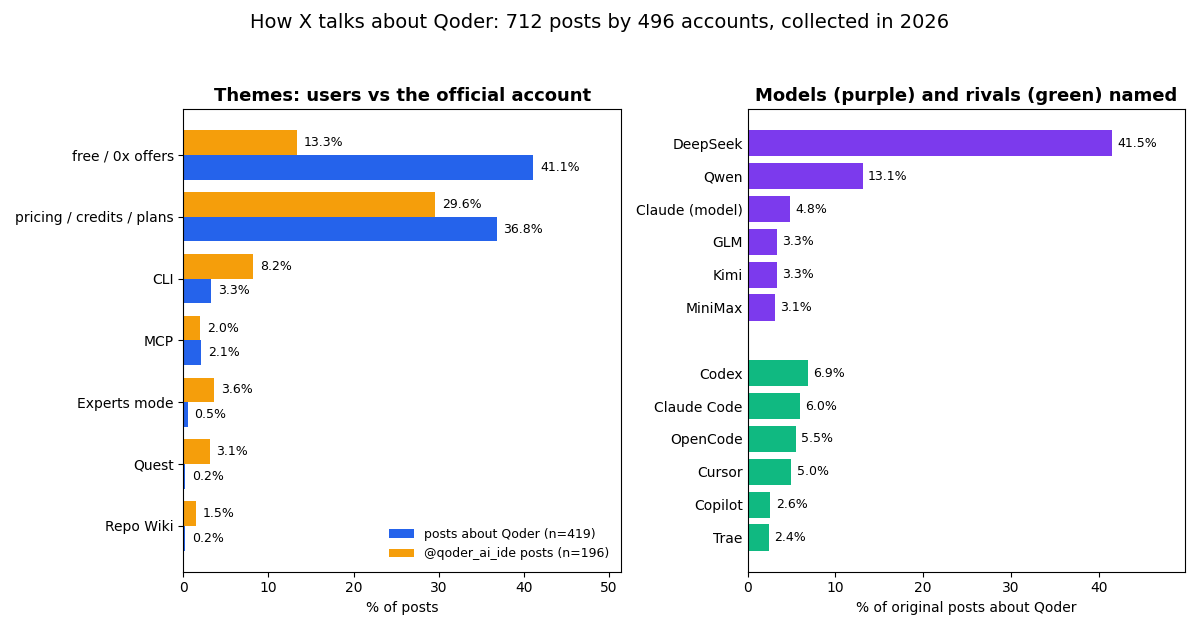
What X users put next to it. In our sample, 14.6% of original posts about Qoder named at least one rival tool: Codex (6.9%), Claude Code (6.0%), OpenCode (5.5%), Cursor (5.0%), Copilot (2.6%) and Trae (2.4%). Antigravity and Windsurf each appeared in 0.5%. Qoder is mostly discussed as a model-access deal, less as a head-to-head editor choice.
Practical read. If you mostly want cheap access to Flash-class models with a full agent, Qoder's Lite and Pro tiers plus its 0x promotions are the draw. If you want one editor and MCP setup shared across a team, compare the per-seat Credits and the config scopes first.
What X says about Qoder, and what @qoder_ai_ide posts: a study of 912 posts
We collected 712 posts about Qoder from 496 accounts (excluding the official account) and the latest 200 posts from @qoder_ai_ide. 419 of the 712 were original posts and 293 (41.2%) were replies; 112 of those replies (38.2%) answered the official account, many of them during its Community Boost campaign. English made up 52.0% of posts, Chinese 35.4% and Japanese 4.4%.
Models drive the conversation. 41.5% of original posts named DeepSeek and 13.1% named Qwen, far ahead of Claude models (4.8%), GLM (3.3%), Kimi (3.3%) and MiniMax (3.1%). The sample overlaps the DeepSeek-Flash free window, which explains much of that share; it is a snapshot of a promotion period, not a steady state.
Users talk money more than the brand does. Free or 0x offers came up in 41.1% of user posts against 13.3% of the official account's own posts. Several posts in the sample complained about how quickly a plan's Credits went on a single model, which matches Qoder's warning that consumption depends on the model and the task.
Attention is concentrated. The median original post got 6 likes and 737 views; the top tenth reached 102 likes and 31,485 views, and the 10 most-liked posts held 75.9% of all likes. 40.7% of the accounts had fewer than 1,000 followers.
MCP is an open lane. Only 2.1% of user posts and 2.0% of the official account's posts mention MCP, although both Qoder IDE and CLI support it fully. Few people are showing what Qoder's agent can do with outside tools such as live X data.
@qoder_ai_ide (display name Qoder, a Business-verified account created in 2025) had 15,591 followers and 793 posts at collection time. Its latest 200 posts span 238.4 days, about 0.84 posts a day.
What it announces. Model news leads: 12.8% of its posts name Qwen, 6.1% DeepSeek, 4.6% Kimi and 3.6% GLM, typically "Day-0 support" posts when a model goes live in Qoder. 29.6% touch plans or Credits (Lite at $10 a month is promoted repeatedly) and 8.2% the CLI.
What that means for you. If you track Qoder for model availability or promotions, the official timeline is the fastest signal. The code below pulls it, and the same search powers the study above.
How we collected this
Question. How do people on X talk about Qoder (languages, themes, models and rival tools named, reach), and what does the official account post?
Accounts and queries. The official account @qoder_ai_ide (handle verified with a profile lookup; it links to qoder.com), its latest 200 posts, and searches for qoder -from:qoder_ai_ide (Latest), the same query restricted to original posts, three single-day slices of original posts, and a Top slice. Posts by the official account were removed from the user sample and duplicates were dropped.
Window and size. The most recent posts at collection time, collected in 2026: 712 user posts and 200 official posts, 912 in total, from 76 API requests (including 4 discarded probe requests) for about $0.14 at our published rates.
Method. Case-insensitive keyword matching on post text for each theme, model and tool; percentages for themes, models and rivals are over original posts (replies are short and repeat campaign text). Likes and views are as reported at collection time.
What the sample cannot show. It is a short window that overlaps a DeepSeek-Flash promotion and a Community Boost campaign, so model and "free" shares are inflated relative to a quiet week. Keyword matching misses posts that discuss Qoder in images, and it cannot tell praise from complaints. X search returns a sample, not every post.
Privacy. Aggregates only. The organization account is named; no private individual is named or profiled, raw search pages were not stored with this page, and the de-identified sample has no IDs, URLs, text or handles.
import os
import re
import requests

BASE = "https://api.twitterapi.io"
HEADERS = {"X-API-Key": os.environ["TWITTERAPI_IO_API_KEY"]}

RIVALS = {
    "Cursor": r"\bcursor\b",
    "Claude Code": r"claude\s*code",
    "Codex": r"\bcodex\b",
    "OpenCode": r"opencode",
}


def official_profile(handle="qoder_ai_ide"):
    r = requests.get(f"{BASE}/twitter/user/info", headers=HEADERS,
                     params={"userName": handle}, timeout=30)
    r.raise_for_status()
    body = r.json()
    if body.get("status") != "success" or body.get("data") is None:
        raise SystemExit(f"lookup failed: {body.get('msg')}")
    d = body["data"]
    return {"name": d["name"], "followers": d["followers"], "posts": d["statusesCount"]}


def search(query, max_pages=5):
    """Yield tweets for an X search, following next_cursor."""
    cursor = ""
    for _ in range(max_pages):
        r = requests.get(f"{BASE}/twitter/tweet/advanced_search", headers=HEADERS,
                         params={"query": query, "queryType": "Latest", "cursor": cursor},
                         timeout=30)
        r.raise_for_status()
        page = r.json()
        for t in page.get("tweets", []):
            yield t
        if not page.get("has_next_page"):
            break
        cursor = page.get("next_cursor", "")


if __name__ == "__main__":
    print(official_profile())
    tweets = list(search("qoder -from:qoder_ai_ide -filter:replies", max_pages=5))
    counts = {k: 0 for k in RIVALS}
    for t in tweets:
        text = t["text"].lower()
        for name, pat in RIVALS.items():
            if re.search(pat, text):
                counts[name] += 1
    likes = sorted(t.get("likeCount", 0) for t in tweets)
    print(f"{len(tweets)} posts; median likes {likes[len(likes) // 2] if likes else 0}")
    for name, n in sorted(counts.items(), key=lambda x: -x[1]):
        print(f"{name}: {n} posts ({100 * n / max(len(tweets), 1):.1f}%)")
    # Cost: 15 credits per tweet returned, so 5 full pages (100 tweets) = $0.015.
Questions readers ask
Is Qoder free?
There is a Free plan at $0 with basic models under daily and monthly limits, limited completions and Next Edits, BYOK, and a one-time 2-week Pro trial with 300 Credits. Paid plans start at Lite, 10 USD a month for 1,000 Credits (docs.qoder.com/account/pricing).
How much does Qoder Pro cost?
Pro is 20 USD a month with 2,000 Credits and the full model lineup. Pro+ is 60 USD (6,000 Credits) and Ultra 200 USD (20,000 Credits). Extra Credit Packs are $20 for 1,500 Credits and expire one month after purchase.
Who makes Qoder?
Qoder's own documentation refers to the product as "Alibaba Qoder" in a customer story, and its Teams and Enterprise plans are sold through the Alibaba Cloud marketplaces. The official X account is @qoder_ai_ide and lists Singapore as its location.
Do unused Qoder Credits roll over?
No. Plan Credits expire at the end of each billing period. Credit Packs last one month from purchase. On a downgrade, unused Credits expire; on an upgrade, the old plan's unused Credits are refunded by remaining value.
Can I use DeepSeek or my own API key in Qoder?
Yes. DeepSeek, Kimi, MiniMax, OpenAI, Google, OpenRouter and others are preset BYOK providers, and any OpenAI- or Anthropic-compatible endpoint can be added. Those calls bill your provider, not Qoder Credits, except Repo Wiki, which always uses Qoder's model.
Does Qoder support MCP servers?
Yes. Qoder IDE supports STDIO and SSE (Streamable HTTP is auto-detected) via Settings > MCP or the MCP Square marketplace. Qoder CLI adds servers with qoder mcp add and supports stdio, sse, http and ws transports at user, local or project scope.
Is Qoder better than Cursor?
It depends on how you pay and work. Qoder sells Credits with per-model multipliers and frequent free-model windows, and spans a desktop agent, IDE, CLI and cloud API. In our X sample only 5.0% of original posts about Qoder named Cursor; see our Antigravity vs Cursor page for Cursor's side.
How do I give Qoder access to Twitter (X) data?
Add the hosted MCP server https://mcp.twitterapi.io/mcp with an Authorization: Bearer header carrying your TwitterAPI.io API key. Tweets cost $0.15 per 1,000 returned versus $5 per 1,000 post reads on the official X API pay-per-usage rate card, and no X account is needed.
Continue
- Qoder docs: individual plans, Credit Packs and trial rules
- Qoder docs: Credits and consumption estimates
- Qoder IDE docs: MCP configuration
- Qoder CLI docs: MCP reference (transports, headers, scopes)
- Qoder docs: custom models and BYOK
- X API pricing (official pay-per-usage rate card)
- X (Twitter) API guide: endpoints, prices and access
- Antigravity vs Cursor: plans, models and MCP setup
- Cursor vs Claude Code: plans, MCP and headless runs
- What an MCP server is and how clients connect to it
- OpenRouter API guide for routing models with one key
- DeepSeek V4 Flash: what the model is and what it costs
- TwitterAPI.io pricing and plans
- 01Cursor vs GitHub Copilot: Plans, Agent Mode, MCP and a Twitter (X) Data Setup in Both
- 02Claude Code hooks: every event, the settings.json shape, and tested recipes (plus an X data budget guard)
- 03Google Antigravity Pricing: Free Tier, Pro and Ultra Quotas, and What X Users Report
- 04OpenRouter Alternatives in 2026: LiteLLM, Vercel AI Gateway, Requesty, Portkey and Direct APIs Compared, With What Developers on Twitter (X) Say
- 05Lovable pricing in 2026: plans, credits, and what an app that pulls Twitter (X) data really costs
- 06What Is twimg? Twitter (X) Media CDN URLs Explained
- 07Twint (Twitter scraper): why it stopped working and how to migrate
- 08Claude Agent SDK: Build a Twitter (X) Research Agent in Python
Stop reading. Start building.
Starter credits cover real testing on real data. Google sign-in, no card, no application queue.
Get an API keyAlready building with TwitterAPI.io? Publish an honest tutorial or build log about it and earn up to $200 a month in API credits.