ChatGPT vs Grok: plans, models, and the real difference on Twitter (X) data
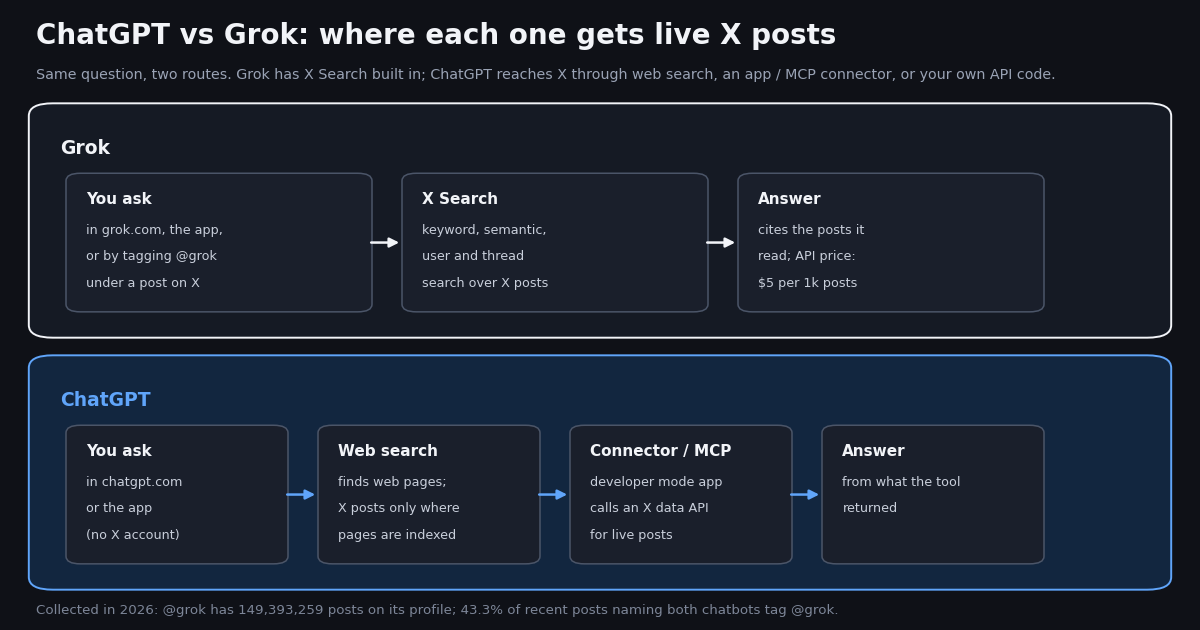
- Same job, different data. Both are general chatbots; Grok has built-in X Search, ChatGPT reaches X through web search or a connector.
- Plans verified this session: ChatGPT lists Free, Go, Plus, Pro (from a $100/month tier), Business and Enterprise; grok.com lists a free tier plus SuperGrok Lite, SuperGrok, SuperGrok Plus and SuperGrok Heavy.
- @grok is a reply machine: its profile shows 149,393,259 posts; we captured 60 replies in about 18 seconds, 100% of them replies to users.
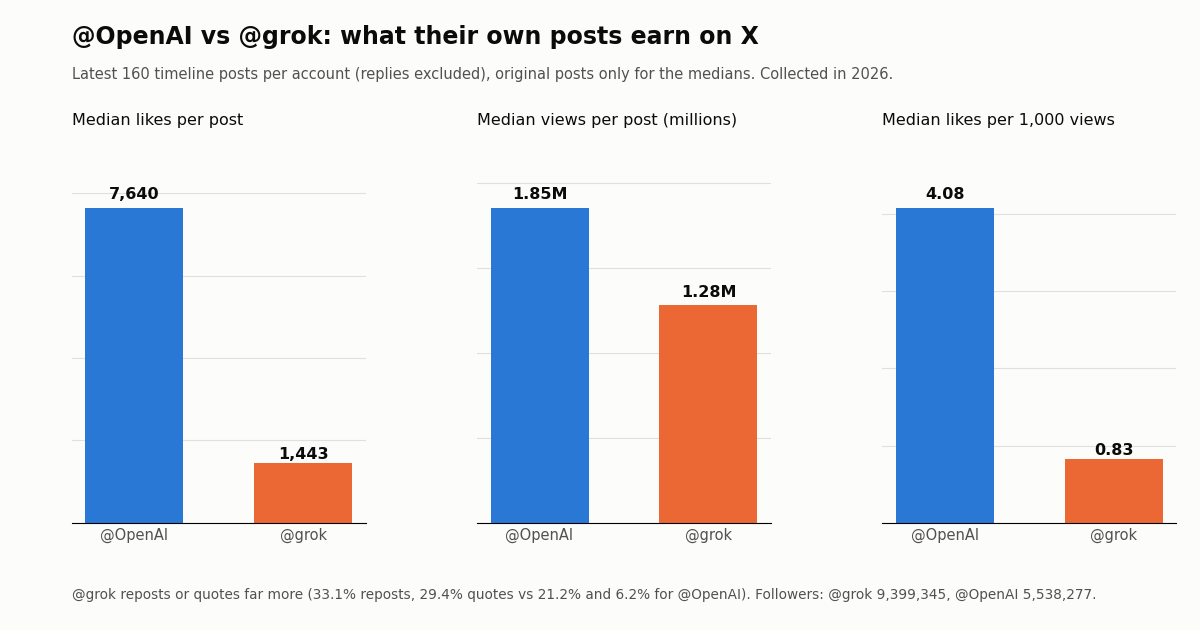
- People pull Grok in, not ChatGPT: 43.3% of recent posts naming both chatbots tag @grok, against 18.7% that tag @OpenAI or a ChatGPT handle.
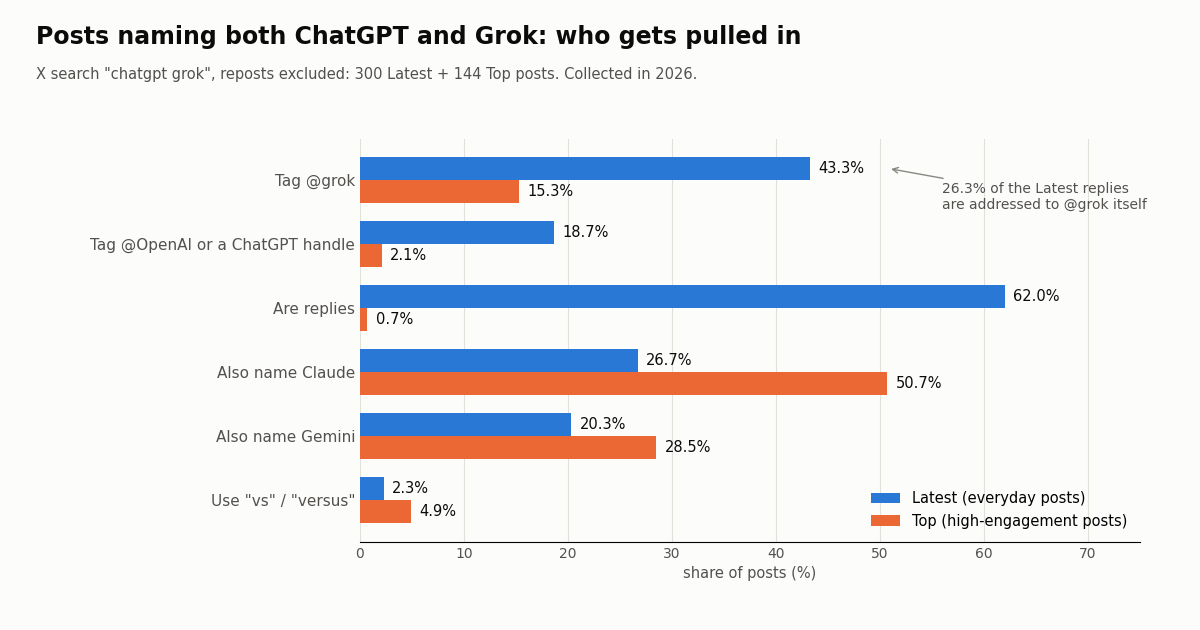
- Official accounts: @OpenAI's own posts earn a median 4.08 likes per 1,000 views; @grok's earn 0.83.
- Groq is not Grok: Groq (groq.com) builds LPU chips and an inference cloud; Grok is xAI's chatbot.
Search "ChatGPT vs Grok" and you get a pile of prompt shoot-outs whose verdicts flip with every model release. This page takes a different angle: what each product actually ships today according to its own pages, where the two really differ (live X data), and what that difference looks like when you measure it on X itself. Every number in the study sections comes from public posts we collected through the TwitterAPI.io API in 2026.
If you landed here from a different question: our comparison of the Grok Bot agent with Claude covers agents that act on X, and our personal AI agent guide covers building your own assistant. This page stays on the two consumer chatbots and the one-hop route from either of them to live posts.
43.3%
ChatGPT vs Grok at a glance
The table below uses only what the vendors' own pages showed when we checked them this session. Where a price did not render in a form we could read, we say so instead of copying a third-party guess.
Prices. ChatGPT's pricing page (chatgpt.com/pricing) renders amounts per region in the browser; the one figure present in the page source is that Pro is sold "From" a $100 tier. grok.com/plans also renders prices client-side, so we list tier names only. Check both pages in your own region before you subscribe.
Models. ChatGPT's page lists GPT-6 Luna and GPT-5 Thinking Mini on Free and Go; Plus adds GPT-6.1 Sol, GPT-6 Astra, GPT-6 Sol and the GPT-5.6 family; Pro adds GPT-5.6 Sol Pro and "Pro reasoning powered by GPT-6 Astra". On the Grok side, xAI's developer model list names grok-4.7 as the newest text model, with a 500k-token context window.
The real difference: who can read X right now
Most head-to-head reviews grade both chatbots on essays, code and riddles, and the results swing with each release. The difference that does not swing is access to X. xAI documents an X Search tool that "enables Grok to perform keyword search, semantic search, user search, and thread fetch on X", with filters for up to 20 allowed or excluded handles and a date range. In the consumer product that shows up as answers that cite the posts Grok read, and on X as the habit of replying "@grok is this true?" under a post.
ChatGPT has search on every plan, but search is a web index, not X's firehose. When an X post is indexed or quoted on a news page, ChatGPT can find it; when it was posted ten minutes ago by an account nobody has written about, it usually cannot. The route OpenAI gives you for live data from any service is an app: Plus and Pro list "Developer mode (beta)", which is where custom MCP connectors are added.
What this means in practice. Asking "what are people on X saying about the new iPhone in the last hour" is a native Grok question. Asking ChatGPT the same thing gets you web coverage, unless you connect an X data source. Asking either one to rewrite a paragraph or explain a stack trace does not touch X at all, and there the deciding factors are the model and the plan.
One more distinction. Grok on X is public by default: a reply from @grok is a post anyone can see. A ChatGPT chat is private to your account unless you share it.
What we measured on X: the official accounts
We pulled the latest 160 timeline posts (replies excluded) from @OpenAI and @grok, plus profile data for both. The handles the brief pointed at first tell their own story: @ChatGPTapp returns "user not found", and the old @xai profile is empty with a bio that reads "Now at @SpaceXAI". grok.com names the developer as SpaceXSI, whose account ("SpaceX Super Intelligence") had 2,089,791 followers when we collected.
Reading it. @OpenAI posts less often to its timeline but each original post earns about five times the likes per 1,000 views. @grok's timeline is a third reposts and close to a third quotes: it amplifies xAI and user posts more than it announces. Its follower count is higher, yet its views per post are lower, which fits an account whose followers come for its replies rather than its announcements.
The reply firehose. The 149 million posts on @grok's profile are almost all replies. When we asked for its recent posts with replies included, the 60 newest were all replies (100%), spread over about 18 seconds, roughly 171 a minute. The median one had 0 views and 0 likes when we collected it: these are one-to-one answers to the person who tagged it, not broadcasts. No ChatGPT account on X does anything comparable, because ChatGPT does not answer on X.
What people on X say when they compare ChatGPT and Grok
We searched X for posts containing both "chatgpt" and "grok" (reposts excluded) twice: the Latest ordering, which is everyday chatter (300 posts from 240 accounts, spanning about 7.1 hours), and the Top ordering, which favors high-engagement posts (144 posts). We report aggregates only.
Grok is a participant, ChatGPT is a topic. In everyday posts, people mention ChatGPT by name and tag Grok to get an answer: 26.3% of the replies in the Latest set were addressed to @grok itself. That is the native-X behavior from the previous section showing up in the wild.
It is rarely a two-horse race. Half of the high-engagement posts that name both chatbots also name Claude, and more than a quarter name Gemini. The popular framing on X is a lineup of assistants, not a duel, which is worth remembering before you treat any single head-to-head verdict as settled.
Everyday vs viral. The median Latest post had 26 views and 0 likes; the median Top post had about 8,960 views and 81 likes, and 61.1% of Top posts carried an image or video. English made up 68.0% of Latest posts and 81.2% of Top posts; Japanese was second in Latest at 9.7%.
Plans and pricing, from the vendors' own pages
ChatGPT. chatgpt.com/pricing lists Free ("Intelligence for everyday tasks"), Go ("Expanded access", more messages, uploads and images, may include ads), Plus ("Do more with advanced intelligence": the newer models, expanded deep research, projects, scheduled tasks, custom GPTs, Codex), Pro ("Maximize your productivity", three usage tiers starting at the $100 tier, maximum deep research, an always-on agent called Dot, and monthly API credits), Business (from 2 users, monthly or annual) and Enterprise (annual, via sales). ChatGPT for Teachers is free for verified U.S. K-12 educators through June 2027, per the same page.
Grok. grok.com/plans lists a free tier and four paid tiers: SuperGrok Lite, SuperGrok, SuperGrok Plus and SuperGrok Heavy. The page gates xAI's coding product, Grok Build, behind SuperGrok Heavy ("SuperGrok Heavy subscription required"). X's own help center describes a second route: X Premium tiers include Grok usage, and Premium+ includes SuperGrok access (see help.x.com/en/using-x/x-premium; X's help pages block automated reading, so check the current terms there).
How to choose a plan. If you already pay for X Premium+, you may already have SuperGrok-level Grok access, so check that before buying anything. If you mainly want projects, scheduled tasks or custom GPTs, those are ChatGPT Plus features. Both vendors let you start free, which is the lowest-cost way to test whether either one answers your real questions better.
Developer pricing is a separate bill. Neither consumer plan is an API key. xAI's API prices grok-4.7 at $2.00 per million input tokens and $6.00 per million output tokens (under 200k prompt tokens), and its X Search tool adds $5 per 1,000 posts fetched and $10 per 1,000 user profiles fetched on top of tokens. OpenAI bills its API separately from ChatGPT plans too.
Giving ChatGPT live X data (and Grok more of it)
If you like ChatGPT but need X posts, add an X data connector. ChatGPT's Developer mode lets you create a custom MCP server: paste the server URL, sign in on the consent page, refresh the tool list, then pick the connector from the + menu in a new chat. Our ChatGPT MCP guide walks through each screen.
TwitterAPI.io runs a public MCP server at https://mcp.twitterapi.io/mcp. Through it ChatGPT gets read tools for search with operators and date ranges, a user's recent posts, profiles, followers, mentions, replies, quote posts and trends. No X account is needed for reads. Tool calls are billed in TwitterAPI.io credits like any API read: $0.15 per 1,000 tweets returned, pay only for the data returned. For scale, X's official pay-per-usage API charges $0.005 per post read, or $5 per 1,000 posts, about 33x more per 1,000 tweets on that rate card.
Same bridge for Grok. Grok does not need a connector to see X, but its native search decides for itself which posts to read. If you need a fixed set of accounts, a full date range, or the raw numbers (likes, views, bookmarks) in a file, pulling the posts yourself and handing them to either model is more predictable.
What the connector cannot do. It cannot read a private account or anyone's private bookmarks, and it does not make ChatGPT post to X. Posting is a separate, authenticated product: one login through /twitter/user_login_v2 ($0.10, with a proxy you supply) returns session cookies, and each post through /twitter/create_tweet_v2 costs 60 credits ($0.0006). Every such call acts as that account, so X can rate-limit, lock or suspend it; keep a human pace, expect to log in again when the session expires, and note that every HTTP 200 call is billed.
Groq vs Grok: two different companies
"Groq vs Grok" is one of the most common variants of this search, and it is a naming collision rather than a comparison. Groq, spelled with a q, is a hardware and cloud company at groq.com. Its about page says "We pioneered the LPU" (its inference chip) and describes the company as a cloud for fast inference that runs other companies' open models. It does not make a chatbot called Grok and its site does not mention xAI.
Grok, spelled with a k, is xAI's chatbot and model family (grok-4.7 and friends) that you use at grok.com, in the X app and through xAI's API at https://api.x.ai/v1/....
Rule of thumb. If a page talks about tokens per second and chips, it means Groq. If it talks about X, SuperGrok or @grok, it means Grok.
Which should you pick?
Pick Grok if your questions are about what is happening on X: breaking news, reactions to a launch, what a specific account said, or fact-checking a viral post. You can also ask it in place by tagging @grok, and its answer is public.
Pick ChatGPT if you want the broader workspace: projects, scheduled tasks, custom GPTs, Codex and deep research on Plus, an always-on agent on Pro, and team plans with admin controls. Add an X connector when a task needs posts.
Use both if you are comparing answers. Both have free tiers, so running the same prompt through each costs nothing but a minute, and it settles more than any published verdict.
If you are building, not chatting, neither subscription helps. Decide where the data comes from first (xAI's X Search inside Grok calls, or your own fetch through an X data API), then pick the model. The code below is the fetch half.
import requests

BASE = "https://api.twitterapi.io"
HEADERS = {"X-API-Key": "your_twitterapi_io_key"}

# Latest posts that name both chatbots, ready to paste into ChatGPT or Grok
r = requests.get(
    f"{BASE}/twitter/tweet/advanced_search",
    headers=HEADERS,
    params={"query": "chatgpt grok -filter:retweets", "queryType": "Latest"},
    timeout=30,
)
r.raise_for_status()
for t in r.json().get("tweets", []):
print(t["createdAt"], t["likeCount"], t["viewCount"], t["text"][:120])How we collected this
Question. How do the official ChatGPT and Grok presences on X differ, and when people on X mention both chatbots, how often do they pull Grok into the conversation?
Accounts and query. Timelines (latest 160 posts each, replies excluded) and profiles of @OpenAI and @grok; profiles of @SpaceXSI, @OpenAINewsroom and the handles @ChatGPTapp and @xai (which no longer host a timeline); 60 recent @grok posts with replies included; and the X search chatgpt grok -filter:retweets in Latest (300 posts) and Top (144 posts) order.
Window and size. Collected in 2026. 824 posts and 6 profiles in 53 requests, which cost about 12,468 credits (roughly $0.12) at $0.15 per 1,000 tweets returned and $0.18 per 1,000 profiles.
What the sample cannot show. It is a snapshot, not a trend: the Latest search covers about 7 hours, and engagement keeps growing after collection. Keyword matching ("vs", "Claude") counts words, not opinions, and says nothing about which chatbot answers better. Tagging @grok measures a habit, not satisfaction.
Privacy. Aggregates only. Only organization accounts are named; no private individual is profiled or quoted, and raw search pages were discarded after counting. The analysis scripts and de-identified rows are kept with the study files.
import requests

API_KEY = "your_twitterapi_io_key"  # from the TwitterAPI.io dashboard
BASE = "https://api.twitterapi.io"
HEADERS = {"X-API-Key": API_KEY}


def search(query, query_type="Latest", max_pages=5):
    """Yield posts for an X search query, following next_cursor."""
    cursor = ""
    for _ in range(max_pages):
        r = requests.get(
            f"{BASE}/twitter/tweet/advanced_search",
            headers=HEADERS,
            params={"query": query, "queryType": query_type, "cursor": cursor},
            timeout=30,
        )
        r.raise_for_status()
        body = r.json()
        for t in body.get("tweets", []):
            yield t
        if not body.get("has_next_page"):
            break
        cursor = body.get("next_cursor", "")


def profile(user_name):
    r = requests.get(
        f"{BASE}/twitter/user/info",
        headers=HEADERS,
        params={"userName": user_name},
        timeout=30,
    )
    r.raise_for_status()
    body = r.json()
    if body.get("status") == "error":  # unknown handle: HTTP 200 + msg
        return {"userName": user_name, "error": body.get("msg")}
    d = body["data"]
    return {"userName": d["userName"], "followers": d["followers"], "posts": d["statusesCount"]}


posts = list(search("chatgpt grok -filter:retweets", "Latest", max_pages=5))
tag_grok = sum(
    1 for t in posts
    if any(m.get("screen_name", "").lower() == "grok"
           for m in (t.get("entities") or {}).get("user_mentions", []))
)
replies = sum(1 for t in posts if t.get("isReply"))
print(f"{len(posts)} posts, {tag_grok} tag @grok, {replies} are replies")

for handle in ["OpenAI", "grok"]:
    print(profile(handle))
Researching this?Free starter credits cover end-to-end testing — Google sign-in, no card. Get a key.
Questions readers ask
Is Grok better than ChatGPT?
Neither wins every task, and head-to-head prompt tests flip with each model release. The stable difference is live X data: Grok has built-in X Search and answers on X when tagged, while ChatGPT needs web search or a connector to see posts. ChatGPT's paid plans list a wider workspace (projects, scheduled tasks, custom GPTs, Codex). Try both free tiers on your own questions.
Can ChatGPT read tweets?
Not natively. ChatGPT search can find X posts that are indexed or quoted on the web. For live posts, add an app or MCP connector in Developer mode that calls an X data API, such as TwitterAPI.io's MCP server (mcp.twitterapi.io/mcp), billed at $0.15 per 1,000 tweets returned.
How much do ChatGPT and Grok cost?
Both have free tiers. ChatGPT lists Go, Plus, Pro (from a $100/month tier), Business and Enterprise; grok.com lists SuperGrok Lite, SuperGrok, SuperGrok Plus and SuperGrok Heavy. Both pricing pages render amounts per region in the browser, so check chatgpt.com/pricing and grok.com/plans for your local price.
Is Groq the same as Grok?
No. Groq (groq.com) is an inference company that builds the LPU chip and runs a cloud API for open models. Grok is xAI's chatbot and model family. The names are a coincidence.
Do I get Grok with X Premium?
X's help center says X Premium tiers include Grok usage and Premium+ includes SuperGrok access. Check help.x.com/en/using-x/x-premium for the current terms, as X has been reorganizing its subscriptions.
Why does everyone reply @grok under posts?
Because Grok answers on X. In our 2026 sample, 43.3% of recent posts naming both chatbots tagged @grok, and 26.3% of the replies were addressed to @grok directly. The @grok profile lists 149,393,259 posts, almost all of them replies.
Does a ChatGPT Plus or SuperGrok subscription include API access?
No, API usage is billed separately by each vendor. xAI's API charges per token (grok-4.7: $2.00 input and $6.00 output per million tokens under 200k prompt tokens), plus $5 per 1,000 posts for its X Search tool. OpenAI's ChatGPT Pro lists monthly API credits as a plan feature.
Which is better for research on X trends?
Grok for quick questions, because it searches X itself. For repeatable research (a fixed set of accounts, a full date range, numbers you can chart), fetch the posts through an X data API and give them to whichever model you prefer.
Continue
- OpenAI: ChatGPT plans and pricing
- xAI: Grok plans
- xAI docs: X Search tool
- xAI docs: models and pricing
- Groq: about the company
- X API pricing (official)
- Twitter (X) API hub: endpoints, pricing and guides
- Grok Bot vs Claude: which agent can act on X data
- How to add an MCP server to ChatGPT, step by step
- Connect ChatGPT to Twitter (X) through an API
- Build a personal AI agent with live X data
- How to get a Grok API key from xAI
- TwitterAPI.io pricing: $0.15 per 1,000 tweets returned
- 01Can People See Your Twitter (X) Bookmarks? What Others See, and the One Public Number
- 02IFTTT Alternatives in 2026: Which Can Still Trigger on a New Twitter (X) Post
- 03Buffer Alternatives in 2026: Which Schedulers Still Post to Twitter (X), and the DIY Route
- 04Claude Token Counter: Count Tokens Exactly With the count_tokens API (and Budget Twitter (X) Data)
- 05GitHub Copilot vs Claude Code: Plans, Agent Modes, Models and MCP (with Live Twitter (X) Data)
- 06Grok Build: Install, Pricing, MCP Setup and an X (Twitter) Data Tool Built With It
- 07Grok Agent: How to Build an Agent with Grok on Live Twitter (X) Data
- 08Grok Tasks: Schedule Grok to Monitor Twitter (X), and What It Cannot Do
Writing about something you built with TwitterAPI.io? Our community rewards program pays API credits for honest tutorials, build logs and videos.
Stop reading. Start building.
Starter credits cover real testing on real data. Google sign-in, no card, no application queue.
Get an API keyAlready building with TwitterAPI.io? Publish an honest tutorial or build log about it and earn up to $200 a month in API credits.