GitHub Copilot vs Claude Code: Plans, Agent Modes, Models and MCP (with Live Twitter (X) Data)
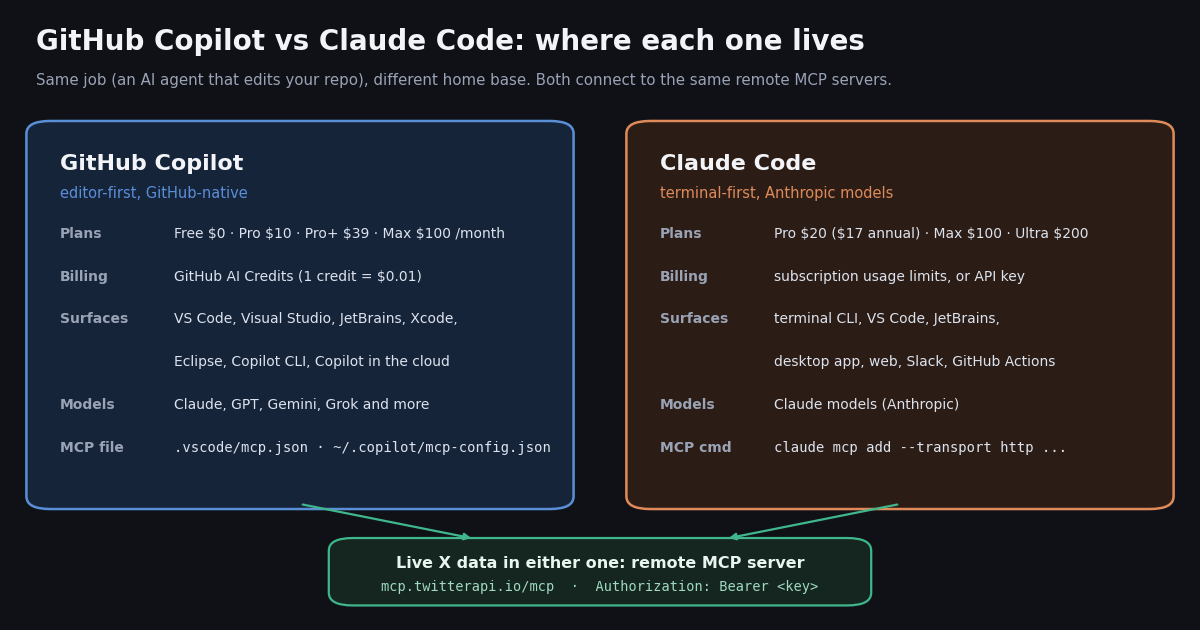
- Copilot plans: Free $0, Pro $10/month, Pro+ $39/month, Max $100/month; Business $19 and Enterprise $39 per granted seat a month. Usage is metered in GitHub AI Credits (1 credit = $0.01).
- Claude Code plans: included in Claude Pro ($20 monthly, $17 a month on annual billing), Max ($100/month, 5x Pro usage) and Ultra ($200 monthly, 10x Pro usage); not in the Free plan. An Anthropic API key also works.
- Agent shapes differ: Copilot has agent mode in the IDE, Copilot CLI and Copilot in the cloud (one branch and one pull request per task, sessions capped at 59 minutes on GitHub Actions). Claude Code runs the same engine in the terminal, IDEs, desktop, web and Slack.
- Models: Copilot lists Claude, GPT, Gemini, Grok and other models in one picker; Claude Code runs Anthropic's models (
opus,sonnet,haiku,fablealiases). - MCP on both: Copilot reads
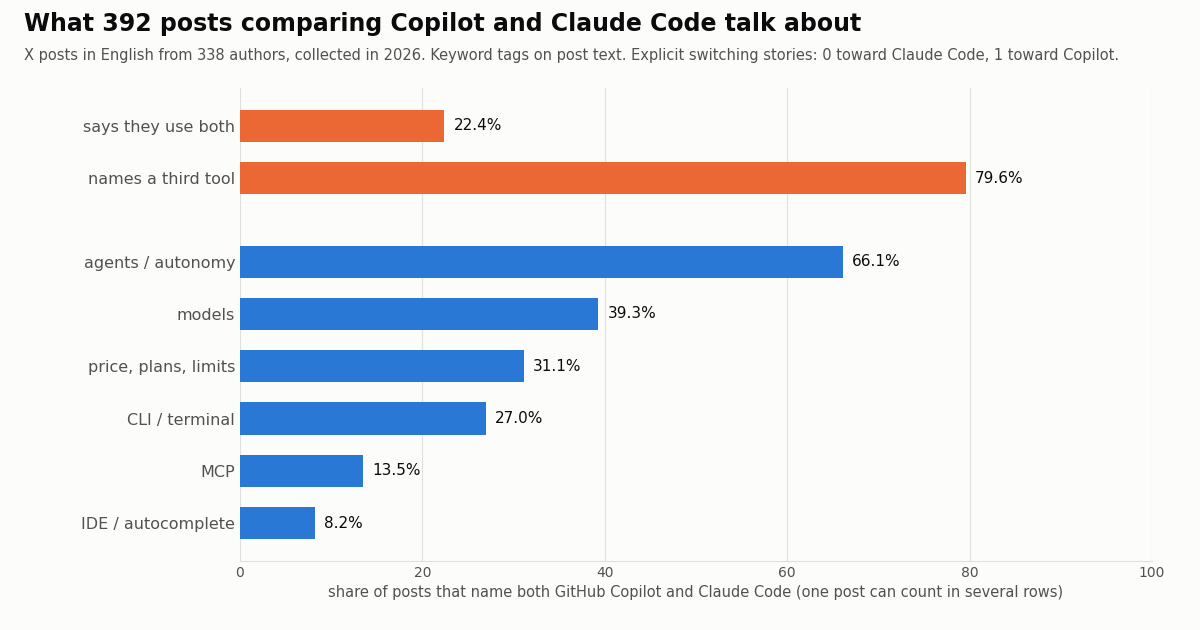
.vscode/mcp.jsonor~/.copilot/mcp-config.json; Claude Code usesclaude mcp add --transport http. One remote server,https://mcp.twitterapi.io/mcp, gives either one live X data. - What people compare: of 392 X posts naming both tools, 66.1% talk about agents, 39.3% models, 31.1% price or limits, and 79.6% name a third tool (collected in 2026).
Searching for GitHub Copilot vs Claude Code usually means one of two things: you already pay for one and wonder whether the other would do more, or you are choosing an AI coding tool for a team and want the plans, agent features and models side by side. This page answers both with facts taken from GitHub's and Anthropic's own pages, then adds something the usual comparison does not have: a look at what developers on X actually say when they put the two names in the same post.
Our angle is this specific pair. If you are weighing Cursor against Copilot, OpenAI's Codex against Claude Code, or Windsurf against Cursor, those pairs have their own pages (linked at the end), and we do not repeat them here. Because we run an X data API, every section that touches tools ends with how each product reaches live X (Twitter) data through MCP.
22.4%
GitHub Copilot vs Claude Code at a glance
The short version: Copilot is a seat inside the tools you already use; Claude Code is an agent you point at a repository. The table compares the facts that most often decide the choice.
Read the table as a map, not a scoreboard. Neither vendor publishes a benchmark that compares the two directly, and the third-party numbers that circulate (first-pass accuracy, share of sessions) are not reproducible, so we leave them out. What you can verify is where each tool runs, what it costs and how it is extended.
Plans and prices, from each vendor's page
GitHub Copilot. The plans page on github.com/features/copilot/plans lists Free at $0, Pro at $10 USD per user a month, Pro+ at $39 and Max at $100. Each paid plan comes with a monthly allowance of GitHub AI Credits, where 1 AI credit is $0.01: $15 of total credits on Pro, $70 on Pro+ and $200 on Max, made of a base amount plus a flex allotment that GitHub says "may change over time". GitHub's plans documentation lists the organization plans: Copilot Business at $19 per granted seat a month with 1,900 AI credits per user, and Copilot Enterprise at $39 per granted seat a month with 3,900 AI credits per user. Verified students get Copilot Student at no cost.
Claude Code. Claude Code is not sold on its own; it comes with a Claude plan or an Anthropic API key. On claude.com/pricing, Pro is $20 if billed monthly or $17 a month with the annual discount ($200 billed up front), Max is $100/month with 5x Pro usage, and Ultra is $200 monthly with 10x Pro usage. Team seats are $25 monthly (Standard) or $125 monthly (Premium), less on annual billing. The Free plan does not include Claude Code.
The real cost is usage, not the sticker. Copilot spends credits as you use premium models and agents, and cloud agent sessions also draw on your GitHub Actions allowance, which GitHub bills separately from AI credits. Claude plans meter usage in five-hour and weekly windows. Our Claude Code pricing guide walks through those limits in detail; for Copilot, the credit balance in your GitHub billing settings is the number to watch.
Agent modes: where each one does the work
Copilot has three agent surfaces. Agent mode runs inside the IDE on every plan, including Free. Copilot CLI is a terminal agent included in all plans (install with npm install -g @github/copilot, brew install --cask copilot-cli or winget install GitHub.Copilot). Copilot in the cloud, the background agent, is for paid plans: GitHub's docs say it can research a repository, plan changes and implement them, works on one branch and opens one pull request per task, and that a session on GitHub Actions runs for at most 59 minutes. GitHub moved paid users to a new Copilot in the cloud experience on October 28, 2026. GitHub's plans page is inconsistent on third-party agents: the Pro plan card lists "Access to 3rd party agents (Claude Code and Codex)", while the comparison table marks delegating tasks to Claude and OpenAI Codex (Preview) as included on Pro+ and Max only. Check your own plan before you count on it.
Claude Code is one engine on many surfaces. Anthropic's overview describes it as an agentic coding tool that reads your codebase, edits files and runs commands, available in the terminal, VS Code (and Cursor through the same extension), JetBrains, a desktop app and the browser at claude.ai/code. The same CLAUDE.md files, settings and MCP servers work across all of them, and it reads an existing AGENTS.md in place of a CLAUDE.md. It runs headless with claude -p in scripts and CI, has GitHub Actions and GitLab CI/CD integrations, and can run sub-agents in parallel or on a schedule.
What this means in practice. If your unit of work is a GitHub issue that should come back as a pull request, Copilot in the cloud fits the GitHub flow with no extra setup. If your unit of work is a terminal session where you steer a large refactor, pipe logs into the agent or script it in CI, Claude Code is built around that loop. Both can do the other's job; the question is which loop your team runs most.
# GitHub Copilot CLI (all Copilot plans)
npm install -g @github/copilot
# start Copilot CLI in your project; on first launch it asks you to run /login

# Claude Code (Pro, Max, Ultra, Team, Enterprise or an API key)
curl -fsSL https://claude.ai/install.sh | bash
cd your-project && claude

# headless, for scripts and CI
claude -p "review the changed files for security issues"Models: one picker vs one vendor
Copilot is multi-vendor. The plans page lists Anthropic Claude models (Fable, Haiku, Sonnet, Opus), OpenAI GPT models, Google Gemini, xAI Grok, Microsoft's MAI-Code and Kimi in one picker. The Free plan is limited to entry-level models (the page names Haiku 4.5 and GPT-5 mini), and GitHub's docs say Free uses auto model selection only. Paid plans spend credits faster on larger models.
Claude Code is Anthropic-only. Its model setting takes aliases: sonnet for daily coding, opus for complex reasoning, haiku for simple tasks, fable for the hardest and longest tasks, and opusplan, which plans with Opus and executes with Sonnet. Anthropic's model docs say that on the Anthropic API those aliases resolve to Opus 5.5, Sonnet 5.5 and Haiku 5.5, and that current Sonnet, Haiku, Opus and Fable models run with a 1 million token context window by default.
Claude inside Copilot is not Claude Code. Picking a Claude model in Copilot gives you that model inside Copilot's agent and tools. Claude Code is Anthropic's own agent loop around the model, with its own permission system, hooks, skills and sub-agents. In our X sample only 5.6% of posts naming both tools also named a Claude model (22 of 392), so most people compare the products, not the models.
MCP support on each, and how both reach live X data
Both tools are MCP clients, which is how either one gets data it was not trained on. GitHub's docs cover MCP in VS Code, Visual Studio, JetBrains, Xcode and Eclipse, plus Copilot CLI and the cloud agent's repository settings. One catch for companies: on Copilot Business and Enterprise, the "MCP servers in Copilot" policy is disabled by default, so an admin has to turn it on; Free, Pro, Pro+ and Max are not governed by that policy. Claude Code adds servers with claude mcp add at three scopes: local (default, you in this project), project (shared through .mcp.json) and user (you, every project). It warns when one tool response passes 10,000 tokens and caps it at 25,000 by default (MAX_MCP_OUTPUT_TOKENS changes the cap).
Live X data, same server for both. Our hosted MCP server at https://mcp.twitterapi.io/mcp exposes 12 read tools, among them search_tweets, get_user_info, get_user_last_tweets, get_user_mentions, get_tweet_replies and get_trends. Reads need no X account and no X developer approval; you send your TwitterAPI.io key as a Bearer token. The code block writes the VS Code file for Copilot and runs the one-line command for Claude Code. For Copilot CLI, add the same URL and header through /mcp add or in ~/.copilot/mcp-config.json.
What it costs. Tool calls that return tweets are billed per result: $0.15 per 1,000 tweets returned, profiles at $0.18 per 1,000. A search that finds nothing costs the 15-credit minimum, $0.00015. For comparison, X's official pay-per-usage rate card on docs.x.com/x-api/getting-started/pricing charges $0.005 per post read, which is $5 per 1,000 posts, about 33x the $0.15. New accounts that pass the automatic bot check get up to $1 of free credits (at most 100,000 credits, no card, one per person or network, expiring after 31 days).
# GitHub Copilot in VS Code: write .vscode/mcp.json (VS Code asks for the key once)
mkdir -p .vscode && cat > .vscode/mcp.json <<'EOF'
{
  "inputs": [
    {
      "type": "promptString",
      "id": "twitterapi-key",
      "description": "twitterapi.io API key",
      "password": true
    }
  ],
  "servers": {
    "twitterapi-io": {
      "type": "http",
      "url": "https://mcp.twitterapi.io/mcp",
      "headers": { "Authorization": "Bearer ${input:twitterapi-key}" }
    }
  }
}
EOF

# Claude Code: run once, available in every project
claude mcp add --transport http --scope user twitterapi-io https://mcp.twitterapi.io/mcp \
--header "Authorization: Bearer your_key_here"What developers on X compare them on
We collected 392 English X posts that name both GitHub Copilot and Claude Code, from 338 distinct authors, in 2026: 296 from the latest-posts feed (about 81.1 a day across 3.6 days) and 96 more from the top-posts feed. Each post was tagged by keywords; one post can carry several tags.
Agents dominate; autocomplete barely appears. Two thirds of the posts are about agents, and only 8.2% mention the IDE or completions, the feature Copilot launched with. The comparison people make today is agent against agent.
It is rarely a two-horse race. 79.6% of the posts also name Cursor, Codex, Windsurf, Gemini CLI, Kiro, Cline, Antigravity or OpenCode, and 45.7% name at least two of them. Most posts list the tools a developer has tried rather than pitting two against each other.
Using both is common; switching stories are rare. 22.4% of posts use wording like "both", "together" or "alongside" (88 posts). We found 0 explicit "switched from Copilot to Claude Code" stories and 1 in the other direction. The median post has 4 likes and 313 views, so this is everyday developer talk, not a few viral threads.
What the two vendors post about on X
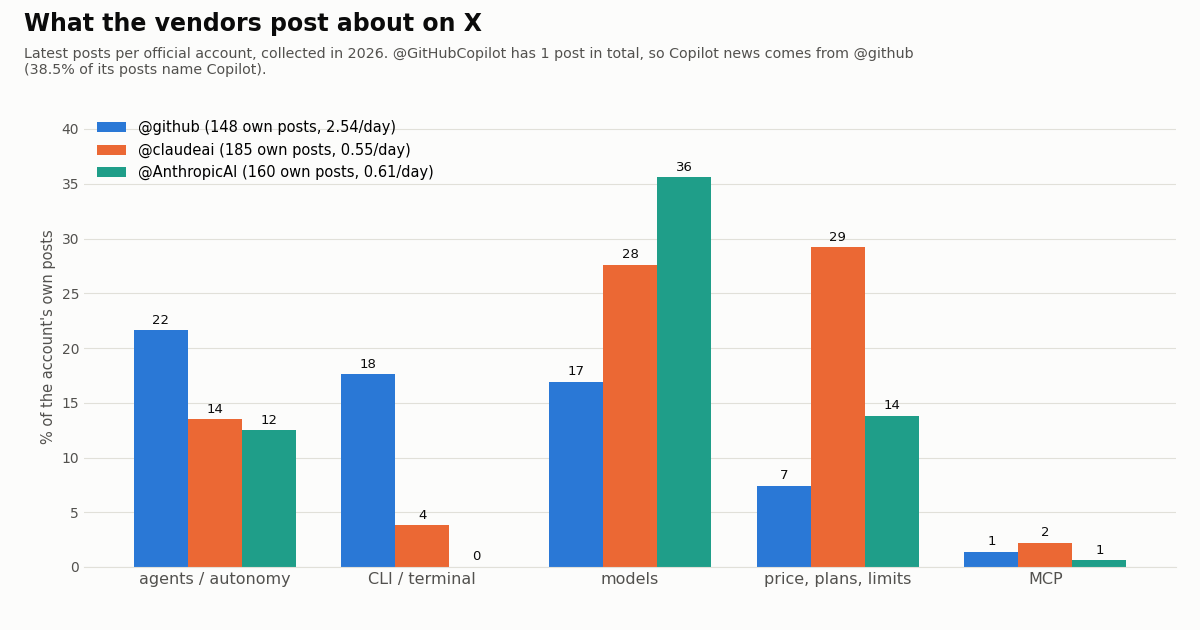
We also read the latest posts of the official accounts. The first surprise: @GitHubCopilot has 1 post in total (a repost of the launch announcement), so Copilot news comes from @github. On the Anthropic side, @claudeai carries the product and @AnthropicAI carries the company and research.
GitHub posts about Copilot often, and those posts do well. 38.5% of @github's own posts name Copilot, and they earn a median of 328 likes against 208 for its other posts. 17.6% of @github's posts mention the CLI or terminal, against 3.8% on @claudeai: GitHub is pushing Copilot CLI hard.
Claude's account talks plans and models more. 29.2% of @claudeai's posts touch plans, usage or limits and 27.6% name models; posts that name Claude Code get a median 10,692 likes against 12,356 for the rest. The two accounts reach very different audiences (median views 72,103 for @github and 2,307,414 for @claudeai), so compare shares, not raw counts. MCP is a small share on all three (1.4% to 2.2%).
When to pick which (and when to run both)
Pick GitHub Copilot if your team works across several IDEs, wants inline completions in every editor, wants to choose between Claude, GPT and Gemini models per task, or wants agents that start from a GitHub issue and end in a pull request. The $10 Pro plan is the lower entry price of the two, and Business seats come with central policy control, including the MCP policy above.
Pick Claude Code if your work is long multi-file changes steered from a terminal, you script the agent in CI with claude -p, or you want hooks, skills and sub-agents around one model family. It needs a paid Claude plan (from $20 monthly) or an API key, and heavy agent use pushes people toward Max or Ultra.
Run both if you like Copilot for completions and quick edits in the editor and Claude Code for larger tasks. That is what 22.4% of the posts in our sample describe. Copilot can also hand a task to Claude Code as a third-party agent from inside GitHub; GitHub's plans page lists it on the Pro card but marks it Pro+ and Max in its comparison table, labeled Preview.
Either way, for an agent that works with X data, add the same remote MCP server to both, keep the API key out of the repository (VS Code's input prompt or a user-scope Claude Code server), and budget by tweets returned rather than by prompts.
How we collected this
Question. When developers on X put GitHub Copilot and Claude Code in the same post, what do they compare, which way do switching stories run, and what do the vendors' own accounts post about?
Accounts and query. Part A: the latest posts of @GitHubCopilot, @github, @claudeai and @AnthropicAI through /twitter/user/last_tweets (up to 10 pages, about 200 posts, each). Part B: /twitter/tweet/advanced_search with the query "claude code" copilot lang:en -filter:retweets, Latest and Top feeds, deduplicated, keeping only posts whose text names both tools.
Window and sample. Collected in 2026. Part A: 200 posts from @github, 200 from @claudeai, 180 from @AnthropicAI and 1 from @GitHubCopilot. Part B: 392 posts from 338 authors. Engagement figures are medians.
What the sample cannot show. Keyword tags are rough: a post that says "cloud" may not mean a cloud agent, and sarcasm is tagged like praise. X posters are not a random sample of developers, the search sees only public English posts, and the Top feed favors posts that already did well. Switching stories need explicit from-to wording, so quieter switches are missed.
Privacy. Aggregates only. Organization accounts are named; no individual author is named or profiled, and the raw search pages were kept out of our repository.
import os, re, requests

API_KEY = os.environ["TWITTERAPI_IO_KEY"]  # your TwitterAPI.io key
BASE = "https://api.twitterapi.io"
QUERY = '"claude code" copilot lang:en -filter:retweets'
THEMES = {
    "agents": r"\bagent|agentic|autonom|background|cloud",
    "models": r"\bopus\b|\bsonnet\b|\bhaiku\b|\bgpt|gemini|\bmodels?\b",
    "price": r"pric|\$\d|\bcost|subscription|credits?\b|rate.?limit|\blimits?\b|usage",
    "cli": r"\bcli\b|terminal|command.?line",
    "mcp": r"\bmcp\b|model context protocol",
}


def fetch(max_pages=5):
    """Latest posts that name both tools; follows next_cursor."""
    tweets, cursor = [], ""
    for _ in range(max_pages):
        params = {"query": QUERY, "queryType": "Latest"}
        if cursor:
            params["cursor"] = cursor
        r = requests.get(f"{BASE}/twitter/tweet/advanced_search",
                         headers={"X-API-Key": API_KEY}, params=params, timeout=30)
        r.raise_for_status()
        body = r.json()
        tweets.extend(body.get("tweets", []))
        if not body.get("has_next_page"):
            break
        cursor = body.get("next_cursor", "")
    return tweets


tweets = fetch()
counts = {k: 0 for k in THEMES}
for t in tweets:
    text = (t.get("text") or "").lower()
    for k, rx in THEMES.items():
        if re.search(rx, text):
            counts[k] += 1

n = len(tweets) or 1
print(f"{len(tweets)} posts")
for k, c in sorted(counts.items(), key=lambda kv: -kv[1]):
    print(f"{k:7s} {100 * c / n:5.1f}%")
top = sorted(tweets, key=lambda t: t.get("likeCount") or 0, reverse=True)[:5]
for t in top:
    print(t.get("likeCount"), t.get("viewCount"), t.get("url"))
Researching this?Free starter credits cover end-to-end testing — Google sign-in, no card. Get a key.
Questions readers ask
Is GitHub Copilot cheaper than Claude Code?
At the entry level, yes on sticker price: Copilot Pro is $10/month and Copilot Free is $0, while Claude Code needs a paid Claude plan starting at $20 monthly ($17 a month billed annually). At the top end both have a $100/month individual plan (Copilot Max, Claude Max), and Claude adds Ultra at $200 monthly. Real cost depends on usage: Copilot spends GitHub AI Credits, Claude plans meter usage in five-hour and weekly windows.
Can I use Claude models in GitHub Copilot?
Yes. GitHub's plans page lists Anthropic Claude models (Haiku, Sonnet, Opus and Fable) in Copilot's model picker; the Free plan is limited to entry-level models such as Haiku 4.5. That is the model inside Copilot's own agent, not Claude Code. Copilot can also delegate tasks to Claude Code as a third-party agent (Preview); GitHub's plans page lists that on the Pro card but marks it Pro+ and Max in its comparison table.
Does Claude Code work in VS Code like Copilot?
Yes. Anthropic publishes a Claude Code extension for VS Code (also installable in Cursor) and a plugin for JetBrains IDEs, with inline diffs and plan review. Its home is still the terminal CLI, and the extensions share the same settings, CLAUDE.md files and MCP servers.
What is the difference between Copilot CLI and Claude Code?
Both are terminal agents. Copilot CLI is included in every Copilot plan, installs with npm install -g @github/copilot, and uses the models in your Copilot plan, billed in AI credits. Claude Code installs with curl -fsSL https://claude.ai/install.sh | bash, runs Anthropic's models only, and is billed through your Claude plan or API key. Both add MCP servers: /mcp add in Copilot CLI, claude mcp add in Claude Code.
Do GitHub Copilot and Claude Code support MCP?
Both do. Copilot supports MCP servers in VS Code (.vscode/mcp.json), Visual Studio, JetBrains, Xcode, Eclipse and Copilot CLI (~/.copilot/mcp-config.json); on Business and Enterprise an admin must enable the "MCP servers in Copilot" policy first. Claude Code adds local, project or user-scoped servers with claude mcp add.
Is Claude Code included in the free Claude plan?
No. Claude's pricing page marks Claude Code as not included in Free and included in Pro, Max, Ultra, Team and Enterprise. You can also run it with an Anthropic Console API key and pay per token.
Can GitHub Copilot or Claude Code read live tweets?
Neither has X data built in, but both can call a remote MCP server. Add https://mcp.twitterapi.io/mcp with your TwitterAPI.io key as a Bearer token and the agent gets tools like search_tweets and get_user_last_tweets. Reads need no X account; results are billed at $0.15 per 1,000 tweets returned.
Do developers switch from Copilot to Claude Code?
In our sample of 392 X posts that name both tools, collected in 2026, explicit switching stories were rare: 0 toward Claude Code and 1 toward Copilot. Far more posts, 22.4%, describe using both, and 79.6% name a third tool as well.
Continue
- GitHub: Copilot plans (Free, Pro, Pro+, Max; AI credits; agent and CLI availability)
- GitHub Docs: Copilot plans (Business and Enterprise seats, AI credit allowances)
- GitHub Docs: extending Copilot with MCP (IDE support, MCP policy)
- Claude pricing (Pro, Max, Team, Enterprise; Claude Code availability)
- Claude Code docs: overview, surfaces and install
- Claude Code docs: MCP (claude mcp add, scopes, output limits)
- X (Twitter) API guide and endpoint hub
- Cursor vs GitHub Copilot comparison
- Codex vs Claude Code: plans, limits and MCP
- Windsurf vs Cursor compared
- Claude Code pricing and usage limits explained
- how to use Claude with the Twitter (X) API
- TwitterAPI.io MCP server setup for every client
- TwitterAPI.io pricing per 1,000 tweets
- 01Can People See Your Twitter (X) Bookmarks? What Others See, and the One Public Number
- 02ChatGPT vs Grok: plans, models, and the real difference on Twitter (X) data
- 03IFTTT Alternatives in 2026: Which Can Still Trigger on a New Twitter (X) Post
- 04Buffer Alternatives in 2026: Which Schedulers Still Post to Twitter (X), and the DIY Route
- 05Claude Token Counter: Count Tokens Exactly With the count_tokens API (and Budget Twitter (X) Data)
- 06Claude Cowork vs Claude Code: Which Anthropic Agent Fits Your Work (and Your Twitter (X) Data)?
- 07Claude Code Alternatives: Seven Coding Agents Checked for License, Free Use and MCP (Twitter/X Data Included)
- 08OpenClaw vs Claude Code: which agent should run your Twitter (X) jobs?
Writing about something you built with TwitterAPI.io? Our community rewards program pays API credits for honest tutorials, build logs and videos.
Stop reading. Start building.
Starter credits cover real testing on real data. Google sign-in, no card, no application queue.
Get an API keyAlready building with TwitterAPI.io? Publish an honest tutorial or build log about it and earn up to $200 a month in API credits.