Grok Bot Alternatives: Open-Source and Hosted Agents for Twitter (X)
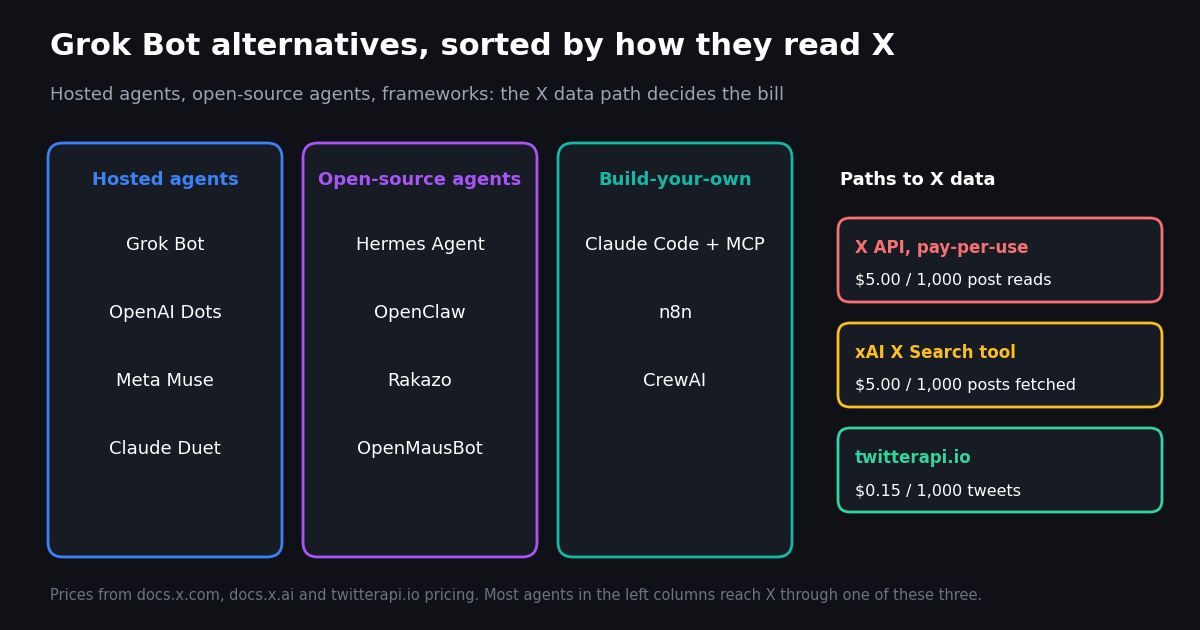
This page is the wide list: every credible alternative to Grok Bot we could verify, hosted and open source, with what each needs to read X and what that costs. It is not the product guide to Grok Bot itself (what Bots are, how @bot works, what the X connector bills), which lives in our Grok Bot guide, and it is not a two-product shootout; Grok Bot vs Claude has its own page. Here you get the field, a comparison table and a decision guide.
Grok Bot made one idea popular in a few weeks: a named AI teammate that keeps a computer running in the cloud, works while your laptop is closed, and can watch X for you. Within weeks the other labs shipped their own versions, and GitHub filled with self-hosted clones whose READMEs literally call themselves an "open-source Grok Bot alternative". Every fact about those products below comes from the vendor's own page, the project's README, or the vendor's own posts on X, read this session; where we could not read a primary source we say "not verified".
We also read 1,075 posts on X that compare Grok Bot with something else, collected in 2026, to see which alternatives people actually name and what they argue about. The answer is mostly price, privacy and usage limits. Almost nobody asks how the alternative reads X, which is exactly where the bills diverge, so that is where this page spends its time.
Grok Bot alternatives at a glance: how each reads X
The table lists the alternatives we could verify from primary sources, with Grok Bot as the baseline row. "How it reads X" means what the product or project documents, not what a clever user could wire up; every row can be extended with an MCP server or a script, and the sections below show how.
The pattern. Only Grok Bot reads public X out of the box without you bringing anything. The two open-source agents with first-party X support (Hermes Agent, OpenClaw) route through the official X API, so they inherit X's per-post price. Everything else reads X only after you plug in a data source, which means you choose the meter.
Hosted alternatives: OpenAI Dots, Meta Muse, Claude Duet
These are the closest like-for-like replacements: a lab runs the agent, the cloud computer and the model, and you pay through an existing subscription. All three arrived within weeks of Grok Bot.
OpenAI Dots. OpenAI announced dots on September 29, 2026 on its own X account: "Introducing dots, powered by GPT-6 Astra. Remarkably capable, always-on agents built to handle everything." The same thread says dots "will be available in ChatGPT on web, mobile, and desktop across Pro, Business Premium, and Enterprise users in eligible markets", and that you start by creating your first dot in the ChatGPT desktop app or a desktop browser and connecting your apps. OpenAI's launch page and help center returned HTTP 403 to our fetches, so we could not read the connector list first-hand: whether a dot can read X is not verified. If it cannot, the practical route is the same as for any agent with a browser and a shell: hand it an API it can call.
Meta Muse. Meta's help page "How Muse works with Connectors" says connectors give Muse "new abilities, like the ability to see your calendar or write an email", that Facebook, Instagram and Threads link through Accounts Center, and that for a service not on the list you can ask Muse to build a custom connector. It adds that "Meta doesn't review custom connectors or how they use your information." The page lists no X connector and does not mention MCP. Pricing for the Muse agent was not on the pages we could read, so it is not verified here. Meta's Connect 2026 post describes more connectors and Muse coming to AI glasses.
Claude Duet. Anthropic introduced Claude Duet on October 21, 2026 as a research preview "available by waitlist today, starting with US Pro and Max subscribers", included in those plans and using "the same usage limits as the rest of Claude." The support article names connectors such as Gmail, Google Calendar, Google Drive, Slack, QuickBooks, HubSpot, Docusign and Calendly, says it checks your accounts "at set intervals", and asks before sending messages, making payments, signing documents or deleting anything. The launch post says Duet can use "the over 6,000 connectors and plugins in the Claude Marketplace". Neither page mentions X.
What this means for X work. If watching X is the job, none of the three hosted alternatives documents the equivalent of Grok Bot's built-in X search. You either connect a third-party X data source (where the product allows custom connectors) or move the X part to a script or workflow the agent triggers.
Open-source Grok Bot alternatives you can self-host
"Open source grok bot" now gets more searches than "grok bot alternatives" itself, and two GitHub projects use exactly that phrase in their description. We read both READMEs this session; star counts are what GitHub showed at that moment and move daily.
Rakazo. The README describes "an open source AI agent for persistent teammates, and a self-hosted AI assistant you can run on your own machine", positioned as an alternative to Grok Bot, Meta Muse, OpenAI Dots, OpenClaw, Hermes Agent and Claude Duet, and says plainly "Rakazo is in beta." You bring your own model credentials (an OpenRouter key is optional) and pick a sandbox: Docker, E2B, Daytona, CreateOS, Boat, Railway or a trusted local computer. Integrations come through Composio, Pipedream Connect, MCP and OpenAPI tool sources. That last part is how a Rakazo bot reads X: add a remote MCP server or an OpenAPI source for an X data API.
OpenMausBot. The README calls it an "Open-source Grok Bot alternative with a virtual machine that bots can use" and "an independent project inspired by Grok Bot". Bots run on the claude, codex and grok CLIs installed on your own machine, so the model bill is whatever those CLIs bill. Each bot can get a cloud Linux desktop from Boat, an isolated local VM, or the host machine; the README notes Boat "is a paid service after its trial." X is not mentioned; the MCP support is generic.
Hermes Agent and OpenClaw. These predate Grok Bot and are general agents rather than clones, but they are the open-source projects people most often set against it (Hermes in 23 posts in our sample, OpenClaw in 12). Both have first-party X support, covered in the cost section below, and both accept MCP servers. Our Hermes Agent and OpenClaw guides walk through the setup.
A note on browser-driven clones. Some self-hosted alternatives to OpenAI Dots and Grok Bot drive a full browser on x.com. That means the agent acts as your logged-in account, page by page, and X can rate-limit, lock or suspend that account. For reading X, an API is the safer and far more predictable route.
Build your own: Claude Code + MCP, n8n, CrewAI
If you do not need a chat-style teammate, a lighter alternative to Grok Bot is a scheduled workflow or a coding agent with the right tools attached. These cost nothing extra in software, and you choose every data source.
Claude Code with an MCP server. Claude Code adds remote servers with claude mcp add --transport http <name> <url> and an optional --header, at local, project or user scope (per code.claude.com/docs/en/mcp). The twitterapi.io hosted MCP server at mcp.twitterapi.io/mcp answered our initialize call this session as twitterapi-mcp, describing 12 tools for X data (search, user lookup, followers, replies, trends) with your API key as the Bearer token; write actions such as posting live on the REST API instead; the same server ships as the npm package @twitterapi_io/mcp-server (version 0.2.0). The command below wires it in. Claude Cowork was not verified this session.
n8n. n8n's built-in X node authenticates with OAuth2 against the official API. The alternative is an HTTP Request node calling any X data API on a Schedule Trigger, then a model node to summarize. n8n Cloud starts at 20 EUR a month billed annually for 2.5K executions (n8n.io pricing), and a self-hosted version is on GitHub. Our n8n workflow guide has a full import-ready example.
CrewAI. CrewAI is an MIT-licensed Python framework (about 60.0k GitHub stars) whose README lists MCP and A2A support; it has no built-in X tool. Give a crew an X data source as an MCP server or as a small HTTP tool, as our CrewAI guide shows.
# Give Claude Code read access to X through the twitterapi.io hosted MCP server
claude mcp add --transport http twitterapi-io https://mcp.twitterapi.io/mcp \
  --header "Authorization: Bearer $TWITTERAPI_IO_API_KEY" --scope user

# Then, inside Claude Code:
# "Search X for posts about 'grok bot' from the last 24 hours and summarize the top themes"What X data costs on each path, per 1,000 reads
Every alternative above ends up on one of a few meters when it reads X. These are the published prices we read this session, per 1,000 posts:
The ratio. On X's pay-per-use rate card a post read is $0.005, or $5.00 per 1,000. On twitterapi.io a tweet costs 15 credits, or $0.15 per 1,000 tweets returned, with a minimum of 15 credits per request, so a search that finds nothing costs $0.00015. That is about 33x less per 1,000 tweets. Profiles are $0.010 per user read on X and $0.18 per 1,000 profiles on twitterapi.io. X caps pay-per-use at 3 million post reads a month (Enterprise above that) and gives $20 in credits on a first card plus a match of up to $50.
What the official-API agents say about cost. Hermes Agent's bundled xurl skill warns that "X API access is typically paid for meaningful usage" and that a zero balance returns CreditsDepleted until you buy credits (minimum $5). OpenClaw's X channel plugin reserves the worst-case cost before each paid call and ships default limits of $100 per UTC day and $1,000 per billing cycle; its docs price replies at $0.015 per post ($0.20 with a URL). Grok Bot's own X announcement ("Grok Bot now works with X", August 29, 2026) says connecting X creates a developer account for you and that paid users "get free X API credits to start"; the amount is not published.
A polling agent on a budget. Watching an account or a search every 60 seconds is 43,200 checks a month. On twitterapi.io the checks that find nothing cost $0.00015 each, $6.48 a month at that cadence, or $1.30 every 5 minutes; you pay only for the data returned on top. Rate limits are 0.2 requests per second before the first payment and 20 once paid; plans and higher limits are on the pricing page.
Acting on X, not just reading. Some Bot jobs post or reply. On twitterapi.io writes run through an authenticated session: one /twitter/user_login_v2 login ($0.10, with a proxy you supply) returns login_cookies, then each post, like, retweet or follow is $0.002 (for example /twitter/create_tweet_v2). The call acts as that account, so X can rate-limit, lock or suspend it; keep a human pace, expect to log in again when a session expires, and note that billing is per HTTP 200 call. Reads need no X account at all.
Which Grok Bot alternatives people name on X
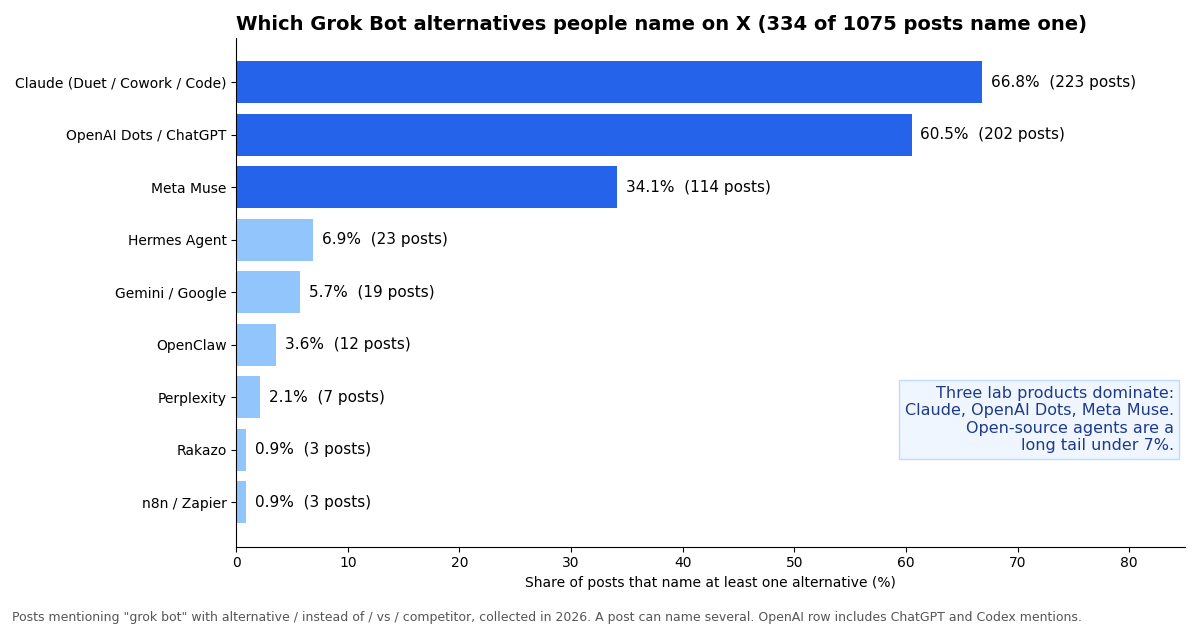
We collected 1,075 posts that mention Grok Bot together with "alternative", "instead of", "vs" or "competitor", spanning 69 days and 845 distinct authors. 334 of them (31.1%) name at least one specific alternative, and 53.9% of those name two or more, usually as a lineup of the labs' agents.
Three labs dominate the conversation. Claude (66.8%), OpenAI's Dots and ChatGPT (60.5%) and Meta Muse (34.1%) account for nearly every comparison. The OpenAI row also counts ChatGPT and Codex mentions and the plain word "dot", so read it as an upper bound.
Open source is a long tail, for now. Hermes Agent (6.9%) and OpenClaw (3.6%) are the open-source names that come up most; Rakazo (3 posts) and OpenMausBot (2 posts) barely register yet, even though search demand for them has jumped. Search interest and X chatter are clearly measuring different people: searchers look for something to install, posters compare the big products.
What Grok Bot comparison posts argue about
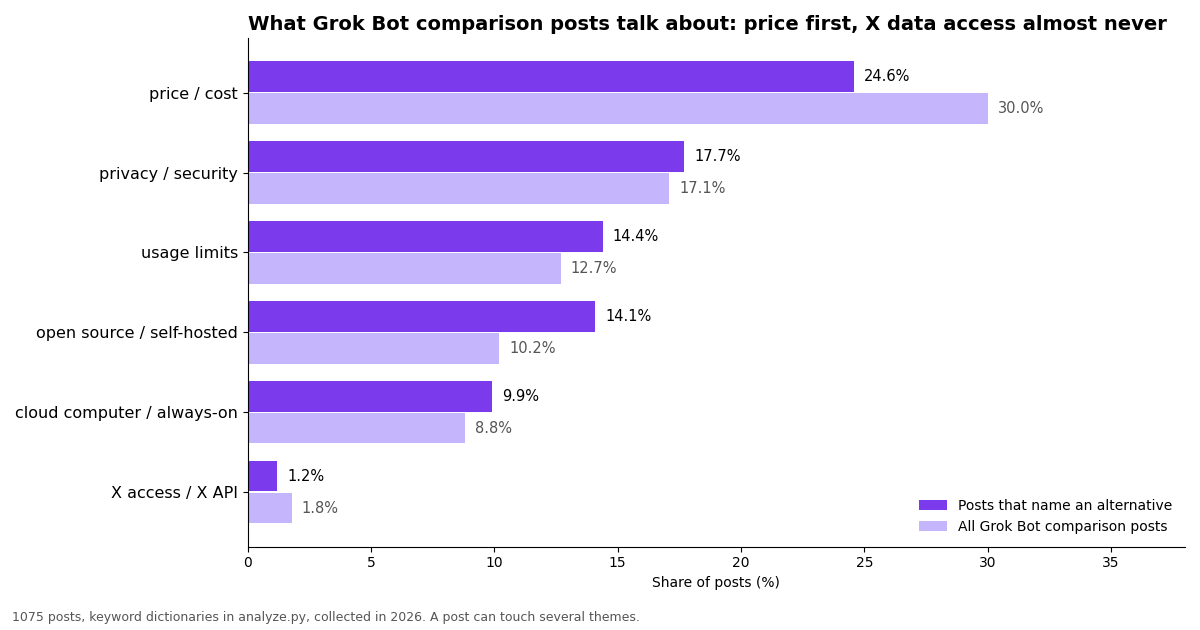
We tagged each post against fixed keyword lists for six themes (the lists are in the study's analyze.py). The first column is the posts that name an alternative; the second is every comparison post.
Price first. Price or cost comes up in 24.6% of posts that name an alternative, ahead of privacy and approvals (17.7%) and usage limits (14.4%). That fits the products: every hosted alternative is bundled into a subscription tier with its own usage limits, so the comparison people make is subscription against subscription.
X access is the blind spot. Only 1.2% of alternative-naming posts mention X data, the X API or the X connector, although X access is the one capability Grok Bot has natively and the others mostly do not. If your Bot's job is monitoring X, that is the row of the comparison table to read first.
Open source matters more when people name an alternative. Open-source and self-hosting language shows up in 14.1% of alternative-naming posts against 10.2% of all comparison posts.
Decision guide: which Grok Bot alternative fits your job
You already pay for ChatGPT Pro, Claude Pro or Max, or use Meta's apps daily. Try the hosted agent you already have (Dots, Duet or Muse) before buying anything. Check first whether it can reach X at all; on the pages we could read, none documents an X connector.
You want Grok Bot's experience but on your own hardware and models. Rakazo if you want web, desktop and phone apps and are fine with beta software; OpenMausBot if you already run the claude or codex CLIs and want each bot on its own VM. Add X through MCP or an OpenAPI source.
You want a mature open-source agent with X built in. Hermes Agent or OpenClaw. Both read X through the official API by default, at $5.00 per 1,000 posts; both accept MCP, so you can point the reading at a cheaper source and keep the official API for the writes it is built for.
Your job is really a schedule, not a teammate. A daily digest of what some accounts posted, or an alert on a keyword, does not need an always-on agent. An n8n workflow or a 40-line script on a cron does it for the cost of the data; see the code below.
You live in a terminal. Claude Code plus an X data MCP server gives you ad-hoc X research inside your editor with no extra subscription.
You want Grok Bot but cheaper X reads. Keep Grok Bot and give its computer a script or a custom connector. Our Grok Bot guide shows both.
How we collected this
Question. When people on X ask for or name an alternative to Grok Bot, which alternatives do they name, how often, and which themes come up?
Query. /twitter/tweet/advanced_search for "grok bot" (alternative OR alternatives OR "instead of" OR vs OR competitor OR competitors) -filter:retweets, read with both the Latest and Top rankings, plus grokbot (alternative OR "instead of" OR vs). Posts were deduplicated and kept only if the text contains "grok bot" or "grokbot".
Window and size. Collected in 2026; the sample spans 69 days from the first posts about Grok Bot alternatives to collection. 1,075 posts from 845 authors, 70 search requests, about $0.19 in credits. Two more requests read @OpenAI's and @AIatMeta's own posts about Dots and Muse.
Method. Each post is matched case-insensitively against a fixed dictionary of alternative names and six theme keyword lists, written before the results were read. A post can count toward several alternatives and themes.
What the sample cannot show. It counts conversation, not usage or quality. It is mostly English (1,019 of 1,075 posts), and 94.5% of authors are blue-verified, so it leans toward people who post a lot about AI products. Keyword matching misses comparisons that do not use our words and over-counts the common word "dot".
Privacy. Aggregates only. Search authors are private individuals, so raw pages were not kept; the published sample has one de-identified row per post (week, language, matched labels, engagement counts) with no ids, handles or text.
"""x_watch.py: the X-reading half of a Grok Bot alternative.

Any agent that can run a script (Rakazo, OpenMausBot, Hermes Agent, OpenClaw,
an n8n Execute Command node, a CrewAI tool) can call this and summarize the JSON.
It reads recent posts for each query, follows pagination, and prints what the
same reads would cost on X's pay-per-use card vs twitterapi.io.
"""
import json
import os
import sys
import time

import requests

BASE = "https://api.twitterapi.io"
HEADERS = {"X-API-Key": os.environ["TWITTERAPI_IO_API_KEY"]}


def search_since(query, since_unix, max_pages=10):
    """Return posts matching query newer than since_unix, newest first."""
    posts, cursor, requests_made, credits = [], "", 0, 0
    for _ in range(max_pages):
        params = {"query": f"{query} since_time:{since_unix}", "queryType": "Latest"}
        if cursor:
            params["cursor"] = cursor
        r = requests.get(f"{BASE}/twitter/tweet/advanced_search", headers=HEADERS, params=params, timeout=30)
        r.raise_for_status()
        body = r.json()
        requests_made += 1
        page = body.get("tweets", [])
        credits += max(15, 15 * len(page))  # 15 credits per tweet, 15-credit minimum per request
        for t in page:
            posts.append({
                "url": t["url"],
                "createdAt": t["createdAt"],
                "author": t["author"]["userName"],
                "text": t["text"],
                "likes": t.get("likeCount", 0),
                "reposts": t.get("retweetCount", 0),
                "views": t.get("viewCount", 0),
            })
        if not body.get("has_next_page"):
            break
        cursor = body.get("next_cursor", "")
    return posts, requests_made, credits


def main():
    queries = sys.argv[1:] or ['"grok bot" (alternative OR "instead of") -filter:retweets']
    since = int(time.time()) - 24 * 3600
    report, total_posts, total_requests, total_credits = {}, 0, 0, 0
    for q in queries:
        posts, n_req, credits = search_since(q, since)
        report[q] = posts
        total_posts += len(posts)
        total_requests += n_req
        total_credits += credits
    print(json.dumps(report, indent=2))
    print(f"posts read: {total_posts} in {total_requests} requests", file=sys.stderr)
    print(f"X API pay-per-use at $0.005 per post read: ${total_posts * 0.005:.4f}", file=sys.stderr)
    print(f"twitterapi.io at $1 per 100,000 credits: ${total_credits / 100000:.4f}", file=sys.stderr)


if __name__ == "__main__":
    main()
Questions readers ask
What is the best open-source Grok Bot alternative?
It depends on what you want to copy. Rakazo (Apache-2.0, in beta) is closest to the Grok Bot experience, with persistent bots, web, desktop and mobile apps, and a choice of model and sandbox. OpenMausBot (Apache-2.0) runs each bot on your local claude, codex or grok CLI with its own VM. If you want a mature general agent with X support documented, Hermes Agent and OpenClaw (both MIT) are the larger projects. None of the Grok Bot clones mentions X in its README, so plan to add an X data source through MCP or a script.
Is there a self-hosted Grok Bot?
Not from xAI: Grok Bot runs on a cloud computer xAI provides, and its docs say the computers run in Cursor's cloud. Self-hosted alternatives that describe themselves as Grok Bot alternatives include Rakazo (Docker, a VPS or Railway) and OpenMausBot (your own macOS, Windows or Ubuntu machine, with optional cloud or local VMs).
Grok Bot vs Hermes Agent: which is better for X?
Grok Bot reads public X with built-in search and needs no X account for that; its X plugin, which signs in as you, runs on X API credits. Hermes Agent reads X through its bundled xurl skill on the official X API ($0.005 per post read, a developer app and OAuth required) or through xAI's x_search tool ($5 per 1,000 posts fetched plus tokens). Hermes is free, self-hosted software, so you can also point it at a third-party X data API over MCP at $0.15 per 1,000 tweets.
Can OpenAI Dots or Meta Muse read X?
Not that we could verify. Meta's connector help page lists Facebook, Instagram, Threads, Gmail, calendars and others, but no X connector, and notes that Muse can build a custom connector that Meta does not review. OpenAI's dots pages returned HTTP 403 to us, and OpenAI's own posts about dots do not mention X. Treat X access as something you add yourself.
Does Claude Duet work with X (Twitter)?
Anthropic's Claude Duet launch post and support article do not mention X. Duet uses connectors such as Gmail, Google Calendar, Slack and HubSpot, and the launch post says it can use the Claude Marketplace's connectors and plugins. For X work in the Claude ecosystem today, Claude Code with an X data MCP server is the documented route.
What does it cost an AI agent to read 1,000 X posts?
$5.00 on the official X API pay-per-use rate card ($0.005 per post read), $5.00 per 1,000 posts fetched on xAI's X Search tool plus model tokens, and $0.15 per 1,000 tweets on twitterapi.io, about 33x less than X's card. Grok Bot's built-in X search counts toward your Grok Bot usage and has no published per-post price.
Which Grok Bot alternatives do people mention most on X?
In 1,075 posts comparing Grok Bot with something else, collected in 2026, 334 named a specific alternative. Claude appeared in 66.8% of those, OpenAI Dots or ChatGPT in 60.5%, Meta Muse in 34.1%, Hermes Agent in 6.9% and OpenClaw in 3.6%.
Continue
- xAI docs: Grok Bot computer and apps (built-in X search, X plugin)
- Rakazo on GitHub: open-source Grok Bot alternative (Apache-2.0, beta)
- OpenMausBot on GitHub: open-source Grok Bot alternative with VMs (Apache-2.0)
- OpenClaw docs: X channel plugin (OAuth2, cost limits, X API rates)
- Anthropic: Introducing Claude Duet (research preview, plans, connectors)
- X API pay-per-usage pricing
- X API overview: endpoints, pricing and limits
- Grok Bot guide: Bots, @bot on X and what the X connector costs
- Grok Bot vs Claude, head to head
- Personal AI agents from the four labs compared
- Hermes Agent with Twitter (X) data: skills and MCP setup
- OpenClaw Twitter (X) skill and MCP setup
- n8n Twitter workflow that posts new tweets to Slack
- Using CrewAI with the Twitter (X) API
- twitterapi.io MCP server for Claude, Cursor and AI agents
- twitterapi.io pricing and plans
- 01Grok for Startups: what the xAI credits cover, who qualifies, and where Twitter (X) data fits
- 02X Chat API: Building on Encrypted Twitter (X) DMs with the Chat XDK
- 03Grok Bot API: Every Way to Drive a Grok Bot From Code, and How to Feed Your Own Agent Twitter (X) Data
- 04Muse Connectors: What Exists, Custom Connectors, MCP, and Live Twitter (X) Data
- 05Grok Bot vs Claude: which agent can read and act on Twitter (X) data, and what it costs
- 06Grok Bot Marketplace: the templates, which ones read Twitter (X), and how to build on them
- 07Grok Bot pricing, limits and the Twitter (X) API: plans, weekly usage, what X reads cost, and how to give it cheaper X data
- 08Grok Agent: How to Build an Agent with Grok on Live Twitter (X) Data
Stop reading. Start building.
Starter credits cover real testing on real data. Google sign-in, no card, no application queue.
Get an API keyAlready building with TwitterAPI.io? Publish an honest tutorial or build log about it and earn up to $200 a month in API credits.